Here are two short videos in which Walter Murch talks about sound editing (the first video) and sound mixing (the second).
Showing posts with label Walter_Murch. Show all posts
Showing posts with label Walter_Murch. Show all posts
Thursday, February 24, 2022
Tuesday, July 23, 2019
The Hunt for Genius, Part 5: Three Elite Schools [RIP #RichardAMacksey]
Once more I'm bumping this to the top of the queue, this time in remembrance of Dick Macksey, who has just died, three days shy of his 88th birthday. In 1999 he sat down with Mame Warren and talked about the history of Johns Hopkins. The material is online, voice recordings and a transcript.
Over the last two weeks or so I've read more than I can stand about the sad case of Avital Ronell, Nimrod Reitman, and NYU. It doesn't have to be like that, and at many places it isn't. I'm reposting this from five years ago. Note my account of graduate school at SUNY Buffalo. These accounts are of times past, over three decades ago. Adjunctification hadn't set in yet.
* * * * *
[From Sept. 2018] Over the last two weeks or so I've read more than I can stand about the sad case of Avital Ronell, Nimrod Reitman, and NYU. It doesn't have to be like that, and at many places it isn't. I'm reposting this from five years ago. Note my account of graduate school at SUNY Buffalo. These accounts are of times past, over three decades ago. Adjunctification hadn't set in yet.
* * * * *
The Three: The Johns Hopkins University, the English Department at SUNY Buffalo back in the 70s (hottest department in the country), and Renssalaer Polytechnic Institute.
[From Oct. 2013]
I grew up in western Pennsylvania in a suburb of Johnstown, a small steel-making city. My father was from Baltimore and he worked with Bethlehem Mines, the mining subsidiary of the now-defunct Bethlehem Steel Corporation. My mother was a native of Johnstown, had been there for the 1937 flood, and was a full-time housewife and mother. That was typical for the time, the 1950s and into the 60s.
Mother loved gardening and she was an excellent cook and seamstress. Father was more intellectual than most engineers. In addition to playing golf, collecting stamps, and woodworking, he liked to read, both fiction and nonfiction. Both parents played the piano a bit and enjoyed playing contract bridge.
I spent many hours happily immersed in books from my father’s library (which contained many books from his father’s library): Arthur Conan Doyle, Rafael Sabatini, Rider Haggard, Charles Dickens, and Mark Twain among them. I went to school in Richland Township. The schools were above average, but not special. They did not regularly send students to elite schools.
I’d applied to three Ivies, Harvard and Yale, which turned me down, and Princeton, which wait-listed me. I’d also applied to The Johns Hopkins University, my father’s alma mater. They accepted me. That my father had gone there no doubt weighed in the decision.
A classmate of mine, quarterback of the football team, was accepted to Princeton. I believe he was the first student from the school to go to an Ivy League school. I don’t think he was very happy there.
I can’t say that I was happy at Hopkins either. But then I didn’t go there for happiness. I went there to get an education, which I did.
The Johns Hopkins University
Hopkins is probably the most distinguished of the elite schools I’ve been associated with. I did my undergraduate work there between 1965 and ’69 and then completed a Master’s degree in Humanities between 1969 and ’72 while at the same time working in the Chaplain’s Office as an assistant. This was at the tail end of the Vietnam War era and I was a Conscientious Objector to military service. I thus had to perform civilian service instead of being drafted into the military. That’s why I worked in the Chaplain’s Office.
After a so-so high school outside a small city in western Pennsylvania the intellectual life at Hopkins came as a welcome revelation to me. Ideas seemed important. Well, sorta’.
At the same time it was clear that coursework had its limitations. If a course clicked, then I tended to lose interest in assigned coursework for the last half or third of the semester. Instead, I’d immerse myself in whatever had attracted my interest. If a course didn’t click, well, I managed to stick it out.
What made Hopkins work was finding Dr. Richard A. Macksey, a polymath who taught comparative literature (in English translation for those who couldn’t read French, German, Italian, or Russian) through the interdisciplinary Humanities Center. I took several courses with him, an independent study, and subsequently did my Master’s under him. Other individual faculty were important as well, particularly Mary Ainsworth, Arthur Stinchcombe, Neville Dyson-Hudson, and Earl Wasserman.
But Macksey was the guy. Without him I’d have had a more difficult time graduating from Hopkins. He provided relief from the “system” and he knew that. Other students were attracted to him and studied with him for the same reason. He was particularly important to students interested in film since he taught a film workshop thereby enabling them to get academic credit for their passion. At least two students slightly older than me went on to distinguished careers in Hollywood (Caleb Deschenel and Walter Murch) and there may well have been others as well.
In terms of sheer brilliance I’ve never worked with anyone superior to Macksey and very few his equal. For whatever reason, he chose to work with and develop others rather than develop a large body of his own research. He taught many courses, more than required of him, and always had a group of students whom he worked with independently.
It would be interesting to compare his record as a talent scout with the record of the MacArthur Fellows Program. There would, of course, be a calibration problem. Macksey went at it for six decades or so (he only retired a couple of years ago) whereas the MFP has only been around for just over three decades. On the other hand the MFP has had more resources at its disposal.
Macksey is most-widely known, however, as the long-term editor of the comparative literature issue of MLN (Modern Language Notes) and as one of the organizers of the in/famous structuralism symposium of 1966: The Languages of Criticism and the Sciences of Man. While Jacques Derrida is perhaps the best-known figure that spoke at the symposium, he was a relative unknown at the time. In fact, he wasn’t even supposed to be there. He was invited as a last-minute replacement for Luc de Heusch. The paper Derrida delivered, “Structure, Sign, and Play in the Discourse of the Human Sciences,” undercut structuralism as a movement and made him a star.
Though I was on campus at the time I didn’t attend the symposium – it wouldn’t have done me any good as it was delivered in French. But Macksey distributed an English translation of Derrida’s paper in one of his classes and I devoured it. It became one of my central texts for a while, though it didn’t diminish my enthusiasm for Lévi-Strauss.
At the time, of course, no one foresaw the consequences of the intellectual currents that organized themselves through that conference. For one thing, the conference was organized as a new beginning, a beginning in the New World, for structuralism as an interdisciplinary mode of investigation. Instead, it functioned as the beginning of the end.
* * * * *
And then there is Chester Wickwire. When I entered Hopkins he was the Executive Secretary of the Levering Hall YMCA. The YMCA subsequently decided to withdraw from the campus, at which time the University took over the building and Wickwire became University Chaplain.
Wickwire was an activist. He was central to both the civil rights and anti-war movements in Baltimore. In the spring of 1966 he brought Bayard Rustin to campus, which inspired the Ku Klux Klan to burn a cross next to Levering Hall. He also ran a tutorial program in which inner city (aka ghetto) kids were brought to campus on Saturday mornings where Hopkins undergraduates helped them with schoolwork. These activities made him suspect among the more conservative folks at Hopkins.
I volunteered at the coffee shop Wickwire ran in Levering Hall, The Room at the Top, and in two film series he ran, one for classic American films and the other for foreign films. Dick Macksey advised Wickwire on films for both series and often held late-night discussions of the films at his house after the evening showing.
One summer Wickwire decided to book some films into the main campus auditorium, Shriver Hall, to raise some money. Chet was forever raising money, because, well, his programs needed it. We picked films that we thought would fill a 1000+ seat auditorium for two shows.
One of those films was John Waters’ Pink Flamingos. This was in the early 1970s before Waters had developed much of a national reputation, but he was well-known in the Baltimore area. As Pink Flamingos had never before been shown in Maryland it had to go before the Maryland Board of Censors for approval – the only such state-level board in the nation. One scene in particular was in notorious bad taste, even by Waters’s standards: a small dog defecates in front of Divine, the film’s transvestite star, and she scoops the feces up so as to deliver a ****-eating grin.
In order to provide a bit of intellectual cover for this cheapest of cheap tricks, we – I forget just who – decided that Macksey should sign a brief but edifying essay about the film. Without ever having seen the film, I drafted the essay, Macksey OKed it, and we included it in the package that went before the censors. They approved the showing and the film played to a packed house. Chet made his money and we all had some fun.
* * * * *
Finally, I should mention Lincoln Gordon. A former United States Ambassador to Brazil, he succeeded Milton Eisenhower (Ike’s brother) as university president in 1967. He introduced coeducation to the undergraduate program in 1970 and was forced out of office by the faculty in 1971. The Wikipedia says that financial problems forced him to cut budgets and that displeased the faculty. No doubt. What I remember is that for some reason the faculty thought him arrogant. Whatever.
The point is simply that faculty displeasure did force him to resign. Universities are like that, at least some of them.
Faculties are by and large intellectually conservative. Academic research and scholarship are not “boldly go where no man has gone before” kinds of business. Library stacks are finite in length and someone has always been over every inch of them at one time or another. Thus I’m pretty sure that intellectual life at Johns Hopkins is still dominated by the walls between departments that Macksey found so troublesome.
At the same time faculty members tend to be prickly and independent minded. The faculty at Hopkins forced Lincoln Gordon out; years later the faculty at Harvard would force Lawrence Summers out.
There is a certain looseness about such institutions that allows interesting people to survive here and there in little nooks and crannies. Some of them may well be geniuses, but that’s not by institutional design. It’s merely accidental.
The English Department at SUNY Buffalo
Not so long before I’d arrived there in the fall of 1973 the State University of New York at Buffalo had been a private university, the University of Buffalo, and it was still known by those initials, “UB”. The State University of New York (SUNY) system had acquired it with the intention of transforming it into a Berkeley of the East. Student riots in the early 1970s, however, scared the local gentry and they put the breaks on any massive upgrading.
But not before the Department of English had been turned into the finest experimental program in the nation and not before David Hays was able to establish an eclectic Department of Linguistics. I did most of my coursework in English, as that was the department in which I was enrolled. However, as I’ve explained elsewhere (e.g. in this essay on computational linguistics and literary study), I got my real education with David Hays. The English Department was fully aware of that and had no problems with it.
It was an extraordinary intellectual environment, as Bruce Jackson has explained in this essay:
For at least a decade, the UB English department was the most interesting English department in the country. Other universities had the best English departments for history or criticism or philology or whatever. But UB was the only place where it all went on at once: hot-center and cutting-edge scholarship and creative writing, literary and film criticism, poem and play and novel writing, deep history and magazine journalism. There was a constant flow of fabulous visitors, some here for a day or week, some for a semester or year. The department was like a small college: 75 full-time faculty teaching literature and philosophy and film and art and folklore, writing about stuff and making stuff. Looking back on it from the end of the century, knowing what I now know about other English departments in other universities in those years, I can say there was not a better place to be.
I have no reason to contradict that judgment.
Wednesday, October 10, 2018
Walter Murch on Collective Creativity [TALENT SEARCH]
When I decided that this week would be Talent Search Week I was hoping to have a new article for today. But I've gotten broadsided by other matters and have spent most of the day putting out fires. So I've decided to bump this up to the top of the queue. Walter Murch has won three Oscars, one for sound on Apocalypse Now and two for The English Patient, sound and editing.Two summers ago I was working on a series of posts about Apocalypse Now. One day I got an email from one Walter Murch, a man I did not know. But I knew the name.
Could it be him?
The Walter Murch I was thinking of had gone to Johns Hopkins a couple of years before I had and, like me, had associated himself with Professor Richard Macksey. When this Walter Murch left Hopkins he went West and ended up in the film business, where he’d worked on a number of important films, including Apocalypse Now, for which he won an Academy Award (aka an Oscar) for sound.
Was this that Walter Murch? Yes, it was, and he liked what I was saying about Apocalypse Now. Since then we’ve carried on a casual and sporadic email correspondence.
Most recently we’ve been talking about the collective nature of movie making. By convention overall creative responsibility for a film is credited to the director, and for sufficient reason. The problem is, however, that our basic cultural model of creativity is one of individual creativity, and that does not do justice to any number of activities, from scientific laboratories, through basketball teams and ballet companies, the founding team of a high-tech start-up and, yes, a motion-picture production ensemble.
Walter sent me a passage from a 1994 journal entry:
Reading Penrose - the fact that billiards, which is the game usually given as an example of mechanical physics in deterministic practice, is not immune to vanishingly small initial conditions for the outcome of complex sequences • A line of 20 balls may be arranged in a zigzag such that each will hit the next in sequence when tapped by the cue ball. But exactly where the last ball will wind up after it is hit is subject to something as small as an intake of breath in the neighboring town. If there are 26 balls, a molecular disturbance in some neighboring galaxy will influence the outcome • Reminds me of my 'magic light' hypothesis of film: that film is the sensitive receptacle of everything that happens during the filming - what the assistant electrician had for breakfast, etc. - caught somehow, invisibly, in the amber of celluloid. In the future, people will be able to see this complex of interactions directly by shining a special ‘light’ through the film. It will look like some 5-dimensional moiré pattern, endlessly shifting, endlessly fascinating.
By Penrose I assume he meant Roger Penrose, a mathematician who had published a number of general interest books in the 1990s. You can find images of moiré patterns all over the place on the internet, or you can look below for some simple examples I ran up on my “classic” Mac back in 1985 or 86:

Walter then went on to comment on his old journal entry:
What I meant by "Magic Light" is the discovery of some new force (Force 5) of nature, which has been with us all along but of which we are presently as ignorant as Newton was of electromagnetism. Using this new “force” as a beam, these hypothetical people of the future will transect our films and see - not the images which we see - but some fascinating interaction of all the people who worked on the film, in all its unexpected contingency, and this will be much more satisfying (to them) than the film itself. And it will be a wonder, to those future people, that we could accomplish this filmmaking without any knowledge of “Force 5”, which will be as crucial to them in their society as electromagnetism is to us today. As wondrous as is the construction of Gothic cathedrals to us today: we can hardly believe that our ancestors achieved these miracles with only human and (literal) horse power, and with no engineering textbooks.
And you could add: Duke Ellington and Shakespeare and the Egyptian Pyramids and many other things to this list.
Combining these two passages we get a sense of a film as a very compact “distillation“ of the diverse events surrounding and accompanying it. One might hazard the word “essence” but I fear it has too much of the wrong baggage associated with it. I’m a bit reminded of the JPEG compression for still images and the MPEG compression for video images. You “squeeze out” the redundancy and get a much more compact encapsulation of the information. Then, at playback, the redundancy is added back in and you see the full photograph or video image.
Walter goes on:
I think part of the mystery is that occasionally there is a balance of forces - what Koestler called the autonomy of the part and the wisdom of the whole - where the “part” (whatever it is) makes autonomous decisions that would be impossible for the theoretically guiding force (whatever that may be) to make. And that these decisions miraculously further the higher goal of the “organism” (Duke Ellington's sound, for instance: Duke did not have to tell each of his musicians exactly what to do at every moment) Similarly, if everything that is done on a film had to be expressed in “machine code” (e.g. “turn thirty degrees to the left and cock your right eyebrow”) the film would never get off the ground. People talk about this happening in sports, in battle, in every communal undertaking in fact. It is the human equivalent of the miraculous (to us) ability of fishes and birds to swim/fly in formation and all turn, repeatedly, at exactly the same moment, as if the school/flock were a single organism.
And when we've understood –mathematically, neurally–the nature of that coupling that makes of many ONE, then we will be on the threshold of a deeper understanding of not only OUR nature, but perhaps of life itself.
Some time ago I read an interview with Jack Welch, then CEO of General Electric, who talked about how he and his colleagues in the executive suite could communicate in “code.” Through years of working together they could speak volumes in very terse ways because their shared experience gave them, well, a code that was meaningful among them but not necessarily to anyone else.
Some time ago I read an interview with Jack Welch, then CEO of General Electric, who talked about how he and his colleagues in the executive suite could communicate in “code.” Through years of working together they could speak volumes in very terse ways because their shared experience gave them, well, a code that was meaningful among them but not necessarily to anyone else.
Yes, there are lone creative “geniuses” but I suspect there are fewer of those than we imagine. Creativity needs community and communities breed creativity, or can do so under the right circumstances. We have only just begun to understand such matters.
Thursday, July 13, 2017
Walter Murch on being immersed in a film project and then pulling yourself out
Walter Murch is perhaps best-known for his work on Apocalypse Now, where he did the sound design (for which he won and Oscar) and much of the editing. This is a passage from an interview about his craft and his career that he did with Emily Buder in 2015:
To be an editor, you have to be the kind of person who can be in a room for 16 hours at a time. You are working alone a lot of the time, but there are also times when you’re working with a director in the room. You have to be able to accommodate that. For feature-length pictures, it’s like running a marathon. You have to pace yourself over a year. When I’m considering a film, that’s in the back of my mind. You have to really like the project. Also, you are frequently away from home. You go where the director is. I was working in Argentina for a year, a number of years ago. Before that, I was in Romania, and before that I was in London, and then after that about 2 years ago I was in New York for a year. If you’re married, you have to find ways of coping with that and that’s a whole chapter unto itself.At the end of the film, it can be very disorienting when the work is suddenly finished. This is not exclusive to film editing; I’m sure it’s true of many other areas of human activity. Soldiers have this problem, actors who are acting in a play when the play is suddenly over, it’s like you’ve been cut loose: “Now what?!” This was never explained to me at film school. So when it first happened, I felt something was wrong with me. It’s the equivalent of a kind of seasickness; if you’ve never been on a ship before and somebody warns you about it, it’s okay. You’ll still feel just as sick, but you won’t feel like killing yourself. This is not that intense, but it is that kind of disorientation. And it passes, but it takes anywhere from two to six weeks to go away. During that time I would be very reluctant to try to decide what to do next. It’s like a love affair where you don’t want to bounce from one relationship to another; that’s dangerous. So, you should just let that project fade away and get back to normal, and then you can decide what to do next. We frequently don’t have the luxury of that, but that’s a goal.
That seems like a kind of mourning. When you work that long and with that intensity, you become attached to the film. When it's over, you've got to unattach yourself. That requires something very like mourning.
Tuesday, February 21, 2012
Bleg: Subjective Sound, Mad Men and Apocalypse Now
I’m interested in the use of sound to emphasize one point of view in a film vs. other points of view. For example in the fifth episode (called “5G”) of the first season of Mad Men, Don Draper is called out of a staff meeting to the reception area to see one Adam Whitman. Adam is his younger brother, from a past that Draper thought he’d left completely behind. This upsets him a great deal and, on the way back to and into the staff meeting, he withdraws into himself. The sound track underlines this (16:50 – 17:30) by eliminating all other sounds except for moody music. We can see other people talking in the staff meeting, but cannot hear them. All we hear is Draper’s moody mental music and a muffled “thk” as he knocks his cigarette against his lighter—to compact the tobacco, I suppose.
I have no idea how often this device has been used, but I first learned of it in a piece by Walter Murch in which he discusses a somewhat different version of the device in Apocalypse Now. This occurs at the Dolung Bridge sequence. In this case, it’s not what we hear, but what we don’t hear:
Wednesday, June 22, 2011
Apocalypse 8: Sampan Massacre
As I remarked in the fifth post on Apocalypse Now, this scene marks the dramatic mid-point of the film, though it ends a bit after the temporal mid-point. Whatever Willard may have done in the past – he recalls having killed six people – and whatever the PBR crew may have done, in the context of this mission, they’ve been spectators up to this point. They saw the killing around them, but didn’t actively participate. Now things change. Coppola remarks: “From this moment on, when, really you see blood shed so directly both by the crew of the boat and by Willard in the case of the girl, once life is taken, the path is very very different.”
This scene wasn’t in the original script. It had been inspired by the My Lai incident. Walter Murch suggested to Coppola that they needed a scene like that, the senseless slaughter of civilians by trigger-happy soldiers. This scene fills that ‘slot’ in the thematic fabric.
* * * * *
By this point in their trip, the crew of the boat were on edge and on one another’s nerves. In this tetchy state they come upon a sampan:
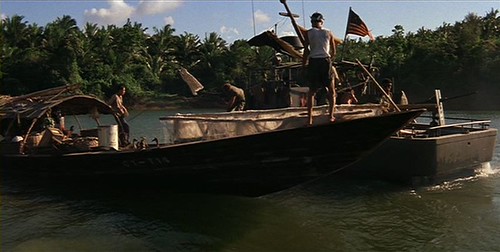
The Chief decides to pull along side the sampan and search it, which is standard procedure. Willard protests, arguing that his mission takes priority. The Chief over-rides him: “Until we reach your destination Captain, you just goin’ for the ride.”
Subscribe to:
Posts (Atom)