Showing posts with label CE workshop. Show all posts

Friday, August 29, 2025

Talking Chimps and UFOs: A thought experiment

I'm bumping this to the top of the queue because I intend to put some version of it in my book in progress: PLAY: How to Stay Human in the AI Revolution.  
* * * * * 
 
This is an out-take from Beethoven’s Anvilmy book on music. It’s about a thought experiment that first occurred to me while in graduate school in the mid-1970s. Consider the often astounding and sometimes absurd things that trainers can get animals to do, things the don’t do naturally. Those acts are, in some sense, inherent in their neuro-muscular endowment, but not evoked by their natural habitat. But place them in an environment ruled by humans who take pleasure in watching dancing horses, and . . . Except that I’m not talking about horses.


It seems to me that what is so very remarkable about the evolution of our own species is that the behavioral differences between us and our nearest biological relatives are disproportionate to the physical and physiological differences. The physical and physiological differences are relatively small, but the behavioral differences are large.

In thinking about this problem I have found it useful to think about how at least some chimpanzees came to acquire a modicum of language. All of them ended in failure. In the most intense of these efforts, Keith and Cathy Hayes raised a baby chimp in their household from 1947 to 1954. But that close and sustained interaction with Vicki, the young chimp in question, was not sufficient. Then in the late 1960s Allen and Beatrice Gardner began training a chimp, Washoe, in Ameslan, a sign language used among the deaf. This effort was far more successful. Within three years Washoe had a vocabulary of Ameslan 85 signs and she sometimes created signs of her own.

The results startled the scientific community and precipitated both more research along similar lines—as well as work where chimps communicated by pressing ironically identified buttons on a computerized panel—and considerable controversy over whether or not ape language was REAL language. That controversy is of little direct interest to me, though I certainly favor the view that this interesting behavior is not really language. What is interesting is the fact that these various chimps managed even the modest language that they did.


The string of earlier failures had led to a cessation of attempts. It seemed impossible to teach language to apes. It would seem that they just didn’t have the capacity. Upon reflection, however, the research community came to suspect that the problem might have more to do with vocal control than with central cognitive capacity. And so the Gardners acted on that supposition and succeeded where others had failed. It turns out that whatever chimpanzee cognitive capacity was, it was capable of surprising things.

Note that nothing had changed about the chimpanzees. Those that learned some Ameslan signs, and those that learned to press buttons on a panel, were of the same species as those that had earlier failed to learn to speak. What had changed was the environment. The (researchers in the) environment no longer asked for vocalizations; the environment asked for gestures, or button presses. These the chimps could provide, thereby allowing them to communicate with the (researchers in the) environment in a new way.

It seemed to me that this provided a way to attack the problem of language origins from a slightly different angle. So I imagined that a long time ago groups of very clever apes – more so than any extant species – were living on the African savannas. One day some flying saucers appeared in the sky and landed. The extra-terrestrials who emerged were extraordinarily adept at interacting with those apes and were entirely benevolent in their actions. These creatures taught the apes how to sing and dance and talk and tell stories, and so forth. Then, after thirty years or so, the ETs left without a trace. The apes had absorbed the ETs’ lessons so well that they were able to pass them on to their progeny generation after generation. Thus human culture and history were born.


Now, unless you actually believe in UFOs, and in the benevolence of their crews, this little fantasy does not seem very promising, for it is a fantasy about things that certainly never happened. Further, even if this had happened, it does seem to remove the mystery from language’s origins. Instead of something from nothing we have language handed to us on a platter. We learned it from some other folks, perhaps they were little short fellows with green skin, or perhaps they were the modern style aliens with pale complexions, catlike pupils in almond eyes and elongated heads.

But, and here is where we get to the heart of the matter, what would have to have been true in order for this to have worked? Just as the chimps before Ameslan were genetically the same as those after, so the clever before alien-instruction were the same as the proto-humans after. The species has not changed, the genome is the same – at least for the initial generation. The capacity for language would have to have been inherent in the brains of those clever apes. All the aliens did was activate that capacity. Once that happened the newly emergent proto-humans were able to sustain and further develop language on their own. Thus the critical event is something the precipitates a reconfiguration of existing capabilities.

However, language origins is not our problem. We are searching for the origins of music. So, instead of alien instruction in Hebrew or Sanskrit we can imagine alien instruction in samba or polka. The basic configuration and dynamics of the story remains the same. However, to make it real we have to get rid of those aliens and their instruction. Instead of the aliens we have only our group of clever apes. They are going to have to instruct one another. What we are looking for is a a way to get a gestalt switch in group dynamics that supports new modes of neural dynamics in the brains of individuals who are interacting with one another in a group.


Let us call this the Gestalt Origins Hypothesis:
Gestalt Origins: The precursor to music arose when groups of hominids interacted in a way that triggered a new configuration of operation in their existing nervous system.
Notice that I talk of a precursor to music. I don’t think we can get from ape to music in a single bound. We need at least one precursor, something that is rhythmic, like music, but not yet fully formed. In order to get even that far, so my argument goes, our proto-humans need better control over their vocal cords than apes have, they need more rhythmic sophistication, and greater mimetic capacity.

Notice that this story says nothing about the adaptive value of music. I do intend to get around to that toward the end of the chapter, but that’s not my primary concern. My primary concern is getting our ancestors to the point where a gestalt switch can happen that will bring about a precursor to music, something we can call musicking. In order for that to happen we need to solve an adaptive problem or two. But those adaptations are not about music; they are about its precursors. Once music-making is going along smoothly we need another gestalt switch to differentiate it into language and music proper.

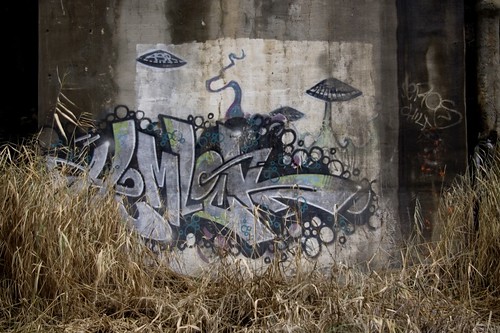
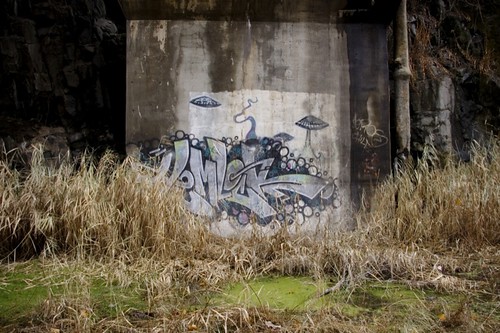
The photos show graffiti that’s at the western end of the Erie Cut (aka the Bergen Arches) in Jersey City. There are at least two layers of graffiti. The back layer contains what appear to be UFOs, though perhaps the two at the right are mushrooms. The top layer has a name, Hemlock, which is obscured by the grass to one degree or another.

Wednesday, December 13, 2023

The Busy Bee Brain

With artificial neural nets (ANNs) all over the place these days, this post from March, 2013, warrants a bump to the top of the queue. Perhaps the chief difference between real brains and ANNs is the fact that each neuron in a real brain is a living agent, albeit of a very small scope, hence the metaphor, the brain as a bunch of busy bees within the skull. The neurons of ANNs are passive bits of data.


Ordering Mark Moffett’s Adventures Among Ants got me to thinking about a science fiction novel that knocked my socks off when I was 12 or 13: Man of Many Minds, by E. Everett Evans. It’s about George Hanlon, a man who had the ability to project his mind into other creatures. At a critical point in the book, when – I believe – Hanlon is about to be tortured, he projects his whole mind, every last bit of it, into a swarm of bees, thereby escaping the pain of torture. [See excerpt below.]

I thought that was pretty neat.

But what does it have to do with Moffett’s book? That’s pretty simple. Ants, like bees, live in groups, and it’s not unusual to think of such groups as being some kind of superorganism – a notion that, according to this blog entry, Moffett subjects to a critical workout. That swarm of bees in Man of Many Minds is such a superorganism.

But when it “absorbed” Hanlon’s mind, what did it become then? The question is a rhetorical one; after all; it’s about something never really happened. It’s just fiction. But a very suggestive fiction.

Could the human brain be something like a hive of bees?

Yes.

There is now a pretty strong consensus that the cerebral cortex (which is, by no means, the entire brain, but it is likely that this is where culture is carried) is organized into small columns of neurons. In a 1978 essay Vernon Mountcastle called these minicolumns and suggested that they have about 100-300 neurons each. He estimated that the neocortex consists of 600,000,000 of these minicolumns. He also suggested that these minicolumns are organized into macrocolumns, about 600,000 of them -- implying that there are hundreds of minicolumns per macrocolumn. (Mountcastle was clear that these numbers were just order of magnitude estimates & that is all I need for my purposes.) That makes these macrocolumns roughly the size of a typical invertebrate nervous system of 10K to 100K neurons. So, here’s my metaphor: Your neocortex consists of 600,000 buzzing bees going about their business.
 
The point of the metaphor is that, just as individual bees are autonomous agents (which must, nonetheless, feed and reproduce in a group), so the macrocolumns are autonomous agents (which are physically coupled to many other such agents). Bees go about their business by sensing optical and chemical gradients and features and by moving their bodies and excreting chemicals. The macrocolumns are not directly connected to the external world, but they have extensive inputs and outputs to other macrocolumns and to other regions of the brain and nervous system. From a purely information processing point of view, they are as capable of action as are bees. They “sense” neurochemical gradients in the intersynaptic space and act on their sensations by excreting chemicals into that space.

This loose metaphor really gets interesting, however, when we begin to think about human interaction, which of course implies interaction between brains. Some interactions are pretty loose, such as those between people strolling the aisles at a supermarket. Other interactions are tighter, such as people having a conversation over a meal. And some interactions are very tight, such as musicians making music with one another. And that brings us back to insects, fireflies in particular.

Allow me to quote a passage from Chapter 3 of Beethoven’s Anvil:
Physicists do understand one element of dance, simple repetitive rhythm. This understanding has been applied to many biological systems, one of which is male fireflies in Southeast Asia. These fireflies gather in large groups on river banks, flashing on and off in unison to signal their availability to females. When they begin gathering around sunset their flashings are uncoordinated. But, as dusk darkens into night, regions of synchronized flashing emerge and spread until whole trees are cloaked in fireflies flashing in synchrony.
That is to say, in some sense, the nervous systems of those flies have become temporarily coupled together into a single physical system where some some signals are transmitted within nervous systems through electro-chemical means while other signals are transmitted from one nervous system to another by energy transduction (sending: chemicals → photons, and receiving: photons → chemicals) and light (i.e. photons). I go on to say:
There is no reason to believe that this activity is directed in the way that a conductor directs an orchestra. There is no lead firefly setting the pace of the others. The flashing simply emerges; it is self-organized. Each firefly is making his own decisions about when he’ll flash, influenced by the activities of his neighbors. This activity has been analyzed as a system of coupled oscillators, a phenomenon first noticed by the seventeenth century Dutch physicist Christiaan Huygens, who invented the pendulum clock—the pendulum being a prime example of an oscillator. One day Huygens saw that the pendulums of two clocks on the same wall were swinging in perfect synchrony. He disturbed one of them so that the synchrony dissolved, but it returned within half an hour. After a bit of experimentation he concluded that the clocks were affected by the vibrations each transmitted to the wall behind them. These vibrations led them to synchronize their periods and thereby minimize their collective energy expenditure.

Any phenomenon common to systems as different as pendulum clocks and fireflies must be very general.
I then go on to develop an argument that music works like that as well. As I say in my review of Steven Mithen’s The Singing Neanderthals, “what musicking does is bring all participants into a temporal framework where the physical actions - whether dance or vocalization - of different individuals are synchronized on the same time scale as that of neural impulses, that of milliseconds. Within that shared intentional framework the group can develop and refine its culture. Everyone cooperates to create sounds and movements they hold in common.” While making music, I argue, we may consider the nervous systems of individuals as being physically coupled together so as to constitute a single dynamical system that is distributed across separate individuals. When the music-making stops, the distributed system dissolves into its individual components; individuals, that is to say, their brains, are free once again to operate independently of one another.

The point of this exercise is that, by (the reductive step of) insisting on thinking of brains as physical systems, and therefore insisting that interactions between brains is physical interaction, we can arrive at a concept of a very special human group – one engaged in music-making – as a single distributed nervous system. That is possible only because the fundamental coupling requirements are very simple, simple enough that fireflies and neurons can meet those requirements.

If fireflies can teach us about how we can make music, than surely ants have much to teach us as well. I look forward to reading Moffett’s book.

Virtual Fly Brain

If you're at all curious about what a bee brain might actually be like, well Nature Precedings has something similar, an account of the brain of the fruit fly:


David J. Osumi-Sutherland1, Mark Longair & J. Douglas Armstrong

Abstract:
Drosophila neuro-anatomical data is scattered across a large, diverse literature dating back over 75 years and a growing number of community databases. Lack of a standardized nomenclature for neuro-anatomy makes comparison and searching this growing data-set extremely arduous.

A recent standardization effort (BrainName; Manuscript in preparation) has produced a segmented, 3D model of the Drosophila brain annotated with a controlled vocabulary. We are formalizing these developments to produce a web-based ontology-linked atlas in which gross brain anatomy is defined, in part, by labeled volumes in a standard reference brain.

We have developed new relations that allow us to use this well-defined gross anatomy as a substrate to define neuronal types according to where they fasciculate and innervate as well as to record the neurotransmitters they release, their lineage and functions. The resulting ontology will provide a vocabulary for annotation and a means for integrative queries of neurobiological data.

The ontology and associated images, queries and annotations will be integrated into the Virtual Fly Brain website. This will provide a resource that biologists can use to browse annotated images of Drosophila neuro-anatomy and to get answers to questions about that anatomy and related data, without any need for ontology expertise.
Man of Many Minds
 
8.31.20: It turns out that the Evans book is available on Project Gutenberg. And that I mis-remembered the incident. Such is memory. It turns out that he sent most of his mind into pigeons:
Hanlon didn't struggle when they bound him firmly in the chair with manacles on hands and feet. He knew it would be useless anyway. He let his body slump into his chair, and again directed his mind through that vent. He must not let them defeat him! He had to survive—to get word—to the Corps!

Then his searching mind contacted another—a weak, primitive one, but a mind. Avidly he fastened onto it, merged with it ... and found himself inside the brain of one of those Simonidean pigeons.

Ah! This is wonderful! Pigeons seldom fly alone. Where you find one you almost always find a number. Activating the bird's brain he sent out a call to others of its kind that it had found food in abundance. Soon more and more of them flew down to where the now enslaved pigeon was standing, and as each one came, Hanlon sent into its brain all of his mind it would hold.
He summoned the birds to his aid, to no avail. One of them was shot. He had to withdraw his mind from it and then...
The other parts of his mind were flying all about the enclosed park that was a part of the great palace, searching, desperately seeking some other form of life that could be used as a housing for the dying part of Hanlon's mind.

Suddenly one of them uttered a cry that drew the rest to it on swift pinions, to see attached to one of the trees a huge swarm of Simonidean bees.

"Will the queen do?" the one mind-portion asked anxiously.

There was a convulsive shudder in all the minds, for the birds knew—and Hanlon had heard—how deadly poisonous these native bees were; how they were hunted down and exterminated when found. They were twice the size, and many, many times more vicious and deadly than Terran bees. Even now two gardeners were running toward the tree with a great metal net and flame-throwers.

But Hanlon was desperate. "She will have to do," the aggregate mind decided.
And he got the queen to relieve him of his torturers.

Sunday, September 17, 2023

Cultural Evolution 8: Language Games 1, Speech

Once again I'm bumping this to the top, this time to emphasize the material I've highlighted in yellow, that the meaning of words is constantly being negotiated through interaction with others. I wish to posit, polemically and provisionally, that what happens within a single head, a single brain, a single mind, that that be thought of as purely mechanical, purely a matter of relationality and adhesion, to use terms I've recently adopted. What happens when people negotiate meaning through interaction is perhaps not so mechanical. This is where freedom and novelty enter the system, where epistemic difference forces us to renegotiate the world.

* * * * *

I'm bumping this post, from 2010, to the top of the queue for two reasons: 1) the section "Language Games and Game Theory" is germane to my recent post, Why do we need a genotype-phenotype distinction for cultural evolution? Because minds are built from the inside.The post proposed as an answer: minds are built from the inside. From that it follows that we can't read one another's minds, which is my point of departure in this post. 2) The following section, "What is a language and what are the memes?," is where I first worked out my current approach to the genetic component of culture, which I have since come to call coordinators. The rest of the posts in this particular series are gathered under the tag CE workshop. Note: You might want to read the comments for this post.
* * * * *

The key to the treasure is the treasure.
– John Barth

But I’m not talking of language games in Wittgenstein’s sense, though the Wittgenstein of the Tractatus had a considerable influence on me as an undergraduate. No, I’m thinking of game theory, not something I’ve studied, though I did have an undergraduate course on decision theory taught by R. B. Braithwaite. But I’m getting ahead of the game.

As the title says, this post is about language. There’s been a fair amount of work done on language from an evolutionary point of view, which is not surprising, as historical linguistics has well-developed treatments of language lineages and taxonomy, the “stuff” of large-scale evolutionary investigation. While this work is directly relevant to a consideration of cultural evolution, however, I will not be reviewing or discussing it. For it doesn’t deal with the theoretical issues which most concern me in these posts, namely, a conceptualization of the genetic and phenotypic entities of culture. This literature is empirically oriented in a way that doesn’t depend on such matters.

The Arbitrariness of the Sign
 
In particular, I want to deal with the arbitrariness of the sign. Given my approach to memes, that arbitrariness would appear to eliminate the possibility that word meanings could have memetic status. For, as you may recall, I’ve defined memes to be perceptual properties – albeit sometimes very complex and abstract ones – of physical things and events. Memes can be defined over speech sounds, language gestures, or printed words, but not over the meanings of words. Note that by “meaning” I mean the mental or neural event that is the meaning of the word, what Saussure called the signified. I don’t mean the referent of the word, which, in many cases, but by no means all, would have perceptible physical properties. I mean the meaning, the mental event. In this conception, it would seem that that cannot be memetic.

That seems right to me. Language is different from music and drawing and painting and sculpture and dance, it plays a different role in human society and culture. On that basis one would expect it to come out fundamentally different on a memetic analysis.

This, of course, leaves us with a problem. If word meaning is not memetic, then how is it that we can use language to communicate, and very effectively over a wide range of cases? Not only language, of course, but everything that depends on language. Literature obviously – which I’ll take up in the next post – but much else as well.

Speech as a Means of Communication
 
Willard van Orman Quine has given us a classic thought experiment that points up the problem of word meaning. He broaches the issue by considering the problem of radical translation, “translation of the language of a hitherto untouched people” (Quine 1960, 28). He asks to consider a “linguist who, unaided by and interpreter, is out to penetrate and translate a language hitherto unknown. All the objective data he has to go on are the forces that he sees impinging on the native’s surfaces and the observable behavior, focal and otherwise, of the native.” That is to say, he has no direct access to what is going on inside the native’s head, but utterances are available to him. Quine then asks us to imagine that “a rabbit scurries by, the native says ‘Gavagai’, and the linguist notes down the sentence ‘Rabbit’ (of ‘Lo, a rabbit’) as tentative translation, subject to testing in further cases” (p. 29). And thus begins one of the best known intellectual romps in the philosophy of language.

Quine goes on to argue that, in thus proposing that initial translation, the linguist is making illegitimate assumptions. Perhaps he begins his argument by noting that the native might, in fact, mean “white” or “animal” and later on offers more exotic possibilities, the sort of things only a philosopher would think of. Quine also notes that whatever gestures and utterances the native offers as the linguist attempts to clarify and verify will be subject to the same problem. Quine’s argument is thorough and convincing.

When he did that work, however, he did not, of course, have access to a range of more recent work in cognitive anthropology and evolutionary psychology that indicated that our adapted minds have a preferred way of parsing the world, as do baboons. To be sure, this is “overwritten” and augmented in culture-specific ways, but those underlying perceptual and cognitive systems do not disappear. To consider a specific example, the work on folk taxonomy (Berlin 1992) suggests that there is a so-called basic level of designation, and that is at the level of “rabbit” and not “animal” (in fact, many languages don’t even have a word at that level of generality). So the linguist is reasonable in assuming “rabbit” is a more likely translation than “animal.” Other considerations are likely to rule out “white” or Quine’s other suggestions. I have no reason to believe that this cognitive architecture so constrains matters that there is only one possible referent for “Gavagai.” But I do think that it is likely to turn out that, all other things being equal, “rabbit” is in fact the best guess.

This situation, of course, is rather different from that of ordinary speech between people who share a common language. In the common situation both parties would know the meaning of “Gavagai.” Yet, however effective it is, ordinary speech sometimes fails to secure understanding between people and, where such understanding is achieved, that achievement has required back-and-forth speech. The mutual understanding is achieved through a process of negotiation. As William Croft reiterates in chapter 4 of Explaining Language Change, we cannot get inside one another’s heads and so must negotiate meanings in conversation.

That is to say, communication through language is not a matter of sending information through a pipeline. It does not happen according to what Michael Reddy (1993) has called the conduit metaphor. Reddy’s article is based on 53 example sentences. Here are the first three (p. 166):
1. Try to get your thoughts across better
2. None of Mary’s feelings came through to me with any clarity
3. You still haven’t given me any idea of what you mean
Reddy’s argument is that many of our statements about communication seemed to be based on the notion of sending something (the thought, idea, feeling) through a conduit, hence he calls it the conduit metaphor. He knows that communication doesn’t work that way, but that’s not is central issue. His central concern is to detail the way we use the conduit metaphor to structure our thinking about communication.

Reddy’s argument is reminiscent of a somewhat earlier argument by Paul de Man, “Form and Intent in the American New Criticism” (1983, first published in 1971). Consider this passage (p. 25):
“Intent” is seen, by analogy with a physical model, as a transfer of a psychic or mental content that exists in the mind of the poet to the mind of a reader, somewhat as one would pour wine from a jar into a glass. A certain content has to be transferred elsewhere, and the energy necessary to effect the transfer has to come from an outside source called intention.
De Man’s point was that, when we read a text, the intention (de Man uses the term in its somewhat rarified philosophical sense) that gives life to those signs on the page is our intention, not the author’s. And he is right.

De Man’s insight, and similar ones by Derrida, Barthes, Foucault and others, had an electrifying effect on literary critics in the United States, leading to a tremendously fertile period in academic literary criticism that, however, became increasingly sclerotic in the 1990s. But that story’s neither here nor there. My point is simply that these thinkers were attempting to deal with a real problem and, ultimately, they failed.

What, for example, could Derrida (1976, p. 158) have possibly meant by proclaiming “There is nothing outside of the text”? What he did not mean is that the world is nothing but a text and a text created by more or less arbitrary social conventions. Read sympathetically, and in context, the phrase seems to mean something to the effect that there is no way we can “step outside” language so as to examine, in full omniscient and transcendental objectivity, the relationship between language and the world. And that, it seems to me, is true. We’re always going to be immersed in “language,” whether natural or the various languages of science and mathematics.

How, then, do we fly free of the bottle? We play games.

Language Games and Game Theory
 
Where de Man argues that intent cannot be transmitted from one speaker to another like pouring wine from a jar, William Croft points out that linguistic communication is tricky “precisely because our thoughts cannot leave our heads” (2000, p. 111). Croft is a linguist who has undertaken to explain language change using an evolutionary approach. He defines a language to be “the population of utterances in a speech community” (p. 26), thus focusing our attention, not on some abstract language system, but on the concrete production of speech.

How does Croft deal with the fact that we cannot transmit thoughts directly to another’s mind? He argues that meaning is negotiated in the back-and-forth of conversation and draws on game theory to make his argument (p. 95):
There is a problem here: the hearer cannot read the speaker’s mind, and she can’t read his. This is what is called a COORDINATION PROBLEM. In speaking and understanding, speaker and hearer are trying to coordinate on the same meaning.
Croft then introduces the notion of a third-party Schelling game in which two players “are presented by a third party with a set of stimuli” which helps them converge on the same meaning. Sometimes it works, sometimes not. One possibility, he argues, is to use “natural perceptual or cognitive distinctiveness [as] a COORDINATION DEVICE” (p. 96). That gives us the adapted mind that I invoked in discussing Quine’s problem. Croft goes on to discuss a variety of linguistic devices as non-conventional coordination devices.

While the details are interesting and important – I recommend his discussion to you – we need not worry about them now.

Save one. Croft notes that, in order for speaker and hearing to reach agreement in conversation their mental states “need not be identical, though it is assumed that they are systematically related” (p. 99). Later on he notes that (114):
successful communication involves not the recovery of and original, ‘correct’ interpretation of the speaker’s original intention, but instead an interpretation that evolves over the course of the conversation, and is assessed by the success or failure of the higher social-interactional goals that the interlocutors are striving to achieve.
One reason why this effort is not doomed to failure from the beginning is the fact that although we cannot read each other’s minds, we do inhabit a shared world.

Croft’s general point, then, is simple, speech communication is a two-way interaction, not the one-way transmission of meaning, information, whatever, though a channel. De Man’s problem is thus solved for the case of face-to-face interaction, a common case, and surely the most basic one. Note that this solution does not involve recourse to a transcendental signified nor to stepping outside the text, nothing like that. It involves the ordinary and obvious means of interactive speech. In this sense, the key to the treasure, is the treasure. Nothing else is required.

But what, you may ask, of written communication, where direct interaction is not possible? After all, de Man was a literary critic, writing about the reading of written texts. What about that?

Good question. I’m going to punt on it. But I observe that some written communication – correspondence – does involve interaction, but at a slower pace than conversation, often much slower. In the case of literary texts, yes, readers cannot ordinary interact with authors, but they can interact with one another. I’ll say a little about that in the next post. Beyond that, yes, there are issues, serious issues. But this is not the place to address them. My concern here is just to get things started.
Note: Mathematician and psychologist Mark Changizi (1999) has an interesting argument about why vagueness of word meaning is essential to the proper functioning of language. His argument is grounded in considerations of computability and I recommend it to you. It makes an interesting complement to the game-theoretic conception of speaking.
Addition: See subsequent post reporting an experiment that David Hays did at RAND in the mid-1950s. It’s relevant to the game theoretic treatment of conversation.
What is a language and what are the memes? 
 
Now I want to shift gears a bit and work my way back to the physical “side” of the linguistic sign, because that’s where we’re going to go looking for memetic entities.

Throughout this post I’ve been assuming that we know what a language is. Now I want to get picky. Here’s what Sidney Lamb has to say in Pathways of the Brain. He’s talking about Roman Jakobson, the great linguist (p. 41):
Using the term language in a way it is commonly used . . . we could say that he spoke six languages quite fluently: Russian, Czech, German, English, Swediksh, and French, and he had varying amounts of skill in a number of others. But each of them except Russian was spoken with a thick accent. It was said of him that “He speaks six languages, all of them in Russian.” . . . the evidence indicates that from a neurocognitive point of view there is no such unit as a language. What exists from a neurocognitive point of view is not so much one linguistic system as a group of interconnected systems, relatively independent from one another.
Lamb goes on to assert that (p. 42):
Professor Jakobson’s internal linguistic information included a single phonological system, that of his native Russian, together with separate systems of grammar and lexicon for Russian, Czech, English, German, French, and Swedish – with some overlap in these grammars and lexicons . . . along with his more limited abilities in various additional languages; plus a conceptual system connected to them all.
So far we’ve been concerned with how meaning is negotiated, where meaning is a matter of the conceptual system. That’s on one “side” of the arbitrary sign, the side inside the brain. Now we’re going to look at the other “side” of the sign, the side that’s in public view, the physical sign. It’s that physical side that most differs among languages.

The question before us is: How do we conceptualize the memetic elements of language? In glossing the emic/etic distinction in a comment to John Wilkins I remarked that (now I’m simply repeating that comment) the distinction originates in linguistics, in the distinction between phonetics and phonemics. The former is about the psychophsics of speech sound while the latter is about phoneme systems. These are obviously very closely related matters, but they aren’t the same. We tend to perceive the speech stream as consisting of discrete sound entities, syllables and phonemes; this is the domain of phonemics. But the speech signal is, in fact, continuous. If you look at a sonogram of some chunk of speech, you don’t draw a series of vertical lines through it separating one phoneme from another; nor can you snip a tape recording into phoneme-long or syllable-long segments and reassemble it into something that sounds like natural speech. The aspects of the speech stream which are phonemically active differ from one language to another, which is why foreign languages all sound like “Greek.” Independently of the fact that you don’t know what the words mean or how the syntax works, you can’t even hear the phonemes in the speech stream.

Now, that’s the distinction I’m after, between phonemes and the raw speech stream. That’s the distinction I drew in my discussion of music (third post). Phonemes are those properties of the speech stream that are linguistically active. We need, however, to distinguish between segmental phonemes and suprasegmental phonemes. The segmental phonemes are roughly parallel to the letters of an alphabetic writing system. Suprasegmentals include tone, stress, and prosodic patterns. And then we need to consider ordering as well, as the order in which elements occur is certainly a property of the speech stream, and a most important one.

Before thinking about order, thought, we need to think a bit more about what’s going on. Roughly speaking, two things need to be extracted from the speech signal: 1) word identities (to be somehow linked to word meanings), and 2) the relations between the words (syntax). My quick take on matters – I’m not a linguist and I’ve not thought this through – is that both segmental and suprasegmental phonemes are involved in both of those processes. Relations between words are often indicated by word affixes, which are realized through segmental phonemes. Word identities are certainly realized by segmental phonemes, but tone and accent are involved as well.

Beyond this, relations between words are signaled by word order. In linguistic typology, typical word order is the primary trait on which classification based. Thus one has SVO languages (subject-verb-object), VSO languages (verb-subject-object), and so forth. As those designations suggest, word order indicates grammatical function, that is, relations between words.

Thus between word order and phonemes we’ve got a rich set of memetic elements. And we could also consider morphology in here as well. Taken together these aspects of the speech signal seem to be as memetically rich and abstract as the musical properties we looked at in discussing Rhythm Changes (first post).


Saturday, July 18, 2020

Memes as Data: Targets, Couplers, and Designators

Bump to the top of the queue on general principle (the discussion of designation is important) and to remind myself that this material is here and that I need to think about it some more.
While these posts have been quite critical of Dennett’s use of the concept of information, that should not be taken to mean that I see no use for such a concept. There is, of course, the technical usage established by Shannon and Weaver, but that is of limited use in these discussions. The challenge is to make use a less specialized, indeed an informal, concept. I intend to do so by identifying memetic information with the formal concept of data, as employed in computer science, and in particular with the concept of a parameter.

The Wikipedia defines parameter in this way:
In computer programming, a parameter is a special kind of variable, used in a subroutine to refer to one of the pieces of data provided as input to the subroutine. These pieces of data are called arguments. An ordered list of parameters is usually included in the definition of a subroutine, so that, each time the subroutine is called, its arguments for that call can be assigned to the corresponding parameters.
Memes are arguments in the sense of that definition. The parameters for which they are values are components of “subroutines” in the mind, where, for the purposes of this discussion, the mind is considered to be a rich and sophisticated computational device whose characteristics are unspecified.

Memes as Targets

Our first task is to reconcile the current explication of memes (as arguments for mental parameters) with the explication I’ve been developing: memes are culturally active observable properties of objects, events, and processes. That is to say, those properties serve as arguments for parameters in mental processes.

For example, one wishes to make a stone ax head of the standard sort. Using an existing ax head as a model, one can treat its size and shape as targets against which one can judge progress in fabricating a new ax head. In this case a target is a parameter in a fabrication procedure that defines some aspect of the fabricated object.

Then there is the fabrication procedure itself. Apprentices, of course, observe master craftsmen at work and so can use their observations as a source of targets for their own activity. In some respects the master may give explicit instruction, Do it this way, thus helping the apprentice to identify more precise targets.

Memes as Couplers

Let’s consider my favorite source of examples, music. Here’s a passage from Beethoven’s Anvil (pp. 177-178) in which I present a just-so story about the origins of music:
So now we have bands of proto-humans using their animal calls, and their animal moves as well. Group musicking would surely be common. I can imagine it starting more or less spontaneously around significant events. A lion is beaten off, a female comes back from the bush with a new infant, a death, a fresh kill, a water hole is found after a two-day search, a quarrel breaks out and is resolved. I'm imagining a group of folks going about their business and then something dramatic happens that captures the attention of more and more individuals; they begin milling around while chattering and gesturing. Then gestures, footfalls, and cries begin intersecting one another, creating ever denser patterns of sonic and gestural coincidence—the dynamics might have been a bit like those of the clapping we examined at the end of chapter 3. That, I believe, is how group musicking emerged.

For generations upon generations, this musicking may have been opportunistic and haphazard. But the particular patterns of group interaction became easier and easier to trigger, the catalytic requirements less and less, and somehow the activity began happening without any particular catalyst at all. It just happened that on this or that occasion enough individuals gathered together in a small space, one of them began a rhythmic stomp and the joined in, for the fun of it. In this context, every once in awhile—and, over time, more and more frequently—magic could happen. People would have fun and, perhaps, anxiety would be dissipated as well.
Forget about whether or not that’s a convincing just-so story. I like it, but that’s beside the point.

The point is: What’s required that people synchronize their motions and vocalization in cyclic activity? What are the parameters? The physicists tell us there are two: period and phase angle. Period is the length of time required by one complete cycle while phase angle has to do with the alignment between adjacent cycles.

Imagine a pair of people walking side-by-side. Imagine that they are walking at the same tempo. If their left feet hit the ground at the same time then their right feet will do so as well, but half a cycle later. We can say, by definition, that they are walking in phase. If, however, one person’s left foot hits the ground at the same time as the other person’s right foot hits the ground, we would say that they are 180 degrees out of phase. If they are 90 degrees out of phase then their footfalls will not be simultaneous. That’s phase angle. The point is that walking at the same pace doesn’t imply that they are performing the same actions at the same time.

Period and phase angle are thus coupling parameters. They constrain movement so that people move together. To the extent that specific values for those parameters recur in session after session, those values would be memes.

More expansively, we can think of the conventions of the blues, for example, as a set of coupling parameters. They specify cycle length (12 bars), certain melodic elements (the so-called blue notes), and the harmonic trajectory through the cycle (in one notation: I IV I V I). The harmonic trajectory is in fact a set of target parameters which have been given a specific temporal order. Rhythm Changes, as we’ve discussed before in this series, is a still more complex set of coupling parameters and associated targets.

Specific values for these parameters would then be memes. When one plays a blues in the key of Bb, the arguments for the harmonic parameters are specified: Bb F Bb G Bb. A skilled musician joining a jam session in progress has only to hear the music in order to identify it as, say, a blues. Once you’ve played a note or two you can identify the specific key as well and it’s off to the races.

Friday, November 29, 2019

Where Are Memes? [Again] [And again]

Another bump, from Nov 20, 2019, in which a take back the suggestion I'd inserted then. This comment is again flush right, but in blue Helvetica.

I’d originally posted this on July 24, 2010. I’m thinking about these things again so I’m reposting it along with comments inserted in italics and flush against the right margin.

Back in 1996 I published a long article, Culture as an Evolutionary Arena (link to downloadable PDF), in the, alas, now defunct, Journal of Social and Evolutionary Systems. In that article I introduced the notion of units of cultural inheritance with these paragraphs:
Following conversations with David Hays, I suggest that we regard the whole of physical culture as the genes: the pots and knives, the looms and cured hides, the utterances and written words, the ploughshares and transistors, the songs and painted images, the tents and stone fortifications, the dances and sculpted figures, all of it. For these are the things which people exchange with one another, through which they interact with one another. They can be counted and classified and variously studied.

What then of the ideas, desires, emotions, and attitudes behind these things? After all, as any college sophomore can point out, words on a page are just splotches unless apprehended by an appropriately prepared mind, one that knows the language. Pots and knives are not so ineffable as runes and ideograms, but they aren't of much use to people who don't know how to use them, that is, to people whose minds lack the appropriate neural "programs". Surely, one might propose, these mental objects and processes are the stuff of culture.

What I in fact propose is that we think of these mental objects and processes as being analogous to the biologist's phenotype just as the physical objects and processes are analogous to the genotype. Properly understood, these mental objects and processes are embodied in brain states (cf. Benzon and Hays 1988). Thus we have the whole of physical culture interacting with the inner cultural environment to produce the various mental objects and activities which are the substance of culture.

Richard Dawkins has proposed the term "meme" for the units of the cultural genotype, but proposes no special term for the cultural phenotype, though he recognizes the necessity of distinguishing the two (Dawkins 1982, pp. 109 ff., see also Dawkins 1989, pp. 189 ff.). Following more or less standard anthropological usage, I offer "psychological trait", or just "trait", as a term designating phenotypical units or features. Note, however, that Dawkins places memes in the brain and traits in the external world, which is just the opposite of what I am doing.
I have maintained that position until quite recently, say a week or two ago. I am now considering abandoning that conception. But first, a little more about how I further developed it. 

In my 2001 book on music, Beethoven’s Anvil, I developed that idea with respect to music, arguing that the neural ‘trace’ (trajectory in neural state space) of musical performances is a cultural phenotype while the memes are those aspects of musical sound around which individuals coordinate their music-making activities. I further developed this idea only a few weeks ago in a series of posts I wrote as background to a post I did for the National Humanities Center on cultural evolution.

Specifically, I developed this notion using so-called Rhythm Changes as my main example (see this post, and then this one [1]). By Rhythm Changes I mean the harmonic structure of George Gershwin’s “I Got Rhythm.” The phrase itself has become a term of art in the jazz world; any reasonably competent jazz musician can jam on Rhythm Changes. In that series of notes, however, I took the further step of extending this approach to language and, by implication, to all of culture, not just music. Here’s what I said in my discussion of language:
The question before us is: How do we conceptualize the memetic elements of language? In glossing the emic/etic distinction in a comment to John Wilkins I remarked that (now I’m simply repeating that comment) the distinction originates in linguistics, in the distinction between phonetics and phonemics. The former is about the psychophysics of speech sound while the latter is about phoneme systems. These are obviously very closely related matters, but they aren’t the same. We tend to perceive the speech stream as consisting of discrete sound entities, syllables and phonemes; this is the domain of phonemics. But the speech signal is, in fact, continuous. If you look at a sonogram of some chunk of speech, you don’t draw a series of vertical lines through it separating one phoneme from another; nor can you snip a tape recording into phoneme-long or syllable-long segments and reassemble it into something that sounds like natural speech. The aspects of the speech stream which are phonemically active differ from one language to another, which is why foreign languages all sound like “Greek.” Independently of the fact that you don’t know what the words mean or how the syntax works, you can’t even hear the phonemes in the speech stream.

Now, that’s the distinction I’m after, between phonemes and the raw speech stream. That’s the distinction I drew in my discussion of music (third post). Phonemes are those properties of the speech stream that are linguistically active.
In thinking about this over the last week or two I’ve begun to suspect that things would work out fine if I reversed my old position and put memes in the head and phenotypes out there in the world. In this view, then, memes are sensorimotor schemas, or aspects of such schemas, with/through which we perceive objects and events in the physical world. And cultural phenotypes are objects and events in the world.

Well, maybe not quite that. Take music. Let’s think of the physical performance, the waves of music out there in the world, as the phenotype. The whole thing, in a lump. So it’s out there as a phonetic object. The memes (which I’m now calling coordinators) can still be emic attributes of that object, in keeping with my current terminology. They can be said to be painted on that phonetic object so as to cover it in an envelope or package (again, terms in my current lexicon for cultural evolution). And, I suppose if we’re going to do this, then we can think of the psychological process, the route, as it were, from coordinators to sense organs through perception, cognition, and motoric guidance of muscles – the whole transit through the mind/brain – that corresponds to the biological process of development from genes to phenotype, which, of course, takes place in interaction with the environment.

Do I believe this? Let’s see.

Perhaps it (now) makes sense to talk about the “fit” between the envelope of coordinators and the physical phenotype. Hmmm... But then, what term do I use for that physical phenotype? And what do I do with the term phantasm, which I’d been using for “the mental act occasioned by a package or envelope of coordinators”? And Cultural Being? Problems, problems!

If we accept that suggestion then books that are no longer read, musical scores that are no longer performed, recordings no one listens to, paintings no one cares about, and so forth, those are phenotypic entities on a conceptual foot with works currently in circulation and use. But if we say, as I had done in the first version of this document, that the cultural phenotype exists only as a living process, a trajectory, in the (collective) brain, that problem goes away. Those unread texts, those abandoned recordings, etc., are just packages or envelopes of coordinators that cease to be active.

But...they could be activated at any time. Sir Gawain and the Green Knight is a good example. The text is from the 14th century, but was lost until the early 19th century. Now it is taught regularly in college and in high school. It has become, once again, a living text.

This solves one rather odd problem in my previous conception. Consider a musical performance where there are, say, 125 people present. Just how they’re divided between performers and audience is irrelevant. What’s relevant is that we have 125 different brains processing the music. Since I’d identified the cultural phenotype with a neural event, does that mean that we’ve got 125 phenotypes, one for each person present? To be sure, we can index them to the one event in the external physical world that they all share, but still, this seems rather odd. Alternatively, do we think of the phenotype as one collective event, which is perhaps not so odd given the discussion in chapters 2, 3, and 4 of Beethoven’s Anvil? We have to think about that collective event anyway, but it’s no longer clear to me that we need to assign such events the phenotype role in an evolutionary account of human culture.

Why, then, did I ever adopt such an odd formulation? For one thing, it’s always been clear to me that the environment to which culture must adapt is the collective psyche of a cultural group.

Yes.

That environment is realized in the brains of the individuals in the group, taken as a collective entity. If that’s the environment, I reasoned, then the thing that thrives or dies in that environment, i.e. the phenotype, must be in that environment, no? Well no, all that’s necessary is that it be closely coupled to that environment. The mechanisms of human perception guarantee that and the specific “points” of coupling are the memes.

Hmmmm...Is that how it works? I note that this is REALLY tricky stuff. It requires careful formulation and close attention to details. Details details details!

Another thing that was certainly on my mind is all the talk of memes flitting about from brain to brain and even, in some cases, hijacking brain space against the biological interests of individuals. Such talk is OK for informal chitchat, as is talk of selfish genes, but it’s useless for serious intellectual work. By sticking the memes in the external world, as properties of things and events, I eliminated the possibility of such idle nonsense.

OK. But of course idle nonsense comes in many varieties. There’s still plenty to go around.

The fact of the matter is, alas, those who insist on talking idle nonsense about culture will do so regardless of how I think of memes. They aren’t my audience. My audience, whoever it is, is going to have to put up with an account that insists on psychological reality. Not only that, on neuropsychological reality. And that precludes notions of ideas hopping from one head to another quite independently of whether or not culture is conceived under the aegis of an evolutionary process involving the selective retention of (that is, repetition of) phenotypes and random variation among memes (culturally conditioned perceptual schemas, or aspects thereof).

In any case, under my conception, memes are not a new and heretofore unidentified class of entities — as they are in Robert Aunger’s embarrassing The Electric Meme. Rather, they are entities that have already been talked about as cultural codes of one sort or another. Identifying them as memes simply assimilates those codes to an evolutionary dynamic.

* * * * *

[1] I have since developed those two posts into a published article:  William Benzon, “Rhythm Changes” Notes on Some Genetic Elements in Musical Culture, Signata 6, Annales des Sémiotiques /Annals of Semiotics: Sémiotique de la musique / Music and Meaning. Per Aage Brandt and José Roberto do Carmo Jr., eds. Presses Universitaires Liège, 2015, pp. 271-285, http://www.academia.edu/23287434/_Rhythm_Changes_Notes_on_Some_Genetic_Elements_in_Musical_Culture.

Monday, June 12, 2017

Cultural Evolution, Memes, and the Trouble with Dan Dennett

This is the final post in a old series (from four years ago) on memes, cultural evolution, and the thought of Daniel Dennett. You can download a PDF of the whole series HERE. The abstract and introduction are below.

* * * * *

Abstract: Philosopher Dan Dennett’s conception of the active meme, moving about from brain to brain, is physically impossible and conceptually empty. It amounts to cultural preformationism. As the cultural analogue to genes, memes are best characterized as the culturally active properties of things, events, and processes in the external world. Memes are physically embodied in a substrate. The cultural analogue to the phenotype can be called an ideotype; ideotypes are mental entities existing in the minds of individual humans. Memes serve as targets for designing and fabricating artifacts, as couplers to synchronize and coordinate human interaction, and as designators (Saussaurian signifiers). Cultural change is driven by the movement of memes between populations with significantly different cultural practices understood through different populations of ideotypes.

* * * * *

Introduction: Taming the Wild Meme

These notes contain my most recent thinking on cultural evolution, an interest that goes back to my dissertation days in the 1970s at the State University of New York at Buffalo. My dissertation, Cognitive Science and Literary Theory (1978), included a chapter on narrative, “From Ape to Essence and the Evolution of Tales,” (subsequently published as “The Evolution of Narrative and the Self”). But that early work didn’t focus on the process of cultural evolution. Rather, it was about the unfolding of ever more sophisticated cultural forms–an interest I shared with my teacher, the late David G. Hays.

My current line of investigation is very much about process, the standard evolutionary process of random variation and selective retention as applied to cultural forms, rather than living forms. I began that work in the mid-1990s and took my cue from Hays, as I explain in the section below, “What's a meme? Where I got my conception”. At the end of the decade I had drafted a book on music, Beethoven’s Anvil: Music in Mind and Culture (Basic 2001), in which I arrived at pretty much my current conception, but only with respect to music: music memes are the culturally active properties musical sound.

I didn’t generalize the argument to language until I prepared a series of posts conceived as background to a (rather long and detailed) post I wrote for the National Humanities Institute in 2010: Cultural Evolution: A Vehicle for Cooperative Interaction Between the Sciences and the Humanities (PDF HERE). But I didn’t actually advance this conception in that post. Rather, I tucked it into an extensive series of background posts that I posted at New Savanna prior to posting my main article. That’s where, using the emic/etic distinction, I first advanced the completely general idea that memes are observable properties of objects and things that are culturally active. I’ve collected that series of posts into a single downloadable PDF: The Evolution of Human Culture: Some Notes Prepared for the National Humanities Center, Version 2.

But I still had doubts about that position. Though the last three of those background posts were about language, I still had reservations. The problem was meaning: If that conception was correct, then word meanings could not possibly be memetic. Did I really want to argue that?

The upshot of this current series of notes is that, yes, I really want to argue it. And I have done at some length while using several articles by the philosopher Daniel Dennett as my foil. For the most part I focus on figuring out what kinds of entities play the role of memes, but toward the end, “Cultural Evolution, So What?”, I have a few remarks about long-term dynamics, that is, about cultural change.

Saturday, September 3, 2016

Rant: Theory of Mind, NOT!

I posted this back in 2010, but I'm thinking about these things these days, so I thought I'd bump it to the top of the queue. Here's a companion piece from last year.
Theory of mind (aka TOM) is all the rage in (some quarters of) cognitive science and evolutionary psychology. It’s driving me batsh¡t crazy. And its use by literary critics makes me super-mega batsh¡t crazy.

Why? By the time literary critics use all that's left is the term itself, undisciplined by the observations that gave rise to the idea. For literary critics it's a "get out of (conceptual) jail free" card.

Let me explain

Well, first, in case you don’t know what TOM is, it refers to the capacity humans have for attending to and wondering about what’s on someone else’s mind. It’s a capacity that’s possibly unique to humans, though perhaps not, and it begins appearing at around four-plus years of age. My problem is not with the research itself or the notion that some-such capacity comes “online” at that point in development. What bothers me is the term and its implications.

It bothers Melvin Konner too. Here’s a passage from an opinion piece* he published in Nature a few years ago:
Meanwhile, social-cognition theorists have come up with a phrase inferential enough to make one almost long for the black-boxers: theory of mind. Freud sought one, Skinner assiduously didn’t, and most people don’t bother to ask themselves whether they have or need one. Yet there is serious debate as to whether chimpanzees or four-year-olds have a theory of mind. Closely inspected, the phrase seems to mean something like perspective-taking or, when mutual, intersubjectivity. True, a four-year-old can see and act on another person’s perspective whereas most three-year-olds can’t.

This is fascinating stuff and something we need to understand. But a term such as ‘theory of mind’ simply stands in the way. It makes for catchy article titles but conveys no meaning. Is the maturing orbitofrontal cortex newly able to calm an impulsive and self-centred limbic circuit? Is there a down-regulation of some neurotransmitter receptor, allowing a younger form of social mirror-imaging to grow into identification and parallel perspectives? As long as we are playing with pretty word-coins that substitute for brain functions, we will never know.
This TOM-talk is rather like Richard Dawkins talking about “selfish” genes. He knows perfectly well that genes aren’t the kind of agents that can be motivated by selfish considerations, but it’s a useful way of talking. And, in a pinch, he’s quite capable of explaining what’s going on without recourse to the personification; that is to say, Dawkins and others can give technical accounts that do not require genes to have mental states.

Similarly, the psychologists don’t believe that four year-old children are reasoning about the mind in the manner of philosophers or cognitive scientists. It’s not that kind of theory they’re imputing to the child. But this odd usage of “theory” is, in the end, grounded in experimental evidence and psychologists can talk and reason about those experiments. Konner’s point, of course, is that too ready explanatory recourse to TOM-talk is likely to get in the way of deeper theoretical investigation.

Wednesday, August 3, 2016

The Sound of Many Hands Clapping: Group Intentionality

I originally posted this in March 2014. I'm bumping it to the top of the queue as this topic is much on my mind these days.
* * *

In my earlier post on the busy bee brain I quoted some passages from Beethoven’s Anvil in which I discussed synchronized flashing among fireflies. Now I’d like to quote a somewhat longer passage, one about synchronized clapping (pp. 67-68):
You may be familiar with the synchronized clapping that routinely rewards a successful performances—music, drama, circus, etc.—in eastern European communities, but which is less common in western Europe and North America. Z. Néda and colleagues have investigated this phenomenon, recording applause for a number of performances in Romania and Hungary. The applause would start out randomly and then quickly become strongly synchronized. Synchronized clapping would continue for a short while and then disintegrate into random clapping, from which synchronized clapping would reemerge, and so forth.

Analysis of the recordings revealed two things:
  1. The average noise level was greater during the random clapping than during the synchronized clapping.
  2. During random clapping individuals clapped at roughly twice the frequency they used during synchronized clapping.
Clearly the greater volume during random clapping came because individuals were clapping faster. But during this phase, the time between individual claps varied more than when people clapped at the lower rate. That variability made it impossible for the group to synchronize at the higher rate—a result that has emerged in a number of studies of groups of globally coupled oscillators.

Néda concluded that audience members were caught in a conflict. On the one hand, they can express one value clapping as rapidly as possible, thereby making the loudest noise. If, however, they wish to express another value by synchronizing their clapping, then they have to clap more slowly, thereby lowering the volume. It is impossible simultaneously to maximize these two aims. The group deals with this conflict by switching back and forth between two different expressive regimes.

We would, of course, like to know what these two values are. The investigators assume that the loudness of the clapping reflects the audience members’ enthusiasm for the performance, while synchronous clapping expresses group solidarity. This seems reasonable enough. For our purposes, however, what is significant is the mechanism by which these two values, whatever they are, were expressed by the group. That mechanism is clearly self-organizing. No one leads audiences in this behavior. It just happens.

Walter Freeman has techniques for identifying and studying intentionality in the brains of individual animals. Néda and colleagues have demonstrated a method for studying group intentionality in this one very simple case—a simple case, however, that is grounded in coupled behavior. If we are to understand musicking we need techniques that work in more complicated cases, … , or the bell magic, or the jam session we turn to next. The important point is simply that group intentionality is amenable to empirical study.
What’s particularly interesting about this example is that we have two modes of behavior, synchronized clapping (expressing group solidarity) and loud random clapping (expressing enthusiasm for the performance), and they alternate with one another at quasi-periodic intervals. No one is directing this behavior. It just happens.

How? What’s the neural mechanism?

Tuesday, July 30, 2013

Cultural Evolution, So What? [Tutti Frutti]

I’d like this to be the last post in this series except, of course, for an introduction to the whole series, from Cultural Evolution by the Word on through to this one. We’ll see.

I suppose the title question is a rhetorical one. Of course culture evolves and of course we need to a proper evolutionary theory in order to understand culture. But the existing body of work is not at all definitive.

In the first section of this post I have some remarks on genes and memes, observing that both concepts emerged as place-holders in a larger ongoing argument. The second section jumps right in with the assertion, building on Dawkins, that the study of evolution must start by accounting for stability before it can address evolutionary change. The third and final section takes a quick look at change by looking at different verstions of “Tutti Frutti”. There’s an appendix with some bonus videos.

From Genes to Memes

I've been reading the introduction to Lenny Moss, What Genes Can't Do (MIT 2003), on Google Books:
The concept of the gene, unlike that of other biochemical entities, did not emerge from the logos of chemistry. Unlike proteins, lipids, and carbohydrates, the gene did not come on the scene as a physical entity at all but rather as a kind of placeholder in biological theory... The concept of the gene began not with the intention to put a name on some piece of matter but rather with the intention of referring to an unknown something, whatever that something might turn out to be, which was deemed to be responsible for the transmission of biological form between generations.
Things changed, of course, in 1953 when Watson and Crick established the DNA molecule as the physical locus of genes.

The concept of the meme originated in a similar way. While the general notion of cultural evolution goes back to the 19th century, it was at best of secondary, if not tertiary, importance in the 1970s when Dawkins write The Selfish Gene. And while others had offered similar notions (e.g. Cloake), for all practical purposes, Dawkins invented the concept behind his neologism, though it didn’t began catching on until several years after he’d published it.

The concept still functions pretty much as a placeholder. People who use it, of course, offer examples of memes and arguments for those examples. But there is no widespread agreement on a substantial definition, one that has been employed in research programs that have increased our understanding of human culture.
 
While there has been no more vigorous proponent of memes and memetics than Dan Dennett, he still seems to regard the notion as somewhat provisional. That’s certainly the drift of this comment in his recent interview at The Edge:
My next major project will be trying to take another hard look at cultural evolution and look at the different views of it and see if I can achieve a sort of bird's eye view and establish what role, if any, is there for memes or something like memes and what are the other forces that are operating.
He’s looking for a role for memes or “something like memes”—that’s pretty tentative.

And rightly so.

My own view, the one I’ve been pursuing in these notes, is that these memes, the physical things playing a certain role in cultural evolution, have already been more or less identified by previous thinkers, but have not been recognized as playing a genetic role in cultural processes. Memes are properties of physical objects, events, and processes, namely those properties that are culturally active. There is an existing name for such properties, etics, which is a generalization from phonetics (as opposed to phonemics). The physical substrate for memes is thus quite diverse, which others have recognized without, however, quite being able to focus on memes as properties of things, rather than the things themselves.

If I am correct in this, then there is no Big Revelation to Come comparable to the discovery of DNA. We’ve been looking at those genetic entities, those memes, all along, but have been unable to conceptualize them as such.

If we’ve already been examining these memes, then what’s the point of thinking about cultural evolution? THAT’s the point, cultural evolution. Evolutionary theory provides a framework in which to think about cultural processes, a framework that has heretofore been neglected. The fact is that the emic/etic distinction has not fared well in anthropology and I suspect that that is, in part, because it hasn’t been articulated within a theoretical framework that made vital use of it. It was just a loose distinction between the
intrinsic cultural distinctions that are meaningful to the members of a given society (e.g., whether the natural world is distinguished from the supernatural realm in the worldview of the culture) in the same way that phonemic analysis focuses on the intrinsic phonological distinctions that are meaningful to speakers of a given language (e.g., whether the phones /b/ and /v/ make a contrast in meaning in a minimal pair in the language)
and
extrinsic concepts and categories that have meaning for scientific observers (e.g., per capita energy consumption) in the same way that phonetic analysis relies upon the extrinsic concepts and categories that are meaningful to linguistic analysts (e.g., dental fricatives).
Well, yes. But that’s all that it is, a distinction that, in practice, has not proved terribly useful.

It remains to be seen, of course, whether or not my recasting of the distinction will prove useful, either in those terms or, more recently, as special kinds of input data (targets, couplers, and designators) for mental machinery. The past decade or so has seen a variety of empirical work (based on historical data, on laboratory experiments, or computer simulation) that is indifferent to just how one theorizes the objects under scrutiny. Can we do deeper work by theorizing them in the way I have been suggesting?

Stability as the Foundation for Evolutionary Change

By the time I had finished up with Beethoven’s Anvil I had concluded that, before we can think about evolutionary change, we must think about stability. Change only makes sense, is only possible, against a stable foundation.

I had no sense that this was a particularly novel idea, but I had no explicit source for it ideas of others. It now seems possible, even likely, that I got it from Richard Dawkins, who dwells on in the second chapter of The Selfish Gene. I was reminded of this in J. T. Burman’s article, The misunderstanding of memes (Perspectives on Science 2012, vol. 20, no. 1, pp. 75-104).

Here’s the second paragraph of Dawkins’s second chapter (p. 12):
Darwin’s ‘survival of the fittest’ is really a special case of a more general law of survival of the stable. The universe is populated by stable things. A stable thing is a collection of atoms that is permanent enough or common enough to deserve a name. It may be a unique collection of atoms, such as the Matterhorn, that lasts long enough to be worth naming. Or it may be a class of entities, such as rain drops, that come into existence at a sufficiently high rate to deserve a collective name, even if any one of them is short-lived. The things that we see around us, and which we think of as needing explanation–rocks, galaxies, ocean waves–are all, to a greater or lesser extent, stable patterns of atoms. Soap bubbles tend to be spherical because this is a stable configuration for thin films filled with gas. In a spacecraft, water is spherical globules, but on earth, where there is gravity, the stable surface for standing water is flat and horizontal. Salt crystals tend to be cubes because this is a stable way of packing sodium and chloride atoms together. In the sun the simplest atoms of all, hydrogen atoms, are fusing to form helium atoms, because in the conditions that prevail there the helium configuration is more stable. Other even more complex atoms are being formed in stars all over the universe, and were formed in the ‘big bang’ which, according to prevailing theory, initiated the universe. This is originally where the elements on our world came from.
Dawkins then goes on to argue that stability in the biological world depends on molecules he will call replicators (p. 15). At first these replicators were free-floaters in the primeval biomolecular soup. In time they became (p. 20) “genes, and we are their survival machines.” I understand that there is some controversy within biology as to whether or not Dawkinsian replicators are in fact the source of stability in the biosphere (see Peter Godfrey-Smith, The Replicator in Retrospect, Biology and Philosophy 15 (2000): 403-423), but that is secondary to my current purpose.

What’s important is Dawkins’s plea for stability as the necessary precursor to meaningful change. That is as important in culture as in biology. In the case of culture, I’m not inclined to invest replicators with primary responsibility for stability. The fact is, I’m not sure the notion of a replicator is terribly useful in studying culture. It may apply to memes functioning as targets–think of those hand axes that show up 1.5 million years ago and remain unchanged for 100s of thousands of years. Even there its use seems forced as it isn’t the objects that are memes, but only certain of their properties. The usage seems even more forced in the case of couplers and designators. At this time I’m inclined to see stability as inherent in the entire process rather than in some one role-player in the process, but I’m not prepared to argue the issue at the moment.

We should recognize, however, that it is only in the last several hundred years the culture seems to change on the scale of decades or so. Prior to that, change was slower.

So, our first job is to account for cultural stability from one generation to the next. Given that, how do we account for change? The post on the history of the meme concept (How Do We Account for the History of the Meme Concept?) suggests one general mechanism: the movement of cultural artifacts and practices between culturally different populations. In that particular case the populations differed in their general intellectual sophistication and in their knowledge of biology. When memes–in that case, strings of printed designators–moved from one popular to another, the meaning of the meme concept changed.

With that in mind, let’s take a brief look at one of the driving dynamics in 20th Century American popular music: the interaction between European and African American populations.