Showing posts with label Bourdain. Show all posts

Friday, June 8, 2018

Anthony Bourdain, R.I.P.


When I got up this morning I thought I’d be writing a post about Joe Rogan. And in that post I figured I’d mention his conversation with Anthony Bourdain. Instead wake to find that Bourdain is dead, an apparent suicide at 61.


I don’t know what to say. You never know, do you?

Bourdain was one of the good ones. Muhammad Ali took boxing beyond boxing into politics. Anthony took food TV beyond food. He took food into adventure and, above all, into culture and society. Food became a way to explore the variety of human life, to explore the multiplicity and richness of human nature.

Food as philosophy?

* * * * *

Thinking about it, for some odd reason I sort of thought about Bourdain as my own secret discovery. He’s mine, mine, mine! And so it’s just a little – but only that, just a little – surprising to see the coverage of his death all over the place, including top of the ‘front page’ of the (digital edition) of The New York Times (did he make that front page of the print edition?). He meant a lot to a lot of people.

Of course, it’s absurd that I should have thought of Anthony Bourdain as my own personal discovery. For one thing, I didn’t know about him until last year, which is rather late in the game. Once I’d discovered him I watched a bunch of his shows on Netflix (mostly the early A Cook's Tour and the more recent Parts Unknown). And I watched scads of interview clips on YouTube. I knew perfectly well that lots of people had discovered him and obviously valued and were touched by his work.

It’s in spite of that knowledge that I thought of him as mine, mine, mine! I wonder of others felt that way as well?

* * * * * *

I suppose my favorite episode of Parts Unknown is the Congo episode. Here’s a brief post on it. If you’ve got Netflix, here’s a link to it.

Thursday, February 23, 2017

Bourdain talks at Google, New York

Looks like I've got a Jones for Anthony Bourdain. I've been watching mostly Parts Unknown, but also A Cook's Tour, and I've even gone scouting for stuff about him on Google Scholar. And, yes, there is an academic literature on cooking shows and travel shows and he's discussed in it. But that's not what this is about. I just wanted to share this interview with Bourdain and three of the production team, Tom Vitale (Producer/Director), Zach Zambonie (Director of Photography), and Todd Liebler (Director of Photography). As you might imagine, there's lots of Bourdain interviews out there, and I've seen a few. I'm posting this one because it's not just Bad-Boy Tony.


BTW, if Bad-Boy Tony were to be reincarnated, he'd like to come back as a kick-ass funk bass player, like Bootsy Collins.

Sunday, February 19, 2017

An Open Letter to Dan Everett about Literary Criticism

If you’ve heard of Dan Everett at all, most likely you’ve heard about his work among the Pirahã and his battle with Noam Chomsky and the generative grammarians. He went into the Amazon to live among the Pirahã in the mid-1970s with the intention of learning their language, translating the Bible into it, and converting them to Christianity. Things didn’t work out that way. Yes, he learned their language, and managed to translate a bit of the Bible into Pirahã. But, no, he didn’t convert them. They converted him, as it were, so he is now an atheist.

Not only did Everett learn Pirahã, but he compiled a grammar and reached the conclusion – a bit reluctantly at first – that it lacks recursion. Recursion is the property that Chomsky believes is irreducibly intrinsic to human language. And so Everett found himself in pitched battle with Chomsky, the man whose work revolutionized linguistics in the mid-1950s. If that interests you, well you can run a search on something like “Everett Chomsky recursion” (don’t type the quotes into the search box) and get more hits than you can shake a stick at.

I’ve never met Dan face-to-face, but I know him on Facebook where I’m one of 10 to 20 folks who chat with him on intellectual matters. Not so long ago I reviewed his most recent book, Dark Matter of the Mind, over at 3 Quarks Daily. I thus know him, after a fashion.

And so I thought I’d address an open letter to him on my current hobbyhorse: What’s up with literary criticism?

* * * * *

Dear Dan,

I’ve been trying to make sense of literary criticism for a long time. In particular, I’ve been trying to figure out why literary critics give so little descriptive attention to the formal properties of literary texts. I don’t expect you to answer the question for me but, who knows, as an outsider to the discipline and with an interest in language and culture, perhaps you might have an idea or two.

I figured I’d start by quoting a fellow linguist, one moreover with an affection for Brazil, Haj Ross. Then I look at Shakespeare as a window into the practice of literary criticism. I introduce the emic/etic distinction in that discussion. After that we’ll take a look at Joseph Conrad’s Heart of Darkness in the course of which I introduce the question, What would I teach in a first level undergraduate class? I find that to be a very useful way of thinking about the discipline; I figure that might also appeal to you as a Dean and Acting Provost. I conclude by returning to the abstractosphere by distinguishing between naturalist and ethical criticism. Alas, it’s a long way through, so you might want to pour yourself a scotch.

Haj’s Problem: Interpretation and Poetics

Let’s start with the opening paragraphs from a letter that Haj Ross has posted to Academia.edu. Of course you know who Haj is, but I think it’s useful to note that, back in the 1960s when he was getting a degree in linguistics under Chomsky at MIT, he was also studying poetics under Roman Jakobson at Harvard, and that, over the years, he has produced a significant body of descriptive work on poetry that, for the most part, exists ‘between the cracks’ in the world of academic publication. The letter is dated November 30, 1989 and it was written when Haj was in Brazil at Departamento de Lingüística, Universidade Federal de Minas Gerais, Belo Horizonte [1]. He’s not sure whom he wrote it to, but thinks it was one Bill Darden. He posted it with the title “Kinds of meanings for poetic architectures” and with a one-line abstract: “How number can become the fabric on which the light of the poem can be projected”. Here’s the opening two paragraphs:
You correctly point out that I don’t have any theory of how all these structures that I find connect to what/how the poem means. You say that one should start with a discussion of meaning first.

That kind of discussion, which I have not heard much of, but already enough for me, I think, seems to be what people in literature departments are quite content to engage in for hours. What I want to know, however, is: what do we do when disputes arise as to what two people think something means? This is not a straw question - I have heard Freudians ram Freudian interpretations down poems’ throats, and I think also Marxists, etc., and somehow, just as most discussions among Western philosophers leave me between cold and impatient, so do these literary ones. So, for that matter, do purely theoretical, exampleless linguistic discussions. Armies may march on their stomachs; I march on examples. So I would much rather hear how the [p]’s in a poem are arrayed than about how the latent Oedipal etc., etc. In the former case, I know where to begin to make comments, in the latter, ich verstumme.
You’ll have to read the whole letter to find out what he meant by that one-line abstract, but I assure you that it’s both naïve and deep at one and the same time, mentioning, among other things, the “joy of babbling” and the role of the tamboura in Indian classical music. At the moment I’m interested in just those two opening paragraphs.

While I got my degree in literary criticism and understand the drive/will to meaning, I also understand Haj’s attraction to verifiable pattern/structures and his willingness to pursue that even though he cannot connect it to meaning. Yes, meaning is the primary objective of academic literary criticism and, yes, justifying proposed meanings is (deeply) problematic. I also know that the academic discipline of literary criticism was NOT founded on the activity of interpreting texts. It was founded in the late 19th century on philology, literary history, and editing – that is, editing the canonical literary works for study by students and scholars. Roughly speaking, the interest in interpretation dates back to the second quarter of the 20th century, but it didn’t become firmly institutionalized until the third quarter of the century. You can see that institutionalization in this Ngram search on the phrase “close reading”, which is a term of art for interpretive analysis:
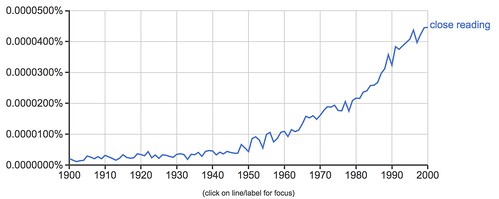
close reading
Figure 1: "Close reading"

And that’s when things became interesting. As more and more critics came to focus on interpretation, the profession became acutely aware of a problem: different critics produced different interpretations, which is the correct interpretation? Some critics even began to wonder whether or not there was such a thing as the correct interpretation. We are now well within the scope of the problem that bothered Haj: How do you justify one interpretation over another?

That’s the issue that was in play when I entered Johns Hopkins as a freshman in 1965. Though I had declared an interest in psychology, once I’d been accepted I gravitated toward literature. Which means that, even as I was working as hard as I could to figure out how to interpret a literary text, I was also party to conversations about the problematic nature of interpretation. As I have written elsewhere about those years at Hopkins [2] there’s no need to recount them here. The important point is simply that literary critics were acutely aware of the problematic nature of interpretation and devoted considerable effort to resolving the problem.

In the course of that problematic thrashing about, literary critics turned to philosophy, mostly Continental (though not entirely), and linguistics, mostly structuralist linguistics. In 1975 Jonathan Culler published Structuralist Poetics, which garnered him speaking invitations all over America and made his career. For Culler, and for American academia, structuralism was mostly French: Saussure, Jakobson (not French, obviously), Greimas, Barthes, and Lévi-Strauss, among others. But Culler also wrote of literary competence, clearly modeled on Chomsky’s notion of linguistic competence, and even deep structure. At this point literary critics, not just Culler, were interested in linguistics.

Here’s a paragraph from Culler’s preface (xiv-xv):
The type of literary study which structuralism helps one to envisage would not be primarily interpretive; it would not offer a method which, when applied to literary works, produced new and hitherto unexpected meanings. Rather than a criticism which discovers or assigns meanings, it would be a poetics which strives to define the conditions of meaning. Granting new attention to the activity of reading, it would attempt to specify how we go about making sense of texts, what are the interpretive operations on which literature itself, as an institution, is based. Just as the speaker of a language has assimilated a complex grammar which enables him to read a series of sounds or letters as a sentence with a meaning, so the reader of literature has acquired, through his encounters with literary works, implicit mastery of various semiotic conventions which enable him to read series of sentences as poems or novels endowed with shape and meaning. The study of literature, as opposed to the perusal and discussion of individual works, would become an attempt to understand the conventions which make literature possible. The major purpose of this book is to show how such a poetics emerges from structuralism, to indicate what it has already achieved, and to sketch what it might become.
However much critics may have been interested in this book, that interest did not produce a flourishing poetics. Even Culler himself abandoned poetics after this book. Interpretation had become firmly established as the profession’s focus.

As for the problem of justifying one interpretation over another, deconstructive critics argued that the meaning of texts was indeterminate and so, ultimately, there is no justification. Reader response critics produced a similar result by different means. The issue was debated into the 1990s and then more or less put on the shelf without having been resolved.

I have no quarrel with that. I think the basic problem is that literary texts of whatever kind – lyric or narrative poetry, drama, prose fiction – are different in kind from the discursive texts written to explicate them. There is no well-formed way of translating meaning from a literary to a discursive text. When you further consider that different critics may have different values, the problem becomes more intractable. Interpretation cannot, in principle, be strongly determined.

What, you might ask, what about the meaning that exists in a reader’s mind prior to any attempt at interpretation? Good question. But how do we get at THAT? It simply is not available for inspection.

What happens, though, when you give up the search for meaning? Or, if not give up, you at least bracket it and subordinate it to an interest in pattern and structure as intrinsic properties of texts? Is a poetics possible? Let’s set that aside for awhile and take a detour though the profession’s treatment of The Bard, William Shakespeare, son of a glover and London actor.

Tuesday, February 14, 2017

Preview: Meaning in Conrad's Heart of Darkness

Here's another draft fragment from my open-letter in progress. This fragment centers on Joseph Conrad's Heart of Darkness.

* * * * *

Now I want to look at a particular example, Joseph Conrad’s Heart of Darkness, which is one of the texts most frequently taught in undergraduate courses. Why? Well, it’s relatively short, 40,000 words, which is a consideration, albeit a minor one. Surely it’s the subject matter – roughly, European imperialism in Africa – and, secondarily, Conrad’s impressionist style. Still, why, why do those things matter?

Let’s look at a short statement by J. Hillis Miller, a senior and very respected literary critic. He is old enough to have gotten his degree at Harvard at a time when, in his view, when few in the English Department there were much good at interpreting texts and his is one in the first generation of deconstructive critics. Shortly after the turn of the millennium the Association of Departments of English honored him for his fifty years in the profession. Of his early days as a faculty member at Johns Hopkins, the 1950s and 1960s, Miller tells us:
English literature was taken for granted as the primary repository of the ethos and the values of United States citizens, even though it was the literature of a foreign country we had defeated almost two hundred years earlier in a war of independence. That little oddness did not seem to occur to anyone. As the primary repository of our national values, English literature from Beowulf on was a good thing to teach. [3]
Which is to say, literature is taught as a vehicle for cultural indoctrination. Of course you know that; you don’t need Hillis Miller to tell you that. But I just wanted to get the idea explicitly on the record along with that little irony about English literature in the United States (Miller had earlier pointed out that, at the time, American literature was marginal in the academy, at least at Hopkins).

Just a bit more about Heart of Darkness, which is a relatively simple story. A pilot, Charles Marlow, needs a gig. He calls on an aunt who gets in an interview with a continental firm, which hires him to pilot a steamer up the Congo River to a trading station that has gone incommunicado. Marlow’s job is make contact with the agent of the Inner Station, named Kurtz, and recover the ivory that Kurtz has, presumably, been accumulating. Marlow is our narrator. Actually, he tells the story to an unnamed third party, who then tells it to us, but we can skip that detail for awhile. That third party presents the bulk of the story to us as Marlow’s own words. Marlow’s steamer is crewed by native Africans and, in addition to personnel from the trading company, there are pilgrims on board.

Marlow is presented as a brilliant and talented man who went to Africa to earn enough money to make him worthy of his Intended; we don’t learn this detail until late in the story, nor are we ever told her name. We’re also led to believe that he has gone mad, setting himself up as a demi-god to the natives and taking a native mistress. As for those natives, it is clear that they have been badly treated by the Europeans.

Whatever else is going on, Heart of Darkness is an indictment of European imperialism in Africa. And yet in 1975 Chinua Achibe, the Nigerian novelist, set off bombshells when he delivered a lecture, “An Image of Africa: Racism in Conrad's Heart of Darkness” [4]. How could Heart of Darkness be racist, people objected, when the text obviously condemns imperialism? Easy, goes the rejoinder, for Conrad deprives Africans of agency, depicts them only as victims, and never has even one of them speak. Now, NOW, we’ve got something to think and talk about. Heart of Darkness may be over a century old, but the issues it embodies are very much alive in this, the 21st century.

Monday, February 13, 2017

Another shout-out to Anthony Bourdain

I've enjoyed both the episode on Tokyo, and that on Detroit, episodes 7 and 8 in season two of Parts Unknown. Tokyo:


Like a lot of non-Japanese, obsessed with Japan, Japanese food and Japanese culture, I've always been amused, occasionally appalled and always befuddled by the more lurid aspects of Japanese fantasy, pop culture and expressions of fetishistic desire. Popular comic books (manga), toys, films, advertisements and entertainments are loaded with images of bondage (shibari), hyper-sexualized school girls, rape, homoeroticism, violation by demons and tentacles – and more (all generally referred to as "hentai"). The honky-tonk Shinjuku district of Tokyo seems to promise galaxies of gratification – for flavors of desire that range from the simply eccentric to the absolutely horrifying. [...]

On one hand, the Japanese seem to have a much more open, nonjudgmental, less puritanical view of sex. Attitudes toward women's roles in the workplace and elsewhere, however, remain largely mired in the long-ago past. Rigorously conventional on one hand, batshit crazy party animals on the other, Japan will always confuse outsiders looking in. Even from close-up. [...]

So in many ways, this show is about fantasy – as much as anything else.

I hope this news will temper, slightly, the reaction of the more easily offended who watch this episode, as it contains images and subject matter of a decidedly "mature" and even offensive nature.

This is a "difficult" show. And I hope it doesn't frighten anyone away from one of the most fascinating and deeply enjoyable places to visit, experience and learn a little about on earth.
Bourdain claims that "it's easily one of the most brilliantly shot and edited episodes we've ever done." I can believe that. My one reservation is that it leaves the impression that manga is mostly about kinky sex. While you can certainly find manga that feature kinky sex, you can find manga about pretty much anything, appropriate for pretty much any audience. Kinky sex is just part of the mix.

Friday, February 10, 2017

Anthony Bourdain on TV (Congo)

A couple of days ago I posted a couple of passages from a New Yorker profile of Anthony Bourdain. I became intrigued, so I've been watching two of his shows that are streaming on Netflix, "A Cook's Tour" (2002-2003), his first I believe, and "Parts Unknown" (2013-present), his current series. I like them. He's created an interesting person, a profane chef-adventurer, and he plays it well.

I was particularly impressed with an episode from the first season of "Parts Unknown." Bourdain visited the Congo, going in from the eastern side through Rwanda, making his way to the Congo River, and taking a boat on it four a couple days.


They make their way to a remote station that had once been a biological research institute:
At the remote Yangambi Research Station, a hundred kilometers downriver, the chief librarian and his clerks also show up to work every day at the powerless library, the showpiece of a once-massive complex of modernist buildings – now without electricity or running water, of course – and do their best to fight the ravages of moisture, mold and age on the thousands of volumes of botanical and agricultural knowledge.

They too are proud and living in some kind of hope. Waiting for something.

The conventional wisdom seems to be that the Congo is "too black and too sad" and certainly too complicated to ever attract the attention of the world, much less television audiences.

Yet it is also magnificently beautiful.

It is – gorgeously – like "going back to the earliest beginnings of the world" and just as gorgeously (if tragically) post-apocalyptic, whole cities, once-grand hotels, lovely buildings, a whole society (albeit a cruel, exclusive and oppressive one) receding into nature.
His voice-over explicitly references Conrad's Heart of Darkness and the soundtrack references Apocalypse Now (not to mention that he "names" the boat after Captain Willard), which, as you know was based on Heard of Darkness. In this episode the food was almost, but not quite, incidental to the adventure (and the commentary implied in that adventure).