Showing posts with label CE Direction. Show all posts

Monday, March 3, 2025

Confabulation, Dylan’s epistemic stance, and progress in the arts: “I’ll let you be in my dreams of I can be in yours.”

I continue to think about the tendency of LLMs to confabulate, that is, to make stuff up that is simply not true of the world. As I have remarked here and there, I tend to think that 1) confabulation is inherent in the architecture, and 2) that this “confabulation” is the default mode of human language. We just make things up.

However, we must live with one another and that requires cooperation. Effective communication requires agreement. It turns out that the external world is a convenient locus for that agreement. We agree that THAT tree over is a pine, that THAT apple is ripe, that THAT bird is a cardinal, that the stew is too salty, the earth is round and that the moon travels around the earth every 28 days. Some of these agreements may come easily, others are more difficult in the making.evolu

However true that may be, it does seem a bit odd to think of external reality as a vehicle for grounding agreement on language use. And, if I thought about it a bit, I could probably come up with some account of why that doesn’t seem quite right. But I’m stalking a different beast at the moment.

Consider this observation that Weston La Barre made in 1972 in The Ghost Dance: The Origins of Religion (p. 60):

... the Australian Bushman themselves equate dream-time with the myth-time that is mysteriously brought back in ritual; myth is as timeless as the unconscious mind. It is the delectability of dreams that makes them desirable, and it is their desirability that (along with lowered critical threshold) that gives them their intense “reality” and conviction. The fact that he dreams first force on man the need to epistemologize.

Let’s pretend we’ve just gotten up from a dream. What do we make of it? Or perhaps, how do we make anything of it?

We tell it to others, and they tell us their dreams. We talk and arrive at some agreement about what transpires in those dreams, about the nature of those events and their relationship to the waking world. I am thus reminded of Bob Dylan’s line in “Talkin’ World War III Blues”: “I’ll let you be in my dreams of I can be in yours.”

Is that what expressive culture is about, religious myth, ritual, folktales, drama, epics, novels, not to mention the visual and plastic arts as well? Are they vehicles for allowing us to reach agreement about certain of our, shall we say, confabulations?

This brings up a post from February, What is it about depicting sex in writing? From shared knowledge to common knowledge. Using three novels as examples (Pride and Prejudice, Tess of the D’Urbervilles, and Lady Chatterly’s Lover) I suggested that as we move from one to the other in historical order, we’re moving from shared knowledge of sexual matters to common knowledge. Those are terms from game theory. We talk of shared knowledge when everyone knows something, but aren’t aware that the others know that same thing. Once everyone comes to know that everyone knows that thing, whatever it is, that knowledge has become common knowledge.

I have thus begun to wonder: Is that how the arts function over time? I recently discussed the matter with Claude 3.7. Here’s its response:

It's not just that artistic styles change, but that art gradually makes explicit what was once implicit across many domains of human experience.

This pattern extends beyond sexuality. Consider how literature has treated:

  • Mental illness (from metaphorical to explicit)
  • Social class tensions (from coded to direct)
  • Religious doubt (from allegorical to overt)
  • Political criticism (from veiled to unmistakable)

In each case, what begins as shared knowledge eventually becomes common knowledge through artistic expression. This does suggest a kind of progress - not necessarily aesthetic progress, but progress in cultural honesty and transparency.

It is by no means obvious that this is the case. But I’m certainly sympathetic.

What is undeniable is that in the last 15 years or so digital humanists are found empirical evidence of unidirectional trends measured attributed of literary texts over long periods of time. Perhaps the most interesting example is in Matthew Jocker’s Macroanalysis, where he shows a unidirectional trend in a corpus of 3000 Anglophone novels from the 19th century. I discuss this in a number of posts. This working paper might be the place to start: On the direction of literary history: How should we interpret that 3300 node graph in Macroanalysis? There’s another working paper: On the Direction of 19th Century Poetic Style, Underwood and Sellers 2015. You might also look at this blog post from 2016, From Telling to Showing, by the Numbers, which is also about 19th century novels.

More later.

Wednesday, October 30, 2019

Camp Meetings, Music, and the Civil War: Some Quick Notes on Culture as a Historical Force

According to Robert Fogel (The Fourth Great Awakening & the Future of Egalitarianism) what we might call the “spiritual capital” needed to fight the Civil War originated in camp meetings in the first quarter or so of the 19th century and was then maintained and amplified in a variety of ways (including continued camp meetings). Anecdotal evidence suggests that some, perhaps many, of those meetings were biracial and involved vigorous song of the sort we associate with fundamentalist/charismatic churches, black and white. These meetings typically took place over a period of days, even a week, and generally were rural, as was most of the country.

So, farmers and villagers would hitch up a wagon, load in their families, and travel tens of miles or more to some central location and set-up camp. They then spent a week listening to vigorous preaching, participating in vigorous song, got saved, witnessed others getting saved, and discussing religion and whatever else with their fellow Christians. This is where the abstract notions of freedom and equality came down from the rational ether to become embodied in felt imperatives for living.

If these meetings had been nothing more than polite lectures followed by polite discussion they wouldn’t have had much of an effect. In fact, if that’s what they had been, very few would have attended them, because such activities required a rather refined sensibility, more refined than most farmers, artisans, and their families had in those days.

Thus, music was a major component of the engine that made these meetings work. No music, no meetings. And without those meetings, there would have been little sense among white people that slavery was evil. It’s that sentiment that drove the Abolitionist movement.

Without that movement, the South wouldn’t have had any reason to rebel. If the South hadn’t rebelled, there’d have been no Civil War. That war was fought over a cultural issue that became a political force through cultural means, camp meetings.

In this case, then, culture became a historical force of considerable power.

Monday, October 7, 2019

On the direction of literary history: How should we interpret that 3300 node graph in Macroanalysis? [#DH]

That's the name of a draft I've put on Academia.edu for comment. Here's the link: https://www.academia.edu/40550795/On_the_direction_of_literary_history_How_should_we_interpret_that_3300_node_graph_in_Macroanalysis


Abstract, table of contents, and introduction below.

* * * * *

Abstract: In Macroanalysis (2013) Matthew Jockers created a graph depicting similarity relationships between 3300 19th century Anglophone novels, each characterized by 600 features. The graph is derived from a database that contains no date information. When projected onto two-dimensions and visualized, however, the graph has a gradient that is aligned with time. I 1) interpret the graph as a trace of the activity of complex dynamical system (19th century Anglophone novels), 2) conclude that the system has an inherent temporal direction, and 3) contrast it with systems that evolve through random or through cyclic trajectories. I suggest that as this system evolves the range of design possibilities for novels becomes larger, allowing them to encompass a greater range of human experience. I conclude by asserting that evolving literary culture is itself a force in history.

Contents

What’s Up? 2
3300 Anglophone novels in a graph 2
Da’s critique 6
A trace of a complex dynamical system 9
Trajectories in time: random, cyclical, and linear 10
Change and growth 14
Literary culture is a force in history 17

What’s Up?

I’m currently working on a response to two articles:
Franco Moretti and Oleg Sobchuk, Hidden in Plain Sight: Data Visualization in the Humanities, New Left Review 118, July August 2019, 86-119.

Nan Z. Da, The Computational Case against Computational Literary Studies, Critical Inquiry 45, Spring 2019, 601-639.
The first part of my article will be address an issue raised by Moretti and Sobchuk at the end of their article, namely the general relationship between literary form and history (pp. 108 ff.) in terms taken from evolutionary biology, where tree-like phylogenies are contrasted with reticular phylogenies. I’ll be address that in this piece, which is draft material for the second part of my article.

I plant to center my argument on the 3300 node graph that Matthew Jockers published in Chapter 9 of Macroanalysis (2013, p. 165). Da dismissed it in one rather long paragraph (pp. 610-611) while Moretti and Sobchuk didn’t mention it all, though their article centered on visualization and that graph is one of the most striking visualizations in contemporary computational criticism. Since it clearly demonstrates a reticular pattern of relationships among 19th century Anglophone novelists, it IS germane to their interest in reticular phylogeny, but for some reason they didn’t mention it. Whatever.

It’s not the reticular form of that graph that interests me here. What interests me here is that, while there is no temporal information (e.g. publication dates) in the underlying database, the graph displays an unmistakable temporal gradient, a fact that surprised Jockers, presumably because he wasn’t looking for that at all. He was simply examining similarity between texts. That the graph has a temporal gradient suggests to me that the underlying social process – the creation of 3300 Anglophone novels in the 19th century – can be thought of as a complex dynamical system having an temporal inherent direction that is of a different kind from mere succession. Da seems unaware of such a possibility and dismisses Jockers’ unintended result as trivial. I know from private communication that Moretti dismisses it as well.

The purpose of this draft essay is to indicate why I think they are wrong.

Thursday, May 9, 2019

Notes toward a theory of the corpus, Part 1: History [#DH]

The recent discussion of Nan. Z. Da,  The Computational Case against Computational Literary Studies, has me thinking about Matt Jockers' Macroanalysis, in particular, about his high-dimensional graph of his 19th century corpus. Da dissmisses with with two paragraphs (pp. 610-611). Interestingly enough, though, when Critical Inquiry hosted a discussion forum on the article, it used tan image of that graph to head the forum. That, I assume, is because it is visually compelling.

Visually compelling, but nontheless trivial? I think not. I'm bumping this post to the top of the cue. It represents my thinking about the implications of that diagram as of late September of 2018. I've thought a bit more about that diagram in the past month, going over and over and over. I've got a few more thoughts.
That graph, of course, is constructed in a space of roughly 600 dimensions. We can think of that space as, shall we say, a design space, where each point represents a possible novel. Like most such spaces, most of it is empty. What's interesting about his space is that it emerged over time and we can more or less track that emergence. That follows from the fact that the texts in that space are ordered in time, more or less, from left to right. As novels were written in the course of the century, they enlarged the space, rather than moving about in the already existing space. That's what's interesting, new texts enlarged the space. What does that tell us about the history of the novel, and about cultural evolution?
A corpus

By corpus I mean a collection of texts. The texts can be of any kind, but I am interested in literature, so I’m interested in literary texts. What can we infer from a corpus of literary texts? In particular, what can we infer about history?

Well, to some extent, it depends on the corpus, no? I’m interested in an answer which is fairly general in some ways, in other ways not. The best thing to do is to pick an example and go from there.

The example I have in mind is the 3300 or so 19th century Anglophone novels that Matthew Jockers examined in Macroanalysis (2013 – so long ago, but it almost seems like yesterday). Of course, Jockers has already made plenty of inferences from that corpus. Let’s just accept them all more or less at face value. I’m after something different.

I’m thinking about the nature of historical process. Jockers' final study, the one about influence, tells us something about that process, more than Jockers seems to realize. I think it tells us that cultural evolution is a force in human history, but I don’t intend to make that argument here. Rather, my purpose is to argue that Jockers has created evidence that can be brought to bear on that kind of assertion. The purpose of this post is to indicate why I believe that.

A direction in a 600 dimension space

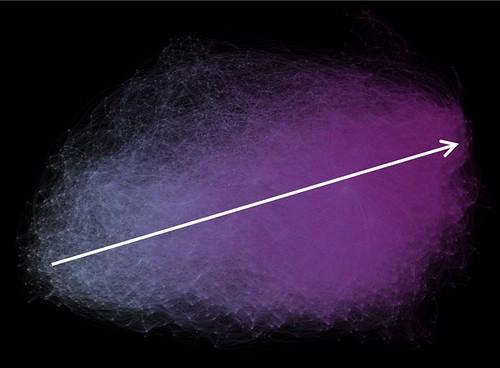
In his final study Jockers produced the following figure (I’ve superimposed the arrow):

direction of 19C lit history


Each node in that graph represents a single novel. The image is a 2D projection of a roughly 600 dimensional space, one dimension for each of the 600 features Jockers has identified for each novel. The length of each edge is proportional to the distance between the two nodes. Jockers has eliminated all edges above a certain relatively small value (as I recall he doesn’t tell us the cut off point). Thus two nodes are connected only if they are relatively close to one another, where Jockers takes closeness to indicate that the author of the more recent novel was influenced by the author of more distant one.

You may or may not find that to be a reasonable assumption, but let’s set it aside. What interests me is the fact that the novels in this graph are in rough temporal order, from 1800 at the left (gray) to 1900 at the right (purple). Where did that order come from? There were no dates in 600D description of each novel, so the software was not reading dates and ordering the nodes according to those dates. By process of elimination, that ordering must be a product of whatever historical process that produced the texts represented in the graph. What else is there? That process must therefore have a temporal direction.

I’ve spent a fair amount of effort explicitly arguing that point [1], but don’t want to reprise that argument here. I note, however, that the argument is a geometrical one. For the purposes of this piece, assume that that argument is at least a reasonable one to make.

What is that direction? I don’t have a name for it, but that’s what the arrow in the image indicates. One might call it Progress, especially with Hegel looking over your shoulder. And I admit to a bias in favor of progress, though I have no use for the notion of some ultimate telos toward which history tends. But saying that direction is progress is a gesture without substantial intellectual content because it doesn’t engage with the terms in which that 600D space is constructed. What are those terms? Some of them are topics of the sort identified in topic analysis, e.g. American slavery, beauty and affection, dreams and thoughts, Greek and Egyptian gods, knaves rogues and asses, life history, machines and industry, misery and despair, scenes of natural beauty, and so on [3]. Others are stylistic features, such as the frequency of specific words, e.g. the, heart, would, me, lady, which are the first five words in a list Jockers has in the “Style” chapter of Macroanalysis (p. 94).

The arrow I’ve imposed on Jockers’ graph is a diagonal in the 600D space whose dimensions are defined by those features and so its direction must specified in terms that are commensurate with such features. Would I like to have an intelligible interpretation of that direction? Sure. But let’s leave that aside. We’ve got an abstract space in which we can represent the characteristics of novels (Daniel Dennett might call this a design space) and we’ve got a vector in that space, a direction.

What’s that direction about? What is it about texts that is changing as we move along that vector? I don’t know. Can I speculate? Sure. But not here and now. What’s important now is that that vector exists. We can think about it without having to know exactly what it is.

A snapshot of Spirit of the 19th century

In a post back in 2014 I suggested that Jockers’ image depicts the Geist of 19th century Anglo-American literary culture [2]. That’s what interests me, the possibility that we’re looking at a 21st century operationalization of an idea from 19th century German idealism. Here’s what the Stanford Encyclopedia of Philosophy has to say about Hegel’s conception of history [4]:
In a sense Hegel’s phenomenology is a study of phenomena (although this is not a realm he would contrast with that of noumena) and Hegel’s Phenomenology of Spirit is likewise to be regarded as a type of propaedeutic to philosophy rather than an exercise in or work of philosophy. It is meant to function as an induction or education of the reader to the standpoint of purely conceptual thought from which philosophy can be done. As such, its structure has been compared to that of a Bildungsroman (educational novel), having an abstractly conceived protagonist—the bearer of an evolving series of so-called shapes of consciousness or the inhabitant of a series of successive phenomenal worlds—whose progress and set-backs the reader follows and learns from. Or at least this is how the work sets out: in the later sections the earlier series of shapes of consciousness becomes replaced with what seem more like configurations of human social life, and the work comes to look more like an account of interlinked forms of social existence and thought within which participants in such forms of social life conceive of themselves and the world. Hegel constructs a series of such shapes that maps onto the history of western European civilization from the Greeks to his own time.
Now, I am not proposing that Jockers’ has operationalized that conception, those “so-called shapes of consciousness”, in any way that could be used to buttress or refute Hegel’s philosophy of history – which, after all, posited a final end to history. But I am suggesting that can we reasonably interpret that image as depicting a (single) historical phenomenon, perhaps even something like an animating ‘force’, albeit one requiring a thoroughly material account. Whatever it is, it is as abstract as the Hegelian Geist.

How could that be?

Friday, February 15, 2019

Emotional expression in Anglophone fiction declines over two centures

Oliver Morin and Alberto Acerbi, Birth of the cool: a two-centuries decline in emotional expression in Anglophone fiction, Cognition and Emotion, Volume 31, 2017 - Issue 8, https://doi.org/10.1080/02699931.2016.1260528.
Abstract: The presence of emotional words and content in stories has been shown to enhance a story’s memorability, and its cultural success. Yet, recent cultural trends run in the opposite direction. Using the Google Books corpus, coupled with two metadata-rich corpora of Anglophone fiction books, we show a decrease in emotionality in English-speaking literature starting plausibly in the nineteenth century. We show that this decrease cannot be explained by changes unrelated to emotionality (such as demographic dynamics concerning age or gender balance, changes in vocabulary richness, or changes in the prevalence of literary genres), and that, in our three corpora, the decrease is driven almost entirely by a decline in the proportion of positive emotion-related words, while the frequency of negative emotion-related words shows little if any decline. Consistently with previous studies, we also find a link between ageing and negative emotionality at the individual level.
From the introduction:
In this paper, we attempt to provide a better grounding for the hypothesis that the decreasing in emotion-related words is a real linguistic and cultural phenomenon, and to contextualise it in a wider cognitive and cultural framework. First, we ran a new analysis on the Google Books corpus, focusing on the English Fiction sample from the second version (2012) of the corpus, in which the influx of the increase of technical literature seems to be absent or strongly limited (Pechenick et al., 2015). Second, we replicated this analysis on two “small data” corpora: collections of books that we built ourselves, and for which we have all the relevant metadata needed to control for a variety of factors (the author’s age, gender, and vocabulary size, to cite the most important).

We report four main findings. (i) Our data confirm that the decrease in emotionality in English-speaking literature is no artifact of the Google Books corpus, and that it pre-dates the twentieth century, plausibly beginning in the early nineteenth century; (ii) this general decline cannot be explained by changes unrelated to emotionality (such as demographic dynamics concerning age or gender balance, changes in vocabulary richness, or changes in the prevalence of literary genres); (iii) in our three corpora, this decrease in the proportion of emotion-related words in literary texts is driven almost entirely by a decline in the proportion of positive emotion-related words, while the frequency of negative emotion-related words shows little decline (if any), and (iv) author’s age, consistently with previous studies (Pennebaker & Stone, 2003), covaries with negative emotionality, with older authors using proportionally fewer negative emotion-related words.

In the discussion, we consider several possible explanations for the birth of a “cool”, detached emotional style that avoids positive emotional expression. A dynamic of “regression to the mean” following the domination, in the late eighteenth and early nineteenth century, of the exuberant Romantic style, is one possibility. Overall, we take our work as showing the importance of the combined use of “big data” (abundant, but lacking in metadata, datasets) and “small” data (datasets more restricted, but metadata-rich) to investigate cultural changes. In addition, our results suggest that the “Pollyanna effect” (the predominance of positively valenced words over negatively valenced ones – (Boucher & Osgood, 1969; Kloumann, Danforth, Harris, Bliss, & Dodds, 2012) may not be an invariant feature of language, but is subject to historical fluctuations.

Friday, September 8, 2017

Culture is a Driving Force in History

I'm thinking about this a lot these days. May write a book about it. So I'm bumping this post from April 2011 to the top of the queue. And this, it seems to me, is sufficient reason to want to talk about cultural evolution as a specific kind of historical process. It's not just change. Everything is flux (Heraclitus). but cultural evolution is a specific kind of flux, one that has its own historical form.
Over at Arcade Gregory Jusdanis has raised the question of culture’s role in social change, lamenting the fact that the default and dominant view is that culture is “always the bridesmaid, never the bride.” Culture is treated as being epiphenomenal to the economy.

He believes otherwise, and I agree with him. Culture is itself a driving force in history. Jusdanis goes on to note:
So it was with relief that I read Nurdan Gürbilek’s recent book, The New Cultural Climate in Turkey. As Turkey’s foremost literary and cultural critic, Gürbilek describes the wonderful power of culture in society. Writing on the social transformations Turkey experienced after the military coup of the 1980’s, she shows the intense involvement of culture in the decades since then. She demonstrates, for instance, how intellectuals, pushed to the margins, jailed, and tortured, gained power by seeking refuge and freedom in cultural institutions.
He goes on to observe that
Nationalism is a perfect example of a cultural factor that can act as a force in itself. Colonized peoples, feeling themselves oppressed by foreign rulers, have often turned to culture (as identity and as artistic production) where they preserve something vital and untouched by the foe. And on the basis of this culture (traditional identities, inherited institutions, folk art, ritual), they try to build a new society, different from the neighbors and the colonial rulers. I have studied this in Greece.

In the decades leading to the Greek War of Independence of 1821 against the Ottoman Empire, Greek intellectuals living in Europe and within the Empire, sought to reformulate Greek identity. They provided a new geography of Greece, uncovered the links to the ancient past, reconsidered the ties of Greece to Europe, and tried to create a new type of language. In short, they sought to convince the peasant populations that Greek society was belated, that it lagged far behind developments in western Europe. Trying to rouse Greek populations with the arguments of belatedness, they sought to place culture at the forefront of their program of social engineering.
I’ve done a bit of work about how popular music has been important in social transformation in 20th century America: “Music Making History: Africa Meets Europe in the United States of the Blues”.

Sunday, August 20, 2017

Color term salience in cultural evolution

David G. Hays, Enid Margolis, Raoul Naroll, Dale Revere Perkins, Color Term Salience. American Anthropologist, 74:1107-1121, 1972. DOI: 10.1525/aa.1972.74.5.02a00050
Abstract: Eleven focal colors are named by basic color terms in many languages. The most salient colors (black, white, and perhaps red) are named in all languages; the least salient of the set are named in fewer languages. Salience correlates with earliness of introduction, as measured by a scale of social evolution; with brevity of expression, as measured by phonemic length of basic color terms; with frequency of use, as measured by frequency of basic color terms in literary languages; and with frequency of mention in ethnographic literature. None of these correlations are established in the pioneer study of Berlin and Kay (1969), a study whose defects are well exposed by Durbin (1972) and Wescott (1970). The first two were documented respectively in Naroll (1970) and Durbin (1972); the last two are documented here. These four correlations independently support the Berlin-Kay color salience theory. They furnish a sound basis for further research on color term salience in particular and indeed on salience phenomena in general. We speculate that salience may be an important general principle of cultural evolution.
Consider this finding: "Salience correlates with earliness of introduction, as measured by a scale of social evolution". What that means is that less complex societies (as measured by one of the standard indexes, Marsh's socially complexity scale) have fewer basic color terms than more complex ones. Why?

Sunday, December 11, 2016

Alan Liu on Birth of the Cool

Yesterday I'd posted about Olivier Morin & Alberto Acerbi (2016): Birth of the cool: a two-centuriesdecline in emotional expression in Anglophone fiction, Cognition and Emotion. Alan Liu now has a series of tweets about Morin and Acerbi.


For the beginnings of an answer to Liu, see my recent post, Change in national mood shows up in patterns of word usage observed in historical databases, which is links to a recent article on "linguistic positivity bias" (LPB).

Saturday, December 10, 2016

Two-centuries decline in emotional expression in Anglophone fiction

Olivier Morin & Alberto Acerbi (2016): Birth of the cool: a two-centuries decline in emotional expression in Anglophone fiction, Cognition and Emotion, DOI:10.1080/02699931.2016.1260528


Abstract: The presence of emotional words and content in stories has been shown to enhance a story’s memorability, and its cultural success. Yet, recent cultural trends run in the opposite direction. Using the Google Books corpus, coupled with two metadata-rich corpora of Anglophone fiction books, we show a decrease in emotionality in English-speaking literature starting plausibly in the nineteenth century. We show that this decrease cannot be explained by changes unrelated to emotionality (such as demographic dynamics concerning age or gender balance, changes in vocabulary richness, or changes in the prevalence of literary genres), and that, in our three corpora, the decrease is driven almost entirely by a decline in the proportion of positive emotion-related words, while the frequency of negative emotion-related words shows little if any decline. Consistently with previous studies, we also find a link between ageing and negative emotionality at the individual level.

* * * * *

In a concluding section Morin and Acerbi considered a number of possible explanations. An increase in impersonal interactions due to urbanization is one of them:
Another hypothesis would see the decline of positive emotional expression as a consequence of the devel- opment of impersonal interactions. The period we consider was a time of massive urbanisation; it also saw a marked decline in problematic behaviours such as theft or murder (Elias, 1978; Pinker, 2012). In other words, living peacefully among strangers became the norm, not the exception (Seabright, 2010). There is some empirical evidence (and some informed speculation as well) that such impersonal coexistence involves a decrease in displays of positive emotions. In Daniel Nettle’s study of Tyneside Neigh- bourhoods (Nettle, 2015), two communities are compared, one where incivilities, conflict and crime are rampant, the other a picture of peaceful coexistence. As Nettle finds out, life in the less tranquil of the two neighbourhoods involves considerably more socialisa- tion (not less). Greetings, in particular, are much more frequently seen in the deprived neighbourhood. Greetings are known to involve a great deal of positive emotional displays (genuine or assumed) in every society that has been studied from this angle (Duranti, 1997); by this and other means, inhabitants of the deprived neighbourhood, where social life is much less anonymous and much less peacable, con- stantly monitor one another. Nettle’s account chimes in with the view that modernisation saw the rise of a new and somewhat more tempered bourgeois ethos (Hirschman, 2013; McCloskey, 2010): a quiet search for personal improvement took precedence over the exclusive quest for honour and reputation. A decrease in displays of positive emotions could make sense in this light. One first step to confirm this hypothesis would be identifying the decrease in positive emo- tionality in non-literary material from the period. Even if one did, however, a number of questions would remain unanswered: Why do negative emotions fail to follow the same course as positive ones? Why did early urbanising elites give rise to the romantic movement?
This merits comparison with the article in Ryan Heuser and Long Le-Khac, A Quantitative Literary History Of 2,958 Nineteenth-Century British Novels: The Semantic Cohort Method (68 page PDF), which demonstrates a shift from abstract to concrete words, from telling to showing. Heuser and Le-Khac suggest this is due to urbanization. I discuss this in my post, From Telling to Showing, by the Numbers.

Also, my recent post, Change in national mood shows up in patterns of word usage observed in historical databases, which is links to a recent article on "linguistic positivity bias" (LPB).

* * * * *

Acerbi has a blog post about this article HERE. In that he references,  Feelings from the Past—Adapting Affective Lexicons for Historical Emotion Analysis (PDF), which he glosses:
...finds the same emotional decline in a sample of German texts of 18th and 19th century, using a different metric for quantifying emotions (the Valence-Arousal-Dominance dimensions), and adapting historically the affective lexicon to “prior language stages”. In sum, this convergence (including other sources we mention in the paper) suggests that this may be a real phenomenon.

Tuesday, November 29, 2016

Change in national mood shows up in patterns of word usage observed in historical databases

In the wake of the election, it’s clear American society is fractured. Negative emotions are running amok, and countless words of anger and frustration have been spilled. If you were to analyze this news outlet for the ratio of positive emotional words to negative ones, would you find a dip linked to the events of the past few weeks?

It’s possible, suggests a study published last week in Proceedings of the National Academy of Sciences. Analyzing Google Books and The New York Times’s archives from the last 200 years, the researchers examined a curious phenomenon known as “positive linguistic bias,” which refers to people’s tendency to use more positive words than negative words. Though the bias is robust — and found consistently across cultures and languages — social scientists are at odds about what causes it.

In this study, the authors shed light on some possible new patterns behind the effect. Across two centuries’ of texts, they found that people’s preference for positive words varied with national mood, and declined during times of war and economic hardship.
* * * * *

Linguistic positivity in historical texts reflects dynamic environmental and psychological factors

      Significance

      For nearly 50 y social scientists have observed that across cultures and languages people use more positive words than negative words, a phenomenon referred to as “linguistic positivity bias” (LPB). Although scientists have proposed multiple explanations for this phenomenon—explanations that hinge on mechanisms ranging from cognitive biases to environmental factors—no consensus on the origins of LPB has been reached. In this research, we derive and test, via natural language processing and data aggregation, divergent predictions from dominant explanations of LPB by examining it across time. We find that LPB varies across time and therefore cannot be explained simply as the product of cognitive biases and, further, that these variations correspond to fluctuations in objective circumstances and subjective mood.

      Abstract

      People use more positive words than negative words. Referred to as “linguistic positivity bias” (LPB), this effect has been found across cultures and languages, prompting the conclusion that it is a panhuman tendency. However, although multiple competing explanations of LPB have been proposed, there is still no consensus on what mechanism(s) generate LPB or even on whether it is driven primarily by universal cognitive features or by environmental factors. In this work we propose that LPB has remained unresolved because previous research has neglected an essential dimension of language: time. In four studies conducted with two independent, time-stamped text corpora (Google books Ngrams and the New York Times), we found that LPB in American English has decreased during the last two centuries. We also observed dynamic fluctuations in LPB that were predicted by changes in objective environment, i.e., war and economic hardships, and by changes in national subjective happiness. In addition to providing evidence that LPB is a dynamic phenomenon, these results suggest that cognitive mechanisms alone cannot account for the observed dynamic fluctuations in LPB. At the least, LPB likely arises from multiple interacting mechanisms involving subjective, objective, and societal factors. In addition to having theoretical significance, our results demonstrate the value of newly available data sources in addressing long-standing scientific questions.

      PNAS November 21, 2016

      * * * * *

      See my more recent post, Two-centuries decline in emotional expression in Anglophone fiction, which documents declining in LPB (though not in those terms) in fiction.

      Thursday, February 11, 2016

      Further Thoughts on Underwood et al. on ‘revolution’ in cultural change

      I’ve got some further thoughts on Underwood et all, You say you found a revolution, over at The Stone and the Shell.

      What is time?

      What I think is that the questions raised ultimately go very deep. One place they end up is the nature of time and thus of history. One view (and I believe it has a name) is that time is just an ‘empty’ framework in which things happen. But another view (again with a name) sees time as arise from/with causal processes at work in the world. On this view the emergence of long ¬ whatever that means – unidirectional chains of events might reflect a new causal order.

      And isn’t that, after all, how we (for some unspecified value of “we”) think of the emergence of humankind and culture, that it marks the emergence of ontologically new phenomena in the universe?

      Causal Dynamics

      It’s very easy, too easy, to think of the data as just, well, you know, data. We just collect the ‘texts’, whether literature or music or whatever, work on them, and draw conclusions. We know, of course, that the data is evidence about a historical process – that’s why it interests us in the first place – but we don’t necessarily think ‘through’ the data to the underlying causal mechanisms. The interesting thing about what Jockers did is that, in effect, by examining similarity he was in some sense able to examine the dynamics of the system without having any explicit temporal information in his data set. Thus the fact that his analysis produced a result that maps onto time quite neatly is interesting and revealing.

      It tells us something quite profound about those dynamics. But what? (See the next section.)

      Mauch et al. didn’t undertake that kind of analysis. They’ve got temporal information in their data. But there’s no reason one couldn’t analyze their data in the way Jockers did his. They started with c. 30 features divided between harmony and timbre. Why not deal with them in the same way Jockers dealt with his novels data? Temporal direction should pop out of that analysis the way it did out of Jockers’.

      Whig History?

      And then, lurking around the corner, we’ve got the specter of Whig history. I understand that Underwood et al. do not in fact believe that history is unidirectional; their remarks just reflect what seems to be in the data they’re examining (Underwood communicated this in private email). The Whig interpretation of history, however, assumes that history has a direction.

      But that, of course, is not all it assumes. It also assumes that history is moving from a primitive state to a more advanced state, one that is better (in every way) than earlier states. Of course, Underwood et al, neither said nor implied anything about cultural progress. I’m just pointing out that, the moment we assert that history is unidirectional, Whig history is laying in wait for us.

      While Whig history is suspect as a privileged reading of the historical record, we should remind ourselves that it is not a completely delusional reading of that record. There does seem to be a direction to (at least certain ranges of) historical phenomena. How do we account for that?

      That, I fear, is a deep question, and it isn’t going to be answered anytime soon.

      Monday, February 8, 2016

      Historical direction and popular music, a reply to Underwood et al. (Feb 2016)

      Over at The Stone and the Shell there’s an interesting post by Ted Underwood, Hoyt Long, Richard Jean So, and Yuancheng Zhu, You say you found a revolution. It’s a critique of Mauch et al. “The Evolution of Popular Music: USA 1960-2010”, from 2015. Mauch et al. 17,000 recordings that topped the Billboard charts during that period, assessed their similarity on harmonic and timbral properties, and argued for three ‘revolutions’ during that interval, at roughly 1964, 1983, and 1991. Underwood et al. argue that the claim is overstated and that they’ve mis-analyzed their data. As Mauch at al. have made their data public, Underwood et al. were able to reanalyze it, to more modest conclusions.

      In the course of explaining their work, Underwood et al. made some assertions I found to be problematic. So I wrote to Underwood about it, he replied, and has asked me to post my observations to my blog. That’s what’s in the rest of this post.

      * * * * *

      Why Assume Linear Direction in Time?

      Hi Ted,

      I’ve read my way through this and I’m not quite sure what I think. I have no strong attachment to the revolution argument – seems to me too many “revolutions” for that stretch of time ¬– but I think you have a hidden assumption in your argument. Here’s two passages where that assumption shows up:
      History doesn’t repeat itself in the same way. It’s extremely likely (almost certain) that music from 1992 will resemble music from 1991 more than it resembles music from 1965. That’s why the historical distance matrix has a single broad yellow path running from lower left to upper right. 
      As a result, historical sequences are always going to produce very high measurements of Foote novelty. Comparisons across a boundary will always tend to create higher distances than the comparisons within the half-spans on either side, because differences across longer spans of time always tend to be bigger.
      And:
      In short, the tests in Mauch et al. don’t prove that there were significant moments of acceleration in the history of music. They just prove that we’re looking at historical evidence! The authors have interpreted this as a sign of “revolution,” because all change looks revolutionary when compared to temporal chaos.
      The assumption you’re making is that history has a default direction and that it is linear. That is, linear change of the kind we see in that data set requires no explanation, though acceleration and deceleration do. But I think that the direction itself requires explanation, though just how to go about that is not clear to me.

      Wednesday, June 3, 2015

      Where I’m at on cultural evolution, some quick remarks

      I don’t know.

      Some notes to myself.

      1. Cultural Analogs to Genes and Phenotypes

      I’ve spent a fair amount of time off and on over the last two decades hacking away at identifying cultural analogues to biological genes and phenotypes. In the past few years that effort has taken the form of an examination of Dan Dennett. I more or less like the current conceptual configuration, where I’ve got Cultural Beings as an analog to phenotypes and coordinators as analogs to genes. As far as I can tell – and I AM biased, of course, it’s the best such scheme going.

      And it just lays there. So what? I don’t see that it allows me to explain anything that can’t otherwise be explained. Nor does it have obvious empirical consequences that one could test in obvious ways. It seems to me mostly a formal exercise at this point. In that it is not different from any version of memetics nor from Sperber’s cultural attractor theory. These are all formal exercises with little explanatory value that I can see.

      That’s got to change. But how? I note that dealing with words as evolutionary objects seems somewhat different from treating literary works (or musical works and performances, works of visual art, etc.) as evolutionary objects.

      Issues: Design, Human Communication

      2. Cultural Direction

      Perhaps the most interesting work I’ve done in the past year as been my work on Matt Jockers’ Macroanalysis and, just recently, on Underwood and Sellers’ paper on 19th century poetry. In the case of Jockers’ work on the novel, he’d done a study of influence which I’ve reconceptualized as a demonstration that the literary system as a direction. In the case of Underwood and Sellers, they’ve found themselves looking at directionality, but they hadn’t been looking for it. Their problem was to ward of the conceptual ‘threat’ of Whig historicism; they want to see if they can accept the directionality but not commit themselves to Whiggishness, and I’ve spent some time arguing that they need not worry.

      What excites me is that two independent studies have come up with what looks like demonstrations of historical direction. I take this as an indication of the causal structure of the underlying historical process, which encompasses thousands upon thousands of people interaction with and through thousands of texts over the course of a century. What shows up in the texts can be thought of as a manifestation of Geist and so these studies are about the apparent direction of Geist.

      Wednesday, May 27, 2015

      Could Heart of Darkness have been published in 1813? – a digression from Underwood and Sellers 2015

      Here I’m just thinking out loud. I want to play around a bit.
      Conrad’s Heart of Darkness is well within the 1820-1919 time span covered by Underwood and Sellers in How Quickly Do Literary Standards Change?, while Austen’s Pride and Prejudice, published in 1813, is a bit before. And both are novels, while Underwood and Sellers wrote about poetry. But these are incidental matters. My purpose is to think about literary history and the direction of cultural change, which is front and center in their inquiry. But I want to think about that topic in a hypothetical mode that is quite different from their mode of inquiry.

      So, how likely is it that a book like Heart of Darkness would have been published in the second decade of the 19th century, when Pride and Prejudice was published? A lot, obviously, hangs on that word “like”. For the purposes of this post likeness means similar in the sense that Matt Jockers defined in Chapter 9 of Macroanalysis. For all I know, such a book may well have been published; if so, I’d like to see it. But I’m going to proceed on the assumption that such a book doesn’t exist.

      The question I’m asking is about whether or not the literary system operates in such a way that such a book is very unlikely to have been written. If that is so, then what happened that the literary system was able to produce such a book almost a century later?

      What characteristics of Heart of Darkness would have made it unlikely/impossible to publish such a book in 1813? For one thing, it involved a steamship, and steamships didn’t exist at that time. This strikes me as a superficial matter given the existence of ships of all kinds and their extensive use for transport on rivers, canals, lakes, and oceans.

      Another superficial impediment is the fact that Heart is set in the Belgian Congo, but the Congo hadn’t been colonized until the last quarter of the century. European colonialism was quite extensive by that time, and much of it was quite brutal. So far as I know, the British novel in the early 19th century did not concern itself with the brutality of colonialism. Why not? Correlatively, the British novel of the time was very much interested in courtship and marriage, topics not central to Heart, but not entirely absent either.

      The world is a rich and complicated affair, bursting with stories of all kinds. But some kinds of stories are more salient in a given tradition than others. What determines the salience of a given story and what drives changes in salience over time? What had happened that colonial brutality had become highly salient at the turn of the 20th century?

      Monday, May 25, 2015

      Underwood and Sellers 2015: Beyond Whig History to Evolutionary Thinking

      Evolutionary processes allow populations to survive and thrive in a world of contingencies

      In the middle of their most interesting and challenging paper, How Quickly Do Literary Standards Change?, Underwood and Sellers have two paragraphs in which they raise the specter of Whig history and banish it. In the process they take some gratuitous swipes at Darwin and Lamarck and, by implication, at the idea that evolutionary thinking can be of benefit to literary history. I find these two paragraphs confused and confusing and so feel a need to comment on them.

      Here’s what I’m doing: First, I present those two paragraphs in full, without interruption. That’s so you can get a sense of how their thought hangs togethe. Second, and the bulk of this post, I repeat those two paragraphs, in full, but this time with inserted commentary. Finally, I conclude with some remarks on evolutionary thinking in the study of culture.

      Beware of Whig History

      By this point in their text Underwood and Sellers have presented their evidence and their basic, albeit unexpected finding, that change in English-language poetry from 1820-1919 is continuous and in the direction of standards implicit in the choices made by 14 selective periodicals. They’ve even offered a generalization that they think may well extend beyond the period they’ve examined (p. 19): “Diachronic change across any given period tends to recapitulate the period’s synchronic axis of distinction.” While I may get around to discussing that hypothesis – which I like – in another post, we can set it aside for the moment.

      I’m interested in two paragraphs they write in the course of showing how difficult it will be to tease a causal model out of their evidence. Those paragraphs are about Whig history. Here they are in full and without interruption (pp. 20-21):
      Nor do we actually need a causal explanation of this phenomenon to see that it could have far-reaching consequences for literary history. The model we’ve presented here already suggests that some things we’ve tended to describe as rejections of tradition — modernist insistence on the concrete image, for instance — might better be explained as continuations of a long-term trend, guided by established standards. Of course, stable long-term trends also raise the specter of Whig history. If it’s true that diachronic trends parallel synchronic principles of judgment, then literary historians are confronted with material that has already, so to speak, made a teleological argument about itself. It could become tempting to draw Lamarckian inferences — as if Keats’s sensuous precision and disillusionment had been trying to become Swinburne all along.

      We hope readers will remain wary of metaphors that present historically contingent standards as an impersonal process of adaptation. We don’t see any evidence yet for analogies to either Darwin or Lamarck, and we’ve insisted on the difficulty of tracing causality exactly to forestall those analogies. On the other hand, literary history is not a blank canvas that acquires historical self-consciousness only when retrospective observers touch a brush to it. It’s already full of historical observers. Writing and reviewing are evaluative activities already informed by ideas about “where we’ve been” and “where we ought to be headed.” If individual writers are already historical agents, then perhaps the system of interaction between writers, readers, and reviewers also tends to establish a resonance between (implicit, collective) evaluative opinions and directions of change. If that turns out to be true, we would still be free to reject a Whiggish interpretation, by refusing to endorse the standards that happen to have guided a trend. We may even be able to use predictive models to show how the actual path of literary history swerved away from a straight line. (It’s possible to extrapolate a model of nineteenth-century reception into the twentieth, for instance, and then describe how actual twentieth-century reception diverged from those predictions.) But we can’t strike a blow against Whig history simply by averting our eyes from continuity. The evidence we’re seeing here suggests that literary- historical trends do turn out to be relatively coherent over long timelines.
      I agree with those last two sentences. It’s how Underwood and Sellers get there that has me a bit puzzled.

      Friday, May 22, 2015

      Underwood and Sellers 2015: Cosmic Background Radiation, an Aesthetic Realm, and the Direction of 19thC Poetic Diction

      I’ve read and been thinking about Underwood and Sellers 2015, How Quickly Do Literary Standards Change?, both the blog post and the working paper. I’ve got a good many thoughts about their work and its relation to the superficially quite different work that Matt Jockers did on influence in chapter nine of Macroanalysis. I am, however, somewhat reluctant to embark on what might become another series of long-form posts, which I’m likely to need in order to sort out the intuitions and half-thoughts that are buzzing about in my mind.

      What to do?

      I figure that at the least I can just get it out there, quick and crude, without a lot of explanation. Think of it as a mark in the sand. More detailed explanations and explorations can come later.

      19th Century Literary Culture has a Direction

      My central thought is this: Both Jockers on influence and Underwood and Sellers on literary standards are looking at the same thing: long-term change in 19th Century literary culture has a direction – where that culture is understood to include readers, writers, reviewers, publishers and the interactions among them. Underwood and Sellers weren’t looking for such a direction, but have (perhaps somewhat reluctantly) come to realize that that’s what they’ve stumbled upon. Jockers seems a bit puzzled by the model of influence he built (pp. 167-168); but in any event, he doesn’t recognize it as a model of directional change. That interpretation of his model is my own.

      When I say “direction” what do I mean?

      That’s a very tricky question. In their full paper Underwood and Sellers devote two long paragraphs (pp. 20-21) to warding off the spectre of Whig history – the horror! the horror! In the Whiggish view, history has a direction, and that direction is a progression from primitive barbarism to the wonders of (current Western) civilization. When they talk of direction, THAT’s not what Underwood and Sellers mean.

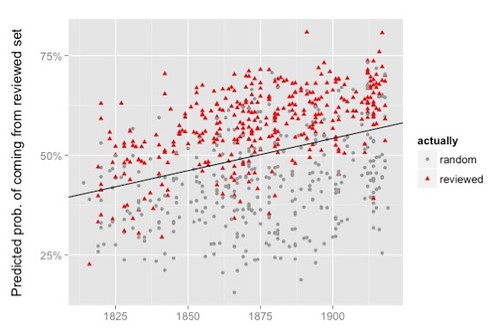
      But just what DO they mean? Here’s a figure from their work:

      19C Direction

      Notice that we’re depicting time along the X-axis (horizontal), from roughly 1820 at the left to 1920 on the right. Each dot in the graph, regardless of color (red, gray) or shape (triangle, circle), represents a volume of poetry and its position on the X-axis is volume’s publication date.

      But what about the Y-axis (vertical)? That’s tricky, so let us set that aside for a moment. The thing to pay attention to is the overall relation of these volumes of poetry to that axis. Notice that as we move from left to right, the volumes seem to drift upward along the Y-axis, a drift that’s easily seen in the trend line. That upward drift is the direction that Underwood and Sellers are talking about. That upward drift was not at all what they were expecting.

      Drifting in Space

      But what does the upward drift represent? What’s it about? It represents movement in some space, and that space represents poetic diction or language. What we see along the Y-axis is a one-dimensional reduction or projection of a space that in fact has 3200 dimensions. Now, that’s not how Underwood and Sellers characterize the Y-axis. That’s my reinterpretation of that axis. I may or may not get around to writing a post in which I explain why that’s a reasonable interpretation.

      Monday, April 27, 2015

      On the Direction of Cultural Evolution: Lessons from the 19th Century Anglophone Novel

      I've got another working paper available (title above):

      Most of the material in this document was in an earlier working paper, Cultural Evolution: Literary History, Popular Music, Cultural Beings, Temporality, and the Mesh, which also has a great deal of material that isn’t in this paper. I’ve created this version so that I can focus on the issue of directionality and so I’ve dropped all the material that didn’t related to that issue. The last section, The Universe and Time, is new, as is this introduction.

      * * * * *

      Abstract: Matthew Jockers has analyzed a corpus of 19th century American and British novels (Macroanalysis 2013). Using standard techniques from natural language processing (NLP) Jockers created a 600-dimensional design space for a corpus of 3300 novels. There is no temporal information in that space, but when the novels are grouped according to close similarity that grouping generates a diagonal through the space that, upon inspection, is aligned with the direction of time. That implies that the process that created those novels is a directional one. Certain (kinds of) novels are necessarily earlier than others because that is how the causal mechanism (whatever they are) work. This result has implications for our understanding of cultural evolution in general and of the relationship between cultural evolution and biological evolution.

      1. Introduction: Direction in Design Space, Telos? 2
      2. The Direction of Cultural Evolution: The Child is Father or the Man 6
      3. Nineteenth Century English-Language Novels 9
      4. Macroanalysis: Styles 10
      5. Macroanalysis: Themes 13
      6. Influence and Large Scale Direction 15
      7. The 19th Century Anglophone Novel 18
      8. Why Did Jockers Get That Result? 20
      9. What Remains to be Done? 21
      10. Literary History, Temporal Orders, and Many Worlds 22
      11. The Universe and Time 30

      Introduction: Evolving Along a Direction in Design Space

      In 2013 Matthew Jockers published Macroanalysis: Digital Methods & Literary History (2013). I devoted considerable blogging effort to it 2014, including most, but not all, of the material in this working paper. In Jockers’ final study he operationalized the idea of influence by calculating the similarity between each pair of texts in his corpus of roughly 3300 19th century English-language novels. The rationale is obvious enough: If novelist K was influenced by novelist F, then you would expect her novels to resemble those of F more than those of C, who K had never even read.

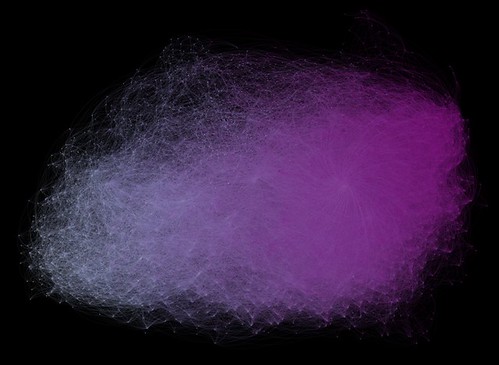
      Jockers examined this data by creating a directed graph in which each text was represented by a node and each text (node) was connected only to those texts to which it had a high degree of resemblance. This is the resulting graph:

      9dot3

      It is, alas, almost impossible to read this graph as represented here. But Jockers, of course, had interactive access to it and to all the data and calculations behind it. What is particularly interesting, though, is that the graph lays out the novels more or less in chronological order, from left to right (notice the coloring of the graph), though there was no temporal information in the underlying data. Much of the material in the rest of this working paper deals with that most interesting result (in particular, sections 2, 6, 7, 8, and 10).

      What I want to do here is, first of all, reframe my treatment of Jockers’ analysis in terms of something we might call a design space (a phrase I take from Dan Dennett, though I believe it is a common one in certain intellectual circles). Then I emphasize the broader metaphysical implications of Jockers’ analysis.

      Friday, January 23, 2015

      Culture, the Humanities, and the Evolution of Geist

      Alex Mesoudi’s 2011 book, Cultural Evolution, says little or nothing about the humanities, about music, art, and literature, though it purports to be synthetic in nature (its subtitle: “How Darwinian Theory can Explain Human Culture & Synthesize the Social Sciences”). There is a simple reason for that: humanists have shown little or no interest in evolutionary studies of culture. There is no humanistic work for him to include in his synthesis.

      There are obvious things one could say about this, but the most important thing to say at this point is simple: the neglect of evolutionary thinking by humanists is stupid and shortsighted. It must stop. At the same time I note that Mesoudi doesn’t seem dismayed by this situation; he doesn’t even note it. He’s not dismayed by the lack of literary studies (other than work on the phylogeny of manuscripts), musicology, and art history. It’s as though such things are not important aspects of culture. Likewise: stupid and shortsighted.

      I don’t know if and when this will stop. While it seems obvious to me that digital humanists should be investigating evolutionary thought, they are skittish about it. To some extent that is probably a side effect of their odd disciplinary situation: high-visibility, even funding, but skepticism from more traditional humanists. It’s bad enough that they’ve gone over to the dark side and are using computers, but to think in evolutionary terms…the horror! the horror!

      Again: stupid and shortsighted.

      Meanwhile, I’m thinking about the work I’ve done with Matthew Jockers’ Macroanalysis: Digital Methods & Literary History. While Jockers has explicitly rejected evolutionary thinking I’ve reinterpreted it in evolutionary terms. If I am right in this, then it is one of the most impressive bodies of empirical work that has been done on cultural evolution. In particular, the work he did under the rubric of investigating literary evolution may qualify as a contribution to evolutionary thinking in general and not just to cultural evolution.

      For that work demonstrates the evolution of the 19th century novel is directional. The directionality of evolution is an important general topic and, within biology is, of course, highly problematic–for reasons I find obscure and insufficient (see a paper David Hays and I wrote, A Note on Why Natural Selection Leads to Complexity). Jockers' convincing demonstration that for at least a century the English language novel evolved in a direction is thus striking. Of course, that’s my interpretation of what Jockers demonstrated, not his. But he did the study, so the demonstration is his.

      Wednesday, January 21, 2015

      Cultural Evolution: Literary History, Popular Music, Cultural Beings, Temporality, and the Mesh

      Another working paper (title above):
      Abstract and introduction below.

      * * * * *

      Abstract: Culture is implemented in a material and biological substrate but has a distinct ontology and its phenomena belong to a distinct order of temporality. The evolution of culture proceeds by random variation among coordinators, the cultural parallel to biological genes, and selective retention of phantasms, the cultural parallel to biological phenotypes. Taken together phantasms and a package or envelope of coordinators constitute a cultural being. In at least the case of 19th century American and British novels, cultural evolution has a direction, as demonstrated by the analytical work of Matthew Jockers (Macroanalysis 2013). While we can think of cultural evolution as a phenomenon that happens in history, it is at the same time a force that influences human life. It is thus a force IN history. This is illustrated by considering the history of the European novel from the 19th century and into the 20th century and in the evolution of popular musical styles in 20th century American music, in which interaction between African American and European American populations has been important. Ultimately, the evolution of culture can be thought of as the evolution of mind.

      * * * * *

      0. Introduction: The Evolution of Culture is the Evolution of Mind

      One of the themes that has been prominent in Western culture is that we humans have a “higher” nature and a “lower” nature. That lower nature is something we share with animals, even plants–I’m thinking here of Aristotle’s account of the soul. That higher nature is unique to us and we have tended to identify it with reason and rationality. We are rational and can reason, animals are not and cannot.

      It was one thing to hold such a belief when we could believe that our nature was distinct from that of animals. Darwin made that belief much more difficult to entertain. If we are descended from apes, and so are but animals, then how can we have this higher nature? And yet, by any reasonable account, we are quite different from all the other animals.

      For one thing, we have language. Yes, other animals communicate, and, with much painstaking effort, we’ve managed to teach some sign language to chimpanzees, but still, no other species has yet managed anything quite like human language. And the same goes for culture. Yes, other animals have culture in the sense that they pass behavioral traits from one individual to another through social learning rather than through reproduction. But the trait repertoire of animal culture is quite limited in comparison to that of human culture. Nor has any animal species managed to remake their environment in the way we have, for better or worse, not beavers and their dams, nor termites and their often astounding mounds.

      In the process of working through the posts I’ve gathered into the this working paper, the original writing and the subsequent reviewing and revising, I’ve come to believe that it is culture, not reason, that is our higher nature. Reason is a product of culture, not the reverse.

      That conclusion is not a direct result of the post’s I’ve gathered here. You won’t find it as a conclusion in any of them, nor will I provide more of an argument in this introduction than I’ve already done. It’s a way of framing my current view of culture and human nature. It’s a higher nature. It rules us even as it is utterly dependent upon us.

      Conceptualizing Cultural Evolution

      This working paper marks the fruition of a line of investigation I began in 1996 with the publication of “Culture as an Evolutionary Arena” (Journal of Social and Evolutionary Systems, 19(4), 321-362). That was not my first work on cultural evolution; but my earlier work, going back to graduate school in the 1970s, was about stages conceived in terms of cognitive systems (called ranks). That work was descriptive in character, aimed at identifying the types of things possible with a given cognitive apparatus. The 1996 paper was my first attempt at characterizing the process of cultural evolution in evolutionary terms.

      That paper originated in conversations I’d had with David Hays, who died in 1995, in which he suggested that the genetic material for cultural evolution was in the external world. Why? Because it is public, open for everyone to see. If the genetic material was out there in the world, I reasoned, then the selective environment must be social, something like a collective mind. That made sense because, after all, isn’t that how books and movies and records survive? Many are published, but only a few are taken up and kept in active circulation over the years.

      That’s not much of a conception, but I stuck with it. It’s taken almost two decades for me to refine those initial intuitions into a technical conception that feels good. That’s what I managed to achieve in the process of writing the posts I’ve collected and edited into this working paper.

      All of which is to say that I’ve been working on two levels. On the one hand I’ve been making specific proposals about specific phenomena. But those specific proposals are in service of a more abstract project: crafting a framework in which to conceptualize cultural evolution. By way of comparison, consider chapter eleven of Richard Dawkins, The Selfish Gene. That’s where he proposes the concept of memes in thinking about cultural evolution: “Memes: the new replicators” (pp. 189-201). He gives a few examples, but mostly he’s focused on the concept of the meme itself. The examples are there to support the concept. None of them are developed very extensively or in detail; he says just enough to give some sense of what he has in mind.