Showing posts with label SSTB. Show all posts

Tuesday, November 21, 2023

The Agni Pariksha segment from Nina Paley's Sita Sings the Blues

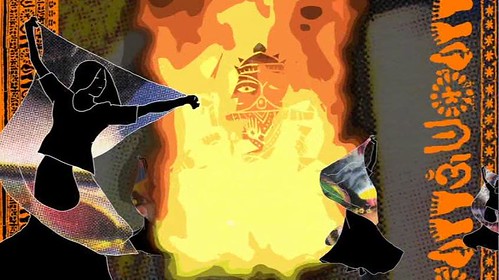
Now that I've just put fire on the table, though a segment from Disney's original animated version of The Jungle Book, I might as well go whole hog. At the center of Nina Paley's Sita Sings the Blues there is an astonishing 3-minute sequence depicting a fire ritual, the Agni Pariksha. Here it is:

I described that sequence in some detail in something I published in 2014, Cultural Evolution: A Vehicle for Cooperative Interaction Between the Sciences and the Humanities. I've also interviewed Nina about that segment, Nina Paley on the Agni Pariksha, where she comments on the segment as we move through it from beginning to end. I've also provided some descriptive information on the sequence.

What follows is an edited version of the presentation in the cultural evolution paper.

* * * * *

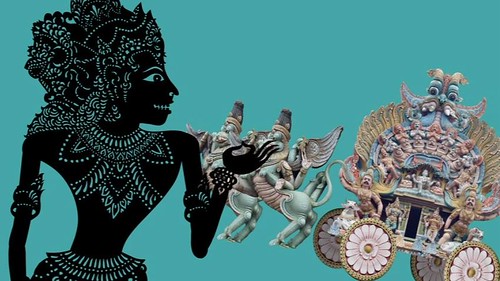
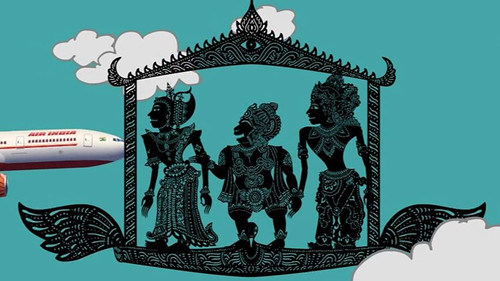
Nina Paley’s animated film, Sita Sings the Blues, revises and retells the story of Rama and Sita from the Ramayana, one of the classic texts of Hinduism. Paley tells Sita’s story in three different ways: 1) in a series of vignettes set to songs recorded by Annette Hanshaw in the 1920s and which is animated in a very “cartoony” style; 2) in a series of scenes based on paintings Paley did in imitation of 18th Century Rajput miniatures and on collages based on what appears to be calendar and greeting-card art, and 3) through voice-over dialogue among three Indian-Americans talking about the Ramayana and realized on-screen as three Indonesian shadow puppets. The multiplicity of this story, its many sources – which I’ve only hinted at in this brief description – is deliberately built-in to the visual and audio texture of the film.

Let's look at the film itself. What does it look like on the screen? How do we describe it? What features are important to the film’s effect, and which are incidental? These are important and difficult questions and I can do no more than indicate what’s entailed.

In particular, I want to examine the Agni Pariksha segment, which is unlike anything other segment in the film. In the Ramayana Sita had to prove her fidelity to Rama in a trial by fire. She throws herself into the flames and is rescued by Agni, the fire deity, thereby establishing her purity.

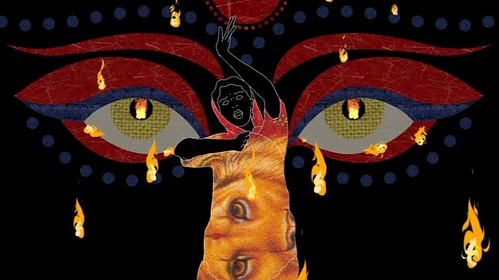
Paley has placed this segment somewhat after the middle of the film at the point immediately after Nina, her alter ego in the film, learns that her husband wants a divorce. On the sound track we hear her heart thumping away while we see it pulsing (a stylized red heart) and finally breaking. At that point Nina screams, the virtual camera zooms into her wide-open mouth, and we’re into the segment, which is basically a solo dance amid flames.
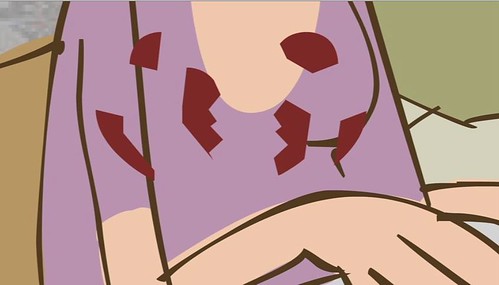
Nina’s broken heart.

The role of Sita is danced by Reena Shah, who voices Sita and who also sings the lyrics, written in Hindi by her mother, Laxmi Shah. This is the only place in the film where we hear Hindi and the only place where we see live action, sort of. Paley videotaped Shah dancing before a green screen and then hand-traced Shah’s movements into the film.

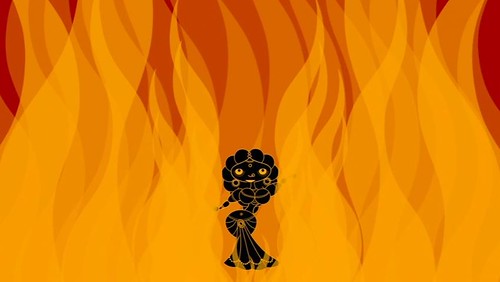
Rather than attempting to describe the entire three-minute segment, which could easily go on and on – “a picture is worth thousand words” and this film packs a lot of them into 180 seconds. Instead, I’ll concentrate on a few frames. The following two frames are from the beginning and the end of the segment, respectively. We see Sita in white outline against a black background, but her hair has some color fill (collaged in) in the ending segment, but not the beginning.
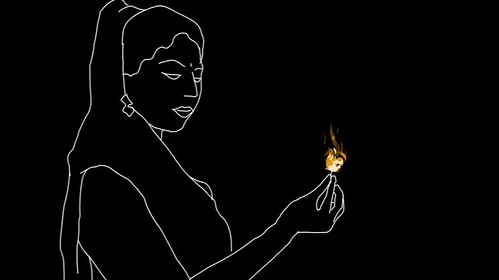
Light the match.
Blowing out the match.

In both frames she is holding lighted match. She lit the match at the opening of the segment and then dropped it, lighting the fire beneath her. At the end she blows the match out, ending the segment. Thus there is a bit of visual continuity between the opening and ending segments. At the same time the final act, in effect, reverses the opening one. The opening act took Sita into the fire; the closing act brings her out of it and back into the world.

Is this a rite de passage? (Of course it is, of course.) For who? Sita, Nina, us? Of what kind, from what to what?

Now consider these three frames, which come one after the other in the film:

Sita dancing, 1, 2, 3

The backgrounds are pretty much the same, which is what you would expect from such closely spaced frames. But look at Sita in the center. Her outline is not quite the same from one frame to the next, for she’s spinning counter-clockwise at a pretty good rate; but her overall visual mass remains in the same position within the frame. The texture filling her form, however, differs radically from one frame to the next. All three body fills are half-tone images magnified to the point where the individual dots are visible, but I can’t make out identity of the material in either the first frame or the third. The second image is the head of a woman.

Paley uses this technique throughout the segment. None of the collage elements is on the screen for more than a fraction of a second. You can identify some of the images, but not most of them. It is obvious that she’s showing lots of different things mostly through Sita’s form, but through other elements of the segment as well.

Now look at Sita in this next frame, to the left. Her outline, in black, is decoupled from the texture-filling forms, one for her hair (yellow-green), one for her body (a warm medium brown) and still others for her eyes. Paley does this for about six seconds. What’s this about?

Form and fill dissociated

If you’ve been reading visual neuroscience you may note that fill and outline are handled in different systems, as is motion. So Paley is “manipulating” those systems, which is interesting. But that doesn’t tell us why she’s doing it? Because she can, and it’s interesting? Certainly, but is that all?

Before I hazard a guess I want to state that the most important thing, at this point, is simply to describe what’s going on. Without that description, nothing else can be done.

So, why’s she doing it? Because it’s different from every other segment in the film, including the two segments that also depict the Agni Pariksha. One of those is set to Annette Hanshaw’s performance of “Mean to Me” while the other is set to her performance of “I’ve Got a Feelin’ I’m Fallin’.” In both of those cases the visual style is Paley’s old-time “cartoony” style, which she uses for all the Hanshaw performances. That is to say, those ritual enactments are not visually different from any other events in the Hanshaw version of the Sita story.

Any anthropologist will tell you that rituals are about transformation (e.g. van Gennup 1960); some literary critics will tell you that as well (e.g. Frye 1965, Barber 1959). By making this segment visually different from anything else in the film Paley is giving the film itself a ritual dimension – though the part of me that is a child of the 60s is thinking “altered state of consciousness” (cf. Fischer 1975). She’s not merely showing a ritual, depicting one in the film; she is inviting us to enact a ritual by experiencing the visual world in a way that is radically different from what we experience anywhere else in the film. This segment of the film IS ritual.

Now, if we wish, we can begin thinking about what happens in the nervous system in this segment that is different from every other segment in the film. In the annoying manner of math textbooks, however, I’ll leave that as an exercise for the reader.
Sunday, July 14, 2019

The Sita Chronicles


This post lists my various work on Nina Paley’s Sita Sings the Blues, from my initial review in The Valve, to the post on cultural evolution which featured it, through my ongoing articles and interviews.

Reviews and Essays
Analysis and Description
  1. The Agni Pariksha in Context
  2. Cultural Evolution: A Vehicle for Cooperative Interaction Between the Sciences and the Humanities (online, downloadable)
  3. Ritual in Sita Sings the Blues, Part 1
  4. Ritual in Sita Sings the Blues, Part 2A
  5. Ritual in Sita Sings the Blues, Part 2B
  6. Ritual in Sita Sings the Blues, Part 3 — Shakespearean Resonance
  7. Ritual in Sita Sings the Blues, Part 4 — The Cosmos
  8. Notes on Ritual: Sita Sings the Blues (PDF) – Consists of 1, 3, 4, 5, 6, and 7 plus some advice from Queen Elizabeth I of England to Nina Paley on sticking to her guns.
  9. Notes on the Agni Pariksha in Sita Sings the Blues (PDF) – Descriptive information about the Agni Pariksha episode, including 1) a nine-page table describing what happens in the episode scene by scene, 2) a list of the heart images, 3) lyrics to the song, with English translation, 4) a set of 21 representative screen shots.
Interviews

A note about the order: All of these are part of the same interview. I've listed them in their order in that one interview. But the second interview segment is the first one I published and the first interview segment is the second one I published.
  1. Nina Paley on Fire
  2. Nina Paley on Directing and Being Directed
  3. Nina Paley: Seeing Gods
  4. Nina Paley: A very brief hot mess  
  5. Nina Sez: Invent Stuff? Who, me? Nah
  6. Nina Paley: Talking about Art is Creepy 
  7. Nina Paley on the Agni Pariksha (PDF) – Transcript of an interview with Nina Paley on the Agni Pariksha episode of Sita Sings the Blues. Includes 21 screen shots used to prompt Paley's comments.

Sunday, July 15, 2018

Jordan Peterson interviews Nina Paley


Nina Paley is an animator and artist who makes unbelievably beautiful films. We discussed her life, her views, and her work, interspersing her animation throughout. Nina has done a particularly brilliant job of animating Exodus as a feature length film (see www.sedermasochism.com, as well as her Vimeo channel https://vimeo.com/user2983855
The interview took place some time last year, before Seder-Masochism was finished. They also discuss Sita Sings the Blues, religion, her artistic process, and copyright. I've got a bunch of posts on SSTB.

BTW, Nina has a prayer to her muse. She recites it at about 50:20:
Our idea, which art in the ether, that cannot be named, thy vision come, thy will be done, on earth as it is in abstraction. Give us this day, our daily spark, and forgive us our criticism, as we forgive those who critique against us. And lead us not into stagnation, but deliver us from ego; for thine is the vision, the power, and the glory forever. Amen.
Peterson remarks:
I would interpret that as a mantra that opens up the gateway between you and this transcendent force that allows people religious inspiration. And you're doing something like clearing out your ego. And I think  it is very interesting that it is associated with something like The Lord's Prayer.

Friday, April 8, 2016

Toward a Fan-Based Research Collaboratory

Cross posted at The Valve
Despite some reservations about fan scholarship -- e.g. I've seen pointless edit wars at Wikipedia & pros are adept at pointless quarrels as well -- I'm seriously thinking about an initiative to see if fans are interested in doing at least some of the descriptive work I call for in the piece on cultural evolution I recently did for the National Humanities Center (cf. this "quasi-festo" for naturalist criticism, and this piece on "Kubla Khan"). I see little prospect that academy-based scholars will under take such work in the near term. The sort of descriptive work I have in mind is not obviously subordinate to an inquiry into the "meaning" of a text. That pretty much means that the work is not unpublisheable on its own; there's no obvious way to earn professional credit for doing it.

But fans may well be interested in doing such work, though on the texts that interest them. And those texts are only rarely going to be canonical high culture texts. And that's just fine with me. I've done such work on manga and cartoons and would have no problem with doing it on episodes of, e.g. Buffy the Vampire Slayer or Star Trek (any generation).

I've recently been doing quite a bit of work on Sita Sings the Blues, an animated film by Nina Paley, which I discuss in the Humanities Center post. As some of you may know, the film is done in four different visual styles. So I've made a table with a column for each style and then gone through the film from beginning to end and briefly annotated each segment in the proper column. You can find that table online in a Google docs file here. One of those segments, the Agni Pariksha, is done in a fifth style. I've gone through that segment an annotated each "shot" or sequence within it. You can find that here. In principle each of the some 60+ segments in the film could be described at the level of detail I've used in the Agni Pariksha segment.

In fact, one could easily describe a film frame-by-frame. Would that be worthwhile? In some cases, yes, and in some cases no. It depends. There's really no way of knowing until the work's been done in at least some cases and we can take a look at it.

It's clear to me that such descriptive work is a necessary precondition to a deeper knowledge of texts, whether written, filmed, or videotaped. All the cognitive psych and evolutionary psych and neuro-psych in the world is not going to accomplish what can only be accomplished through description. If the pros aren't going to do the work, then it's up to the fans. If the fans get into it, then in a decade or two the pros will have no choice but to follow or simply to drop off the edge of the earth.

Seel also, this post on Tvtropes.org.

Friday, April 5, 2013

Frog Up Ponyo Sita: Complacency vs. Vision

An old post in which I talk about Disney (The Princess and the Frog), Pixar (Up), Hayao Miyazaki (Ponyo on the Cliff by the Sea), and Nina Paley (Sits Sings the Blues). Disney isn't what it was in the old days, Pixar may be cresting the hill and looking a the down slope, but Miyazaki is still going strong and Nina Paley, who knows what she'll do next.
Walt Disney’s company created the first feature-length animated film and was, for a long-time, the most distinguished producer of such films. Pixar, now owned by Disney, is the most important producer of animated features made though 3D computer graphics, techniques Pixar pioneered. Hayao Miyazaki is arguably the most important Japanese filmmaker currently working in feature-length animation and Nina Paley is, well, her blog tags her as “America’s best-loved unknown cartoonist.” The purpose of this post is to examine and assess four films by each of these, respectively, The Princess and the Frog, Up, Ponyo on the Cliff, and Sita Sings the Blues. The first two are wonderful technical achievements, but only so-so as stories. The last two are just wonderful.

Disney’s The Princess and the Frog was better than its trailers led me to believe it would be, but it is hardly the sign of a renaissance of traditional hand-drawn animation it was touted to be. A combination of action and musical numbers, it continues the approach to feature-length animation Disney has been exploring since Snow White and the Seven Dwarfs. Some of the musical numbers are wonderful – I’m particularly fond the psychedelic voodoo imagery of “Friends on the Other Side” and the clouds of glass bottles at the end of Mama Odie’s “Dig a Little Deeper” – and Louis, the trumpet-playing alligator, was a clever delight. But the story, not so much.

The story conflates a standard-issue frogboy-meets-girl fairy tale with a plea for the virtue of hard thankless work, as opposed to, say, magical hokum, unless it’s good magical hokum to counteract bad magical hokum. Bad magical hokum is purveyed by long tall city-living males dressed in black while good magical hokum is purveyed by short swamp-dwelling earth mamas dressed in white. To add a bit of tension to this already tenuous plot we throw in some frog-loving back woods bumpkins. They’re foiled by a good-ole boy Cajun firefly, who turns out to be the real hero of the film. All of which is to say, there’s a lotta’ stuff been thrown into the story, but it’s not clear why it’s all needed.

What about race? This was to be the Walt Disney film that deals with race. And, yes, Tiana and Naveen are black, which is to say, they have brown skin. And that’s all that being black means in this film, set in early 20th Century New Orleans. One might well say: So what? And, if Disney hadn’t made such a big deal of race in touting the film, that’s what I’d say. I know race is more than complexion, but one needn’t do EVERYTHING in a film. Disney chose to make race an issue, however, so their failure to come to terms what race as a social fact, rather than as a cosmetic fact, suggests a fundamental lack of seriousness about the story they’re telling. In the end it’s just one more story about a princess and her party dress.

Pixar’s Up is often gorgeous and occasionally poignant, but it is confused about what film it wants to be. Yes, the ten-minute recap of Carl and Ellie’s life together is touching; but that’s well within the range of any competent film-maker. And, yes, I too shed a tear when Carl gave Russell his merit badge at the end of the film. But those moments certainly don’t lift the film out of the ordinary, and that’s what Up is, an ordinary film, albeit one made though extraordinary technical means. It rode its technical virtuosity to the Oscars, but that hardly compensates for a diffuse and confused story.

That opening recap is done in highly stylized, but realistic terms. And so it is with Carl's conflict with the construction workers and their all-but faceless boss. It's all highly stylized, but within the imaginable capabilities of an old man living in our world. It isn't until the house actually lifts off that we realize we're not in Dorothy's Kansas anymore, no we're not. Still, this isn't much more than a plausible exaggeration. But, at some point the exaggeration ceases being plausible. At some point a carefully constructed world gave way to a disconnected set of gags. And the gags weren't in support of any particular premise. They're just gags – the talking dogs, Alpha with the high squeaky voice, and so forth – and those gags and stunts and obliterate the serious underpinnings of this story: Carl’s loss of Ellie, Russell’s estrangement from his father.

Wednesday, December 5, 2012

Facing up to Relativism: Negotiating the Commons

The bad news is that it's a long way through this post, 4000 words. The good news is that the discussion turns to Latour in a strong and perhaps a bit surprising way. I know I wasn't expecting it. Further, the end is near. I'll be writing up one more post that reviews the whole discussion, from objects, to Realms, Arenas, Unity of Being, Life Ways and, now, Latourian negotiation. I'll then gather the series into a PDF, write an intro, and we're done. For the time being.
In my earlier post, Unity of Being 2: Choosing Life Ways, I brought this discussion of pluralism to the edge of ethics. I now wish to look over that edge, and not just with respect to ethics, but revisit aesthetics as well, this time looking beyont literature.

It is the fact strong suspicion that the possibilities for human Life Ways far exceed the capacities of any individual and any one collective, to use a term from Latour, it is this fact that forces ethics and aesthetics upon our pluralist enterprise. That, and the practical ongoing business of life.

Remix Culture

For it has been the practical business of history that peoples of different beliefs—beliefs about what exists in the world (ontology), beliefs about the beautiful (aesthetics), beliefs about the good (ethics)—have been mixing and clashing and negotiating their mutual affairs from day to week to month to year and beyond. Until relatively recently, however, the parties to these interactions have assumed, if only by default, the one of them is right, or at least more right than the others, and so in the end must, or at least should, win out.

For the last two or three decades “multiculturalism” has been a reference point in American cultural and political life. Often enough it is a code word for race, with cultural matters being secondary. For the politics of identity and the so-called culture wars have conflated race and culture along with culture and society. America’s national mythology proclaims the nation to be a “melting pot,” a metaphor implying that the various inflowing cultures become one.

The historical reality in America is far more complex, and interesting than that. And that reality extends beyond America. Differing peoples have been mixing and mingling since whenever and the result, so far, has been a continual regeneration and remixing of differences.

Immigration across widely different cultural boundaries is a fact of contemporary life. In 2010, for example, 9.4% of the population of European Union countries consisted of people born outside of their resident country, with most of them being born outside the EU. And then we have the internal conflict in nation states created by Western colonialism where people of different cultures find themselves co-existing within the same state. And so.

I do not, however, intend to preface these reflections with even the most cursory review of cultural flow in human history, for that would amount of a précis of that history. My point, rather, has been simply to say enough to remind us that interaction between peoples of differing cultures is a fact of human life, and one that is becoming more pressing as the globe “shrinks” through the multiple interacting forces of economic globalization, population growth, and global climate change. We are in this together and so must figure out how to live with one another.

This existing pluralism, this pluralism on the ground if you will, has received scant philosophical attention, the expansive and open-ended nature of the Stanford Encyclopedia of Philosophy’s entry on relativism not withstanding. This is, I presume, because all philosophers are necessarily partisans of some cultural formation—I know I certainly am—and so work as advocates of that formation, if only by default.

Bruno Latour is a significant exception though he, like Lévi-Strauss in an earlier generation, writes as an anthropologist pursuing philosophical matters. Thus the fourth chapter of We Have Never Been Modern is a subtle examination of relativism, rather mostly with respect to ontology and epistemology rather than the ethical and aesthetic issues I’m concerned with here. However, it is his more recent Politics of Nature that I wish to examine, if only briefly. Like the earlier discussion, this one focuses on epistemology and ontology, but the apparatus Latour creates in the process can, it seems to me, be extended into ethics and aesthetics, into politics.

Sunday, September 11, 2011

Network Awesome Features Sita Sings the Blues

On Monday 12 September 2011 Network Awesome will feature Nina Paley’s Sita Sings the Blues.

Network Awesome? Never heard of it.

You’ve never heard of Network Awesome!#? What rock have you been sleeping under?

No rock, sheesh! Don’t get cranky on me. It’s a big world, you know, awesome. I’m busy, already flying on information overload. So chill out.

Well, to be honest, I didn’t know about Network Awesome ‘till about a month ago, when Michael Sporn hipped me to it. Well, not just me, but anyone who read his blog. Newtwork Awesome had programmed some classic Japanese animation, which interested him because he’s an animator—and, incidentally, runs one of the best animation blogs in Greater Blogistan. And it interests me because I’m interested in Japanese animation.

So I virtually hauled my virtual ass over there and took a look. Yep, there they were, old Japanese cartoons. Even better, interesting commentary, such as this piece by Cory Gross about Mitsuyeo Seo’s Divine Sea Warriors, which was Japan’s first feature-length animated film, and also war propaganda.

That’s the formula, interesting material intelligently curated coupled with compelling commentary. Where else can you find that?

Awesome!

See, I told you.

Network Awesome was founded in January of 2011 by Jason Forrest, an electronic musician and entrepreneur, who wants to make the best of an almost forgotten past available to us now and for the future. That is to say, he wants to keep culture alive, a mission that is particularly important as we face the daunting task of creating a new ways of living on this planet, not to mention an outpost on Mars one of these days.

Sunday, December 5, 2010

Sita Sings the Freakin' Gorgeous Blues

Since I've got so much Nina Paley material here I thought I'd retrieve my original 2009 review of Sita Sings the Blues from The Valve and copy it here. That way it's surrounded by more Sita stuff.

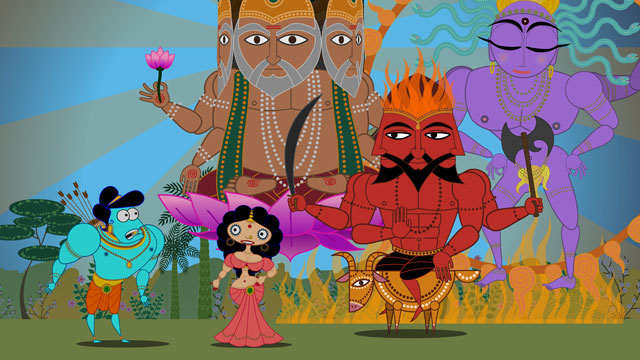
05.RamSitaGods.jpg

I suspect I first heard about Nina Paley’s Sita Sings the Blues in a January 2008 post at Cartoon Brew. The film had been selected to premier at the Berlin International Film Festival but Paley had to scrounge up $35,000 so she could have a 35mm print made. “Fat chance,” said I to myself. But she did it and I kept reading more about Sita here and there, watching clips, getting interested. Finally, Mike “The Curmudgeon” Barrier saw it on DVD and said “It's one of the very few animated features of the last few decades that I can recommend enthusiastically.” And he's seen Pixar, and Miyazaki!

That cinched it. I went link link z00m! on the internets, gave up a credit card number, and a couple of days later had my very own DVD (you can also stream it or download it free of charge).

Yes, it’s all that: imaginative, gorgeous, seamless, original, art.

Since the DVD contains a press kit, I’ll save myself some think-write time and simply copy the synopsis:
Sita is a Hindu goddess, the leading lady of India’s epic the Ramayana and a dutiful wife who follows her husband Rama on a 14 year exile to a forest, only to be kidnapped by an evil king from Sri Lanka. Despite remaining faithful to her husband, Sita is put through many tests. Nina (the filmmaker Nina Paley herself) is an artist who finds parallels in Sita’s life when her husband – in India on a work project – decides to break up their marriage and dump her via email. Three hilarious Indonesian shadow puppets with Indian accents – linking the popularity of the Ramayana from India all the way to the Far East - narrate both the ancient tragedy and modern comedy in this beautifully animated interpretation of the epic.

In her first feature length film, Paley juxtaposes multiple narrative and visual styles to create a highly entertaining yet moving vision of the Ramayana. Musical numbers choreographed to the 1920's jazz vocals of Annette Hanshaw feature a cast of hundreds: flying monkeys, evil monsters, gods, goddesses, warriors, sages, and winged eyeballs. A tale of truth, justice and a woman’s cry for equal treatment. Sita Sings the Blues earns its tagline as "The Greatest Break-Up Story Ever Told."
Now you know roughly what Sita’s about. And if your inner geek is thinking “ancient text + contemporary story = Ulysses,” well then your inner geek’s ahead of mine, because I didn’t think that until 10 or 20 minutes into my first viewing. But I wouldn’t count that as any more than a casual observation, one with a non-casual corollary.

Saturday, November 27, 2010

Behind the Scenes: Disney, Miyazaki, Paley

I’ve been reading around in Hayao Miyazaki’s Starting Point, 1979-1996, a collection of short pieces by and interviews with Miyazaki. Among them is a speech he gave to Japan’s Association of Scenario Writers in August 1994. He observes (p. 103):
So, why don’t we script the film in advance? Well, it’s mainly because this is the way my brain has been trained to work. I’ve tried writing the story out many times before, but even if I think a story works great in text, when we render it in continuity sketches it’s usually unusable. It just doesn’t work, and usually reveals how shallow my original ideas were.
A bit later (p. 104): “In the old days, we always thought getting the sketches first was essential, but the problem is that drawing the continuity sketches seemed to always get behind schedule…” [ellipsis in the original text]. What emerges from this discussion is that Miyazaki and his colleagues start animation before the story has been completely worked out in continuity sketches (that is, story-boarded). “If you keep working, making adjustments here and there, in the process you really develop a much better understanding of the characters you are trying to animate.”

Though Miyazaki doesn’t discuss either the voice acting, the musical scoring, or overall sound design, I assume that that isn’t done until the film is completely animated. Given his “work it out as we go” improvisational process, Miyazaki’s not going to have a speaking script until it’s all done, nor will he know the sound effects required nor the music.

What I find so interesting is that this process is quite different from what I had understood the “classic” process to be, the process that used by Disney, to name an obvious example. In that process full animation would be the last part of the process. Before that could happen a script would be written, characters and settings would be designed, a complete storyboard would be worked out, the actors would voice their parts and the music would be composed and recorded. Then the animators go to work, synching their drawings to the sound where necessary. Of course, things might not quite work out as planned up front, so some revisions might be necessary along the way. But the basic idea is to create a detailed plan – storyboard and sound – before starting to animate. That, I assume, is what Miyazaki had in mind when he asserted that in “the old days” they did the sketches first.

I have assumed that this classical process arose, at least in part, as a way of coordinating the activities of what, in a feature film production, would be a very large team of artists, animators, writers, inkers, actors, and so forth. What Miyazaki found, however, is that it didn’t work for him.

Is this merely a difference between his personal style and Disney’s, for example? We know that Disney stopped drawing in the mid-1920s and thereafter functioned strictly as a director, albeit as a director who demanded control over every detail and often micromanaged his projects into chaos. Miyazaki, however, has always done a great deal of drawing in his projects, often doing most of the story-boarding himself. But it’s not entirely obvious to me how that difference would itself translate into the very different overall management styles, the classic and the Miyazaki.

Friday, July 30, 2010

From Elizabeth to Nina: Stick to Your Guns, Baby

No sooner had Elizabeth I of England ascended to the throne than the House of Commons urged marriage upon her. Here is a portion of the speech she offered in response, her first speech before Parliament, given on 10 February 1559, in her 25th year:
“. . . As concerning instant persuasion of me to marriage, I must tell you I have been ever persuaded that I was born by God to consider and, above all things, do those which appertain unto His glory. And therefore it is that I have made choice of this kind of life, which is most free and agreeable for such human affairs as may tend to His service only. From which, if either the marriages which have been offered me by divers puissant princes or the danger of attempts made against my life could no whit divert me, it is long since I had any joy in the honor of a husband; and this is that I thought, then that I was a private person. But when the public charge of governing the kingdom came upon me, it seemed unto me an inconsiderate folly to draw upon myself the cares which might proceed of marriage. To conclude, I am already bound unto an husband, which is the kingdom of England, and that my suffice you. And this,” quoth she, ”makes me wonder that you forget, yourselves, the pledge of alliance which I have made with my kingdom.” And therewithal, stretching out her hand, she showed them the ring with which she was given in marriage and inaugurated to her kingdom in express and solemn terms. “And reproach me so no more,” quoth she, “that I have no children: for every one of you, and as many as are English, are my children and kinsfolks, of whom, so long as I am not deprived and God shall preserve me, you cannot charge me, without offense, to be destitute.”[1]
But what, pray tell, has this to do with Nina Paley, who is not a monarch, nor even a monarch-in-waiting, but merely an artist, a cartoonist and film-maker? What has such a royal speech to do with Ms. Paley, who, after all, was once married?

Sita heads for home.
 
Let’s take another look at Sita Sings the Blues. At the beginning of the film, Nina is married. A bit over halfway through the film her husband dumps her: disaster. What happens then? Well, in principle, and often enough in Hollywood practice, Nina could meet Mr. Right, fall in love, get married, and move to a mansion in Greenwich, Connecticut, where she would birth little sons and daughters of Mr. Hedge-Fund Manager. But that’s not what happens in the film, not at all.

What happens is that Nina ends up in bed, with her beloved cat, reading Valmiki’s Ramayana. No husband, no mansion, no babies. From that certain Hollywood POV, that’s No Nuthin.’ But really, do you believe that? I mean, yes, Katherine Hepburn married Cary Grant at the end of Philadelphia Story, but in real life she never married (though she carried on a long-term affair with Spencer Tracy). She had her art, and splendid art it was. That would seem to be where Nina’s headed at the end of Sita Sings the Blues, on the way to making a feature-length cartoon about her life and Sita’s, and then . . .

But where I’m really headed is to the cosmological element in Sita Sings the Blues, all the myth and ceremony. Not only does it provide the context which allows Nina’s and Sita’s stories to intermingle, as I’ve previously argued, it also supports and sustains Nina’s decision to become a self-sufficient artist, rather than wife and mom. When she was married, Dave was her link to the world; he WAS her world. Now her art is her link to the world; it IS her world. And the cosmology sustains that link.

Not that I’m suggesting that Paley takes that cosmology at face value, that she’s a Hindu. On her Facebook page Paley lists her religious views as “Lapsed Atheist.” Whatever THAT is, it’s not Hinduism, orthodox or heterodox, though perhaps it stretches to paradox. Rather, Paley uses Hindu cosmology as a way of extending her artistic vision to the edges of human experience and to the ends of the cosmos. It is a way of affirming her artistic responsibility to the world. That’s what sustains her and joins[2] her to the world.

Now we can return to young Queen Elizabeth. Her speech was, of course, a political act and, as such, was designed to give her room to act as she felt she must. Elizabeth stated her justification in terms of the cosmology available to her. She served her god, and the nation’s. In terms of that cosmology, she was married to that nation. The nation of England was and is, of course, a real entity, but an entity of an abstract kind.

And so it is with the cosmos to which Paley has committed herself. It is real, there really is a universe out there (and also within), but it is abstract in conception and apprehension. She has chosen, as her vocation, to make that cosmos visible, palpable, and comprehendible through means of her craft and artistry.


* * * * *


[1] Leah S. Marcus, Janel Mueller, and Mary Beth Rose, eds. Elizabeth I: Collected Works. University of Chicago Press: 2000, pp. 58-59.

The Sanskrit word yoga has many meanings, and is derived from the Sanskrit root "yuj", meaning "to control", "to yoke" or "to unite". Translations include "joining", "uniting", "union", "conjunction", and "means". It is also possible that the word yoga derives from "yujir samadhau," which means "contemplation" or "absorption."

Wednesday, July 28, 2010

Nina Sez: Invent Stuff? Who, me? Nah

You didn’t really think you’d seen the last of my interview with Nina Paley about the Agni Pariksha episode of SSTB, did you? This exerpt is from the very beginning of the interview, before we’d actually begun to talk about the Agni Pariksha. I asked Paley how much she invented in order to do Sita Sings the Blues. And, interestingly enough, she proceeded to down-play her inventiveness.

Why is that interesting? Because inventiveness and originality are supposed to be good. That's what we want from artists and scholars. I mean, second-tier thinkers and artists trip all over themselves with claims to be the first one to cross a T with a double-squiggle, or dot an I 37° right of center and here's Nina Paley being modest about her inventiveness. I suppose she's being consistent with her position that All Creative Work is Derivative, which, of course, is true. But I also wonder, is that all?
[Other excerpts are listed on this page.]
Parent-teacher conference at the local school

BB: Let’s go back a few steps. When you started this, you had already done a whole bunch of stuff of one sort or another. You’d made some short films, so you had all sorts of skills.

NP: Yes.

BB: How much did you invent in the process of doing this over five years?

NP: How could I possibly know how much I invented? How could I possibly know that?

BB: Well, a lot, a whole fuck of a lot, or a super-whole mega lot.

NP: What do you mean by invent? All I did was I took skills that I already have and I used them with ideas that are already out there. So, like, where’s the invention? Is it just like nobody but this thing with this thing, but people have put things together before. People’ve put lots of disparate things together. And in my case I just put things together that, to many people’s minds, have not been put together before. But that doesn’t mean that it hasn’t been done though. It just means that I surprised people. But I don’t know if surprising people and inventing is the same thing.

BB: It’ll do.

NP & BB: Chuckle.

NP: I mean a lot of people think it’s far more original than it actually is. A lot of people, like, ‘she did a feminist Ramayana.’ There’s a huge history of feminist Ramayanas. This is not remotely original, the feminist aspect of it. And there’ve been other animated Ramayana’s, and then, OK, so, there haven’t been any Ramayana’s that put Annette Hanshaw with the Ramayana. That’s probably the most unique thing about it.

A lot of this was driven by technology. So I did things, you know, the collagy stuff and the techniques that I used, I did because they were possible.

BB: How many of those techniques did you learn in animation school.

NP: Well, I never went to animation school.

BB: If you had, how many of them would you have learned in animation school, like zero.

NP: I don’t know. Like this specific technique. Everything I did comes from. . . OK, so rotoscope is very old.

BB: Right, is very old.

NP: Flash, there’s all sorts of things that are done in Flash. Masking is a Flash technique. So this uses rotoscope and masking. The technique of combining rotoscope with different fills or different patterns on every frame. That was done in Yellow Submarine, “Lucy in the Sky with Diamonds.” It was painstakingly done because they had to actually paint every single one of those things by hand. But that technique is at least as old as that.

BB: Did you see Across the Universe?

NP: Does that have animation in it?

BB: No.

NP: What’s the point?

BB: It has Beatles tunes.

NP: Yeah, but come on. Who cares. It has Beatles tunes that are resung by other people.

Yeah, anyway, you know, grabbing images from all over the place because of the internet that turns people like me and others into criminals. Federal criminals, and soon to be international criminals.

Of course this particular combination of techniques isn’t [unintelligible] but that’s true of any piece of art.

Monday, July 26, 2010

Ritual in Sita Sings the Blues, Part 4 – The Cosmos

And then some.

It’s now time to conclude my remarks on ritual patterns in Sita Sings the Blues. Somehow.

Let’s hit the reset button and pretend that I never wrote the first essay in this series, the one where I introduce the anthropological conception of ritual and discuss the cosmological opening and closing of the film. What happens if we simply drop that opening sequence (from the opening to 5:15 and from 77:11 to the end) so that the entire film consists of Sita’s narrative, Nina’s narrative, and the Agni Pariksha. Nothing would seem to be lost from either narrative, but the relationship between the two would be reduced to mere juxtaposition and the Agni Pariksha sequence would be poorly motivated. Remember, that sequence originates from Nina’s life, immediately after Dave dumps her, and takes us back in time into Sita’s life at the point where rumors are being spread about her fidelity. How do we explain that connection?

We could, for example, imagine it being accomplished through some kind of time-travel. To do that, however, you would have to set up the time-travel tech by introducing the technology itself and by coming with a reason for it to work in just that way. That is to say, you would have to add something to the film that performs the job that that cosmology now does. So why bother when the cosmology is immanent in the mythological materials?

Cosmology

And just how does the cosmology perform that job? Most fundamentally, it establishes Sita as a divine being – she IS a goddess – and so she can be a model for events in the lives of ordinary women, even a woman such as Nina, who is not Indian and who is living in the 20th and 21st centuries CE. It is not simply that Nina Paley, the film-maker, points out a parallel between events in the life of film-Nina and Sita’s life. No, given the cosmological context, the connection between Sita’s life and Nina’s is much more immediate and intimate than that. That film-Nina’s life should track Sita’s life is now inherent in the structure of the cosmos rather than being a correspondence observed by some external person such as film-maker Nina Paley.

And given that cosmology, it is natural that the Agni Pariksha should be one and the same event in both Nina’s life and Sita’s. Sita established the pattern and Nina is just one of the many women who have participated in that pattern across historical time and geographical space. In that moment of purification and anguish, all are one.

Sounds sorta’ mystical & magical, you say? Yes, it does. But the cosmology is like that. It is all happening, all the time.

Lotsa Stuff

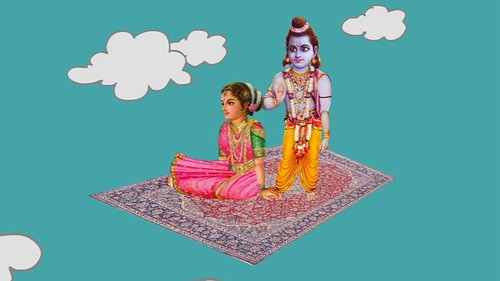
Now let’s consider an implication of this cosmology and of Paley’s use of it in the movie. Look at these screen shots, which I took from a discussion the three commentators had about how Rama and Sita got back to Ayodhya (44:19 – 45:03):


Sunday, July 25, 2010

Nina Paley: A very brief hot mess

Here is yet another excerpt from my interview with Nina Paley about the Agni Pariksha episode of her feature-length animated film, Sita Sings the Blues. In this excerpt we’re talking about film Nina’s life comes crashing into Sita’s and how that’s just how Paley felt about her life and the Ramayana.

At a few of points in the interview I’ve stuck a double asterisk (**) to point out a passage where Paley seems unsure of what she’s saying, where she’s seems to be saying something more to accommodate my questions than as a report on what she actually thought. After this interview was concluded I had another, much shorter, conversation with Paley about her discomfort at talking about art in these terms. I’ll transcribe that one of these days.

[Earlier excerpts are here (1), here (2), and here (3).]

Hot tears, hot anger, hot grief


NP: OK. Ah, the eyes. Sadness. This is all about, like, crying –

BB: Crying hot tears –

NP: Yes, crying tears of flame. Um, yeah, I might’ve had the idea just that – this is a guess, I don’t know what was really happening. But, you know, Sita’s a goddess, she represents transcendent principles of suffering and devotion and like that. ** Ah, but she’s divine and, um . . . I don’t know, what was I really thinking? It’s sorta’ hard to talk in words about what this was about. I think just the idea that there’s –

BB: What about those eyes?

NP: Oh these? Well these come from, ah, I mean I’ve seen them in Tibetan art. In fact I, the apartment I lived in Brooklyn, I sublet from a friend who was in Tibet and he these Tibetan flags, he decorated it with, that were just these eyes. [too soft to hear]

BB: Is that lion from a devotional card?

NP: Oh, of course. Yes, that’s probably Durga’s mount.

Yeah, so anyway, they’re actually relating to Sita, or Sita’s relating to them. They’re all feeling this together. It’s not just Sita, it’s become a sorta’ universal activity.

BB: Well you see, the interesting thing about where this is placed in the film is that it’s right after film Nina gets the news –

NP: Yeah!

BB: - so it’s, I mean, up to that point it’s sort of Nina’s story juxtaposed against Sita. And at this point, I mean, Nina’s story plunges right into Sita’s story.

NP: That’s how I felt! That’s how I actually perceived my own life. It’s like laahaa just goin’ along, then I had this like weird crashing into the Ramayana.

BB: Yeah, I mean, so Sita’s crashing into the gods and they’re crashing into her, and now you’re crashing into that whole thing, and basically the whole universe is becoming one in this hot mess of anger and grief.

NP: [laugh] Yeah. A very brief hot mess.

BB: [laugh]

A Rip in Reality

NP: And then, you know, she blows out the flame and we go on our separate ways. Maybe that’s why you say it’s like a ritual. There is where I myself in my own experience, that like, rip –

BB: Sure.

NP: - rip in reality happened, there’s this weird intersection –

BB: That’s what rituals are about.

NP: OK.

BB: I mean, you mark this sort of – there’s this sacred space. And we do a little ceremony and we all leave the regular world. And we go in this sacred space and we go crazy. And then, we come out, and we’re changed.

NP: Huh. This was involuntary – [both laugh] – very involuntary. And when I’ve tried, the thing about most rituals is that, they, most of them fall pretty flat on me. ‘I know this is supposed to be happening. but it’s not.’

BB: Yeah.

NP: Oh, is that it? [That is, is that the last screen shot?] No.

Sita and Sitas


NP: ** I think here what I’m trying to say is that Sita is not just one, but that Sita is –

BB: Oh yeah, this is the multiple Sitas.

NP: ** Yeah, and as the story just keeps repeating, um, and regenerating –

Saturday, July 24, 2010

Nina Paley: Seeing Gods

This is another excerpt from my interview with Nina Paley about the Agni Pariksha episode of her feature-length animated film, Sita Sings the Blues. In this excerpt we’re talking about Sita seeing gods and about how Paley depicted them in the Agni Pariksha.
About Fire, and Agni


NP: That’s Agni.

BB: Right. And several frames back he was much larger. And these borders -

NP: Yeah, these are traditional borders. This border specifically [right hand border] is actually from – with the feet – it’s from prayer shawls that actually sorta tell the story of the Ramayana. So they’re very Sita-Rama specific fabric design. And then all this stuff, these things [left side], came from just a book of traditional block design.


BB: And so here, how many concentric circles of Agni’s do you think you have going –

NP: I don’t know, because they got larger, um, so they were a cycle, not just a cycle in terms of walking and then rotating, but they were also coming towards you. So in that sense they were infinite.

[Note: animators talk of ‘walk cycles’ as a sequence of images that you can cycle over and over to depict a character walking.]

BB: I mean, at one point I counted at least four of them.

NP: Yeah, there’d be at least four. [Counts them in them image.] One, two, three, four, maybe five of them.

BB: And, the various fills, you just grabbed this that and the other thing.

NP: They’re devotional cards. They’re specifically devotional cards so they relate to deities, they relate to religion here. And the idea behind that is that, you know, in a state of so much grief and pain, you’re actually sorta’ crossing worlds, you’re –

BB: Right –

NP: - more in the world of the divine at that point.

BB: Sure sure sure.

Friday, July 23, 2010

On Learning to See Sita Sings the Blues


Back in June of double-ought nine when I reviewed it for The Valve, I’d watched Sita Sings the Blues two maybe three times. In that review I declared it “imaginative, gorgeous, seamless, original, art.” Now I’ve watched it umpteen times, watched some segments over and over and over, stepped through some sections frame by frame, and taken a bunch of screen shots. You know what?

It’s still imaginative, gorgeous, seamless, original, art.

It just gets better and better.

But what was I thinking back then? I didn’t know what I had watched. I’m not talking about some kind of ‘deep meaning’ that has only emerged through lots of viewing and thinking – no such luck. No, I’m talking about basic superficial understanding about what takes place on screen. Here’s a list of some of the things I hadn’t grasped when I wrote that review:
  • The laundry man, Dhobi, who’s beating his wife. The significance of that event, its role in explaining Rama’s rejection of Sita, didn’t register with me.
  • The two Agni Parikshas, the one accompanied by “Mean to Me” and the later one danced and sung by Reena Shah. I didn’t recognize that Sita was rescued from the fire by Agni – heck, I’m not even sure I recognized it as an honest-to-goodness test of purity. It was just something happening on the screen and this woman was in the fire. I certainly didn’t identify these two sequences, much less understand what was going on in the second, where Sita sees and then merges with divinities.
  • There’s a sequence where the three commentators talked about Sita having her own issues, that there’s something strange about her fidelity to Rama given his treatment of her. Nor sure I followed what was going on there, what it had to do with the story, much less grasped the implications for the Nina story. I must have gotten something from it, but just what . . .
  • And those deities? Fuhgeddaboudit! Rama an avatar of Vishnu? Sita an avatar of Laxmi? Who they? Avatar – isn’t that some kind of internet thingy? Or a game thingy? & it took me a bit of digging to figure out which deity grabbed the hot dog during intermission (it was Agni).
There’s a lot of basic stuff that just whizzed by me. It’s not like I wasn’t aware of missing things. I was. And yet, still, I reviewed the film and praised it to the sky. How could I do such a thing?

Well . . . First, let’s just note that it is not at all unusual for movie reviewers to miss what’s happening in the film. Even top-shelf full-time reviewers – e.g. Robert Ebert, Stanley Kaufman – will make factual mistakes about what happened in the film. It’s very difficult to remember what happens, especially if you’ve been drawn into a film. When you’re in that state, believe me, you DO NOT want to be messing around taking notes and trying to remember things for the review. I mean, when you’re making love do you want to be taking notes on things to list in Schedule C of your tax return?

But that’s a secondary matter. The primary matter is that I missed a lot of what’s happening in the film, and yet the film still got through to me. How’s that possible?

Thursday, July 22, 2010

Ritual in Sita Sings the Blues, Part 3 – Shakespearean Resonance

It is high time I concluded my investigation into ritual patterning in Sita Sings the Blues [1].  But alas, that is not to be. Once I plunged into it, the Shakespeare connection has proven to be too rich to be given only the first half of a post, where the other half was to be a return to cosmology and such. So, that’s what we’ve got here, just Shakespeare and Paley. Cosmology will have to wait.

Multiple Plots

Much Ado About Nothing, like all of Shakespeare’s comedies, and Elizabethan comedy in general, is multiply plotted. We have two couples, Claudio and Hero, Beatrice and Benedick, who become engaged, though it takes a bit of work to pull it off. The play gets its dramatic shape from the Claudio-Hero plot, so let’s start there.

Claudio has returned from war (along with his friend, Benedick); he sees Hero and decides that she’s the woman he wants to marry. He asks his company commander, Don Pedro, to speak with Hero’s father, Leonato, to arrange a marriage. And so it is done, though not without a hitch or two.

Meanwhile, Don Pedro’s misanthropic and bastard brother, Don John, does not at all like the outbreak of happiness that is likely to follow upon this wedding. So he schemes to stop it. He arranges for Claudio to witness a tableau in which he thinks that Hero is having an assignation with another man. Thus it comes about that, when all are gathered in the chapel for the big wedding, Claudio himself has different ideas. When he arrives he denounces her as a whore.

The frame grab is from Sita, but the issue, woman’s purity, is as old as the hills.

Not only is the wedding called off, but in the ensuing anger and confusion, Hero faints. She is presumed dead by most of those present, who leave the scene before she revives. Those who remain determine to preserve the appearance of her death so as to watch and see what happens. Perhaps things aren’t as they seem – are they ever? What happens, of course, is that everything gets worked out and we have a happy ending; Claudio and Hero become engaged once again, and so do Beatrice and Benedick.

The first thing to note is that this botched wedding has become, in effect, a rite of separation (as I explained in the first post in this series [2]). Hero is socially dead – and presumed physically dead as well. This event takes place at the opening of Act Four (of five). That is to say, it happens a bit after the mid-point of the play. Thus it takes place at the same relative point in the play’s action as the point where Dave dumps Nina, 51 minutes into a 78 minute film (not counting the end credits).

In both cases we, the audience, saw the break coming. In Much Ado we saw Don John’s plot; in Sita we could see that Dave had lost interest in Nina – she saw it too, but didn’t want to draw the logical conclusion, not until the fateful email hit her over the head with it. The endings, of course, are different. Hero becomes reconciled to her man and so will re-enter society as his wife. Nina does not become reconciled to Dave, nor does she find another man. She finds the Ramayana and makes a film. That’s a very different kind of ending for a romantic comedy and reflects, among other things, 400 years of history between Shakespeare’s play and Paley’s movie.

My first point, then, is simply about relative timing. In both cases the woman goes into social exile at roughly the same time in the action – presumably this reflects some aspect of how the nervous system works, we need so much time for the build-up and then, Wham! break things wide open. My second point is, again, a simple one: it is the woman who goes into social exile, not the man. Yes, it is 400 years in the past, but we in the West are still in touch with Shakespeare’s world. On this point, his world is not so different from Valmiki’s rather older world half-way around the globe.


Tuesday, July 20, 2010

Ritual in Sita Sings the Blues, Part 2b

In my immediately preceding discussion of ritual patterning in Sita Sings the Blues I considered the Nina’s story up to the very end where “we see her in bed, cat cradled in her arm, and reading Valmiki’s Ramayana. She appears to be content with her life. And so we may say that that last scene functions as a rite of incorporation.” And that led to a series of questions:
Under what terms? If she’d organized her identity around her husband, and he’s left her, and she doesn’t have a new husband or even a boyfriend, then why say that she has become reintegrated into society? There is an answer to that, and a fairly obvious one, but I’d like to pose another question: What happened that she went from begging Dave to taking her back to being content with her new kitty and a book?
It’s now time to take up Sita’s tale. Not only is it more complex than Nina’s tale – more complex in that it involves more actors in more episodes over a longer period of time – it is presented in a more complex manner. Paley presented Nina’s tale in a single visual style while she presents Sita’s tale through three visual styles, one of them featuring three narrators and commentators who both tell us what happens and comment on the action. Another visual style, a classically “cartoony” one, is used for the Annette Hanshaw songs, and the other is based on Indian miniatures. Because of this complexity, I won’t run through her story event by event as I did Nina’s – though I may do so at a later time.

Sita’s Is Lost, then Found

Sita is married to Rama, heir apparent in the kingdom of Ayodhya. As a result of a promise his father had made to one of his wives, Rama is sent into exile for 14 years and Sita, the ever-dutiful wife, insists upon accompanying him. While in exile, Sita is abducted by Ravana and taken to his kingdom, Lanka. Though he wants to bed her, Sita refuses, and he, scholar and gentleman that he is, doesn’t force himself on her. With the help of Hanuman, the monkey king, Rama rescues Sita and returns with her to . . . just where is not exactly clear to me.

Wherever it is, what Sita had hoped would be a happy reunion is not. Rama is cold toward her. And Paley places this cold reunion (37:21 – 39:06) immediately after Dave’s rejection of his Nina’s charms (36:09 – 37:21), with Tchaikovsky’s Romeo and Juliet sawing away on the soundtrack. In response to Rama’s unexpected and inexplicable rejection, Sita asks that a funeral pyre be built. And so Sita immolates herself to the tune of “Mean to Me,” sung by Annette Hanshaw (39:38 – 42:53).


She survives the flames unharmed, meaning that she is indeed pure, but Rama remains unconvinced. Nonetheless, he takes her back to Ayodhya with him by some means of air transport (which is much discussed by the commentators, 44:19 – 45:03), as his 14 years of exile have come to a close.


That’s where Sita’s tale stands when the film goes into intermission (47:55 – 50:56), followed by Sita’s being dumped (50:56 – 51:40), which is then followed by the Agni Pariksha segment (51:40 – 54:40).

Whoa whoa whoa! Didn’t you just say that Sita underwent trial by fire as Hanshaw sang “Mean to Me”?

Friday, July 16, 2010

Ritual in Sita Sings the Blues, Part 2a

In my previous discussion of ritual patterning in Sita Sings the Blues I discussed the anthropological concept of ritual and showed how film-going itself can be analyzed as a ritual. I then showed how Sita Sings the Blues uses that pattern in the large, to establish a cosmological context for the core narratives of Sita and Nina, and in the small, the Agni Pariksha, to blend the core narratives together. Now it’s time to look at those core narratives. Let’s start with the Nina narrative.

Nina’s Tale

Cuddles

When the opening cosmology ends, we find ourselves in San Francisco, in the bedroom with Nina, Dave, and their cat, Lexi (roughly 5:15 to 6:30). Lexi wakes them, Nina troops to the kitchen, puts food in Lexi’s bowl, and comes back to bed, jumps enthusiastically in, cuddles with Dave, and they do to sleep with smiles on their faces and Lexi atop the blanket. Then Dave gets a job in India (6:30 - 6:58). Then Dave leaves for India; hugs and kisses at the airport (14:32 – 15:01).

When you take these scenes together with the other Nina and Dave and Nina-only segments it is clear that, when Dave leaves for India, Nina’s rite of separation has begun. We assume that, while he’s away, she continues doing whatever it was when he was with her, but we don’t see that at all. It’s clear that Dave is the center of her world; her relationship with him is what anchors her to society.

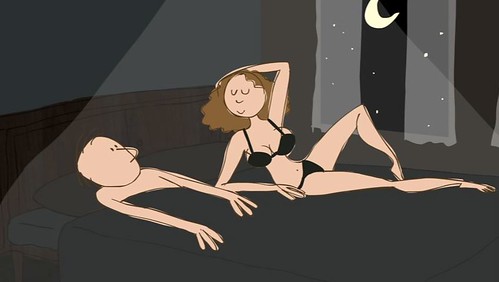
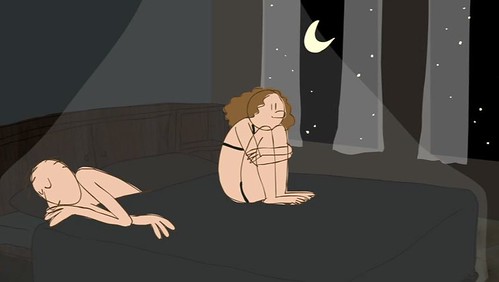
In their next scene (24:30 – 25:36), Dave calls Nina from India to tell her that his contract has been extended. She fears that their relationship is falling apart and, in response, Dave suggests that she come to India. Which she does (31:32 – 32:00). When she arrives, Dave is cold toward her at the airport. What is worse, that night Nina arrays herself in her most seductive lingerie, and Dave simply roles over and goes to sleep. Nina is devastated (36:09 – 37:21).


Presentation

Rejection

In their final scene before the intermission, Nina gets an offer to come to New York City on business – five days, all expenses paid. Dave urges her to take the offer (43:29 – 44:19).

Immediately after intermission, Nina is dumped by Dave (50:56 - 51:40). That completes her rite of separation. She is now in the transition phase, which begins with the Agni Pariksha. Nina has three more scenes before the film ends. In the first of these she’s in a cold, bug infested apartment that leaks water (60:20 - 61:13). In the next she calls Dave and asks him to take her back (66:29 – 67:02). Finally we see her in a different apartment (76:13 – 77:11). Framed pictures on the walls depict the shadow puppets that have been narrating and commenting throughout the film. There’s a moment where she’s working at her computer and rubbing the belly of a new cat. Finally, we see her in bed, cat cradled in her arm, and reading Valmiki’s Ramayana. She appears to be content with her life. And so we may say that that last scene functions as a rite of incorporation.

Under what terms? If she’d organized her identity around her husband, and he’s left her, and she doesn’t have a new husband or even a boyfriend, then why say that she has become reintegrated into society? There is an answer to that, and a fairly obvious one, but I’d like to pose another question: What happened that she went from begging Dave to taking her back to being content with her new kitty and a book?

Was it magic? Yes. But no. To understand what happened we need to consider the other core narrative, Sita’s.

Sita’s Tale

Whereas Nina’s story is a relatively simple one, presented in a straightforward manner, and in a single visual style, Sita’s story is complex, a bit convoluted, and is presented in three visual styles, one of them featuring three narrators and commentators who both tells us what happens and comment on the action. Because of this complexity, I won’t run through her story event by event as I did Nina’s – though I may do so at a later time.

Nor will I run through it now, in this post. Real life calls, got things to do. This’ll have to wait a bit.

Sorry.

Wednesday, July 14, 2010

Ritual in Sita Sings the Blues, Part 1

I want to discuss ritual patterns in Nina Paley’s Sita Sings the Blues. Specifically, I want to look at the beginning and ending of the film, the beginning and ending of the Agni Pariksha sequence, and the parallel progression of Sita and Nina through the film. But first I need to define what I mean by ritual pattern. Then we can return to the movies.

Ritual Patterns

The patterns I have in mind are an abstraction from structures anthropologists have found in rituals around the world. Here’s how I characterized that structure in my essay on Sir Gawain and the Green Knight (abstract plus link to PDF):
In “Two Essays Concerning the Symbolic Representation of Time” Edmund Leach has described the ritual structure of Durkheim's “states of the moral person.” They are: 1) secular life, 2) separation from the secular world and transition to 3) the marginal state where the ‘moral person’ is in a world discontinuous from the ordinary world, often being regarded as being dead, and from which a return to the secular is made by a process of 4) aggregation or desacralization, often symbolized by rebirth. Arnold van Gennep talks of separation, transition, and incorporation in The Rites of Passage. The ritual sequence involves two realms of being, the secular and the sacred, and is designed to order the transition of initiates between these two realms.
As a simple example, consider the bride’s role in the now standard Christian wedding ceremony, a ceremony in which she will loose the surname she was born with and assume her husband’s surname, thereby changing her social identity. She enters the church with a veil over her face. She is thus faceless; symbolically, she has no social identity and is now separated from the secular world. Accompanied by her father, she walks to the altar where she is met by the groom; she is in a transitional state. She and the groom exchange vows and the officiate pronounces them to be married. Now that she has her new social identity, and a new name, the veil can be lifted and the new woman can be incorporated into society in that new identity.

This ritual is a relatively short, but anthropologists have recorded rituals that last for hours and days and even longer. Adolescent initial rites, for example, can last for months. There is an initial rite of separation where the young men, shall we say, are stripped on their ordinary identity. They may have to wear special dress and have special markings on their bodies. They may be given a different name as well. Once they have thus been separated from society, they’ll go live in some other place reserved for them and they’ll be taught things needful to be an adult man in their society. This process can easily last several months and may involve arduous physical tasks or a vision quest. During this period their friends and family may well treat them as being dead, which they are, socially. They are in transition, without an identity in their society. Once the proper things have been done another ceremony will be performed and the young men will be given new names, perhaps new body make-up, and will be incorporated into society as adults.

What’s important about the ritual pattern is not how elaborate it is, or how long it takes for the full ritual to run to completion. What’s important is the pattern itself: separation, transition, and incorporation. That’s the pattern we’re going to look for in Sita Sings the Blues.

Bounded by Ritual

First of all, we could see the experience of watching Sita Sings the Blues as itself a ritual experience, especially if one sees it in a theatre, preferably an old-time movie palace. Here you go to a building purpose built for movie watching, and you meet other people there who have come for the same thing you did: to watch Sita Sings the Blues. Once you’ve entered the building you’ve separated yourself from the mundane world and begun the transition to the magical world of Movieland. First you buy your ticket (that is, make an offering to the gods); then, perhaps, you buy some popcorn and a soda, whatever. You may hang out in the lobby a bit while chatting with your friends, whatever. But, when the time comes, you enter the theatre proper, take a seat, and watch the movie. You are now in a transition zone; your mind has withdrawn its attention from the mundane world and is given over to consuming the flickering images on the screen and the sounds coming from the speakers. This goes on for 90, 100, 120 minutes or more, and then you exit the theatre and become, once again, incorporated into mundane life. If the movie was a good one, you will be in a different mood from when you went in; you will have been transformed, if only for a few hours.

That, of course, is general to all movies, not just Sita Sings the Blues. Likewise, all movies have title credits and end credits that bracket the movie proper, and one might think of them as rites of separation and incorporation. And so we have a ritual structure (title credits, film, end credits) within another ritual structure (lobby experience, theatre proper, lobby experience). Sita Sings the Blues has one more layer of embedded ritual.


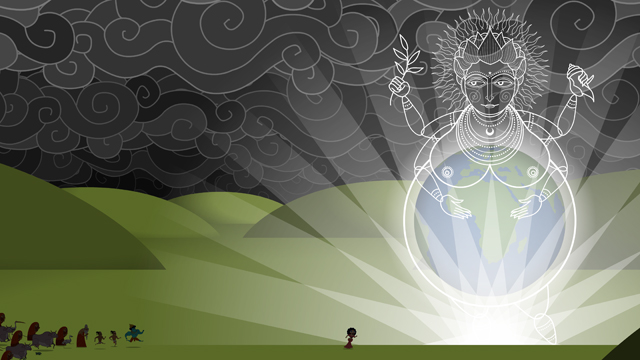
Starting at about 1:53 and running to 5:15 Paley presents us with a brief cosmology that starts with a cosmic explosion that gives way to a procession of Hindu deities, a beating heart, and finally, a heliocentric solar system. The (virtual) camera zooms in on earth and, ZIP! we’re in San Francisco, it’s night, and Nina and Dave are sleeping. That sequence lasted 202 seconds, and nothing that happened in it is necessary to the story told in the film. If you miss that sequence, there’s nothing in the subsequent story that will puzzle you. Why then, is it there?