Showing posts with label Fantasia. Show all posts

Tuesday, July 22, 2025

East is East and West is West, and the two have been consorting for a long time [can we use LLMs to change the world?]

Ted Underwood has recently written about machine learning as cultural technology: A more interesting upside of AI. While I don’t find that the idea of LLMs as cultural technology tells us much about how they actually work, that’s not what interests Underwood. He remarked in a recent comment on Facebook:

But my own attitude has taken a strong turn toward Marx's line, "the point however is to change it." I'm still interested in understanding cultural history. But I'm interested in it more and more as a map of resources we could actively remix to produce new things. If LLMs don't do that exactly the same way as the human brain, I think ... I might be fine with that?

I’ve certainly got nothing against changing the world. In fact, I’ve been approaching that in some of my recent use of ChatGPT and Claude. Let’s take a look.

Sonnet 129

Consider this recent blog post: Toward a Tantric reading of Shakespeare’s “Th' expense of spirit in a waste of shame,” with two mandalas.

First I had ChatGPT create a mandala based on Shakespeare’s Sonnet 129, “Th’ Expense of Spirit.” Then I asked it to gloss the poem’s concluding couplet: “All this the world well knows; yet none knows well / To shun the heaven that leads men to this hell.” Here’s what it concludes:

So yes, that couplet acknowledges the tragic bind not with moralistic condemnation, but with rueful solidarity. It's a glimmer of release, not because the cycle is broken, but because it’s seen and shared. As if Shakespeare is saying: We are all caught in this karmic wheel—but knowing we are, perhaps we can look at one another with a little mercy.

Then I ask it about the hunter simile in lines six and seven, and possibly eight as well. Here’s part of my prompt:

In it we have a hunter laying poisoned bait to catch an animal. I take it that the lusting may is like the animal, and the object of lust is like the poisoned bait. But where in the body of the poem is there a figure parallel to the hunter? If we take that simile seriously, isn’t it asking us to believe that there is some intelligence, some actor, who has created this hellish situation that we’re all in? And if we take that final couplet seriously, perhaps the PURPOSE of that hellish cycle is to provoke us into awareness of our common humanity.

In my own work on the poem, that is central. It may be a secular poem, but it displays a pattern found in Christian theology, and pattern that informs Milton’s Paradise Lost. ChatGPT has no trouble responding to my prompt. Here’s part of its response:

Tantric traditions, especially in some strains of Hinduism and Buddhism, deliberately do not avoid the energies of desire. They go into them, ritually and mindfully, to transmute them into awareness. Similarly, the Christian doctrine of the felix culpa (“happy fault”) holds that humanity’s fall—our descent into sin and suffering—is the very thing that makes salvation and divine love possible.

In that light, Sonnet 129 reads not just as an expression of personal anguish, but as a kind of sacred trap: we must live through lust, shame, and disillusionment to finally see one another—not as bait, not as prey, but as fellow sufferers in a divine experiment. The hell of lust is not just punishment—it is revelation.

It concludes: “Shakespeare becomes almost a mystic, using sonnet form like a mantra to push us into confrontation with the sublime.”

How does this respond to Underwood’s desire to treat LLMs as “as a map of resources we could actively remix to produce new things.” Well, a tantric reading of an ostensibly secular poem from a Christian culture, that seems rather new to me. I suppose Stanley Fish might regard it as a reading generated within a different “interpretive community,” one populated by Hindus and Buddhists. But there’s no interpretive community here at all, just the “cultural technology” of the LLM underlying ChatGPT.

It’s not at all clear to me just what to make of this, and to be honest, I’ve not thought all that much about it. At the moment I’m mostly interested in the fact that we can do this sort of thing at all. That’s new.

Here’s more of that some kind of thing.

Shakespeare, Disney, Coleridge

Here’s a working paper: Claude on the Eightfold Way: Sonnet 129, Fantasia, Kubla Khan. It records a conversation I had with Claude about those three texts. Here’s the abstract, which I’ve edited out of a series of summaries I’d asked ChatGPT to create:

A) The circular structure of Shakespeare’s Sonnet 129 mirrors contemplative technologies found in both Hindu/Buddhist and Christian traditions. The sonnet's recursive exploration of desire creates what can be understood as a secular meditation technology that operates through psychological rather than explicitly spiritual means, transforming destructive cycles into opportunities for deeper understanding.

B) Walt Disney's Fantasia (1940), functions as a cinematic mandala structured around the mystery of sound-sight relationships. Despite appearing as popular entertainment, Fantasia employs sophisticated contemplative architectures, including radial organization around central insights, recursive motifs (particularly hands as symbols of creative consciousness), and a progression that builds contemplative capacity rather than advancing linear narrative.

C) Coleridge's “Kubla Khan” provides the most striking example of unconscious contemplative mastery. Structural analysis reveals the poem's recursive architecture, where the emblem “A sunny pleasure-dome with caves of ice” functions as what modern AI research would recognize as a semantic attractor—a compressed representation in high-dimensional meaning space that contains the informational content of the entire preceding text. This insight, impossible before the advent of large language models, illuminates how consciousness naturally creates contemplative technologies through semantic compression and decompression cycles.

D) There is a consistent meta-pattern across all examined works: (1) presentation of a psychological or existential problem, (2) circular exploration that deepens rather than resolves the problem, (3) semantic compression into forms that contain the entire exploration, and (4) recursive return that transforms the initial problem into contemplative opportunity. Is this a fundamental cognitive architecture that emerges when consciousness operates at optimal integration?

E) Finally, the conversation itself becomes an example of the contemplative consciousness it analyzes, suggesting that such deep structural patterns represent universal features of human cognitive architecture rather than culturally specific techniques.

The general point is the same as it was with the previous example, involving Sonnet 129 alone: We have a Hindu and Buddhist thought applied to secular texts from an entirely different culture.

And there’s something else, something specific to Stanley Fish. He made his name as a theorist by announcing something he called “affective stylistics” in an article published in 1970. The idea is that the meaning of a text is to be found in the process that unfolds as the reader moves through a text, word after sentence, after paragraph, etc. It’s a method he’d arrived at in his book on Milton, Surprised by Sin: The Reader in Paradise Lost (1967). Forget the fact that his criticism is not affective, and forget that, once he’d announced the method as such in the 1970 article, he didn’t much practice the method, whatever it is. What’s interesting about this working paper is that ChatGPT is interested in the process by which the reader, or audience member in the case of Fantasia, moves through the text.

It talks of (in D) “circular exploration,” “semantic compression,” and “recursive return.” And who’d’ve thought of comparing these three texts? Well, I did, not ChatGPT. But it was able to do the work that validated the comparison.

Are we changing the world yet? Probably not, but things are looking interesting.

Homo Ludens, Pleasure, Gross National Happiness

As you probably know, I’m working on a book whose current title is, Play: How to Stay Human in the AI Revolution. In that book I will be arguing that we live in a world where the institutional structure is dominated by the economic metaphor of the efficient marketplace. In that world one’s place in society is tied to one’s place in the occupational system. As AI displaces people from the occupational system they will, in effect, be left to drift in a world that is now bereft of meaning for them, something I explore in a recent article in 3 Quarks Daily, Trapped in Work Mode: The Real Challenge of AI is not Technical, It’s Conceptual, Mythic, and Institutional. We need to replace an ethic of Homo economicus with one of Homo Ludens.

I note that the small kingdom of Bhutan has already done that. In 2008 Bhutan adopted a new constitution, one in which Gross National Happiness (GNH) becomes that nation’s guiding philosophy. To that end Bhutan has instituted an index for measuring GNH.

While happiness and pleasure at by no means the same thing, they are closely allied. But Western culture has never quite known what to do with pleasure. We tolerate it, market it, even celebrate it in the abstract—but we rarely take it seriously. Pleasure is seen as secondary, indulgent, or morally suspect. Hinduism and Buddhism, however, are better suited to the intellectual task of grounding an ethos where pleasure is treated as a first principle. That’s something I’ve explored in conversation with ChatGPT: Redeeming Pleasure through Hinduism and Buddhism.

Now we’re talking about changing the world. Just how that will happen, who knows? But I don’t doubt that the creative and effective use of LLMs, cultural technology, will be part of the process.

Sunday, June 8, 2025

Claude on the Eightfold Way: Sonnet 129, Fantasia, Kubla Khan

New working paper. Title above, link, abstract, table of contents, and introductory material below.

Download from Academia.edu: https://www.academia.edu/129826893/Claude_on_the_Eightfold_Way

ABSTRACT: A) The circular structure of Shakespeare’s Sonnet 129 the analysis mirrors contemplative technologies found in both Hindu/Buddhist and Christian traditions. The sonnet's recursive exploration of desire creates what can be understood as a secular meditation technology that operates through psychological rather than explicitly spiritual means, transforming destructive cycles into opportunities for deeper understanding.

B) Walt Disney's Fantasia (1940), functions as a cinematic mandala structured around the mystery of sound-sight relationships. Despite appearing as popular entertainment, Fantasia employs sophisticated contemplative architectures, including radial organization around central insights, recursive motifs (particularly hands as symbols of creative consciousness), and a progression that builds contemplative capacity rather than advancing linear narrative.

C) Coleridge's “Kubla Khan” provides the most striking example of unconscious contemplative mastery. Structural analysis reveals the poem's recursive architecture, where the emblem “A sunny pleasure-dome with caves of ice” functions as what modern AI research would recognize as a semantic attractor—a compressed representation in high-dimensional meaning space that contains the informational content of the entire preceding text. This insight, impossible before the advent of large language models, illuminates how consciousness naturally creates contemplative technologies through semantic compression and decompression cycles.

D) There is a consistent meta-pattern across all examined works: (1) presentation of a psychological or existential problem, (2) circular exploration that deepens rather than resolves the problem, (3) semantic compression into forms that contain the entire exploration, and (4) recursive return that transforms the initial problem into contemplative opportunity. Is this a fundamental cognitive architecture that emerges when consciousness operates at optimal integration?

E) Finally, the conversation itself becomes an example of the contemplative consciousness it analyzes, suggesting that such deep structural patterns represent universal features of human cognitive architecture rather than culturally specific techniques.

Contents

Prefatory Note: Full Circle 4
An Esoteric Reading of Sonnet 129 6
A Christian Reading: Felix Culpa 8
Compare the two readings 11
Summarize the Discussion 14
Memory Palace vs. Mandala 16
Walt Disney’s Fantasia 19
Confirmation 25
Coleridge’s “Kubla Khan” 28
The Common Architecture 36
Recursion on Recursion 39
Summary 41
The Title-Page Mandala 43

Prefatory Note: Full Circle

The conversation I report in this paper simply evolved. I wanted to have a “pure” discussion of Shakespeare’s Sonnet 129, “The Expense of Spirit,” in both Esoteric (Hindu/Buddhist) and Christian terms. I put “pure” in quotes because I had already done such a comparison in ChatGPT, but that was in the context of a longer discussion that began with having ChatGPT make a mandala suitable for the sonnet. That led me to suggest that ChatGPT examine particular aspects of the poem, the concluding couplet and the simile of the hunter. That is when I brought up that similar that I suggested a Tantric reading.

“What would happen,” I wondered, “if I simply asked for an esoteric reading of the poem, without any of the preparation I had in the existing discussion?” Since I had enabled a feature in ChatGPT that allows it to track back through earlier sessions, it seemed to me that, even if I started a new session with ChatGPT where I simply uploaded the text of 129 and asked for the readings, it might access the earlier work. I decided that I should switch to Claude for this exercise.

So here we are.

First I had Claude do an esoteric reading of Sonnet 129. I took a break and then added the Christian reading a few hours later. That was on June 4, 2025. I then came back the next day, June 5, and did the rest of the discussion – comparing the two readings, summarizing the discussion, and finally commenting on mandalas and memory palaces as cognitive tools – though not in one continuous session. Why did I then decided to switch from Shakespeare to Disney? Why not? Though seriously, it was the circular aspect, the mandala form.

Not only does Shakespeare call our attention to, report about, the cycle of desire/satisfaction/shame, but he takes us through the cycle two or three times in the course of the sonnet, depending on how you count them. The sonnet thus embodies the cycle in its very form. Similarly Fantasia cycles back and forth between little lessons about music, delivered by Deems Taylor, and the music itself, which has been visually realized through animation. That had been a signal point in my analysis of the film, but I was not thinking in terms of mandalas when I did that work over a decade ago. Now I am. The connection now seemed natural to me.

And so was the addition of “Kubla Khan” to the exercise. That poem, after all, with its center-symmetric structures, is what got me started on this adventure. “Kubla Khan” has been my touchstone, my lode star, my intellectual home base. I judge my intellectual progress according to whether or not I have gained new insight into that poem. Would it be too much to say that my intellectual life has been cycling to and from “Kubla Khan” for over fifty years?

A Note about the Title

Yes, the title is an allusion to Buddhist doctrine (mentioned on p. 43 below). But it also alludes to a book I saw in the home of one of my undergraduate professors, Dr. Richard Macksey. The book was entitled The Eightfold Way. I can’t recall whether or not I registered anything about the book other than the title, which intrigued me for some reason. Did I know that it was a collection of papers about quantum mechanics? I can’t recall.

The collection had been assembled by Murray Gell-Mann and Yuval Ne'eman and published in 1964. Gell-Mann had used that title for a paper he’d published in 1961, “The Eightfold Way: A theory of strong interaction symmetry.” Just why Gell-Mann chose to allude to Buddhist doctrine eludes me. Yes, it’s a mathematical scheme for ordering eight kinds of subatomic particles (hadrons) , but why liken that to Buddhism? Poetic license?

Thursday, May 22, 2025

Dandelions, with the sun rising over Ellis Island

That’s one of my favorite photos, ever. It’s one of my various experiments in the minimal image. Yes, the sun is obvious, as are the dandelions down there at the bottom. The rest is a blur. I took in on Sept. 25, 2011, at 06:34:04. I was on my belly in the wet grass at Liberty State Park in Jersey City.

I took this shot two photos before:

It’s a nothing photo, nothing’s in focus. But you can see the fairly high grass and the blurry dandelions. And the light’s entirely different, yet I took the shot only seconds before. Why the difference? Because I wasn’t shooting into the sun.

I took this photo immediately before the favorite shot.

Again, I’m shooting directly into the sun, but the sun is behind a cupola atop one of the buildings on Ellis Island. That tells you pretty clearly what those colored blurs are in the first shot.

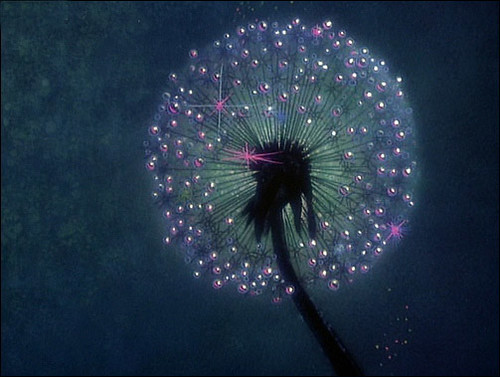
As for my interest in dandelions, that’s been with me since childhood when I first saw “The Nutcracker Suite” episode of Disney’s Fantasia. Here’s a frame grab:

That wonderful image of the dew-tipped dandelion is etched in my brain.

Monday, November 13, 2023

Disney's Fantasia as Masterpiece

This is currently the fifth most popular post at New Savanna.  I originally published it in The Valve in August, 2006; I then republished it here in November, 2010. It's about why Fantasia is one of the great works of 20th Century art. The first time I formulated that thought to myself — that Fantasia is one of the great works of 20th Century art — it took my breath away. But in time I got used to the idea. Almost.

The argument in the post, however, is at most only half the argument. It's about what happens in Fantasia, what phenomena Disney chose to represent. The other half of the argument is, it seems to me, rather more difficult to state, for it is about how things look on the screen. If the film doesn't look good, well, the representational content is not in itself enough to make compelling art. I believe, of course, that it does look good. This post on The Nutcracker Suite is part of that argument, as is this post on Dance of the Hours.
April 27, 2014: It's now the 4th most popular post. Another Fantasia post, Two Rings in Fantasia, is 3rd.
June 14, 2021: It's now the 6th most popular post. Two Rings in Fantasia is now 4th.

November 13, 2023: My sister, Sally, has just informed me that Fantasia premiered on this day back in 1940. So I'm bumping this post to the top of the queue. I've published a working paper on the film: Walt Disney’s Fantasia: The Cosmos and the Mind in Two Hours.

dandilion

In 1938 Walt Disney decided to bet the farm on an extravaganza originally entitled The Concert Feature. Disney's intention was twofold. On the one hand he would use the power of animation to present Classical Music to the Masses. Get it out of the concert hall, into the movie palace, and dress it up to make it more approachable. But also, showcase the powers of this new medium - one in which Disney had a considerable investment, both in time and imaginative effort and in money - in a way that had never been done before.

Disney secured the collaboration of Leopold Stokowski, the best-known conductor of the day (who had already been parodied in a cartoon or two) and devoted the full resources of his studio to the effort. The film premiered in late 1940 under a new name, Fantasia, and received mixed critical notices. Music critics were offended, film critics didn't quite know what to think, though some liked it. The public, for the most part, did not. The film was a financial failure, though it finally managed to break-even in the late 1960s, after Disney had died.

Fantasia is highly regarded among students of animation and has sold well in videotape and DVD. I have little sense of where it stands among more general arbiters of culture. I'm convinced it is a masterpiece. But a masterpiece of what?

Encyclopedic Forms

In 1976 Edward Mendelson published an article on “Encyclopedic Narrative: From Dante to Pynchon” (MLN 91, 1267-1275). It was an attempt to define a genre whose members include Dante's Divine Comedy, Rablais', Gargantua and Pantagruel, Cervantes' Don Quixote, Goethe's Faust, Melville's Moby Dick, Joyce's Ulysses, and Pynchon's Gravity's Rainbow. Somewhat later Franco Moretti was thinking about “monuments,” “sacred texts,” “world texts,” texts he wrote about in Modern Epic (Verso 1996). He came upon Mendelson's article, saw a kinship with his project, and so added Wagner's Ring of the Nibelung's (note, a musical as well as a narrative work), Marquez's One Hundred Years of Solitude, and a few others to the list. It is in this company that I propose to place Fantasia.

On the face of it, the idea is absurd. For one thing, the works Mendelson and Moretti discuss are securely ensconced in the Western Canon of High Art, Fantasia is a cartoon. Perhaps it occupies a significant place in popular art of the 20th century, but how could it possibly be anything more?

I'm not sure what kind of consideration this is. But I'm just going to ignore it.

The fact that Fantasia is not even a narrative - it tells no connected story from beginning to end - is a more serious matter. If genres are to be defined by intrinsic characteristics, then Fantasia fails. In a footnote Mendelson indicates that Frye discusses various encyclopedic forms in his Anatomy of Criticism, namely Menippean satire and anatomy. But Fantasia doesn't fit there either. Perhaps it is sui generis.

What is important to me is simply the encyclopedic scope of these various works. All of them seek to encompass the entire world as it was known at the time.

So does Fantasia. In the brief compass of two hours Fantasia traverses an astonishing range of . . . of what? “Human experience” would be a good phrase here, but one major segment, The Rite of Spring, concerns things which no human being could possibly have experienced. Human experience, yes. But more generally, the world.

10 hot sun.jpg


Tuesday, January 4, 2022

Fantasia and Transnational Film Culture

I'm bumping this 2012 post to the top of the queue primarily for the argument (starting halfway through) it makes about film culture being fundamentally transnational. 

* * * * *

I have argued that Disney’s Fantasia is a signal work in a film culture that is fundamentally transnational. By transnational I don’t mean universal, or anything like it. I mean only that film culture at that time, the mid-20th Century, operated across national borders and, indeed, had been doing so since its inception.

This argument goes back to a piece I’d originally published in The Valve in 2006 and republished here in 2010: Disney’s Fantasia as Masterpiece. First I want to reprise aspects of that argument and then I’ll flesh out some things I didn’t get to back then.
Fantasia as a Singular Work

In order to argue that Fantasia is a masterpiece I had to argue that it is not, as it is so often considered, an unordered collection of autonomous episodes. That the film is not a narrative is obvious. What is not so obvious is that it is, I argue, an encyclopedia. The episodes have been carefully, if unconsciously, chosen to indicate the whole of the cosmos. In making that argument I called on two literary critics, Edward Mendelson and Franco Moretti:

In 1976 Edward Mendelson published an article on “Encyclopedic Narrative: From Dante to Pynchon” (MLN 91, 1267-1275). It was an attempt to define a genre whose members include Dante's Divine Comedy, Rablais', Gargantua and Pantagruel, Cervantes' Don Quixote, Goethe's Faust, Melville's Moby Dick, Joyce's Ulysses, and Pynchon's Gravity's Rainbow. Somewhat later Franco Moretti was thinking about “monuments,” “sacred texts,” “world texts,” texts he wrote about in Modern Epic (Verso 1996). He came upon Mendelson's article, saw a kinship with his project, and so added Wagner's Ring of the Nibelung's (note, a musical as well as a narrative work), Marquez's One Hundred Years of Solitude, and a few others to the list. It is in this company that I propose to place Fantasia.

And so I did.

You’ll have to consult that old post if you want the full argument where I consider the contribution of each of the film’s eight episodes. In this post I’m concerned with only one aspect of the argument, that these encyclopedic works are special kinds of cultural markers:

One other characteristic looms large in Mendelson's formulation. These works are identified with particular national cultures and arise were these nations become aware of themselves as distinct entities. This creates a problem for his nomination of Gravity's Rainbow as an encyclopedic work because Moby Dick already has the encyclopedic slot in American letters. He deals with the problem by suggesting that Pynchon is “the encyclopedist of the newly-forming international culture whose character his book explicitly labors to identify” (pp. 1271-1272).

Fantasia presents the same problem, for, like Moby Dick before and Gravity's Rainbow after, it is nominally an American work. But there is no specifically American reference in the film. None of the music is American, none of the segments are set in America nor refer to American history or culture. It is not, in any ordinary sense, a nationalist work, an expression of national identity. Rather, it is an expression of a naïve middle-brow universalism, unaware of the cultural specificities on which it depends.

That seems right to me, a naïve middle-brow universalism, one that circulated transnationally. That’s what Disney was after and the company still pursues it, I suppose, long after the founding genius, Walter Elias Disney, has died.
Nationalism Gets in the Way

First of  all, we need to recognize that national boundaries are not good markers of cultural kinds, though nationalist ideologies insist otherwise. I’ve argued this point at some length in a working paper, Culture, Plurality, and Identity in the 21st Century. The physics conducted behind Japanese borders is not Japanese physics in any culturally significant sense. It is just physics that is done on Japanese soil in Japanese-built structures and is readily intelligible to anyone who knows contemporary physics.

Nor is the golf played on American golf courses an essentially American game merely because American citizens play it on American soil. That the game originated in Scotland is one thing; that it is now played the world over is another. What that implies about cultural identity, I don’t quite know. But we’ve got to step back from the automatic practice of hanging national labels on cultural formations.

Culture doesn’t work that way, and never has. Cultural practices have circulated freely among human groups long before the nation state was invented. Upon its invention, though, which happened relatively recently according to Eric Hobsbawm, Nations and Nationalism Since 1780 (Cambridge 1990), it set out to create a myth of cultural homogeneity within its borders. Of national languages Hobsbawm writes (p. 54):

National languages are therefore almost always semi-artificial constructs and occasionally, like modern Hebrew, virtually invented. They are the opposite of what nationalist mythology supposes them to be, namely the primordial foundations of national culture and the matrices of the national mind. They are usually attempts to devise a standardized idiom out of  a multiplicity of actually spoken idioms, which are thereafter downgraded to dialects, the main problem in their construction being usually, which dialect to choose as the base of the standardized and homogenized language.

Of France, for example (p. 60):

However, given that the dialect which forms the basis of a national language is actually spoken, it does not matter that those who speak it are a minority, so long as it is a minority of sufficient political weight. In this sense French was essential to the concept of France, even though in 1789 50% of Frenchmen did not speak it at all, only 12-13% spoke it ‘correctly’—and indeed outside a central region it was not usually habitually spoken even in the area of the langue d’oui, except in towns, and then not always in their suburbs. In northern and southern France virtually nobody talked French.

Italy was even more problematic, with only 2½ % speaking Italian in 1860 when the country was unified.

One aspect of this nationalizing process that shows up in university curricula is the teaching of national literature and history to undergraduates as an aspect of training them to be good national citizens. Ironically enough, in American universities, it was, until relatively recently, English literature that was taught to undergraduates, not American. There were no courses in American literature at Johns Hopkins when I was a student there in the 1960s, nor were there any Americanists in the faculty of the English Department. That situation was not unusual for the time, though that time has since passed.

American national mythology has it that America is a melting pot, implying that many cultures went into it but we’ve all come out the same: American. But we haven’t. America wasn’t culturally homogeneous when Disney made Fantasia and it isn’t homogeneous now.

National boundaries and national institutions, political, economic and military, certainly have cultural consequences. But they do not constitute cultural essences. Cultural formations cross national borders all the time.
Film Culture as Transnational

In this perspective, the assertion that film culture is transnational would seem almost a trivial truism. By the late nineteenth century, when motion picture technology was invented and put to practical use, European conquest had linked the world with lines of trade and exploitation, which necessarily involved global circulation of cultural materials and practices of all kinds. The World’s Columbian Exposition, held in Chicago in 1893—where Elias Disney, Walt’s father, had worked as a carpenter—had exhibits from 46 nations around the world and was attended by 27 million people. Eadweard Muybridge exhibited moving pictures of animals at the fair.

The early film industry was, of course, built on silent films. So language was no barrier to circulation of films. According to Robert Sklar, Movie-Made America (1994, p. 22) American film-makers copied the comedies of Georges Méliès as soon as they landed—copyright was not established for films until 1912. Until World War I the French company Pathé Frères was the world’s largest film producer (p. 29). The Europeans were the first to make long films, a market the American producer, Adolph Zukor entered into in 1912 (pp. 42-44).

Zukor, like many of the early movie moguls, as a Jewish immigrant from Eastern Europe. This fact prompted Neal Gabler to write An Empire of Their Own: How the Jews Invented Hollywood, in which he argues that the Hollywood film industry was built by such men used it as a vehicle to make themselves into Americans, but also to make an imagined America in their image, as Christopher Lehman-Haupt notes in this review:

But above all things, these moguls ''wanted to be regarded as Americans, not Jews; they wanted to reinvent themselves here as new men.'' And in doing so, ''the Hollywood Jews created a powerful cluster of images and ideas - so powerful that, in a sense, they colonized the American imagination.''

By the time we get to Disney—the studio was founded in the early 1920s—the American film industry may have been the largest but the industry was itself a world industry in which it was  routine for films to circulate outside their countries of origin.

That was certainly true of Disney’s cartoons, which were known around the world. Mickey Mouse, and Mickey Mouse merchandise, was not exclusively American. By the time Fantasia came out, 1940, Mickey was known around the world. By then Disney had become so dependent on overseas exhibition that the advent of World War II hurt him badly, forcing him to stop making feature films and to make propaganda and training films for the Federal Government in order to keep the studio solvent.

Disney himself may have been an example of the rags-to-riches story so central to American mythology, and he may even have thought of his films as pure Americana. But pure they were not. He and his artists borrowed freely from many cultures in making their cartoons.
Disney Culture

Consider the first five feature length films, the ones completed before Disney shut down feature production at the beginning of World War II. Two of them, Snow White and the Seven Dwarfs and Pinocchio, are based on European sources and take place in European settings. Bambi is set entirely in the woods and so could take place anywhere with the appropriate flora and fauna, which is a rather large part of the world. The many settings of the episodes in Fantasia defy easy geographical reference, though The Rite of Spring takes nothing less than the solar system as its setting. That leaves us with Dumbo, which is set in America, starting in Florida with the winter quarters for the circus. But the circus itself is a European cultural form that was brought to America in the 19th Century.

Yes, these films are American in the sense that they were made in America and it is probably the case that most of the men and women involved in the making were born in America. But not all of them. Danish illustrator Kay Nielson joined Disney in 1939 and did concept art for the Ave Maria and Night of Bald Mountain sequences of Fantasia. More to the point, Robin Allen (Walt Disney in Europe) has documented a wide range of European influences in Disney’s cartoon imagery in general. In the particular case of Fantasia Kendall O'Conner, an art director on the Dance of the Hours, asserted African and Japanese influences (quoted in John Culhane, Walt Disney's Fantasia, pp. 168, 170).

Finally, all of Fantasia’s music is European; none of it is America. This was generally true of  soundtrack music for feature films. It may have been composed by American composes, some of them European immigrants, but the idiom was 19th Century European romanticism. Cartoon music was different. While much of it was from the 19th Century European classics—which were, of course, not in copyright—swing and jazz did show up in soundtracks, but not on the soundtracks of any of these old Disney features.

So, where does that leave the cultural identify of Disney’s cartoons, but most particularly, of Fantasia? If we insist on assigning them an identity, then the obvious identity is Disney. They’re an expression of Disney culture, but not in the contemporary sense of corporate culture, where, for example, the culture of Apple is said to be different from that of Monsanto or Goldman Sachs. The cultural identity of those films is Disney in the more interesting sense that it is an amalgam of diverse cultural influences that Disney himself—for he was very much a hands-on micro-manager for at least the first two decades of his studio—authorized and, to some extent, sought out.

In this process Disney and his artists did not confine themselves to American sources. That this Disney amalgam has something of a middle-brow universalism about it, that is interesting. And it is not too difficult to see how that would have a broad transnational appeal. Not universal, though. Just transnational. A lot of people in a lot of nations like Disney films, some more than others. And many, especially intellectuals, feel that they are trite and kitschy as well, not at all authentic. That’s OK as well, though not compatible with my belief that Fantasia is one of the great works. But THAT’s a different argument.

THIS argument is simply that, in the large, film culture is inherently transnational in that, from the beginning, films have circulated across national borders and film-makers in one nation have been influenced by film-makers in other nations. Yes, there ARE national cinemas, and there is more to that than the mere location where the film is made. Any number of  Hollywood Westerns, for example, can plausibly be said to be somehow culturally American in a way that Fantasia is not. And that is my argument in the small, that Fantasia in particular is not culturally American, despite having been made in America by people who were, for the most part, American citizens.
American Culture?

Is there such a thing as American culture? I believe so, though I’m not sure just what it is. I’ve already mentioned the Hollywood Western. I think a case can be made that it is authentically American. But it hasn’t stayed in America—think of the spaghetti Westerns from Italy. There is a national political mythology that encompasses the Revolutionary War, George Washington and the cherry tree, Lincoln’s Gettysburg Address, not to mention the Constitution and any number of such documents. And there’s Thanksgiving, a specifically American holiday. And so forth.

Such things constitute the cultural formation of American identity and, as such, of course they are American. And no doubt much else besides. All nation states have cultural apparatus specifically devoted to validating national identity and thus obscuring what actually takes place, on the ground, in modern nations with international trade, travel, and communications.

It precisely on account of that nationalist mystification that I think that we must be wary of the reflexive identification of cultural formations with nation states. And these large identities such as Western, Eastern, and African culture are even more doubtful. Such reflexive and pervasive identifications beg too many questions and get in the way of understanding cultural dynamics.

* * * * *

Note: The Wikipedia has a short entry on transnational cinema:
A key argument of Transnational cinema is the necessity for a redefinition, or even refutation, of the concept of a national cinema. National identity has been posited as an 'imaginary community' that in reality is formed of many separate and fragmented communities defined more by social class, economic class, sexuality, gender, generation, religion, ethnicity, political belief and fashion, than nationality.
The references are quite recent.

Thursday, August 12, 2021

Reading Spacecraft 2: Hyperspace, a lounge at the center of the world [& the Disney version]

“Hyperspace” is the third chapter in Tim Morton’s Spacecraft, a book with four chapters plus an introduction. Let’s start with a passage near the end of the chapter. I’ve not chosen it at random, say by tossing divination sticks in the manner of John Cage I-Chinging his way toward a composition. Nor have I spent a great deal of time choosing just the right passage for this (illustrative) purpose. Because, really, any of various passages would serve.

Here we go (p. 85-86):

To the outside world you disappear when you enter hyperspace. But for you, it’s as if you’ve stepped out of the street into the lounge. Star Wars sensualizes hyperspace in this way too – hyperspace is not a place of cosmic speed and massive realizations, but rather a quiet lounge. There’s an achieved privacy. It’s soft and comfy. You can play chess. You can flirt. You can talk about boyfriends. Suddenly you arrive at your destination and your spacecraft floats a little. It’s as if you’ve been in a traveling lounge that can relocate anywhere. Then you have to get to work and do stuff like fighting or landing.

What do you think as you read that? After all, you’ve not read Spacecraft so you’re not accustomed to Morton’s way of talking. Stepped out of the street into the lounge? What street, and what lounge? What’s this have to do with Star Wars?

Morton opens the chapter in the lounge area at the center of the Millennium Falcon where Chewbacca’s paying holographic chess (p. 53). So the chapter starts in a lounge. A bit later Morton will offer a brief disquisition on lounges in which he informs you, trickster that he is, that the Falcon is itself a lounge that contains a lounge much larger than it is – in the same way that the Tardis, from another science fiction franchise, contains within it much more than could possibly be fit inside a phone booth – and that this much larger lounge is hyperspace (p. 55). How do you get to hyperspace? By hitching a ride on the Falcon. Or you can watch the Tardis tumble thought hyperspace at the beginning of a each episode of Doctor Who.

Honestly, it’s as though all those roads that lead to Rome? When you turn around and look at them all squinty-eyed, it turns out they can to hyperspace as well. Though you might have to click the heels of your red shoes to get the full effect.

Later (p. 56-57): “...hyperspace is definitely not an empty box. [...] hyperspace has a feel. Hyperspace is ‘space-feel’ just like potato chips have ‘mouthfeel’ in the PR business. [...] Hyperspace is a place.

You are perhaps confused? From hyperspace to mouthfeel to place, that’s just how it goes. How about Claude Monet’s water lilies, Einstein’s spacetime, stream of consciousness (Woolf and Joyce), “Space...has contours...is creamy...a kind of roaring blue and white curdled ocean” – I’m not making this up. I’m just collecting things as I leaf through the book. Then: Hyperspace is the ecological niche of spacecraft – their habitat.” Finally we land, with Morton telling us that the term hyperspace was coined in 1967 (p. 61). Then right back out, we’re off into Gauss and non-Euclidean geometry and “reference mollusks” (Einstein) and then Wham! Han Solo tells us: “Traveling in hyperspace ain’t like dusting crops boy” (p. 62). It sure didn’t feel that way, zipping all over the map in Morton’s OOO-charged prose.

* * * * *

It’s time to slow down and get serious. What strikes me about this chapter ¬– and it’s why I want to get to Walt Disney – is Morton’s discussion of the way hyperspace is visually presented in Doctor Who (the Tardis tumbling though a tunnel), Kubrick’s 2001: A Space Odyssey (a psychedelic light show), the Star Wars saga, more psychedelia, and the relationship between those tunnels and the ones in near death experiences, the Tibetan Book of the Dead, and DMT trips. In some cases the hyperspace tunnel is a way of getting from here to there while in other cases it’s a place where you are (for awhile). Morton discusses the kinesthetic and haptic feel of these tunnels, whether one is penetrating into the tunnel or enveloped by the tunnel (those are gender typed), and so forth. He manages to bring Plato’s cave into play, for it is a tunnel too, no? and therefor implies light, which blinds one upon leaving the tunnel.

And so (pp. 83-4, just three pages short of the passage where we began):

When we enter or “make” hyperspace, it’s also like having an orgasm. The fourth wall collapse I discussed a moment ago is a kind of orgasm of the film stock, a sudden shudder or “petit mort” as the French say about coming: la mort, l’amour. There is a sudden spring or ripple that demonstrates how not in control of our bodies we really are. We move from extreme pleasure into bliss. In the esoteric “tantric” parts of Hinduism and Buddhism bliss is a pathway beyond the ego – into the hyperspace of enlightenment.

Like Han said, it ain’t like dusting crops.

* * * * *

But it might be like the closing sequence of the “Toccata and Fugue in D Minor” episode of Disney’s Fantasia (1941). It is the first episode, of eight (plus in interlude in the middle), in the film.

During the opening toccata we see the orchestra in images like this:

We recognize the images, but we never see them fully rounded. There’s always an element of flattening.

When we move into the fugue we see quasi abstract imagery:

Tuesday, July 27, 2021

Walt Disney and the scientists, Hubble and Huxley

The photo was taken on October 24, 1940, about a month before the release of Fantasia. You can see art work for the film on the wall behind the men.

Thursday, June 17, 2021

Scaling: Fear not big numbers [Disney’s Fantasia scaled the cosmos to two hours]

Aiyana Green and Steven Strogatz, Who’s Afraid of Big Numbers, NYTimes, June 17, 2021.

... vast sums of money become more comprehensible if they are reframed in terms of more familiar amounts. In a 2009 blog post, the mathematician Terry Tao rescaled the entire United States federal budget to the annual household spending for a hypothetical family of four. In Dr. Tao’s rescaling, a $100 million line item in the budget became equivalent to a $3 expenditure for the family.

Research in psychology and science education supports Dr. Tao’s strategy. In 2017, cognitive scientists found that students could grasp extremely long time periods — say, between the extinction of dinosaurs and emergence of humans — more readily if they created a personal timeline of the most significant events in their lives and rescaled it to progressively longer time spans: all of American history, all of recorded history and so on. These students were also better than controls at estimating numbers in the billions, an ability that is vital to understanding geological time, astronomical distances or the bewildering sums in the federal budget.

To that end, we thought it could be instructive to update Dr. Tao’s exercise, this time using the numbers in Mr. Biden’s proposed 2022 budget.

Here’s the scaled budget based on total revenue of $4.174 trillion scaled to a family income of $100,000:

... as the graphic shows, this hypothetical nation-family spends about $144,000 a year, exceeding the budget by about $44,000. Most of the expenditure goes to four big-ticket items: about $29,000 to pay for Social Security, $18,000 for Medicare, the same for Defense and around $14,000 for Medicaid.

Taken together, these four items add up to almost $80,000 in expenses for our nation-family. In addition, we must still pay off the interest on the national debt, for another $7,000, plus $36,000 on other assorted mandatory programs. So exceeding the budget by as much as Mr. Biden is proposing leaves only about $22,000 to spend on the other things we care about, the so-called nondefense discretionary spending.

* * * * *

So what, you ask, does that have to do with Walt Disney’s Fantasia? Some years ago, in a blog post entitled “Disney’s Fantasia as Masterpiece”, I argued that that film scaled the entire cosmos, as it was then understood, to a moving running roughly two hours. This is not the place to reprise the whole argument – you can find that in the original blog post and in a subsequent working paper, Walt Disney’s Fantasia: The Cosmos and the Mind in Two Hours – but I can give you a taste.

Both a microcosm and a macrocosm, from the blog post:

Pyotr Ilyich Tchaikovsky - Nutcracker Suite: Six pieces, each fully representational, each presenting some aspect of the natural world, but in small compass. The virtual field of view is, say, a foot or two wide at the focal plane. Individual leaves, flowers, sprigs, spider webs, goldfish, snowflakes, and so forth loom large on the screen. The first and last pieces show faeries causing change in Nature (the transition from night to day, the procession of the seasons), while the second, third, and fifth show dancing plants; goldfish in the fourth piece seduce us with their sinuous movements and large eyes that look at us. This is an animist microcosm. [...]

Igor Stravinsky - The Rite of Spring: Here we experience 100s of millions of years of life on earth. Disney begins with an initial zoom from outside the galaxy to the earth's surface, traversing 100s of millions of miles of space. But we also see single-celled life in the early seas. And pterodactyls, all manner of terrestrial dinosaurs, a fight between a T. Rex and a Stegosaurus, violent cataclysms and storms. This may well be the first time anyone has attempted such a visualization, the origin of and evolutionary development of life. It is a naturalist macrocosm.

I wish especially to emphasize what Disney did with “The Rite of Spring,” compressing 100s of millions of years to a half hour of screen time. I dare say that is the first time it had been done – which is, I suppose, why that segment was shown in elementary schools for years. I don’t know how many times I saw it as a child, but enough so that a year came when I anticipated the day the school would be called to the auditorium to watch that film.

I don’t care that Disney got the microscopic world wrong because science has advanced considerably since then – the film came out in 1941 while, e.g. Watson and Crick published the double helix paper in 1953. Nor do I care that the climax, a fight between a T. Rex and Stegosaurus, could never have happened because the two species did not walk the earth at the same time (and I’m reasonably sure Disney’s people knew that). From a scientific point of view there are many things wrong in the film.

What Disney got right is the poetry, if you will, the scope of the movement, the evolution of the universe, the solar system, life on earth, from one time step to the next. I doubt that he intended to do that; he thought he was using a medium he knew and loved, cartoons, to sell classical music to the masses. It’s not at all clear to me that the film succeeds in that task. Where it does succeed, though, is in conveying a sense of the whole cosmos. And good old Uncle Walt didn’t even know he was doing that. He just did it.

Monday, June 14, 2021

Sampling the Space: Disney’s Fantasia [is it time for a 21st century re-realization, one that evokes the current space?]

Bumping this to the top of the queue because, well, because it's about time. The world's changing. We need a new realization of the Fantasia idea. This realization should sample the world's musics rather than remaining confined to Western Classical music. What should the visual subjects be? Perhaps choose the same general topics as the original Fantasia, from 1941, but realized in different ways.

dandilion

The following notes are an addendum to my original conjecture that Fantasia is encyclopedic in scope. That is, that it spans our knowledge of the cosmos, not by exhaustive listing, but by strategic indication. Each of the eight episodes, plus the interlude, depicts a different aspect of the cosmos – think, e.g. Rite of Spring for the cosmos large and small, Pastoral Symphony for domesticity, and so forth. If you then ask yourself, what’s the most compact subject area that embraces all of Fantasia, you’re left with nothing smaller than the cosmos as a whole.

How’d Disney do it? It was a group effort. Sure, good old Uncle Walt had the final say. But tens and hundreds of people were involved in coming up with ideas. Each searched their individual minds and offered ideas into the complex evolving system that was the production of Fantasia.

For those in digital humanities, note that I employ a mathematical metaphor, that of a space. But I don’t think of it as a mere metaphor. Done properly, it’s a model.

volcanos.jpg

I’ve been thinking about this encyclopedia notion. I like it, I think it works, but I also think it’s a bit vague. What’s it mean to “cover/imply the world”? How many and what distribution of topics does a real encyclopedia have to have in order to qualify, good and proper, as an encyclopedia? How is it that Mendelson and Moretti know that those texts are encyclopedic? Sure, they give reasons and examples – as I did for Fantasia. But that’s all after-the-fact rationalization. What’s the original “aha!” recognition about?
 
I’ve asserted that Fantasia is encyclopedic in the way that Allegro Non Troppo and Fantasia 2000 are not. I’m sure I can argue the point – though I’d want to watch them again, while taking notes, rather than work from, e.g. the Wikepedia summaries (which seem adequate to me BTW). And that argument will be a comparison and contrast talking about the sorts of things I mention in the summaries of the Fantasia episodes. There’s nothing wrong with that, but I’m looking for something more precise, more quantitative. Or, perhaps a better formulation, something that's tractable in a different way, even objective.

What I’m thinking is that encyclopedic works have to “sample the space” in a certain way. What space? It’s a metaphor, obviously, and a common one. Color space is well known and has been extensively explored by artists, physicists, and perceptual psychologists. So, imagine a space that displays all the colors in the world – somewhere on your computer you’ve got color-pickers that allow you to navigate through various color spaces. Pick three colors. Three shades of red will be relatively close together in the space while a red, an orange, and a yellow will be further apart. But a red, a blue, and a yellow will be still further apart. That red, blue, and yellow “cover” more of color space than your three reds.

That’s the sort of thing I’m looking for. Color is well understood and the little story I told in the previous paragraph can be told in fairly precise mathematical terms. Can we do the same thing for all of human knowledge?

We’re working on it. Psychologists and cognitive scientists map all sorts of things onto abstract spaces. The classic semantic differential maps the connotative meaning of words onto three dimensions, goodness, strength, and activity. The five-factors personality model maps personality onto five dimensions. Computational semanticists map texts onto spaces of relatively high dimensionality – 100s or 1000s of dimensions. That’s what’s doing on in the text-mining software that Matt Kirschenbaum talked about during the Moretti-fest.

What could this possibly mean for literary texts? Well, we’re used to analyzing texts in terms of binary oppositions: male-female, nature-culture, rural-urban, good-evil, Caucasian-Other, ancient-modern, mechanical-organic, and so on. Think of each opposition as indicating the positive and negative poles of a continuum. We can now think of each of these oppositions as a dimension in semantic space. How many such dimensions do we need to characterize the semantic space of a given text? I’m thinking that the dimensionality of an encyclopedic text will be higher than that of an ordinary narrative.

Let’s consider 19th century American novels. Moby Dick is Mendelson’s designated encyclopedic text. So we take the that text and those of other 19th century American novels, analyze them with text mining software, and arrive at something we might call the “space of minimum covering dimensionality.” The space for Moby Dick should be higher than that for any other novel. And I’d guess it would be higher by a considerably margin rather than just a bit higher.

So, the value for MD would be, say, 2364, while the values for the other texts would range between, say, 937 and 1272. The numbers aren’t important, what’s important is that there’s a big gap between value for MD and the highest value for any non-encyclopedic narrative.

Pastoral 2 Pegasus and child

How do I know this? I’m just guessing, making it up as I go along. Why do I care about this sort of thing? Because I do. I’m just playing. Don’t I think this line of investigation will, er, harm literature? No, not in the least. The texts won’t feel a thing.

ave maria

In contrast, we might say that, e.g. Oliver Twist, covers more area in some abstract space than, e.g. Hard Times, in the way that a quarter covers more area than a dime. But that’s not about dimensionality; that’s just spatial extent. Dimensionality is about the nature of the space, its structure. The difference between an encyclopedic and an ordinary narrative is like that between a sheet of paper (2D) and a cube (3D).

x5 ignition.jpg

One of the things Moretti noted (p. 5) is that these works “do not really work all that well,” are perhaps “semi-failures”. Some measure of failure, it seems to me, follows from the singular nature of these works. If you are inventing a form as you go along, you are in no position to learn from previous examples, either your own or those of others.

But these (peculiar) failures might also be the result of the dimensionality requirements of encyclopedic coverage. There’s only so much “stuff” that can be packed into a coherent narrative. High narrative coherence puts limits on the dimensionality of the space. If you want to exceed those limits, then you have to use intrusive devices or various sorts – like long passages on whale taxonomy. If you are going to break the narrative once in such a way, well, that’s a flaw, straight-up. The flow is broken, but you don’t get much in return. So, do it once, do it 37 times, a different time each way, and be clever so that the whole becomes more than the sum of these multiple narrative interruptions.

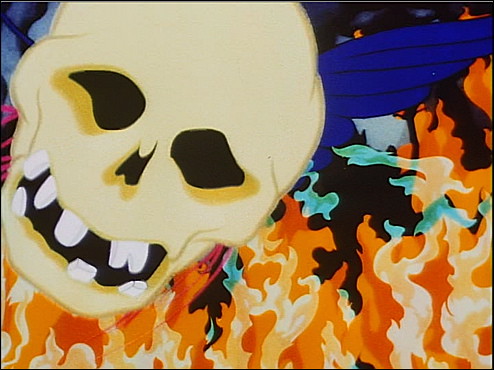
SC22 skull in hell

Why write such narratives at all? Because we need to bring the entirety of the world within the scope of a single imaginative vision. Why do we need to do that? Because that’s the way the brain is?

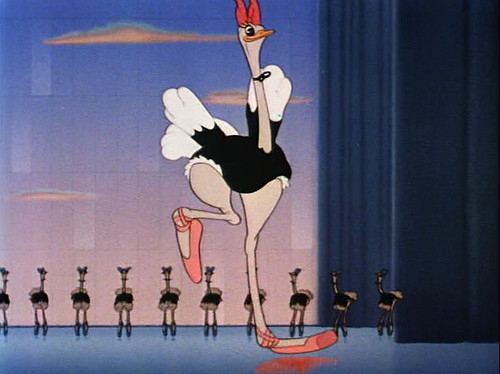
2 0 onstage.jpg

Conducting this kind of investigation for written texts is one thing. We’ve got very sophisticated tools for handling them. How would we do it for movies?

For certain movies, screen plays might be adequate proxies for the films themselves. For Fantasia, I don’t know. We might be able to work from the cue sheets used to indicate the relationships between the animation and the music. More likely, we’d have to devise a coding scheme and devise methods to analyze the codings, not only of Fantasia, Fantasia 2000, and Allegro Non Troppo, but also of ordinary narrative feature-length animated films.

9 glory

Monday, October 14, 2019

Fire in life and animation

The board of the Bergen Arches Preservation Coalition (BPAC) when on a camping trip over the weekend and, of course, we had a campfire. Since I had my camera with me, I took lots of photos of the fire. Why? Because fire is fascinating, so quick and mercurial. It's wonderful to watch.


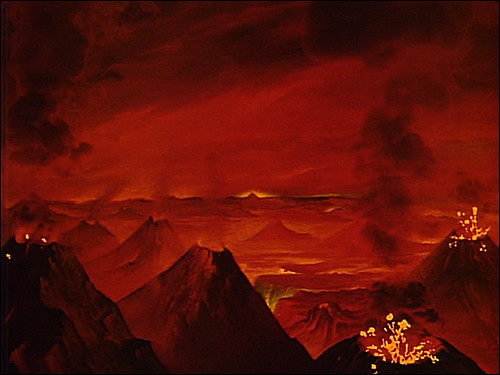
Fire has also fascinated artists. But I'm not interested in artists in general, but particular artists, the animators working for Walt Disney when the studio produced Fantasia. Fire was featured in two sequences, The Rite of Spring (volcanoes) and Night on Bald Mountain, where the devil Chernobog played with fire on his hand in one sequence.

Thursday, August 1, 2019

Disney’s Fantasia analyzed according to cultural rank


One of the trickiest aspects of the theory of cultural ranks is what happens in multirank societies. If a society is Rank 1, that’s all there is. Things change with Rank 2, which is the product of literacy. Historically, only a relatively small portion of the population would be literate, hence only a relatively small population could have rank 2 cognition, personality, and so forth. Most of the population would be of rank 1, though in a style inflected, influenced, or even reconstructed under “pressure” from the rank 2 elite. The same thing for Rank 3 and Rank 4.

Rank is a property of modes of thought, feeling, expression, and action and so resides in individuals and can be shared among individuals in a social network or a group. In a society that has Rank 3 aspects, a given individual might be, for example, rank 2 in their general outlook, rank 3 in an occupational specialty, and enjoy entertainment of ranks 1 and 2. Hays and I talked about this, and alluded to it in our publications, but never really focused on it.

As a rule of thumb we thought of middle school as providing students with rank 1 modes of thought and expression. High school is about rank 2 and broad-ranging liberal education at the college level is rank 3, though much of college is mostly intense rank 2 vocational training. As for rank 4, many programs provide specialized training in rank 4 thought. Perhaps the very best business schools provide a more general sort of rank 4 thought. But that’s as far as we took it.

With this in mind I’d like to take a quick look at Walt Disney’s Fantasia [1]. I’m thinking that, by and large, theatrical films were intended to provide rank 1 or rank 2 entertainment [2]. Disney’s intention was to present Western classical music to the masses. Classical music is of rank 3, while most popular music would have been of rank 1 or rank 2 (I discuss this in “Stages” [2]). I’m inclined to think that the images visual sequences are of rank 2, but with inflections from rank 3 realism (in particular, the use of coherent perspective) and even rank 4 abstraction (the opening Bach sequence, which was influenced by Oskar Fischinger [3]) and surrealism (“Dance of the Hours”, “Night on Bald Mountain”). Moreover, Disney animators worked hard to imbue their characters with distinct personalities and that seems to be of rank 2; it is consistent with my analysis of rank 2 narrative, which I argue is about revealing an actor's character (I discuss this in "Narrative" [2]).

And, for reasons I’d find a bit tricky to justify at the moment, so I’m taking a leap, the overall conception has a distinct reflection of rank 4. As I’ve argued, taken as whole, the film presents a cosmos, a view of the world over a wide range of temporal and spatial scales and experiential modes [4]. It’s an astonishing conception, and one not appreciated at the time; the film was released in 1940 and was not well-received, either by critics or the public. Moreover that conception was degraded in some later reissues that changed the order of the episodes and even eliminated one or more of them.

Now, let’s go behind the scenes. Disney’s film technology was absolutely state of the art mechanically, optically, and electronically. Call if rank 3, perhaps with a bit of rank 4. Disney’s personnel would have had skills at ranks 1, 2, and 3 as required for their jobs. And, you know, I’m going to take another wild leap and say that the overall organizational conception was of rank 4, though it’s possible that there wasn’t a single rank 4 thought in anyone’s mind. But, you know, not terribly likely [5]. Neither Walt nor his brother Roy, who ran the business side of the company, had any education beyond high school. But, by the time they started producing feature-length films, Walt Disney Studios was probably as sophisticated an enterprise as any one of any kind anywhere.

Animated films were at the center of the business. And the animators were at the center of that. How do you organize sophisticated and temperamental artists to produce on an assembly-line basis? For that is what the business required. And then we had international distribution and merchandising. And so forth and so on. No, Walt Disney Studios was a very sophisticated operation. I’m calling it rank 4. Perhaps just barely so, but that’s what it is.

The point is that various ranks or cognition and expression can exist side-by-side and intermingled in a single complex phenomenon, in this case an animated film. The point holds regardless of whether or not my characterizations of various aspects of Fantasia and of Walt Disney Studios are accurate. It’s the multiplicity and intermingling that’s important.

References

[1] I’ve written a extensively about this film, but not from a ranks perspective. See William Benzon, Walt Disney’s Fantasia: The Cosmos and the Mind in Two Hours, November 30, 2011, 99 pp., https://www.academia.edu/1128493/Walt_Disney_s_Fantasia_The_Cosmos_and_the_Mind_in_Two_Hours.

[2] Hays and I did write about expressive culture:

David G. Hays, The Evolution of Expressive Culture. Journal of Social and Evolutionary Systems, 15: 187-215, 1992, https://www.academia.edu/9547332/The_Evolution_of_Expressive_Culture.

William L. Benzon, The Evolution of Narrative and the Self. Journal of Social and Evolutionary Systems, 16(2): 129-155, 1993, https://www.academia.edu/235114/The_Evolution_of_Narrative_and_the_Self.

William L. Benzon, Stages in the Evolution of Music. Journal of Social and Evolutionary Systems, 16(3): 283-296, 1993, https://www.academia.edu/8583092/Stages_in_the_Evolution_of_Music.

[3] Wikipedia, Oskar Fischinger, https://en.wikipedia.org/wiki/Oskar_Fischinger.

[4] Fantasia as Masterpiece, New Savanna, blog post, https://new-savanna.blogspot.com/2010/11/disneys-fantasia-as-masterpiece.html. This post is included in the working paper on pp. 3-8.

[5] But gosh, I really like the idea that the overall business operation could be rank 4 without having a rank 4 thought in anyone’s head. We could say that the rank 4 character is an “emergent” property of the interaction among the various actors in the business. And then, if and when someone starts to think about and explicitly rationalize the business, rank 4 thoughts begin to crystallize in particular people.