Showing posts with label regulate-mind. Show all posts

Monday, August 25, 2025

Five Hacks To Enhance Your Pleasure In The Bedroom

The five hacks:

  1. Support your nervous system (0:58)
  2. The Intimacy Accelerator (1:20)
  3. Bridging Activities (2:30)
  4. Figure Out What You Like (5:00)
  5. Use Lube (6:30)

I note that the first three are about regulating your behavioral mode (as I've discussed it here and there on the Savanna). No. 3 in particular is about transitioning from one mode (e.g. work mode) to sexuality. The last two are about sexual activity itself. 

FWIW I think that learning to regulate one's behavioral mode is one of the most important skills a person can have. I'm still figuring it out.

Sunday, March 17, 2024

What we can learn from toddlers about well-being

Jancee Dunn, Who Has the Secret to Well-Being? The Answer May Surprise You. NYTimes, Mar. 17, 2024. From the article:

Try positive self-talk.

Young children tend to coach themselves out loud, a practice known as private speech (such as this popular clip from a 4-year-old snowboarder).

Toddlers aren’t shy about self-talk, Dr. Merali said, and you shouldn’t be, either. Research suggests that for adults, positive self-talk can help with problem-solving, learning, confidence and managing your emotions.

Take any opportunity to move.

Two-year-olds are active for almost five hours a day, according to a review of 24 studies. They move joyfully and instinctively, Dr. Merali said.

Adults can look for ways to move more, even if it’s just for a minute.

That's one thing that's a drag about my current living situation. There's not much room for me to pace the floor, which I love to do.

Ask questions.

Young kids are not afraid to pose questions, Dr. Merali said. One study found that they asked an average of 107 questions an hour. (This will not surprise their parents.) [...]

Adults have been socialized to hold back our questions because we’re often worried about what other people think, Dr. Merali said. But asking questions not only helps us to gain information, it’s also an important way to build relationships, he said. [...]

Fix your sleep schedule.

Toddlers thrive on routine, and having a schedule with consistent sleep and waking times will help you, too, said Alberto Ramos, a sleep neurologist and researcher with the University of Miami Miller School of Medicine.

If your schedule permits, and if you have the urge, napping also has a host of benefits, including sharper thinking and reaction times and improved memory.

Yes, I love naps, always have. And then there's laugh when you can:

One study found that young children laugh six times as much as adults. But we can seek ways to build playfulness and humor into our day.

Wednesday, March 13, 2024

Multi-tasking and its vicissitudes [consciousness]

Anna Borges, A Multitasker’s Guide to Regaining Focus, NYTimes, March 11, 2024.

Doing a single task:

First, “multitask” itself is typically a misnomer. According to experts, it’s not possible to do two things at once — unless we can do one without much thinking (like taking a walk while catching up with a friend).

“Usually, when people think they’re multitasking, they’re actually switching their attention back and forth between two separate tasks,” said Gloria Mark, a professor of informatics at the University of California, Irvine, and author of “Attention Span: A Groundbreaking Way to Restore Balance, Happiness and Productivity.”

Let’s consider what happens when you engage in a single task like cooking dinner. From the moment you decide what to make, different regions of your brain, collectively referred to as the cognitive control network, collaborate to make it happen, said Anthony Wagner, a professor of psychology at Stanford and the deputy director of the university’s Wu Tsai Neurosciences Institute.

This network includes areas of your brain that are involved in executive function, or the ability to plan and carry out goal-oriented behavior. Together they create a mental model of the job at hand and what you need to accomplish it. Your brain might do this, Dr. Wagner said, by drawing on both external and internal information, like the ingredients in your fridge or your memory of the recipe.

Switching cost:

As you would probably expect, the potential harm varies depending on the activity and how adept you are at doing it. But, generally, “when we switch between tasks, we pay what’s been dubbed a ‘switch cost,’” Dr. Wagner said. “We’re going to be slower and less accurate than we would have been if we stayed on a single task.”

Speed and precision aren’t the only risks, either. Multitasking is more cognitively demanding, even when we’re doing things we find enjoyable or easy. When we multitask, we can tax our working memory, or our ability to hold and handle information in our mind, Dr. Byers explained. “The more we overload that system and the more we’re trying to keep in our brains at once, the more mental fatigue it can lead to,” she said. And other studies have found that multitasking can set our heart racing, raise our blood pressure, trigger anxiety, dampen our mood and negatively impact our perception of the work at hand.

The article then goes on with advice for focusing on one thing at a time, which is all well and good. For example:

Dr. Mark suggested you start by observing yourself throughout the day, noticing when and how you task-switch without realizing it. From there, the advice is simple yet challenging: You’ll need to practice monotasking, or doing one thing at a time, to gradually retrain your focus and build your tolerance.

Then we have: When to keep multitasking ... by sticking to your strengths weighing the risks, finding break points, and, finally, Use multitasking when it actually helps. And so forth, yada yada, as they said on Seinfeld.

This is all about one of my current hobby-horses, and a recurring theme here on the Savanna, regulating the mind, which is in turn about consciousness. It puts me in mind of Walter Freeman's speculation that consciousness is like frames in a motion picture, flitting from frame to frame at the rate of about 10 frames (of consciousness) per second. I discuss this in, e.g. this post: Two more thoughts on ChatGPT: Conceptual spaces and system time-steps. You might also want to look at an old working paper: Music and the Prevention and Amelioration of ADHD: A Theoretical Perspective. For that matter, I've got a number of posts that mention ADHD, which, I suppose, could be characterized as involuntary multi-tasking.

Friday, March 1, 2024

Mind Regulation in the 4th Arena

I’ve been thinking and writing a bit on the theme of a coming Fourth Arena, where the First Arena is the world of inanimate matter, the Second is the world of life, and the Third is the world of culture. What’s the Fourth about? I don’t know.

But I’m thinking it has something to do with mind. I figure mind arose in the universe in the Second Arena. Just where in the Second Arena (hereafter A2), I don’t know. I doubt that it makes sense to ascribe minds to bacteria. To insects maybe? Not likely. Vertebrates, sure, somewhere among the vertebrates. I’m not sure where, but it doesn’t matter now.

But with A3, mind can elaborate itself through culture. What’s next beyond culture? Not sure, and not sure where this is beginning.

What I’m thinking about is mind-regulation and, in particular, mind-regulation in conjunction with “intelligent” computers. If we’re going to be working more closely with a variety of computers, what’s that imply about mind-regulation? Here I’m not thinking about Musk-style physical linkage between brains and computers, though – who knows? – we may well have that for non-therapeutic purposes, for mind-augmentation or whatever. 

What if I set out to deliberately alter my mood through interacting with ChatGPT? 

At the moment I’m thinking more along the lines of my various interactions with ChatGPT. For the most part they just same-old same-old; nothing happening. Every once in a while, however something special happens, and I’m delighted, laughing to beat the band. I’m thinking, in particular, about moments during the sessions in which I created the story of the OpenWHALE, whaling ship of between two worlds, of the Jolly Green Giant chronicles. I didn’t create those things for the purpose of provoking laughter in myself, or in anyone else. But what if I did? What if I set out to deliberately alter my mood thought interacting with ChatGPT?

That’s the kind of thing I have in mind. We do all kinds of things to alter our mood. We take drugs of various sorts. Meditation. Bio-feedback. We go to movies, listen to music, read books, and so forth. We may do those things for entertainment, but they also change our mood – and isn’t entertainment itself mood-changin?

I’m thinking of other things as well. Writing sometimes comes easily to me, other times it comes hard. Sometimes I avoid it, put it off, for reasons I don’t understand – I’m doing that right now with my report on last year’s work with ChatGPT. Would interaction with a computer assistant help me over the hump? Could we create computer assistants that come to know our moods and adjust themselves accordingly? Is that what virtual reality is for?

I don’t know. I’m thinking about it. 

What about computers and the flow states they enable?

The right to disconnect

Over at Crooked Timber John Quiggin has a piece, Back to the office: a solution in search of a problem (feb. 27, 2024) where I read:

But the rise of working from home and, more recently, Labor’s right to disconnect legislation pose unprecedented threats to the power of managers over information workers — those employees formerly known as “office workers.”

I'd never heard of such legislation. Apparently it's now a thing:

The right to disconnect is the idea that employers shouldn’t require employees to perform any work-related duties outside their set work hours. The concept suggests workers have the right to a personal life that isn’t interrupted by tasks, such as answering messages or completing projects, once they’ve “clocked out” for the day.

While this isn’t a particularly new idea, the right to disconnect has gained popularity due to the increase in mobile technology and remote work. More employees are working from home, which can sometimes lead to employers reaching out to them more outside of traditional workday hours. But this accessibility can have a negative impact on a worker’s physical and mental health.

That’s why new legislation is circulating about the right to disconnect—although it’s not without pushback. Some employers believe they’re too vague, unenforceable, not flexible enough across time zones, and can’t work for every type of organization.

That article, at PeopleKeep, goes on to list some examples:

  • France passed a law in January 2017 requiring employers and unions to support employees' right to disconnect in a way that works best for their business. While the method used to comply with this law is up to the employer, some ideas include having a cut-off time to respond to emails or redirecting emails to other workers when the cut-off point begins.
  • In December 2018, Spain created a remote working law, which includes the right to disconnect to promote a proper work-life balance. The law requires employers and employees to agree on a specific time of day to limit all work-related communication.
  • Since January 2022, employers in Portugal with ten or more staff members may face a penalty if they contact their employees outside of regular work hours. The “right to rest” law also allows employees to work from home if they have kids under eight years old.
  • Ontario enacted its right to disconnect law in June 2022 as part of the Working for Workers Act1. It requires businesses with more than 25 employees to have a written policy allowing workers to disconnect outside regular work hours. Before this law, employers typically didn’t ask Ontario employees to work more than eight hours daily.

Tuesday, February 27, 2024

Has the pandemic “broken the back” of 9 to 5?

John Quiggin at Crooked Timber, Back to the office: a solution in search of a problem (2.27.24):

Once the lockdown phase of the pandemic was over, workers were in no hurry to return to the office. The benefits of shorter commuting times and the flexibility to handle family responsibilities were obvious, while adverse impacts on productivity, if any, were hard to discern.

Sceptics argued that working from home, though fine for current employees, would pose major difficulties for the “onboarding” of new staff. Four years into the new era, though, around half of all workers are in jobs they started after the pandemic began. Far from lamenting the lack of office camaraderie and mentorship, these new hires are among the most resistant to the removal of a working condition they have taken for granted since the start.

Nevertheless, chief executives have issued an almost daily drumbeat of demands for a return to five-day office attendance and threatened dire consequences for those who don’t comply. Although these threats sometimes appear to have an effect, workers generally stop complying. As long as they are still doing their jobs, their immediate managers have little incentive to discipline them, especially as the most capable workers are often the most resistant to close supervision. Three days of office attendance a week has become the new normal for large parts of the workforce, and attempts to change this reality are proving largely fruitless.

The upshot is that attendance rates have barely changed after more than two years of back-to-the-office announcements. The Kastle Systems Back to Work Barometer, a weekly measure of US office attendance as a percentage of February 2020 levels, largely kept within the narrow range of 46 to 50 per cent over the course of 2023.

This fact is finally sinking in. Sandwiched between two pieces about back-to-the-office pushes by diehard employers, the Australian Financial Review recently ran up the white flag with a piece headlined “Return to Office Stalls as Companies Give Up on Five Days a Week.”

This trend, significant in itself, also marks a change in power relations between managers and workers. Behind all the talk about “water cooler conversations” and “synergies,” the real reason for demanding the physical presence of workers is that it makes it easier for managers to exercise authority. The failure of “back to the office” prefigures a major realignment of power relationships at work.

Conversely, the success of working from home in the face of dire predictions undermines one of the key foundations of the “right to manage,” namely the assumption that managers have a better understanding of the organisations they head than do the people who work in them. Despite a vast literature on leadership, the capacity of managers to lead their workers in their preferred direction has proved very limited.

I would add that we all have different biorhythms and are alive to various kinds of tasks at different times of the day. I’m a morning person and tend to do my most intellectually demanding work in the morning. Can I do intellectual work in the afternoon, or even the evening? Sure, but I’m best in the morning. And there are times, when I’m on a hot streak, that I’ll do excellent work in a one or even two-hour stretch in the middle of the night. When you work from home, as I’ve been able to do most of my adult life, you have more control over when you do what. And that likely increases one’s productivity rather than detracts from it.

Saturday, February 24, 2024

Why snow days are good for kids

Michael Venutolo-Mantovani, What kids lose without snow days, Vox, Feb. 24, 2024.

With the proliferation of virtual learning, do kids even get to enjoy the magic of an unexpected snow day anymore? Are true snow days an endangered species?

Earlier this month, nearly 1 million students in New York City’s public school system learned that their schools would remain open, despite the threat of a predicted half-foot of snowfall (in the end, estimates ended up being a bit high, with John F. Kennedy International Airport reporting just over 4 inches of accumulation). Classes would be held virtually, they were told — even though there was a network outage that prevented smooth proceedings. There was plenty of pushback, even including some reports of teachers telling parents to ignore the edict from Mayor Eric Adams.

But the point remained: Access to virtual learning was robbing kids of one of the premier highlights of youth (at least in those geographical sweet spots like New Jersey, where snow falls sometimes in the winter).

Adams’s comments that New York City had to “minimize how many days our children are just sitting at home making snowmen,” completely disregarded the social needs of a generation of overworked and overstressed children.

Because there’s nothing wrong with a day or two spent sitting at home, making snowmen. At least not according to Melanie Killen, a professor of human development and quantitative methodology at the University of Maryland.

“Snow days need to be sledding days,” she said. Snow days offer “a different kind of learning ... an important kind of learning.” [...]

“I wouldn’t necessarily call it a ‘brain break,’” Killen said. “Kids are out there using their brains in different ways on snow days. It’s a break from the traditional teacher-children dissemination, which kids need.”

Killen likened the typical snow day of the past to something like an extended recess, highlighting how during that less structured playtime, kids continue to learn. She added that almost everything about playing in the snow offers some sort of quantifiable lesson about the world.

YES! There's more at the link.

Saturday, January 6, 2024

Meditation, Psychedelics, Computers, and the Mind

Early in the millennium I had an idea for a book, tentatively entitled, Mind Hacks R Us: Computing & Tripping to the Millennium's End, and I wrote a formal proposal under that title. I was unable to find a taker, but I kept the proposal around.

The rest of this post consists of two sections. The first is the prose introduction to the proposal. The second is a series of queries I put to ChatGPT about meditation, psychedelics, the computers, and the mind. What I’ve got on my mind, obviously, is what the future could hold:

Beyond AI displacing workers, creating new kinds of jobs, and solving all sorts of puzzles and problems, what are the possibilities for the general development of and flourishing of minds?

I’ve written about a Fourth Arena beyond the three arenas that the universe has so far evolved: inanimate matter, life, and culture. That’s where this post is headed. Note that I have a variety of posts under the tags, mhacks, and Arena.

Mind Hacks R Us

During the last half of the 20th century various groups of insiders and outsiders adopted mind-altering drugs and computer technology to create cultural spaces in which we imagined and realized new venues for the human mind. These spaces engaged fundamental issues of freedom and control, of emotion and reason, which have bedeviled humans everywhere, and elaborates them in the through modern science and technology. The psychoactive drugs which, in some sense, free us, have been synthesized through laboratory techniques we have invented, but only recently. The computers which extend our powers of control and order in often surprising ways embody logical forms that date back to Aristotle but where only recently brought to fruition in the late nineteenth century work of George Boole and others. Science and technology thus provide us with objective physical touchstones for the otherwise abstract powers and activities of our hearts and minds.

Taken together with that great Victorian invention, childhood innocence, the technologies of drugs and computers would constitute a cultural arena which served as incubator, nursery, and playground for some of the major lines of development in late twentieth century culture. For, if a society is to progress it needs cultural playgrounds where new ideas can be conceived, tested and developed. Psychedelic drugs and computing – and their associated cultures – functioned as such playgrounds in the latter half of the 20th century. They were, in fact, among the most important cultural playgrounds in America.

Given the fundamental differences between drugs and computers – what they are and how people use them, between Dionysian drugs and Apollonian computers – it is not surprising that different groups of people have been most interested in one or the other. What is most curious is that these people, and their creations, have often interacted, either directly or indirectly. In some cases, drug people and computer people are one and the same, as was the case in the San Francisco-Silicon Valley area during the 1970s.

Well before that, back in the 1950s, the Josiah Macy Foundation sponsored one series of high profile conferences about psychoactive drugs and another about computers. The cybernetics conferences – a series of about a half dozen of them – were chaired by MIT’s Grand Old Man of neuroscience, Warren S. McCulloch, and included such scientific luminaries as John von Neumann, Norbert Wiener, Claude Shanon, Gregory Bateson and Margaret Mead. Late in the decade, with the help of money from the CIA, the Foundation sponsored conferences on LSD; Bateson and Mead figured in those conferences as well. Both drugs and computers promised to reveal, in their different ways, the material basis of mind. And both were new in the 1950s, and so held forth only promise – but promise of what?

The answer to that questions depends, of course, on what people were looking for, what they wanted beyond what they knew and understood. In one way or another people looked to drugs and computers for powers beyond the ordinary, for transcendence of the human condition, and, more rarely, for insight into that condition. Thus if we are to understand the way in which drugs and computers have affected our culture over the last 50 years, we have to start with the aspirations we brought to drugs and computers.

Back in 1940s – and before – and continuing through the present. Animated films directed specifically at children (with their parents in tow) is the matrix in which these forces were brought together, a “universal kid space” in which fancy and fantasy are given full-rein. Walt Disney is the key catalytic figure. The images themselves came to depict human movement with a gravity-defying fluid grace heretofore realized only in the abstract designs of music, though shamans have imagined themselves in such flights while under the ritual influence of sacred drugs and sacred music. But the technology required to create those images embodied a relentless assembly-line logic that was new in the scope and precision of its repetitive actions. By directing these animated pictures specifically at children, film-makers freed themselves from the bonds of reality and allowed themselves freely to imagine idealized worlds quite unlike any places that humans had actually seen and inhabited. Disney’s Fantasia is the apotheosis of this cultural movement. It represents a fully-adult imaginative achievement that would have been impossible to those particular adults, raised as they were, without the facilitating guise of a commercial product aimed at children.

Fantasia, then, is the starting point for my main narrative. Psychedelic drugs take the mind to a different dimension, one that is often as more real than the mundane world. So it was with Fantasia. But Fantasia was constructed in a technological matrix which would soon give birth to the digital computer and, along with it, another series of idealized versions of human possibility, of a future in which machines relieved us of further work and toil. That too was part of the Disney vision.

From there I follow the development of computers and the emergence of psychedelic drugs as people use them to explore different ways of solving the same socio-cultural problem: How do you take the best aspects of the child-oriented world of animated films and make it the basis of a way of life? We have to drop the posture that this fantasy world is only for children and find a way to accept and rework selected aspects of it into lived adult reality.

Psychedelic culture dealt with this problem by trying out an ethic of in-the-moment hedonism that also included strains of romantic pastoralism, on the one hand, and Eastern mysticism on the other. Computer culture dealt with the same issues by offering a workplace ethic of libertarian entrepreneurship and dreams of a future where everyone can achieve a technologically-supported nirvana. These lines of cultural development have converged on science fiction, fantasy, and games as common venues for cultural exploration and expression. In either case, life is conceived along different lines than those described in the buttoned-down middle-class combat zone depicted in William Whyte, The Organization Man, David Riesman, The Lonely Crowd, or Vance Packard, The Status Seekers.

This cultural reworking is by no means complete. Nor has it been an easy matter. On the contrary, it has often been confusing, difficult, and painful. As such things always are. Always.

ChatGPT on meditation, psychedelics, the computers, and the mind

What can you tell me about the various styles and practices of meditation?

Meditation encompasses a wide range of practices and styles, each with its unique techniques, goals, and cultural origins. Here are some of the most popular styles and practices of meditation:

  1. Mindfulness Meditation (Vipassana):
    • Originating from Buddhist traditions, mindfulness meditation involves paying attention to the present moment without judgment. It often focuses on breath awareness and observing thoughts and sensations.
  2. Transcendental Meditation (TM):
    • TM is a mantra-based meditation technique. Practitioners repeat a specific mantra to achieve a state of relaxed awareness, promoting inner calm and stress reduction. TM has its roots in ancient Vedic traditions.
  3. Loving-Kindness Meditation (Metta):
    • This form of meditation emphasizes the cultivation of love and compassion. Practitioners focus on sending positive intentions and well-wishes to themselves and others, gradually expanding the circle of compassion.
  4. Zen Meditation (Zazen):
    • Rooted in Zen Buddhism, Zazen involves sitting in a specific posture and focusing on the breath or a koan (a paradoxical question or statement). The goal is to develop insight and experience a direct, unmediated awareness of existence.
  5. Yoga Nidra:
    • Also known as yogic sleep, Yoga Nidra is a guided meditation that induces a state of conscious relaxation. It's often used for deep relaxation and stress reduction, allowing practitioners to explore the inner world through guided imagery.
  6. Guided Meditation:
    • In guided meditation, a teacher or a recording leads participants through a series of visualizations or mental exercises. It can be tailored for various purposes, such as stress relief, personal growth, or healing.
  7. Body Scan Meditation:
    • This mindfulness-based practice involves systematically bringing attention to different parts of the body. It helps increase body awareness and release tension.
  8. Chakra Meditation:
    • Derived from Indian spiritual traditions, chakra meditation involves focusing on energy centers (chakras) within the body. Practitioners aim to balance and align these energy centers for overall well-being.
  9. Mantra Meditation:
    • Beyond TM, various meditation practices involve repeating specific sounds, words, or phrases (mantras). This repetition can help quiet the mind and deepen concentration.
  10. Movement-Based Meditation (Tai Chi, Qigong):
    • Practices like Tai Chi and Qigong combine meditation with gentle, flowing movements. These aim to cultivate mindfulness, balance, and harmony between mind and body.
  11. Breath Awareness Meditation:
    • Focusing on the breath is a common element in many meditation practices. Techniques range from simple breath awareness to more structured practices like Anapanasati in Buddhist traditions.

It's important to note that the effectiveness of meditation can vary from person to person, and individuals may find that different styles resonate with them at different times in their lives. Experimenting with various techniques can help you discover what works best for your preferences and goals.

Thursday, January 4, 2024

Update: My mood over the long term [intellectual productivity]

As you may know, I use my posting pattern as a gauge of my overall long-term mood. The better my mood, the more I post in a month. I’ve written about this a number of times, most recently in mid-September of this year, New Savanna Moods: I was down, but I’ve started back up. The trend I reported in that post has continued through the end of the year, with a total of 112 posts in September, 120 in October, 132 in November, and 111 for December. Here’s how things look for the last three years:

And here’s how things look over the life of New Savanna, starting back in June 2010:

The overall trend is up. Last year (2023) is my highest annual total: 1004. Then we have 2019 (912) followed by 2018 (871).

I should note, however, that prior to September of 2018 I had not been posting tweets to New Savanna, though I joined Twitter in October of 2011. In terms of psychic energy, tweet posts are cheap posts, so I tend to think that some of the increase since has to be discounted in the sense that the increase doesn’t reflect my mood, rather it reflects ease of posting.

See also, A Mind Over the Long Haul: My Posting Patterns For that matter, take a look at this while you're at it, What is depression? [an umbrella term]..

Saturday, September 16, 2023

New Savanna Moods: I was down, but I’ve started back up.

I have, at various times, written about how my general mood is subject to long-term swings, apparently seasonal. I go down in the fall or winter and come back up in spring: A Mind Over the Long Haul: My Posting Patterns.

This has been going on, it seems like, my entire adult life, starting in young adulthood (my freshman year in college). At one time a friend suggested that I had seasonal affective disorder (SAD). I never really checked that out, though earlier this year I thought about getting those bright lights that are supposed to stave it off.

Anyhow, things changed this year. Look at this chart, which depicts my monthly blogging frequency since 2021:

We see the standard pattern in 2021. There’s a big drop from August to October, to a low in November. I start back up in December, but don’t come back until April.

In 2022 again, have a big drop between August and September, a low in November, but then I shoot up in December up through April and then, whoops! back down for May. What happened?

At the end of November 2022 Open AI released ChatGPT to the web. I started playing with it, a lot, and got back to blogging, a lot. I kept that going through the end of April, when I lost intellectual and creative steam. But then, late in August, things started back up (I wrote over half of the August posts in the last week of the month). My thinking has come back.

Why? Interesting question. I don’t really know. Let’s just leave it for now and move on.

If my winter slumps were due to SAD, then that shouldn’t have happened. Sure, there’s ChatGPT, so what? Why should that make a difference if my mood is controlled by biochemical events that are cued by seasonal variations in illumination? But what if my moods are not cued by the weather? What if something else is going on and, whatever that is, it just happened to more or less coincide with seasonal variations in light?

NOTE: The bar for September of this year, at the far right of the chart, is a guess. I set the number at 90 so the chart would show what I think is going on. The month isn’t over yet. It’s the 16th. When this post goes up I’ll have 50 for the month. I’m over half way to 90 and I still have half a month left.

Tuesday, August 25, 2020

Perhaps these conditions aren't mental disorders at all (anxiety, depression, PTSD)

What if mental disorders like anxiety, depression or post-traumatic stress disorder aren’t mental disorders at all? In a compelling new paper, biological anthropologists call on the scientific community to rethink mental illness. With a thorough review of the evidence, they show good reasons to think of depression or PTSD as responses to adversity rather than chemical imbalances. And ADHD could be a way of functioning that evolved in an ancestral environment, but doesn’t match the way we live today.

Adaptive responses to adversity 
Mental disorders are routinely treated by medication under the medical model. So why are the anthropologists who wrote this study claiming that these disorders might not be medical at all? They point to a few key points. First, that medical science has never been able to prove that anxiety, depression or post-traumatic stress disorder (PTSD) are inherited conditions.

Second, the study authors note that despite widespread and increasing use of antidepressants, rates of anxiety and depression do not seem to be improving. From 1990-2010 the global prevalence of major depressive disorder and anxiety disorders held at 4.4% and 4%. At the same time, evidence has continued to show that antidepressants perform no better than placebo.

Third, worldwide rates of these disorders remain stable at 1 in 14 people. Yet “in conflict‐affected countries, an estimated one in five people suffers from depression, PTSD, anxiety disorders, and other disorders,” they write.

Taken together, the authors posit that anxiety, depression and PTSD may be adaptive responses to adversity. “Defense systems are adaptations that reliably activate in fitness‐threatening situations in order to minimize fitness loss,” they write. It’s not hard to see how that could be true for anxiety; worry helps us avoid danger. But how can that be true for depression? They argue that the “psychic pain” of depression helps us “focus attention on adverse events... so as to mitigate the current adversity and avoid future such adversities.”

If that sounds unlikely, then consider that neuroscientists have increasingly mapped these three disorders to branches of the threat detection system. Anxiety may be due to chronic activation of the fight or flight system. PTSD may occur when trauma triggers the freeze response which helps animals disconnect from pain before they die, and depression may be a chronic activation of that same freeze response.
The article linked in the first paragraph: Kristen L. Syme, Edward H. Hagen, Mental health is biological health: Why tackling “diseases of the mind” is an imperative for biological anthropology in the 21st century, Yearbook Phys Anthropol. 2020;171 (Suppl. 70):87–117, https://doi.org/10.1002/ajpa.23965
Abstract: The germ theory of disease and the attendant public health initiatives, including sanitation, vaccination, and antibiotic treatment, led to dramatic increases in global life expectancy. As the prevalence of infectious disease declines, mental disorders are emerging as major contributors to the global burden of disease. Scientists understand little about the etiology of mental disorders, however, and many of the most popular psychopharmacological treatments, such as antidepressants and antipsychotics, have only moderate‐to‐weak efficacy in treating symptoms and fail to target biological systems that correspond to discrete psychiatric syndromes. Consequently, despite dramatic increases in the treatment of some mental disorders, there has been no decrease in the prevalence of most mental disorders since accurate record keeping began. Many researchers and theorists are therefore endeavoring to rethink psychiatry from the ground‐up. Anthropology, especially biological anthropology, can offer critical theoretical and empirical insights to combat mental illness globally. Biological anthropologists are unique in that we take a panhuman approach to human health and behavior and are trained to address each of Tinbergen's four levels of analysis as well as culture. The field is thus exceptionally well‐situated to help resolve the mysteries of mental illness by integrating biological, evolutionary, and sociocultural perspectives.
FWIW, this line of thought is consistent with my sense of why I enter a melancholy phase at the beginning of the year. Here's three paragraphs from a post where I talk about that:
I do think my mood follows my productivity, or vice versa, and that’s what’s interesting. David Hays once conjectured that melancholy (aka depression) is the price you pay for large-scale reorganization or the sort implied by creativity. “Reorganization” is a term of art from William Powers’s account of the mind. It is so deeply embedded in that theory that there is, alas, no easy gloss.

Start out by thinking of learning. When you learn, your mind is also reorganizing on a large scale. Now think of mourning as well. When you mourn the loss of someone close you have to reorganize your mind for life without them. You don’t actually learn anything, but you have to figure out how to function in those situations where you would have go to that person. It’s unlearning.

In order to be creative you must first unlearn on a large scale. That is accompanied by melancholy. That, on this view, accounts for those troughs in my intellectual output, which is mostly though not entirely through New Savanna. That creates some “slack” in the system. Once enough unlearning has taken place I can then think new thoughts and my productivity goes up. When the slack has been used up, it’s time for more unlearning./blockquote>

Sunday, January 12, 2020

Hilary Hahn on daydreaming as a mode of practicing music, of priming yourself to go with the flow in performance

Some time in the last week I discovered TwoSet Violin, a YouTube channel for two Australian violinists, Brett Yang and Eddy Chen. They are classically trained and are perhaps the most interesting musical comedians since Victor Borge – though admittedly, musical comedy, in the sense of comedy acts organized around musical performance, is a scarcely populated genre. They’ve done a number of videos with Hilary Hahn, the classical violinist, who has also performed with them in some live concerts.

The following video is an hour and a half of conversation between the three of them. It starts off with chit-chat about being a performer, the logistics of touring, this that and the other, and then hits pay dirt when Hilary talks about daydreaming when she practices.


Of course, I know about daydreaming. And I know about daydreaming while practicing, too (I’m a semi-virtuoso jazz trumpeter). But daydreaming is something that’s been extensively studied, in one way or another, by contemporary neuroscience, and is associated with a complex of neuro-functional areas known as the default mode network (which I’ve blogged about). So I’ve transcribed some of that conversation below.

Starting at roughly 55:54:
Hilary: I daydream a lot when I practice. I don’t practice full volume all the time. I don’t practice like I’m performing. I’m daydreaming about the music. I’m playing it but I’m thinking what could I do? Can I do more of this here, or could I do more of that there? I just kind of leave my mind blank to see if something suddenly occurs to me that I wanna’ then practice, expound up on in the practice session. [...]

I don’t do visualizations, I guess. I don’t know. I’ll be practicing and I’ll think...Well, I kind of want to...

Brett: You talk about tinkering with practice.

Hilary: Yeah.

Brett: How does that work? Because it’s – I mean –

Eddy: I think a lot of people watching this would love

Eddy & Brett: to know how to

Eddy: Even help their own practice improve in efficiency, right?

Brett: What goes on in the mind of Hilary Hahn?
There’s a bit of chat back and forth in which they agree that Hilary will give a demonstration a bit later (at 1:22:22). She makes it clear she’s not talking about “spacing out,” that she’s “not giving them permission to not focus” (Eddie’s words).
Hilary: I’m not daydreaming about other things. I’m daydreaming about what the music could be.
Brett and Eddie with questions:
Do you hear it? Do you see like characters playing a story? Do you see yourself doing it? Do you see colors? Do you feel something? Smell? Taste?

Hilary: Let’s see. So, I’m trying to think of a parallel in another topic because it’s really hard to describe. It’s like if you just have a blank piece of paper and you have a pen and you draw a line. What else can you do with that line? Are you going to draw another line off of that line? Are you then gonna do like a circle? It’s kind of doodling? It’s mental doodling, with phrasing, with tempo, with everything.

I kind of start with a blank slate. I reverse the assumptions that I have. I just neutralize everything and then I’m...Kind of letting my mind wander. I’m thinking about what is going on with the orchestra. [Remember: she’s talking about personal practice here, not rehearsal much less actual performance.] Waiting for something to occur to me. I think people don’t ever think that happens in practice.

For a lot of people, I think practice is about being more accurate, improving your playing, being more expressive, being more this or that. But for me, yes, there’s that, but... Those are the tools to get to the point where you can let your mind wander and get ideas. Or it’s like having a bunch of Legos. What are you going to build with those Legos? You put one Lego on top of another and it kind of looks like a house. But then you realize, oh, I have these other Legos. Am I gonna build more in this house? Or am I gonna go off in that direction?

I’ll think about basic things like do I want a crescendo when it goes up or a decrescendo when it goes up? I’m always trying to trigger in mind into new phrasing ideas, so I don’t get stuck and so that when I’m working with other people, I don’t have a lot of rehearsal time and I need to present a unified concert. So, when I’m working with other people, how can I play it in a way that’s authentic to me, but really coincides with what they’re doing and brings out a better version of the music than we could arrive at ourselves separately.
Just a few seconds later after a question from Brett she’s switched from questions of aesthetic interpretation to matters of bottom-level physical technique. That is to say, these may seem to be very different worlds – the highest levels of almost “spiritual” artistry and the brute business of how to hold and manipulate your instrument – but to the skilled performer, one is but the obverse of the other:
I change my technique all the time too. I tinker with the angle of my thumb, the angle of my hand and I notice something’s getting explicably tired. So I’m playing and thinking, why is that – why is that tired? [...] Why is this...Is it how I’m...It’s like ... What is it? I’m just asking questions. [...] Why is this happening? Where is this going? What’s that about?
Eddy goes on to remark that after he left university things got better because he began to question the traditional way he was taught. And then he began to “play around with it.” But, “how much do you think one should balance between just self-experimentation and that creativity versus have a strong kind of teacher or a guide?”

And at this point (1:01:59) I’m going to leave off transcribing. You can decide for yourself whether or not you want to listen to the rest.
Hilary (1:02:23): “I know it’s good when I get goosebumps. [...] Or you feel like the audience was just 100% silent for a second and that second felt like forever. It’s just wow something magical just happened.”
Let that be the last word. But, I assure you, there’s some really interesting chat about actual performance from all three of them. Audience interaction makes all the difference in the world.

* * * * *

On magical moments in music, see this working paper for a collection of anecdotes: Emotion & Magic in Musical Performance. When Miles Davis brought the audience to 100% silence. Finally, note the remarks about riding a roller coaster and music at about  1:07:09. I've got a post on that.

Sunday, October 6, 2019

I did it again, another day without blogging (almost) [regulating the mind] [Ramble 13]

Metadata: I had to hunt around a bit to find the file where I’d written the previous post in this series. Found it in “New Savanna Notes 17.docx” and moved it to “Weekly Ramble.docx”, where I’m writing this.

Back on Thursday, Sept. 26, I’d posted about how I’d taken two days off of blogging, and that photo expeditions had something to do with it. Well, it’s happened again. No blogging yesterday, Saturday, except for three photos, which I’ll get to.

I hadn’t planned it that we, not at all. My blogging to-do list is full, and I’ve got several lines in development: there’s my major post on Matt Jockers’ 3000 node graph in Macroanalysis, I’d planned out a second post in my series about Mark Moffett’s The Human Swarm, and there’s this post on Heart of Darkness I’ve been planning for a couple weeks now – that one just gets bigger and bigger. I’d figured that I’d at least post the Moffett, if not the Jockers.

But I’d already made plans to meet my friend Gregg for a little urban exploring in the morning, 10 AM. He wanted to show his aunt what we’d been up to. So he made plans to give her a tour and tapped some of our band of creative miscreants as well. I got up, did a little of this and that and went out for breakfast at the Malibu Diner. Which I like to do. Sit down, drink my coffee, then eat the waffles and bacon, all the while just mulling things over. Which I did. Took a short walk along the shore on the way back to my place, then put on my ‘grunge wear’ – old tattered jeans and Timberlands – for the safari. Got in my car, drove to Jersey City.

And met Greg and his Aunt Jane at the spot at 10 AM, as planned (Greg had gotten there early). Alas, fellow miscreants would not be with us. Off we went. Greg and his aunt talked, I took photos and joined in every once in awhile. Needed the boots, got the jeans dirty, as expected. Met other explorers as well, which was a bit unusual for that particular excursion. Chatted with them for a bit. I recognized one of them, G. from Cool Vines.

We finished up a bit after noon. Greg and Jane went about their business and I went to the photo exhibit by the Jersey City Photo Meetup, of which I am a member, though I didn’t have any photos in the show. Spent 15 or 20 minutes there and then headed back home to Hoboken (about 3 miles). I figured I take a nap – I’ve been a napper since forever – render some photos, and do some blogging.

Nap, check.
Render photos, check.
Write blog post(s). No, though I did post three photos from the day’s safari.

And then ... I don’t quite know what. I went to King’s picked up some soda, OJ, cookies, and my dinner. After dinner I watched the finale of Season One of The Great British Baking Show. Then...Watched a couple episodes of Law & Order SVU and went to bed. Got up at about 1:30, took a quick look online and went back to bed/sleep.

Then I got up at 2, 2:30 and did a bit of work on the Jockers’ post, things I’d thought of earlier in the day. Took a look through some of my photos and did two new renderings which I plan to post after I’ve posted this. And then, after I woke up I made progress on the Heart of Darkness piece, but only in my mind. I haven't written anything down yet.

That’s it.

More later.

Thursday, September 26, 2019

I took a day off from blogging: More on regulating the mind [in the zone] [Ramble 12B]

Actually it’s two: no blog posts on Tuesday the 24th and Sunday the 22th. If I were in a down phase, as I usually am in the Spring, that would be normal. But at the moment I’m in an up phase, 98 posts so far this month, 96 for August, 98 for July, 77 for June, and only 25 for May (down phase). What’s up?

Well, Sunday afternoon I went to Liberty State Park and took a bunch of photos. What did I do in the morning? Can’t recall. Nor do I remember what I did when I came back from the photo shoot, though no doubt I did spend some time examining and rendering the photos. But the rest of the day? Probably read a bit, watched some online video. No matter.

But it’s Tuesday that interests me.

A photo safari

Whatever else I do on Tuesdays, the morning is always punctuated by the need to move my car to accommodate street cleaning. At about 9:45 AM or so I walk to my car and then drive it around the block so I’m in position to park once the street cleaner has gone through. This is VERY important. I live in Hoboken, NJ, a small city across the Hudson River from New York. On street parking is very difficult. It’s not unusual to drive around for 15 or 20 minutes to find a parking space a quarter of a mile or more from my building.

But Tuesday the 24th was different. I decided to return to Liberty State Park for more photos. Fact is, I’d somehow neglected to take my DSLR with me on Sunday, though I’d gotten it out, and only had my point-and-shoot. I wanted photos with the good camera. I decided to deal with the parking problem by going out early enough so that I could take my photos and be back in time to slip into a parking spot after the street cleaner passed by. Plus, this would get me in the park early enough to get some sunrise shots.

Since I routinely get up early that was no problem. I was in my car by 6:10 AM or so and arrived at the park at about 6:30, just a few minutes after the sun made it over the buildings in Brooklyn on the east side of the Hudson River. I got my sunrise shots, and then some.

I spent the next two hours walking through the park and taking photos. Lots of photos, leisurely walk. After about a hour my right hand began to hurt a bit, especially my index finger, which I use to trip the shutter. That never happened to me before, though I’d been on many two-hour photo walks. Had I taken THAT many photos? When I got back and downloaded the photos to my computer I found that I’d taken 471 photos. I’d done 200, 250 shots, maybe more, in other safari’s but that seemed like the most I’d taken in one shoot. But I’m getting ahead of myself.

I finished shooting at about 8:30, too early to head back to Hoboken. So I drove to my old neighborhood, Bergen-Lafayette, in Jersey City–the oldest in the city. I walked around a bit and then dropped in on June Jones at the Morris Canal CDC (Community Development Corporation). I’d worked with her quite a bit when I was living in there and we had a few things to catch up on.

I left June at about 9:45, which meant I’d be cutting it close on the parking spot. It was no more than five miles away, but this is city driving. But I made it.

I went back to the apartment, called up my buddy Greg, and then downloaded my photos to the computer. I started going through them and rendered a generous handful, say a dozen to 20, before I knocked off to... To do what? I don’t recall exactly. I took a nap at some point, and another one a bit later. Took a run to the grocery store to get some stuff. Rendered some more photos. Posted some photos online to Facebook. Had dinner at some point. Did a bit of reading. Videos.

But no blogging, none. It was a lazy kind of day. I was wiped out.

Why?

In the mood

I don’t really know.

Let me speculate. It WAS the photo shoot. Though I’ve done many early morning shoots before, not so many this year. But I think it was mostly the intensity.

It didn’t feel all that intense at the time, but still, hear me out.

Some years ago when I was living in Troy, NY, I went on a video shoot with a local news team. I noticed that a half-hour or an hour into the shoot the videographer was sweating. The shoulder mounted camera must have weight 30 or 40 pounds, but it wasn’t that weight that was forcing the sweat. I ask his producer, Steve Rosenbaum, about it and he agreed that, no, it wasn’t the weight. It was the perceptual and emotional intensity involved.

I think it was something like that for me. When I’m on one of these shoots I’m absorbed into the process of taking photos. This morning I was particularly absorbed. I took a lot of shots into the sun, which means I spent time looking into intense light. But more than that, it was the particular kind of photos I was taking.

I like to play around with the sun by using intervening objects to block and deflect the light. That requires taking a bunch of shots in close succession while moving the camera ever so slightly to control just how much the sun is occluded. This is the sort of thing I’m talking about:


In that shot I was aiming directly into the sun. In this next one I kept the sun just off the frame above my focal point:


In this one I’m shooting at those leaves of grass in the center while keeping the sun to the upper right:


Nor do you have to use nearby objects in this way. I went out this morning, walked two blocks to the river, and took a lot of shots of the sun rising over Midtown Manhattan. Here I’ve put the sun behind the spire atop the Empire State Building:


And, yes, I didn’t do anything to the sun. Rather I moved to a position where the relationship between the sun and the building pleased me. But that's how I (almost have to) think about it, moving myself as a way of positioning objects I'm photographing.

That takes a lot of concentration and more than a little motor control. And we know that the brain is an energy hog.

That’s part of the story of why I was wiped out after Tuesday’s photo shoot. But only part of the story. The energy part.

Friday, July 26, 2019

Dr. Jerry is in – how to manage your mind


Starting at about 23:33 Seinfeld (along with his hosts) has some interesting comments on how to manage your mind. You have a daily routine, you have a place set aside for your work, and so forth. You have a system.

"You treat your brain like a schnauzer. You got your little bag of treats and tricks. And you're going to walk on hind legs. And he will. He wants those treats."

Friday, July 5, 2019

Ramble on: Managing the mind [Ramble 12]

I wonder, basic physical needs aside, is managing the mind the basic activity of being human? Or may be just straight out: Is managing the mind the basic activity of being human?

* * * * *

Just this morning in my open-the-day cruise on the web, what do I find? Tyler Cowen quotes one Ben Westoff:
Americans take more opioids per capita — legitimate and illegitimate uses combined — than any other country in the world. Canada is second, and both far outstrip Europe. Americans take four times as many opioids as people do in the United Kingdom
And then from an article in the NYTimes on Marianne Williamson:
Devotees of new American religions — Spiritualist healers, Mormons, Scientologists — have sought political office over the years. The Lincolns, famously, were known to hold séances. The Reagans consulted an astrologist.

Truly, spiritual experimentation is an American tradition. The 1960s and ’70s were awash with entrepreneurs of the esoteric. Mediums in every state claimed to be conduits for all manner of spirits: warriors from lost continents, wise Native American elders, even voices from distant planets. It was out of this milieu that “A Course in Miracles” bubbled to the surface.
Mind management, all of it.

Sometimes we seek to do it alone, other times in small groups, and still other times, as many people as can gather together in as large a space as possible.

Mind management, all of it.

* * * * *

My earliest memory is of listening to “Fiddle-de-de” over and over again on the record player. Once drove a visiting uncle crazy, so I’m told.

When I was a bit older I remember becoming engrossed playing with toy figures – people, animals, but also cars and trucks and such – in my sandbox. I’d enter a different world, with joy and fascination. Then one day the magic no longer worked. Moving the little men around – were they soldiers? not that it matters – pushing the cars, digging in and piling up, it no longer attracted, no longer gave back. I was just going through the motions. A sad day.

And then there was books, to get lost reading a book. My father would read books to me before I went to sleep – Huck Finn, King Solomon’s Mines, Moby Dick (yes! Moby Dick – I wonder if he skipped parts without telling me). Simply getting to sleep, mind management again. That’s what bedtime ritual is. Awakening as well.

Back to the books. I read on my own. For some reason I remember being drawn into Pagoo while on vacation one year. It’s about the life of a young hermit crab, with wonderful illustrations. Later on, in my early teens, I stayed up all night reading Spartacus. I did that often in those days, read late into the night.

Not so much any more. My reading habits are much different from what they were even five years ago, much less 10 or 20. I supposed the internet has something to do with it. But also the need to write, to figure out what I know.

* * * * *

I get up in the morning, around 6AM, sometimes earlier, sometimes later. Make my rounds of the internet, which may take 10 or 15 minutes, or perhaps as much as an hour or more. It depends. Some days I’ll write a bit – as I’m doing today – while other days I’ll have breakfast, perhaps shower. And then write, if that’s what’s on the schedule. I generally save the mornings for the toughest intellectual work of the day, whether it’s writing, perhaps drawing some figures, but maybe just reading around and taking notes, making preparations for writing, perhaps going through my files to see what I’ve got ¬¬– there’s more than I can keep track of.

Then lunch. And then more routine work. Perhaps I’ll spend an hour or two formatting a working paper – getting the fonts right, inserting the footnotes, that kind of thing. And then there are chores, a trip to the grocer, move the car, whatever. Maybe I’ll take some photos.

And maybe I’ll watch some Netflix or Amazon video – something I can do any time of the day.

Late afternoon have a scotch or two. Not everyday, though. I’ll go for a week or two, or even a couple of months without the daily scotch. Then come back for a couple of weeks.

After the scotch I’ll have dinner, maybe Netflix. But there are days when I’ll have may scotch and then write, sometimes the easy writing, sometimes the tougher stuff. I learned to drink scotch – and I do believe that “learn” is the proper word – when I was at Johns Hopkins, as secretary of the Tudor and Stuart Club, which was a literary society. I’m still trying to figure out how to use it. Back in those days I also smoked weed, generally twice a week, Wednesday and Saturday evening (yes, I had a schedule), but no more.

* * * * *

Sleep. I supposed my baseline is seven or eight hours. I like to go to bed at 10 or 11 and awake, as I’ve said, around 6. But it varies. And when I’m on a creative streak I may work in the middle of the night, perhaps for an hour at a time, sometimes more.

Last night I went to bed at 10:30 or so, did something or another (I forget what) at midnight without really having fallen asleep, and I got up, say, an hour, hour and a half, later and worked on photos. My friend Peter invited me to his place for a BBQ and I decided to take some photos. Here he is cleaning the grill:


And here’s my favorite photo:


That’s a grill there at the bottom. The contraption sitting on it is for getting the charcoal started. You don't need to know (how it works). Just look for the “C8”, middle right.

Getting back to the flow, this doesn’t feel all that creative, not like last summer and early fall, but it’s good enough. A bit more like work.

We’ll see how it goes.

* * * * *

I wonder what I’d learn if I kept a daily journal of my activities, what I did and when. I’m sure I’d learn something. But would the activity itself be (too) intrusive? FWIW, I’m not feeling it now.

I was going to say something about mind wandering – which has been a topic of psychological research for the last several years – but maybe later.

Are these rambles a form of mind wandering?

* * * * *

Addendum, July 6, 2019: I forgot to mention something very important, napping. I enjoy napping, always have. In 4th grade was it? I read that Gen. Robert E. Lee was a napper. I found that reassuring. Sure, he was on the wrong  side of history. But nonetheless he was an Important Person and he was a Napper. That's what I cared about at the time.

I believe there are now companies that permit, even encourage, napping. Wonderful.

Friday, November 2, 2018

A Mind Over the Long Haul: My Posting Patterns

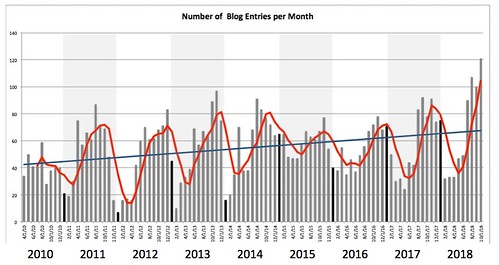
I'm reposting from January 1, 2017, almost two years ago, but with the latest stats. As the title indicates, it’s about my blog posting since I started New Savanna. Here’s the new stats:

Apr-2010-Oct-2018

The length of a bar is proportional to the number of posts I made that month. Black bars indicate January.

A little calibration is in order. You’ll notice that prior to this year there wasn’t a single month with 100 posts; the highest was November 2013 with 97. Now, as of the end of October, we’ve got three months with 100 or more posts; what will November and December bring? But those months really aren’t directly comparable to the whole previous run. Why? Because it’s in those months that I began using Tweets as blog posts. I hadn’t done that before, but if I’d known that was possible, I’d have done it.

Why? Because it’s a low-energy way to make a post. And low energy’s is what’s going on in those slumps. Why the low energy? That’s what the rest of the post is about.

Finally, on December 18 of last year I posted, Reflections on entering my eighth decade and why it portends to be the most productive one of my life. When I posted that I can assure you that I was not anticipating the slump that slammed me in February and kept me down through June. Will that happen again? Who knows? But notice 2015; the slump wasn’t so bad. Who knows?

* * * * *

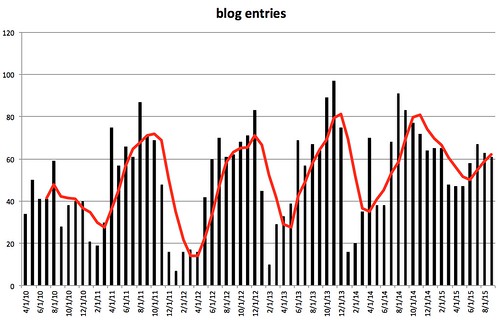
In October of 2015 I had a post at 3 Quarks Daily entitled, Have the Internets Rotted My Brain and Wrecked My Mind? I included the following figure:

WLB Blog entries

Each column represents on month’s worth of posts, starting with April 2010 and running through September 2015. Here’s what I said about it then:
It’s a very spiky pattern, with the dips happening in the winter months. Ever since I went away to college winter has been a down time for me. Am I afflicted with seasonal affective disorder? I don’t know.

Look at the recent end of that chart (to the right). There is a dip, but it’s not nearly so deep as in previous years, and the lowest three months aren’t in the winter, but in the spring and early summer. Wrong season. The pattern seems to be different.
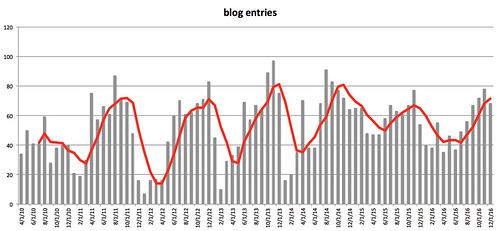
I’ve now updated the graph to the end of last year:

WLB blog entires thru 2016

The cyclicity continues, though, if you look closely, the troughs don’t line up particularly well with winter for 2015 and 2016. The 2015 trough is in spring while the 2016 trough is roughly the first half of the year.

What’s going on? Of course, I don’t really know, other than the obvious changes in blogging productivity. I do think my mood follows my productivity, or vice versa, and that’s what’s interesting. David Hays once conjectured that melancholy (aka depression) is the price you pay for large-scale reorganization or the sort implied by creativity. “Reorganization” is a term of art from William Powers’s account of the mind. It is so deeply embedded in that theory that there is, alas, no easy gloss.

Start out by thinking of learning. When you learn, your mind is also reorganizing on a large scale. Now think of mourning as well. When you mourn the loss of someone close you have to reorganize your mind for life without them. You don’t actually learn anything, but you have to figure out how to function in those situations where you would have go to that person. It’s unlearning.

In order to be creative you must first unlearn on a large scale. That is accompanied by melancholy. That, on this view, accounts for those troughs in my intellectual output, which is mostly though not entirely through New Savanna. That creates some “slack” in the system. Once enough unlearning has taken place I can then think new thoughts and my productivity goes up. When the slack has been used up, it’s time for more unlearning.

Do I believe this? How could I? I just made it up. And it’s rather vague, too vague to support strong belief. Still, I’m attracted to the idea that something like this is going on over the long haul.

Addendum, 1.2.17: Are we dealing with reorganization on a scale where we could talk of neural plasticity?