Showing posts with label evol-force. Show all posts

Monday, July 1, 2019

Cultural evolution conceived dynamically as an interplay of forces.

Lorenzo Baravalle, Cultural evolutionary theory as a theory of forces, Synthese, May 2019, DOI: 10.1007/s11229-019-02247-0. Downloadable Preprint.
Abstract: Cultural evolutionary theory has been alternatively compared to a theory of forces, such as Newtonian mechanics, or the kinetic theory of gases. In this article, I clarify the scope and significance of these metatheoretical characterisations. First, I discuss the kinetic analogy, which has been recently put forward by Tim Lewens. According to it, cultural evolutionary theory is grounded on a bottom-up methodology, which highlights the additive effects of social learning biases on the emergence of large-scale cultural phenomena. Lewens supports this claim by arguing that it is a consequence of cultural evolutionists’ widespread commitment to population thinking. While I concur with Lewens that cultural evolutionists often actually conceive cultural change in aggregative terms, I think that the kinetic framework does not properly account for the explanatory import of population-level descriptions in cultural evolutionary theory. Starting from a criticism of Lewens’ interpretation of population thinking, I argue that the explanatory role of such descriptions is best understood within a dynamical framework—that is, a framework according to which cultural evolutionary theory is a theory of forces. After having spelled out the main features of this alternative interpretation, I elucidate in which respects it helps to outline a more accurate characterisation of the overarching structure of cultural evolutionary theory.
Note: I have, for some time know, been thinking of cultural evolution as a force in history; indeed, as perhaps the single strongest force in history. The thrust of this article is a bit different, but I welcome its formulation of cultural evolution as a theory of forces.

Wednesday, December 12, 2018

A short note on why it is important to conceive of culture as giving rise to an evolutionary process

On December 1 I posed four questions in the study of cultural evolution, offering short answers for each:
1. What is the target/beneficiary of the evolutionary dynamic?

2. Replication (copying) or (re)construction.

3. Is there a meaningful distinction comparable to the biological distinction between phenotype and genotype?

4. So what? That is to say, what can an evolutionary account of cultural history tell us that isn’t captured in a pile of narratives of the more standard kind?
I want to say a bit more about that fourth question. I have variously argued that cultural evolution is the single most important force in human history. If true, then we can’t understand human history unless we understand cultural evolution.

Specifically we have to understand that cultural evolution is a force. The first time I posed the issue (to myself) I went to the Stanford Encyclopedia of Philosophy and consulted the article on Philosophy of History looking for a list of forces supposed to be operative. There was a section on “Causation in History” that had something about how analytical philosophers thought about “the role of causal ascriptions in historical explanations.” But that said nothing that spoke to my question. I learned as well that this is a “new” philosophy of history that “emphasizes historical narrative rather than historical causation.” That does not sound good. And so it went through the whole article.

Are there no forces in history? What does “force” mean in this context? Surely it must mean something more than a jumble of individual narratives. Indeed, that’s one thing I’m arguing against. Here’s a passage from the SEP article on Cultural Evolution:
One might fear that in the end cultural change, and the influence of cultural change on other aspects of the human species, are best understood through a series of individual narratives. Our brief examination of memetics illustrated this concern. We gain no real explanatory insight if we are told that ideas spread through populations, some more successfully than others. We want to know what makes some ideas fitter than others. And it is not clear that there will be any general rules that can help us to answer this question. In the biological realm we need detailed accounts of local environmental circumstances, species-specific physiology and anatomy, and so forth, to tell us what makes one organic variant fitter than another. Similarly, in the cultural realm we will need to look at local psychological dispositions to explain why some ideas are more likely to spread than others. So any explanatory value to be had from memetics is parasitic on conventional work done in psychology.
Yes, sure, we’ve got all those narratives. But cultural evolution considered as a force is surely more than a pile of individual narratives. And the same for biological evolution.

Should we consider it a force in history, the history of the earth? I should think so. That is, if I’m going to conceive of cultural evolution as a force, I’m going to do the same with biological evolution.

In both these cases, what does it mean to conceive of evolution as a force? In both cases it’s a force acting on and through populations of individuals. What authorizes that we talk of force? That is certainly a matter of (mere) semantics. But it is also one of substance. I’m asserting that evolution plays a (causal) role in the living world that is similar to the roles of gravity, electromagnetic, and strong and weak nuclear forces.

Hmmmm....

I’m (provisionally) willing to think of history as a pile of narratives. Biological and cultural evolution are forces that operate on and through piles of narratives. Of course earth has a prebiotic history. Those narratives could not have been affected by the bio-evolutionary force (much less the cultural EF). And the BEF would have been weak in the beginning, but in time it remade the earth, e.g. the Great Oxygenation Event in which O2 was deposited in the atmosphere. The same with CEF. BEF and CEF thus bring about organization among millions of individual narratives.

And THAT’s what needs to be appropriately conceptualized, that coordination. That’s why we need a concept of force.

Sunday, August 13, 2017

The emergence of cumulative culture, or: What Dawkins got right

This is a follow up to my post, Gestalt Switch in the Emergence of Human Culture. I want a way to differentiate my version of culture from the current ‘orthodoxy’ (gene-culture coevolution, dual inheritance theory). At the moment I’m thinking that the emergence of cumulative culture is the Rubicon. But why and how?

In orthodox cultural evolution theory fitness is evaluated at the biological phenotype, and only at the phenotype. Dawkins’ insight, I believe, is that, to understand cultural evolution, we need to think of entities where fitness is evaluated with respect to some (purely) cultural entity, rather than and more or less independently of fitness for biological individuals carrying those cultural features.

Here’s what I think: It is the emergence of cumulative culture, however that happened, that created an arena in which purely cultural entities could survive and thrive, or not. What determines fitness for preservation in the domain of cumulative culture?

However it arose, that domain is the coupled nervous systems of interacting humans. And to account for how it operates we need a cultural analog of both the biological gene and the biological phenotype.

Now we have sharability, in effect, as a fitness criterion for cultural entities. They are fit because they afford us opportunities for social interaction (like mutual grooming among infra-human primates?). They may well afford other benefits, but sharability is always a factor.

* * * * *

With this in mind we can take a look at what Dawkins has to say about memes. First, though, I want to start with the second paragraph of The Selfish Gene (p. 12):
Darwin’s ‘survival of the fittest’ is really a special case of a more general law of survival of the stable. The universe is populated by stable things. A stable thing is a collection of atoms that is permanent enough or common enough to deserve a name. It may be a unique collection of atoms, such as the Matterhorn, that lasts long enough to be worth naming. Or it may be a class of entities, such as rain drops, that come into existence at a sufficiently high rate to deserve a collective name, even if any one of them is short-lived. The things that we see around us, and which we think of as needing explanation–rocks, galaxies, ocean waves–are all, to a greater or lesser extent, stable patterns of atoms. Soap bubbles tend to be spherical because this is a stable configuration for thin films filled with gas. In a spacecraft, water is spherical globules, but on earth, where there is gravity, the stable surface for standing water is flat and horizontal. Salt crystals tend to be cubes because this is a stable way of packing sodium and chloride atoms together. In the sun the simplest atoms of all, hydrogen atoms, are fusing to form helium atoms, because in the conditions that prevail there the helium configuration is more stable. Other even more complex atoms are being formed in stars all over the universe, and were formed in the ‘big bang’ which, according to prevailing theory, initiated the universe. This is originally where the elements on our world came from.
Dawkins then goes on to argue that stability in the biological world depends on molecules he will call replicators (p. 15). At first these replicators were free-floaters in the primeval biomolecular soup. In time they became (p. 20) “genes, and we are their survival machines.

What’s important is Dawkins’s plea for stability as the necessary precursor to meaningful change. That is as important in culture as in biology. Stability is the foundation of cumulative culture. Without it groups would be continually ‘reinventing the wheel’ because the wheel just wouldn’t stay invented. Just how cumulative culture emerged, that’s obviously an important issue, but let’s shelve it for the purposes of this post and take a look at why Dawkins hypothesized the concept of memes.

He offers these remarks in the course of talking about the god “meme” (193):
Some of my colleagues have suggested to me that this account of the survival value of the god meme begs the question. In the last analysis they wish always to go back to ‘biological advantage’. To them it is not good enough to say that the idea of a god has 'great psychological appeal'. They want to know why it has great psychological appeal. Psychological appeal means appeal to brains, and brains are shaped by natural selection of genes in gene-pools. They want to find some way in which having a brain like that improves gene survival.
“Appeal to brains” is the operative phrase. Later he’ll remark (199):
This is that when we look at the evolution of cultural traits and at their survival value, we must be clear whose survival we are talking about. Biologists, as we have seen, are accustomed to looking for advantages at the gene level (or the individual, the group, or the species level according to taste). What we have not previously considered is that a cultural trait may have evolved in the way that it has, simply because it is advantageous to itself.
I find the phrase “advantageous to itself” a bit iffy, though it’s consistent with his arguments about the ‘selfishness’ of genes, which I accept. My point here is that Dawkins is quite clear that, in positing the existence of memes he’s up to more than talking about a way of inheriting behavior from one generation to another. Somehow culture is a different arena for evolutionary processes, though one necessarily coupled with biology.

Orthodox cultural evolution theory doesn’t have much to say about what makes culture “appeal to brains”–though Dan Sperber’s theory of cultural “attraction” is relevant here. Unfortunately, Dawkins was unable to formulate a useful concept of “appeal to brains”, nor was his acolyte in this, Daniel Dennett. To get it right, or at least a plausible first approximation, you need to think seriously about just how brains CAN communicate cultural materials. I’ve devoted a lot of time and effort to that over the years, so I won’t try to summarize that work here. For the curious, I recommend:
  • Beethoven’s Anvil: Music in Mind and Culture (Basic Books 2001). Here I use Walter Freeman’s work on complex neurodynamics to, in effect, define the domain of cumulative culture, at least for music (chapters 2 and 3), which sets the stage for defining attractors in this domain as the cultural analog to the biological phenotype (chapter 8 and 9).
  • “Rhythm Changes” Notes on Some Genetic Elements in Musical Culture. This paper builds on my work in Beethoven’s Anvil and develops the idea of a coordinator as the cultural analog to the biological meme.
The following two working papers are directed at Dennett’s discussions of memes (prior to his most recent book, From Bacteria to Bach and Back, which I’ve not read).
Friday, October 31, 2014

Literary History, Temporal Orders, and Many Worlds

What, you might ask, does many worlds theory have to do with literary history? One is science while the other is, well, humanities I guess. And ne’er the twain shall meet.

Well, that was the 19th and 20th centuries. We’re living in a new world. And I’m just thinking out loud here, making stuff up.

Most of my long-form posts have an element of trying to figure out what I think about a topic. As such I’m not much concerned about the existing literature on the subject. I’ll worry about that if and when I decide to pursue formal (academic) publishing.

This post will be even more so, almost pure thinking out loud. It’s about time, the issues raised by Jockers’ study of literary influence (Macroanalysis, chapter 9), which I’ve reinterpreted as being about the cultural evolution of the 19th century novel and that that evolution has a direction.

As happens every so often, when I started on this post I figured it would take me three or four morning hours. But it just grew and grew. I don’t know how many hours I’ve put in, but I’ve had to spread those hours over four days or so in order to think things thru. And still, it’s very speculative. I start out be reprising Jockers’ account of influence in the 19th century novel and then move onto time. And that – inevitably in retrospect – leads reductionism. That’s what I’ve learned in writing this post, that the questions of temporality and reductionism are intertwined. That culture cannot be reduced to biology, nor biology to chemistry and physics, is about how objects and processes unfold in time. It’s about patterns in time.

Cultural Evolution in 19th Century Novels

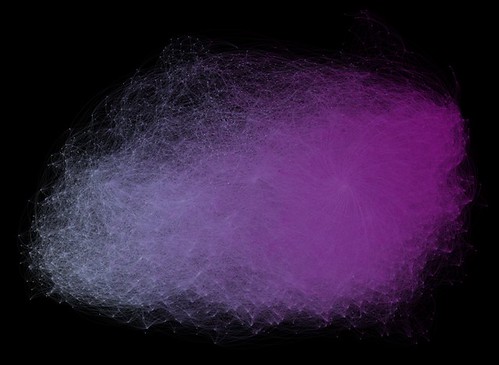
As you may recall, at the end of Macroanalysis Jockers argued that, if author A influences author B, then the texts B writes will be like those written by A. So, to study influence in the corpus we’ve got to make a massive comparison among all the texts and list only those pairs that are very much like one another. To that end Jockers measured some 600 characteristics of each novel in a corpus of over 3000 19th century American and British novels. He then calculated the Euclidean distance between these texts in that high-dimensional space.

9dot3

To visualize those measurements Jockers created a graph in which each node was a text and the length of each edge was proportional to the degree of similarity between the two texts connected by the edge. When Jockers visualized the graph, he got the above image. The left to right ordering of nodes in that graph is roughly chronological.

How did that happen? Jockers’ database didn’t contain any temporal data, no publication dates, about those texts, but the order he found by looking for similarity/influence was also temporal. To some degree that’s inevitable. Text A cannot influence Text B unless it pre-exists it. But why should later texts resemble earlier ones at all? And why should the degree of similarity be roughly proportional to the temporal distance between the texts?

It is not too difficult to suggest answers to those questions, and to state those answers in terms of the psycho-social process through which texts arise: Texts are written by authors; people read texts; authors write texts like the texts they like to read – they don’t have to do this, but they do, why? – and this happens year after year. The directional ordering of those texts is an indicator of the nature of the socio-cultural process that produced them.

I thus – and here we leap – find myself thinking about an old distinction, between “clock time” (calendar dates) and “real time” (the psycho-cultural ordering of those texts). That’s what I want to think about first.