Showing posts with label #GVM004. Show all posts

Thursday, August 28, 2025

A mandala for the 10-year anniversary of the Demolition Exhibition [#GVM004]

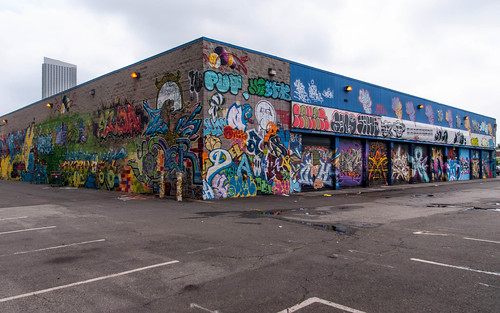
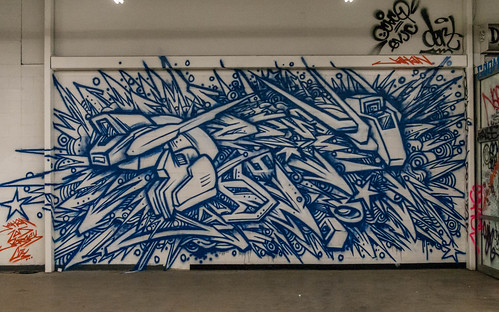
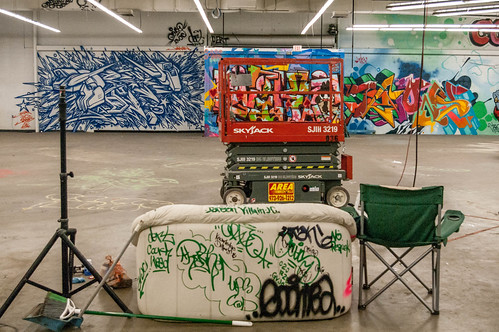
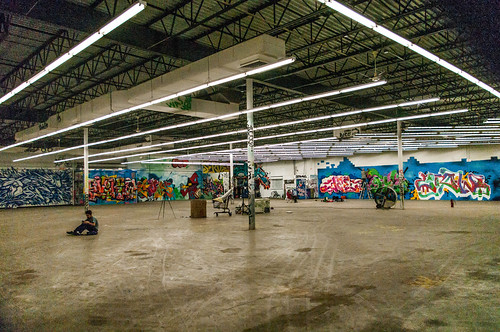
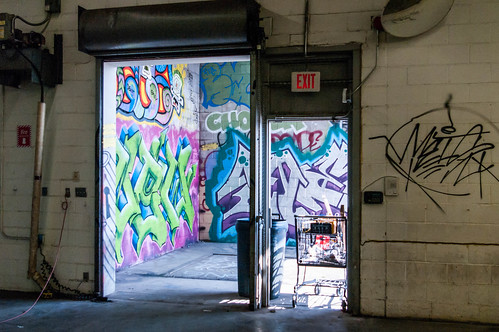
It's been just over ten years since the Demolition Exhibition ran in the Pep Boys Building in the Newport area of Jersey City, June 27-July 5, 2015. Here's a report on the whole thing: #GVM004: The Demolition Chronicles. I decided to have ChatGPT make a mandala for the occasion. I gave it this photo:

And here's the mandala it produced:

Saturday, December 7, 2024

Claude 3.5 Sonnet becomes an art critic

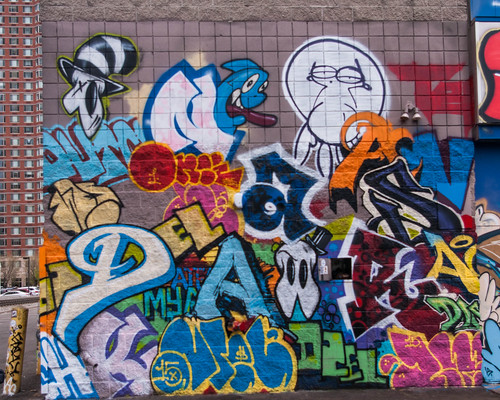
This is from the Demotion Exhibition (#GVM004) in Jersey City which took place in the summer of 2015 in and on a building that once held a Pep Boys store.

You may want to click on the photo to enlarge it.

What’s going on in this photo? This is a tricky one. Take your time.

This appears to be a vibrant street art mural depicting a band or musical performance, painted in a stylized graffiti art style. The composition shows several cartoon-like figures who appear to be playing musical instruments, rendered in a dynamic, energetic style characteristic of urban art.

Looking more closely at the details, there are several interesting elements:

  • In the upper left corner, there's a small white figure with a red scarf or bandana on what appears to be an orange platform or surface
  • The main composition features several abstract-stylized figures with rounded, expressive faces
  • The color palette is rich and varied, with a prominent blue background and pops of orange, yellow, red, and green
  • The surface appears to be a tiled or grid-patterned wall, suggesting this might be in a subway station or similar urban setting
  • There's some text visible in the upper right corner, though it's partially cut off

The style combines elements of traditional graffiti lettering with more cartoonish character design, suggesting this might be a commissioned or permitted piece rather than unauthorized street art, given its level of detail and completion.

Given the apparent musical theme and subway-like setting, this could potentially be a tribute to subway musicians or the role of music in urban culture, though without more context it's difficult to be entirely certain of the specific meaning or intent.

Would you like to provide any additional context about the location or significance of this piece?

That small white figure is Snoopy the beagle, pretending to be a World War One flying ace. Does that suggest anything about the other characters?

Ah, this observation completely transforms the interpretation of the mural! Given Snoopy's presence as the World War I Flying Ace (one of his famous imaginary personas from the Peanuts comic strip), this appears to be a creative interpretation of Charlie Brown characters as musicians, rendered in a street art style.

Looking at the mural again through this lens, the rounded, somewhat melancholic faces and character designs align with Charles Schulz's iconic Peanuts art style, though dramatically reinterpreted through urban art aesthetics. The figures appear to be Charlie Brown and his friends performing music – likely a reference to the jazz and musical elements that were frequently featured in both the Peanuts comic strips and television specials, where characters like Schroeder playing piano and Snoopy dancing were recurring motifs.

The bold colors and dynamic, graffiti-influenced style presents these beloved childhood characters through a distinctly urban lens, creating an interesting dialogue between the wholesomeness of Peanuts and the edge of street art culture. The vibrant blue background and energetic composition suggest the joyful, expressive quality that music brought to the Peanuts universe.

This artistic choice – combining the innocent world of Charlie Brown with contemporary street art styling – demonstrates how classic cultural touchstones can be reinterpreted to speak to new audiences while maintaining their core emotional resonance.

Bingo! What about the small black figure at the lower left?

That small black silhouette would be Woodstock - Snoopy's little bird friend from the Peanuts comic strip. His inclusion completes the Peanuts reference, as Woodstock and Snoopy were inseparable companions throughout much of the comic's run.

Saturday, July 11, 2015

Some points of interpretation: young girls, crowns, graffiti [#GVM004]

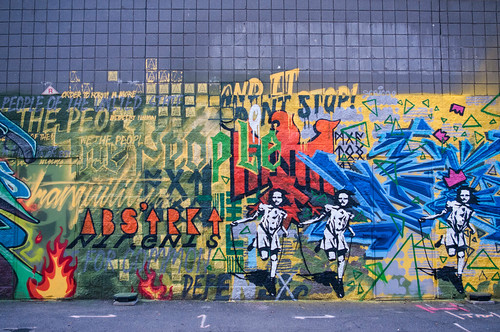
This is from the second layer (of three) of graffiti at the northern end of the rear facade of the now abandoned (and soon to be demolished) Pep Boys in the Newport area of Jersey City.

20141128-_IGP0536

It is by NTEL, of the AIDS crew. If you look closely you’ll see wording from the Preamble of the Constitution of the United States: “We the People…” You'll also see (left of center) "ABSTRACT" in orange with shadows cast below. Those shadows hint at "intelligence" or "NTELigence".

I’m not sure what’s going on with the three identical little girls jumping rope in a dress out of the 1950s. They’re rendered in the style of stencil work and may reference Banksy, the best-known stencilist in the world. Banksy frequently uses images of young girls.

20141128-_IGP0545

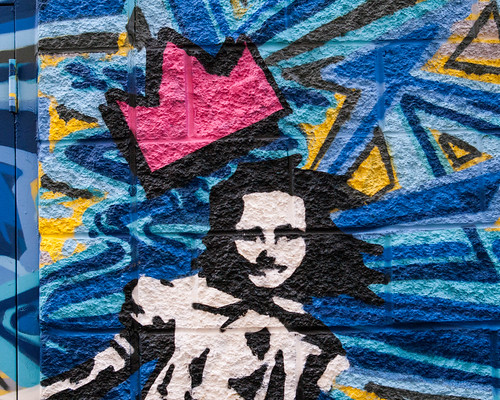
Notice the magenta crown over the heard of the right-most girl and the small crowns above it, as though they were blown from the heads of the other two girls. Crowns do not get on graffiti pieces by arbitrary artistic choice. They have a special meaning in graffiti culture. Crowns are used to mark a so-called King of graffiti. You’re a King if you’ve mastered the three basic disciplines – tags, throw-ups, and pieces – and have executed a large body of work over several years that is visible in many places. Why, then, are these girls being marked as kings, if that’s what’s being done?

20141128-_IGP0544

Monday, July 6, 2015

Even Heather Mac Donald’s Welcome to Tag-Up at the Demolition Exhibition [#GVM004]

20150705-_IGP4888

A defense of graffiti’s egalitarian values in an age of oligarchic excess, financial gamesmanship, and ecotastrophe

Who the Eff, you ask, is Heather Mac Donald? And just why are you addressing her?

Heather Mac Donald is a well-known commentator and is the Thomas W. Smith Fellow at the Manhattan Institute for Policy Research. As the name indicates, it’s a Manhattan-based think-tank that, in its own words, “has been an important force in shaping American political culture and developing ideas that foster economic choice and individual responsibility.” Four years ago Mac Donald wrote two critiques of graffiti for City Journal, a quarterly published by the Manhattan Institute. The pieces were occasioned by Art in the Streets, an exhibition at the Los Angeles Museum of Contemporary Art, which billed it as “the first major U.S. museum survey of graffiti and street art.” And that, so far as I know, is true. It’s by no means the first time graffiti’s made it into a museum, but it was the first major retrospective.

One piece, Radical Graffiti Chic, is about graffiti and graffiti culture generally while the other, Crime in the Museums, is a review of the exhibition. Needless to say, she was not impressed. But she WAS angry and disgusted. Graffiti after all, is vandalism, as we all know. Moreover Mac Donald asserted that it’s not particularly accomplished or interesting as art, it does nothing to better the lives of poor communities, and, in the museum world it’s just something for rich oligarchs to play with while they’re safe in their urban aeries. I rather agree with the last, but have severe doubts about her other objections. But I don’t want to go into that here, as I’ve already responded to some of her remarks in two pieces:
Rather, I want to look at a stunt she pulled when she went to see the show. As she tells it in Crime in the Streets:
Once allowed inside the show, I went to Martha Cooper’s influential photos of bombed subway cars and made ready to write my tag on the wall next to them, eyeing a guard conspiratorially. “Oh, no, please!” intervened the watchman apologetically. “You can’t do that.” I tried again next to the timeline entry celebrating the start of Fairey’s stickering campaign in 1989. “You can’t write on the wall,” another guard told me.

Hypocritical to the end, MOCA is selling graffiti spray paint in its bookstore along with its $55 Art in the Streets catalogues.
Of course she knew very well that she wouldn’t be able to write on the walls.

20150705-_IGP4877

As to whether or not she should have tried that stunt, that’s an interesting question. If she’d consulted Socrates, who drank hemlock for his work among Athenian youth, he might well have advised her: “If you’re willing to pay the fine and do the time, sure, go ahead.” [I’m thinking, of course, of the Crito.] But obviously she wasn’t. She was indulging in a bit of theater so she could use it in her review. It was a cheap no-risk trick.

But she does have a point. There is some hypocrisy there. Anyone who’s involved with graffiti knows of the criminal risk involved and we all think about it. Just what we think, that obviously varies from one person to another. But some of us do think we’re living in a world that calls for trespass and some of us just want to get over. As I’ve said, I don’t want to argue the point here and now. I want to switch the game a bit.

I want to look at Green Villain’s Demolition Exhibition. As you may know, it’s a graffiti show that recently concluded it’s one-week run in a now-abandoned Pep Boys store in the Newport area of Jersey City. Why only one week? Because the building’s slated for, you guessed it, demolition. Green Villain, a small production company, made a deal with Pep Boys to do, first the rear wall (facing a commuter railway line), and then when the building was sold and slated for demolition, the entire exterior. GV then made another deal with the developer, Forest City, to do the interior and open the building to the public for a week. That’s what’s just concluded: one week (June 27 to July 5) and 100 hundred artists, free.

Thursday, July 2, 2015

Sacred Animal Beyond Category: Super-Dope in Layers [#GVM004]

20150702-_IGP4457

Three layers: 1) The Animal is the top layer and is outlined in black (the artist, Fathima [& Instagram], is from Dubai). It's painted on 2) the wall of a small semi-enclosed office (look at the way the wall meets the floor). The surface of that wall is the middle layer. Everything else is the 3) bottom layer: the floor and the wall behind the office wall.

I took that photo today: July 3, 2015. Here's how that wall looked on June 5, 2015:

20150605-_IGP3950

May 27, 2015:

20150527-_IGP3910

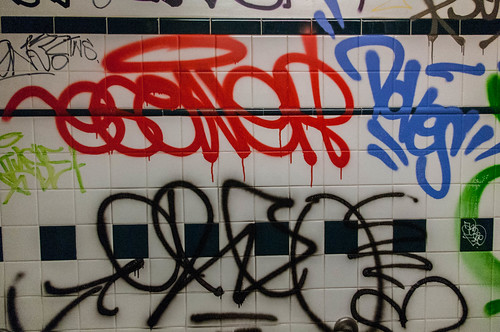
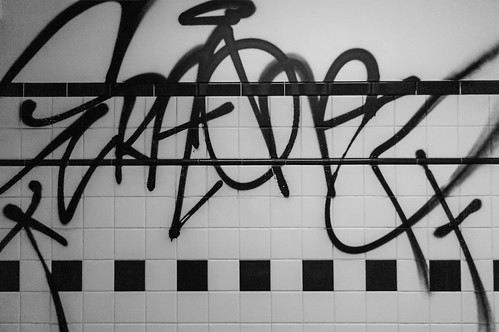
Bathroom scrawl [#GVM004]

20150627-_IGP4454

Friday, June 26, 2015

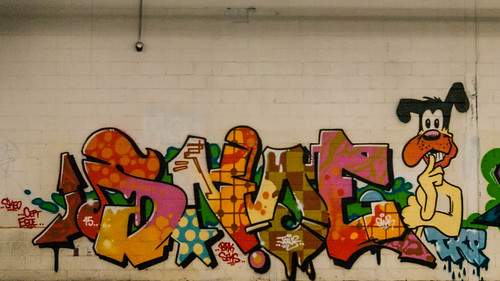
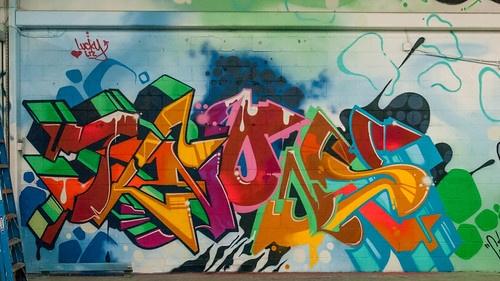
Friday Fotos: Some Styles at the Demolition Exhibition [#GVM004]

20150430-_IGP3307
AIDS crew
Tomorrow (Saturday, June 28, 2015) marks the official opening of Green Villain’s Demolition Exhibition, a show of graffti installed (good Art Word, that) on 30,000 sq. feet of walls in the Newport area of Jersey City. Of course artists and others have been in and out of the building for the last two months, so the boundary between official opening hours and the rest of time and space is somewhat porous. But that will all come to an end sometime in July, when the building is demolished and returned to dust.

With all that in mind, I thought I’d offer a few comments on some of the styles in view. As far as I know graffiti styles have not been subject to classification and analysis beyond the standard distinction between wild style, in which the letters and cut up, confused, and disguised, and all the rest. So there is no official nomenclature. Nor do I intend to introduce any here.

But I do think it’s useful/helpful to note that it’s not all alike, especially if you’re not familiar with graffiti.

* * * * *

These pieces exhibit a ‘flat’ style, which may be the most common style in the show. There may be some 3D cues here and there, but they’re minimal. There’s no attempt to imply and overall 3D space. Notice the way patterns are deployed across the surfaces of the letters:

20150605-_IGP3946
Revenge
20150527-_IGP3848
CURVE
20150605-_IGP3993
SNOE
This, in some ways, is flat. But the 3D cues (drop shadows) are very strong, though there is no overall 3D space:

20150605-_IGP3964
Knows

Monday, June 22, 2015

Demolition Exhibition @ #GVM004: Graffiti at the Transition from Industrial to Informatic Culture

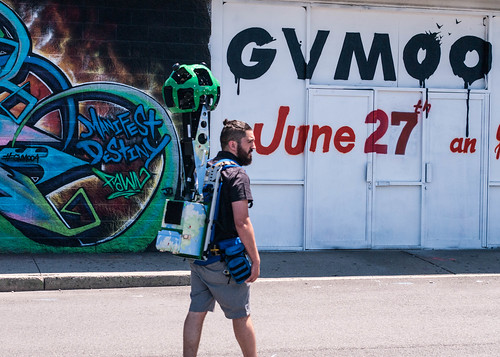
While the human act of marking walls goes back 10s of thousands of years, aerosol graffiti is quite recent and, in its current form, is often propagated around the world through digital images residing on the web. With that in mind, consider the following photo, taken at the site of Green Villain’s Demolition Exhibition in the Newport area of Jersey City:

20150613-_IGP4087

The man is Omar, and he works for Google Street View. The contraption on his back is a Trekker camera, which Google developed for photographing streets. While the camera was originally development for deployment on top of an automobile which drives the streets and photographs the scene, this version allows access to off-street areas. In this case Omar is walking around a building that is covered with graffiti. Omar’s compatriot, whose name I forget, went inside the building with a slightly different version of the camera, one mounted on a frame you can push along the floor.

The building used to be a Pep Boys store. Pep Boys, as you know, services automobiles and sells parts, accessories, and supplies. Pep Boys is thus about the automobile, a technology which dominated American life in the second half of the 20th century, though it originated in the 19th century.

Street View is also about the automobile, but it’s 21st century technology based on computers. Google itself arose in the last decade of the 20th century as a search engine for the web; and that is still the center of its business. At some point, though I forget just when, it also started serving up street maps, and it created Street View to augment that business.

Street View images live online. They don’t come bundled up with paper maps you buy at a gas station or from AAA. The camera is itself 19th century technology, with antecedents going back a century or three before that, but the Trekker system combines lasers and GPS and digital computing, all late 20th century tech.

Graffiti of the sort on and inside this building originated in the late 1960s and early 1970s. It is based mostly, though not entirely, on paint delivered by aerosol cans. The aerosol can originated in the mid-20th century. During the 1970s and 1980s the subway system of New York City was the most important site of graffiti development. Subways are, of course, train technology, which dates back to the early 19th century, with electrification coming at the end of the century.

So, graffiti originated with the application of paint using 20th century technology to trains based in 19th century technology. When the web bootstrapped onto the Internet in the mid-1990s graffiti followed almost immediately. It will be six months or more before the images Omar took will go live on the web. But when that happens, we will be taking another step into a new era in graffiti culture.

Sunday, June 7, 2015

Study in Pink and Silver: Why Not Call It an Installation? [#GVM004]

What, pray tell, is this?

20150605-_IGP3982

It’s two bottles on a shelf or something.

Well, yeah, that’s obvious. But what kind of bottles...

look like beer bottles, maybe

but beer bottles aren’t silver

neither are they. that’s paint

not applied very carefully either, looks like it was sprayed

and the spray caught the wall too.

Saturday, June 6, 2015

Good Grief! War Boys in the Promised Land [#GVM004]

One could, of course, dismiss it because it’s comic strip imagery, and therefore Not Serious. One could also dismiss it as graffiti, and therefore Not Serious.

But I can’t do that, not while I’m being a Martian Anthropologist. In that role I have no choice but to take what the natives do as being quite serious. That is, serious in the sense that it indicates what’s going on in their society.

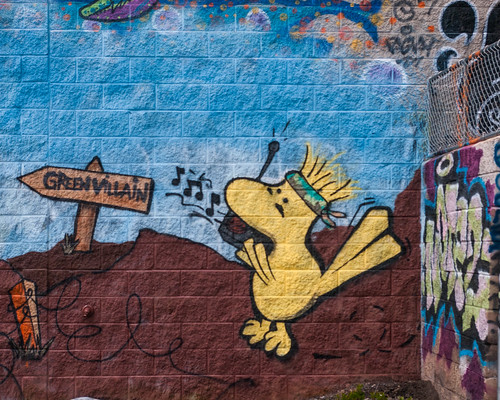
Here’s Woodstock, a character from the comic strip, Peanuts, which is surely smack dab in the center of post-war (WWII) American culture and which has shown up in graffiti culture since the mid-1970s–that is to say, from the beginning:

20150605-_IGP3920

The headband establishes Woodstock’s hippie cred and the music-blaring transistor radio dates him.

The “Greenvillain” sign is a shout-out to Greg Edgell, who runs Green Villain, the production company that’s organizing the graffiti on the soon-to-be-demolished Pep Boys building in the Newport area of Jersey City. This is painted on the southwest corner of the building.

But why the brown? Is it supposed to represent bare dirt? What about the black loops? Since I’ve seen the whole mural I’ll tell you what it is, it’s barbed wire. Woodstock is strolling around on a battlefield. Vietnam perhaps? After all, the war there was going hot and heavy when the flower children gathered in the mud at Woodstock, New York, and listened to Jimi Hendrix transform “The Star-Spangled Banner” into a war protest anthem.