Showing posts with label scale. Show all posts

Thursday, January 8, 2026

The compute theory of everything

Samuel Albanie, Reflections on 2025, December 30, 2025. The first section, of three, is entitled "The Compute Theory of Everything." Here's an excerpt:

I have come to believe that every engineer must walk the road to Damascus in their own time. One does not simply adopt the Compute Theory of Everything by hearing others discuss it. You have to be viscerally shocked by the pyrotechnics of scale in a domain you know too well to be easily impressed.

For many senior engineers, that shock arrived in 2025. I have watched colleagues who were publicly sceptical through 2023 and 2024 quietly start to integrate these systems into their daily work. The “this is just a stochastic parrot” grimace has been replaced by the “this stochastic parrot just fixed my RE2 regex”. They still say “this can’t do what I do”, but the snorts of laughter have been replaced with a thoughtful silence and the subtle refreshing of their LinkedIn profile.

My own conversion came earlier. It is a privilege of my career that I was working in one of the first fields to get unceremoniously steamrollered by scaling: Computer Vision. During a glorious period at the VGG in Oxford, I spent months crafting bespoke, artisanal architectural inductive biases. They were beautiful, clever, and they had good names. And then, in early 2021, my approach was obliterated by a simple system that worked better because it radically scaled up pretraining compute1. I spent a full afternoon walking around University Parks in shock. But by the time I reached the exit, the shock had been replaced by the annoying zeal of a convert.

Returning to my desk, it did not take long to discover that the Compute Theory of Everything is 50 years old and has been waiting patiently in a Stanford filing cabinet since the Ford administration.

In 1976, Hans Moravec wrote an essay called “The Role of Raw Power in Intelligence“, a document that possesses both the punch and the subtlety of a hand grenade. It is the sort of paper that enters the room, clears its throat, and informs the entire field of Artificial Intelligence that their fly is down. Moravec’s central thesis is that intelligence is not a mystical property of symbol manipulation, but a story about processing power, and he would like to explain this to you, at length, using log scales and a tone of suppressed screaming.

He starts with biology, noting that intelligence has evolved somewhat independently in at least four distinct lineages: in cephalopods, in birds, in cetaceans, and in primates. He spends several pages on the brainy octopus covering the independent evolution of copper-based blood and the neural architecture of the arms, citing a documentary in which an octopus figures out how to unscrew a bottle to retrieve a tasty lobster from inside. One gets the impression he prefers the octopus to many of his colleagues. The evolutionary point is that intelligence is not a fragile accident of primate biology. It is a recurring architectural pattern the universe stumbles upon whenever it leaves a pile of neurons unattended. The octopus and the crow did not copy each other’s homework. Instead, they converged on the answer because the answer works. The question is: what is the underlying resource?

Moravec’s answer is: it’s the compute, stupid.

To make his point, he compares the speed of the human optic nerve (approximately ten billion edge-detection operations per second) to the PDP-10 computers then available at Stanford. The gap is a factor of more than a million. He calls this deficit “a major distorting influence in current work, and a reason for disappointing progress.” He accuses the field of wishful thinking, scientific snobbery, and (my favourite) sweeping the compute deficit under the rug “for fear of reduced funding.” It is the sound of a man who has checked the numbers, realized the Emperor has no clothes, and is particularly annoyed that the Emperor has neither a GPU nor a meaningful stake in God’s Chosen Company: Nvidia (GCCN).

This leads to his aviation aphorism that has become modestly famous, at least among the demographic that reads 1976 robotics working papers for recreational purposes: “With enough power, anything will fly.” Before the Wright brothers, serious engineers built ornithopters (machines that flapped their wings, looked elegant, and stayed resolutely on the ground). Most failed. Some fatally. The consensus was that AI was a matter of knowledge representation and symbolic reasoning, and that people who talked about “raw power” were missing the point and possibly also the sort of people who enjoy watching videos of monster truck rallies (a group that includes your humble author). Moravec’s point was that the Symbolic AI crowd were busy building ornithopters, obsessing over lift-to-drag ratios, while the solution was to strap a massive engine to a plank and give researchers the chance to brute-force the laws of physics into submission.

Twenty-two years later, he published an update. “When Will Computer Hardware Match the Human Brain?“ which opens with a sentence that has aged like a 1998 Pomerol:

“The performance of AI machines tends to improve at the same pace that AI researchers get access to faster hardware.”

He plots curves, whips up a Fermi estimate that human-level cognition requires on the order of 100 million MIPS, and predicts this capability will be available in affordable machines by the 2020s. The paper includes a chart in which various organisms and machines are arrayed by estimated computational throughput. The spider outperforms the nematode by a humiliating margin. Deep Blue appears as a reference point for what IBM’s R&D budget bought you in 1997, which was the ability to defeat Garry Kasparov at chess while remaining unable to recognise a photograph of a chess piece. The figure is instructive, but after staring at it for a few minutes, it can start to grate on one’s sensibilities. Perhaps because it treats the human soul as an arithmetic problem. Philosophy on two axes.

There's more on the compute theory of everything, which is worth your while.

Let me add that, for myself, sure, we need enough compute. That's necessary, but not sufficient. LLMs are a limited architecture. Throwing more compute at them isn't going solve all the problems. I've got a working paper that's relevant: What Miriam Yevick Saw: The Nature of Intelligence and the Prospects for A.I., A Dialog with Claude 3.5 Sonnet. Here's Claude's summary:

Thursday, July 21, 2022

Effects of scaling model parameters, but not number of tokens

Rohin Shah, [AN #173] Recent language model results from DeepMind, LessWrong, July 20, 2022.

Scaling Language Models: Methods, Analysis & Insights from Training Gopher (Jack W. Rae et al) (summarized by Rohin): This paper details the training of the Gopher family of large language models (LLMs), the biggest of which is named Gopher and has 280 billion parameters. The algorithmic details are very similar to the GPT series (AN #102): a Transformer architecture trained on next-word prediction. The models are trained on a new data distribution that still consists of text from the Internet but in different proportions (for example, book data is 27% of Gopher’s training data but only 16% of GPT-3’s training data). [...]

The most interesting aspect of the paper (to me) is that the entire Gopher family of models were all trained on the same number of tokens, thus allowing us to study the effect of scaling up model parameters (and thus training compute) while holding data constant. Some of the largest benefits of scale were seen in the Medicine, Science, Technology, Social Sciences, and the Humanities task categories, while scale has not much effect or even a negative effect in the Maths, Logical Reasoning, and Common Sense categories. Surprisingly, we see improved performance on TruthfulQA (AN #165) with scale, even though the TruthfulQA benchmark was designed to show worse performance with increased scale.

There's more at the link.

Chart: Gopher vs. SOTA, from the original paper, p. 9.

Tuesday, July 5, 2022

The limitations of scale in deep learning

Sunday, June 21, 2020

Wolfram says it's computation all the way down

One of the questions that comes about when you imagine that you might hold in your hand a rule that will generate our whole universe, how do you then think about that? What's the way of understanding what's going on? One of the most obvious questions is why did we get this universe and not another? In particular, if the rule that we find is a comparatively simple rule, how did we get this simple-rule universe?

The lesson since the time of Copernicus has been that our Earth isn't the center of the universe. We're not special in this or that way. If it turns out that the rule that we find for our universe is this rule that, at least to us, seems simple, we get to ask ourselves why we lucked out and got this universe with a simple rule. I have to say, I wasn't expecting that there would be a good scientific answer to that question. One of the surprises from this project to try to find the fundamental theory of physics has been that we have an understanding of how that works.

There are three levels of understanding of how the universe works in this model of ours. It starts from what one can think of as atoms of space, these elements that are knitted together by connectivity to form what ends up behaving like the physical space in which we move. The first level of what's going on involves these elements and rules that describe how elements connected in a particular way should be transformed to elements connected in some other way. This connectivity of the elements is what makes up when we look at, say, 10^100, 10^400 of these elements. That's what behaves like space as we're familiar with it, and not only space but also all of the things that are in space—all the matter and particles—are all just features of this underlying structure and its detailed way of connecting these elements together.

We've got this set of transformation rules that apply to those underlying elements. In this set up, space is a very different thing from time. One of the wrong turns of 20th-century physics was this idea that space and time should always be packaged together into this four-dimensional spacetime continuum. That's wrong. Time is different from space. Time is the inexorable operation of computation in figuring out what the next state will be from previous states, where our space to something that is a more specific extent of, in this particular case, the hypergraph that knits together these different elements.
One rule:
The main point is that at every event, you can have an update event that corresponds to every possible rule you might apply. You, as an observer of the universe, could choose a frame in which you're only considering the path through this ultra-multiway system of all possible applications of rules. You're only considering the path that corresponds to the application of one particular rule. It's like saying, I've got my way of describing the universe and I'm only going to consider that one; the fact that all these other possible paths are being followed, well, yes, but I'm not interested in those aspects of the universe—I'm just interested in the aspects of the universe that correspond to the particular rule that I've identified as being my reference frame for thinking about the universe. You might say, but there are all these other universes, and they're all doing different things. Because of this property of causal invariance, in the end it doesn't matter because they're all in some sense doing the same thing.
Universal computation:
This idea of universal computation already tells one that once you say the universe is something that can be generated by a universal computer, that fact is telling you that there's some sort of singleness to the way of describing the universe. In this rulial space of all possible rules, everything that's there is representable by a universal computer. You can translate between reference frames by essentially having what amounts to one universal computer description emulate another universal computer description by giving it the appropriate programming to emulate that other thing.

The one ultimate fact would be that the universe is computational, that the universe can be represented by a universal computer. That fact is not self-evident. It might not be true. It might be that there are hypercomputers that go beyond the computers we can build with Turing machines, that our universe might be a hypercomputer. Though, I don't think it is. What we're learning from this adventure in studying fundamental physics is that there is a description of the universe in terms of ordinary universal computation, and we're finding the details of how that works.

Friday, October 12, 2018

Chilltown 2.0: Is Jersey City Ready for the World Stage?

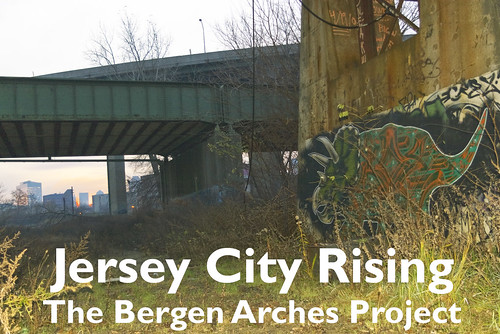
JC_Rising BPA 5
I'm feeling feisty. This is from five years ago & I'm bumping it to the top of the queue.
* * * * *

For one thing, with immigrants from the Caribbean, Latin America, the Middle East, Asia, and the Pacific, Jersey City is already ON the world stage. But is it ready to PLAY on the world stage, that’s the question?

The most obvious response is that the question is pointless. Jersey City is a mid-size city on the west bank of the Hudson River in the shadow of New York City. New York City, of course, is a major player on the world stage. But why should Jersey City aspire to be anything more than an appendage to New York City? And even if it aspires to be more, how could it do that?

IMGP3467rd

Good questions, questions I’ll be thinking about in the coming days, weeks, and months. You should do so as well.

My basic conviction–and I’m just going to state it, not argue it–is that Jersey City’s long-term survival depends on it’s ability to actively take a role on the world stage.

In a recent column, I Want to Be Mayor, New York Times pundit Thomas Friedman argued that cities are where the action is:
In fact, if you want to be an optimist about America today, stand on your head. The country looks so much better from the bottom up — from its major metropolitan areas — than from the top down. Washington is tied in knots by Republican-led hyperpartisanship, lobbyists and budget constraints. Ditto most state legislatures. So the great laboratories and engines of our economy are now our cities. This is the conclusion of an important new book by the Brookings Institution scholars Bruce Katz and Jennifer Bradley, entitled: “The Metropolitan Revolution: How Cities and Metros Are Fixing Our Broken Politics and Fragile Economy.” ...
exit from manhattan.jpg

Jersey City’s Mayor Steven Fulop agrees:
I really think that the opportunity today is not really at the federal level or even at the state level to make change. It’s really on the local level. You have all this gridlock at different levels of government and the most meaningful opportunity is at the local level,” Fulop said. “I saw Jersey City as a really special place that was under-achieving and a unique opportunity to really turn it into kind of the best mid-size city in the country.”
My point is that Jersey City can ONLY do that if it plays on the world stage. Returning to Friedman’s piece:
First, [Katz and Bradley] argue, the Great Recession blew up the deformed growth model we had settled into — one “that exalted consumption over production, speculation over investment, and waste over sustainability.” The new growth model ... focuses on creating networks that combine skilled laborers and knowledge workers, with universities and technical schools, with quality infrastructure and high-speed Internet, to do manufacturing, innovation, technology development and advanced services — with an eye to exporting all of them. That’s how we build a 21st-century middle class. “The best cities now understand that you need to a have a sector of your economy that is world class” in order to thrive, the authors argue.
What’s the world-class sector of Jersey City’s economy going to be?

That’s what we have to figure out.

* * * * *

As food for thought, look at these posts where I argue, in one way or another, the general point that the action is shifting away from (large) nation states and towards smaller regions: cities, municipalities, and small nations. And then there's my recent piece, Jersey City: A 21st Century Florence? Don't forget, back in the 15th Century, when Florence was on the rise, nations as we know them didn't exist. The action in Europe was in city-states. Finally, there's my report, Jersey City: From a Skate Park to the World, where I lay out a plan that will make Chilltown 2.0 a world destination.

misty morning graffs.jpg

Monday, January 22, 2018

The Story of Civilization: Stuck in Traffic

Are things too big and out of hand? I'm bumping this one from September 2012 to the top of the queue.
One day I waited an hour in traffic to go a quarter of a mile so I could enter the Holland Tunnel and cross under the Hudson River to my home in Jersey City. While sitting in the cue and kept thinking why why why? Why?

In answer the question with a boiling-frog story, a parable about Happy Island. I conclude by suggesting that the world is happy island and we’re stuck in traffic.

Tunnel Traffic

I live in Jersey City, New Jersey, which is across the Hudson River from Lower Manhattan. Whenever I go to Manhattan I use public transportation, which is reasonably good, though just a bit inconvenient from my present location. Driving my car through a tunnel or over a bridge and parking it on Manhattan, that’s VERY inconvenient. And so I avoid doing it.

But I had to go to rural Connecticut to meet Charlie for a trip up to Vermont. I could have taken public transportion to a point where Charlie could pick me up. But that’s a longish walk and four trains, or a longish walk and three trains and a long walk or a cab. Which was a hassle. So I decided to drive. Yes, I’d have to cross the Hudson River, but the Holland Tunnel’s nearby and I could avoid rush-hour traffic on both trips, too and from. And driving on Manhattan was a bit of a hassle, but not too bad on this trip because I’d be mostly on the West Side Highway.

So I drove. I left on Thursday morning at, say, 9:45 AM. By 11:30 I’d crossed off the northern end of Manhattan and was headed toward Connecticut. That’s an hour and forty-five minutes to go the first 15 miles, and probably an hour to go the first four miles, from my place in Jersey City through the Holland Tunnel and onto the West Side Highway headed North.

And that wasn’t rush-hour.

Nor was it rush-hour mid-afternoon on Saturday when I made the return trip. It took at least 45 minutes to get from West Side Avenue and 12th street into the tunnel, and traffic was unusually slow inside the tunnel, for whatever reason.

I’d be very surprised indeed if tunnel traffic was that bad when the Holland Tunnel first opened early in the 20th century. Nor do I have any idea when traffic began to build-up at the tunnel. It was opened in 1927 and the first tube of the Lincoln Tunnel followed a decade later; the second tube took another eight years. Was it built in response to traffic build-up in the Holland Tunnel and the George Washington Bridge? Seems possible. A third tube was opened in ’57, a response to increased traffic.

These days local news features regular reports on traffic delays at all tunnels and bridges crossing to Manhattan. The information is, of course, readily available on the web. Rush-hour delays run between half an hour and an hour. It’s crazy.

No one would ever design a system to work like that. But that’s how the system’s evolved. And it’s going to get worse.

Two years ago the governor of New Jersey killed a project to build another railroad tunnel under the Hudson. It would have doubled the number of passenger trains at peak hours. Meanwhile the mayor of New York City, Michael Bloomberg, billionaire, wants to change zoning in Mid-Town so that higher office towers can be built. You know what that means, don’t you? More traffic on the already over-loaded bridges and tunnels.

Of course, that has no direct meaning to Mayor Mike. He can afford to live in Manhattan, along with his executive cronies. When he crosses the Hudson or the East River he can fly his helicopter or he can sit in the back of a nice limo, with his laptop wified to the world, along with a wet bar, pool table, squash court and whatever else he needs to pass the time while the limo waits in traffic, the limo driver twiddling his thumbs while Mayor Mike is reeling in the big ones off the Grand Banks. Bridge and tunnel traffic is just numbers to him; it’s not a reality that hits him directly.

Sure, build taller office buildings in Mid-Town. You know what that means to Mayor Mike, Billionaire? It means more business for his company, that’s what it means. His company and the companies of his buddies. That’s the reality that’s most immediate to him. Not all the hassle more traffic will cause for the people who work in those bigger buildings, but can’t afford to live on Manhattan.

So the problem’s just going to get worse and worse.

Sunday, September 10, 2017

Bleg: Beyond/Beneath the Nation-State

This stuff is much on my mind these days. If anyone has any suggestions, please pass them on.
Back in September, 2012, I put up a post in which I asserted, by the time-honored method of pulling it out of my arse, that
in the long run, more and more political action which shift to cities and thereby ‘hollow out’ the increasingly sclerotic system of nation states which governs the earth and the global level. In a century the nation states will be husks of what they are now and most of the world’s civic business will be conducted by shifting coalitions of cities and regions.
I’m interested in exploring that notion.

Very.

Anyone have ideas, suggestions for things to check out, etc.? Any relevant science fiction?

* * * * *

In that post I cited, as examples,
  • the Second Vermont Republic, a group of citizens who want Vermont to secede from the USofA,
  • the Transition Town movement, folks who are adamantly apolitical but who, in anticipation of peak oil, are working toward local self-sufficiency in food and energy and all that that implies, and
  • Mayors of Peace, an international organization of cities seeking to end nuclear weapons by 2020.
What else is there like that, where “like that” is interpreted generously?

Do sister cities programs belong here? The Wikipedia definition:
Twin towns or sister cities are cooperative agreements between towns, cities, and even counties in geographically and politically distinct areas to promote cultural and commercial ties.
And the charter cities movement? Again, the good old Wikipedia:
A charter city is a city in which the governing system is defined by the city's own charter document rather than by state, provincial, regional or national laws. In locations where city charters are allowed by law, a city can adopt or modify its organizing charter by decision of its administration by the way established in the charter. These cities may be administered predominantly by citizens or through a third-party management structure, because a charter gives a city the flexibility to choose novel types of government structure. Charter cities are similar in administrative structure to special administrative regions.
A special administrative region (SAR) is a provincial-level administrative division of the People's Republic of China, for which creation is provided by Article 31 of the 1982 Constitution of the People's Republic of China (while the administrative divisions are provided by Article 30 of the Constitution.) Article 31 reads "The state may establish special administrative regions when necessary. The systems to be instituted in special administrative regions shall be prescribed by law enacted by the National People's Congress in the light of the specific conditions".

At present, there are two special administrative regions, namely Hong Kong and Macau, which were former British and Portuguese territories respectively. Neither of them is part of any other administrative division.
Beyond that, will China be able to sit on Tibet forever? What about the Uyghurs in Zingjiang?

And then we have the curious legal status of Native American peoples within the United States:
Tribal sovereignty in the United States refers to the inherent authority of indigenous tribes to govern themselves within the borders of the United States of America. The federal government recognizes tribal nations as "domestic dependent nations" and has established a number of laws attempting to clarify the relationship between the federal, state, and tribal governments. The Constitution and later federal laws grant local sovereignty to tribal nations, yet do not grant full sovereignty equivalent to foreign nations, hence the term "domestic dependent nations".
The conventional money, of course, says that those are all just curious exceptions to the rule of the nation-state, which is here to stay. And perhaps it is. I note, however, that cities didn’t disappear when nations rose up around them. The nations may well stick around, but in somewhat reduced form.

The imaginative money notes several things. In the first place, many existing nation states are colonial constructions cobbled out of disparate peoples who have little more in common than they fact that they lived in contiguous territories ruled by colonial powers. Secondly, while many things no doubt contributed to the collapse of the Soviet Union, with economic stress perhaps chief among them, it never really was a unified nation in the sense that America has been. Three, Vermont is by no means the only contemporary secession movement in the USofA. Indeed, the world is riddled with secession movements. Four, the European Union is looking mighty shaky. Will it hold, or break up?

Perhaps the biggest threat to national sovereignty comes from the large multi-national corporations, who can, among other things, deprive nation states of tax revenue by moving money around internally. Who rules the USofA anyhow, the citizens through their elected representatives, or the large corporations through their influence on the electoral process? One could make an argument that 100 years from now, or less, the international order will be dominated by these corporations rather than by nation-states.

Not a happy prospect.

Finally, over the long historical haul things change, radically and fundamentall so. The nation-state is a relatively new form of government, less than a millennium old. Why should it be eternal? Is there any reason to believe that humankind has run out of political imagination? I see none.

And so I see the possibility of radical change in the future, but based on principles and mechanisms not yet articulated.

Tuesday, August 8, 2017

Scale and Context in Computational Criticism [#DH #DH2017 special]

I no longer remember just who started it off, if I ever knew, but the Twitter convo went on and on and branched here and there and covered a lot of territory. Somewhere in there one of Scott Weingart’s tweets led me back to a post by Ryan Cordell and I started thinking. Here’s what I thought. It’s about the difference between macro-scale (a corpus) and micro-scale (individual texts) analysis, how we conceptualize the relations between them, and context.

Tweet and Response

Here’s the tweet where Scott Weingart that got me thinking:
Something about that quote, which is from Cordell’s post, struck me as odd. After more than a little thought scattered over a couple of days I’ve come to conclude that the oddness centers on the phrase “how corpus-scale phenomena make their meaning”. Phenomena MAKE their meaning? Well, yes, if THAT’s what’s going on then it IS a puzzle.

Long before I’d gotten to that, however, I told myself a simple story, starting with the assertion that I think about such phenomena as being evolutionary in kind. Evolutionary phenomena typically involve large populations of entities interacting with one another over some period of time. In this case we’ve got populations of 1) words, tokens of which are organized into 2) books (codices), populations of which circulate among 3) a population of readers. The fate of those books depends on the preferences of readers.

Macro and Micro Scale

With this in mind, let’s take a look at Cordell’s post. Here’s the paragraph the contains the phrase Weingart quoted:
Most incisively, Bode shows how much “distant reading” work reconstitutes the primary assumption of close reading: “the dematerialized and depopulated understanding of literature in Jockers’s work enacts the New Criticism’s neglect of context, in a manner rendered only more abstract by the large number of ‘texts’ under consideration.” The problem may be, in other words, not that computational analysis departs from analog methods, but that we interpret the results of corpus-level analysis too much like we interpret individual texts. To be provocative, I might rephrase to say that we don’t yet as a field understand precisely how corpus-scale phenomena make their meaning, or how those meanings relate back to codex-scale artifacts.
Let’s set Bode’s concerns about context aside.

The central issue is whether or not we should drawing conclusions about corpus-level phenomena in the same way we draw conclusions about individual texts. Let’s take a specific example, Heuser and Le-Khac, A Quantitative Literary History of 2,958 Nineteenth-Century British Novels: The Semantic Cohort Method (2012). Much of the pamphlet is devoted to explaining how they were able to make a series of observations of their corpus indicating a shift from abstract to concrete vocabulary. That's a descriptive statement. For the purposes of this post I'm going to treat that process as a black box and take the description at face value.

What interests me is how they get from that descriptive statement to a (possible) explanation for it. Roughly speaking, very roughly:
1) Over the course of a century England’s population shifts from rural to urban. This is a macro-scale phenomenon.

2) Following Raymond Williams, The Country and the City: At the micro-scale, patterns of social relations depend on local arrangements for living and working, with rural and urban areas having distinctly different patterns. In particular, people living in urban environments spend relatively more time interacting with strangers and casual acquaintances rather than intimates. People in rural environments spend more time with intimates.

3) These different patterns of social arrangements are expressed in different ways of characterizing people, their thoughts, feelings and motives, and their interactions in fiction. This is a micro-scale phenomenon, happening at the level of individual readers and authors. People living among intimates are relatively comfortable with abstractions whereas those living among strangers need concrete language.

4) The effect of these two micro-scale phenomena (2 and 3) in the context of the macro-scale population shift (1) is a macro-scale phenomenon visible at the level of the corpus, a shift from abstract to concrete vocabulary.
This argument thus moves between two scales of phenomenon, macro and micro, and two phenomenal ‘registers’, living arrangements and habits of mind.

That is indeed very different from how we interpret individual texts. There we have the text, on the one hand, and an interpretive scheme on the other, where both are constituted though ideas and affects. We match the text to the interpretive scheme and then employ the interpretive scheme to craft an interpretation.

Friday, April 28, 2017

Four Point Plan to Change the World, or at Least the USofA

In the era of His Highness Lord Trump, this old post seems worth a thought.
Ha!

This is going to be quick and crude.

Some Assumptions

I’m making many assumptions, including: 1) Limits are near, 2) Science and technology cannot change that, and therefore 3) the American Century is over. 4) Recognizing and accepting 3 is the chief stumbling block to major political change. It’s a matter of mythology, symbolism, and emotional investment, not rational principle and reasoned argument.

Until this symbolic problem is overcome the reasoning behind 1 (limits), 2 (tech won’t work), and 3 (hegemony gone) is invisible.

The Hegemony Myth

So, how do we create a new mythology to replace that of American Hegemony? Good question. I don’t know.

I do know that, after Japan was defeated in World World II, some Japanese managed to shed the old imperial mythology which had Japan at the center of the world. One can see that process of mourning in, for example, three manga by Osamu Tezuka: Lost World, Metropolis, and Next World. That the Japanese had lost the war was an inescapable fact, and so many Japanese could find their way to a new mythology. Those Japanese grieved for their lost Japan and, out of that grief, managed to create a new one.

Nothing of comparable finitude has happened to America. The recent financial disaster was a shock, and it has had permanent repercussions, but it isn’t the equivalent of having several major cities incinerated, two by atom bombs, and enduring a military occupation. Before that, there was the terror bombing of 9/11. That too was shocking, but America responded to the shock by doubling down on the old mythology and thereby walking into two unwinnable wars half way around the world.

Wednesday, April 5, 2017

GOOD: Global Organization of Democracies

Here’s a triple, a trifecta, a trinity, from Charlie Keil. It’s about a Global Organization of Democracies (GOOD). Let him explain it.

An Open Letter to Citizens of the World

Dear Citizen:

I think we need a common GOOD, a Global Organization Of Democracies, one nation one vote, (so that a confederation of indigenous peoples up the Amazon can have the same voting power as the USA, Okinawa the same vote power as Japan, etc.) [big so-called democracies may not want to be members at first], to be meeting year round to suggest ways of: stopping "ethnic cleansing" and "administrative massacres," terrorism, and wars; sharing air, water and resources fairly; raising global carbon taxes for local carbon sequestration (planting trees, fostering permacultures) going strong everywhere; planning and fostering a global literacy campaign focused on young women, etc., etc.

For every real problem you can think of, the world needs to hear these discussions, suggestions, planning sessions year round so that hopes can realistically be raised about stopping climate destruction, reducing global storming, etc. Can you give these "self-determination of peoples" and "conserving the speciation" ideas 8 minutes a day? 12 minutes a day on Saturday and Sunday?
Peace is the Way! (to ecological balance)

Charlie Keil
For the common GOOD

To stop the ecocatastrophe and build world peace processes a Global Organization of Democracies (GOOD) supporting the International Criminal Court (ICC) could coordinate efficient regional police forces to help prevent "administrative massacres" and terrorism, thereby enhancing the security of all peoples and encouraging states to redirect a growing portion of their military budgets to economically sustainable problem-solving over time.

The existence of a Global Organization Of Democracies whose representatives meet regularly to instruct a reform caucus at the UN and to mobilize regional police in pursuit of justice as defined by the arrest warrants and subpoenas of the new International Criminal Court, might make possible five important processes:
1) a continuing effort to intervene diplomatically, economically, politically, and to make arrests, if necessary, whenever the International Criminal Court determines that the "cleansings" or "administrative massacres" which lead to genocide are in the planning and/or early execution stages;
2) the pursuit and arrest of individuals and small groups of terrorists, as identified and located by international intelligence, for the International Criminal Court;
3) a continuing effort to halt the invention and proliferation of weapons of mass destruction, so many of which are ever more easily delivered by a single person;
4) a rapid disarmament process in all the nations of the world that would release billions of dollars, euros, yuan, yen, rubles, francs, pounds, kroner, pesos, etc; for
5) solving the world’s most pressing problems - climate change, ozone layer depletion, top soil erosion, AIDS, illiteracy, overpopulation, famine, landmines, etc. - that currently are the root causes of civil unrest, wars, more terrorism, insecurity, etc.
Without small, professional but unarmed police teams in each region of the world that are capable of making arrests, giving safe haven to witnesses, backing up the diplomacy of democratic nations supporting the international courts, there is no reasonable alternative to unjust and unwinable wars that destroy people, resources, Nature and the speciation we depend upon for our very survival.

A Race to the Top: the Common G.O.O.D as a Race to Achieve Ecological Balance

With the US corpstate escalating drone warfare to the level of mass-murder (when 100s of innocent victims become thousands) and hardly anyone protesting these ongoing "administrative massacres," with China and Russia blocking UN resolutions month after month, year in year out, that might bring aid to the people attempting to overthrow the murderous Assad dictatorship in Syria, it is hard to imagine a friendly competition in which nations all over the world compete to see who has:
  • the highest carbon taxes,
  • the largest percentage of land devoted to true (no humans) wilderness,
  • the greatest number of trees planted per year per capita,
  • the smallest standing army,
  • the best approach to peace,
  • the fewest number of citizens incarcerated per 100,000,
  • the fewest youth murders and youth suicides per year,
  • the highest percentage of vegetarians,
  • the best health system at lowest cost per capita,
  • the best quality-of-life expectancies,
  • the lowest infant mortality rate,
  • the lowest birth rate,
  • the fewest number of citizens "under surveillance,"
  • the best child care centers as measured by 8 very different sets of creativity criteria,
  • the smallest annual income gaps between CEOs and average workers,
  • and so on and so forth.
Which country on Earth is doing the best to nurture Nature rather than destroy Her? Who is second, and trying hardest to slow the extinction of species and maximize the diversity of cultures within it's borders? What are those 8 or a dozen language-neutral sets of creativity criteria that can be applied to child care centers around the world? What are the criteria for best ecological practices and most imaginative approaches to world peace?

A Global Organization Of Democracies (G.O.O.D.) meeting five days a week 50 weeks a year --one nation, one official delegate, one vote -- might quickly find itself giving Quality of Life awards each year in 50 different categories to its member states for meritorious service to a state's citizen constituents and another list of awards to small democracies that have given notable services and contributions to states that are struggling to become democracies capable of joining the common GOOD. This seems quite possible to me: A "race to ecological balance" with many dimensions, each dimension a component of achieving a world where limited resources are fairly distributed, quality of life is measured and growing, people can count on good behavior winning praise and prestige as well as making world peace and a broad but limited prosperity possible.

We reached a point somewhere in the previous century where huge human populations leveraged by an exploding technological destruction of the planet started to reduce the Earth's carrying capacity for life forms very dramatically. Now our weather is changing for the worse, and an estimated 200 species go extinct each day. The Holocene extinction that began 50 thousand years ago with man's wiping out most of the megafauna on all continents over a 40,000 year period, is now accelerating! It takes about 10 million years for the speciation to fully recover after a 50 to 90% extinction of species like the one our best scientists are saying is upon us. Once upon a time the planet probably lost just a few species each year. Now we lose at least one or two each hour.

To survive, we have to stop burning fossil fuels. We have to stop using cars and planes. Is anyone traveling by solar powered blimp yet? We need a total transformation to "appropriate" and "sustainable" technology ASAP. Big money prizes for Nature-friendly scientific and technological breakthroughs in the direction of 'less is more.' A moratorium on genetically modified organisms. I feel a very long list coming on. . . . . . But what's the point if there is no Global Organization Of Democracies meeting daily to discuss these issues, plan accordingly, make suggestions, reach agreements, set realistic goals?

Sunday, March 9, 2014

Could Vermont Really Secede from the Union?

A year an a half ago I went to a meeting in Vermont where people talked seriously about seceding from the Union. But I don't recall any discussion of what that would actually involve. The current conflict in the Ukraine over Crimea has put the issue of secession on the front page and the NYTimes has an op-ed on the subject: Sovereignty vs. Self-Rule: Crimea Reignites Battle. Here's a couple of paragraphs:
Of course, the fractiousness that has chopped up the Soviet empire into increasingly smaller and often dysfunctional pieces is not relegated only to that part of the world, although in the West in recent years it has played through political and legal processes rather than military ones.

In September, for example, Scotland will hold a referendum on secession, a vote being held with the acquiescence of London. In November, Catalonia plans its own vote on independence from Spain, although in that case the Madrid government has called it illegal. Quebec held unsuccessful referendums on independence from Canada in 1980 and 1995 and as recently as last week its separatist government was discussing whether another should be held.
I assume that a Vermont – or, for that matter, a Texas secession – secession would be more like Scotland or Quebec than like what's been happening with the former Soviet empire. Under what circumstances could that actually happen? How would the free republic of Vermont disentangle itself from the Federal system, the military, banking, and tax systems?

Thursday, November 8, 2012

What Have I Learned from Sandy? Resilience Begins in Responsibility

I phrase it as a question because, though, considered as a weather event, hurricane Sandy is over and done with, as a psycho-cultural-historical event, it is only in the early phases of its life. In an earlier post (Thoughts on Sandy: We Must Change Our Ways, NOW) I talked about the need to restructure our world:
We have to rethink and restructure. We have to decouple and downsize. Otherwise we’re committing suicide by “civilization” and technology.
That idea isn’t new to me. It’s been with me in one form or another for a long time.

But, whatever lessons Sandy has for others—and I hope her lessons have been deep ones—I’m beginning to think that she does have a lesson for me, a lesson about self-reliance, community, and their interdependence. Still, I’m not sure. It’s too soon to tell. In any event, before I get around to a tentative account of THAT lesson, I want first to talk about some other lessons.

Sputnik, Martial Law, Berlin Wall

These lessons are personal lessons, though not entirely so. They are lessons about the intersection of my life with the larger currents of history. As such, I don’t expect that these historical events will have the same or similar significance for others, though they might. Briefly, these are the events:
  • 1957: The Russians launched Sputnik, the first man-made satellite to circle the earth
  • 1968 1969: Martin Luther King was assassinated, riots broke out, and martial law was declared in Baltimore
  • 1989: Berlin Wall came down and set the stage for the reunification of Germany
I was ten years old in 1957 and was fascinated by outer space, rockets, and such—a fascination stoked, no doubt, by various TV programs by Walt Disney and films such as Forbidden Planet (1956). The launching of Sputnik marks the first time my dreams and fantasies met-up with history.

The launching of Sputnik was certainly a world historical event. Shorn of politics, it was the first time that humans stepped off of the earth to function in outer space, if only indirectly. But of course, we can’t divorce Sputnik from Cold War politics, nor did I do so as a ten-year old. I knew, in my ten-year old way, that it was important for America to beat the Russians in the space race that Sputnik had catalyzed.

However, by the mid-1960s I had decided that, if the Cold War was in fact a real and pressing international conflict, it was a conflict dominated by a military-industrial complex that was more interested in preserving itself than in preserving the peace. The war in Vietnam had made me a pacifist and the counter-culture had almost made me a hippie.

Almost. I wore hippie clothing, listened to the Beatles, the Doors, and Jimi Hendrix, and smoked weed—yes, I inhaled. But I never made it to full-out hippiedom. I was too much of an intellectual for that.

And when Martin Luther King was assassinated in 1968, riots broke out in Baltimore, where I was attending The Johns Hopkins University. The riots took place in East Baltimore, far from the North Charles Street campus of university (though the medical school and hospital were in East Baltimore), but that made no difference when martial law was declared. The whole city was put on lock-down. Curfew was 4PM and National Guard vehicles and men patrolled the streets. Of course I had to break curfew, along with some of my hippie (and non-hippie) friends.

Wednesday, September 19, 2012

Political Connections: Lafayette to Montpelier

On the one hand I’m involved in projects in my neighborhood (Lafayette in Jersey City, NJ), most notably a community garden, but also an anti-litter campaign, and I’m looking to do something with music. On the other hand I just got back from a trip to northern Vermont where I was part of a five-state aggregation of nine musicians that provided music for a conference on Vermont independence, which means Vermont seceding from the United States and establishing itself as a sovereign nation once again (Vermont was a republic between 1777 and 1791).

What do these two spheres of activity have to do with one another? What are the connections?

Some People Links

There is, of course, the fact that I’m involved in both sets of these arenas. I live in the Lafayette neighborhood of Jersey City and am working to make it a better neighborhood. Lafayette’s my home.

I traveled to Vermont at the behest (when was the last time I used that word?) of Charlie Keil, an intellectual and musical compatriot. Charlie is an anarchist, as am I, and a pacifist, ditto. We were both conscientious objectors during our years of draft eligibility. And we’re both musicians.

In particular, Charlie is interested in getting more people to make live music and he’s interested in what he calls a 12/8 Path band, which is a strolling brass band at home in 12/8 time. We’ve played many demonstrations together in New York City, including a large anti-war demonstration prior to the invasion of Iraq and an anti-nuclear demonstration where Japanese and out-numbered everyone else.

But, how’s that get us to Vermont celebrating the future independence of Vermont? Simple, really. Charlie believes in “small is beautiful” and I’m OK with it. Breaking the USofA into a number of smaller and more flexible states seems like a reasonable thing to do. That’s something advocated by Thomas Naylor, an economist and an activist for Vermont independence. It’s Naylor who brought Charlie to Vermont and I came along.

Me and a bunch of other guys. Since this post is about connections I could legitimately talk about these others. But I won’t. For one thing, that could easily go on and on and on as I start moving out along those networks. For another, I don’t know much about most of them except that they’re good and versatile musicians, which I learned from playing with them, some of the for the first time in Vermont. But I’ll mention one, trombonist Steve Swell, who’s sympathetic to Charlie’s politics and mine. You can track his musical links through his Wikipedia entry. Also, Steve’s loosely familiar with my neighborhood as he went to college in Jersey City.

Sunday, September 16, 2012

Celebrating the Future Independence of Vermont, at the Vermont Statehouse in Montpelier: Toward a Politics of Jubilee

I spent Friday, 14 September, in and around the Vermont Statehouse. Sometime back in the mists of time past some good Vermont citizens decided that, in the face of the cancerous growth of the American state, that Vermont folks of conscience and caring had to organize and urge their fellow Vermonters to secede from the Union. And so the Vermont Independence Party (VIP) was born.

Friday was their third state-wide convention, with visitors from several other states as well. This convention was organized toward the reading of The Montpelier Manifesto, listing 29 grievances against the Federal Government of the United States of America and urging secession. The conference was held in the House Chamber of the Vermont Statehouse, for it seems that, by law, Vermont citizens have the right to occupy use the statehouse when it is not otherwise in use.

I was there with the Northeast Irregulars, a contingent of the New York Path to Peace, organized by Charlie Keil. We brought musicians from Jersey City, New York City, Connecticut, and Vermont. At least.

Here's some photographs of that glorious day. I apologize to all those who were there but not in these photos.

* * * * *

IMGP0226rd

That's Charlie Keil on the right and Jack Lazarowski on the left. Jack and his wife Linda put Charlie and I up for the night. Thanks, Jack and Linda!

Tuesday, September 4, 2012

Downsize the State: Nothing Succeeds Like Secession

The good people at the Second Vermont Republic are at it again, helping to organize The Third Statewide Convention on Vermont Self-Determination, with a keynote address by Morris Berman (Why America Failed).

The convention will be held in the Vermont State House, Montelier, VT, on Saturday 14 September, 2012, from 9AM ro 4PM (party afterwards!).

Occupy Secession has this to say:
Only in Vermont would it be possible to hold a statewide convention on political independence in the House Chamber of the State House, where the Governor, the Lt. Governor, Council of State, Congressional Delegation, and the vast majority of the members of the State Legislature are all unconditional apologists for the American Empire and vehemently opposed to Vermont separatism. Yet that is precisely what is about to happen in Montpelier, Vermont on September 14th. Not only that, it is the third such convention, the other two having been held in 2005 and 2008. There is no charge for the use of the most prestigious venue in the entire Green Mountain State, because it happens to be the People’s House....

At the end of the meeting convention delegates will be invited to consider endorsing The Montpelier Manifesto calling for the rejection of the immoral, corrupt, decaying, dying, failing American Empire as well as its rapid and peaceful dissolution. Not unlike the 1963 Port Huron Statement issued by the Students for a Democratic Society, The Montpelier Manifesto is aimed at all citizens of the United States, not just those living in Vermont.