Showing posts with label adulthood. Show all posts

Sunday, August 17, 2025

Adult sleep-away camps for making friends

Tyler Cowen has the following quote posted at Marginal Revolution:

At Camp Social, creating chemistry is everything: campers are divided by age, which range from 20s to 60s, into bunks of eight to 10. Each is staffed with a trained counselor who serves as a camp concierge and bonding facilitator—they are even tasked with coming up with a bunk cheer. During the day, campers create their own schedules from a buffet of traditional activities including boating, archery, ropes course, bracelet making, waterfront, tie-dye and tennis. But there are adult embellishments too: paint-and-sip and a mixology class are on the schedule.

It's to an article in The Wall Street Journal, which is gated, so I couldn't read it. But it was easy enough to search on "Camp Social," so I did.

Here's three passages from a recent article by Amanda Breen in Entrepreneur:

Liv Schreiber, 28, was a recent college graduate working in New York City, building businesses and a social media following, when she noticed that a lot of content in her orbit centered on "keeping up with the Joneses" and summers spent with "slick-back buns" in the Hamptons. "I was like, You know, I really just wish I could jump in the lake and wear no makeup and go back to sleepaway camp," Schreiber tells Entrepreneur.[...]

Schreiber has just one rule for Camp Social's campers: Everyone comes solo and leaves as friends. "It's a lunch table where everyone is welcome to sit," she says. [...]

In an era when many Americans struggle to cultivate meaningful relationships more than ever before — 21% of U.S. adults feel lonely, and 73% attribute it to technology, according to a recent report from Harvard Graduate School of Education — in-person connection remains Schreiber's primary goal.

Here's what Ashleigh Carter said about it in Teen Vogue says:

The concept of Camp Social comes at a time when young people are searching for connections in a post-pandemic, social media-exhausted world. Single people are trading in dating apps for in-person meet-ups, joining run clubs, and picking up any hobby to avoid the endless swiping on their phones. And based on the popularity of this camp, it seems people who desire genuine friendship are in the same boat. Jaye Taylor, a 30-year-old Londoner living in California, told me she came to Camp Social to “live out” her “Parent Trap dreams.” [...]

As I walk through the camp and up to my cabin, the scenery does, in fact, look like Hallie’s camp in The Parent Trap — mixed with the fictional Kellerman’s Resort in Dirty Dancing. Almost every woman who walks past me smiles and says hello, and in the first hour of being there, I notice that nobody is on their phone.

On Friday, after a full afternoon of checking in and getting past awkward small talk with other hesitant campers on a tour of the grounds, the nervous energy shifts as soon as we get to cocktail hour. This is when I happened upon a group of women cracking jokes who I meshed with immediately. I soon found out that they had all met just a few hours before, some sharing a cabin, despite acting like they had years of friendship between them. They adopted me into their group without hesitation.[...]

“One thing that surprised me is that you can literally sit anywhere and people will be like, ‘Hey what’s your name? Where are you from? What cabin are you in?’” Becca Pineda-Sholl, a 29-year-old camper from Minnesota says. “Everyone is super friendly and we all come from different walks of life and everyone is just accepting.”[...]

Looking around at the hundreds of women at the camp, you’ll certainly find every walk of life. There are sporty women, musical theater women, introverted women, sober women, mothers, lawyers, former child stars, artists, influencers, and teachers.

“I feel like I didn’t expect to form such actual connections with people so fast,” Meghan Tuccitto, 28, from Minnesota, tells me. “Last night, it was like I’ve known these people for six hours and I’m like, ‘I love you, I’ll come visit you.’”[...]

I’ll admit, in the first few hours of being at camp, I was skeptical that anyone could form a true friendship in just over 48 hours. But when I left on Sunday, I found myself in a new group chat, had dozens of new Instagram followers, and an invite to a birthday getaway in Minnesota.

As someone who would consider herself more extroverted, I even drove up to Camp Social with some anxiety — my only airbag being that I was there first and foremost to write this story. Still, I was nervous about not finding a group, not finding anyone to joke around with, nervous that it would end up being a Fyre Festival situation. But there wasn’t one moment that I was ready to leave or spend time by myself.

Is there one of these for guys? Camp No Counselers offers four days at several locations (New York, California, and Texas) and seems to accommodate both men and women. Here's a search on "adult summer camps."

Monday, August 11, 2025

How Older People Are Reaping Brain Benefits From New Tech

Paula Span, How Older People Are Reaping Brain Benefits From New Tech, NYTimes, Aug. 10, 2025.

The lede: “Overuse of digital gadgets harms teenagers, research suggests. But ubiquitous technology may be helping older Americans stay sharp.”

Whoops!

Some neuroscientists researching the effects of technology on older adults are inclined to agree. The first cohort of seniors to have contended — not always enthusiastically — with a digital society has reached the age when cognitive impairment becomes more common.

Given decades of alarms about technology’s threats to our brains and well-being — sometimes called “digital dementia” — one might expect to start seeing negative effects.

The opposite appears true. “Among the digital pioneer generation, use of everyday digital technology has been associated with reduced risk of cognitive impairment and dementia,” said Michael Scullin, a cognitive neuroscientist at Baylor University.

It’s almost akin to hearing from a nutritionist that bacon is good for you. [...]

They found that those who used computers, smartphones, the internet or a mix did better on cognitive tests, with lower rates of cognitive impairment or dementia diagnoses, than those who avoided technology or used it less often.

“Normally, you see a lot of variability across studies,” Dr. Scullin said. But in this analysis of 57 studies involving more than 411,000 seniors, published in Nature Human Behavior, almost 90 percent of the studies found that technology had a protective cognitive effect.

Developing brains seem more vulnerable:

“There’s pretty compelling data that difficulties can emerge with attention or mental health or behavioral problems” when young people are overexposed to screens and digital devices, Dr. Scullin said.

Older adults’ brains are also malleable, but less so. And those who began grappling with technology in midlife had already learned “foundational abilities and skills,” Dr. Scullin said.

Then, to participate in a swiftly evolving society, they had to learn a whole lot more.

Social connections:

Still, digital technology may also protect brain health by fostering social connections, known to help stave off cognitive decline. Or its reminders and prompts could partially compensate for memory loss, as Dr. Scullin and Dr. Benge found in a smartphone study, while its apps help preserve functional abilities like shopping and banking.

There's more at the link.

Sunday, January 12, 2025

Claude 3.5 on Mental Growth in Adulthood

We’re back to my series of reflections on melancholy and creativity. As you may recall, it started with an article in 3 Quarks Daily: Melancholy and Growth: Toward a Mindcraft for an Emerging World. 

* * * * *

What do we know about mental growth in adulthood?

Research on adult cognitive development has revealed that mental growth continues well beyond adolescence, challenging earlier beliefs that cognitive development plateaus in early adulthood.

The traditional view of crystallized intelligence - our accumulated knowledge and experience - shows steady growth throughout adulthood. This includes vocabulary, general knowledge, and expertise in specific domains. Professional experience and continued learning contribute significantly to this form of intelligence.

Fluid intelligence, which involves abstract reasoning and novel problem-solving, follows a different trajectory. While it typically peaks in early adulthood, studies indicate that regular mental stimulation and learning can help maintain these capabilities. Furthermore, adults often compensate for any decline in processing speed with improved strategic thinking and wisdom accumulated through experience.

Recent neuroscience research has demonstrated remarkable brain plasticity in adults. The brain continues to form new neural connections throughout life, particularly when engaging in novel learning experiences or complex problem-solving tasks. This neuroplasticity supports the development of new skills and adaptation to changing environments well into advanced age.

Social-emotional intelligence represents another dimension of adult mental growth. As individuals progress through different life stages, they often develop enhanced emotional regulation, better perspective-taking abilities, and more sophisticated approaches to interpersonal relationships. This emotional maturation process can continue well into later adulthood.

Environmental factors significantly influence adult cognitive development. Continuous education, engaging work environments, strong social connections, and healthy lifestyle practices all contribute to sustained mental growth. Conversely, lack of cognitive stimulation or chronic stress can impede development.

Understanding these patterns has important implications for professional development and lifelong learning programs. Organizations and educational institutions can support adult mental growth by providing opportunities for complex problem-solving, encouraging continuous learning, and creating environments that promote both intellectual and emotional development.

Monday, December 23, 2024

Retirement may not be what you think it is

Hannah Seo, America is doing retirement all wrong, Business Insider, December 11, 2024.

When we think of retirement, we often think of endless leisure and zero responsibility. You might imagine yourself relaxing poolside with a book, strolling through a golf course, or binge-watching TV shows. In fact, many retirees live like this. The 2023 American Time Use Survey found that adults between 65 and 74 spent, on average, almost seven hours a day on leisure and sports, with four of those hours spent watching TV. Adults 25 to 54, on the other hand, averaged about four hours of leisure time and about two hours watching TV.

Spending your twilight years lying around might sound ideal — after all, everyone deserves a chance to relax after decades of working. But research suggests a life of pure leisure doesn't make you happier or healthier. About a third of American adults have said they struggled in transitioning to a life without work, and sedentary lifestyles are associated with earlier death. People are living about 15 years longer than they did a hundred years ago, which means we have many more years to spend in retirement. While there's much hand-wringing over how to save up enough money to enjoy those work-free years, much less discussed is how we should spend those years. More and more research is finding that both physical and social activity are crucial for well-being in old age — they keep people happier and living longer.

Retirement is not a breeze:

Dee Cascio, a counselor and retirement coach in Sterling, Virginia, says the growing urge to work in retirement points to a larger issue: Work fulfills a lot of needs that people don't know how to get elsewhere, including relationships, learning, identity, direction, stability, and a sense of order. The structure that work provides is hard to move away from, says Cascio, who is 78 and still practicing. "People think that this transition is a piece of cake, and it's not," she says. "It can feel like jumping off a cliff."

In an online survey conducted early this year by Mass Mutual, a majority of retirees said they'd become less stressed and more relaxed upon retirement, but as many as a third reported that they'd become unhappier. Research from the Health and Retirement Study from the University of Michigan suggests that some of the negative effects people can experience in retirement are tied to lifestyle changes such as being less active and social in the absence of work.

Purpose in retirement:

Meanwhile, more and more research suggests that a sense of purpose is a vital factor for health and happiness, especially in older age. "Higher purpose in life is associated with reduced risk of heart attacks and strokes," says Eric Kim, an assistant professor of psychology at the University of British Columbia. For adults older than 50, it's also associated with better grip strength and faster walking speed, better overall health, healthier habits, less loneliness, and a lower risk of depression.

There's more at the link. 

See the post I wrote about my father playing solitaire in his retirement.

Saturday, November 30, 2024

Neural maturation, cerebral plasticity, and the adaptive value of vacations

I’ve had another session with Claude (3.5 Sonnet) in connection with the article I’m writing. Tentative title: “Melancholy and Growth: Toward a Mindcraft for an Emerging World.” The post title carries the topics under discussion.

I’ve read widely in neuroscience over the years, and continue to dip into the technical literature now and then. Some years ago David Hays and I published on “Principles and Development of Natural Intelligence” in which we reviewed a wide range of material: neural processes and organization, behavioral correlates, the phylogeny of the nervous system, and growth in human development. That’s my basic framework. On that basis Claude’s remarks make sense to me. Still, I’d advise caution in making use of those remarks.

I’ve appended its remarks below. I’m using my standard convention, setting my words in bold Courier and Claude’s reply in plain Courier.

Version: Claude 3.5 Sonnet

* * * * *

What can you tell me about the development of the nervous system in humans? I know something about the course of myelination, which I believe is mostly complete by the early 20s, when the sutures of the skull finally set. I also know about the proliferation and pruning of dendrites early. Give me some more information.

I see you already have some knowledge about neural development! Let me add to that while gently correcting a small misconception - the cranial sutures actually begin fusing in early childhood and are typically mostly fused by age 6, though some continue fusing into adulthood. This is separate from the process of myelination you mentioned.

Neural development is a fascinating process that begins very early in embryonic development. Here are some key aspects and timeline points:

During embryonic development, the nervous system starts forming from the neural tube around week 3 post-conception. This process, called neurulation, creates the foundation for the entire central nervous system.

The early stages involve rapid neurogenesis (creation of new neurons), with neurons being produced at a rate of about 250,000 per minute during peak periods of fetal development. Most of our neurons are actually produced before we're born!

You mentioned dendritic pruning - this is indeed a crucial process. After birth, there's massive synaptic proliferation (synaptogenesis) creating many more connections than we'll ultimately keep. This peaks in different regions at different times:

  • Visual cortex peaks around 6 months
  • Prefrontal cortex peaks around age 1-2

The subsequent pruning you referenced continues through adolescence, following a "use it or lose it" principle where frequently used connections are strengthened and unused ones are eliminated.

Regarding myelination, it proceeds in a predictable pattern:

  • Begins in the spinal cord during fetal development
  • Progresses from back to front in the brain
  • Sensory pathways myelinate before motor pathways
  • Higher-order association areas myelinate last
  • The prefrontal cortex indeed continues myelinating into the early 20s

One fascinating aspect is how this development correlates with function. For instance, the areas controlling basic functions like breathing and temperature regulation are well-developed at birth, while areas involved in executive function continue developing into early adulthood.

Would you like me to elaborate on any particular aspect of neural development? I find the relationship between developmental timing and functional capabilities particularly interesting.

Tell me more about this, “though some continue fusing into adulthood,” and this “The prefrontal cortex indeed continues myelinating into the early 20s.”

Let me address both of those ongoing developmental processes.

Regarding cranial sutures, while most fusion occurs early, the sagittal suture (running along the top of the skull from front to back) can continue its fusion process into the 30s. The sphenofrontal and frontoethmoidal sutures typically complete fusion between ages 20-40. Some parts of the lambdoid sutures (at the back of the skull) may not fully fuse until around age 60, though this varies considerably between individuals.

As for prefrontal cortex myelination, this prolonged development has significant implications. The extended myelination period correlates with ongoing refinement of executive functions including:

  • Complex decision-making
  • Impulse control
  • Planning ability
  • Social cognition
  • Risk assessment

Recent research has shown that myelination isn't simply a linear process of adding more myelin. Instead, it involves active remodeling where myelin sheaths can be modified based on neural activity and learning. This process is particularly active in the prefrontal cortex through adolescence and early adulthood.

This extended development period helps explain certain patterns of adolescent behavior and why capabilities like judgment and impulse control continue to mature into the early-to-mid 20s. It's also relevant to understanding vulnerability to certain psychiatric conditions that often emerge during this period.

Would you like me to expand on the functional implications of either of these developmental processes?

Sunday, June 16, 2024

Fatherhood changes the brain and brings meaning and purpose

Darby Saxbe, Dad Brain Is Real, and It’s a Good Thing, NYTimes, June 15, 2024.

The brain and hormonal changes we observe in new dads tell us that nature intended men to participate in child-rearing, because it equipped them with neurobiological architecture to do so. They too can show the fundamental instinct for nurturing that’s often attributed solely to mothers.

Not only that, but men’s involvement in fatherhood can have long-term benefits for their brain health — and for healthy societies. At a time when boys and men seem to be experiencing greater social isolation and declining occupational prospects, the role of father can provide a meaningful source of identity. [...]

In a 2022 study, my colleagues and I collaborated with researchers in Spain to gather brain scans of a small number of first-time fathers before and after their babies were born. Our results echoed studies of mothers done by some of the same researchers. In several landmark studies, they found that as women became mothers, their brains lost volume in gray matter, the layer of brain tissue rich with neurons, in regions across the brain, including those responsible for social and emotional processing.

Although a shrinking brain sounds like bad news, less can be more: These changes might fine-tune the brain to work more efficiently. [...] Women who lost more brain volume showed stronger attachment to their infants after birth, indicating that the shrinkage promoted bonding.

Our findings for fathers were similar. Men also lost gray matter volume in new fatherhood, in some of the same regions that changed in women. But volume reductions for dads were less pronounced.

Fatherhood brings meaning and purpose:

Even so, most fathers tell us that they derive tremendous meaning and purpose from their connection to their children. Contemporary fathers are almost as likely as mothers to say that parenthood is central to their identity, and men are even more likely to report that children improve their well-being than women are. And the newest data suggests that parenting may ultimately promote long-term brain health; among older men and women, a brain-age algorithm estimated that the brain looked younger among people who had children.

There's more at the link. I've linked the original research below the asterisks.

* * * * *

Magdalena Martínez-García, María Paternina-Die, Sofia I Cardenas, Oscar Vilarroya, Manuel Desco, Susanna Carmona, Darby E Saxbe, First-time fathers show longitudinal gray matter cortical volume reductions: evidence from two international samples, Cerebral Cortex, Volume 33, Issue 7, 1 April 2023, Pages 4156–4163, https://doi.org/10.1093/cercor/bhac333

Abstract: Emerging evidence points to the transition to parenthood as a critical window for adult neural plasticity. Studying fathers offers a unique opportunity to explore how parenting experience can shape the human brain when pregnancy is not directly experienced. Yet very few studies have examined the neuroanatomic adaptations of men transitioning into fatherhood. The present study reports on an international collaboration between two laboratories, one in Spain and the other in California (United States), that have prospectively collected structural neuroimaging data in 20 expectant fathers before and after the birth of their first child. The Spanish sample also included a control group of 17 childless men. We tested whether the transition into fatherhood entailed anatomical changes in brain cortical volume, thickness, and area, and subcortical volumes. We found overlapping trends of cortical volume reductions within the default mode network and visual networks and preservation of subcortical structures across both samples of first-time fathers, which persisted after controlling for fathers’ and children’s age at the postnatal scan. This study provides convergent evidence for cortical structural changes in fathers, supporting the possibility that the transition to fatherhood may represent a meaningful window of experience-induced structural neuroplasticity in males.

Tuesday, April 30, 2024

Strong social relationships, the key to mental health in old age?

Dana G. Smith, A Peek Inside the Brains of ‘Super-Agers,’ NYTimes, April 30, 2024.

For a little over a decade, scientists have been studying a subset of people they call “super-agers.” These individuals are age 80 and up, but they have the memory ability of a person 20 to 30 years younger. [...]

Experts don’t know how someone becomes a super-ager, though there were a few differences in health and lifestyle behaviors between the two groups in the Spanish study. Most notably, the super-agers had slightly better physical health, both in terms of blood pressure and glucose metabolism, and they performed better on a test of mobility. The super-agers didn’t report doing more exercise at their current age than the typical older adults, but they were more active in middle age. They also reported better mental health.

But overall, Dr. Strange said, there were a lot of similarities between the super-agers and the regular agers. “There are a lot of things that are not particularly striking about them,” he said. And, he added, “we see some surprising omissions, things that you would expect to be associated with super-agers that weren’t really there.” For example, there were no differences between the groups in terms of their diets, the amount of sleep they got, their professional backgrounds or their alcohol and tobacco use.

The behaviors of some of the Chicago super-agers were similarly a surprise. Some exercised regularly, but some never had; some stuck to a Mediterranean diet, others subsisted off TV dinners; and a few of them still smoked cigarettes. However, one consistency among the group was that they tended to have strong social relationships, Dr. Rogalski said.

There's more at the link.

Sunday, October 15, 2023

The Effects of Adverse Childhood Experiences on Adults' Subjective Wellbeing

Blanchflower, David G. and Bryson, Alex, The Effects of Adverse Childhood Experiences on Adults' Subjective Wellbeing. IZA Discussion Paper No. 16479, Available at SSRN: https://ssrn.com/abstract=4587415 or http://dx.doi.org/10.2139/ssrn.4587415

Abstract: Using four cross-sectional data files for the United States and Europe we show that Adverse Childhood Experiences (ACE) have a significant impact on subjective wellbeing (SWB) in adulthood. Death of a parent, parental separation or divorce, financial difficulties, the prolonged absence of a parent, quarreling between parents, parental unemployment, sexual assault, experiencing long-term health problems, being bullied at school and being beaten or punched as a child all have long-term impacts on wellbeing. These experiences impact a wide range of wellbeing measures in adulthood including satisfaction with many aspects of everyday life, happiness and life satisfaction, self-assessed health, and are positively linked to measures of negative affect including the GHQ6. The evidence linking ACEs to lower SWB in adulthood is consistent across fifty different measures including sixteen positive affect and twenty-six negative affect measures relating to assessments of one's one life, and eight variables capturing how the individual feels about the area she lives in, including unemployment, drugs, violence and vandalism plus democracy in their country. Trauma in childhood is long lasting.

H/t Tyler Cowen

I'm reminded of the literature on childhood attachment,  a subject I studied as an undergraduate at Johns Hopkins where I took an independent study with Mary Ainsworth (and in Wikipedia), one of the founders of attachment theory. That has been central to my thinking every since.

Wednesday, February 1, 2023

The Next Level: Universal Children and a New Humanity

I'm bumping this post from Feb. 2014 to the top because it seems like a very Kimono Mom kind of post. For one thing it opens with a line from Wordsworth that I used to close my 3QD Kimono Mom piece. It ends with a short segment on one aspect of Japanese culture, "Robots, Cyborgs, and Kawaii," and the two sections before that are about kids. Perhaps I should do a Kimono Mom post about their visit to Studio Ghibli and Sutan's Totoro birthday cake. Anyhow, here it is, a  post about a New Humanity, which is what Kimono Mom philosophy is all about.

* * * * *

The child is father to the man.
–Wordsworth


In countless conversations–on the phone, through email, above all, in person–David Hays and I cobbled together a theory of long-term cultural evolution in which ever-more sophisticated cultural forms would bootstrap themselves out of the remainders, ragged edges, and random sallies of extant regimes. We looked around for a suitable word, but “stages” had been taken by Piaget, and “levels” had been taken by William Powers. So we settled on “ranks” as our term: The first humans had Rank 1 culture; Rank 2 culture emerged through agriculture and literacy; the European Renaissance–art, the scientific revolution, capitalism, the whole ball of wax as they say–nurtured Rank 3 ideas, attitudes, and practices; and Rank 4 started emerging here and there around the world at the beginning of the 20th Century.

One facet of this process has to do with personality structure. We’ve all got the same basic biology, but different societies organize it into different ways of being human. Different languages, different technology, different architecture, different forms of governance, and so forth, all that’s obvious. But, when you think about it, really think about it, all of that implies and requires different personality structure. That’s more difficult to conceptualize and talk about, and it inevitably attracts the attention of intellectual police of various kinds. It’s also part of the practical tradecraft of diplomacy.

Hays and I come closest to this in our articles The Evolution of Expressive Culture (Hays 1991) and The Evolution of Narrative and the Self (Benzon 1993). What most concerned us, however, is: What’s happening now and what’s next? Those are very difficult questions to answer. Since we’re in the middle (muddle?) of the NOW it’s next to impossible to get the kind of critical distance that allows you to see what’s going on. It’s the old problem of not being able to see the forest because you’re lost in the trees and there’s no helicopter in sight. As for the future, seeing THAT is even worse.

And yet we’ve got to try, if only as a gesture toward steering our way in the now. So I’ve cobbled together some passages from here and there. First, two long ones, the final sections from those two essays Hays and I wrote. Then I’ve got three shorter passages. The first is from A. O. Scott’s NYTimes piece on the end of American adulthood. Then some old notes of mine on “universal kid space,” where you find, among other things, “family” movies that appeal to children from six to sixty and, as Buzz Lightyear would note, beyond. Finally, a short passage from Takahashi Murakami’s essay “Earth in my Window,” where he gives his take on managa, anime, and contemporary Japanese popular culture.
 
Hays 1992 – Coda: Toward a Fourth Rank

The preceding section makes obvious that many perversions conceal themselves behind the rubrics of politics, art, business, and romance. An object or event presented as art should be coherent, even if its coherence is obscure to any but the initiated. Its coherence should tend to elicit a sense of the coherence of the self in recipients, if only in the healthy initiated recipients. An object or event that broadcasts incoherence is a manifestation of perversion; it is not art. A theater of the absurd is, on its face, itself absurd, although it may be that the facade is meant to confuse only the uninitiated. The sense of coherence and meaningfulness is not paralleled by some sense of incoherence and meaninglessness. The first promotes health and effectiveness, fulfillment and inner well being; the latter promotes breakdown, not integration of a higher order.

Yet the twentieth century has been a time of transition, and transitions are not easy. Three ranks of cognitive capacity and cultural evolution are complete; a fourth rank may be taking shape. If not, then a time of darkness is likely to come next. In times of transition, children are not raised in a way that makes adult integration on the new level as easy as it will later become. They come to maturity with a congeries of incompatible materials in their heads, and no generally accepted cultural pattern to adopt. With luck, some make it; at first, perhaps, only in narrow technical domains, but later larger and larger fractions of the population arrive at the new way of understanding the whole of life. The most fortunate among us may just now be achieving such integrity.

In this context, let me turn once more to ballet. Around the beginning of the century, thinking about time began to change. Motion pictures were conceived and made real. Time-and-motion studies began, and used photographs exposed long enough to record the path of a small light during the course of a complete action. Painters began to try to capture temporal phases in a single canvas. Just at this time, Balanchine began to study ballet. His perception and conception of movement was perhaps in the new vein, different from his predecessors'.

On this interpretation, Balanchine's "art" is quintessentially of the twentieth century. But is it art? We still use the word "science" to identify the study of nature with instruments and mathematics, but serious work in our time is deeply different from the science that prevailed from the time of Copernicus, say, to 1895. Has art, which belongs to Rank 3, been superseded? Did structure, goals, and audience change when the representational manner gave place to impression and abstraction? When harmony gave place to the atonal?

Balanchine's pieces are variously called abstract, pure, or plotless. They are certainly not emotionless, although some pieces seem to present no emotion other than reverence (or awe)--the emotion that Denby could give no name to. If they are of a new kind, not art but something unnamed as yet, then it is all the more remarkable that little children watch them in fascination. As a new rank forms, early work is often cold; to achieve a result of a new kind, the worker gives up what was commonplace in the old kind. Older ballet told stories; Balanchine does not exactly tell stories, but he sometimes suggests them. In Scotch Symphony, the leading ballerina wears a tutu and all the other dancers wear kilts. Man and woman dance together and are separated by a group of men. Without narration or mime, a generic plot comes across.

With better trained dancers, Balanchine could make tighter sequences, and he knew how to form sequences effectively. He could make new combinations of movements over the parts of a dancer's body, and across the whole company. He used these new capacities to arouse more powerfully the modal action patterns of the audience; and once the audience acquired the skill of watching, and the courage to be so moved, he obtained the response and the recognition that he had earned--but development of an audience began in the 1920s and did not cross a threshold until 1947.

And so we continue. Perversity, incoherence, and constriction cover most of the world. The minority that can free itself, maintain dignity, and find fulfillment in work, play, adventure, and love is still small but seems to be growing The creative, productive, and organizational powers of those whose emotions are under control but not repressed is great enough to give them the future. Unless the barbarians once more overrun civilization, the world is moving toward a new stage.

Benzon 1993 – Rank 4: Civilization and Its Discontents

For all its sophistication, however, the coherence of the Rank 3 self has been bought at the price of considerable emotional repression. This coherence makes it possible for us to create large complex social organizations affording a high degree of security for large numbers of people. But emotional dissatisfaction runs high. And so Rank 3 expressive culture began to break down at the turn of the twentieth century, yielding modernism in all sectors.

Some twentieth century narratives, like twentieth some century music, are so dense and complex that only a specialist could love them and then, one fears, primarily because they are fertile territory for scholarly exegesis—James Joyce's Finnigan's Wake and John Barth's Letters are the first examples which come to mind... Many narratives abandon the realism which dominated the nineteenth century novel... Donald Barthleme has blended anything with everything in an astonishing range of short pieces; Thomas Pynchon has done the equivalent in a few long narratives of spectacular depth and breadth. Other writers— e.g. Timothy Mo, Frank Chin, Amy Tan, V.S. Naipaul, Wole Soyinka—articulate their concerns from a limbo between Western and non-Western culture.

It is not obvious to me that any of this is fully Rank 4 narrative, though much of it is profound and moving. Rather, as I have argued in the case of music ... we have a rich and roiling evolutionary soup from which new expressive devices can, in time, emerge...

I do not really know where serious literature is going. Some friends, however, have made comments I find suggestive. One friend, Janet Hays, has suggested that adults, men and women, need to learn how to enact a female role in some situations, a male role in others. I believe her suggestion is aiming beyond recognizing and acknowledging characterological androgyny—that individuals of either sex have both male and female tendencies—to asserting the need for psychological and social mechanisms regulating and supporting switching back and forth from one type of role to the other. When a woman dons a business suit she would thereby undergo a transformation similar to that which occurs in phone booths for Clark Kent. A man would undergo a similar transformation upon donning a housedress or, at least, a Mr. Rogers cardigan.

Another friend, Druis Knowles, asserts that African-Americans are bicultural, acting according to one set of norms among themselves and according to different norms when among European-Americans. Sidestepping the question of just what “culture” means in “bicultural,” Knowles's assertion seems similar in kind to Hays's suggestion. Both are alluding to a fairly high-level organization of personal resources, allowing one to function efficiently in diverse contexts which differ from one another in deep and extensive ways...

Another observation from my own experience seems germane. Back in my days as a university faculty member, I noticed that I was not in a really good research frame of mind until three or four weeks after the Spring semester had ended—my brain had to have one set of modes to handle the academic routine of teaching and committee work and another set for intense thinking. Transition from one set of modes to the other took time.

Extended vacations may well afford a similar change in modal organization. One takes a month off from work and spends two weeks on safari in Africa; then boards a small sailing boat and island-hops in the Caribbean for a week, and concludes with a climb up El Capitan. With all that time away from work, the mind changes and we enter different modes of experience. Reading travel books, or novels, even the best, is quite different from going there. Physically restructuring the mind requires time and a steady regime of different sensations, desires, and acts. That “willing suspension of disbelief for the moment” (Coleridge, 1817, p. 6) through which the Rank 3 reader transports him/herself to another world is but a transition between currently available modes. What happens after days and weeks of exploration has a different quality.

What has to happen so that it doesn't take weeks to get there?—rather, you step through the door and, in a manner of seconds, or minutes at the most, you are in a different world. Back in the 1960s, many of the best and brightest of a generation of Rank 3 Americans sought to make this quick leap with hallucinogenic drugs. Now a new generation projects the same desires into a polysensory and hyperkinetic cyberspace conjured up through virtual reality technology (Porush, 1993). Neither the chemical nor the electronic technology is directly to the point. The chemical technology carries grave risk. The electronic technology has yet to display long-term dangers, but we do not know what to do with it. If we knew what to do, we could realize suitable expressions in any available medium, electronic or otherwise.

In this situation we can only explore, as our ancestors before us, and theirs before them, have done. With passion, trust, attention to craft, and an intellect nourished and strengthened by love, we may emerge in a twenty-first century both brave and new. Avanti!

A. O. Scott: Adulthood’s End?

“The Death of Adulthood in American Culture,” published in The New York Times Magazine, Sept. 11, 2014:
A little over a week after the conclusion of the first half of the last “Mad Men” season, the journalist and critic Ruth Graham published a polemical essay in Slate lamenting the popularity of young-adult fiction among fully adult readers. Noting that nearly a third of Y.A. books were purchased by readers ages 30 to 44 (most of them presumably without teenage children of their own), Graham insisted that such grown-ups “should feel embarrassed about reading literature for children.” Instead, these readers were furious. The sentiment on Twitter could be summarized as “Don’t tell me what to do!” as if Graham were a bossy, uncomprehending parent warning the kids away from sugary snacks toward more nutritious, chewier stuff.

It was not an argument she was in a position to win, however persuasive her points. To oppose the juvenile pleasures of empowered cultural consumers is to assume, wittingly or not, the role of scold, snob or curmudgeon. Full disclosure: The shoe fits. I will admit to feeling a twinge of disapproval when I see one of my peers clutching a volume of “Harry Potter” or “The Hunger Games.” I’m not necessarily proud of this reaction. As cultural critique, it belongs in the same category as the sneer I can’t quite suppress when I see guys my age (pushing 50) riding skateboards or wearing shorts and flip-flops, or the reflexive arching of my eyebrows when I notice that a woman at the office has plastic butterfly barrettes in her hair...

Fiedler [Love and Death in the American Novel] saw American literature as sophomoric. He lamented the absence of books that tackled marriage and courtship — for him the great grown-up themes of the novel in its mature, canonical form. Instead, notwithstanding a few outliers like Henry James and Edith Wharton, we have a literature of boys’ adventures and female sentimentality. Or, to put it another way, all American fiction is young-adult fiction.

The elevation of the wild, uncivilized boy into a hero [Huck Finn] of the age remained a constant even as American society itself evolved, convulsed and transformed. While Fiedler was sitting at his desk in Missoula, Mont., writing his monomaniacal tome, a youthful rebellion was asserting itself in every corner of the culture. The bad boys of rock ‘n’ roll and the pouting screen rebels played by James Dean and Marlon Brando proved Fiedler’s point even as he was making it. So did Holden Caulfield, Dean Moriarty, Augie March and Rabbit Angstrom — a new crop of semi-antiheroes in flight from convention, propriety, authority and what Huck would call the whole “sivilized” world...

Y.A. fiction is the least of it. It is now possible to conceive of adulthood as the state of being forever young. Childhood, once a condition of limited autonomy and deferred pleasure (“wait until you’re older”), is now a zone of perpetual freedom and delight. Grown people feel no compulsion to put away childish things: We can live with our parents, go to summer camp, play dodge ball, collect dolls and action figures and watch cartoons to our hearts’ content. These symptoms of arrested development will also be signs that we are freer, more honest and happier than the uptight fools who let go of such pastimes.
Cartoons and Universal Kid Space

I devoted a post to various notes about “universal kid space” back in 2010. My earliest notes on the subject date back to September of 2003:
What I find so interesting an peculiar about those films [the early Disney features and similar films] is that they are intelligible and entertaining both to fairly young children and to their parents and grandparents. That is to say, Grandpa’s grandchildren can enjoy these films on their own terms, but so can Grandpa. Grandpa might take special pleasure in viewing these films with his grandchildren, but he doesn’t need to be with them in order to take pleasure in the films; he doesn’t need to borrow his pleasure from theirs.

I think such films, and the cultural space they inhabit, are a remarkable creation. When and where did it come into existence? What are its characteristics?

On the first question, the narrowest possible answer is that Disney created that space in the later 1930s. I do think that is too narrow an answer. We can, for example, look to such 19th century texts as “A Christmas Carol,” “Tom Sawyer” (but perhaps not “Huckleberry Finn”) and the “Alice” books. Most broadly we might think of Neolithic campsites where the band gathers in the evening to chat and to tell stories. Everyone in the band is there and so everyone hears the stories – as such bands do have specifically children’s music, they may also have specifically children’s tales, but I don’t really know. This answer, I feel, is perhaps too broad, as Neolithic cultures are, in general, rather undifferentiated.

As for the characteristics of such a cultural play space, the question arises because of the very different psychologies of children and adults. Here I’m thinking both in cognitive terms and affective-motivational terms. I assume that children and adults construe the objects in this space in very different ways – each according to her needs and capacities. What interests me is that objects can be created which answer to such very different psychologies. How is that possible? What specific characteristics must those objects have?
Robots, Cyborgs, and Kawaii

Takashi Murakami seems to be suggesting all of this and more in “Earth in my Window,” his long essay in Little Boy: The Arts of Japan’s Exploding Subculture (2005, p. 148):
Robots are refined to a level at which they compensate for the inadequacy of human communication, expand human capabilities, and even possess self-consciousness. With the aid of such robots, humans can evolve into superhuman New Types. People themselves become a black hole: life in death, transformation, repeated mutation. Thought stops and the child never grows up. Sucked in by kawaii, you lose initiative, or laugh at your own lethargy and take a robot for a real-world partner. And yet, amidst it all, people awaken and evolve toward a new humanity.
Sunday, June 21, 2020

William Benzon, 1912-1998: He Went Out Swinging and Smooth Shaven [born on Jan 31, 1912]

Father & co 400 dpi jpg copy

My father, William Benzon, was born on Jan. 31, 1912 in Baltimore, MD, and died November 21, 1998 in Allentown PA. His parents were Danish immigrants. For about the first six years of his life he lived with his parents and two older sisters, Karen and Signe, on Curtis Bay in Baltimore in a house which had formerly been a yacht club. The family then moved to Longwood St. He attended Boy's Latin School and, according to his high school year book, was regarded as an intellectual and as the 2nd brightest in his class. He was on the boxing, fencing, and football teams and his favorite expression was "Well blow me down."

He did two years at the University of Virginia, where he managed to run up gambling debts that his father had to satisfy. He completed his college education at Johns Hopkins, graduating in 1934 with a degree in chemical engineering. He then went to work for Bethlehem Steel (initially at Sparrows Point) where he spent his entire career. He entered their "loop" program which was for hotshot college graduates they wanted to nurture. I don't know what his initial duties were or how he ended up in the mining division of the company (Bethlehem Mines Corp.). He spent most of his career there and rose to Superintendent of Coal Preparation, a position that was created for him. He stayed in that post until his retirement in 1974. He continued to consult on coal preparation after retirement.

Early in his career he moved to Johnstown Pa. where Bethlehem Mines had its headquarters. There he met my mother, Elizabeth Tredennick, and married her in 1940. I was born in 1947 and my sister in 1951.

What was he like?

He was a brilliant man, attaining an international reputation in his field, coal preparation. He was also a loving father, expressing his love in various ways, including making some very fine things for me and my sister. He made furniture for my sister’s dolls, a high chair, and a very elegant play pen with the letters of the alphabet cut into the slats. He made me a gorgeous Indian headdress – feathers of various kinds, ermine tails, abalone shell ornament, a beaded head band – and various swords and knives etc. as appropriate for various Halloween costumes. He encouraged my sister and me in whatever we wanted to do. When I went off to Hopkins and grew long hair, a beard and mustache, that was OK. And so was going to graduate school in something as impractical as English literature. When, as an adult I needed to borrow money from him because I was out of work, he loaned me money (even after he had retired and was obviously living on a fixed income). He never ever suggested that I "face reality" and move into the corporate world, etc. He knew my intellectual work was important and helped me pursue that, as he has helped my sister pursue her interest in poetry.

He was an intellectual and books were important to him; he had many of them, including many he inherited from his father. I remember a number of Christmas seasons where he read Dickens' A Christmas Carol to the family after dinner on a number of evenings. And he certainly read stories to me before bed as a child – I remember him reading me from Mark Twain, Rafael Sabatini, and others. I was particularly struck by his ability to read dialog so naturally, with expression, like people would actually have said it. He spent a great deal of time helping me and my sister with our homework. He never just told me answers or worked problems. He always asked questions designed to lead me to the answers myself.

My father had an excellent sense of humor, which he slyly attributed to his Danish heritage. He loved Mark Twain, Charles Dickens, Lewis Carroll, and one Jerome K. Jerome, and the Marx Brothers. He was also quite fond for Victor Borge. For one thing, Borge was from Denmark, where his parents were born and raised. Borge's humor was often of a linguistic nature, and my father was interested in language (he owned books by Otto Jesperson, the Danish scholar of the English language, and H. L. Mencken). Borge was a musician and much of his humor involved committing mayhem on various pieces of classical and not-so-classical music.

An Athlete - Golf

He was a good and dedicated athlete. Beyond his high-school sports he was also an excellent swimmer and loved the sea. As an adult he was a cyclist (mostly in his youth, in Baltimore and in his early days in Johnstown) and, above all, golf. 

He took up the sport as an adult and pursued it passionately. During his prime – say from 30 though 55 – he had a single digit handicap, even as low as two or three. He kept systematic notes about his game throughout his entire golfing career. One winter he painted golf balls in red nail polish and golfed in the snow. He experimented with putters he either built himself or modified from putters he'd bought. He also had ideas about custom golf shoes which he half-way finished (my sister and I found the half-completed shoes in the basement).

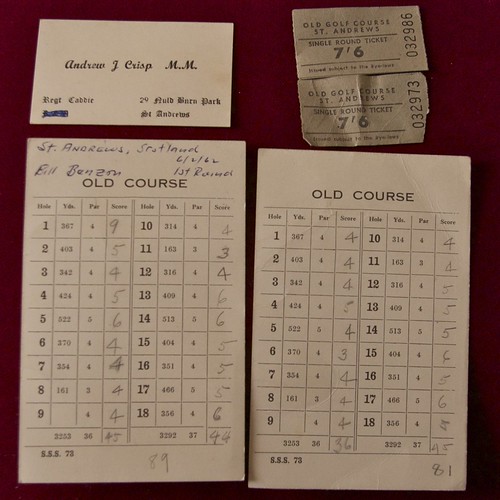
One of the highlights of his life was playing golf at St. Andrews in Scotland (he shot 81 on one round). He read a great deal about the sport, knew its history backwards and forwards, and had a good collection of golf books, including a classic written by a relative of Charles Darwin. It is absolutely clear to me that, as I use music to balance out my intellectuality, so my father used golf to achieve balance in his life.

IMGP5036
Caddie's card, tickets, and scorecards for two rounds at St. Andrews

Stamps

My father was an avid stamp collector, with particular interests in Canada, Liberia, Germany, and China. He loved the look of stamps, their design (line, color, shape, form, etc.), but also what they told about history and society. Stamps were his vehicle for encountering and organizing human history. Stamps commemorate individuals, events, ideas, and so forth, and thus tell the history of the nations that issue them. All of that was important to my father.

As was the craft of collecting itself. Used stamps are, of course, stuck on envelopes. They have to be separated from the envelope before they can be mounted in books. My father spent hours doing that. He had special chemicals, magnifying glasses, balances, tweezers, hinges etc. all relevant to the physical preparation of the stamps. He had books about stamps, and catalogues. He engaged in extensive correspondence with various stamp dealers, some he had come to know on an all but personal basis, even though he'd never met them. Over the years he'd developed relationships with them through the simple and cumulative acts of buying stamps.

Monday, September 25, 2017

Extended Adolescence – Adulthood Revised?

An analysis by researchers at San Diego State University and Bryn Mawr College reports that today’s teenagers are less likely to engage in adult activities like having sex and drinking alcohol than teens from older generations.

The review, published today in the journal Child Development, looked at data from seven national surveys conducted between 1976 and 2016, including those issued by the U.S. Centers for Disease Control and Prevention and the National Institutes of Health. Together, the surveys included over eight million 13- to 19-year-olds from varying racial, economic and regional backgrounds. Participants were asked a variety of questions about how the they spent their time outside of school and responses were tracked over time.

Beyond just a drop in alcohol use and sexual activity, the study authors found that since around 2000, teens have become considerably less likely to drive, have an after-school job and date. By the early 2010s, it also appeared that 12th graders were going out far less frequently than 8th graders did in the 1990s. In 1991 54 percent of high schoolers reported having had sex at least once; in 2015 the number was down to 41 percent. What’s more, the decline in adult activity was consistent across all populations, and not influenced by race, gender or location.
Affluence:
The analysis found adolescents were more likely to take part in adult activities if they came from larger families or those with lower incomes. This mirrors so-called “life history theory,” the idea exposure to an unpredictable, impoverished environment as a kid leads to faster development whereas children who grow up in a stable environment with more resources tend to have a slower developmental course.

In families with means there is often more anticipation of years of schooling and career before one necessarily has to “grow up”—there’s plenty of time for that later. As Twenge and Park conclude, despite growing income disparities, a significant percentage of the U.S. population has on average become more affluent over the past few decades and are living longer. As a result, people are waiting longer to get married and have children. We’re also seeing a higher parental investment in fewer children—or, in the parlance of our times, more “helicopter parenting.”
Erik Erikson talked of adolescence as a “psychosocial moratorium”, however
Yet many child psychologists believe today’s children seem to be idling in this hiatus period more so than ever before. “I'm keenly aware of the shift, as I often see adolescents presenting with some of the same complaints as college graduates,” says Columbia University psychologist Mirjana Domakonda, who was not involved in the new study. “Twenty-five is the new 18, and delayed adolescence is no longer a theory, but a reality. In some ways, we’re all in a ‘psychosocial moratorium,’ experimenting with a society where swipes constitute dating and likes are the equivalent of conversation.”
See these posts for further discussion on extended adolescence:


Is but one aspect of a new mode of life? You may recall that, in Western history, childhood wasn't recognized as a distinct phase of life until the early modern era (Philippe Ariès, Centuries of Childhood) and adolescence itself didn't emerge until the late 19th and early 20th centuries.

Wednesday, August 30, 2017

LARB interviews Alejandro Jodorowsky: "The work is to live all our years at once."

I saw Jodorowsky's El Topo when it first toured the States, back in the early 1970s. It blew my mind. I had to see it again, and I did. Maybe even a third time.

I watched it a half dozen years ago on DVD. Meh. "Lots of sun and sand and sending the intellectual rubes up the flag pole. With meaning."

Anyhow, Gregg LaGambina interviews him in the Los Angeles Review of Books. Here's a snippet:
What is the greatest difference between your 88-year-old self and your eight-year-old self?

That is a beautiful question. In some ways, I am still a little boy of eight years. In another part of my brain, I have 1,000 years. The soul when you are born is always the same. She was the soul before you were born, and she will continue to be when you die. That does not change. You have the same age. The work, in our life, is to live all our years at once. I am a child. I am an adolescent. I am a man of 40 years, or 80 years. At 88, I am starting! I swear I am starting! For me, it is an easy age. When you feel old, you get old. That’s why I don’t get old. Next, I will prepare three pictures. I may not have 100 pictures when I have 100 years, but I will do it, if I don’t die.
Feels about right, though he's got a couple of decades on me.

Saturday, August 19, 2017

Creativity through the life cycle

Writing in the NYTimes, Alison Gopnik and Tom Griffiths, report the results of a study involve people of various ages: 4- and 5-year-old preschoolers; 6- to 11-year-olds; 12- to 14-year-old teenagers; and adults. They presented these groups with two problems, one involving a physical machine and one involving a social situation.
When it came to explaining the physical machine, the pattern was straightforward. The preschoolers were most likely to come up with the creative, unusual explanation. The school-age children were somewhat less creative. And there was a dramatic drop at adolescence. Both the teenagers and the adults were the most likely to stick with the obvious explanation even when it didn’t fit the data.

But there was a different pattern when it came to the social problems. Once again the preschoolers were more likely to give the creative explanation than were the 6-year-olds or adults. Now, however, the teenagers were the most creative group of all. They were more likely to choose the unusual explanation than were either the 6-year-olds or the adults.
In explaining these results the introduce a distinction between exploitation and exploration:
When we face a new problem, we adults usually exploit the knowledge about the world we have acquired so far. We try to quickly find a pretty good solution that is close to the solutions we already have. On the other hand, exploration — trying something new — may lead us to a more unusual idea, a less obvious solution, a new piece of knowledge. But it may also mean that we waste time considering crazy possibilities that will never work, something both preschoolers and teenagers have been known to do.
This leads to:
Childhood and adolescence may, at least in part, be designed to resolve the tension between exploration and exploitation. Those periods of our life give us time to explore before we have to face the stern and earnest realities of grown-up life. Teenagers may no longer care all that much about how the physical world works. But they care a lot about exploring all the ways that the social world can be organized. And that may help each new generation change the world.
About the idea that each new generation sets out to change the world, isn't that a relatively recent idea?

Here's the original research paper: Alison Gopnik, Shaun O’Grady, Christopher G. Lucas et al. Changes in cognitive flexibility and hypothesis search across human life history from childhood to adolescence to adulthood. Published online before print July 25, 2017, doi: 10.1073/pnas.1700811114. PNAS July 25, 2017 vol. 114 no. 30 7892-7899.
Abstract: How was the evolution of our unique biological life history related to distinctive human developments in cognition and culture? We suggest that the extended human childhood and adolescence allows a balance between exploration and exploitation, between wider and narrower hypothesis search, and between innovation and imitation in cultural learning. In particular, different developmental periods may be associated with different learning strategies. This relation between biology and culture was probably coevolutionary and bidirectional: life-history changes allowed changes in learning, which in turn both allowed and rewarded extended life histories. In two studies, we test how easily people learn an unusual physical or social causal relation from a pattern of evidence. We track the development of this ability from early childhood through adolescence and adulthood. In the physical domain, preschoolers, counterintuitively, perform better than school-aged children, who in turn perform better than adolescents and adults. As they grow older learners are less flexible: they are less likely to adopt an initially unfamiliar hypothesis that is consistent with new evidence. Instead, learners prefer a familiar hypothesis that is less consistent with the evidence. In the social domain, both preschoolers and adolescents are actually the most flexible learners, adopting an unusual hypothesis more easily than either 6-y-olds or adults. There may be important developmental transitions in flexibility at the entry into middle childhood and in adolescence, which differ across domains.

Thursday, December 22, 2016

The brain is maturing into one's 30s

The human brain reaches its adult volume by age 10, but the neurons that make it up continue to change for years after that. The connections between neighboring neurons get pruned back, as new links emerge between more widely separated areas of the brain.

Eventually this reshaping slows, a sign that the brain is maturing. But it happens at different rates in different parts of the brain.

The pruning in the occipital lobe, at the back of the brain, tapers off by age 20. In the frontal lobe, in the front of the brain, new links are still forming at age 30, if not beyond.

“It challenges the notion of what ‘done’ really means,” Dr. Somerville said.

As the anatomy of the brain changes, its activity changes as well. In a child’s brain, neighboring regions tend to work together. By adulthood, distant regions start acting in concert. Neuroscientists have speculated that this long-distance harmony lets the adult brain work more efficiently and process more information.
This is based on a recent review article by Dr. Leah Sommerville, published in Neuron (PDF).

Saturday, November 5, 2016

The benefits of extended adolescence

In a time when college graduates return to live under their parents’ roofs and top careers require years of internships and graduate degrees, the age of adulthood is receding, practically into the 30s. Adolescence, loosely defined as the period between puberty and financial independence, now lasts about 15 years, twice as long as it did in the 1950s.

Part of this is due to the declining age of puberty in both males and females, but most of that extension appears in the 20s, when an increasing number of young people are still dependent on their parents. There is some concern that all of this dependence could lead to a lasting immaturity and failure to take on responsibility.

But according to developmental researchers, there is one lasting gift that extended adolescence can bestow, and it resides in the brain. “Neurobiological capital” is built through a protracted period of learning capacity in the brain, and it is a privilege that comes to those lucky enough to enjoy intellectually stimulating environments in late adolescence. Far from a contributor to emotional immaturity, the trend toward an adolescence that extends into the mid-20s is an opportunity to create a lifelong brain-based advantage.
Novelty and metaplasticity:
“There is reason to believe that continued exposure to novelty keeps the brain plastic for longer,” says Laurence Steinberg, a psychologist at Temple University whom many consider the leading expert on adolescence. Some of this evidence comes from brain studies of those who have had access to higher education.

The window for developing self-regulation closes when adult life settles into a routine, and the brain begins to exchange growth for efficiency. But if an adolescent continues to be stimulated intellectually—through higher education or travel, for example—their brain remains in its formative stage into the mid-20s, and even primes itself for future learning in adulthood. Dubbed “metaplasticity,” changing brain circuits through learning during adolescence can make subsequent modifications easier in those areas.
Adolescence vs. adulthood:
Steinberg likens the distinction between the brain’s adult state and its adolescent development mode to the difference between reading a new book and learning to read in the first place. For an adult to learn, she must pay attention and place information in the context of what she already knows. In contrast, an adolescent brain remembers things even through passive exposure. After that sensitive period has closed, the brain begins to focus on stabilizing the connections it has already made, through the process of myelination. It becomes exponentially more difficult to shape decision-making and higher cognitive functions. Those final pre-adult years may be the last, best chance to put a person on a healthy path.

Friday, August 21, 2015

It's time to create new adulthoods for the new worlds now emerging

Recently the NYTimes published an article on wage-slavery in the white collar ranks of Amazon.com. Many of us reacted in horror at what we read. But there soon followed articles pointing out that, after all, that's not so different from other high-tech workplaces, which tend to brutally competitive and all-demanding. This was even offered as a defense of Amazon.

But perhaps what the article revealed is that the meritocratic ideal as realized in the Amazon workplace is toxic and embedded in a now unworkable conception of adulthood. Do we need to rethink adulthood?

For it turns out that the nature of adulthood, like childhood and adolescence as well, is not written in stone, nor inscribed in our genes. It's something we create. The world's changing and so we must reconceptualize adulthood.

That seems to be the burden of Susan Nieman's Why Grow Up?, reviewed by Tom Slater in Spiked!:
The lines between childhood, adolescence and adulthood are mutable, and have changed over time. Less than a century ago, childhood, as a time of pampered play and dependence, lasted barely a few years for the vast majority of the population. And when most young people were out of school and married by the end of their teens, adolescence – the rebellious grace period between Tonka trucks and 2.4 children – didn’t even exist.

Instead, Neiman presents adulthood as a process of coming to terms with the circumstances you find yourself in and then committing to changing them – reconciling the ‘is’ and the ‘ought’. She situates this in the history of Enlightenment thought, in which the doomy realism of Hume clashed with the rugged idealism of Rousseau. ‘It would take Kant’, Neiman writes, ‘to appreciate the fact that we must take both seriously – if we are ever to arrive at an adulthood we need not merely acquiesce in but actively claim as [our] own’.

Kant’s concept of ‘the Unconditioned’, a point at which the world makes perfect sense, is central here. In order to develop into intellectual and moral maturity we must never lose sight of the idea of perfectible society – even as we come to recognise that the world is far from perfect.
Slater concludes: "This elegant, and accessible book is the philosophical kick up the arse my generation so desperately needs." Hmmm.

Friday, October 3, 2014

Adulthood in Flux

I just wanted to point out that yesterday’s post, The Next Level: Universal Children and a New Humanity, is the “other side” of my post, Solitaire (in Retirement). That post was specifically about my father, but treated him as an example of people who’d worked hard all their lives but, upon retirement, didn’t know how to spend their time. Now, it seems, if you’re high enough on the income totem pole you can hire a retirement coach to help you with the transition.

Well, if that’s what adulthood is, then there’s something deeply wrong with adulthood as it has developed in the industrialized West in the last century. And that, of course, was the point of yesterday’s post, which included a section on A. O. Scott’s NYTimes piece, “The Death of Adulthood in American Culture.” It seems that a lot of people have decided that adulthood isn’t what it was cracked up to be.

But it’s one thing to reject adulthood as the culture has defined it. It’s another thing to come up with a new way of being adult. I haven’t the foggiest idea where that project is, but it’s worth serious thought, though not now. I note only that the so-called counter-culture of the 60’ and 70’ took a run at the problem, but wasn’t able to quite pull it off. Meanwhile, what do we make of a culture, Japan, that took expressive forms relegated to children in America–comics and cartoons–and developed them into adult forms–manga and anime?

Monday, August 11, 2014

Solitaire (in Retirement)

The New York Times just ran a piece on retirement coaches, professionals who help retirees figure out what to do with their lives now that they don't have work to take up their time. Their example retirees are chosen from among professionals who, we assume, had satisfying careers. But what about them men and women who just worked fort a paycheck? 

One issue, of course, is relating to other people. Work gives you a circle of people who interact with day in and day out. When you're retired, that's gone, especially if you move away. But there's another problem; it has to do with what I've been calling behavioral mode. Work requires and supports a certain ecology of tasks, an economy of attention. You train your mind to it – though you might want to think of breaking a horse to saddle. When the job's gone, that economy is rendered useless. But you've devoted so much time to it that you don't know how else to deploy your behavioral resources.

And so you sit and twiddle your thumbs. Or, as in my father's case, play solitaire. I'm republishing the following note from April 15, 2011.

* * * * *

One scene that’s etched deeply in my mind is what I saw the first time I visited my parents after my father had retired. My father was playing solitaire hour after hour, day by day. Reveal a card, look at the table, place the card on the table. Reveal a card, look at the table, place the card on the table. Reveal a card, look at the table, place the card on the table. Reveal a card, look at the table, place the card on the table. Repeat.

Why? Why play solitaire when his time was his own? Who stole his life that he no longer had it?
 
My father was a brilliant man with many interests. We was a superb craftsman. He made my sister a play-pen for her dolls. He made if from wood, and made it so you could fold it up, just like real playpens. It was, oh, 30 to 36 inches square when opened up. The real marvel was that he’d cut the letters of the alphabet, and the numerals 0-9, into the slats on the sides. He outlined each letter on the slat. Drilled a hole inside the letter. Put the blade of a coping saw through the hole and then reattached the blade to the saw frame. Then stroke by stroke he sawed out the letter or number. When that was done he used small pieces of sandpaper to finish the edges.

Now, I didn’t actually see him do that, or, if I did, I don’t remember it. But that’s pretty much how he would have done it. Just which coping saw he used – he had several – I don’t know.

But that’s only one of many things he built down in his workshop with more tools than he had time to use.

He collected stamps, thousands upon thousands of them. The sale of his collection (after he’d died) was a minor event in the stamp-collecting world.

He played golf, a game he loved deeply. He like music, liked to read, and was a good bridge player.

But when he had his time back, when he didn’t have to go into work five days a week, he filled these blocks of time with solitaire. Not with those other things he used to do only on evenings and weekends.

In time, over the months and, yes, years, he cut back on the solitaire. He never did much, if any, wood working; the tools in his shop lay dormant. He played more golf, spent more time with his stamp collection. And bought some records.

The solitaire never left him. Always the well-worn decks of cards. Hours and hours.

Why?