Showing posts with label personal. Show all posts

Saturday, March 21, 2026

Milk bottle from the Ancient Days

I've been getting breakfast for the last two years, maybe three, and only just recently realized that what I thought of as an oddly shaped water caraffe was in fact modeled after the standard bottle in which milk was packaged in the middle of the previous century.

I grew up in Richland Township, a suburb of Johnstown, in Western Pennsylvania, in the 1950s. We had a small insulated metal box on the front porch. It was just large enough to hold four, probably six, such milk bottles. Every few days the local milkman, from Galliker's or Weller's (I didn't actually remember those names, but I've done a bit of Googling), would stop his truck in the front of the house. He had a small rectangular basket with a handle in which he'd placed some bottles of fresh milk, perhaps a pint of cream, even orange juice, depending on the order. He'd remove the empties from the milk box, place them on the porch, and then fill the box with the fresh milk.

[Note: I don't actually remember seeing that, much less the specific order of operations, to borrow a phrase from Adam Savage. But something pretty much like that must have happened. How do I know? I'm sure of the box, the truck, and the milkman. Given that, the logic of the physical world dictates something like the sequence I described. Sure, it is theoretically possible that the milkman also did handsprings on the way from the truck to the porch. But, as a practical matter, that's not very likely. It is also theoretically possible that the milk man was a milk woman. But in the 1950s, not very likely.]

Those milk bottles were pretty much gone by the 1970s, at least that's what Google (AI mode) tells me. I don't actually remember the last milk bottle I saw or opened.

Tuesday, December 31, 2024

Abu Simbel: Two Modes of Thought (an analogy)

This post was created in June of 2011. As you can see by the note immediately below, I bumped to the top back on July 29, 2013, because it was germane to my life situation at the time. It is once again germane, so I'm bumping it again.

* * * * *

These days I've got two things on my mind: 1) my current series of posts on cultural evolution, memes, and the thought of Dan Dennett, and 2) murals, Mana Contemporary, and current events in Jersey City, where I live. These are both big sprawling messes and meshes of ideas, very difficult to get a hold of. It is in THAT context that I re-post this note from 2011 on conceptual styles, particularistic and holistic. How do you combine them, because that's what I'm now wrestling with, the need to combine these two styles into a single synthetic act–actually, two synthetic acts, one about cultural evolution and the other about civic life in Jersey City.
Once upon a time the two temples of Abu Simbel sat on the western bank of the Nile River in Nubia, that is, southern Egypt. Then it was decided to dam the Nile at Aswan, creating a large lake. And that lake, it was realized, would, in time, submerge those temples.

What to do? The temples must be saved.

A number of plans were devised, and sometime during the process National Geographic did an article on the problem, and the proposed solutions. I read that article in my youth – I was, maybe, 12, 13, somewhere in there – and was quite impressed. Not so much with the temples, but with the proposed solutions. And not so much with them directly, but because two of them seemed to embody different ways of thinking about problems and working toward solutions.

12.31.24: Now that I think about it, a third method was proposed: Simply build a large wall around the temple so it is protected from the rising water.

One proposal was to cut the temple in cubes roughly two meters on a side. The cubes would then be moved, one by one, to higher ground, where they would be reassembled. This is what was done.

Another proposal was to cut the temple free from its matrix in one huge block. Then you place thousands of hydraulic jacks under that block and jack it up, fractions of a millimeter at a time. As I recall, it was estimated that it would take a year or more to raise the temple at the rate of, say, an inch a day.

This is the proposal that grabbed my imagination. It seemed so impossible and fantastic at the same time. How do you make that first cut? How do you slip the jacks under the bottom surface? How do you coordinate the jacks? How do you . . . ?

I suspect, though, that it mostly it grabbed my imagination because it seemed to me that’s how I thought about complex problems, and, as such, it contrasted with a different way of thinking about complex problems, a way represented by the cut-it-into-chunks approach. Though I couldn’t do so then, now I could assign labels to these two modes of thinking. Heck, I could probably supply several different pairs of labels.

But I won’t. Because that would reduce this story to those labels. And that’s not how the story exists in my mind, and that’s not how I use it as an object to think with. To this day.

Thursday, February 22, 2024

My use of ChatGPT in my intellectual work

 I recently posted this note to an online community, Brainstorms, hosted by Howard Rheingold (whom I address in the final paragraph):

I've spent a LOT of time using ChatGPT since it went online at the end of Nov. 2022. Most of the time I've been investigating its behavior and have written a number of posts about it. But more recently I've been using it a bit in for my own research purposes, where it's a tool for me, not the object of my inquiry. Thus, back in October the economist Tyler Cowen announced that he'd written a book about the greatest economists of all time. You can download the PDF, but he's also made AI versions that you can query like an AI engine. I've only used the AI once or three times. It seemed OK, but not great.

However, I decided, why the hell not? I'll write so posts about great literary critics. I've now got over a half dozen posts in the series, and I've used ChatGPT in the process. But always in a background role. If you look at any of those posts and see something set in Courier, that's from ChatGPT. I'm not using it to do any of the writing. not even drafts for me to edit into (more or less) finished prose. If I'm going to stick its text into my work, I want the reader to know that it did it, not me.

Now, I'm trained as a literary critic. I've published in professional journals. Though I've mostly been doing other things for the last three or four decades, I still follow some things here and there. From 2007 to 2010 or so I was a member of a (now-defunct) group blog (The Valve) of mostly professional literary scholars and a philosopher or two. In the last decade I've followed work in digital humanities, often on Twitter. So I'm pretty confident of using ChatGPT in that arena. If it produces some nonsense, there's a good chance I'll detect it.

Of course, I'd really like to be able to use it in areas where I know little or nothing. There I'm more likely to be fooled. However, I've looked into and published about a lot of things over the years. I'm very sophisticated about these things. And I know how to check things. If I get some stuff from ChatGPT in an area I don't know, but I like what it's given me. I'll check it.

I've got a lifetime's worth of crap-detection behind me. Now how you distil that down, you've thought a lot more about that than I have, Howard. It seems to me, though, that the tricky part is that you learn best if you're really interested and the work means something to you. Then you'll automatically take care and, I assumem, would be open to specific instruction on crap-detection. But if you're just doing it to get a grade in something that otherwise doesn't interest you, or to rack up education points at a boring job, then I'd think you're more vulnerable.

Monday, February 5, 2024

Into the Bopi, Me & Charlie Keil @3QD

My latest essay for 3 Quarks Daily went up last week:

On the 12/8 Path with Charlie Keil

It’s about my relationship with Charlie Keil, from the time I read Urban Blues in the late 1960s up to now, more or less.

As for the bopi, Charlie tells me that’s what the Tiv – of Nigeria, where he did some fieldwork – call an area that’s set aside for children’s play. Not only that, but adults are forbidden to enter. When I was a kid there were areas that more or less functioned like that in my neighborhood. It’s not that adults were forbidden to go there, or even that these areas were unofficially understood to be ‘kids only.’ But adults simply didn’t go there. They were interstitial spaces, liminal, boondocks. Alas, I keep reading that these days the lives of children are being micro-managed by adults. No bopi, no more.

It’s been a long time since either of us were children, but we’ve each spent our adult lives in interstitial spaces of one sort of another. The early success of Urban Blues earned him a place in the academic world that I was never able to secure for myself. But, by the end of the century, it became a bit much and he squeezed himself out to rural Connecticut, making occasional sorties into New York to march and make music in the cause of peace. I was happy to join him there.

We both found the academic study of music rather too Platonic and too lopsided in favor of The Classics. He spent his career dancing to different drummers and exploring paths. My intellectual interests, though were somewhat different – literature, cognition, the brain – but at the end of the millennium I wrote a book about music (Beethoven’s Anvil) in which I argued that it’s the socio-cultural glue that transformed clever apes into dancing humans, thereby giving intellectual expression to some of Charlie’s themes. Call it collaborative groovology with a neurocognitive twist.

For that matter, I suspect it’s Charlie’s interest in fostering music and dance among children that got me watching YouTube videos of children making music (and at play) – see these YouTube play lists: prodigies, kid dance and music, kids at play, Japanese school bands, Twinkle Twinkle, patty-Paddy cake, Double Dutch.

It's been a fruitful collaboration.

More later.

The photos are from Charlie's place in Lakeville, Connecticut, in September of 2012.

Thursday, January 4, 2024

Update: My mood over the long term [intellectual productivity]

As you may know, I use my posting pattern as a gauge of my overall long-term mood. The better my mood, the more I post in a month. I’ve written about this a number of times, most recently in mid-September of this year, New Savanna Moods: I was down, but I’ve started back up. The trend I reported in that post has continued through the end of the year, with a total of 112 posts in September, 120 in October, 132 in November, and 111 for December. Here’s how things look for the last three years:

And here’s how things look over the life of New Savanna, starting back in June 2010:

The overall trend is up. Last year (2023) is my highest annual total: 1004. Then we have 2019 (912) followed by 2018 (871).

I should note, however, that prior to September of 2018 I had not been posting tweets to New Savanna, though I joined Twitter in October of 2011. In terms of psychic energy, tweet posts are cheap posts, so I tend to think that some of the increase since has to be discounted in the sense that the increase doesn’t reflect my mood, rather it reflects ease of posting.

See also, A Mind Over the Long Haul: My Posting Patterns For that matter, take a look at this while you're at it, What is depression? [an umbrella term]..

Wednesday, January 3, 2024

Frost on the Punkin’

I'm bumping this to the top of the queue on general principle. I've been looking around on my hard drive and came across this post from September of 2013, which I'd all but forgotten. Now it's unforgotten. 

* * * * *
 
I was looking through my “on deck” folder to see which photos I had ready for uploading to Flickr and I saw this one:

IMGP3592

And that got me to thinking about George Bowers, G. Lionel Bowers.

He’s one of the guys I worked with summers at the lab in Johnstown. Summers, you know, my summer job between years off at college. As for the lab, it wasn’t much. It was a laboratory run by Bethlehem Mines, the mining subsidiary of the now-defunct Bethlehem Steel Corporation. My father was Superintendent of Coal Preparation, which meant he was in charge of designing the plants used to clean coal. This little lab analyzed samples of coal from the mines to determine their sulfur content – sulfur was the main impurity to be removed by the cleaning process.

Building No. 1 is where they crushed the coal samples. It was a dusty, dirty, job. And lowest in the status hierarchy. That’s where you started when you worked at the lab. The crushed samples were ‘washed’ in Building No. 2. It wasn’t a matter of cleaning the samples – hence the scare quotes – but rather of separating them into grains of differing sizes. This involved floating the coal in some medium, generally perchlorethylene (tetrachloroethylene), a nasty chemical used in dry cleaning, and then running the slurry through successively small sieves. Building No. 2 was in the middle of the hierarchy.

And then we had Building No. 3, which is where the samples were actually analyzed. The building had two floors and, you guessed it, the bottom floor was one rung up from Building No. 2, the top floor was a level above that, making it fourth from the bottom. Or, turning the count around, second from the top. The boss’s office was on that top floor and it was the top of the status hierarchy. So there you have it, three buildings, five status levels, from highest to lowest: 1) boss's office, 2) upper floor of building no. 3, 3) lower floor of building no. 3, 4) building no. 2, and 5) building no. 1.
 
Over the course of three summers I worked in all three buildings, starting with Building No. 1. As I recall I only did a week or three there before being moved to Building No. 2. I forget how long I spent there, perhaps the rest of that first summer, but perhaps not. Anyhow, I made it to Building No. 3, bottom floor, which is where I met G. Lionel. And I also worked the top floor in Building No. 1. As a college-going son of company brass I operated outside the normal hierarchy, which everyone knew. But at the same time I had to respect it, like everyone else. Which is why I started in Building No. 1, where I had to wear a breathing mask and got coal dust all over my clothes and up in my hair.

Anyhow, George Bowers. I liked him, and we got along well. He was a high school graduate, no college, and so was pretty much stuck there on the ground floor of Building No. 1, at least if he stayed at the lab.

At some point he uttered a ditty, bits and pieces of which have stuck in my mind ever since: “... and the frost is on the punkin’, that’s the time for dickie dunkin’.” But what’s the rest of that phrase?

Time for googling. I typed “frost is on the punkin” into the magic slot and came up with an entry from the Urban Dictionary and came up with this:
Time for making love. After the hard work of the harvest is done, and to relieve the pent-up tension of not being able to mate because of sweltering August weather (you know - sleeping on the porch, all the windows open, etc...).
OK. That’s the right ballpark. But a bit further got me what I was looking for:
When the weather's hot and sticky
there's no time for dunkin' dickie;
When the frost is on the punkin
that's the time for dickie dunkin'!
That’s the little ditty G. Lionel was saying.

Hot dog! Google does it again. High tech wizardry took me back to the past.

But there’s more. It also coughed up a poem by James Whitcomb Riley (1853–1916), a name I’ve heard, but that’s about it:
Known as “The Hoosier Poet” because of his birth in Indiana and poems celebrating the state, and as “The Children’s Poet” due to his appeal for young readers, James Whitcomb Riley was one of his day’s best-selling writers. Full of sentiment and traditional in form, his work features rustic subjects who speak in a homely, countrified dialect. When Riley died, Woodrow Wilson called him “a man who imparted joyful pleasure and a thoughtful view of many things that other men would have missed,” and some 35,000 people filed past his casket in the Indiana State Capitol.
Seems he’d written a poem, “When the Frost is on the Punkin”. Here it is:
When the frost is on the punkin and the fodder’s in the shock,
And you hear the kyouck and gobble of the struttin’ turkey-cock,
And the clackin’ of the guineys, and the cluckin’ of the hens,
And the rooster’s hallylooyer as he tiptoes on the fence;
O, it’s then’s the times a feller is a-feelin’ at his best,
With the risin’ sun to greet him from a night of peaceful rest,
As he leaves the house, bareheaded, and goes out to feed the stock,
When the frost is on the punkin and the fodder’s in the shock. 
They’s something kindo’ harty-like about the atmusfere
When the heat of summer’s over and the coolin’ fall is here—
Of course we miss the flowers, and the blossums on the trees,
And the mumble of the hummin’-birds and buzzin’ of the bees;
But the air’s so appetizin’; and the landscape through the haze
Of a crisp and sunny morning of the airly autumn days
Is a pictur’ that no painter has the colorin’ to mock—
When the frost is on the punkin and the fodder’s in the shock. 
The husky, rusty russel of the tossels of the corn,
And the raspin’ of the tangled leaves, as golden as the morn;
The stubble in the furries—kindo’ lonesome-like, but still
A-preachin’ sermuns to us of the barns they growed to fill;
The strawstack in the medder, and the reaper in the shed;
The hosses in theyr stalls below—the clover over-head!—
O, it sets my hart a-clickin’ like the tickin’ of a clock,
When the frost is on the punkin and the fodder’s in the shock!
Then your apples all is gethered, and the ones a feller keeps
Is poured around the celler-floor in red and yeller heaps;
And your cider-makin’ ’s over, and your wimmern-folks is through
With their mince and apple-butter, and theyr souse and saussage, too! ...
I don’t know how to tell it—but ef sich a thing could be
As the Angels wantin’ boardin’, and they’d call around on me—
I’d want to ’commodate ’em—all the whole-indurin’ flock—
When the frost is on the punkin and the fodder’s in the shock!
Now, what’s the relationship between that little quatrain about dickie dunkin’ and this poem? Which came first? Did G. Lionel Bowers know the poem?

Questions.
 
* * * * *
 
Here's a somewhat longer post about that summer job that says more about it: My summer job, working in a coal mine – or, how I learned about class in America.
 

Thursday, December 7, 2023

UPDATE AT 76: Reflections on entering my eighth decade and why it portends to be the most productive one of my life

I posted this six years ago, a few days after my 70th birthday. It’s still a reasonable overview of things I’ve accomplished, though the future looks a bit different. GPT-3 and then ChatGPT came along unexpectedly. I’ve devoted a great deal of time on ChatGPT over the last year, over 100 blog posts and 11 working papers. I’d hoped to finish a 12th paper by today, but other things intervened so I’ve still got a day’s or so worth of work on it. Then I’ve got to look over that work, arrive at some conclusions, and set directions for future work. That’ll take several more days.

One of those working papers, Xanadu, GPT, and Beyond: An adventure of the mind, outlines the connections between this strand of current work and my earlier work going back to “Kubla Khan” and even a bit before. Back in 2022 I posted Relational Nets Over Attractors, A Primer: Part 1, Design for a Mind, which knits together the work I did with David Hays, first on cognitive networks in the 1970s, and then our two papers on the brain in 1988, Principles and Development of Natural Intelligence and Metaphor, Recognition, and Neural Process. That was unexpected.

It also appears that I’ve undertaken yet another overview of literary criticism, GOAT Literary Critics. I’ve posted two pieces already and have tentative plans for five more. I don’t know just when I’ll do them as the ChatGPT wrap-up has higher priority.

Finally, back in 2017 I wrote about how I made Jersey City my home: through photographs. Now Hoboken has become my home and, once more, it’s been through photographs. I post photos to a Facebook group for Hoboken photos and am planning a small exhibit of some of my photos. I’m working with one of my Jersey City friends, Greg Edgell, on that (& Greg’s gotten married and moved to the house near Morristown where he grew up).

Things are moving along. Like my friend Al used to say, “These are the good old days. The best days are yet to come.” 

* * * * *

Reflections on entering my eighth decade and why it portends to be the most productive one of my life


KK in Arches 70
In destinies sad or merry, true men can but try.
– Sir Gawain and the Green Knight 
In scientific prognostication we have a condition analogous to a fact of archery—the farther back you draw your longbow, the farther ahead you can shoot.
– Buckminster Fuller
Birthdays are generally just that, even “major” birthdays, like my most recent one, my 70th. They are an occasion for a celebration, perhaps a modest one, perhaps not quite so modest – our house was crowded with dinner guests for my father’s 50th birthday – perhaps even extravagant. I’ve never been to an extravagant birthday party. Birthdays may also be a time for reflection, but by no means necessarily so.

But in my experience birthdays rarely correspond to major life events. What’s a major life event? Getting married, whether at a small civil ceremony before a judge or an elaborate wedding with 100s of guests into the church and out to the reception where a great band – like me and my colleagues in The Out of Control Rhythm and Blues Band – performs for hours of dancing, that’s a major life event. Climbing a mountain you’ve trained for over a period of years, that’s a different kind of major life event. Graduating from school, or completing basic training in the military, passing the bar exam, all major.

Years ago, in my early 20s, I was in a rock band called “St. Matthew Passion.” It was our last gig, the sax player and I were jamming a whacked out intro to “She’s Not There” and suddenly it all disappeared, me, the musicians, the room, the world, all into a brilliant, but soft, white light. Only the light and the music. It lasted what, half a second, a second, two seconds? Whatever. Those few moments challenged me for years, changing my sense of myself and the world.

Major life events come in all forms and durations, but they rarely coincide with a birthday. Birthdays simply mark the passage of time.

And so it set out to be on Thursday, December 7, 2017, when I turned 70. I woke up, cruised the web, made four posts to New Savanna, had breakfast and then, and then I decided to go out and take some photos, including some of that green platform pump I’ve been having so much fun photographing.

20171207-_IGP1519

That was a bit unusual because I generally write in the morning, and perhaps I was motivated by my birthday to do something a bit different. But that’s all it was, a change in routine. It’s no big deal; I do it all the time.

But then I realized, sometime in the afternoon, that this birthday IS a big deal, and that I really can make it a big deal. How? By finishing my working paper, Calculating meaning in “Kubla Khan” – a rough cut. Why is that important, major milestone important? Because I’ve been working on it almost 50 years, all my adult life.

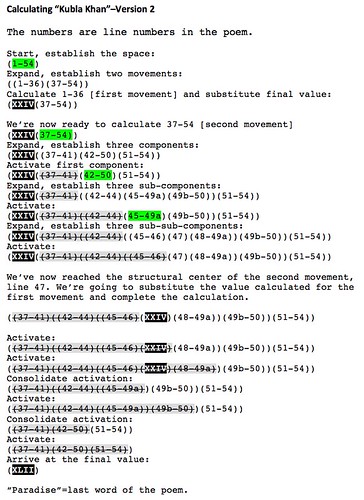
Calculating Kubla Khan 3
Teaser: Calculating meaning in “Kubla Khan”, 2017
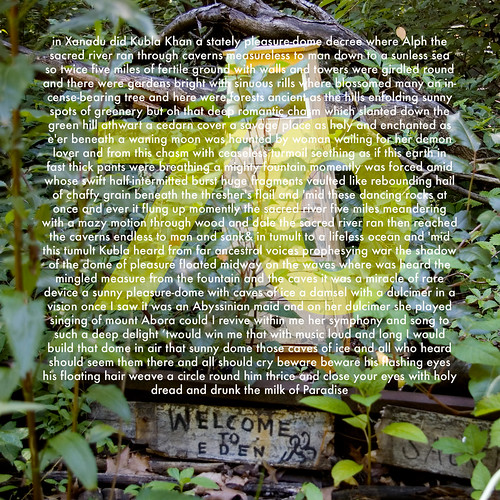
This image likely makes little sense. Don’t worry about it. There are two more images that won’t make much sense. Don’t worry about them either. Just look at them as you would displays in a museum or gallery and move on.
Not that paper, no, not that. It’s the poem, “Kubla Khan”, by Samuel Taylor Coleridge, that I’ve been tracking all my adult life. I’ve been working on it since the spring of 1969 when I read it in Earl Wasserman’s class in my senior year at The Johns Hopkins University in Baltimore – where my father had gone to school. To have completed a project that framed one’s adult life, that is indeed a major event. Not completed, not in the sense that it’s all over and done with – for it isn’t, but in some deep and fundamental sense, things have changed. I’ve got a new understanding, and new obligations to go with it.

The first five lines:
In Xanadu did Kubla Khan
A stately pleasure-dome decree:
Where Alph, the sacred river, ran
Through caverns measureless to man
          Down to a sunless sea.
There are 49 more.

Let me explain. Perhaps then you will understand why I expect the next decade to be the most productive one of my life. And not just my intellectual life. There is the Bergen Arches Project as well. And who knows what else? I wonder if Rita Moreno is available for salsa lessons?

Thursday, September 28, 2023

My summer job, working in a coal mine – or, how I learned about class in America

Another blast from the past. I decided to jump this one to the top of the queue more or less on general principle. I originally published it five years ago, almost to the day.
 
Well, not quite.

Let me explain.

I spent the first three or four years of my life in Ellsworth, Pa., but I don’t remember much, if anything, of that life. It was a “company town”, as they called it. The company was The Bethlehem Steel Corporation. My father worked for the mining division, Bethlehem Mines Corporation. Ellsworth was a coal town; they used coal to make coke; and they used coke to fuel the blast furnaces that turned iron ore into iron. From iron, steel.

When I was four the company – Bethlehem Mines – moved my father to company headquarters in Johnstown Pa. You may have heard of Johnstown, flood city – three floods, 1889 (the big one, the one that put Johnstown on the map), 1937 (my mother lived through that one, though she lived in Westmont, a suburb high on a hill), and 1977 (by which time I was long-gone, so was my family). We settled in Geistown in Richland Township: 315 Cherry Lane. Like Westmont, a suburb. Whereas Westmont was high class, more or less, Geistown was middle class, a mixture of blue and white collar workers.

For a number of years our house was heated with coal. There was a coal bin in the basement, a small room with a hatch opening to the driveway outside. A truck would pull up and dump a load of coal down the hatch. It was up to dad to shovel the coal into the furnace that heated the boiler that heated the house. I suppose mom shoveled the coal when dad was away on business, as he often was. Sometimes I’d help.

My father was a white collar worker, an engineer. He had a management title, Superintendent of Coal Preparation, but he didn’t do much managing of people. He was in charge of the technology, the design and upkeep of the plants that cleaned the coal used to make coke [1]. Our neighbors to the left and right on Cherry Lane were also white collar; that is, the man, the husband and father in the family, was white collar. One was the Johnstown postmaster the other, I don’t really know what he did, but it was management I’m sure. My best friend in those years, Jackie Barto, was the son of a steelworker; his mother worked as a records librarian in a local hospital. I couldn’t off hand give you the demographic mix of white collar and blue collar in the area, but there certainly was a mix. A lot of steelworkers, a lot.

There was one Jewish family in the area; owned the local bowling alley. Otherwise it was all white –  yes, I know, but recall that back in the 1920s Jews were brown (you can find it in Hemingway). The only ethnic matter than had any impact on my daily life was the difference between Protestant and Catholic. The local Catholic high school was a football powerhouse, but then so were we, the Richland Rams. I was in the band [2]. There was a black section of Johnstown; we drove through it on the way downtown; but that wasn’t my neighborhood. For a number of years, though, a black woman helped my mother around the house once a week – a common arrangement in those days, still is. I don’t know where she lived.

Early in those years we would drive down into downtown Johnstown, through it, and out the other side and go up into Westmont – the somewhat higher class neighborhood where my mother grew up. The parents of her best friend from childhood – maybe her BEST friend? I forget – still lived there and we’d visit them when Louise was in town. My father played golf at the country club there, Sunnehanna Country Club (it’s an Indian name – Native American, I know, but usage varies and back then it was Indian 24/7/365). We’d go there for dinner and for the annual Christmas party. I remember the magician; don’t remember what tricks he performed (rabbit? hat? cards?); I just remember that he was there.

But then a golf club was established in Windbur, not far from us. My father quit Sunnehanna and joined it; in fact, I believe he was a founding member. For one thing, it was closer to home. But I also think he thought the Sunnehanna crowd was a bit pretentious.

So, my summer job.

I graduated from Richland High in 1965 and that summer I went to work for Bethlehem Mines. Other friends went to work for the steel company. But I didn’t work in the mines. I worked in the coal preparation laboratory, three summers: 1965, 1966, and 1967.

The lab was somewhere else, I forget what the area was called, but it was somewhere between Geistown and Westmont but a bit closer to downtown. There were three small buildings at the lab, called No. 1, No. 2, and No 3.

For the first couple of weeks I worked in No. 1 building. It was the dirtiest, a hardhat job. Coal samples would come in from the mines and be taken here to be crushed. When you crush coal, you get dust, lots of coal dust. All over the place. On your face, in your hair, and seeping down your butt crack. Mike Karoly – I believe that was his name – worked there.

After a couple weeks there I was moved up to building No. 2. Not literally up, as all three buildings were within 50 or 70 yards of one another on the same ground. But there was a status hierarchy that was the inverse of the numbering. No. 1 building was lowest on the totem poll while the second floor of No. 3 was highest.
 
Everyone knew I was the boss’s son. Couldn’t hide it, didn’t try to. But like everyone else who worked at the lab, at least those without college degrees (only two of those at the lab), I had to start at No. 1 building and then No. 2.

That’s where the crushed coal was cleaned. You’d float the crushed samples in a medium, such a perchloroethylene, aka perc, and run it over a sieve. The coal would go over the sieve while the rock would go down through it. The cleaned coal was then put in some suitable container and taken to the basement of No. 3 building for further processing.

Perc was nasty foul-smelling stuff. That’s why its use was confined to a separate building. It’s also used as dry-cleaning fluid. Man, you do not want to be around that stuff eight bleeping hours a day. No you don’t. Nasty – worse, in fact, than the dust at No. 1. That was just dirty and could get in your lungs (we wore respirators). But perc, shit, perc felt like it crawled into your blood.

After a couple of weeks breathing perc in No. 2 building I was moved up to the basement of No. 3 building, where I remained for the rest of that first summer and all of my second summer (1966). In addition to the work we did, the basement was also a hang-out spot when things were slow in No. 1 and No. 2. We’d just hang around and chat.

A number of guys worked there. The was G. Lionel Bower, lanky guy, we called him “G. Lionel” or “George” – both were used, don’t recall the distribution. There was P. J. Shmeer (or was it Schmeer?) and his dad, Joe. Joe used to chauffeur some Bethlehem executives but developed heart problems or something – I don’t really know the story – and was retired to the lab, mostly just to keep him on the payroll. Because that’s how those big companies did it back in the day. P. J., what’d he do? Things and stuff. He was just a guy. But, as I remember, he was fond of Johnny Mathis.

Aside from shooting the shit, we did two things in the basement of No. 3. One thing was to size the crushed and cleaned coal. We had a stack of screens attached to the bottoms of steel hoops. The top screen had a coarse mesh (an eighth of an inch, a bit larger? not much smaller though) and then successively finer meshes down the stack until we get to the bottom where there’s a shallow pan to catch whatever coal made it all the way though. That stuff was finer than sand. Maybe even fine as dirt.

You’d place a sample of coal on the top screen and put the whole stack on a device that would vibrate it. You’d jiggle the stack for awhile – 10, 15 minutes, a half hour – and the coal would trickle down through. Then you’d take the stack into a back room where there was a heat lamp to dry it thoroughly. Once that was finished the coal in each screen would be placed in a small sample can that we’d label. Those sample cans went upstairs for the final analysis.

Why’d we have to separate the sample into various sized particles? I don’t really know at this point, though my father must have explained it to me. It surely had to do with getting things properly tuned at the cleaning plants, which dealt with wet coal by the ton. Also we needed to know just how much sulfur remained in the coal that was eventually going to be coked (that is, turned into coke). And that, I’m guessing, varied among different sizes of grains. Anyhow, we were supposed to do it, so, like everyone else, I did what I was told.

Tuesday, September 26, 2023

Notes on How I Practice the Trumpet

Practice tends towards two kinds of things: exercises and real music. One does them for different purposes, that is to say, I have different things in mind when I undertake them. I must confess, however, that my practice tends to be unruly. Some players have nice routines worked out, perhaps: warm-up, followed by exercises, followed by real music. Warm-up generally consists of exercises, but specific to the job of getting the chops – lips, and lungs – reved up. Long-tones and lip-slurs are common forms of warm-up for trumpeters, but there are other things. While I do those things, mostly warm-up is simply what I start out with in a session. For the most part, it will be easy and relaxed. I’m not going to come out of the gate wailing away.

And then we have exercises. Like any instrument used in the Western classical (or ‘legit’) tradition, there is a vast trove of technical exercises that have been handed down. A set of exercises codified by Jean-Baptiste Arban in the middle of the 19th century is central to this body of work. Like, I suppose, most trumpeters who’ve been trained this way, I’ve got an edition of Arban’s book and I’ve got some other books as well. But I don’t have a whole lot of them, though trumpeters who’ve gotten a conservatory degree probably have a closet full.

But one can make up one’s own exercises, which I have done, many based on jazz tunes . You can even make one up on the spot, while playing a tune. You hit a rough patch so you stop, and turn it into an exercise which you work on for a few minutes.

And then there’s real music. All kinds. If you’re working in the classical tradition you’ve got passages in orchestral and other works, but you’ve also got solo literature, quintets and so forth. I’ve done some of that at one time or another, more when I was younger. I also worked through a lot of Rafael Mendez solos. But I’m mostly a jazz musician. So I improvise. Maybe I’ll play along with a recording, and maybe – mostly these days – I’ll just play. I can hear the accompaniment in my head if relevant.

Here's the important part: It’s about what you’re attending to. When you’re playing exercises, you’re attending to the mechanics of playing the instrument. When you’re playing real music, you forget the mechanics – they’re on autopilot, and attend to the music itself.

It’s easier to talk about attending to the mechanics than attending to the music. Mechanics: lip tension, ease back on the pressure, relax, lower the shoulders (relax), lighen-up on the fingers, tighten the abdominal muscles – stuff like that. I shift my attention around as needed. Sometimes I’ll pick an exercise to work on something specific, a particular finger pattern, or lip control. Otherwise, this and that.

Music; What’s it mean to attend to the music itself? Just that. But when all’s flowing, it just flows. Half a notch below that and you may ease up a bit here, then pull back, and so forth – where “ease up” and “pull back” are global movements/attitudes. Back another half notch and maybe you’re mind will flash on a particular move you want to make next – “repeat the phrase,” “got high and hang there,” “slow down & invert the figure,” stuff like that. What you’re NOT doing is thinking specifically about particular notes and fingers and such. If that starts happening, then you’ve lost it. The music stops and you’ve got to either stop entirely or at least pause

Saturday, September 16, 2023

New Savanna Moods: I was down, but I’ve started back up.

I have, at various times, written about how my general mood is subject to long-term swings, apparently seasonal. I go down in the fall or winter and come back up in spring: A Mind Over the Long Haul: My Posting Patterns.

This has been going on, it seems like, my entire adult life, starting in young adulthood (my freshman year in college). At one time a friend suggested that I had seasonal affective disorder (SAD). I never really checked that out, though earlier this year I thought about getting those bright lights that are supposed to stave it off.

Anyhow, things changed this year. Look at this chart, which depicts my monthly blogging frequency since 2021:

We see the standard pattern in 2021. There’s a big drop from August to October, to a low in November. I start back up in December, but don’t come back until April.

In 2022 again, have a big drop between August and September, a low in November, but then I shoot up in December up through April and then, whoops! back down for May. What happened?

At the end of November 2022 Open AI released ChatGPT to the web. I started playing with it, a lot, and got back to blogging, a lot. I kept that going through the end of April, when I lost intellectual and creative steam. But then, late in August, things started back up (I wrote over half of the August posts in the last week of the month). My thinking has come back.

Why? Interesting question. I don’t really know. Let’s just leave it for now and move on.

If my winter slumps were due to SAD, then that shouldn’t have happened. Sure, there’s ChatGPT, so what? Why should that make a difference if my mood is controlled by biochemical events that are cued by seasonal variations in illumination? But what if my moods are not cued by the weather? What if something else is going on and, whatever that is, it just happened to more or less coincide with seasonal variations in light?

NOTE: The bar for September of this year, at the far right of the chart, is a guess. I set the number at 90 so the chart would show what I think is going on. The month isn’t over yet. It’s the 16th. When this post goes up I’ll have 50 for the month. I’m over half way to 90 and I still have half a month left.

Tuesday, December 20, 2022

Potpourri! Taking photos (again!), back to the future, ChatGPT, organizing a workshop? [Ramble]

I’ve been busy. Time to sit back for a second and take a quick look.

Photos

It looks like I put my camera(s) down from August through the end of November. That’s four months that I’ve been hibernating in a funk when damned near everything shut down, not just camera. Just look at the number of blog posts over there at the right. You can see my mood in the numbers, something I wrote about back in 2018, A Mind Over the Long Haul: My Posting Patterns.

Here's my first shot upon coming back:

Chatting with ChatGPT

It’s not photography that brought me back, though, it’s ChatGPT, the newest and baddest chitter-chatter from our friends in Silicon Valley. I’m exhausted from all the playing, thinking and working I’ve been doing with ChatGPT. My document of Chat interactions has almost 50K words over 147 pages.

There are things you learn that you add to your current repertoire, little things, big things. There’s a bit of that here. But there’s something much deeper. Some things lead you to reorganize some, a lot, of what you already know. That’s harder work, burns more energy, touches more cells. That’s what I’ve been doing.

There’s Benzon’s second law:

If you want to know what it’s like to drive a car, you have to sit in the driver’s seat. Going along for the ride isn’t the same.

Thus, while the effect of working with ChatGPT has been deep, it hasn’t much affected my fundamental ideas about computing & AI. It doesn’t work that way. We’re not going to get from here to there – whatever wherever there is – simply by scaling up our current technology. We do need to go back and recoup some stuff from the classical era of symbolic AI and computation linguistics. And we need a more thoroughly embodied intelligence that moves about the world easily and fluently.

Intelligence without consciousness or intention?

Moreover, you know, the classical arguments against AI, the arguments by Dreyfus and Searle (Chinese Room), remain valid. But the context has changed radically. Back then AI technology couldn’t do anything really impressive. Oh sure, it was impressive to those who built it because they know how difficult it is. And there is that Eliza Effect, which involves humans attributing intentionality where it really isn’t there. But what the tech could actually do, wasn’t impressive. The ARPA Speech Understanding project of the mid-1970s was a massive and impressive project spread across three or four institutions and a half dozen sites for three years. But the end result was a system that couldn’t do much, certainly much less than the smart phones since forever.

Where I’m going is that those classical arguments, the arguments from intention, got most of their rhetorical force, as opposed to the cognitive force, from the impoverished abilities of that technology. The current technology does not diminish the cognitive force of those intentional arguments, but the capacities of current tech ultimately weakens the rhetorical force of those arguments. We’re on the threshold of something that might as well be called intelligence without intention and consciousness. That’s a very strange beast.

Where does that put us? It’s been clear to me for some time that this technology, based on deep learning, is unlike anything we’ve seen before. We’re in “here be dragons” territory. ChatGPT is NOT a conscious intentional (in the philosophical sense) actor. It is a very complex inanimate contraption of some sort. But what sort?

I am provisionally thinking of them as devices that exhibit intelligence (whatever that is) without having either consciousness or intentionality – though perhaps one cannot have intentionality without consciousness, certainly not consciousness without intentionality. If that seems weird, well then, it is. And I’m comfortable with it, provisionally.

Back to the Future

All this GPT chatting has gotten me thinking about the future once again, about the Fourth Arena: first there was inanimate matter, then life, after that we have human culture, which circles the glob though the brains of very clever hairless apes. We’re now stepping on to the Fourth Arena, just what that will turn out to be like, that remains to be seen. I’m thinking of it as a community in which these new creatures will be interacting with us, through desktop, online, and handheld systems, as they currently, but also through robots. They’re also be interacting among themselves.

Of course, current systems are already doing this kind of thing. But we’re headed to something new, something strange, something exciting, but also dangerous. Once more I’m thinking about Neal Stephenson’s The Diamond Age: Or, A Young Lady's Illustrated Primer as a loose and suggestive framework in which to situate my thinking about the future.

A Methodology for describing and analyzing interactions with ChatGPT

When I started playing with ChatGPT at the beginning of December I was doing just that. But as I got deeper and deeper into it, I began a more systematic style of prompting. I was looking for things. I began to see patterns in what ChatGPT was doing.

The upshot is that I now see the possibility of constructing a competence grammar (to borrow from Chomsky) of ChatGPT’s discourse. I don’t know what this grammar will look like, but Joseph Becker’s phrasal lexicon (from the ancient days, the mid-1970s) is very suggestive. From the abstract of his 1975 paper:

This paper will focus on the contrary aspect of language, wherein utterances are formed by repetition, modification, and concatenation of previously-known phrases consisting of more than one word. I suspect that we speak mostly by stitching together swatches of text that we have heard before; productive processes have the secondary role of adapting the old phrases to the new situation. (For more, see my posts, The phrasal lexicon [System 1 vs System 2 for language] and GPT-3, the phrasal lexicon, Parry/Lord, and the Homeric epics.)

That’s the stuff. Whereas he was looking at relative short strings, I want to open it up to include longer strings, 10, 20, 30 words, maybe more. That’s what ChatGPT is working with at the discourse level.

My next step is to get people in the industry to recognize the usefulness of this work: 1) it will point the way to understanding what those (otherwise) opaque artificial neural networks are doing, and 2) help in creating more satisfactory benchmarks to evaluate the capabilities of these systems. To that end I’ve begun thinking about an explicit methodology and setting up a workshop to develop and teach that methodology.

Saturday, December 17, 2022

Margaret Masterman, pioneering computational linguist [+ Haiku]

Margaret Masterman was one of the pioneers of computational linguistics, though it was called machine translation when she first worked in the field. She had studied with Wittgenstein in 1933-34. Student notes from that year became The Blue Book. She founded the Cambridge Language Research Unit in 1953. Three researchers from the CLRU were eventually awarded an Annual Lifetime Achievement Award from the Association for Computational Linguistics in the US.

And she was one of the first, if not THE first (I don’t really know), to use a computer to create haiku. She reported on that work for the Times Literary Supplement in, I believe, 1970. As computing has changed a great deal since then, I thought I’d see what the latest cat on the computational block could do.

Four Haiku by ChatGPT

Notice that I requested that the haiku be formatted as a computer program. That explains the black background and the colored text. Note: if you click on these images, they'll become larger and more legible.

Now ChatGPT gets serious about code formatting. You can read the haiku in the line labeled “return.”

Connections

While Masterman was getting things started at Cambridge, a man named David Hays was heading up the machine translation program at the RAND Corporation. By the late 1960s he decided that the excitement at RAND was over, at least for him, and he became the founding chairman of the Department of Linguistics at the State University at Buffalo. That’s where I met him.

I joined his computational linguistics work group in the fall of 1975. One day I was at Hays’s house – perhaps working on putting out an issue of the American Journal of Computational Linguistics (AJCL), of which he was editor – and we were talking about things and stuff. He said that he’d had in interesting and possibly important idea about consciousness, but that it was so crazy he was reluctant to tell it to anyone for fear they’d think he’d gone off the deep end. There was, however, one person he trusted.

Who?

Margaret Masterman.

Margaret Masterman! You mean THE Margaret Masterman?

Yes.

And then he told me about her and computational linguistics and about Martin Kay, whom he had hired at RAND in the late 1950s. I already knew about Kay – he typeset some pages of AJCL on his Xerox Alto (he was working at PARC at the time) – but hadn't known that he had been a student of Masterman's. Dave also told me that she was the one who knitted that white sweater he wore so often in cool weather.

Why had I been so impressed that Hays knew Masterman? Because she had written a superb and now classic essay on Kuhn’s concept of a paradigm, “The Nature of a Paradigm.” I read that sometime in the early 1970s and was quite impressed. She catalogued 22 different senses in which Kuhn had used the word. I suppose that it was during the conversation that I learned that she was married to a philosopher named R. B. Braithwaite.

I had studied decision theory with him in my senior year at Johns Hopkins. He was visiting at Hopkins in 1968-69 and, as a philosophy major, I was urged to take the course. We were given to believe that he was a major figure. Also a bit eccentric. I knew nothing about his relationship with Masterman, nor did I learn anything about her relationship with him when I read the Kuhn essay. Those were different worlds and different people.

This diagram lays out those relationships:

The poetry linkage at the right reflects the fact that I worked on the semantics of Shakespeare’s Sonnet 129, “The Expense of Spirit.” I didn’t code anything, but I took a computational view about the workings of the mind, literature in particular.

Now, six haiku for Margaret Masterman

Given the way that I structured this piece you may have gotten the impression that I had Masterman in mind when I prompted ChatGPT to produce some haiku. That’s not the case, however. I was just messing around, having it produce text in code format. But there is no reason I couldn’t now prompt ChatGPT to write haiku in honor of Masterman. I did so this morning. Here is that session:

Are you familiar with Margaret Masterman, the linguist and philosopher who did pioneering work in machine translation?

Yes, I am familiar with Margaret Masterman. She was a linguist and philosopher who made significant contributions to the field of machine translation. Masterman is known for her work on the Cambridge Language Research Unit, where she developed the concept of the "interlingua," which refers to a hypothetical language that can be used as a translation intermediary between any pair of natural languages. This concept was influential in the development of machine translation systems and remains an important idea in the field today. Masterman also made contributions to the study of semantics and the philosophy of language.

Did you know that she is perhaps the first person to have a computer generate haiku?

Yes, I am aware that Margaret Masterman is credited with being one of the first people to have a computer generate haiku. Haiku is a traditional form of Japanese poetry that consists of three lines with a syllable count of 5-7-5. It is characterized by its brevity and the use of sensory imagery to convey a mood or atmosphere. Masterman's work on machine translation and natural language processing made it possible for computers to generate haiku by analyzing the structure and content of existing haiku and using that information to create new poems. This was a significant achievement at the time and contributed to the development of more advanced natural language processing systems.

Would you be willing to generate three haiku in her honor?

1. Translating words of old 
2. Masterman's interlingua 
3. Bridging cultures anew

1. A pioneer of thought 
2. Masterman's machine translation 
3. A path to understanding

1. The linguist's mind at work 
2. Masterman's haiku creation 
3. A poetic masterpiece

Still in her honor, would you give me one haiku that mentions persimmons, one that mentions cherry blossoms, and one that mentions Mount Fuji?

1. Persimmons hanging low
2. Nature's bounty in autumn's glow
3. Sweetness on the tongue

1. Cherry blossoms dance
2. In the springtime's gentle breeze
3. A fleeting beauty

1. Mount Fuji stands tall
2. A symbol of Japan's might
3. Eternal and grand

ありがとうございました

どういたしまして (You're welcome!) I'm glad that I could help. Haiku is a beautiful and concise form of poetry that can convey a lot of meaning in just a few words. I hope you enjoyed the haiku I generated for you. Let me know if you have any other questions or need further assistance.

Sunday, June 19, 2022

Hyperviscosity and Bathtub Philosophy [complex neural dynamics, really]

This was originally published 11.30.12, but I'm bumping it to the top of the queue because I'm thinking about the general idea of the fluid mind. Here's a working paper, From Associative Nets to the Fluid Mind,
A couple of mornings ago I had a good idea while lounging in the tub. A good idea, but not a great or surprising idea. Good’s enough.

As I explained a year or so ago, I do a lot of thinking while lounging in the tub in the morning—or, for that matter, at other times of the day, on occasion. So this was not at all unusual. Still, I thought I’d post a brief note to the blog, you know, just to note the cognitive utility of hanging out in the tub. ‘Cause tending to one’s mind is important, but a rather obscure and tricky business.

Alas, I forgot to do so. And I forget just now which good idea I had that day, though I have a sense that I did act on it. Anyhow, it happened again today. So I made a point of writing a note this time.

Today’s insight is simple, that I could, and perhaps even should and will, talk about manga and anime at the end of my next, and I hope penultimate post, on pluralism. Working title for the post: Facing up to Relativism: Pluralist Axiology.

A mouthful, that: “axiology.” It’s basically a cover term for ethics and aesthetics. What’s a pluralist got to say about the fact that different peoples have different Life Ways?

Negotiation, that’s what. Latour talks about it in “Exploring Common Worlds” in Politics of Nature. While I had no specific itinerary in mind when I set out on this venture into OOO-land, I certainly didn’t expect to find myself with an occasion to talk about cartoons. But now...

* * * * *

Enough. This is about the bathtub, not about a post I’m going to write sometime in the next several days (I hope).
 
What is it about bathtub lounging that’s so congenial to meandering thought, to reverie? And why’s such thought useful?

It’s certainly not about working out details, about dotting i’s and crossing t’s. That requires sustained attention. Bathtub thinking seems to allow things to float to the surface and there wander around and mingle together.

I like to think of the mind as fluid, and has having many different viscosities at once. Call it hyperviscosity. Some things move very slowly, like chilled molasses, only slower. Other things move rapidly, like gas in a flame. But, in the mind, these things are all going on at once and consciousness, well, it attends sometimes to the fast things, sometimes to the slow things, and sometimes to the glacial things.

It’s not just that, in the tub, you really don’t have anything else to do; it’s not just the open time. It’s also the warm water. That’s important. It doesn’t have any effect on the brain’s temperature, of course, as that’s regulated to be body temperature, but the relaxation does have an effect on the overall state of the mind.

Tub thinking seems to affect the dynamics of hyperviscosity. The different viscosities tend to segment into different layers. Tub thinking gets the layers to interact with one another.

I’m thinking that some very slow things move just a bit faster and creep up a layer or three. Some of the fastest things dissipate and get out of the way. Other slow down, even way down, and sing. Thus there’s a gentle turnover in the depths and surfaces of the mind.

Hyperviscosity, of course, is just a metaphor.

Just a metaphor.

Nothing to it.

Monday, May 9, 2022

All settled down on my Academia page, Part 3

Back at the end of March I noticed that my view count on my Academica page was blowing up. As you can see from this snapshot I took on May 8, things are now back to normal:
This sixty day shot gives you the whole story:
That was a remarkable spike. Still don't have a clue about what caused it. But then New Savanna itself has had a rather spiky time of it. Here's the whole run, from the beginning in April 2010 to now:

Tuesday, April 26, 2022

It looks like things have gotten back to normal on my Academia page, Part 2

 I'd previously reported that my view-count at Academia.edu was blowing up:

They're still back to normal. I don't expect any deviations from that in the near future.

But I do wonder what happened.

Thursday, April 14, 2022

It looks like things have gotten back to normal on my Academia page

Back on April first I’d posted that, for some unknown reason, action on my Academia page had all of a sudden skyrocketed to 875 on March 29, and then quickly dropped down below 400. Would things drop back to the way they’d been previously or stabilize around a higher value, say 80 to 100 hits a day?

Things have now dropped back to the old regime:

I took that image this morning, April 14. The total dropped into the old regime on April 7 and have now remained there for a week. To be sure, I took that shot at 8:06 AM, so there’s plenty of time for today’s number to rise to unexpected heights. But I have no reason to expect that it will.