Showing posts with label percussion. Show all posts

Saturday, June 15, 2024

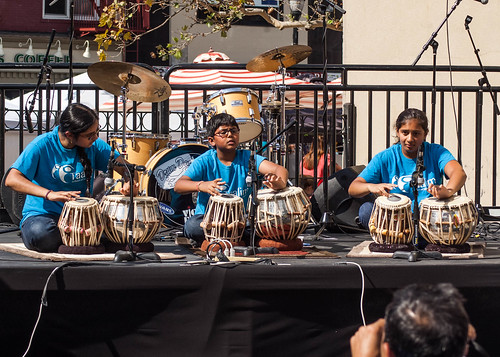
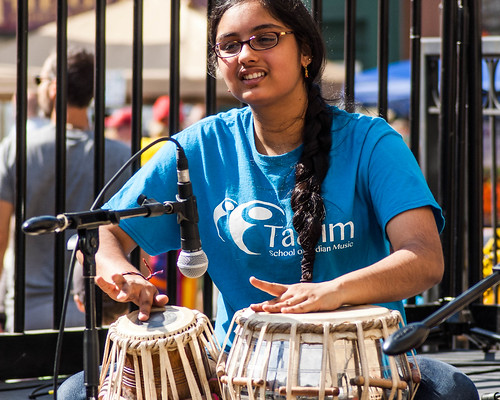
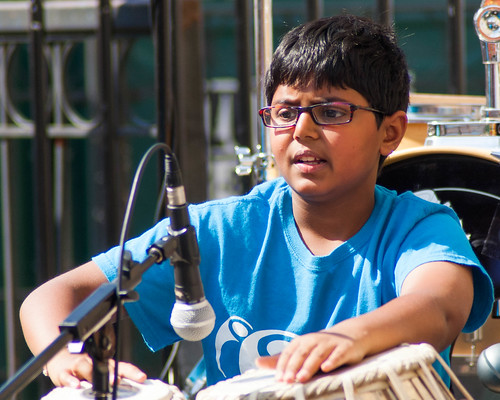
Sayesha Chowdhury TABLA WIZARD

From the YouTube page:

A Tabla duet by Pt. Pandit Keshab Kanti Chowdhury & Sayesha Chowdhury (grand daughter & shishsya at age of 7) performing on the occasion of CA TV California Festival on 15 Jan 2023 in the Church of Scientology of Los Angeles under the direction of Shuvananda Puri Maharaj Ji who heads the media broadcasting channel CA TV California.

Thanks a lot Shuvananda Puri for giving us this opportunity to showcase Delhi Gharana original Tabla in a duet form.

Sayesha Chowdhury, age 7, is learning Tabla since the age of 1.5 years and have been performing for the last 3 years in national and international level. She has been awarded by CATV California, Sarb Akal Music Society Calgary Canada, Born to Shine ZEE India, Sangeet Kala Kendra Agra and many more.

Listen to the vocables that they utter while they're playing. 

Tuesday, February 26, 2019

Musician's Journal: The Magic of the Bell

This experience has had a profound effect on how I think about music. I used a reworked version to open the second chapter of Beethoven's Anvil: Music in Mind and Culture. One of my all time favorites.

Introduction: Together on the One


Interpersonal synchrony, moving, precisely, to the same beat as your fellows, is the core of social experience. The thrusts and jerks of an infant’s limbs, the timing of glances and twists of the body, will follow the speech rhythms of someone talking to the infant. Couples casually strolling in the park walk in step. People at a ball game make a “wave” in support of their team. All societies have rituals where people gather together and synchronize their movements, and thereby their hearts and minds, in affirmation of the central values of their culture.

I want to consider an example which is immediately familiar to me. This happened when I was living in upstate New York, which is as familiar to me as Africa was to the original African-Americans. It involves bell playing based on traditional African techniques.


The Craft


However, before getting to the magic, you need to understand a little about the craft. Few physical tasks are easier than getting a sound from a bell by hitting it with a stick. But that doesn’t mean that you can play your bell in a mood of casual somnambulance. No, you must be sensitive to small details, for nuance matters.

Generally you hold the bell in your left hand and the stick in your right—if you are right-handed. When you hit the bell with a stick the stick will bounce back. You need to learn to work with the rebound, not against it. If you hold the stick too firmly your grip will damp out the rebound and you will thereby waste the energy the bell has imparted to the stick. Rather, you want to hold the stick lightly and learn simply to redirect the stick’s energy back to the bell. You want to “cooperate” with the stick and the bell rather than “dominate” them.

Further, you need to attend to just where you hit the bell. The sound of a bell is complex and varies depending on just where you hit it. Thus, by hitting a bell in different places you can get several distinctly different sounds from a single bell. The different sounds you get from the bell will blend with other bell sounds in different ways. You have to be conscious of these blending possibilities when playing your bell.

By hitting the bell with sensitivity to the elastic properties of stick and bell you become one with the bell. By hitting the bell with sensitivity to the way your bell tones blend with other bell tones you become one with the group. While thus “becoming one with” has a mystical aura about it, you need to understand that this mystical aura is grounded in the subtleties of physical technique.

Thursday, June 23, 2016

The Birth of the Drum Set

For the drums are not one instrument, but many. The drum set is a hybrid of instruments from around the world, from cultures that were assembling in port cities like New Orleans. The snare and bass drum were once slung over shoulders in European militaries, the drum heads pulled tight by ropes, and that tradition carried over to American armies. Chinese immigrants came to the United States because they were hired or forced into labor, and they brought with them their own centuries-old theater traditions, highlighted by colorfully-painted tom-toms that made a beautiful full sound, distinct from snares or bass drums. Cymbals evolved from bronze cisterns made in places like Turkey and China; they were later pounded into flatter shapes and supplied to countries around Europe for operas and military music, becoming so popular in the United States that Zildjian, the original Turkish cymbal company, eventually moved to Massachusetts.
The Dee Dee Chandler and the groove:
The drum set was coalescing at the same time jazz was, and they helped to push each other along. The distillation of the different rhythmic instruments into one set to be played by one person meant that the rhythmic interpretation was now codified in one human body. For centuries, percussion instruments in classical music were played by different people, and, perhaps partly for that reason, “groove” and feel were never paramount. For the first time in history, one human body was able to create the pulse, the back beat, the syncopation, and the texture of a percussion part all by itself. The possibilities for more forward, propulsive, linear grooves turned the musical world upside down for decades to come.

Edward “Dee Dee” Chandler was a drummer living in New Orleans at the turn of the century. He played music in two worlds: the down and dirty shows in the brothels of Storyville and the high-society gigs at places like the Grunwald Hotel off of Canal Street. He was of mixed race and could roughly pass for white, but when Plessy v. Ferguson was handed down, it included rules limiting the freedom of anyone with even a drop of mixed-race blood from going to places like the Grunwald.

But again, from limitation comes innovation. Other people had done such a thing before, but Dee Dee Chandler was perhaps one of the first drummers to use a makeshift pedal to play the bass drum with his foot while playing snare with his hands. Before that you would have to have a different musician play each instrument or use a style called “double drumming,” which involved playing bass drum and snare drum simultaneously with both hands and no feet, limiting the kind of rhythms you could express on the snare. The weird contraption that allowed Chandler to play the bass drum with his foot was not smooth like today’s pedals and must have been a challenge to play. But it was a point on the evolution of the drum set as a more dynamic instrument that, in just a few decades, would become the lynchpin of jazz ensembles, whose rhythmic playfulness created some of the best music of the century. And it was the music created in those poorer places, with audiences innovating new dance steps like swing, that made jazz music so alive.
In a comment on the article Samm Bennett links to his page of vintage drum kits from the 1920s and 1930s.

Saturday, November 7, 2015

Talking drums

I don't know just when or how I first heard of talking drums. It was likely in my childhood and quite possibly in some African adventure TV show or movie where you could hear drumming in the background, perhaps ominous drumming, and then some sage white person would make some remark about the "talking" drums. I certainly would have taken the remark as metaphorical and more likely than not it was.

But the idea that drums can talk is not metaphor. Well, of course, the drums don't talk. People talk by drumming. And not in the metaphorical way that music 'speaks' to us. No, this is real semantically differentiated and syntactically articulated language.

By imitating the tones and rhythms of Twi, the Akan can “speak” with their musical instruments—their horns and trumpets, their drums and bells—almost as clearly as they do with their mouths. The atumpan, which produce two distinct pitches, are particularly well suited to this task; but the bommaa can do it, too. That was why the crowd at the palace had been so quiet: They were listening to what the drums had to say. The phenomenon, widespread in both West and Central Africa, is known as surrogate speech. It can add a layer of semantic depth to even the simplest music.

Every time that the chief, Nana Djan Kwasi, got up and walked around the courtyard, for instance, the two Kwames and I engaged in a little call-and-response.

Kwame Obeng: bom bom

Kwame Antwi and me: BRRM BRRM!

The rhythmic phrase bom bom BRRM BRRM, bom bom BRRM BRRM had a nice beat to it, and could just have been pleasant filler, something to play while the chief moved from place to place. And on one level, it was. On another, though, it was an earnest plea from the principal talking drums in the ensemble: Nana, bre bre! Nana, bre bre! “Chief, slowly! Chief, carefully!” If a chief stumbles in public, it’s a sign of bad luck. So we were asking him to watch his step.

The drums didn’t just speak to the living, but also to the dead: the revered ancestors who have left this earthly plane, yet continue to influence the affairs of their kin. The Akan believe that their ancestors are forever watching over them, and must forever be placated with prayers, offerings, and other remembrances. They also believe that their ancestors are particularly sensitive to the sound of the drums. That’s one of the reasons why Akan drummers normally take great care to avoid mistakes. You wouldn’t want to anger your ancestors by saying the wrong thing. In the old days, a sloppy royal drummer was likely to have an ear cut off. So when I butchered my part alongside Antwi that day at the palace, I wasn’t just making the group sound bad—I was sticking a wrench in the gears of a rich cultural system where speech, art, and religion are all intertwined. Little wonder my heart was pounding in my ears as I walked away from the drums, the echoes of my mistakes still ringing through the courtyard.
And Western notation biased the rhythms of Western music in the direction of rhythms that could be notated:
Western music has evolved in concert with its own notation system, so that Western musicians tend to hear what they can read, and read what they can hear. It did not evolve to reflect the rhythmic subtleties of fontomfrom. There were, we discovered, brief snippets of those bommaa rhythms that we could not notate accurately; as far as our musical system was concerned, they did not exist. Perhaps as a consequence, we couldn’t quite hear them, either: They sounded blurry, like figures in an Impressionist landscape. The problem was almost certainly not with our ears, but with our brains.

Bill Thompson, a psychologist at Macquarie University in Australia who specializes in music perception and cognition (and whom I once served as a graduate assistant at York University in Toronto), suggests that we may have lacked a mental template, or schema, for categorizing these rhythms, and were therefore unable to perceive them clearly. “Rhythm is an interesting case,” Bill told me, “because my sense is that the capacity to ‘hear’ a particular rhythmic pattern is first and foremost equivalent to the ability to ‘predict’ what will come next at varying time spans.” In the absence of such a schema, Bill adds, “we cannot predict what will come next, and have the experience of ‘not being able to hear the rhythm.’ Of course we ‘hear’ the rhythm in a literal sense, but we just can’t predict the unfolding pattern.” The ethnomusicologist David Locke, a specialist in West African drumming at Tufts University, experienced something similar when studying a form of fontomfrom played by an ethnic group known as the Ga. Echoing Thompson, he believes that a “lack of organizing features of mind” can make it “hard to even perceive what the ears are receiving.”

Tuesday, March 31, 2015

Time after Time: Music and Memory in the Group

Or, messing around in one another’s mind space for fun and funk
This is about a simple, but profound, matter: that we cannot always and reliably access the contents of our own minds. In some circumstances we need external prompts. For reasons that I'll have to explain in a later post, this absolutely sinks the superficial notions of "information transfer" from one mind to another that seem to be the norm in discussions of cultural evolution. Certain activities seem to be irreducibly GROUP activities. And THAT's why I'm bumping this post from 2011 to the top of the stack.
John Miller Chernoff has an interesting observation in his book, African Rhythm and African Sensibility. It’s about playing one’s part in a percussion choir. Each of three, four, five, etc. players has a specific, simple, repetitive pattern to play. These individually simple patterns interlock to create a rich sonic wall of rhythm.

Chernoff notes that even highly skilled percussionists often have a difficult time playing a specific part without also hearing the other accustomed parts. This suggests that what the percussionist has learned is not just a motor pattern, but an auditory-motor gestalt that includes the whole rhythmic soundscape and not just one specific part of it. In such a gestalt the motor and auditory components would so intertwined that one cannot simple ‘extract’ the sound of one’s own phrase, along with the motor pattern, in order to execute in isolation. Rather, proper execution requires the entire gestalt and that includes the sounds executed by other players, the group sound, not the individual sounds.

It is thus not just that individual parts only sound correct in the context of other parts, but that the motor schema for executing one part is interwoven with the auditory schema for hearing the entire complex of parts. The drummer needs to hear the sound that the others are playing in order properly to activate his own motor schemas. The performance is thus inextricably a collective one.

In order to be as explicit as possible I want to suggest a very strained analogy. I am imagining a scene in a certain kind of action movie where it is time to launch the nuclear missiles. The process requires that two people insert keys into locks and turn them simultaneously. In the case of our African drummer, his auditory-motor schema for a rhythm is analogous to the launch of the nuclear missles. The drummer has the key to one lock, but that isn’t sufficient. Think of the auditory gestalt of the entire pattern as being the other key. Both keys are necessary. The drummer cannot access motor patterns in his own brain and body without help from others. Again: The drummer cannot access motor patterns in his own brain and body without help from others. Both keys must be inserted into their respective locks and then turned in order for the drummer to play his component of the rhythm. Without the full sound the drummer can certainly play something, but it will not be just exactly the appropriate part.

What is so very peculiar about my argument is that it contravenes a deep an unquestioned assumption of almost all of our thinking about the human mind. That assumption is that we are masters of our own mind and body. To be sure, there is, for example, the Freudian unconscious, which I do not here deny. But that does not seem germane in this situation. Our drummer’s inability to drum alone is not a matter of neurotic repression. It is quite different.

Thursday, October 2, 2014

Monday, December 16, 2013

Cece’s Drum Lesson: Differentiated Control

This is a follow-up to Cece’s Jam. It’s about her drum lesson, that part that I saw when we re-entered the studio. Mitch was teaching her a basic drum beat. He’d put together another traps set-up in the studio and they faced one another.

What made it tricky was that it involved three different limbs, the two arms and one foot. The foot was playing the bass drum with a kick pedal; the right hand was playing a cymbal; and the left hand played the snare drum.

The right hand played a steady uninterrupted stream of (eighth) notes. The kick drum was on the first and second beat, the snare on the third. The ear picks up the kick-snare pattern as the rhythm while the stream of eighth notes on the cymbal is background. Here’s a crude depiction:

drum pattern

I couldn’t really hear what Cece was doing with the kick drum, but it was obvious she was having trouble keeping the motions of her two hands – actually, the whole arm – separate. Abstractly, you’d think that would be easy since the left hand had only one hit while the right hand had eight. But the one left-hand hit had to be exactly timed with the correct one of those right-hand hits, and the same for the two foot kicks.

Keeping those things separate the first time is tricky. The tendency is to strike everything on every beat. I’ve had similar problems in playing the tongue drum, and that only involves two limbs (see this post on three against two and this one on free drumming). Adding a foot into the mix makes things even more complicated.

Tuesday, August 28, 2012

Musician’s Journal: Free-Drumming and Visual-Motor Space

This is from an email I wrote to Walter Freeman (neuroscientist, UCal Berkeley) and Ralph Holloway (neuroscientist, Columbia U) on April 6, 2002. This is a sequel to an early post on learning to play 3-against-2 but does not depend on it.
Walter and Ralph,

I noticed something interesting the other day that has to do with “free drumming” (to be defined). I seemed to be making choices in visual-motor space rather than auditory space. This is quite different from what I do when improvising on the trumpet, where I seem to make choices in auditory space. That is to say, when playing the trumpet I make choices in terms of what I want to hear rather than in terms of what I want my body to do. I’m not sure whether or not this is because I’m considerably more expert on the trumpet than on my drum.

IMGP9254rd

Let me begin by describing my drum. It’s what’s called a tongue drum or slit drum. It’s a wooden box about 24 inches along its greatest dimension (which is oriented horizontally and transverse when playing) and 8 inches along the other dimensions. It has six “tongues” cut into the top (playing) surface arranged in three rows with two tongues in each row. The tongues are of different lengths but are not precisely tuned. While you can, in most cases, easily hear which tongue in any pair is higher, you cannot assign any particular interval to the pitch difference. I should note, however, that you can get different sounds from any given tongue depending on where you hit it. Thus you can hit a long tongue in such a place that the tone will sound higher than that you get when hitting a shorter tongue. The major point, however, is simply that the tongues are not precisely tuned and, in consequence, you cannot play melodic lines and riffs. This is a drum, not a six-toned marimba.

So, the melodic and harmonic imagination I employ when playing the trumpet isn’t very useful here. Rhythm, of course, remains. But we do need a term for the higher and lower aspect of the sound. Brain imaging data does suggest that interval perception is different from pitch perception and that, in turn, suggests that our ordinary sense of melody is really the joint produce of interval and pitch perception. Thus interval perception by itself tells you whether one tone is more or less higher or lower than another and gives some sense of the magnitude of the difference. But the ordinary sense of melody combines that with perception of the pitches of the individual tones in the melodic stream. My drum patterns are thus based on rhythm, interval, volume and, to a limited extent, timbre.

In most musical situations drums play repetitive patterns. That is certainly the case, for example, with African polyrhythms. Each player has a certain pattern to play and she plays it more or less without variation for the duration of the performance, or performance segment. There may be some variation here and there, but it’s not large and not systematic. In a given performance the master drummer may signal a change, at which time everyone will switch to a new pattern. This doesn’t happen often, and it always happens in prescribed and well-understood ways. The master drummer is the only one who’s free to play something other than a repetitive pattern. Even then, he’s generally not doing the sort of thing a jazz drummer or a tabla player does when they are soloing; the range of variation is generally more restricted.

When I talk of free drumming I mean anything other than playing the same pattern over and over and over without (significant) variation. Free drumming requires that you make a lot of choices. So, how are those choices made?

Sunday, May 8, 2011

Musician’s Journal: On Learning to Play Polyrhythms

A couple weeks ago I wrote, in a general and impersonal way, about playing three-against-two. In this post I revisit that topic, but personally. This is a long email I’d written to Walter Freeman, a neurobiologist at UCal Berkeley, about how I’d learned to play polyrhythms, first two against three, then three against four. Note especially the last section, which is about breathlessness that seems to be induced by a certain kind of rhythmic practice. This email is dated 22 March 2002.

Dear Walter,

I thought I’d offer some informal observations about learning to play polyrhythms. The occasion for these observations is simple: about a week ago I was finally able to play 3 beats in the left hand against 4 in the right. But I’m getting ahead of the story.

The Early Years

The early part of the story takes place in my childhood, of which my memories are poor. I started learning the trumpet in the 4th grade, when I was 10. Somewhere, say within the first two years, I learned to play eight-note triplets, three (more or less) evenly spaced notes within a single beat. I then learned to play quarter-note or “drag” triplets, three notes spaced over two beats. I vaguely remember that as being somewhat more difficult. The problem was that, like lots of kids, I was taught to beat time with my foot. Eight-note triplets occur within the span of a single foot tap, while quarter-note triplets span two foot-tapes. That’s the problem, placing three notes over two foot taps. You are, in effect, playing polyrhythms between the arm-hand-tongue-breath system of trumpeting and the foot system of time-keeping (which also has a verbal component). In any event, I somehow learned that. [My impression is that, in general, children have a more difficult time learning quarter-note triplets than eight-note triplets.]

We move ahead a few years to my early teens when I took piano lessons for about two years (in addition to continuing on trumpet). Somewhere in that period I encountered playing two in the left hand against three in the right. I lost the encounter. I couldn’t get the hang of it.

Two Against Three

We now move ahead about 30 years. I was playing with a group called the New African Music Collective (NAMC). The group varied from one occasion to the next, but had a core personnel of me on trumpet (and some percussion), Ade on percussion, and Druis on percussion and vocals. When we added players to the group, we added percussionists, though we had a bass player for awhile. The central musical premise of the group was to explore African and Afro-Cuban rhythms: polyrhythm central. So I got used to floating my trumpet lines over and against polyrhythms and became proficient at superimposing various groupings on whatever was happening with the percussionists. Thus I could play lines that would have been four-square and dull if they had stood alone; but they bristled with tension and force in a polyrhythmic context.

It is in this context that I began to practice playing an small 8-key balaphone (a marimba-like instrument with gourd resonators) and a tongue drum (a wooden box with eight “tongues” cut into the top surface). Every so often I’d take a wack at playing 2 against 3 (2-3). One day it just clicked. And it became reliable fairly quickly, within one or two days. That is to say, I could sit down at the instrument (whether balaphone or tongue drum) and start playing 2 against 3 without any preparation.

IMGP9254rd