Showing posts with label Father. Show all posts

Monday, May 26, 2025

Sarah Silverman: Postmortem [Media Notes 161]

Jason Zinoman, in the NYTimes (May 25, 2025):

“Death is really hard for me,” Sarah Silverman says with the kind of impeccably performed earnestness that makes you believe her banal statement for just long enough to be sideswiped by the punchline. “And that’s what makes me unique.” What actually makes Silverman different is that few others would handle the death of a father and stepmother in the same month by joking merrily about merch. “I really feel like my parents would want me to monetize this,” she says.

No amount of tragedy is going to turn Silverman into a maudlin solo artist. Her funniest jokes employ sarcasm, not sincerity.

That’s a reasonable characterization of the special. It’s worth watching. I enjoyed it. And of course I thought of the deaths of my own parents.

Very different. 

Silverman’s parents died nine days apart. My father died several years before my mother. He died of complications (sepsis) following surgery to remove his bladder (cancer). His surgeon thought he could save his life by removing his colon, but my father did not want the reduced quality of life. He’d signed a DNR (do not resuscitate), but my sister and I had to make the final authorization as my mother had Alzheimer’s. I’ve said more about his death in this post

That was 1998 when he was 86. My mother died in 2001 at the age of 85. 

Since she could no longer take care of herself after my father died, my sister and I had to make various arrangements for her. At first we arranged for a companion to stay with her in her home, where, my sister observed, she now slept on her husband’s side of the bed. But it was too exhausting for the companion – my sister and I were unable to make arrangements to relieve her often enough – and so we had to put her in some kind of home. My sister eventually found the Mary Drexel Home outside of Philadelphia, which was excellent.* One day she fell into a coma and didn’t wake up. My sister and I stayed with her until the end. Or at least, I assume, my sister did. I was tired and went down the hall to sleep, not very comfortably, on a small not-quite-sofa in a waiting room. 

* * * * *

*This post is about one Thanksgiving day at the Mary Drexel Home.

Monday, April 14, 2025

Why Daniel Kahneman chose to die on his own terms

Katarzyna de Lazari-Radek and Peter Singer, There’s a Lesson to Learn From Daniel Kahneman’s Death, NYTimes, April 14, 2025.

Daniel Kahneman was a world renowned psychologist and a Nobel Laureate in economics. He was old, 90 years, and in reasonable health. I did not have a debilitating or terminal illness. He was still capable of doing the intellectual work to which he had devoted his life. He died by assisted suicide on March 27 of this year. Lazari-Radek and Singer interviewed him on March 23.

About half-way through the article:

He surprised us by denying that his work had any objective significance. “Other people happen to respect it and say that this is for the benefit of humanity,” he said. “I just like to get up in the morning because I like the work.”

We pushed back, arguing that there are objectively good things to do with one’s life. But he resisted. “I feel I’ve lived my life well,” he said, “but it’s a feeling. I’m just reasonably happy with what I’ve done. I would say if there is an objective point of view, then I’m totally irrelevant to it. If you look at the universe and the complexity of the universe, what I do with my day cannot be relevant.”

We do not agree that the size and complexity of the universe render irrelevant an individual’s work for the benefit of humanity. But if, after careful reflection, you decide that your life is complete and remain firmly of that view for some time, you are the best judge of what is good for you. This is especially clear in the case of people who are at an age at which they cannot hope for improvement in their quality of life.

The final paragraph:

Professor Kahneman signaled concern that if he did not end his life when he was clearly mentally competent, he could lose control over the remainder of it and live and die with needless “miseries and indignities.” One lesson to learn from his death is that if we are to live well to the end, we need to be able to freely discuss when a life is complete, without shame or taboo. Such a discussion may help people to know what they really want. We may regret their decisions, but we should respect their choices and allow them to end their lives with dignity.

You might want to compare with a passage from Mary Douglas's Purity and Danger that I have quoted in this post: A spearmaster's way of death. Spearmasters are spiritual leaders among the Dinka of South Sudan. You might also read my account of my father's death. Here's the final paragraphs:

When, later that day, my sister, my mother, and I returned to the hospital, Dad was restless and tossed and turned quite a bit. Both my sister and I asked him whether or not he was uncomfortable and he indicated that he was not. One time when I asked him how he felt he just shrugged his shoulders and looked at me as if to say, "How should I know how I feel, I've never done this before." One thing he did, and it was quite striking, was to clasp his hands together and move them together over his right shoulder and then down to his waist. He seemed to be practicing his golf swing.

By this time the the morphine drip had began to relax him. Figuring we might have to be here all night, my sister, mother, and I went to the waiting room to rest. When we returned to his room, Gino, a nurse, was shaving him. Gino told us that he'd asked Dad if he wanted a shave and Dad indicated that he did. Dad had enough presence of mind to move his chin and cheeks to cooperate with the shave. Then he simply went to rest. About 10 minutes or so after that he'd died.

He went out swinging and smooth shaven.

Friday, March 28, 2025

My father’s most important lesson: fundamental change is difficult

Perhaps the most important lesson my father gave to me explicitly is that people resist change. I forget this exact wording – for I’m thinking about a specific conversation, dimly remembered – but it was something like this: given a choice between learning how to swim, and drowning, most people would drown. Rather dramatic, no?

But that kind of rock-bottom resistance to change has certainly dogged me my professional life (Rejected! @ New Literary History, with observations about the discipline). And I’m pretty sure that observation can out of his professional life. He was a chemical engineer and spent most of his career with the Bethlehem Mines Corporation where he was in charge of coal preparation, which involved removing impurities (mostly rock) from coal before it was used in smelting iron.

I assume that the change he was talking about – for I don’t recall him mentioning it in that conversation – was introducing European technology into North America. I’ve appended a conversation I had with Claude 3.5 about that, since I don’t personally recall the dates. He went on to other innovations at the end of his career, innovations which were, unfortunately, still born. Oh, he got some patents, but Bethlehem Mines was unable to put them to good use. Not so long after that the bottom fell out of the American steel industry, and that changed everything, whether or not people liked it.

* * * * *

My conversation with Claude 3.5 about change in cleaning coal. My prompts are in boldface while Claude’s replies are plain.

I’m interested in a specific development in the history of coal preparation. As background, my father, William Benzon, was Superintendent of Coal Preparation for Bethlehem Mines Corp. from, say, 1960 until his retirement in the mid-1970s. I remember that he was involved in introducing heavy medium cyclones (magnetite) into the US from, I believe, Dutch State Mines in the Netherlands. Do you know anything about that process and its history?

Heavy medium cyclones using magnetite suspension were indeed a significant innovation in coal preparation, introduced to the US coal industry in the 1950s-60s after being developed at Dutch State Mines (DSM). The technology improved the efficiency of separating coal from impurities by using a dense magnetite suspension in a cyclone to separate materials based on density differences.

Given your father's role at Bethlehem Mines during this key period of adoption, he would have been directly involved in implementing this important technology transfer from Europe to the US coal industry. The timing aligns with when US coal companies were actively seeking more efficient separation methods.

I should note that while I'm confident about the general history of heavy medium cyclones and their introduction from DSM to the US, I may not be able to verify specific details about your father's individual role since this represents fairly specialized historical information.

Would you be interested in sharing more about what you remember about your father's specific involvement in this technology transfer?

Thank you. You've given me enough. I just wanted to confirm the timing of that technology. Beyond that, I really don't know much. I know that my father traveled to the Netherlands. And Dutch engineers came to the states. Some stayed with at our hours on several occasions. But I don't really know the dates, the early-mid 1960s seems right, nor do I remember names.

Indeed, the timing fits the historical record. The collaboration between Dutch State Mines and US coal companies in implementing heavy medium cyclone technology was an important development in coal preparation during that period. Your memory of Dutch engineers visiting and your father traveling to the Netherlands provides valuable first-hand confirmation of how this technology transfer occurred.

What I do remember, and this is why I asked the question, is that at some time my father told me that the hardest thing in the world to do is to get people to accept new ideas. I’ve remembered that for my whole life. I suspect that what he had in mind was this business of heavy medium cyclones. That would have been about the time we had that conversation. Much earlier and I would have been too young to understand. Much later, well, much later and I would have been in college. But I just don’t remember him specifically mentioning heavy-medium cyclone technology in that particular conversation. All I have to go on is the timing.

There’s a company known as, I believe, Robertson and Shafer. Did they have anything to do with this technology?

Your father's observation about the difficulty of getting people to accept new ideas is particularly poignant given the context. The introduction of heavy medium cyclones would have represented a significant change in coal preparation practices, likely facing resistance despite its technical advantages.

Regarding Roberts & Schaefer (which I believe is the company you're thinking of) - yes, they were involved in coal preparation plant design and construction during this period. However, I should note that while I'm confident they were active in the coal preparation industry, I can't say with certainty their specific role in heavy medium cyclone implementation without risking making incorrect claims.

Yeah, that's the name of the company. Thanks.

Your father's insight about resistance to new ideas, combined with the timing and context of heavy medium cyclone implementation, suggests that observation likely did stem from his experience with this technology transfer. Coming from his position as Superintendent of Coal Preparation during this key transition period, it's a particularly meaningful observation about technological change and human nature.

Thursday, September 28, 2023

My summer job, working in a coal mine – or, how I learned about class in America

Another blast from the past. I decided to jump this one to the top of the queue more or less on general principle. I originally published it five years ago, almost to the day.
 
Well, not quite.

Let me explain.

I spent the first three or four years of my life in Ellsworth, Pa., but I don’t remember much, if anything, of that life. It was a “company town”, as they called it. The company was The Bethlehem Steel Corporation. My father worked for the mining division, Bethlehem Mines Corporation. Ellsworth was a coal town; they used coal to make coke; and they used coke to fuel the blast furnaces that turned iron ore into iron. From iron, steel.

When I was four the company – Bethlehem Mines – moved my father to company headquarters in Johnstown Pa. You may have heard of Johnstown, flood city – three floods, 1889 (the big one, the one that put Johnstown on the map), 1937 (my mother lived through that one, though she lived in Westmont, a suburb high on a hill), and 1977 (by which time I was long-gone, so was my family). We settled in Geistown in Richland Township: 315 Cherry Lane. Like Westmont, a suburb. Whereas Westmont was high class, more or less, Geistown was middle class, a mixture of blue and white collar workers.

For a number of years our house was heated with coal. There was a coal bin in the basement, a small room with a hatch opening to the driveway outside. A truck would pull up and dump a load of coal down the hatch. It was up to dad to shovel the coal into the furnace that heated the boiler that heated the house. I suppose mom shoveled the coal when dad was away on business, as he often was. Sometimes I’d help.

My father was a white collar worker, an engineer. He had a management title, Superintendent of Coal Preparation, but he didn’t do much managing of people. He was in charge of the technology, the design and upkeep of the plants that cleaned the coal used to make coke [1]. Our neighbors to the left and right on Cherry Lane were also white collar; that is, the man, the husband and father in the family, was white collar. One was the Johnstown postmaster the other, I don’t really know what he did, but it was management I’m sure. My best friend in those years, Jackie Barto, was the son of a steelworker; his mother worked as a records librarian in a local hospital. I couldn’t off hand give you the demographic mix of white collar and blue collar in the area, but there certainly was a mix. A lot of steelworkers, a lot.

There was one Jewish family in the area; owned the local bowling alley. Otherwise it was all white –  yes, I know, but recall that back in the 1920s Jews were brown (you can find it in Hemingway). The only ethnic matter than had any impact on my daily life was the difference between Protestant and Catholic. The local Catholic high school was a football powerhouse, but then so were we, the Richland Rams. I was in the band [2]. There was a black section of Johnstown; we drove through it on the way downtown; but that wasn’t my neighborhood. For a number of years, though, a black woman helped my mother around the house once a week – a common arrangement in those days, still is. I don’t know where she lived.

Early in those years we would drive down into downtown Johnstown, through it, and out the other side and go up into Westmont – the somewhat higher class neighborhood where my mother grew up. The parents of her best friend from childhood – maybe her BEST friend? I forget – still lived there and we’d visit them when Louise was in town. My father played golf at the country club there, Sunnehanna Country Club (it’s an Indian name – Native American, I know, but usage varies and back then it was Indian 24/7/365). We’d go there for dinner and for the annual Christmas party. I remember the magician; don’t remember what tricks he performed (rabbit? hat? cards?); I just remember that he was there.

But then a golf club was established in Windbur, not far from us. My father quit Sunnehanna and joined it; in fact, I believe he was a founding member. For one thing, it was closer to home. But I also think he thought the Sunnehanna crowd was a bit pretentious.

So, my summer job.

I graduated from Richland High in 1965 and that summer I went to work for Bethlehem Mines. Other friends went to work for the steel company. But I didn’t work in the mines. I worked in the coal preparation laboratory, three summers: 1965, 1966, and 1967.

The lab was somewhere else, I forget what the area was called, but it was somewhere between Geistown and Westmont but a bit closer to downtown. There were three small buildings at the lab, called No. 1, No. 2, and No 3.

For the first couple of weeks I worked in No. 1 building. It was the dirtiest, a hardhat job. Coal samples would come in from the mines and be taken here to be crushed. When you crush coal, you get dust, lots of coal dust. All over the place. On your face, in your hair, and seeping down your butt crack. Mike Karoly – I believe that was his name – worked there.

After a couple weeks there I was moved up to building No. 2. Not literally up, as all three buildings were within 50 or 70 yards of one another on the same ground. But there was a status hierarchy that was the inverse of the numbering. No. 1 building was lowest on the totem poll while the second floor of No. 3 was highest.
 
Everyone knew I was the boss’s son. Couldn’t hide it, didn’t try to. But like everyone else who worked at the lab, at least those without college degrees (only two of those at the lab), I had to start at No. 1 building and then No. 2.

That’s where the crushed coal was cleaned. You’d float the crushed samples in a medium, such a perchloroethylene, aka perc, and run it over a sieve. The coal would go over the sieve while the rock would go down through it. The cleaned coal was then put in some suitable container and taken to the basement of No. 3 building for further processing.

Perc was nasty foul-smelling stuff. That’s why its use was confined to a separate building. It’s also used as dry-cleaning fluid. Man, you do not want to be around that stuff eight bleeping hours a day. No you don’t. Nasty – worse, in fact, than the dust at No. 1. That was just dirty and could get in your lungs (we wore respirators). But perc, shit, perc felt like it crawled into your blood.

After a couple of weeks breathing perc in No. 2 building I was moved up to the basement of No. 3 building, where I remained for the rest of that first summer and all of my second summer (1966). In addition to the work we did, the basement was also a hang-out spot when things were slow in No. 1 and No. 2. We’d just hang around and chat.

A number of guys worked there. The was G. Lionel Bower, lanky guy, we called him “G. Lionel” or “George” – both were used, don’t recall the distribution. There was P. J. Shmeer (or was it Schmeer?) and his dad, Joe. Joe used to chauffeur some Bethlehem executives but developed heart problems or something – I don’t really know the story – and was retired to the lab, mostly just to keep him on the payroll. Because that’s how those big companies did it back in the day. P. J., what’d he do? Things and stuff. He was just a guy. But, as I remember, he was fond of Johnny Mathis.

Aside from shooting the shit, we did two things in the basement of No. 3. One thing was to size the crushed and cleaned coal. We had a stack of screens attached to the bottoms of steel hoops. The top screen had a coarse mesh (an eighth of an inch, a bit larger? not much smaller though) and then successively finer meshes down the stack until we get to the bottom where there’s a shallow pan to catch whatever coal made it all the way though. That stuff was finer than sand. Maybe even fine as dirt.

You’d place a sample of coal on the top screen and put the whole stack on a device that would vibrate it. You’d jiggle the stack for awhile – 10, 15 minutes, a half hour – and the coal would trickle down through. Then you’d take the stack into a back room where there was a heat lamp to dry it thoroughly. Once that was finished the coal in each screen would be placed in a small sample can that we’d label. Those sample cans went upstairs for the final analysis.

Why’d we have to separate the sample into various sized particles? I don’t really know at this point, though my father must have explained it to me. It surely had to do with getting things properly tuned at the cleaning plants, which dealt with wet coal by the ton. Also we needed to know just how much sulfur remained in the coal that was eventually going to be coked (that is, turned into coke). And that, I’m guessing, varied among different sizes of grains. Anyhow, we were supposed to do it, so, like everyone else, I did what I was told.

Friday, October 2, 2020

What’s an idea? An informal case study about an industrial idea that was awarded two patents [Stagnation]

I'm bumping this to the top of the queue because I'm working on a paper about the materiality of ideas and the prospects of progress. I'm going to discuss this material in the body of the paper and include it as an appendix.
In my working paper, Stagnation and Beyond: Economic growth and the cost of knowledge in a complex world [1], I took a close look at two cases examined by Bloom et al., Are Ideas Getting Harder to Find? [2]. In discussing their conceptual framework they noted (p. 5):
Ideas are hard to measure. Even as simple a question as “What are the units of ideas?” is troublesome. We follow much of the literature and define ideas to be in units so that a constant flow of new ideas leads to constant exponential growth in A. For example, each new idea raises incomes by a constant percentage (on average), rather than by a certain number of dollars. This is the standard approach in the quality ladder literature on growth: ideas are proportional improvements in productivity.
That makes sense to me. It doesn’t take much reflection to understand that this is so. We can count words, for example, but the relationship between words and ideas is not at all clear.

Still, I think it would be useful to consider a real example of ideas, just to get a feel for the phenomenon. The example I choose, however, is not one that could have occurred in the three cases Bloom et al. have examined in detail (chip production, drug discovery, seed yields). Rather it is one I know something about, just barely.

It’s an idea my father had in the mid-1970s. He had spent most of his career working for Bethlehem Mines Corporation, the mining subsidiary of Bethlehem Steel Corporation. At that time he was Superintendent of Coal Preparation and, as such, was responsible for the design of plants that cleaned coal. He referred to his idea as “evaporative cooling”. Judging from how he talked about it, it was one idea in his mind [3]. He was awarded two patents for the idea and the company built a cleaning plant based on it.

Background: Cleaning Coal

Let us work backwards: Steel is made from iron, and iron is made from iron ore which is heated to a high temperature by coke. Coke is made from coal by driving off water and volatile organic material. Before that can be done, however, coal must cleaned of impurities, mostly sulfur-bearing rock. Most cleaning techniques take advantage of the fact that the rock is denser than coal. So, you crush the raw coal until all the particles measure less than, say, an eighth of an inch in diameter. Then you float the crushed coal in some medium – generally, but not always, water – and take advantage of the fact that the rock sinks faster than the coal. There are several ways you can do that, but whichever technique you use, you end up with wet coal when you’re done.

You need to dry the coal. The old drying techniques – drying ovens – leave a lot of coal dust in the air. Coal dust is dirty nasty stuff.

Starting early in the 1970s environmental regulators demanded that the output of coal dust be severely limited. The common method of doing this was to exhaust the dust-laden air through very tall chimneys lined with electrostatic precipitators. The precipitators used charged plates to attract the dust particles and draw them out of the air. They thus used a great deal of electricity in the process. Further, these precipitators sometimes emitted sparks, which then triggered explosions in the chimneys, filled, as they were, with fine coal particles in suspension. It was a messy and expensive business.

Evaporative Cooling

During the mid to late 1970s my father designed a new cleaning plant based on a new process. After doing some testing (in his basement), he discovered that, by using heated water (to about 200° Fahrenheit I believe) for the slurry (crushed coal in water), you could dry the coal through evaporation. The heat in the water was enough to evaporate it off the coal. When the impurities had been removed you simply filtered most of the water out and then dumped the still-wet coal on a conveyor belt. The conveyor then moved the coal to the storage pile. By the time it arrived at the pile the water had evaporated.

No drying ovens. No tall chimneys. No electrostatic precipitators. No explosions. And the air’s cleaner.

To do this, of course, we must heat the water. That costs money. But that one cost allows considerable savings. And there is a specific piece of new apparatus that must be constructed and operated (as we’ll see in the next section). But you no longer need drying ovens, chimneys or precipitators. That eliminates capital costs, operating costs, and maintenance costs. Further it turns out that heated slurry flows through the system more efficiently; so the plant works better.

Two patents

This idea resulted in two patents. While the patents were granted to my father, I assume that he had assigned the rights to them to his employer, The Bethlehem Mines Corporation, which built a cleaning plant based on this idea in Cambria County, Pennsylvania. The two patents:
Method of Cleaning Raw Ore, Patent No. 4,072,539, Feb. 7, 1978.

Abstract: A method of cleaning a raw ore product such as coal is disclosed wherein the ore product temperature is increased up to about 200°-212° F. before water is separated therefrom whereby the moisture content of the cleaned product is controlled. The ore product is passed through a bath of hot water, then surface water is removed before the ore product is moved through an evaporative cooler in a downward direction while being subjected to air at ambient temperature and at an air capacity of between 10,000 and 15,000 cubic feet per ton of ore product.

Method and Apparatus for Drying and cooling Products of a Granular Nature, Patent No. 4,141,155, Feb. 27, 1979.

Abstract: Apparatus and method for drying and cooling products of a granular nature such as coal as they move downwardly through two flow paths by directing ambient air horizontally through the flow paths into a chamber between the flow paths are disclosed. The chamber is partitioned, and air flow is controlled, so that more air flows through the upper part of the chamber as compared with the lower part of the chamber.
Patent 4,072,539 is for the process flow while 4,141,155 is for a specific piece of apparatus used in that flow. Notice that both patents treat coal as a specific example of something to be cleaned and dried rather than as the sole substance at issue. In addition to the abstract each patent cites prior relevant patents, has a short section of background and a somewhat longer section in which we have a narrative of disclosures along with appropriate diagrams.

This is the first diagram from 4,072,539, which is called “a block diagram of the method of the present invention”:


Something like that, along with the accompanying narrative, is what existed in my father’s mind as “evaporative cooling”. To him it is one thing, one thing that then unfolds into various components.

Sunday, June 21, 2020

William Benzon, 1912-1998: He Went Out Swinging and Smooth Shaven [born on Jan 31, 1912]

Father & co 400 dpi jpg copy

My father, William Benzon, was born on Jan. 31, 1912 in Baltimore, MD, and died November 21, 1998 in Allentown PA. His parents were Danish immigrants. For about the first six years of his life he lived with his parents and two older sisters, Karen and Signe, on Curtis Bay in Baltimore in a house which had formerly been a yacht club. The family then moved to Longwood St. He attended Boy's Latin School and, according to his high school year book, was regarded as an intellectual and as the 2nd brightest in his class. He was on the boxing, fencing, and football teams and his favorite expression was "Well blow me down."

He did two years at the University of Virginia, where he managed to run up gambling debts that his father had to satisfy. He completed his college education at Johns Hopkins, graduating in 1934 with a degree in chemical engineering. He then went to work for Bethlehem Steel (initially at Sparrows Point) where he spent his entire career. He entered their "loop" program which was for hotshot college graduates they wanted to nurture. I don't know what his initial duties were or how he ended up in the mining division of the company (Bethlehem Mines Corp.). He spent most of his career there and rose to Superintendent of Coal Preparation, a position that was created for him. He stayed in that post until his retirement in 1974. He continued to consult on coal preparation after retirement.

Early in his career he moved to Johnstown Pa. where Bethlehem Mines had its headquarters. There he met my mother, Elizabeth Tredennick, and married her in 1940. I was born in 1947 and my sister in 1951.

What was he like?

He was a brilliant man, attaining an international reputation in his field, coal preparation. He was also a loving father, expressing his love in various ways, including making some very fine things for me and my sister. He made furniture for my sister’s dolls, a high chair, and a very elegant play pen with the letters of the alphabet cut into the slats. He made me a gorgeous Indian headdress – feathers of various kinds, ermine tails, abalone shell ornament, a beaded head band – and various swords and knives etc. as appropriate for various Halloween costumes. He encouraged my sister and me in whatever we wanted to do. When I went off to Hopkins and grew long hair, a beard and mustache, that was OK. And so was going to graduate school in something as impractical as English literature. When, as an adult I needed to borrow money from him because I was out of work, he loaned me money (even after he had retired and was obviously living on a fixed income). He never ever suggested that I "face reality" and move into the corporate world, etc. He knew my intellectual work was important and helped me pursue that, as he has helped my sister pursue her interest in poetry.

He was an intellectual and books were important to him; he had many of them, including many he inherited from his father. I remember a number of Christmas seasons where he read Dickens' A Christmas Carol to the family after dinner on a number of evenings. And he certainly read stories to me before bed as a child – I remember him reading me from Mark Twain, Rafael Sabatini, and others. I was particularly struck by his ability to read dialog so naturally, with expression, like people would actually have said it. He spent a great deal of time helping me and my sister with our homework. He never just told me answers or worked problems. He always asked questions designed to lead me to the answers myself.

My father had an excellent sense of humor, which he slyly attributed to his Danish heritage. He loved Mark Twain, Charles Dickens, Lewis Carroll, and one Jerome K. Jerome, and the Marx Brothers. He was also quite fond for Victor Borge. For one thing, Borge was from Denmark, where his parents were born and raised. Borge's humor was often of a linguistic nature, and my father was interested in language (he owned books by Otto Jesperson, the Danish scholar of the English language, and H. L. Mencken). Borge was a musician and much of his humor involved committing mayhem on various pieces of classical and not-so-classical music.

An Athlete - Golf

He was a good and dedicated athlete. Beyond his high-school sports he was also an excellent swimmer and loved the sea. As an adult he was a cyclist (mostly in his youth, in Baltimore and in his early days in Johnstown) and, above all, golf. 

He took up the sport as an adult and pursued it passionately. During his prime – say from 30 though 55 – he had a single digit handicap, even as low as two or three. He kept systematic notes about his game throughout his entire golfing career. One winter he painted golf balls in red nail polish and golfed in the snow. He experimented with putters he either built himself or modified from putters he'd bought. He also had ideas about custom golf shoes which he half-way finished (my sister and I found the half-completed shoes in the basement).

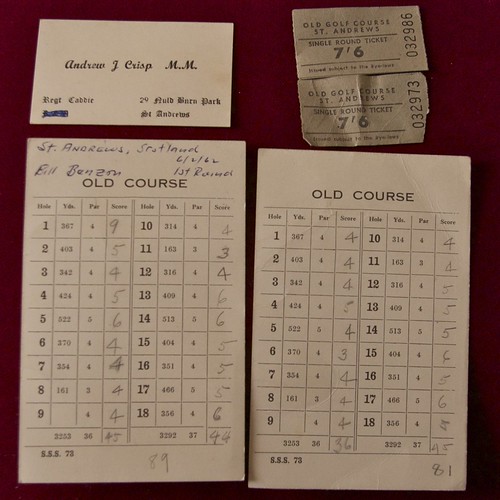
One of the highlights of his life was playing golf at St. Andrews in Scotland (he shot 81 on one round). He read a great deal about the sport, knew its history backwards and forwards, and had a good collection of golf books, including a classic written by a relative of Charles Darwin. It is absolutely clear to me that, as I use music to balance out my intellectuality, so my father used golf to achieve balance in his life.

IMGP5036
Caddie's card, tickets, and scorecards for two rounds at St. Andrews

Stamps

My father was an avid stamp collector, with particular interests in Canada, Liberia, Germany, and China. He loved the look of stamps, their design (line, color, shape, form, etc.), but also what they told about history and society. Stamps were his vehicle for encountering and organizing human history. Stamps commemorate individuals, events, ideas, and so forth, and thus tell the history of the nations that issue them. All of that was important to my father.

As was the craft of collecting itself. Used stamps are, of course, stuck on envelopes. They have to be separated from the envelope before they can be mounted in books. My father spent hours doing that. He had special chemicals, magnifying glasses, balances, tweezers, hinges etc. all relevant to the physical preparation of the stamps. He had books about stamps, and catalogues. He engaged in extensive correspondence with various stamp dealers, some he had come to know on an all but personal basis, even though he'd never met them. Over the years he'd developed relationships with them through the simple and cumulative acts of buying stamps.

Friday, February 3, 2017

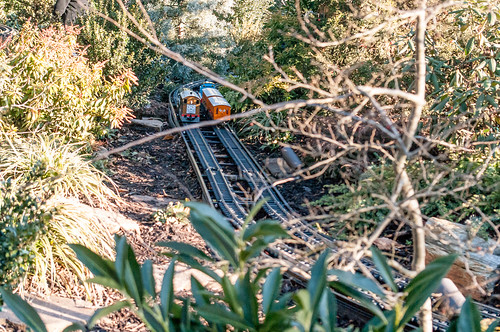
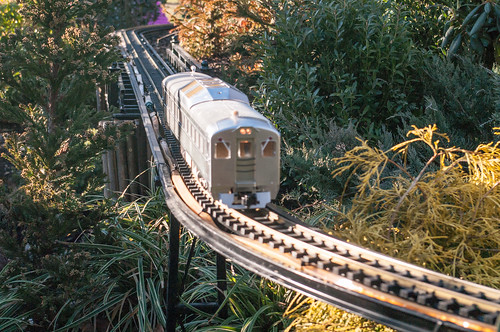
Friday Fotos: Toy Trains, Longwood Gardens, December 25, 2017

20161225-_IGP8476

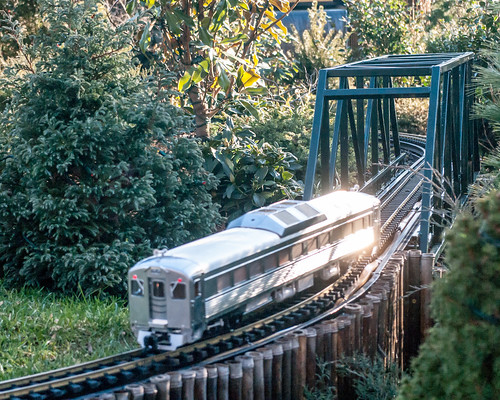
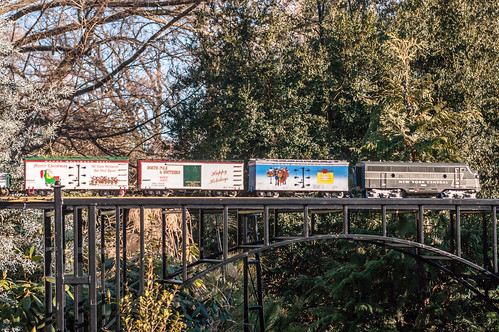
Trains are magical mythical beings. During the 19th century they crisscrossed the globe, binding regions into continents. Here is what Henry David Thoreau said about them in Walden (1854):
When I meet the engine with its train of cars moving off with planetary motion ... with its steam cloud like a banner streaming behind in gold and silver wreaths ... as if this traveling demigod, this cloud-compeller, would ere long take the sunset sky for the livery of his train; when I hear the iron horse make the hills echo with his snort like thunder, shaking the earth with his feet, and breathing fire and smoke from his nostrils, (what kind of winged horse or fiery dragon they will put into the new Mythology I don’t know), it seems as if the earth had got a race now worthy to inhabit it.

20161225-_IGP8478

Movies were made about them, bluesman sang about them, and Walt Disney built a theme park organized around a high-tech monorail, while he had a scale model train in the yard of his home.

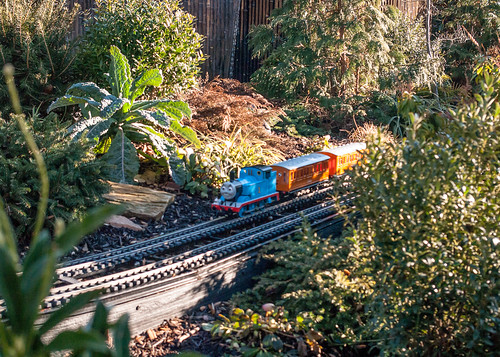
I still remember going downstairs one Christmas morning when I was a child and seeing an electric train circling on its tracks beneath the Christmas tree. I was entranced. It was mine, from the mythical Santa Claus.

20161225-_IGP8483

I remained entranced long after I’d figured out that Santa Claus was not real. My model trains were real, if only diminished simulacra of real trains. I would buy model railroad hobby magazines and marvel at the fantastic things they contained, even the advertisements: for trains, tracks, accessories of all kinds – signal lights, coal loaders, water towers, stations, trees, miniature trees, paper to clothe imaginary mountains, everything you needed to make a model world bound together with the magic of the railroad. And, of course, there were the stories of layouts that hobbyists built, generally in their basements.

20161225-_IGP8486

My father built a platform in our basement, taking up most of one half, the other half was given over to his workshop (and the furnace). By that time I had two trains, Lionel O-gauge, a steam locomotive pulling freight cars and a diesel, from the Santa Fe line, with its red and yellow colors, hauling sleek aluminum passenger cars. The layout was relatively simple, involving only three switches, two circuits, a siding or two, and a short tunnel. I had several buildings but never got around to building the land formations I envisioned in my mind’s eye.

20161225-_IGP8487

I also designed ever more elaborate layouts for that platform. I had a drawing board, T-square, triangles, and drafting instruments. I would tape a piece of paper to the board, draw nice border around it, and then design a layout in that space. I used the same instruments to design space ships. They, of course, were somewhat further from by ambit than a model train layout. No matter what you design the drawing board, paper, and instruments are the same.

Is that what trains are, instruments of the imagination, transport to the stars?

Monday, August 11, 2014

Solitaire (in Retirement)

The New York Times just ran a piece on retirement coaches, professionals who help retirees figure out what to do with their lives now that they don't have work to take up their time. Their example retirees are chosen from among professionals who, we assume, had satisfying careers. But what about them men and women who just worked fort a paycheck? 

One issue, of course, is relating to other people. Work gives you a circle of people who interact with day in and day out. When you're retired, that's gone, especially if you move away. But there's another problem; it has to do with what I've been calling behavioral mode. Work requires and supports a certain ecology of tasks, an economy of attention. You train your mind to it – though you might want to think of breaking a horse to saddle. When the job's gone, that economy is rendered useless. But you've devoted so much time to it that you don't know how else to deploy your behavioral resources.

And so you sit and twiddle your thumbs. Or, as in my father's case, play solitaire. I'm republishing the following note from April 15, 2011.

* * * * *

One scene that’s etched deeply in my mind is what I saw the first time I visited my parents after my father had retired. My father was playing solitaire hour after hour, day by day. Reveal a card, look at the table, place the card on the table. Reveal a card, look at the table, place the card on the table. Reveal a card, look at the table, place the card on the table. Reveal a card, look at the table, place the card on the table. Repeat.

Why? Why play solitaire when his time was his own? Who stole his life that he no longer had it?
 
My father was a brilliant man with many interests. We was a superb craftsman. He made my sister a play-pen for her dolls. He made if from wood, and made it so you could fold it up, just like real playpens. It was, oh, 30 to 36 inches square when opened up. The real marvel was that he’d cut the letters of the alphabet, and the numerals 0-9, into the slats on the sides. He outlined each letter on the slat. Drilled a hole inside the letter. Put the blade of a coping saw through the hole and then reattached the blade to the saw frame. Then stroke by stroke he sawed out the letter or number. When that was done he used small pieces of sandpaper to finish the edges.

Now, I didn’t actually see him do that, or, if I did, I don’t remember it. But that’s pretty much how he would have done it. Just which coping saw he used – he had several – I don’t know.

But that’s only one of many things he built down in his workshop with more tools than he had time to use.

He collected stamps, thousands upon thousands of them. The sale of his collection (after he’d died) was a minor event in the stamp-collecting world.

He played golf, a game he loved deeply. He like music, liked to read, and was a good bridge player.

But when he had his time back, when he didn’t have to go into work five days a week, he filled these blocks of time with solitaire. Not with those other things he used to do only on evenings and weekends.

In time, over the months and, yes, years, he cut back on the solitaire. He never did much, if any, wood working; the tools in his shop lay dormant. He played more golf, spent more time with his stamp collection. And bought some records.

The solitaire never left him. Always the well-worn decks of cards. Hours and hours.

Why?

Wednesday, April 2, 2014

Cleaning Coal: An Informal Study of Ecological Design

Slightly revised from My Father Cleaned Coal for a Living, originally published for the Truth and Traditions Party.
My father was trained as a chemical engineer. He spent his entire career with Bethlehem Mines, the mining division of the now defunct Bethlehem Steel Company. He designed coal cleaning plants, at least the system for actually cleaning the coal.

This is a story about the last plant that he designed, one designed to keep the air clean while at the same time reducing the cost of running and maintaining the plant. It was a beautiful and elegant solution to a nasty design problem. A study in systems thinking – though my father probably never used that phrase.

Cleaning Coal

Before coal can be turned into coke (for subsequent use as a fuel in steel-making) it must be cleaned of impurities, mostly sulfur. Most cleaning techniques take advantage of the fact that the rocks containing the impurities are denser than coal. So, you crush the raw coal until all the particles are less than, say, an eighth of an inch along any dimension. Then you float the crushed coal in some medium – generally, but not always, water – and take advantage of the fact that the rock sinks faster than the coal. There are several techniques you can use to do this, as I recall, but whichever technique you use, you end up with wet coal when you’re done.

Wet coal is considerably heavier than dry coal. As railroads charge by the pound, it costs more to ship wet coal than dry. Further, in the winter a hopper car filled with wet coal at the mine – where coal is generally cleaned, there's no point in shipping useless rock to the steel plant – is likely to be filled with frozen coal when you get to the plant. How do you empty that mess from the cars?

So, you need to dry the coal.

The old drying technique – drying ovens – leaves you with a lot of coal dust in the air. A lot. And coal dust is nasty stuff. You don't want it spewing out of chimneys anywhere in your neighborhood. Or near your farm.

Wednesday, December 4, 2013

A Meditation on Golf: What Would Dad Think about Liberty National?


Thinking about golf and trying to master it takes one’s mind away from other troubles.
– William Benzon


I think a lot about golf as a metaphor for life. The harder you swing, the less far it goes.
– Paul Fireman


IMGP4652

That’s the clubhouse for Liberty National Golf Course, on the banks of the Hudson River – or is it the upper end of New York Bay at that point? – at the south end of Jersey City, NJ. When you go up the steps, which are chained off midway, you go onto the club grounds which are, of course, private. When you go down, you come to the club’s private pier. You can see the Statue of Liberty at the left edge of the photo, hence the club’s name:

IMGP4654

The pier is for a motor launch that ferries club members back and forth to Manhattan. Club members with helicopters can land on the club’s helipad.

* * * * *

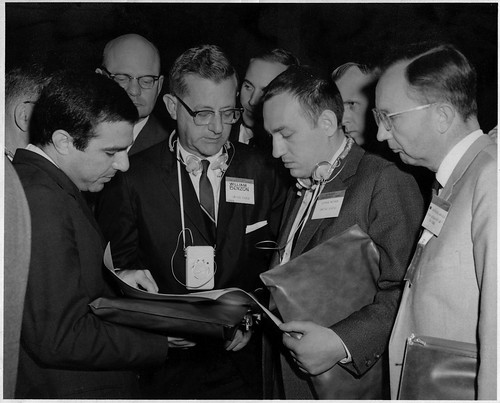
The man left of center in the photo below is my father:

Father & co 400 dpi jpg copy

I don’t know exactly what meeting this was, or when it took place. But it would have had to do with coal preparation in some way and it probably took place in the 1960s – the date on his badge appears to be 1966. He worked with Bethlehem Mines, the mining subsidiary of Bethlehem Steel (now defunct), and was Superintendent of Coal Preparation. He was in charge of removing impurities from coal so it could be used in smelting iron ore into iron. He has a few patents to his name and was quite distinguished in that field.

Tuesday, January 31, 2012

In Memoriam: William Benzon

IMGP3517rd - Five ducks and freedom tower

* * * * *

From Dad

by Sally Benzon


William Benzon
(1912 – 1998)


Clinging to light
By weeping tears

Charged with this silence
Only sorrow can receive:

Whispered heights of trees
Sway the breathless memory

Out of nowhere,
From the airs of body

You walk at once alone,
And beside us: Not that we are

Asked by a flock of birds
Who insist on behalf

Of one shy authority,
“Part our days together

To a different branch. Larry, Sally,
Sing to laugh around the world

With me!”
Tiding this canopy,
You are the man whose voice outlives

Agreeable disbelief
Into our inhabited green

Hundreds of leaves, golf balls, too
And leaves growing! . . .

Round of arms’ reach
The echo of echoed wings

Reveals the merry chance
Now a sunbeaming glow:

Chimes to sound
The melody of you.

Wednesday, September 14, 2011

Our Father

Two things you should know about our father. He loved golf, a game played, as you must surely know, in a garden. One winter, for example, he painted some old golf balls with red shoe polish and then went out on the course to practice in the snow. Was his golf jones so bad he needed a fix in mid-winter? Or was he secretly amused at the thought of a middle-aged man trudging about in the snow hitting red balls with some very expensive sticks?

Perhaps both.

He also kept meticulous practice notes and designed and constructed his own putter.

* * *

He had a sense of humor. We called it his “Danish sense of humor.” Whether or not it was peculiarly Danish is beside the point. His parents were from Denmark, of which he was proud. Victor Borge was Danish, played the piano well, had a sense of humor. From this it follows that Dad’s humor was Danish.

A favorite riddle: A duck family was swimming in a pond, Mother, Father, and the Baby. Perhaps there was a fourth; I forget; but it doesn’t matter. Anyhow, they swam about: circles, S-curves, spiracles, ogives, pterodactyls, parabolas, equilateral triangles, eternal ones too, helices, and hemi-demi-semiquavers, all the standard figures of Olympic pond swimming. As they were heading back to shore, feeling all flushed and satisfied, the baby duck remarked: “Aren’t we five ducks having fun?”

Why'd the baby ask that?

* * * * *

From Dad

by Sally Benzon


William Benzon
(1912 – 1998)


Clinging to light
By weeping tears

Charged with this silence
Only sorrow can receive:

Whispered heights of trees
Sway the breathless memory

Out of nowhere,
From the airs of body

You walk at once alone,
And beside us: Not that we are

Asked by a flock of birds
Who insist on behalf

Of one shy authority,
“Part our days together

To a different branch. Larry, Sally,
Sing to laugh around the world

With me!”
Tiding this canopy,
You are the man whose voice outlives

Agreeable disbelief
Into our inhabited green

Hundreds of leaves, golf balls, too
And leaves growing! . . .

Round of arms’ reach
The echo of echoed wings

Reveals the merry chance
Now a sunbeaming glow:

Chimes to sound
The melody of you.