Showing posts with label read-hyperobjects. Show all posts

Tuesday, August 5, 2014

Working Paper: Reading Morton’s Hyperobjects

I've collected my Hyperobjects posts into a working paper: Reading Morton's Hyperobjects.

Abstract: Timothy Morton’s Hyperobjects: Philosophy and Ecology after the End of the World, takes global warming as the starting point for a philosophical investigation our current moment. The world as we’d conceived it is over; the world we’re now living in is a strange one. Time and space aren’t empty containers and objects aren’t simple. We aren’t separate from the universe, nor it from us. Quantum mechanics, relativity, climate modeling, phase spaces, environmental art, nuclear waste, Morton covers them all.

Introduction: Hyperobjects as Concrete Universals

We live in apocalyptic times. But then, in a sense, all times are apocalyptic, for all times have births and deaths, and at many scales.

As I read it, Hyperobjects uses global warming as the paradigm case of a hyperobject. It is massively distributed in time and space and, when we finally found it, we found that we’d been living inside it for decades and centuries. It is at once here and now and a long way into the future.

How big is here and how big is now?

Those questions ask for one sort of answer if you conceive of time and space as empty containers, the classical view that Morton rejects. They’re whole different kettle of fish if you think of time and space as emanating from objects. And if the objects turn out to be hyperobjects – which is where Morton ends up – then they emanate time and space on all the scales at which the objects exist.

Many times and spaces enmeshed with one another.

Global warming is concrete, it is real. In that it is a hyperobject, and all objects are hyperobjects, it would seem to follow that global warming is a universal condition of time and space emanating from the many here-and-nows.

Take Leibniz’s world of monads and, for each monad, swap in a hyperobject, one existing on multiple scales. That’s Morton’s hyperuniverse.

Does THAT make any sense? No more sense that sacralizing nuclear waste, as Morton advocates – how else will we properly attend to it?

Of course not, but there isa logic to it.

For it is a mistake to read Hyperobjects as a discursive argument whose multiple propositions can be neatly separated from their verbal form. They can’t and it isn’t.

Hyperobjects is a performance and asks to be read as such. How you get there is as important as where you end up. And where you end up is where you started. You see, it’s a hyperobject and your path is a viscous circle, sticking to you as you doggedly stick to the reading.

As you read Hyperobjects you must be mindful, mindful of all that passes in array, accumulating connections as you move on through. That’s what this is about, moving through the world as it slips over the side and into the sea.

* * * * *

When I wrote “Hyperobjects and the Thinking of Timothy Morton” I had no intention of reading my way through the book; I didn’t even have a copy of it. I just wanted to comment on Ursula Heise’s gently devastating review and explain how, given that he was deep in a world I’d walked away from in my intellectual youth, I’d come to take Morton seriously. Nor had I any intention of reading the book when I posted a follow-up: “‘Hyperobject’ as Concept and as Rhetorical Device.” That’s where I explained that Morton’s thinking is a process one steps into, not an enumeration of propositions one takes away from.

And I was stuck. Morton asked me if I’d read the book and, if not, he’d send me a copy. It arrived, and I started reading. As I read, so I posted. In order. For awhile.

And I managed to ride some of my own hobby horses in the process: Disney’s ponk elephants in “What does real mean?”, the Marx Brothers in “Pardon Me”, and chaos/complexity in “High Dimensional Spaces” (complete with illustrations).

Then I saw an opportunity to write a formal reivew for my upcoming column in 3 Quarks Daily. To do that, though, I sorta’ had to finish the whole book, and write about it, whole. That became the 5th post in the series, though I cribbed some prose from the first.

At that point I started wondering just how much longer I wanted to keep this up. I had material for at least three or four most posts, but by then I’d decided I wanted to move on to Matt Jockers’ Macroanalysis. I made some decisions and decided to end it with the post on objectification and objects. One the one hand, the issue was central to my thinking – it was my concern about objectification that motivated my interest in object oriented ontology – but it connects with Jockers work as well. He doesn’t talk of hyperobjects, but his data manipulations visualize the outlines and skeletons of hypobjects, very abstract and tenebrous ones at that: the collective mind, anyone?

Time to move on.
Friday, August 1, 2014

Reading Hyperobjects 7: Objectification and Objects

Note: I’m counting my 3QD piece as #5 and my introduction to that as #6.
Let’s begin obliquely, with something I’ve come to think of as Hartman’s Line. Hartman is Geoffry Hartman, one of the (in)famous Yale Mafia, the dons of deconstruction back in the last quarter of the previous century, and the line is the one he draws between reading and semiotics/structuralism in this passage, among others, from The Fate of Reading (p. 271):
I wonder, finally, whether the very concept of reading is not in jeopardy. Pedagogically, of course, we still respond to those who call for improved reading skills; but to describe most semiological or structural analyses of poetry as a ”reading” extends the term almost beyond recognition.
Jonathan Culler had the same line in Structuralist Poetics (1975) when he asserted that linguistics is not hermeneutic.

That line, I submit, was about objectification. Linguistics objectifies language; structuralism and semiotics, at least in their more technical incarnations, objectify poetry. Objectification gets in the way of reading, of interpretation.

But what’s this have to do with hyperbojects?

Hold on. I’m getting there. Have a little patience.

OK.

By the time Hartman and Culler had made those statements, I’d already passed over to the dark side. I’d pretty much decided that the objectification of literary texts was the way to go, a story I’ve told in this post about my early encounter with Lévi-Strauss and “Kubla Khan.” Culler himself didn’t return to structuralism nor did the profession show any further interest in linguistics and structuralism. The profession had, in effect, rejected objectification.

And that left me stranded, pursuing objective knowledge while my one-time colleagues critiqued everything in sight. When I first encountered object-oriented ontology I was hoping that perhaps I could use it as philosophical support, or at least as ideological camouflage, for my own work. It didn’t take me long to figure out that that wasn’t very likely, but by then I was hooked.

And that brings us back to Morton and hyperobjects. For Hartman’s Line is just a special case of the more general line that phenomenology and its offshoots and critiques has drawn between thought and the world. The object oriented ontologists don’t cross that line either.

Monday, July 28, 2014

Reading Hyperobjects at 3QD: A Quake in Being

IMGP8008

My latest post is up at 3 Quarks Daily, and it’s a review-essay on Hyperobjects: Sing Me a Song of Hyperobjects: Starting over with Humans and Other Creatures in the 21st Century CE.

In the process of writing that piece I had, of course, to run back through the book. Near the end of the process, too late to take account of it in the article, I was struck by the title of Morton’s introductory chapter, “A Quake in Being.” He introduces the phrase on page 19:
The discovery of hyperobjects and OOO are symptoms of a fundamental shaking of being, a being-quake. The ground of being is shaken. There we were, trolling along in the age of industry, capitalism, and technology, and all of a sudden we received information from aliens, information that even the most hardheaded could not ignore, because the form in which the information was delivered was precisely the instrumental and mathematical formulas of modernity itself. The Titanic of modernity hits the iceberg of hyperobjects.
Catchy, yes, very.

But what does it mean, this quake in being? The phrase evokes an earthquake, when the ground shakes beneath your feet and the earth opens up and starts swallowing without apparent end. Very dramatic. But what’s that have to do with Being? BTW, what’s this Being anyhow?

IMGP7989

Friday, July 25, 2014

Reading Hyperobjects 4: Digital Humanities Edition – High Dimensional Spaces and Descriptions

This may take awhile. After explaining my change in plan for this series I wade into phase space, complete with pictures illustrating an example of my own. What’s that got to do with the digital humanities? Easy: the search for hyperobjects. I then affirm Morton’s characterization of mathematics and conclude with a passage from Bethany Nowvitskie.

IMGP6635rd

First, a change in plan

I’d planned on writing a commentary on each chapter, in order, with supplements. But the previous installment took more time than I’d expected. If that’s how things are going to go, then I don’t have time to follow through on that plan.

So, I’m skipping commentary on the “Temporal Undulation.” That means I’m not going to get to puzzle over Gaussian time and Einsteinian reference mollusks (the Wikipedia entry on Time fields in general relativity is useful here). But I’ll leave you with a two snippits.

From page 64, in his discussion of the Gaussian nature of hyperobjects: “The contemporary philosophical obsession with the monstrous provides a refreshing exit from human-scale thoughts.”

Concerning an example from the Islamic philosopher al-Razi, “Ignore the wrongness of this supposition, because it’s irrelevant” (p. 66). That’s good advice I find myself applying to Hyperobjects here and there.

Phase spaces, an example

Let’s skip to the next chapter, “Phasing,” where I want to concentrate on Morton’s definition of phase space and his account of math.

Morton defines a phase space as “the set of all possible states of a system” (p. 71). OK. But what does that mean? How do we work with such an object? How can we visualize it?

Let’s consider a system that’s somewhat smaller than earth’s weather system, the example Morton himself gives, and look at it with some care and a bit of detail.

Thursday, July 24, 2014

Reading Hyperobjects 3: Are We Are Poems about the Earth?

Before considering the subtitle of today’s post, which is derived from the last sentence on page 51 of the thirteenth page of “Nonlocality”, I want to examine the first paragraph, just to examine what’s in there, with some care and attention to detail. First I’ll quote the paragraph in full without commentary; then I’ll comment on it line-by-line.
When I look at the sun gleaming on the solar panels on my roof, I am watching global warming unfold. Carbon compounds and other molecules in the upper atmosphere magnify the burning intensity of the sun in the Great Central Valley of California. Yet I do not see global warming as such. I see this brilliant blade of sunlight, burning the top of my head as I watch it with half-closed eyes reflecting off the burnished, sapphire surface of solar panels. The manifold that I witness is not merely a “subjective impression,” but is rather just this collusion between sunlight, solar panels, roof, and eyes. Yet global warming is not here. Hyperobjects are nonlocal.
Microsoft Word tells me that paragraph has 93 words. Let’s go through it sentence by sentence.

1) When I look at the sun gleaming on the solar panels on my roof, I am watching global warming unfold: Three things, the sun, solar panels/roof, and global warming. An three spatial scales, the solar system at millions of miles, the earth at 10s of thousands of miles, and the house, at tens of feet. All linked by the fact that Morton is aware of them.

2) Carbon compounds and other molecules in the upper atmosphere magnify the burning intensity of the sun in the Great Central Valley of California: Morton now elaborates on warming and introduces a fourth scale, the microscopic scale of molecules and atoms; objects invisible to the naked eye; objects we think about only through scientific investigation and reporting. Action has shifted from Morton and his seeing to those molecules distributed about the upper atmosphere; they’re magnifying. And, by implication, he’s feeling the sun’s burning intensity. Morton closes the sentence by opening out on a fifth scale, the Central Valley: smaller than the earth, larger than the house.

3) Yet I do not see global warming as such: This sentence inserts a gap (a word Morton uses often, as in the gap between phenomenon and thing) between Morton, the observer writer, and global warming, his subject. He’s seeing something, and he knows global warming is somehow IN that something, but he really isn’t seeing global weather. Rather...

4) I see this brilliant blade of sunlight, burning the top of my head as I watch it with half-closed eyes reflecting off the burnished, sapphire surface of solar panels: Now we’re moving back into the conceptual space of the first two sentences, e.g. burning intensity of the sun (2), burning the top of my head (4); solar panels (1) solar panels (4). To this we add his head and his eyes, organs of sight.

Wednesday, July 23, 2014

Reading Hyperobjects: Pardon Me While I Have a Strange Interlude

I’ve begun reading Morton’s second chapter, “Nonlocality,” and have decided I need to say something about Morton’s use of science, a subject matter that’s already occasioned a fair amount of discussion. Jon Cogburn’s written a useful post, How not to engage with other humanists; Nathan Brown and the continental/continental divide, which generated a great deal of discussion, much of it about Morton’s Realist Magic (which I’ve not read). Some thinkers are appalled by what Morton does and think it discredits his work. Others, while cognizant of difficulties, take a somewhat different view.

In reply to Cogburn, Terrence Blake said: “I do not discuss Morton at all as, like you, I think he is doing something very different than philosophy most of the time...” Others seem to agree; I’m one of them. In my own remark I observed that
I've been strongly influenced by Lévi-Strauss, an important precursor to (while also being contemporary to) much of the thinking in question. He made use of mathematical ideas. In particular, his four-volume study of myth is larded with technical-seeming diagrams, notation, and he talks of proving this or that in a mathematical way. But he also says, in the introduction to The Raw and the Cooked, that this is all by way of metaphor, analogy. He isn't really using algebraic group theory, but finds some notions from it useful.

It seems to me that his use of those ideas is rhetorical and, in a way, necessary as well. The short-hand notions allow you to see relationships that cannot be expressed very well in prose. It's the visual layout and the way you can examine relationships among items as they're laid out on the page – very useful.

Reading Hyperobjects 2: What does real mean?

The question is from “Viscosity,” p. 32, and “real” is italicized. It’s a good question, one I often ask myself from within my own worldview – you’ll recall l concluded last time with a confession that I live a somewhat different ethos from the one through which Morton is writing, and so the answer I seek likely has a different valence and distribution. But I suspect we’re using those word forms under similar existential pressure.

* * * * *

The chapter opens:
I do not access hyperobjects across a distance, through some transparent medium. Hyperobjects are here...Like faces pressed against a window, they leer at me menacingly...From the center of the galaxy, a supermassive black hole impinges on my awareness (p. 27)
Don’t ask how it does that, for Morton tell us “as if... in the car next to me...” Just believe it and roll on.

Later:
Hyperobjects are agents. They are indeed more than a little demonic, in the sense that they appear to straddle worlds and times, like fiber optic cables or electromagnetic fields. And they are demonic in that through them causality flows like electricity. (p. 29)
Causality flows?

Bosh!

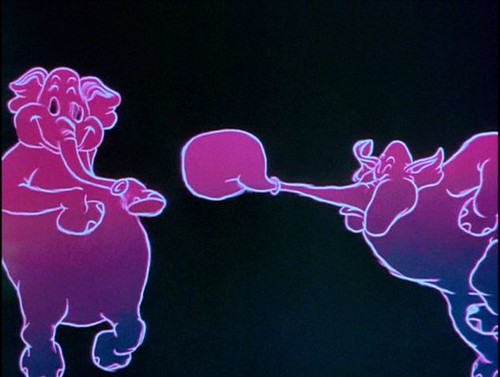
Why not? And you know, Disney was there long before he started doing PR for atomic energy (Our Friend the Atom). See:

PACHYDERM THREE

Tuesday, July 22, 2014

Reading Hyperobjects 1: The World has Ended

Timothy Morton. Hyperobjects: Philosophy and Ecology after the End of the World. University of Minnesota Press 2013. 229 pp.

I’m finding the book to be a bit of a tough read, requiring frequent pauses for thought. But more of that at the end.

* * * * *

I’ve finished the introduction, “A Quake in Being,” pp. 1-24.
A hyperobject could be the Lago Agrio oil field in Ecuador, or the Florida Everglades. A hyperobject could be the biosphere, or the Solar System. A hyperobject could be the sum total of all the nuclear materials on Earth; or just plutonium, or the uranium. A hyperobject could be the very long-lasting product of direct human manufacture, such as Styrofoam or plastic bags, or the sum of all the whirring machinery of capitalism. Hyperobjects, then, are “hyper” in relation to some other entity, whether they are directly manufactured by humans or not. (p. 1)
That quells some misgivings I had when Morton was explaining the concept at Stanford’s Arcade. At that time he seemed to dwell on weirdness, but the terms of his definition – hyperobjects are massively distributed in space and times, etc. – didn’t specify weirdness. But there’s nothing weird about the Solar System, or Styrofoam, or even capitalism, though it is perhaps a bit weird to think of all the world’s Styrofoam as one (collective) (hyper-)object.

You know how when you read Borges’ The Library of Babel you had little choice but to imagine books one might find there? There’s the one with a joke about three clergymen and a mosquito on page 79, but the punch line’s missing. The punch line is on page 123 in some other book, but in Klingon. And of course there’s a book containing the draft text of Hyperobjects, except that it reads right-to-left and back-to-front.