I say discover because I regard the poem’s structure as something existing objectively in the world, prior to and independent of my work, or anyone else’s for that matter. However, I regard that discovery as tentative because it really hasn’t been confirmed. The profession – academic literary criticism – isn’t like that.
But I’m getting ahead of myself with this talk of a discovery that hasn’t been confirmed. Let’s set that aside for the moment. We’ll return to the issue at the end – though that’ll take awhile (you might want to get a cup of coffee, or some scotch, whatever’s appropriate).
This is about description, and how I came to realize the importance of description. That happened through my work on “Kubla Khan” – other texts as well, but that was the Rubicon. I’m going through this once again now because the profession seems to be in the process of discovering, or rediscovering description – e.g. the special issue of Representations (Summer 2016) devoted to it – and is still quite tentative about it. By my reading – and here I’m being polemical – they don’t know what they’re up to.
But then I didn’t know what I was doing either, not back then. That’s why I’m writing this, to emphasize how very difficult it can be to understand what you’re doing. It was only two decades or more after the fact that I came to understand what I had done in the early 1970s.
A structuralist analysis of “Kubla Khan”
In my senior year at Johns Hopkins I enrolled in a two-semester course on Romantic Literature, taught by (the legendary) Earl Wasserman. Keats, Shelley, and Sir Walter Scott in the Fall (1968); Wordsworth, Coleridge, and Jane Austen in the Spring (1969). That’s when I became hooked on “Kubla Khan”, the spring of 1969. I had this idea that the poem attained completeness by asserting its own incompleteness, a formulation that Wasserman loved, and that would have been well suited to the emerging deconstructive dispensation, though I didn’t frame it that way.
I stayed at Hopkins for a master’s degree in Humanities and wrote my thesis on “Kubla Khan”. I had become interested in structuralism and wanted to do a structuralist analysis – I refuse to call it a reading – of the poem, which was dripping with the binary oppositions so central to structuralist thought. Oh, I had other thinkers I wanted to bring to the poem, but I centered on Lévi-Strauss.
Therein lies the problem. It stalked and ambushed me and laid me low. When he began his work on myth Lévi-Strauss pursued the idea that a myth began with a binary opposition – life vs. death, nature vs. culture, that sort of thing – expressed in extreme form and proceeded by substituting successively less extreme forms of the opposition until, with one final substitution, it all but eliminated the opposition. Thus he had an intriguing scheme that explained why myths took the form they did. That’s what attracted me, the possibility of an actual explanation.
But he’d abandoned that scheme when he began Mythologiques. Oh well, never mind. Anyhow, I wasn’t dealing with a myth or group of myths, I was dealing with a poem. One poem: “Kubla Khan”.
Finding binary oppositions was easy – Kubla vs. the wailing woman, the wailing woman vs. the Abyssinia maid, Kubla vs. the maid, the dome vs. the caves, wailing vs. song, maid vs. auditors, Kubla vs. poet. They were all over the place, those oppositions. But I couldn’t see any order to them.
Here’s a fragment from one of my worksheets:
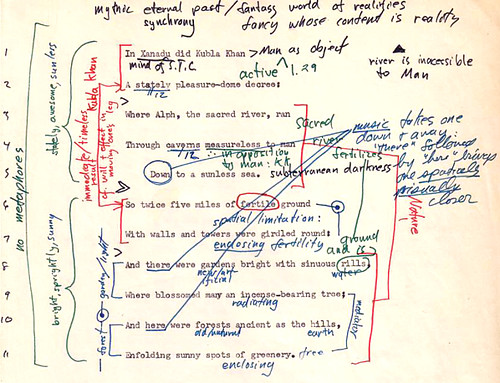
I’d typed the poem out in triple-space and then marked it up. I must have done this half-a-dozen times. Sometimes double spaced, sometimes triple. And I used different colors of felt-tip pens to indicate different aspects of structure.
It just went on and on. And then I gave up.
Of course there was more on my mind than those oppositions. For one thing I had been reading everything I could find on “Kubla Khan” in the Hopkins library. Along with bits and pieces of that scholarship I was also weaving my other core thinkers into the mix, Wittgenstein, Piaget, Merleau-Ponty, and Nietzsche. But it wasn’t working. In the spring of 1970 I stopped typing on page 142. Some time after that, I don’t recall when, I had the idea of treating line-end punctuation as a means of dividing the text into hierarchically ordered units in the same way that parentheses, brackets and braces are used in grouping elements of mathematical expressions. Once I had done that I could see that the punctuation structure of the poem matched the units I that had slowly emerged in my examination of binary oppositions.