Showing posts with label #Canon/Archive. Show all posts

Monday, November 18, 2019

2 Comments on Moretti’s LitLab 15: Patterns and Interpretation [#DH] [now 3 comments]

And now let me add a third comment based on a 2016 lecture which covers much of the conceptual ground in this pamphlet. I've added the third comment after the first two. Accordingly, I've bumped this post to the top of the queue.
Franco Moretti has produced another pamphlet:
Franco Moretti, Patterns and Interpretation, Stanford Literary Lab, Pamphlet 15, September 2017, 10 pp. [In Canon/Archive (2017) as the conclusion, pp. 295-308.]
I have two comments to offer. In the first I contrast meaning with explicit semantic models while I the second I suggest that Lévi-Strauss was in pursuit of the form of myths.

Meaning and Semantics

Early in the pamphlet Moretti remarks (p. 2):
Now, meaning is not one of the things literary critics study; it is the thing. Here lies the great challenge of computational criticism: thinking about literature, removing meaning to the periphery of the picture. But of course this is also the great challenge for computational criticism: you discard meaning and replace it with – what?
Yes.

Meaning is a peculiar beast. It is inherently subjective, by which I mean primarily that it arises within subjects; that subjectivity is its mode of existence. As a practical matter assertions about the meaning of texts varies widely and seemingly idiosyncratically from one critic to another, though agree is possible. The former is subjectivity in the ontological sense while the later is subjectivity in the epistemic sense – a distinction I have from John Searle [1]. That the meaning of texts is ontologically subjective implies that, as investigators, we cannot grasp as an object of examination and investigation. All we can do is translate, paraphrase, wheedle and cajole, in an attempt to indicate a text’s meaning(s). It’s a slippery Heraclitean business.

Moretti, if I understand him correctly, would have us, as computational critics, set meaning aside in favor of pattern and, I believe, form. I’m OK with that in the context of contemporary digital criticism. However, there is a different, though by no means contradictory, “replacement” for meaning.

Semantics –

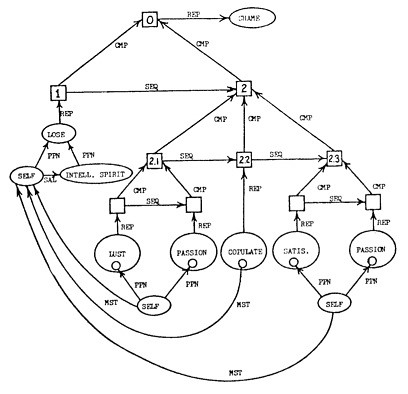
By which I mean an explicit account of how words have, well, you know, meaning. Back in the 1960s cognitive scientists began to create such explicit accounts, often in the form of computer simulations. I learned one such model when I studied with the late David Hays in the Linguistics Department at SUNY Buffalo and employed it in an account of Shakespeare’s Sonnet 129, “The Expense of Spirit” [2]. The model took the form of a semantic or cognitive network where the nodes represented ‘words’ (approximately, more or less) and the edges connecting them represented the relations between them.

This diagram depicts a small fragment of such a model:

Shame s129 mln76

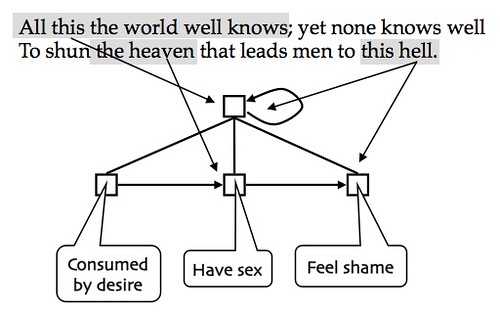
One could then ‘account for’ the text as a path through the semantic model. This depicts a fragment of such a path, which arrows pointing from the text to the network fragments they realize:

heaven&hell2

I say account for because such a path doesn’t actually explain the text. It doesn’t tell you why that path was taken in the first place, nor why it takes this form rather than that form. That’s a different matter.

My point is that such a model doesn’t “give” you the meaning of the text. When you examine such a model, when you follow a text through such a model, you are not reading the text in any reasonable sense of the word. You are simply examining the operations of a model, and a very complex one at that.

Monday, October 28, 2019

Enchanted by meaning – That’s been the fate of American criticism, but elsewhere?

Though, to be blunt, in my more polemical moods I’m inclined to think that “besotted” is a better word to characterize academic literary criticism’s engagement with the search for meaning, at least in America. It wasn’t always thus; there is a history here. And in the rest of the world? Has that enchantment taken hold, or is there a bit of distance, even resistance? That’s what I’m wondering about.

This enchantment had all but taken hold by the time I’d become an undergraduate at Johns Hopkins in the mid-1960s. But I did see hints of and hear echoes from other modes of literary study. And I noted the transformation of the meaning of “reading” from common sense word into a term of professional art. As a common sense term it meant simply “to read”, as any literate person does with a text of any kind, whether a greeting card, the daily newspaper, a technical report or user’s manual, or, yes, a literary text. As a term of art it meant “to interpret, to explicate”, a mostly written activity in which one comments on the meanings inherent in (in one formulation) or one finds in (a somewhat different formulation) a literary text. For anyone entering literary study, however, a decade or so later, and whether at the undergraduate or graduate level, those hints and echoes would have been gone. Reading, that is, interpretive reading, had become the focus of literary study and, for all practical purposes, it had always been thus.

But, as I’ve said, there IS a history there. According to Gerald Graff in Professing Literature (1987) interpretive criticism, in the form of so-called close reading, was a response to a demographic shift in higher education after World War II. While close reading has pre-war roots but became particularly attractive as a pedagogical tool when college enrollment increased after the war and it thus became necessary to educate large numbers of undergraduates from disparate backgrounds. This educational imperative was, if anything, more ethical than merely cognitive, where by “ethical” I mean to invoke ethos, which my dictionary glosses as “the characteristic spirit of a culture, era, or community as manifested in its beliefs and aspirations.” Close-reading was a means by which large numbers of undergraduates could be imbued with the values of American culture, indeed, of Western civilization. Close-reading’s assertion of textual autonomy meant that it was not necessary to be steeped in historical knowledge in order to think and write about literary classics. One merely had to learn how to attend to the text.

And if close-reading was to become a pedagogical technique, well then the pedagogues themselves had to master it. So they did, and in the process close reading became the focus of post-war literary criticism. By the mid-1960s, however, critics began to notice and wonder about the fact that different critics arrived at different meanings for the same text. How could this be? If criticism is a form of knowledge, then shouldn’t we all agree on textual meaning? Otherwise criticism would seem to be little more than personal opinion decked out in often high-flown rationalizations. And so the profession entered a period of methodological reflection that lasted, let us say, through the 1970s and into the 80s. It is during this period that both structuralism and linguistics were considered as means of textual commentary that didn’t necessarily focus on decoding textual meaning, but were concerned with techniques and forms of construction.

Both, however, were discarded. Not completely, to be sure, narratology has persisted, and a bit of poetics and even linguistics. But they were not regarded as central to the discipline. They have little presence in mainstream journals such as PMLA, Critical Inquiry, New Literary History, and so forth. During the mid-1990s both cognitive psychology and evolutionary psychology entered the scene, but both were firmly subject to the reigning focus on meaning. They provided new interpretive vocabularies and little more.

And that, more or less, is where the profession is today. Yes, there is computational criticism, which is a whole different ball of wax. But it seems to me that, whatever its potential, it still functions, or valiantly attempts to function, under the sign of meaning.

That’s academic literary criticism in the United States. What’s going on elsewhere? I have the distinct impression that narratology and even linguistics have received more play in (Continental) Europe than they have in the United States. Is that the case, or am I imagining things? What about elsewhere in the world? For example, I’ve got a post where I excerpt an exchange between J. Hillis Miller and Zhang Jiang, a senior critic in the People’s Republic of China. That conversation is about interpretive criticism, specifically deconstruction. I’ve got another short post in which Hollis Robbins talks about Chinese scholars’ knowledge of literary theory, that is, (advanced) interpretive criticism? Is that all that the Chinese have taken Western criticism. What about narratology (from Europe)? And so I wonder about Japan, India, and the rest of the non-Western world. For that matter, what about native intellectual traditions?

All of which is to say: Is interpretive criticism all that there is in the academy? If so, we’re in deep trouble, for interpretive criticism has bottomed out. There’s nothing left but new variations on old themes.

On the other hand, here’s an opportunity. If some body of scholars out there in the wider world were to latch on to the best of computational criticism and combine it what what I have been calling naturalist criticism and within an intellectual generation, perhaps two, they could show those backward Westerner’s a thing or two.

Tuesday, December 12, 2017

From distant reading to computational criticism: Canon/Archive @ 3QD [#DH]

n_1_moretti-shopify_1024x1024

As far as I can tell literary studies will remain committed to pre-computational intellectual formations for the foreseeable future and will do so from a position of quasi-aristocratic superiority over crass calculation, of which it will remain fitfully ignorant.

One might say that my participation in the academic blogosphere is framed, for the moment, by engagement with the work of Franco Moretti. It began with a so-called book event at The Valve, a now dormant group blog I joined late in 2005. Jonathan Goodwin had organized an online symposium about Moretti’s Graphs, Maps, Trees. It went live on the web on January 2, 2006 and had contributions by 15 people. Eight of us were Valve contributors: John Holbo, Ray Davis, Matt Greenfield, Amardeep Singh, Adam Roberts, Bill Benzon, Jonathan Goodwin, and Sean McCann. There were guest appearances by seven: Franco Moretti, Matthew Kirschenbaum, Timothy Burke, Eric Hayot, Steven Berlin Johnson, Jenny Davidson, and Cosma Shalizi.

I have no idea how many people contributed comments to those discussions, which unfolded over a period of three weeks. Most, but not all of these authors held academic posts (I did not). Two, I believe, did not have doctorates. The contributors came from all over the place and I wouldn’t hazard a guess about their backgrounds. Some were academics, I’m sure, and some where not. The symposium eventually became (self-published) book: Jonathan Goodwin and John Holbo, eds. <i>Reading Graphs, Maps, and Trees: Responses to Franco Moretti (Glassbead Books 2009).

That was over a decade ago. It was a collective event that took place outside the ordinary confines of the academic world – my use of confines is, of course, quite deliberate.

At the time Moretti was talking about distant reading. He had not yet become involved with computing and, necessarily, with people who know how to program then. He formed the Stanford Literary Lab in 2010 with Matthew Jockers, who had computer skills that he did not. The Lab issued its first pamphlet in, I believe, January of 2011: Quantitative Formalism: an Experiment. It was signed by Moretti and four others: Sarah Allison, Ryan Heuser, Matthew Jockers, and Michael Witmore. The most recent pamphlet, no. 16, was issued in November of this year: Totentanz. Operationalizing Aby Warburg’s Pathosformeln, by Leonardo Impett and Franco Moretti.

That first pamphlet had been submitted to a prestigious journal but was turned down in terms that suggested that the intellectual method itself was being rejected, not just that particular argument. And so the group decided to sidestep the world of formal academic publication and publish its work in the form of stand-alone pamphlets. This is common enough in technical disciplines, where work will be published in the form of technical reports – though that work will sometimes/often then by published in journal form as well; but it was unheard of in the humanities.

My point, then, is that the literary lab has worked at the edge of the academic world. It is located at a prestigious university, and its pamphlets bear the imprimatur of that university. But they do not exist in the world of formal academic publication.

Moretti, who is now retired from Stanford, and the lab have now gathered eleven of those pamphlets into a book:
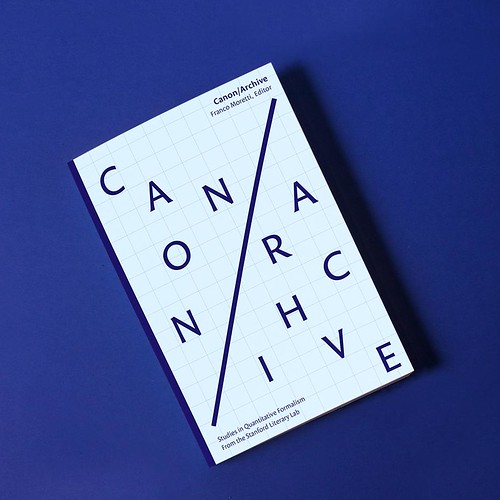
Canon/Archive: Studies in Quantitative Formalism by Franco Moretti (Author, Editor), Mark Algee-Hewitt, Sarah Allison, Marissa Gemma, Ryan Heuser, Matthew Jockers, Holst Katsma, Long Le-Khac, Dominique Pestre, Erik Steiner, Amir Tevel, Hannah Walser, Michael Witmore, and Irena Yamboliev, published by n+1.
Note the term, quantitative formalism. Moretti now refers to this approach as computational criticism rather than distant reading, though some in the field use the latter term.

I have written an essay/review about the book and published it in 3 Quarks Daily, December 11, 2017, which is not an academic journal: Moretti and the Stanford Literary Lab: Computational criticism in two senses and the prospect of a new approach to literary studies.

The epigraph to this post is the final sentence of that essay/review.

Will the future of literary studies unfold outside departments of literature and their associated societies and journals?

More later.

Wednesday, November 29, 2017

Rejected @NLH! Part 4: Déjà vu all over again at New Literary History + Welcome to the club, Franco! [#DH #Canon/Archive]

I've been reading the new Canon/Archive by Franco Moretti and 13 others and decided to bump this post to the top of the queue for reasons that will become obvious when you read addition I've made to the head of the post.

EXTRA! EXTRA! READ ALL ABOUT IT! LATE ADDITION!

In the first paragraph of his preface to Canon/Archive Moretti tells us how the Literary Lab decided to publish its own pamphlets:
A well-known scholarly journal had been asking for an article on new critical approaches, and that’s where we sent the piece once it was finished. But it came back with so many requests for corrections that it felt like a straightforward rejection. It was dismaying; a few years ago, computational criticism was still shunned by the academic world, and we couldn’t help thinking that what was being turned down was not just an article, but a whole critical perspective. And since we also thought that the essay was perfectly fine as it was, we decided that—instead of trying our fortune with another journal (or, god forbid, making the required alterations)—we would publish it on our own, as a document of the Literary Lab. I cannot remember how the term “pamphlet” came up; and, frankly, it wasn’t even the right one: pamphlets have a public vocation that our work, with its heavily technical aspects, couldn’t possibly have. But the word captured the euphoria of being on our own; the freedom to publish what we wanted, when and how we wanted: short, long, even very long, our pamphlets never come out a minute earlier than they’re ready, nor a minute later, either; and without going through the grinder of editing “styles.” And all this, because “Quantitative Formalism” was rejected by—Never mind. They did us a favor.
YES! To all of it, been there, done that. The following post tells how I was rejected at MLN early in my career in 1980 and at NLH just last year. It's pretty clear in both cases that "what was being turned down was not just an article, but a whole critical perspective." Moreover, it is computation that was being rejected in those cases as well as Moretti/LitLab's. I had framed the MLN submission as being structuralist, which it was in a way, but it was computational at its heart. The NLH submission was explicitly computational. Silly me, I thought the critical world was changing.

As for the term "pamphlet", it's fine. But hundreds if not thousands of academic, government, and industrial labs issue things called "technical reports", some of which become articles in the formal literature, and many do not. I've read 100s if not thousands of these tech reports, and have even written two (back at the Center for Manufacturing Productivity and the Rensselaer Polytechnic Institute).

And I certainly understand "the freedom to publish what we wanted ... long, even very long". Some of my best work takes the form of pieces that are too long for journal publication but too short for monograph publication. The economics of hardcopy publication places restrictions on what can be published and therefore, if only indirectly, on what is thought. 

More later on Canon/Archive.

* * * * *

I’ve been discussing a manuscript of my that was rejected at New Literary History:
Sharing Experience: Computation, Form, and Meaning in the Work of Literature, https://www.academia.edu/28764246/Sharing_Experience_Computation_Form_and_Meaning_in_the_Work_of_Literature
In previous posts I’ve laid some groundwork, first discussing why I decided to submit to NLH, then positioning the article within my larger intellectual project, and, most recently, recounting the history of literary criticism in the 1970s as it moved from openness to closure.

That brings us to 1980, when I decided to submit an essay about “Kubla Khan” to MLN. It was turned down on the basis of a deeply conflicted set of reviewer’s comments. Some of those comments are resonant with comments made by the reviewer who rejected the current essay for NLH. It’s that resemblance that, in part, prompted me to once more re-examine the 1970s and to write this series of posts.

In this post I begin by telling the story of being rejected at MLN. Then I discuss my rejection at NLH, in two parts. In the first part I discuss the similarities between the two rejections. In the second part I suggest that the NLH reviewer is skeptical about computing for reasons that seem more ideological than the result of well-informed study.

“Kubla Khan” – Rejected at MLN

In 1972 I filed a master’s thesis with the Humanities Center at Johns Hopkins. I forget the exact title, but it was a more or less structuralist analysis of “Kubla Khan,” the work that prompted me to go all-in on the emerging cognitive sciences (though the term, “cognitive science”, wasn’t coined until 1973). It wasn’t until 1980 that I decided to publish that work. I deleted a lot of the philosophical discussion, added some new diagrams of a style owing more to cognitive science than structuralism, and sent it out under the title “Articulate Vision: A Structuralist Reading of ‘Kubla Khan’.” By that time I’d ceased thinking of myself as a structuralist, after all I written a 1978 dissertation entitled “Cognitive Science and Literary Theory”, but I presented the paper that way because I figured that a literary audience would at least recognize structuralism.

But where should I submit it? No one was publishing essays like that.

I decided to submit to the comparative literature issue of MLN. The basic reason was simple; Richard Macksey edited that issue and he’s the one who directed that master’s thesis. Moreover the comparative literature issue publishes theoretical pieces, which this more or less was. And, of course, MLN had published my first cognitive networks piece in the special Centennial Issue, “Cognitive Networks and Literary Semantics” (MLN 91: 952-982, 1976).

So I submitted the piece to MLN. Macksey had to turn it down because the reviewer’s report was unfavorable. The reader noted that “I found myself teetering on the edge of Kubla’s girdling wall, uncertain whether to tip one way and fall into Benzon’s enchanted ground, or the other way and run from his tables and charts”. Note the reviewer’s alarm at the diagrams [1], which were somewhat more complicated than the one’s that Mark Rose had apologized for in Shakespearean Design back in 1972 [2]. The reviewer goes on to register “surprise at encountering a straightforward, unembarrassed structuralist analysis” in the deconstructive era.

Yet the reviewer acknowledges that those same charts “have a real value in coming to terms with the text, and I will no doubt refer to them when I teach the poem.” That strikes me as a very strong positive remark, a clear statement of his approval. After all, you don’t – at least I didn’t – ordinarily base your teaching on far-out crazy ideas; you are conservative in what you present to students. The reviewer went on, however, to complain that the essay “ought to argue with itself, to put into question some of the patterns it establishes – or better, perhaps to let the poem talk back.” And after this that and the other, they [yes, I know, but I prefer that usage to the more awkward “his or her”] flatly recommend against publication, no chance for revision.

It was a strange and conflicted review. The analysis seems to have made sense to the reviewer but did so in terms so at odds with their sense of the proper (deconstructive) way to approach a poem that they were in the grip of cognitive dissonance. It shouldn’t have made sense at all. But it did, gosh darn it! What to do? The easiest way to resolve that dissonance was simply to wish my article out of existence, that is, to reject it. Whatever Macksey himself may have thought about the article, he had little or no choice but to follow the reviewer’s advice and reject it.

And you know, come to think of it, since I knew Macksey personally, I called him up and we discussed the rejection. I don’t recall the discussion in any detail, though I remember that his wife, Catherine picked up the phone, but it was amiable. Macksey acknowledged the review was strange, but I didn’t push him on it. And that was that. But I’m not in a position to call Rita Felski, the editor of NLH.

Rejection at NLH

The reviewer at NLH didn’t express any such conflict or ambivalence. The rejection was firm and unequivocal. That’s quite clear. Beyond that, however, I’m a bit up in the air since I don’t know who the reviewer was and so have no sense of what they know. In particular, what do they know of computing, which is how I framed by article?

Wednesday, November 15, 2017

Ted Underwood on Canon/Archive [#DH]

Ted Underwood reviews Canon/Archive, by Franco Moretti (Author and Editor) and 13 others (Mark Algee-Hewitt, Sarah Allison, Marissa Gemma, Ryan Heuser, Matthew Jockers, Holst Katsma, Long Le-Khac, Dominique Pestre, Erik Steiner, Amir Tevel, Hannah Walser, Michael Witmore, and Irena Yamboliev, all authors). How, you might ask, could that be? Simple, says Underwood, more or less. Moretti worked at Stanford's Literary Lab (he's now retired from Stanford) and laboratories are (typically) sites of collaborative and collective work. People at different stages in the intellectual life, with different sets of conceptual, craft, and rhetorical skills, work together in a common intellectual enterprise. I participated in such a group when I was doing by PhD work at Buffalo (English), where I was a member of David Hays's linguistics/cognitive science group (Linguistics). It can be a good way to work, but it is not how work in the humanities has ordinarily–classically, if you will–been done.

And, despite the sense one gets in the general media that quantitative work is new to the humanities, that's not the case, says Underwood. It's been around for several decades.
But over the last 30 years, the enclaves have joined to produce a practice of quantitative interpretation that is no longer purely sociological, or purely linguistic, but able to range freely across the spectrum from single words to social trends. Computers are certainly useful in this mode of interpretation, but they aren’t the new element.
What's new is a certain "human connection between scholars." Initially Moretti and Matthew Jockers, but others joined the party, and this volume presents their collective work.

And so:
Experiment is presented here not just as a test of reliable knowledge but as a style of intellectual growth: “By frustrating our expectations, failed experiments ‘estrange’ our natural habits of thought, offering a chance to transcend them.” At moments, the point of experiment seems to become entirely aesthetic. In the book’s introduction, Moretti admits that he set out to write “a scientific essay, composed like a Mahler symphony: discordant registers that barely manage to coexist; a forward movement endlessly diverted; the easiest of melodies, followed by leaps into the unknown.”
I wonder, did Moretti get the musical trope from Lévi-Strauss, who uses it to structure The Raw and the Cooked, with section, chapter, and subchapter titles all derived from music (e.g. "The Fugue of the Five Senses", "The Oppossum's Cantata").

Underwood continues:
The essays within are unified by a deliberately wandering structure, which keeps its distance both from scientists’ predictable sequences (methods → results → conclusions), and from the thesis-driven template that prevails in the humanities (counter-intuitive claim → evidence → I was right after all). Instead, these essays become stories of progressive disorientation, written in the first-person plural, and arriving at theses that were only dimly foreshadowed.

This narrative form has given the Literary Lab a coherent authorial persona, which may lead readers to assume that the experiments gathered here are also unified by shared methods and theories, more or less identified with Moretti. That would be a mistake. The Literary Lab is genuinely a collective project, and these essays have been shaped by many different approaches to the literary past.
Of numbers and meaning?
The most important fracture in the book involves the nature of the connection between numbers and interpretation. Several of the essays make this connection with statistical models. In chapter 1, for instance, Michael Witmore reveals that a model of textual similarity based purely on word frequencies can group Shakespeare’s plays into comedies, histories, and tragedies. But when Moretti describes the book’s methods in the conclusion, he downplays the interpretive connection provided by models, in order to tell a story that leaps from observation of opaque “patterns” to the “discovery of a causal mechanism.” This account again reveals Moretti’s commitment to framing the work of the Lab as a humanistic narrative. Scientists don’t usually understand their methods as a process of pure induction that produces meaning at the last moment; instead, they tend to begin with a hypothesis, and find a way to test it (often using a model).
Except that "humanistic narrative" tends to be short on causal mechanism.

But who cares? Will it spread? Underwood notes that New Historicist criticism spread rapidly because it didn't require new skills, just a somewhat different deployment of standard lit crit skills, "surprising connections between works of literature and historical events" plus anecdotes. Computational criticism of the sort done at the Literary Lab, however, is a different kind of beast. The work requires people with programming skills, statistical skills, and a nose for experimental design in addition to a feel for literary phenomena. No one individual has to have all these skills, but all skills must be available in the group, and all members of the group need to be able to talk with one another.

Thus, Underwood assures his (humanistic) reader, "there is no danger that a quantitative approach to literature will spread like wildfire". Whew!  However, "there will certainly be more books like this one." Yes, there will.

And even stranger ones. I've been exploring this territory for some time now, since the mid-1970s. Oh, not the particular regions Moretti and Underwood (and others) have been exploring so fruitfully for the last decade or two. That's new to me, as it is to the discipline. But that's not all there is here, wherever THIS is, not by a long shot. I've got to tell you, Guys, this isn't the East Indies, it's not even Kansas. It's something else, maybe not even terrestrial.

Stay tuned.

Monday, June 19, 2017

Extra! Computational Criticism Breaks with Tradition! Sky Remains Overhead

Andrew Goldstone has decided that perhaps so-called distant reading is not reading at all. The document is relatively short, “The Doxa of Reading” (PDF), and will appear in PMLA for May 2017. Goldstone takes “doxa” from Pierre Bourdieu (whom I’ve not read) who regards it “as what participants in the literary field take for granted.” What critics take for granted is “the assumption that the primary activity of academic literary study is textual interpretation.” Though Goldstone doesn’t say so, this wasn’t always the case, though it has been the case for the last five or six decades.

Bourdieu also allows for orthodoxy and heterodoxy, which stand in opposition to rupture. In Goldstone’s analysis–I refuse to call it a reading–the term “distant reading” functions as a heterodox form of reading and does so, in effect, to ward off the realization that it is not a form of reading at all but a rupture from reading. Goldstone’s analysis is both subtle and complex, just enough so that I’m not sure where he stands. But his penultimate sentence seems clear enough: “If we cease to regard the different versions of distant reading as a singular project [...] we gain a wider sense of the possibilities for scholarship.” I take that to mean in some version distant reading computational criticism really does point beyond “reading” and so to new modes of literary investigation.

In the course of his argument Goldstone considers the visual objects that have become a signal feature of so much work in computational criticism:
Looking back on the work of the Literary Lab in a recent pamphlet, Moretti asserts:
Images come first, in our pamphlets, because–by visualizing empirical findings–they constitute the specific object of study of computational criticism; they are our “text”; the counterpart to what a well-defined excerpt is to close reading. (“Literature, Measured” 3)
As an account of a quantitative methodology, this is a strange statement: visualizations are powerful exploratory tools, but they should be considered provisional summaries of the data of literary history, not primary objects. As a description of argumentative rhetoric, however, Moretti’s analogy between visualization and excerpt is illuminating. It positions the “computational critic” as an expert interpreter of visual texts, a heterodox version of the close reader.
He is correct. Those visual objects are not the “primary objects” of investigation. Yes, they are “exploratory tools”.

It seems to me that they have the character of observations (of the primary object of investigation). Think of the images created in radio astronomy; they make look rather like optical photographs, but they aren’t. The process through which they are constructed is different. The visual objects of computational criticism don’t look like photographs; they look like the charts and graphs that are ubiquitous in so many quantitative disciplines. But they have the same status in the intellectual process as those images of radio astronomy, that of observations.

It is through observations that a phenomenon of interest enters the investigative field. Observations as well have something of a descriptive character. Wouldn’t you know, description has recently become of interest in discussions of critical method and practice, along with “surface reading”.

And with that I want to turn to the aborted structuralist moment in the history of literary criticism. Jonathan Culler published Structuralist Poetics in 1975. In his preface he observed (xiv-xv):
The type of literary study which structuralism helps one to envisage would not be primarily interpretive; it would not offer a method which, when applied to literary works, produced new and hitherto unexpected meanings. Rather than a criticism which discovers or assigns meanings, it would be a poetics which strives to define the conditions of meaning.
Culler himself never followed up on the poetics he proposed, nor did others take him up on it. To be sure, we have narratology, a poetics of the narrative. But it is hardly central to the discipline as it has been practiced over the past half-century or so.

A turn to poetics would have been a rupture from emerging interpretive practices (aka reading). But then those practices themselves constituted a rupture from the practice of a discipline rooted in philology and (traditional) literary history. While interpretive criticism has its roots before World War II, it isn’t until after the war that it became the center of critical activity. As that happened interpretive practice became the focus of scrutiny, scrutiny that led, among other things, to the (in)famous structuralism conference that took place at Johns Hopkins in 1966. But the rupture that actually happened, was not a turn to poetics, but a turn to deconstruction. And if deconstruction was noisy and obstreperous at the time, in retrospect it is clear that it was not a rupture at all, but just a further variation on interpretive reading.

It remains to be seen whether or not computational criticism will flourish as a genuine rupture from interpretative reading, though not so much as a replacement as a supplement. If so, will it find common cause with a new poetics, one based on surface “reading”, description, and perhaps even the newer psychologies (cognitive, neuro-, and evolutionary)? Can we move beyond reading, not only in the analysis of large corpora, but in the analysis of single texts? And can we move beyond a meta language centered on notions of reading and space (close, distant, hidden, surface) to one based on the intellectual operations involved (among others, description, analysis, interpretation, explanation)?

* * * * *

Of course I've addressed these issues endlessly here and in my working papers. For a start, see this post from 3 Quarks Daily, “The Only Game in Town: Digital Criticism Comes of Age”, and in numerous blog entries and working papers (e.g. these working papers on description).

Saturday, May 7, 2016

What’s Interesting? Is Moretti Getting Bored?

“The interesting” or “interestingness” came up in the Twittersphere in a response Ted Underwood made to Ryan Heuser:


This is something I think about from time to time – I blogged about it back in 2014: The Thinkable and the Interesting: Katherine Hayles Interviews Alan Liu – generally in connection with my own work on description and, in particular, the description of formal features of texts and films, such as ring-composition. I find this activity to be quite interesting, intrinsically interesting if you will. But, judging by what literary critics actually do, most critics aren’t particularly interested in such things.

Why not?

I don’t know. I assume, though, that I’ve got some unseen conceptual context to which I assimilate such description and in terms of which it is interesting. Whatever that context is, most literary critics don’t have it.

But enough about me in my possibly peculiar interests.

I want to think about Franco Moretti. In both a recent interview in the Los Angeles Review of Books and his most recent pamphlet, Literature, Measured (which is now the preface to Canon/Archive, 2107, pp. ix-xvii), Moretti has expressed misgivings about the current state of affairs in computational criticism. He ends the pamphlet thus (p. 7):
“Bourdieu” stands for a literary study that is empirical and sociological at once. Which, of course, is obvious. But he also stands for something less obvious, and rather perplexing: the near-absence from digital humanities, and from our own work as well, of that other sociological approach that is Marxist criticism (Raymond Williams, in “A Quantitative Literary History”, being the lone exception). This disjunction […] is puzzling, considering the vast social horizon which digital archives could open to historical materialism, and the critical depth which the latter could inject into the “programming imagination”. It’s a strange state of affairs; and it’s not clear what, if anything, may eventually change it. For now, let’s just acknowledge that this is how things stand; and that – for the present writer – something needs to be done. It would be nice if, one day, big data could lead us back to big questions. It would be nice if, one day, big data could lead us back to big questions.
What I’m wondering is if “big questions” is a marker for missing intellectual context. Is Moretti unable to see that these investigations will lead, even must eventually lead, to home truths? It’s not that I can see where things are going – I can’t – but, for whatever reason, I don’t share his feeling that things might be going amiss.

The curious thing is that, even as he expresses these misgivings in both these texts, he also expresses a certain fondness, even nostalgia, for traditional critical discourse. Thus, in Literature, Measured he says (p. 5):
Forget the hype about computation making everything faster. Yes, data are gathered and analyzed with amazing speed; but the explanation of those results – unless you’re happy with the first commonplace that crosses your mind – is a different story; here, only patience will do. For rapidity, nothing beats traditional interpretation: Verne’s “Nautilus” means – childhood; Count Dracula – monopoly capital. One second, and everything changes. In the lab, it takes months of work.
And maybe the explanation, if and when it comes at all, seems a bit weak. This, from the LARB interview:
But again, think of this: to make it better — it's a perfect expression because it's a comparative, it was good and now it's more good — this is not how the humanities think in general. It's usually much more of a polemical, an all-or-nothing affair. It's a conflict of interpretation. It's: you thought Hamlet was the protagonist of Hamlet, how foolish of you; the protagonist is Osric. Digital humanities doesn't work in this mode and I think there is something very adult and very sober in not working in this mode. There is also something, maybe especially for older people like me, which is always a little disappointing: the digital humanities lacks that free song — the bubbliness of the best example of the old humanities.
The thing is, that traditional critical discourse, the one in which the critic can construct a bubbly free song, is embedded in a conceptual matrix that is linked to some version of Home Truth, whether Christian humanism, Hegelian phenomenology, Marxist theory, or critique in its many flavors, whatever. That matrix gives the critic intellectual purchase on the Whole of Life.

That’s the context of the traditional humanities. That’s where the traditional humanities draw their interest: Life, the Universe, and All.

By contrast, computational criticism seems to have cut the cord. Can’t get there from here. The big questions seem impossibly distant, if not actually gone.

I wonder what sustained all those pre-Darwinian naturalists, the ones who went out in the field and were both content and even eager to describe the flora and fauna they found? For that matter, would Darwin have spent so much time describing barnacles if he didn’t find the activity itself interesting apart from whatever it might contribute to his larger intellectual enterprise? Could he even have found that larger enterprise if he hadn’t been fascinated by the details of the morphology, physiology, and lifeways of flora and fauna?

Tuesday, April 26, 2016

From Telling to Showing, by the Numbers

I've been thinking about some remarks Moretti made about the digital humanities in  a recent interview. Among other things he suggested that the results of computational criticism have so far been disappointing. But he also held up Lit Lab Pamphlet #4 as an example of "an intelligence that takes the form of writing a script, but in the writing of the script there is also the beginning of a concept, very often not expressed as a concept, but that you can see that it was there from the results that the coding produces." Here's what I wrote about that pamphlet back in October of 2012.
I’ve just looked at a pamphlet from Stanford’s Literary Lab: Ryan Heuser and Long Le-Khac, A Quantitative Literary History Of 2,958 Nineteenth-Century British Novels: The Semantic Cohort Method (68 page PDF), May 2012. I’ve not read it in detail, but only blitzed my way through, looking for the good parts. Well, not even all of those. I was just looking to get a sense of what’s going on.

Which I did. And I like it. THIS is the sort of work I want to see from ‘digital humanities.’ Not the only sort, but it’s one of the things we can do with ‘big data’ and pretty much only do with big data. If traditional humanists can’t see value in this kind of work, well, then forget about them.

First I’ll give you the abstract, then I’ll quote a bunch and make some comments.

Authors’ abstract
The nineteenth century in Britain saw tumultuous changes that reshaped the fabric of society and altered the course of modernization. It also saw the rise of the novel to the height of its cultural power as the most important literary form of the period. This paper reports on a long-term experiment in tracing such macroscopic changes in the novel during this crucial period. Specifically, we present findings on two interrelated transformations in novelistic language that reveal a systemic concretization in language and fundamental change in the social spaces of the novel. We show how these shifts have consequences for setting, characterization, and narration as well as implications for the responsiveness of the novel to the dramatic changes in British society.

This paper has a second strand as well. This project was simultaneously an experiment in developing quantitative and computational methods for tracing changes in literary language. We wanted to see how far quantifiable features such as word usage could be pushed toward the investigation of literary history. Could we leverage quantitative methods in ways that respect the nuance and complexity we value in the humanities? To this end, we present a second set of results, the techniques and methodological lessons gained in the course of designing and running this project.

Tuesday, August 12, 2014

Reading Macroanalysis 3.1: Style, or Measuring the Autonomous Aesthetic Realm

Yesterday I posted on Chapter 6, “Style,” in which Jockers argued, in effect, that insofar as we can measure (or estimate) the factors that affect a text’s style, authorial identity is the strongest of those factors. The key is that phrase, “insofar as we can measure,” because that’s the intellectual world in which we are now functioning.

I now want to take Jockers’ arguments on that score and refit them for use as evidence that an autonomous aesthetic realm does indeed exist, as the late Edward Said believed but couldn’t quite explain.

First I want to take up the topic that was the subject of Moretti’s most recent pamphlet, operationalization. Then I’ll introduce Said’s conundrum about the existence of an autonomous aesthetic realm and discuss how we could operationalize it. I’ll conclude by arguing that Jockers has already, in effect, all but given us an operationalization of it.

Operationalization

If we can’t measure it, or operationalize it, to use a term Moretti adopted from physics (“Operationalizing”: or, the Function of Measurement in Modern Literary Theory, Literary Lab, Pamphlet, December 2013) then we can’t reason about it in this universe of discourse. In some other universe of discourse, sure, but not in this one.

Moretti glosses “operationalize” by a passage from P.W. Bridgeman (p. 2):
We may illustrate [the meaning of the term] by considering the concept of length: what do we mean by the length of an object? [...] To find the length of an object we have to perform certain physical operations. The concept of length is therefore fixed when the operations by which length is fixed are fixed: that is, the concept of length involves as much and nothing more than the set of operations by which length is determined. In general, we mean by any concept nothing more than a set of operations; the concept is synonymous with the corresponding set of operations [...] the proper definition of a concept is not in terms of its properties but in terms of actual operations.
If I might push the term a bit, since the middle of the last century, and a bit before, literary criticism has ‘operationalized’ the concept of meaning by the procedure of so-called close reading. That is to say, the meaning of a literary text, whether a sonnet by Shakespeare or a narrative by Murasaki Shikibu, is what the procedure of close reading determines it to be.

Alas!, or if you are so inclined, mirable dictu!, the result of this process tends to vary from one critic to another. In science, that would be a problem. In literary criticism it is merely a provocation to theory.

Many critics simply ignore it, perhaps covering it over with the anodyne topos that the multiplicity of meanings simply shows the richness of the text. Other critics assume that the concept has been inadequately operationalized and go in search of more adequate methods – the literary Darwinists, led by Joseph Carroll, are the most recent such school. And still other critics accept this as evidence that meaning is indeterminate.

But I digress. It’s not meaning we’re after. It’s style. Traditionally the concept of style has been operationalized – and here I’m again pushing things a bit – by describing texts in rhetorical, philological and, more recently, linguistic terms. Since the middle of the previous century computational humanists have operationalized the concept by counting textual features and undertaking a statistical analysis of the counts.

From the standpoint of traditional humanism that seems odd and terribly impoverished, and no doubt it is. But it is also reliable from one researcher to another and has allowed stylisticians to accomplish at least one task beyond the reach of traditional humanists, with their richer methodology. Namely, identifying the authors of otherwise anonymous texts. This is the tradition in which Jockers is working.

Friday, May 2, 2014

Method in DH: Signal and Concept, Operationalization

Signal and concept: distinction employed by Ryan Hauser and Long Le-Khac: A Quantitative Literary History of 2,958 Nineteenth-Century British Novels: The Semantic Cohort Method. Stanford Literary Lab, Pamphlet 4, May 2012.

Operationalization: concept discussed in Franco Moretti, “Operationalizing”: or, the Function of Measurement in Modern Literary Theory, Stanford Literary Lab, Pamphlet 6, December 2013.

Think like a social scientist: Arthur Stinchcombe, Constructing Social Theories, New York: Harcourt, Brace, and World, 1968.

• • • • • •

Toward the end of their pamphlet Hauser and Le-Khac observe (pp. 46-47):
How do we get from numbers to meaning? The objects being tracked, the evidence collected, the ways they’re analyzed—all of these are quantitative. How to move from this kind of evidence and object to qualitative arguments and insights about humanistic subjects— culture, literature, art, etc.—is not clear. In our research we’ve found it useful to think about this problem through two central terms: signal and concept. We define a signal as the behavior of the feature actually being tracked and analyzed. The signal could be any number of things that are readily tracked computationally: the term frequencies of the 50 most frequent words in a corpus, the average lengths of words in a text, the density of a network of dialogue exchanges, etc. A concept, on the other hand, is the phenomenon that we take a signal to stand for, or the phenomenon we take the signal to reveal. It’s always the concept that really matters to us. When we make arguments, we make arguments about concepts not signals.
I’ve already noted that I believe the equation of computing with quantitative is misleading (From Quantification to Patterns in Digital Criticism). That’s one thing.

The solution Heuser and Le-Khac propose is to distinguish between signals, which they can measure, and concepts, which are the phenomena being indicated by the signals. The distinction is useful and it’s also pretty much standard in social science, though not necessarily in those terms. While the mechanisms responsible for the operation of, for example, an automobile, can be observed directly, those operating in human society or the human mind are generally inaccessible to direct observation.

In order to investigate those mechanisms one must propose a theory or a model and then operationalize that theory. What does that mean? Moretti (p. 1):
Forget programs and visions; the operational approach refers specifically to concepts, and in a very specific way: it describes the process whereby concepts are transformed into a series of operations—which, in their turn, allow to measure all sorts of objects. Operationalizing means building a bridge from concepts to measurement, and then to the world. In our case: from the concepts of literary theory, through some form of quantification, to literary texts.
Just so.

Wednesday, April 23, 2014

Toward a Computational Historicism. Part 3: Abstraction at the Time Scale of History


Poets are the hierophants of an unapprehended inspiration; the mirrors of the gigantic shadows which humanity casts upon the present; the words which express what they understand not; the trumpets which sign to battle, and feel not what they inspire; the influence which is moved not but moves. Poets are the unacknowledged legislators of the world.

–Percy Bysshe Shelley

In the first post in this series, Discourse and Conceptual Topology, I reviewed network models on three scales, micro, meso, and macro. In the second post, From History to Abstraction, I moved to the micro scale and argued that the mechanism of abstraction proposed by David Hays gives us a way of thinking about how a historical process can lead to subsequent abstraction and illustrated the model through an examination of Shakespeare’s Sonnet 129. In this post I examine Heuser and Le-Khac on the 19th Century British novel and undertake a formal comparison of The Winter’s Tale and Wuthering Heights in which I argue that Brontë had the advantage of conceptual machinery unavailable to Shakespeare, though in some way anticipated by him. I hope to conclude this series with a fourth post in which I return to purely theoretical and methodological matters.

History: Showing and Telling

As we all know, one of the major problems of literary studies up to now is that it has concentrated its attentions on a relatively small body of texts, the so-called canon, and has allowed the examination of those texts to stand as a proxy for all of literary history. The assumption is either that, because of their quality, those are the only texts that matter or, perhaps, their quality allows them to “stand-in” for the rest. The widespread availability of powerful computers now allows as to put these assumptions to the test or, rather, simply to abandon them.

Sister disciplines have developed techniques for analyzing large bodies of texts, corpus linguistics, and literary critics are applying these to newly available digital text collections. I want to examine one such study, Ryan Heuser and Long Le-Khac, A Quantitative Literary History of 2,958 Nineteenth-Century British Novels: The Semantic Cohort Method (Stanford Literary Lab, Pamphlet 4, May 2012; HERE is an older post that looks at this study). Their corpus included almost 3000 British novels spanning the period from 1785 to 1900. What they discovered, roughly speaking, is a shift from abstract terms to concrete, which they characterize as shift from telling (abstract terminology) showing (concrete terms). They read this shift through Raymond Williams (The Country and the City) as reflecting a population shift from small rural closely-knit communities to large urban communities where people are constantly amid strangers.

Here is how Heuser and Le-Khac characterize the texts toward the beginning of the period (p. 35):
Thinking in terms of the abstract values, the tight social spaces in the novels at the left of the spectrum are communities where values of conduct and social norms are central. Values like those encompassed by the abstract values fields organize the social structure, influence social position, and set the standards by which individuals are known and their behavior judged. Small, constrained social spaces can be thought of as what Raymond Williams calls “knowable communities,” a model of social organization typified in representations of country and village life, which offer readers “people and their relationships in essentially knowable and communicable ways” (Country 165). The knowable community is a sphere of face-to-face contacts “within which we can find and value the real substance of personal relationships” (Country 165). What’s important in this social space is the legibility of people, their relationships, and their positions within the community.
Toward the end of the period writers wrote and readers read texts Ryan and Le-Khac characterize like this (p. 36):
If this is how the abstract values fields are linked to a specific kind of social space, then we can make sense of their decline over the century and across the spectrum. The observed movement to wider, less constrained social spaces means opening out to more variability of values and norms. A wider social space, a rapidly growing city for instance, encompass- es more competing systems of value. This, combined with the sheer density of people, contributes to the feeling of the city’s unordered diversity and randomness. This multiplicity creates a messier, more ambiguous, and more complex landscape of social values, in effect, a less knowable community... The sense of a shared set of values and standards giving cohesion and legibility to this collective dissipates. So we can understand the decline of the abstract values fields—these clear systems of social values organized into neat polarizations—as a reflection of their inadequacy and obsolescence in the face of the radically new kind of society that novels were attempting to represent.
The upshot (p. 36): “Alienation, disconnection, dissolution—all are common reactions to the new experience of the city.”

I have no problems with this, as far as it goes. But, in light of Hays mechanism of abstraction, where abstract terms are defined over terms, I want to suggest that something else might be going on. Perhaps all those concrete terms in the later novels are components of abstract patterns, patterns defining terms which may not even be named in the text (or elsewhere). 
 
That is to say, abstract terms do not contain their definitional base somehow wrapped up “inside” them. The signified is not enclosed within the signifier. It lies elsewhere. When constructing discourse intended to circulate within a known world one can rely on others to possess, internally, the defining pattern of terms. But when sending a text to circulate among strangers, a message in a bottle, one cannot rely on them to already to have internalized the definitional patterns. One must also supply the patterns themselves. And once the patterns are there, perhaps the terms they define become irrelevant. Perhaps, in fact, this situation is an opportunity to gather new patterns – which others may or may not name and rationalize.

The fact that these later novels do not use abstract terms so liberally thus does not necessarily mean that those texts do not imply abstraction. Perhaps they are but using abstraction in a different mode; they are supplying the patterns themselves.

Let us consider a text from the end of that period, Joseph Conrad, Heart of Darkness. If alienation, disconnection, and dissolution are your cup of tea, that text abounds in them, though it’s not a novel of the city at all. To be sure, it starts with four men on a yacht in the Themes River, but those men are not really of London in that moment, though they may be in it. Though the story moves to the European continent, and ends there too, its heart is in Africa, but colonial Africa.

I don’t have the means to examine the lexical usage in the whole text, so I don’t know where Conrad’s text appears on the continuum between showing and telling. But the text is a highly abstracted and elliptical. A key rhetorical indicator: only two of the characters are known by name, Kurtz and Marlow; the rest are known by title, the Director, the Intended. People are merely nodes in a social net, one stretched to the breaking point.

But I want to focus on one paragraph; at about 1500 words it’s the longest one in the text. Prior to this point Marlow has made it clear that his African crew was just barely competent, his helmsman in particular. It this point in the trip the boat is attacked from the shore and the helmsman is speared. Bleeding profusely, he falls to the deck. At this point Marlow interrupts the story and delivers a long set of comments about Kurtz – the paragraph of interest – and then, when he’s done, he returns to the helmsman bleeding on the deck and throws him overboard. This paragraph is strongly and dramatically marked.

The paragraph starts with the Intended and moves from there to Kurtz and his bald head and then to the all-important ivory, the “fossil” as it is called. Then there’s talk of the moral comforts and pressure of home, which are gone in the jungle, Kurtz’s pan-European background – “His mother was half-English, his father was half-French. All Europe contributed to the making of Kurtz...” – his education, his ideas, his beautifully-written report to the International Society for the Suppression of Savage Customs, the unspeakable practices Kurtz allowed himself, and, of course, the report’s postscript: “Exterminate all the brutes!” The paragraph ends with something of an abbreviated eulogy for his helmsman:
I missed my late helmsman awfully,—I missed him even while his body was still lying in the pilot-house. Perhaps you will think it passing strange this regret for a savage who was no more account than a grain of sand in a black Sahara. Well, don't you see, he had done something, he had steered; for months I had him at my back—a help—an instrument. It was a kind of partnership. He steered for me—I had to look after him, I worried about his deficiencies, and thus a subtle bond had been created, of which I only became aware when it was suddenly broken. And the intimate profundity of that look he gave me when he received his hurt remains to this day in my memory—like a claim of distant kinship affirmed in a supreme moment.
Immediately before those lines Marlow weighs Kurtz against this helmsman: “No; I can't forget him, though I am not prepared to affirm the fellow was exactly worth the life we lost in getting to him.” He thus implies that the dead helmsman was more to him than Kurtz. The fellowship of one African is worth more than the accomplishments of a remarkable Englishman.

Marlow is not only measuring one man against another in that sentence, he’s measuring African against Europe, which is rather a more abstract comparison. In that moment Africa noses out Europe in the comparison, a rather extraordinary thing, no? To be sure, the terms of comparison are rigged, as Chinua Achebe pointed out in a lecture entitled “An Image of Africa: Racism in Conrad’s Heart of Darkness.” Still, it is an extraordinary moment.

But was it prophetic in Shelley’s sense? With the advantage of hindsight one might claim it was, for not long thereafter Europe was singing and dancing to the music of the African diaspora and sun tans came in vogue, perhaps in imitation of African skin, as Ann Douglas argues in Terrible Honesty: Mongrel Manhattan in the 1920's (Farrar, Straus, 1995).

But the point I really want to make is more modest. And I want to make it by way of Leslie Fiedler. Early in Love and Death and the American Novel (1966, pp. 32-33) he says:
The series of events which includes the American and French Revolutions, the invention of the novel, the rise of modern psychology, and the triumph of the lyric in poetry, adds up to a psychic revolution . . . a new kind of self, a new level of mind; for what has been happening since the eighteenth century seems more like the development of a new organ than a mere finding of a new way to describe old experience.
Is Fiedler correct about this? But I do not see how one can account for this “new organ” by reference to our biological nature – Fieldler is talking metaphorically – for this new organ arose long after our biological nature had stabilized. Its origin thus must be found in the culturally evolved refashioning of biological materials.

This new organ is more is constructed in the mind and not the body or, if you will, it is in the brain, but not thereby of the body. It is the sort of thing that culture can craft and I suggest that Piaget’s notion of reflective abstraction and Hay’s concept of abstract definition tell us something of the machinery culture has at its disposal. The kind of evidence Hauser and Le-Khac offer about the British novel is consistent with this view, though it would require more work to offer a stronger statement on the matter.
[I’ve examined the Conrad paragraph in some detail. I situate this paragraph in Conrad’s text in this post: The Heart of Heart of Darkness. I undertake an informal analysis of that paragraph, almost at the sentence level, in Heart of Darkness 6: Some Informal Notes about the Nexus. I examine Marlow’s comparison of the helmsman and Kurtz in Marlow’s Calculation. All of these posts are included in Heart of Darkness: Qualitative and Quantitative Analysis on Several Scales (PDF).]
From Shakespeare to Bronte

Now let’s take a look at Shakespeare’s The Winter’s Tale and Emily Brontë’s Wuthering Heights. Both narratives span two generations in which the first generation narrative ends in tragedy while the second-generation narrative ends happily. To be sure, the happy ending of Wuthering Heights is muted and rather bizarre in that Heathcliff must reunite with his beloved Catherine in the grave whereas Leontes’ beloved Hermione turns out to be alive at the end. But Heathcliff goes happily to that grave.

The first thing that interests me is that Brontë’s novel uses a complex double narration—Nellie Dean to Lockwood, Lockwood to the reader—of a sort that is completely absent in Shakespeare (and his contemporaries). I’m suggesting that she has conceptual machinery that he didn’t have and that double narration is the most obvious trace of that machinery. This machinery allows how to manipulate and reorder the events of her story in a way that Shakespeare could not.

Brontë opens her narrative with events that in fact happen late in the two-generation history she is telling. Catherine Linton née Earnshaw has been long dead and her daughter is coming into her majority. Heathcliff has taken over both estates, Wuthering Heights and Thrushcross Grange, while residing at Wuthering Heights. Lockwood has just come off a failed summer romance and has decided to rent Thrushcross Grange.

As the novel opens Lockwood is narrating the story of his visit to Heathcliff at the Heights, two visits actually. Those visits extend through three chapters (of 34). It isn’t until the fourth chapter that we meet Nelly Dean and get a clear indication that this is not going to be the story of Lockwood getting over his failed summer romance, but rather a story about the Earnshaws, Lintons, and Heathcliff.

While there is much to remark on in these opening chapters, I want specifically to look at the second. What happens is that Lockwood makes a series of mistaken inferences about the relationships among the people residing at the Heights. There are five, Heathcliff, Catherine Linton, Hareton Earnshaw, and two servants, Joseph and Zillah. First he presumes that Catherine was Heathcliff’s wife:
'It is strange,' I began, in the interval of swallowing one cup of tea and receiving another--'it is strange how custom can mould our tastes and ideas: many could not imagine the existence of happiness in a life of such complete exile from the world as you spend, Mr. Heathcliff; yet, I'll venture to say, that, surrounded by your family, and with your amiable lady as the presiding genius over your home and heart--'

'My amiable lady!' he interrupted, with an almost diabolical sneer on his face. 'Where is she--my amiable lady?'

'Mrs. Heathcliff, your wife, I mean.'

'Well, yes--oh, you would intimate that her spirit has taken the post of ministering angel, and guards the fortunes of Wuthering Heights, even when her body is gone. Is that it?'

Perceiving myself in a blunder, I attempted to correct it. I might have seen there was too great a disparity between the ages of the parties to make it likely that they were man and wife. One was about forty: a period of mental vigour at which men seldom cherish the delusion of being married for love by girls: that dream is reserved for the solace of our declining years. The other did not look seventeen.

Then it flashed on me--'The clown at my elbow, who is drinking his tea out of a basin and eating his broad with unwashed hands, may be her husband: Heathcliff junior, of course. Here is the consequence of being buried alive: she has thrown herself away upon that boor from sheer ignorance that better individuals existed! A sad pity--I must beware how I cause her to regret her choice.' The last reflection may seem conceited; it was not. My neighbour struck me as bordering on repulsive; I knew, through experience, that I was tolerably attractive.

'Mrs. Heathcliff is my daughter-in-law,' said Heathcliff, corroborating my surmise. He turned, as he spoke, a peculiar look in her direction: a look of hatred; unless he has a most perverse set of facial muscles that will not, like those of other people, interpret the language of his soul.
Notice that, upon correction, Lockwood infers that Hareton is married to Catherine and is Heathcliff’s son. He is mistaken on both counts. Heathcliff is without issue (his son had died shortly before Lockwood arrived) and Catherine and Hareton are not married, though they will have become engaged by the end of the novel, after we’re been told some 30 chapters worth of events.

Lockwood’s mistaken inferences were natural enough given the existing customs about who lives together under one roof, customs which aren’t so different from current one, though servants are not so prevalent now as they were in the 19th Century. The effect is to turn the story into something of a mystery, it seems to me, is to foreground the fact of family-hood. Just how is it that these came to be living together under one roof?

Not only do these two texts span two generations, both are explicitly concerned about character as well. In The Winter’s Tale this takes the form of commentary about how a lowly shepherdess, Perdita, is nonetheless worthy of a prince, Florizel. In Wuthering Heights it takes the form of remarks about how the personalities of second-generation people are blends of the personality traits exhibited by their first generation parents. Such discussion, I submit, was just beyond Shakespeare and his audience, but was routine for Brontë and hers.

Let us first examine a passage from The Winter’s Tale. Polixenes arrives at the Shepard’s hut and Perdita sees him for the first time, Act IV Scene IV:
Polixenes

Shepherdess,
A fair one are you--well you fit our ages
With flowers of winter.

Perdita

Sir, the year growing ancient,
Not yet on summer's death, nor on the birth
Of trembling winter, the fairest
flowers o' the season
Are our carnations and streak'd gillyvors,
Which some call nature's bastards: of that kind
Our rustic garden's barren; and I care not
To get slips of them.

Polixenes

Wherefore, gentle maiden,
Do you neglect them?

Perdita

For I have heard it said
There is an art which in their piedness shares
With great creating nature.

Polixenes

Say there be;
Yet nature is made better by no mean
But nature makes that mean: so, over that art
Which you say adds to nature, is an art
That nature makes. You see, sweet maid, we marry
A gentler scion to the wildest stock,
And make conceive a bark of baser kind
By bud of nobler race: this is an art
Which does mend nature, change it rather, but
The art itself is nature.
Though Perdita and Polixenes are talking of the breeding of flowers, we in the audience can’t help but read this conversation against the characters in the play. Perdita appears to be base born but in fact she is not. And that seems to be the burden of Shakespeare’s concern: appearances do not tell all.

Turning to Wuthering Heights, we see that Brontë is much more direct and explicit in her examination of character through descent. She takes great pains, almost geometric in their precision, to show how the personalities of second generation characters are derived from the personalities of their parents. It’s not only that this derivation is obvious to readers, but it is obvious to characters in the story, who comment upon it, e.g. Nelly Dean and Joseph. Note the passages Joseph Carroll quotes as he describes these relations of character descent (The Cuckoo's History: Human Nature in Wuthering Heights, Philosophy and Literature 2008, 32: 241-257:
Heathcliff and Catherine are physically strong and robust, active, aggressive, domineering. Edgar Linton is physically weak, pallid and languid, tender but emotionally dependent and lacking in personal force.... Isabella Linton, in contrast, is vigorous and active. She defends herself physically against Heathcliff, and when she escapes from him she runs four miles over rough ground through deep snow to make her way to the Grange. Her son Linton, weak in both body and character, represents an extreme version of the debility that afflicts his uncle Edgar. …. Isabella’s son has “large, languid eyes—his mother’s eyes, save that, unless a morbid touchiness kindled them a moment, they had not a vestige of her sparkling spirit.” Despite his inanition, Linton Heathcliff can be kindled to an impotent rage that recalls his father’s viciousness of temper. Witnessing an episode of the boy’s “frantic, powerless fury,” the old servant Joseph cries in malicious glee, “Thear, that’s t’ father! ... That’s father! We’ve allas summut uh orther side in us.”. … The younger Cathy is as physically robust and active as her mother and her aunt Isabella. She also has her mother’s dark eyes and her vivacity, but she has her father’s blond hair, delicate features, and tenderness of feeling. … Her cousin Hareton Earnshaw is athletically built, has fine, handsome features, and his mind, though untutored, is strong and clear. He has evidently not inherited the fatal addictive weakness in his father’s character. (pp. 247-248)
There is nothing like this in Shakespeare. Thus, while he may be unmatched in his capacity to create rich and subtle characters, for all the talk of nature, breeding, and descent in the fourth act of The Winter’s Tale, he did not use his powers to show this kind of process. In this matter Emily Brontë has—if I may be so heretical—done the master one better. She is depicting an aspect of human life that eluded him.

I leave it as an exercise to the reader to consider whether or not Brontë has factored this descent of personality into components of nature and nurture (breeding) and, if so, what techniques she uses to do so. Were I to undertake this exercise I would probably begin by noting Brontë’s depiction of dogs, some of which are large and violent (e.g. Wolf and Skulker) while others seem quite tamed (the small dog the Linton children fought about in Chapter VI). That is, some dogs seem more or less wild while others are more highly bred for human companionship. Nurture vs. nature exists in both the human and the animal world.

Thus, while the two-generation story at the core of Wuthering Heights bears a strong resemblance to the stories in Pandosto and The Winter’s Tale, the narrative displays two signal characteristics that are absent in those earlier narratives: a complex double narration and a depiction of the descent of character. The two-generation story exists independently of the narrative frame and can be told without it, as I did above. The narrative frame thus exists in addition to the story itself; its narrative machinery is meta to the basic machinery of the story itself.

My argument, then, is that Brontë had the use of conceptual machinery unavailable to Shakespeare, machinery that emerged from the interactions of many readers and writers over the intervening years. Among other things she had the formal strategies embodied in the modern novel itself. Those strategies imply and stand upon the existence of earlier modes, but they also move beyond them. They allow novelists to present and thereby identify new patterns of human experience.