Showing posts with label demonstration. Show all posts

Friday, November 3, 2023

Jamming for Peace [Iraq in 2003]

I wrote this on March 24, 2003, two days after the event it describes, a protest march in Manhattan. We were protesting invasion of Iraq. In view of the current state of war in the Middle East I thought it worth bumping to the top of the queue.
It was Saturday, March 22, 2003, the day of the big peace demonstration. I got off the PATH train in mid-town Manhattan at about 12:30. Five minutes later I was in Harold Square, home of Macy's, checking out the demo. I’d agreed to hook up with Charlie Keil between 1 and 1:30, so I had a few minutes to get a feel for the flow.

People filled Broadway from side-to-side for block after block. Here and there I heard drums and bells and a horn player or two, but no organized music. Shortly after the Sparticists passed (they’re still around?) I noticed a trombonist standing on the sidewalk. Just as I was about to invite him to come with Charlie and me he headed out into the crowd. I let him go his way as I went mine.

I arrived at 36th and 6th – our meeting point a block away from the demo route – at about 1. Charlie arrived about five minutes later, with two German house guests. We were to meet with other musicians and then join the demo, providing some street music for the occasion. None of the other musicians had arrived by 1:45, so we waded into the crowd searching for the drummers we could hear so well – one of our musicians arrived about ten minutes later and managed to find us in the demo. We made our way to the drummers and starting riffing along with them, Charlie on cornet and me on trumpet. I could see one guy playing bass drum, another on snare, a djembe player or two, and various people playing bells, a small cooking pot, plastic paint cans. Then I heard some wild horn playing off to the left. I looked and saw the one-armed cornetist I’d seen playing in Union Square in the days after 9/11. Charlie and I made our way toward him and joined up. Then I noticed two trumpeters and a trombonist a few yards behind us.

So there we were, a half dozen horns, perhaps a dozen percussion, all within a 20-yard radius. We’d come to the demo in ones, twos and threes, managed to home-in on one another’s sounds, and stayed in floating proximity for the two or three mile walk down Broadway to Washington Square. Sometimes we were closer, within a 5 or 6-yard radius, and sometimes we sprawled over 50 yards. The music was like that too, sometimes close, sometimes sprawled.
 
When the march slowed to a stop, one of the djembe players would urge the percussionists to form a circle. The horn players executed punctuating riffs as one person after another moved into the circle’s center to dance their steps. These young women clearly had taken African dance classes. When the demo started to move, the dancers dispersed into the crowd, the circle dissolved, and we starting moving forward.

Sometimes the music made magic. The drummers would lock on a rhythm, then a horn player – we took turns doing this – would set a riff, with the four or five others joining in on harmony parts or unison with the lead. At the same time the crowd would chant “peace now” between the riffs while raising their hands in the air, in synch. All of a sudden – it only took two or three seconds for this to happen – a thirty-yard swath of people became one. Horn players traded off on solos, the others kept the riffs flowing, percussionists were locked, and the crowd embraced us all. You walked with spring and purpose. Even as the crowd chanted “peace” I was feeling “Onward Christian Soldiers” and “Battle Hymn of the Republic” in my mind and in my step.

The tribe was rising.

Things got jammed up as we got to Waverly Place – the street that runs just north of Washington Square, the demo’s end. One of the cornet players looked off to the side. I followed his gaze and saw the trombonist I’d passed when I’d first reconnoitered the demo in Harold Square. His horn was pointed to the sky, slide pumping away, as he worked his way toward us. He settled into “All You Need Is Love” and the other horns joined him in sweet, crude, rough harmony. I was hearing John Lenon in my mind’s ear, along with the sardonic horn riffs answering the treacly refrain.

Leaving us wanting more, that’s how it ended.
Friday, January 4, 2019

The Japanese Take Manhattan, Protest Nukes

Another bump, just as a reminder: Give Peace a Chance!
As it's the season for peace I thought I'd bump this one to the top of the queue.
Yesterday (May 2010) I marched in my umpteenth protest march. This one was organized by United for Peace and Justice and took place in mid-town Manhattan, starting in Times Square and ending up near the United Nations building. As things would have it, this march turned out to be my first Japanese anti-nuke demonstration. It wasn't planned by the Japanese, nor was it planned to be Japanese, though Japanese organizations were intimately involved, e.g. the Japanese Trade Union Confederation (RENGO), and Mayors for Peace, an international organization started by the mayors of Hiroshima and Nagasaki. I expected this demonstration be like every other protest march I've been in these past few years – though, not, for example, on the scale of the March 2003 anti-war protest, the one that didn’t prevent the invasion of Iraq under the pretext that it harbored nukes. That is, I expected to be marching with mostly North American descendants of European immigrants, but with the visible presence of the Japanese and Koreans, among others.

But the North American Euros didn't show up, maybe because to do so would have been to repudiate the 8-year rolling disaster that was the Bush presidency. Or maybe they thought that we didn’t have to hold Obama’s feet to the fire on all this hope he’s been offering us. Whatever. The upshot is that Japanese out-numbered everyone else by three or four to one.

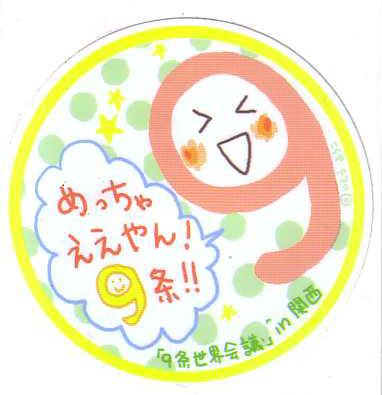
And they were insistent about Article 9 of their constitution, the constitution we gave them after WWII. Article 9 forbids the Japanese state from engaging in warfare. There was an exhibit about the article in the meeting area near the United Nations building and many Japanese were giving out decals and packages of facial tissue (a common promotional item in Japan) promoting Article 9. As you might have expected, there was also at least one Japanese in a Doraemon costume. Pop culture is pop culture, it’s everyone, and certainly at anti-nuke protests.

Article 9 Decal

I was there with The New York Path to Peace performing "Peace Now", a band of guerilla musicians dedicated to making music for good causes.


At one point a block’s worth of marchers were singing "Peace Now!" along with us. Of course we didn’t know it – we were told by one of the dozen or so people who hooked up with us along the way – because we were in the middle of the crowd playing our keesters off. The most gratifying moment, however, came when a Japanese group passed us (we were playing from the sidewalk at that point) singing “We Shall Overcome.”

We joined them. Of course.

That’s music.

* * * * *

Sunday, September 16, 2012

Celebrating the Future Independence of Vermont, at the Vermont Statehouse in Montpelier: Toward a Politics of Jubilee

I spent Friday, 14 September, in and around the Vermont Statehouse. Sometime back in the mists of time past some good Vermont citizens decided that, in the face of the cancerous growth of the American state, that Vermont folks of conscience and caring had to organize and urge their fellow Vermonters to secede from the Union. And so the Vermont Independence Party (VIP) was born.

Friday was their third state-wide convention, with visitors from several other states as well. This convention was organized toward the reading of The Montpelier Manifesto, listing 29 grievances against the Federal Government of the United States of America and urging secession. The conference was held in the House Chamber of the Vermont Statehouse, for it seems that, by law, Vermont citizens have the right to occupy use the statehouse when it is not otherwise in use.

I was there with the Northeast Irregulars, a contingent of the New York Path to Peace, organized by Charlie Keil. We brought musicians from Jersey City, New York City, Connecticut, and Vermont. At least.

Here's some photographs of that glorious day. I apologize to all those who were there but not in these photos.

* * * * *

IMGP0226rd

That's Charlie Keil on the right and Jack Lazarowski on the left. Jack and his wife Linda put Charlie and I up for the night. Thanks, Jack and Linda!

Tuesday, October 18, 2011

Come Together, Right NOW! Music on the March

Yeah, Dylan was cool. But today we have marchin’ music that would burn his protestin’ butt.

Last Saturday Salon published an article by Stephen Deusner on protest music: Will a new Dylan emerge from Occupy Wall Street? For better or worse it struck me as a bit of a lament for the Good Old Days when they had Good Old/New Protest songs, but, alas, kids today don’t write ‘em like they used to:
As Occupy Wall Street has gained momentum, it has been compared to the anti-war and civil rights protests of the 1960s by commentators as diverse as comedian Dick Gregory, Republican presidential candidate Herman Cain and scores of newspaper columnists. Yet, as Mangum’s performance demonstrates, they are very different in at least one regard, however minor: Music is not quite the central force today that it was 40 and 50 years ago, when a song like “We Shall Overcome” or “Fixin’ to Die Rag” could communicate certain motivating ideals and reinforce solidarity among a great throng of participants. Instead, it remains peripheral.
Things get moderated toward the end:
The lesson of the 2000s seems to be to approach politics obliquely instead of head-on, to make it one concern among many. If protest songs are largely absent from Occupy Wall Street, it’s not that they aren’t being written. It’s that they no longer serve the same purpose they once did — and are so spread out across genres and audiences that they don’t register as broadly as they once did. ...

On the other hand, protests inspire music, not vice versa. Perhaps the artists participating in or even just witnessing the Occupy Wall Street gatherings will be moved to write about their experiences. Perhaps the next great wave of radicalized pop is just a few months or years away.
Well, maybe.

People’s Music

But I have a somewhat different take on the whole business. Back in the day the most important music was the music sung in black churches, mostly traditional hymns and gospel. That’s the music that summoned, organized and energized the civil rights movement. The anti-war movement was a different group of people and, of course, a different issue, but it emerged in a public arena that had been activated by the civil rights movement.