Showing posts with label depression. Show all posts

Wednesday, June 4, 2025

Melancholy, Growth, and Mindcraft: A Working Paper

I've posted a new working paper to the web. Title above, links, abstract, table of contents, and introduction below.

Academia.edu: https://www.academia.edu/129757296/Melancholy_Growth_and_Mindcraft_A_Working_Paper
SSRN: https://papers.ssrn.com/sol3/papers.cfm?abstract_id=5282480
ResearchGate:  https://www.researchgate.net/publication/392400067_Melancholy_Growth_and_Mindcraft

Abstract: This document explores the relationship between melancholy, creativity, and mental growth through the lens of personal blogging patterns. The author, William Benzon, analyzes his 14-year blogging frequency data as a proxy for mood fluctuations, revealing periodic slumps initially attributed to Seasonal Affective Disorder. However, examining recent years shows patterns contradicting SAD, suggesting these cycles instead reflect periods of mental reorganization facilitating creativity. Drawing parallels to computational processes like code refactoring and neural network training, Benzon proposes that depressive episodes serve as adaptive "stepping back to better jump forward" phases. The author quantifies his intellectual growth by tracking blog tag proliferation (expanding at approximately 7% annually), representing cognitive differentiation. The document concludes by exploring broader implications for a society where technological acceleration necessitates continual mental retooling, advocating for new forms of "mindcraft" to navigate these transitions. This analysis connects personal experience with wider questions about depression, creativity, and adapting to an AI-driven future.

CONTENTS

Introduction: Tracking my mind across 14 years 3
More about Growth, Melancholy, and Mindcraft 3

The core argument 4
Clarifying the core 5
Where I was headed 6

Melancholy and Growth: Toward a Mindcraft for an Emerging World 7

My Posting Habits Over the Last Decade 8
Depression and Mental Growth 12
Measuring My Mental Growth 15
Some More General Observations: Mind and Brain 18
Conclusion: Crafting Minds 20
Appendix 1: Secondary features of my posting pattern 21
Appendix 2: New Savanna tags as of December 1, 2024 21
Coming out of a melancholy period [down phase] 24

Discussions with Claude 28

Neural maturation, cerebral plasticity, and the adaptive value of vacations 28
Depression and Creativity 33
From a tag collection to a digital companion and beyond 37

Introduction: Tracking my mind across 14 years

This working paper is a bit unusual. It is autobiographical in the sense that it is about events in my life as they have unfolded over time. It is, however, very abstract. The events are the posting of entries to my blog, New Savanna, and they are present in this document only as monthly totals depicted in several charts. The number of posts in a month is a clear indication of my overall mood for that month. The primary objective of this paper is thus to analyze and comment on that pattern, which seems to indicate yearly cycles of creativity and melancholy.

My secondary objective is to analyze the production of tags making blog entries and to take that production as a measure of mental growth. While both of these exercises are somewhat speculative, this is more speculative than the first.

About the sections of this working paper:

More about Growth, Melancholy, and Mindcraft: This both introduces the argument without all the analysis and commentary and clarifies the structure of the argument, separating it into two phases.

Melancholy and Growth: Toward a Mindcraft for an Emerging World: This is the main argument, presenting that basic data about posting frequency and then about annual increase in the number of tags. There is an appendix listing all of the tags as of December 1, 2024 (I’ve added more since then.)

Coming out of a melancholy period [down phase]: This documents my posting and sleeping patterns in October and November of 2024 and my sleeping patterns from November 2024 through the end of January 2025. When I’m coming out of a melancholy phase I tend to wake up during the night and do some work, whether simply cruising the web or writing and posting. During this most recent “awakening” I decided to make entries on my Facebook page to give notice that I was awake and working in the night.

Discussions with Claude: It is now my habit to consult with both Claude and ChatGPT on projects I’m working on. While some sessions are merely informational, others involve more intense working-through-ideas. This contains three such discussions: 1) neural maturation, 2) depression and creativity, and 3) the use of tag count as an index of mental growth

Thursday, April 10, 2025

I've just learned there's something called "high-functioning depression"

Kelsey Pelzer, 7 Signs of ‘High-Functioning Depression,’ According to a Columbia-Trained Psychiatrist, Parade, April 8, 2025.

“You don't seem depressed,” is a comment nobody with depression wants to hear. It doesn't change the reality of how you're feeling, and the skepticism doesn't offer any actual support. If anything, this type of statement might make you feel like something else is wrong with you or cause you to self-gaslight. However, you might be experiencing signs of high-functioning depression (HFD), according to a psychiatrist.

“Just because someone isn’t crying or sad doesn’t mean they aren’t struggling,” Dr. Judith Joseph, MD, MBA, tells Parade.

For example, “Anhedonia is a common symptom of HFD,” she continues. “It is a lack of pleasure in things that once brought you joy.”

Not enjoying something that you used to love might be easy to ignore or disregard. You're busy, after all! But it's worth paying attention to and flagging.

We live in a world where productivity is prized and staying busy can look like a successful life. However, even if things “look good” from the outside, if you're living out of an abundance of stress, your mental health is likely suffering.

The article goes on to list seven signs of HFD and explain how it differs from (ordinary?) depression. Here's a web-search on "High-Functioning" Depression

Frankly, the term seems a bit ‘hinky’ to me. What I think is that there’s something going on, but we don’t really know just what. Since it seems like some kind of depression, let’s slap a “depression” label on it and go with that. Perhaps we need to rethink the whole business.

Saturday, April 5, 2025

Using Machine Learning to Measure CEO Depression

Cheng, S.-Y. and Golshan, N.M. (2025), Silent Suffering: Using Machine Learning to Measure CEO Depression. Journal of Accounting Research, 63: 689-767. https://doi.org/10.1111/1475-679X.12590

Abstract: We introduce a novel measure of CEO depression by applying machine learning models that analyze vocal acoustic features from CEOs' conference call recordings. Our research was preregistered via the Journal of Accounting Research's registration-based editorial process. In this study, we validate this measure and examine associated factors. We find that greater firm risk is positively associated with CEO depression, whereas higher job demands are negatively associated with CEO depression. Female and older CEOs show a lower likelihood of depression. Using this novel measure, we then explore the relationship between CEO depression and career outcomes. Although we do not find any evidence that CEO depression is associated with CEO turnover, we find some evidence that turnover-performance sensitivity is higher among depressed CEOs. We also find limited evidence of higher compensation and higher pay-performance sensitivity for depressed CEOs. This study provides new insights into the relationship between CEO mental health and career outcomes.

H/t Tyler Cowen

I have an article in 3 Quarks Daily that has a different approach to depression:  Melancholy and Growth: Toward a Mindcraft for an Emerging World.

Monday, March 17, 2025

Connections between sexual activity, depression, and mortality

This video is based on information from the two studies below.

Chao Cao, Lin Yang, Tianlin Xu, Patricia A. Cavazos-Rehg, Qinran Liu, Daragh McDermott, Nicola Veronese, Thomas Waldhoer, Petre Cristian Ilie, Shahrokh F. Shariat, Lee Smith, Trends in Sexual Activity and Associations with All-Cause and Cause-Specific Mortality Among US Adults, The Journal of Sexual Medicine, Volume 17, Issue 10, October 2020, Pages 1903–1913, https://doi.org/10.1016/j.jsxm.2020.05.028

Abstract

Background: Sexual activity can be referred to as a health behavior and may also act as an indicator of health status.

Aim: To evaluate temporal trends in sexual activity and to examine associations of sexual activity with all-cause and cause-specific mortality risk.

Methods: We examined the trends and prevalence of sexual activity and association of sexual activity with all-cause and cause-specific mortality in a nationally representative sample using data from the US National Health and Nutrition Examination Survey from 2005 to 2016 and the National Health and Nutrition Examination Survey 2005-2014 Linked Mortality File (through December 31, 2015).

Outcomes: All-cause, cardiovascular disease, and cancer mortality.

Results: A total of 15,269 US adults (mean age, 39.1 years [standard error, 0.18 years]) were included in the trend analysis. In the 2015-2016 cycle, while 71.7% (95% CI, 67.7–75.7%) US adults aged 20-59 years engaged in sexual activity ≥ 12 times/year (monthly), only 36.1% (95% CI, 31.6–40.7%) of them engaged in sexual activity ≥ 52 times/year (weekly). Since the 2005–2006 cycle, the estimated prevalence of sexual activity, ≥52 times/year and ≥12 times/year, were both stable over time among overall and each age group (all P for trend >0.1). During a median follow-up of 5.7 years (range, 1–11 years) and 71,960 person-years of observation, among 12,598 participants with eligible information on mortality status, 228 deaths occurred, including 29 associated with cardiovascular disease and 62 associated with cancer. Overall, participants with higher sexual activity frequency were at a lower risk of all-cause death in a dose-response manner (P for trend = 0.020) during the follow-up period. In addition, the multivariable-adjusted hazard ratios for all-cause mortality, CVD mortality, cancer mortality, and other cause mortality among participants who had sex ≥52 times/year compared with those having sex 0–1 time/year were 0.51 (95% CI, 0.34 to 0.76), 0.79 (95% CI, 0.19 to 3.21), 0.31 (95% CI, 0.11 to 0.84), and 0.52 (95% CI, 0.28 to 0.96), respectively.

Clinical Implications: Sexual activity appears to be a health indicator of all-cause and cancer mortality in US middle-aged adults.

Strengths & Limitations: Clear strengths of the present study include the large representative sample of the noninstitutionalized US population as well as the identification of precise estimates in relation to sexual activity and mortality. However, because of the observational nature of the study design, causality could not be determined.

Conclusions: Sexual activity was found to be associated with a lower risk of mortality from all cause and cancer.

Banerjee S, Anderson P, Davis WS. Connection Between Depression, Sexual Frequency, and All-cause Mortality: Findings from a Nationally Representative Study. Journal of Psychosexual Health. 2024;6(1):35-44. doi:10.1177/26318318241256455

Abstract:

We used the 2005–2010 National Health and Nutrition Examination Survey (NHANES), constructed to evaluate health of adults in the United States using consolidated data from interviews and physical exams that were conducted to obtain data for this study. The analysis sample was representative of noninstitutionalized US adults aged 20–59 years. When considering sexual frequency, overall, only female participants with lower sexual frequency were at a higher risk of all-cause death in a dose-response manner with a hazard ratio (HR) of 1.70 (95% CI 1.38–2.10, p trend < .001) during the follow-up period. This relationship was not significant in males. However, when sexual frequency was categorized (<52 times/year vs. ≥52 times/year), the adjusted HR was elevated [2.97 (CI 1.20–7.32, p = .02)] among individuals who had depression and low sexual frequency, but it was close to 1.0 (1.75, CI 0.50–6.07, p = .36) among individuals who had depression and high sexual frequency after adjusting for medical (obesity) and demographic (age, gender, education, and ethnicity) risk factors, indicating a 197% increase in mortality among individuals with low sexual frequency and depression than depression alone. Sexual activity is important for overall cardiovascular health possibly due to reduction of heart rate variability and blood flow increase.

Friday, December 13, 2024

Depression and Grief [Claude]

I think that understanding the relationship between depression and grief is particularly important for my current investigation of depression – which, BTW, I am provisionally calling The Melancholy Project. Why is this particularly important? Because, on the one hand, grief is something we all go through more than once in life. It is necessary. But it doesn’t always tip over into depression. We need to understand why and how that happens.

Why is grief necessary? We grieve for people whom we’ve lost – though not necessarily only people. These are people with whom we’ve had a strong personal relationship. That relationship is necessarily mediated by widely-distributed neural connections. The “valence,” if you will, of those connections has to be altered.

If human memory was organized like computer memory, that would be a relatively easy process. For computer memory can organize items in discrete blocks. If Mother has died, you just access the block for Mother and change its contents. Since, however, human memory is not like that, but widely distributed over many neurons and synapses, changing them is much more difficult.

Anyhow, I consulted Claude (3.5 Sonnet) to gather some background information. While I was at it I probably should have quizzed it about different groups and societies handle grief. I can do that later. While I have not made any attempt to verify this information in the technical literature, it is consistent what I know. As always, my prompts are set in boldface while Claude’s responses are plain.

* * * * *

What do we know about the relationship between depression and grief?

The relationship between depression and grief is complex and clinically significant. While both are emotional responses to loss, they have important distinctions in their characteristics, progression, and treatment approaches.

Grief is a natural response to loss that typically follows a progression through various emotional stages. These emotions can include denial, anger, bargaining, depression, and acceptance. During grief, individuals often maintain their sense of self-worth and can experience positive emotions alongside their sadness, particularly when remembering their loved one.

Clinical depression, in contrast, is a mental health condition characterized by persistent feelings of hopelessness, diminished self-worth, and a reduced capacity to experience pleasure. Unlike grief, which tends to come in waves and gradually evolves, depression typically manifests as a more constant state of emotional distress that can persist regardless of circumstances.

These conditions can intersect in several ways. Prolonged or complicated grief can develop into clinical depression, particularly when the grieving person lacks adequate support systems or has a history of mental health challenges. Research indicates that approximately 40% of bereaved individuals meet the criteria for major depression one month after their loss, though this percentage typically decreases over time.

Healthcare providers must carefully differentiate between normal grief and clinical depression when determining appropriate interventions. While grief typically benefits from supportive counseling and time, clinical depression often requires professional treatment, which may include psychotherapy, medication, or a combination of both.

What makes this distinction particularly challenging is that grief and depression share several symptoms, including sleep disturbances, appetite changes, and difficulty concentrating. However, grief tends to maintain a connection to the specific loss, while depression affects multiple aspects of a person's life more pervasively.

Wednesday, December 11, 2024

Claude 3.5 on the causes of depression and SAD

More background material for my Melancholy Project. Notice the variety of causal factors involved in depression. As always, read this information with caution. I've not checked it, but it does seem reasonable enough.

Tell me about the causes of depression.

Depression is a complex mental health condition that typically develops through a combination of different factors working together. Key factors that can contribute to depression include:

Biological factors:

Brain chemistry and structure play important roles. Differences in neurotransmitters like serotonin, norepinephrine, and dopamine can affect mood regulation. Some people may have genetic variations that increase their vulnerability.

Life experiences:

Difficult or traumatic events can trigger depression, such as losing a loved one, experiencing abuse, going through a breakup, or facing major life changes. Chronic stress, whether from work, relationships, or other sources, can also contribute.

Social circumstances:

Isolation, loneliness, and lack of social support can increase risk. Financial hardship, unemployment, and housing instability can create chronic stress that contributes to depression.

Medical conditions:

Certain illnesses like thyroid disorders, chronic pain conditions, or other health issues can increase depression risk. Some medications may also have depression as a side effect.

Early life experiences:

Childhood trauma, neglect, or unstable attachment relationships can affect brain development and increase vulnerability to depression later in life.

Importantly, depression is highly treatable through various approaches, including therapy, medication when appropriate, lifestyle changes, and social support. If you or someone you know is experiencing depression, speaking with a mental health professional can help identify personal contributing factors and develop an effective treatment plan.

Would you like to discuss any particular aspect of depression's causes in more detail?

What about seasonal affective disorder?

Seasonal Affective Disorder (SAD) is a type of depression that follows a seasonal pattern, typically occurring during winter months when daylight hours are shorter. Here's what we know about it:

Thursday, December 5, 2024

Coming out of a melancholy period [down phase]

I’m want to continue investigating my blogging pattern as I’ve discussed it in my recent 3 Quarks Daily article, Melancholy and Growth: Toward a Mindcraft for an Emerging World. This time I want to my daily activity for October and November.

This chart shows my daily posting activity during October and November. It’s been sparse during October, with many days where I didn’t post at all.

I had 30 posts in October, 15 in September, 18 in August, and 61 in July. So, I started going down in July, hit bottom in August and September, and started back up in November. Starting on the 15th I’ve posted every day – and I’m continuing to post daily in December.

That’s not all. I’ve gotten relatively little sleep for the last few days. I’d wake up during the night, start thinking, and then go to the computer and look around, maybe even write some stuff and do a post or two. Then I’d go back to bed. Maybe I’d sleep, but maybe I’d just lie in bed and think, sometimes on my back, which is not generally how I sleep.

[Note, by the way, that the practice of sleeping straight through the night is a cultural convention, not a biological necessity or preference. It’s called “segmented sleep.” I’ve got a number of posts about it.]

There’s more. During some of those night sessions I’d make a post on Facebook indicating I was awake. This started on November 22, where I posted a Dunkin’ Donuts commercial from the 1980s. This is one of those commercials featuring an owner of a Dunkin’ Donuts who awakens in the early morning, uttering “Time to make the donuts.” Here’s a list of those posts: first the time, then the date, and then the content of the post.

3:37 AM 11.22.24 – [Post a Dunkin’ Donuts TV commercial]
2:07 AM 11.24.24 – Again, I'm waking up in the middle of the night and thinking. What's next? Writing?
3:24 AM 11.24.24 – I’ve thought. Now back to sleep.
4:35 AM 11.24.24 – Back at it. More thinking.
11:31 AM 11.24.24 – I’ve spent the last two hours immersed in a remarkable line of thought. More later.
11:37 PM 11.25.24 – It’s been a productive day.

4:18 AM 12.1.24 – Awake in the middle of the night. Good thoughts. All’s well.
3:22 AM 12.2.24 – Middle of the night. Awake. Good thoughts.
4:02 AM 12.3.24 – 4:02 AM Tue 12.3.24 [I simply noted the time]
4:30 AM 12.4.24 – Just another marker.

Note that I’ve highlighted two of them. The content of the posts is like that of the other posts, but the first one went up late in the morning while the second went up late at night, after my normal bed time.I believe that first post, on the 25th, is when I began thinking about the implications for splintered career paths as AI becomes more deeply embedded in society.

The thoughts and ideas I have been having during this period are new and different. In particular this is the period where I decided, first, to write a 3QD article about my blogging habits, and second, to actually write the article. That article is a substantially new kind of intellectual activity for me.

If, as I’ve argued in my 3QD piece, those down-times are for the kind of mental reorganization that precedes a creative phase, one would expect new things to emerge [tumble out] at the start of an up-cycle.

Has this happened at the beginning of every up-cycle back to 2010, when I started blogging? I don’t know. I’ve not been keeping those kinds of records. I could go through the blog and take note of the content of every post to determine whether or not new stuff shows up immediately after every down cycle. That would take time, but I’m not going to do it now. I’ve got other things to do.

But looking at my blog posts won’t tell me anything about changes in my daily routine of the kind I’ve reported above. But I have been through this kind of thing before. It’s not new to me. It will slow down – it already is – it always does. And there are other night-notices scattered in Facebook, going a few years back. But I’m not going to look for them now.

Things to do.

More later.

Thursday, November 28, 2024

Depression and Creativity

I’m working on an article about depression and decided to ask about the connection between depression and creativity. Claude makes a few general remarks and asks for my thoughts. So I mention some remarks that my teacher, David Hays, had made years ago about his own creativity, suggesting that a down period was necessary for the conceptual reorganization required by creativity. I also mentioned that he was a computational linguist. After some general remarks, Claude asks:

... did Hays develop this idea through his work in computational linguistics? It seems like there might be interesting parallels between how computer systems need to reorganize data structures and how human minds might need to reorganize mental frameworks.

Interesting, most interesting. Our ensuing interaction felt a bit like a real conversation. I was surprised and pleased. This felt a bit like, you know, real intelligence. But don't take any of it as ground truth. It's high class chit-chat.

I’ve appended its remarks below. I’m using my standard convention, setting my words in bold Courier and Claude’s reply in plain Courier.

Version: Claude 3.5 Sonnet

* * * * *

Is there evidence for a relationship between depression and creativity?

The relationship between depression and creativity is complex and has been studied extensively. The research shows several interesting patterns:

Historical observations have noted many renowned artists, writers, and musicians who experienced depression, like Virginia Woolf, Vincent van Gogh, and Sylvia Plath. However, we should be careful not to romanticize mental illness or assume correlation equals causation.

Scientific studies have found some evidence for links between depression and certain aspects of creativity:

Some research suggests that people with mood disorders may experience enhanced divergent thinking during certain phases, allowing them to generate more unique associations and ideas. The changes in emotional processing and perspective that can come with depression might contribute to seeing things in new ways or having deeper emotional insights.

However, severe depression typically impairs cognitive function and motivation, which can significantly reduce creative output. Many artists report that while their experiences with depression may inform their work, the actual creative process usually happens during periods of better mental health.

A key factor seems to be that creative pursuits can serve as a coping mechanism and form of emotional expression for people experiencing depression. The relationship may also be bidirectional - creative personalities might be more prone to rumination and emotional sensitivity.

What are your thoughts on this relationship between mental health and creativity? Have you observed any patterns in your own creative process?

That’s tricky. A teacher of mine, the computational linguist David Hays, thought that depression might indicate a process of mental reorganization that precedes a period of creativity. It’s as though you get stuck on a line of thought and have to undergo something like mental hibernation. During that “hibernation” the mind reorganizes.

That's a fascinating perspective from David Hays. His idea of depression as a period of mental reorganization or "hibernation" adds an interesting cognitive dimension to the discussion. It aligns with some modern theories about the potential adaptive functions of depression, particularly the "analytical rumination hypothesis" proposed by evolutionary psychologists.

This hypothesis suggests that depression's characteristic features - social withdrawal, reduced activity, and intense focus on problems - might serve to create mental space for working through complex problems or restructuring one's understanding. The "stuck" feeling you mentioned could represent this deep processing phase.

The metaphor of hibernation is particularly apt because it suggests both:

1. A necessary withdrawal or dormancy period
2. An underlying productive process that sets the stage for future growth

I'm curious - did Hays develop this idea through his work in computational linguistics? It seems like there might be interesting parallels between how computer systems need to reorganize data structures and how human minds might need to reorganize mental frameworks. His background in computational thinking might have given him unique insights into cognitive restructuring processes.

I think Hays primarily developed the idea from observing his own creative process. But he might also have been thinking about computers. Your remark about reorganizing data structures is suggestive. I know one thing that programmers do is refactor their code. That’s a specific kind of reorganization so it is more coherently organized.

The parallel between mental reorganization and code refactoring is quite illuminating. In refactoring, you don't change what the code does (its external behavior), but you restructure its internal organization to make it clearer, more efficient, or more maintainable. This often involves recognizing patterns that weren't obvious in the original implementation and finding a better way to express them.

This maps interestingly onto Hays's idea about depression and creativity. Just as a programmer might hit a point where the code has become too unwieldy and needs refactoring, a person might reach a point where their current mental models or ways of thinking have become inadequate for handling their experiences or insights. The depressive period could be like the uncomfortable but necessary process of pulling apart the existing structure to create something more robust.

Sunday, November 24, 2024

Depression is on the rise

I’m preparing an article on depression and want to say a few words about rising rates of depression. I decided to ask Claude about it. Note its remarks about long-term historical trends, Robert Burton's The Anatomy of Melancholy, and about the “melancholy Dane” (Hamlet). I’ve not attempted to verify any of this, but it looks reasonable to me. It’s certainly a reasonable starting point for a serious look through the archives; here are some posts about depression at New Savanna. I did read large chunks of Burton’s remarkable book while in graduate school.

I’ve appended its remarks below. I’m using my standard convention, setting my words in bold Courier and Claude’s reply in plain Courier.

Version: Claude 3.5 Sonnet

* * * * *

Is there any evidence that depression has been increasing in the US in the last couple of decades?

Yes, there is evidence of increasing depression rates in the US over recent decades, with several notable trends: Data from major studies shows rising prevalence, particularly among certain groups:

The National Survey on Drug Use and Health found the percentage of adults experiencing a major depressive episode increased from 6.6% in 2005 to 8.4% in 2020, with particularly sharp increases among young adults aged 18-25.

Youth depression has shown especially concerning trends. The CDC reported that the percentage of high school students experiencing persistent feelings of sadness or hopelessness increased from 26% in 2009 to 37% in 2019.

Some demographic patterns in the increases include:

  • Higher rates among women compared to men
  • Particularly sharp rises among adolescents and young adults
  • Greater increases among people with lower incomes and education levels
  • Notable increases across racial and ethnic groups, though with some variations

Several potential contributing factors have been identified:

  1. Increased social media use and screen time
  2. Economic pressures and inequality
  3. Changes in sleep patterns and physical activity
  4. Decreased in-person social connection
  5. Greater awareness and willingness to report symptoms

It’s worth noting that some of the reported increase may also reflect improved recognition and diagnosis of depression, as well as reduced stigma around mental health that leads more people to seek help and report symptoms. However, researchers generally agree there has been a real increase in depression beyond just better detection.

Would you like me to elaborate on any particular aspect of these trends or their potential causes?

Wednesday, June 26, 2024

What we got wrong about depression and its treatment

Steven D. Hollon, What we got wrong about depression and its treatment, Behaviour Research and Therapy, Volume 180, 2024, 104599, ISSN 0005-7967, https://doi.org/10.1016/j.brat.2024.104599.

Highlights

  • Depression is neither disease nor disorder rather an adaptation that evolved to serve a purpose.
  • Depression is so much more prevalent than currently recognized that it is “species typical”.
  • Antidepressants may suppress symptoms in a manner that increases risk for subsequent relapse.
  • Cognitive therapy works by making rumination more efficient and “unsticking” self-blame.
  • Adding antidepressants may interfere with any enduring effect that cognitive therapy may have.

Abstract: The paradigm is shifting with respect to how we think about depression and its treatment. Some of that shift can be attributed to new findings with respect to its epidemiology and genetics and the rest can be attributed to the incorporation of a new perspective derived from evolutionary theory. In brief, depression is far more prevalent than previously recognized with the bulk of additional cases involving individuals who do not go on to become recurrent. Nonpsychotic unipolar depression (but not bipolar mania which likely is a “true” disease) appears to be an adaptation that evolved to facilitate rumination in the service of resolving complex social problems in our ancestral past. Cognitive behavior therapy appears to structure that rumination so that patients at elevated risk for recurrence do not get “stuck” blaming themselves for their misfortunes, whereas antidepressant medications may suppress symptoms at the expense of prolonging the underlying episode such that patients remain at elevated risk for relapse whenever they try to discontinue. This means that patients not otherwise at risk for recurrence may be put on medications that they do not need and kept on them indefinitely whether they need to be or not.

Thursday, January 4, 2024

Update: My mood over the long term [intellectual productivity]

As you may know, I use my posting pattern as a gauge of my overall long-term mood. The better my mood, the more I post in a month. I’ve written about this a number of times, most recently in mid-September of this year, New Savanna Moods: I was down, but I’ve started back up. The trend I reported in that post has continued through the end of the year, with a total of 112 posts in September, 120 in October, 132 in November, and 111 for December. Here’s how things look for the last three years:

And here’s how things look over the life of New Savanna, starting back in June 2010:

The overall trend is up. Last year (2023) is my highest annual total: 1004. Then we have 2019 (912) followed by 2018 (871).

I should note, however, that prior to September of 2018 I had not been posting tweets to New Savanna, though I joined Twitter in October of 2011. In terms of psychic energy, tweet posts are cheap posts, so I tend to think that some of the increase since has to be discounted in the sense that the increase doesn’t reflect my mood, rather it reflects ease of posting.

See also, A Mind Over the Long Haul: My Posting Patterns For that matter, take a look at this while you're at it, What is depression? [an umbrella term]..

Tuesday, January 2, 2024

What is depression? [an umbrella term]

Joanna Thompson, The Cause of Depression Is Probably Not What You Think, Quanta Magazine, Jan. 26, 2023.

Thompson opens by discussing a recent literature review that cast strong doubt on the idea that depression is the result of serotonin deficiency. She then moves through other chemical theories, to genetics, neural wiring, and inflammation, ending up with:

Increasingly, some scientists are pushing to reframe “depression” as an umbrella term for a suite of related conditions, much as oncologists now think of “cancer” as referring to a legion of distinct but similar malignancies. And just as each cancer needs to be prevented or treated in ways relevant to its origin, treatments for depression may need to be tailored to the individual.

If there are different types of depression, they may present similar symptoms — such as fatigue, apathy, appetite changes, suicidal thoughts, and insomnia or oversleeping — but they might emerge from completely different mixes of environmental and biological factors. Chemical imbalances, genes, brain structure and inflammation could all play a role to varying degrees. “In five or 10 years, we won’t be talking about depression as a unitary thing,” Sen said.

To treat depression effectively, medical researchers may therefore need to develop a nuanced understanding of the ways it can arise. Nemeroff expects that someday the gold standard for care won’t be just one treatment — it will be a set of diagnostic tools that can determine the best therapeutic approach to an individual patient’s depression, be it cognitive behavioral therapy, lifestyle changes, neuromodulation, avoiding genetic triggers, talk therapy, medication or some combination thereof.

Sounds like we're getting somewhere, at last.

Thursday, August 26, 2021

The devastating effects of trauma [and the return of Freud, albeit unnamed?]

Ezra Klein, This Conversation Will Change How You Think About Trauma, NYTimes, Aug 24, 2021.

Klein interviews Bessel van der Kolk about his book, The Body Keeps the Score (2014). I've not yet read the interview, but Klein's introduction makes the book sound very Freudian without mentioning that (dreaded) name.

I’ll be honest of my own history of it here. “The Body Keeps the Score” is one of those books people have told me to read for a long time. But I thought I knew what it was about. I’d heard it discussed so many times, and I’d read it written about. So even though I hadn’t read it, I thought I knew it: trauma lodges in the body, we carry a physical imprint of our psychic wounds, it’s all very hard to heal. Got it.

But I was really wrong about that. The core argument is — I want to use the word “subversive” here. Certainly subversive in how it will leave you thinking about yourself and those around you. It is about traumatic experiences: sexual assault, incest, emotional physical abuse, war and much, much more. They can disconnect our body and our mind. That is when an experience becomes a trauma — when it disconnects us.

And this is a part I didn’t understand from the way the book is talked about. The devastating argument it makes is not that the body keeps the score, it’s that the mind hides the score from us. The mind — it hides and warps these traumatic events and our narratives about them in an effort to protect us. Human beings are social animals. And our minds evolve to manage our social relationships.

So when we face an event that could rupture our relationship with the community or the family, particularly for children of the family that we depend on, the mind often talks us out of it. It obscures the memories or convinces us our victimization was our fault or it covers the event in a shame so thick, we refuse to discuss it. But our body — and that’s an imprecise term here. But the parts of us that are more automatic that manage and respond to threat — our body doesn’t forget that. Our mind can’t talk that part of us into feeling safe again. And it’s this disconnection of mind and body where trauma lives.

From the beginning of the interview:

EZRA KLEIN: You have this very powerful line in the book from the writer Jessica Stern where she says, quote, “Some people’s lives seem to flow in a narrative. Mine had many stops and starts. That’s what trauma does — it interrupts the plot.” Tell me a bit about how trauma interrupts the plot.

BESSEL VAN DER KOLK: Well, trauma is really a wound that happens to your psyche, to your mind, to your brain. Suddenly you’re confronted with something that you are faced with horror and helplessness. That nothing prepares you for this and you go like, oh, my God. And so something switches off at that point in your mind and your brain. And the nature of trauma is that you get stuck there. So instead of remembering something unpleasant, you keep reliving something very unpleasant.

So the job of overcoming trauma is to make it into a memory where your whole being knows this happened a long time ago, it’s not happening right now. But the nature of traumatic stress is that you keep reacting emotionally and physiologically as if these events are happening right now.

More later, possibly.

Later:

EZRA KLEIN: Tell me a bit about the conditions under which an event that could be traumatic becomes a trauma. And in particular, I was very struck by how much of your research suggests that trauma is an event plus a kind of instigated social crisis. There are objectively catastrophic events, like 9/11, that were less likely to cause trauma because they were shared by the community. Where, on the other hand, things like child sexual abuse is very reliably traumatic because it disconnects you from your family. So could you talk a bit about the social structure of trauma?

BESSEL VAN DER KOLK: Yeah. So what we tend to leave out of most of our discussions about human functioning is to what degree we are primates. We have brains in order to get along with each other, to be with other people, to connect with other people. That’s really what we are fundamentally all about. And so, much of trauma is about a rupture of the safety of the people who are supposed to protect you and the people who are supposed to come to your help.

So basically, the way that we are wired is that we are wired to not be able to do everything by ourselves, but to be able to look for help and for other people to take over when we can no longer do the job ourselves. And that’s perfectly normal. But if, at that point, the people you can count on most are not there for you, let you down, have been killed, or whatever, then it’s entirely up to you. It’s a much harder thing to deal with terrible situations. [...]

And sometimes, in order to survive, you need to keep your realities [INAUDIBLE] the people around you. And so when you go through a terrible reality like 9/11 in New York or terrible natural disasters, oftentimes people get very close together because it’s out there, everybody can see it, people help each other. Part of our nature is to be altruistic and to be generous when people are in distress.

But if your feelings conflict with your loyalty — let’s say, if your own mom or dad beat you up and you don’t feel safe with them — you cannot tell other people about it either because you’re supposed to love your mom or dad. And so you need to keep it to yourself. And then it starts festering inside of you. So the reason why you do psychotherapy is mainly to help people to find words for the reality that they have dealt with. And oftentimes, those are realities that are not acceptable for the people around you. [...]

So the issue there is that we need our parents or caregivers to take care of us. And so the moment we give up on our caregivers as little kids, we’re done for. And so the way the child is wired is to stay as close to the people who are supposed to take care of them as possible. And with that, they will deny the reality of being beaten. Or the imprint is very much like, I’m being beaten or I’m being molested because I’m a bad person. I must deserve it.

So your identity becomes basically, I’m fundamentally a bad and flawed human being. And if I had been a nicer child, people would have loved me and taken care of me.

A bit later Van Der Kolk mentions John Bowlby, who was trained as a psychoanalyst:

But the great hero here is John Bowlby, attachment researcher, who really showed how children really need to cling to their caregivers and will do anything they can to keep a semblance of connection going so they don’t die or get totally abandoned. And the price they pay for that is very much this very profound sense of self loathing, oftentimes despising yourself, getting into a lot of difficult behaviors because I’m no good anyway. And it’s a deep sense of, I may as well put myself in danger, I may as well take drugs because I’m no good anyway.

Therapy:

EZRA KLEIN: We’re going to go through a bunch of these therapies. But one thing I want to ask about them as a group is that one thing lurking around your book, and certainly that I felt reading it and that I felt in my own life as I’ve looked at various modalities for things that I’ve struggled with, is that there’s a hierarchy of status to different treatments. So it’s very accepted at this point, very rational, to take a pill for depression or anxiety. Talk therapy has a very long history. Nobody looks askance at that. That’s something intellectuals do in New York, and they sit in a chair and talk about feelings. And I don’t want to say anything bad about either of those. But then you start looking some of these other things, like E.M.D.R. which we can talk about, or dance therapy or yoga. And it feels soft. You’re like, well, that’s silly, that’s holistic, that’s — and something I think the book is trying to get at is that maybe we have come to overweight certain kinds of approaches to how we feel and underweight others. So before we get into how these therapies work, can you talk about that meta level of coming to respect therapies that maybe don’t have a lot of social status right now?

BESSEL VAN DER KOLK: Very important point you make. It’s a cultural issue. You hear from my accent, I’m northern European, and North America is still very northern European. The world and northern Europe developed two ways of dealing with bad stuff. One of them was to drink. And so taking a pill is a respectable thing in Western culture to do, and normal people ingest stuff to make themselves feel better.

Nobody feels bad about it. Other places in the world may say, that’s weird. Then the other thing that Western people are very good at is talking. We’re not very good in singing together and moving together. You go to China after a disaster and people are doing qigong together, and so that’s interesting, or tai chi.

And you go to Brazil in [INAUDIBLE] area, and you see people practice capoeira. You go, are they practicing capoeria because it looks good to the tourists, or are they practicing capoeira because it does something to the way they relate to their bodies and their sense of self-control?

So I think to some degree, we are trapped in this post- alcoholic paradigm that the only way to change is through taking pills or by talking. But of course, once you raise kids and you hang around with kindergarten teachers, they don’t do a lot of talking. They’d also do a lot of singing together, and a lot of moving together, and a lot of tossing balls together. And a lot of things that help you get in tune and in rhythm with each other.

And that’s not really the strong point of Western culture. So it all depends on the cultural assumptions you have about what’s helpful to people.

EZRA KLEIN: This part of the book made an interesting connection for me. I had the journalist Anna Sale on the show a couple of months ago for her book about having difficult conversations, and something she says in that book is that we used to have more institutions, and rituals, and conventions, and structures that guided us through the hard conversations, and hard parts of life.

I mean, things like churches and civic organizations. There is a lot of singing in those places, there is a lot of dancing in those places. I mean, you go to a Jewish synagogue, a lot of singing and dancing. And one point she was making is that as some of these institutions have faded in American life, we’ve been left without a template for these conversations.

But reading your book made me think of it on another level, too. I mean, a bunch of the modalities you just talked about, like capoeira or qigong, I don’t want to suggest they don’t have therapeutic roles, but they’re not primarily seen as therapeutic. They’re just a bigger part of those cultures.

And I wonder if you think that one of the issues with trauma in America is that we have lost institutions that were comfortable with ways of being embodied, even if they didn’t frame them in a “the body keeps the score” kind of framework that we used to have. And so they were playing roles that maybe they framed themselves as religious, or civic, or something else, or communal or ritual, but they were also doing things for how we process difficult issues or allowed us to get in touch with our emotions, that they had these side benefits that we didn’t understand and never knew how to measure.

Saturday, July 31, 2021

What happens when you achieve a goal you’ve pursued for over 20 years? Crash, that’s what happens.

David Epstein talks with champion bobsledder, Steve Mesler.

Five or so years ago, Steve stayed with me while he was in town for work. I took him, and his gold medal, to meet the sports-crazy seven-year-old twin boys who lived next door. Everyone took a turn trying on the medal. When the boys’ father got his turn, he draped the saucer-sized medal over his neck, turned to Steve, and asked: “So, when you got this, was it just like, everything for the rest of your life is fine?” It was a compliment about Steve’s achievement, but also betrayed the gap between perception and reality when it comes to the lives of Olympians.

“If you would have asked me that question before I won gold,” Steve told me, “I would have said, ‘Yes, I’ll be good for the rest of my life.’ Bobsled was my identity, and that was everything that I wanted.” But over the next few years, Steve would struggle with building a new identity. He would also bury two teammates, both of whom struggled with mental health issues, and he would recognize and get help for his own depression.

Mesler talks of “Speedy” Peterson:

I remember watching Speedy win the Olympic medal that he’d strove for, and wanted for his whole career. He’d been through his ups and downs, and in February of 2010, he wins his silver medal. In July of 2011, he phones the police and lets them know where they can find his body. And he walks out into the woods in the mountains with a shotgun and…. So, you know, here’s Speedy in 2010, winning a medal, and a year later he’s dead. Speedy had that joyful side, and he also had a darker side. You know, our experiences were pretty similar in that we both reached our goals.

There’s sport and there’s the rest of your life:

I’m starting to talk to other athletes about, you know, some of the behaviors that you have are good for your sport, but not good for other parts of your life. And ultimately, I’m starting to recognize that it’s almost like you’ve got to go through the stages of grief, because you’re experiencing loss even when you win. Because I had this thing in my life, this pursuit of being the best in the world. I had these people in my life who are all going after the same thing, and then we accomplished it, which is fantastic. But nothing replaces that journey and camaraderie. That part of me is gone now. Whether it’s a win or a loss, the outcome is only a moment in time. February 27, 2010, that was the day I won a gold medal, but from June 1990 until February 2010 was the pursuit. And so you tell me which one you think is going to be easier to get over, the thing that happened in one day, whether you won or lost, or the thing that was 20 years?

H/t Tyler Cowen.

Wednesday, March 17, 2021

Depression, Spirituality, and Jerry Seinfeld

On the first day of this year I had a post about Jerry Seinfeld at at 3 Quarks Daily:

  Seinfeld On His Craft, Or: Comedy As A Path To Metaphysical Grace.

That post is based on this podcast with Tim Ferriss:

There’s some discussion of depression at c. 51:05:

A lot of my life is, I don’t like getting depressed, I get depressed a lot, I have the feeling, and these routines, these very difficult routines, whether its exercise or writing, and both of them are things like where it’s brutal....[on to his daughter]...

Later at 54:16, after Ferriss talked about his own depressive episodes:

Ferriss: Is there anything else that has contributed to your ability to either stave off or mitigate depressive episodes or manage?

Seinfeld: No. I still get them. The best thing I ever heard about it was that it’s part of a kit that comes with a creative aspect to the brain, that a tendency to depression always seems to accompany that. And I read that like 20 years ago and that really made me happy. So I realized well I wouldn’t have all this other good stuff without, that that just comes in the kit.

Seinfeld goes on to observe that he doesn’t know a human that doesn’t have the tendency, though he’s sure it varies.

He also discussed spirituality with Mark Maron. Starting at about 59:58, Maron asks him if he’s a “spiritual guy”, “yes,” though

JS: Not in any conventional terms...

MM: ... How do you define that? If you have a full spiritual life that you’re comfortable in your heart that enables you to not seek that type of satisfaction from comedy, what do you do?

JS: Well, comedy’s very spiritually satisfying. You’re risking your own personal comfort to make total stranger happy, make them feel good, for just a moment.

MM: Right.

JS: That’s a spiritual act.

MM: Okay. And what else do you do?

JS: I try and be good to people, all the time, you know, with strangers, when I’m driving.

MM: Yeah.

JS: I try and, I’m always trying to be generous to people.

MM: And do you have a practice of any kind?

JS: No.

MM: No religion thing that you do.

JS: No. I mean I’m Jewish and we celebrate some of the big ones, you know.

And then into his brush with Scientology. He took one course when he was in New York in 1975. It gave him an emphasis on ethical behavior.

Tuesday, August 25, 2020

Perhaps these conditions aren't mental disorders at all (anxiety, depression, PTSD)

What if mental disorders like anxiety, depression or post-traumatic stress disorder aren’t mental disorders at all? In a compelling new paper, biological anthropologists call on the scientific community to rethink mental illness. With a thorough review of the evidence, they show good reasons to think of depression or PTSD as responses to adversity rather than chemical imbalances. And ADHD could be a way of functioning that evolved in an ancestral environment, but doesn’t match the way we live today.

Adaptive responses to adversity 
Mental disorders are routinely treated by medication under the medical model. So why are the anthropologists who wrote this study claiming that these disorders might not be medical at all? They point to a few key points. First, that medical science has never been able to prove that anxiety, depression or post-traumatic stress disorder (PTSD) are inherited conditions.

Second, the study authors note that despite widespread and increasing use of antidepressants, rates of anxiety and depression do not seem to be improving. From 1990-2010 the global prevalence of major depressive disorder and anxiety disorders held at 4.4% and 4%. At the same time, evidence has continued to show that antidepressants perform no better than placebo.

Third, worldwide rates of these disorders remain stable at 1 in 14 people. Yet “in conflict‐affected countries, an estimated one in five people suffers from depression, PTSD, anxiety disorders, and other disorders,” they write.

Taken together, the authors posit that anxiety, depression and PTSD may be adaptive responses to adversity. “Defense systems are adaptations that reliably activate in fitness‐threatening situations in order to minimize fitness loss,” they write. It’s not hard to see how that could be true for anxiety; worry helps us avoid danger. But how can that be true for depression? They argue that the “psychic pain” of depression helps us “focus attention on adverse events... so as to mitigate the current adversity and avoid future such adversities.”

If that sounds unlikely, then consider that neuroscientists have increasingly mapped these three disorders to branches of the threat detection system. Anxiety may be due to chronic activation of the fight or flight system. PTSD may occur when trauma triggers the freeze response which helps animals disconnect from pain before they die, and depression may be a chronic activation of that same freeze response.
The article linked in the first paragraph: Kristen L. Syme, Edward H. Hagen, Mental health is biological health: Why tackling “diseases of the mind” is an imperative for biological anthropology in the 21st century, Yearbook Phys Anthropol. 2020;171 (Suppl. 70):87–117, https://doi.org/10.1002/ajpa.23965
Abstract: The germ theory of disease and the attendant public health initiatives, including sanitation, vaccination, and antibiotic treatment, led to dramatic increases in global life expectancy. As the prevalence of infectious disease declines, mental disorders are emerging as major contributors to the global burden of disease. Scientists understand little about the etiology of mental disorders, however, and many of the most popular psychopharmacological treatments, such as antidepressants and antipsychotics, have only moderate‐to‐weak efficacy in treating symptoms and fail to target biological systems that correspond to discrete psychiatric syndromes. Consequently, despite dramatic increases in the treatment of some mental disorders, there has been no decrease in the prevalence of most mental disorders since accurate record keeping began. Many researchers and theorists are therefore endeavoring to rethink psychiatry from the ground‐up. Anthropology, especially biological anthropology, can offer critical theoretical and empirical insights to combat mental illness globally. Biological anthropologists are unique in that we take a panhuman approach to human health and behavior and are trained to address each of Tinbergen's four levels of analysis as well as culture. The field is thus exceptionally well‐situated to help resolve the mysteries of mental illness by integrating biological, evolutionary, and sociocultural perspectives.
FWIW, this line of thought is consistent with my sense of why I enter a melancholy phase at the beginning of the year. Here's three paragraphs from a post where I talk about that:
I do think my mood follows my productivity, or vice versa, and that’s what’s interesting. David Hays once conjectured that melancholy (aka depression) is the price you pay for large-scale reorganization or the sort implied by creativity. “Reorganization” is a term of art from William Powers’s account of the mind. It is so deeply embedded in that theory that there is, alas, no easy gloss.

Start out by thinking of learning. When you learn, your mind is also reorganizing on a large scale. Now think of mourning as well. When you mourn the loss of someone close you have to reorganize your mind for life without them. You don’t actually learn anything, but you have to figure out how to function in those situations where you would have go to that person. It’s unlearning.

In order to be creative you must first unlearn on a large scale. That is accompanied by melancholy. That, on this view, accounts for those troughs in my intellectual output, which is mostly though not entirely through New Savanna. That creates some “slack” in the system. Once enough unlearning has taken place I can then think new thoughts and my productivity goes up. When the slack has been used up, it’s time for more unlearning./blockquote>

Friday, November 23, 2018

Psilocybin as a treatment for depression


Monday, November 5, 2018

Control, dynamics, and depression

Kenett YN, Beaty RE, Medaglia JD. (2018) A Computational Network Control Theory Analysis of Depression Symptoms. Personality Neuroscience. Vol 1: e16, 1-11. https://doi.org/10.1017/pen.2018.15.

Abstract:
Rumination and impaired inhibition are considered core characteristics of depression. However, the neurocognitive mechanisms that contribute to these atypical cognitive processes remain unclear. To address this question, we apply a computational network control theory approach to structural brain imaging data acquired via diffusion tensor imaging in a large sample of participants, to examine how network control theory relates to individual differences in subclinical depression. Recent application of this theory at the neural level is built on a model of brain dynamics, which mathematically models patterns of inter-region activity propagated along the structure of an underlying network. The strength of this approach is its ability to characterize the potential role of each brain region in regulating whole-brain network function based on its anatomical fingerprint and a simplified model of node dynamics. We find that subclinical depression is negatively related to higher integration abilities in the right anterior insula, replicating and extending previous studies implicating atypical switching between the default mode and Executive Control Networks in depression. We also find that subclinical depression is related to the ability to “drive” the brain system into easy to reach neural states in several brain regions, including the bilateral lingual gyrus and lateral occipital gyrus. These findings highlight brain regions less known in their role in depression, and clarify their roles in driving the brain into different neural states related to depression symptoms.

* * * * *

This appears roughly consistent with the view I advanced in A Mind Over the Long Haul: My Posting Patterns (November 2, 2018). But I've not read the article, and it looks rather more challenging than I want to undertake at the moment.

Friday, November 2, 2018

A Mind Over the Long Haul: My Posting Patterns

I'm reposting from January 1, 2017, almost two years ago, but with the latest stats. As the title indicates, it’s about my blog posting since I started New Savanna. Here’s the new stats:

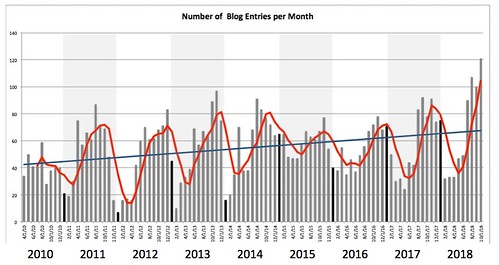
Apr-2010-Oct-2018

The length of a bar is proportional to the number of posts I made that month. Black bars indicate January.

A little calibration is in order. You’ll notice that prior to this year there wasn’t a single month with 100 posts; the highest was November 2013 with 97. Now, as of the end of October, we’ve got three months with 100 or more posts; what will November and December bring? But those months really aren’t directly comparable to the whole previous run. Why? Because it’s in those months that I began using Tweets as blog posts. I hadn’t done that before, but if I’d known that was possible, I’d have done it.

Why? Because it’s a low-energy way to make a post. And low energy’s is what’s going on in those slumps. Why the low energy? That’s what the rest of the post is about.

Finally, on December 18 of last year I posted, Reflections on entering my eighth decade and why it portends to be the most productive one of my life. When I posted that I can assure you that I was not anticipating the slump that slammed me in February and kept me down through June. Will that happen again? Who knows? But notice 2015; the slump wasn’t so bad. Who knows?

* * * * *

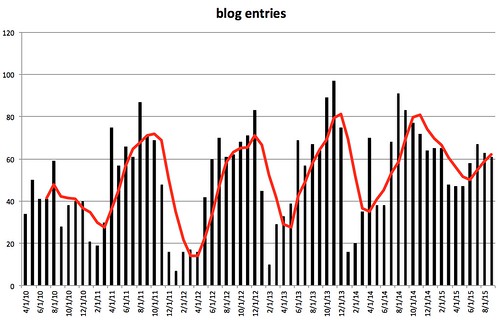
In October of 2015 I had a post at 3 Quarks Daily entitled, Have the Internets Rotted My Brain and Wrecked My Mind? I included the following figure:

WLB Blog entries

Each column represents on month’s worth of posts, starting with April 2010 and running through September 2015. Here’s what I said about it then:
It’s a very spiky pattern, with the dips happening in the winter months. Ever since I went away to college winter has been a down time for me. Am I afflicted with seasonal affective disorder? I don’t know.

Look at the recent end of that chart (to the right). There is a dip, but it’s not nearly so deep as in previous years, and the lowest three months aren’t in the winter, but in the spring and early summer. Wrong season. The pattern seems to be different.
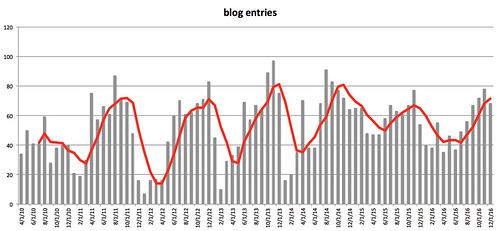
I’ve now updated the graph to the end of last year:

WLB blog entires thru 2016

The cyclicity continues, though, if you look closely, the troughs don’t line up particularly well with winter for 2015 and 2016. The 2015 trough is in spring while the 2016 trough is roughly the first half of the year.

What’s going on? Of course, I don’t really know, other than the obvious changes in blogging productivity. I do think my mood follows my productivity, or vice versa, and that’s what’s interesting. David Hays once conjectured that melancholy (aka depression) is the price you pay for large-scale reorganization or the sort implied by creativity. “Reorganization” is a term of art from William Powers’s account of the mind. It is so deeply embedded in that theory that there is, alas, no easy gloss.

Start out by thinking of learning. When you learn, your mind is also reorganizing on a large scale. Now think of mourning as well. When you mourn the loss of someone close you have to reorganize your mind for life without them. You don’t actually learn anything, but you have to figure out how to function in those situations where you would have go to that person. It’s unlearning.

In order to be creative you must first unlearn on a large scale. That is accompanied by melancholy. That, on this view, accounts for those troughs in my intellectual output, which is mostly though not entirely through New Savanna. That creates some “slack” in the system. Once enough unlearning has taken place I can then think new thoughts and my productivity goes up. When the slack has been used up, it’s time for more unlearning.

Do I believe this? How could I? I just made it up. And it’s rather vague, too vague to support strong belief. Still, I’m attracted to the idea that something like this is going on over the long haul.

Addendum, 1.2.17: Are we dealing with reorganization on a scale where we could talk of neural plasticity?

Sunday, January 13, 2013

Aaron Swartz, Depression, and Prosecution

Writing at Question Copyright, Karl Fogel observes:
There are many remembrances [of Aaron Swartz] already on the Internet, but two in particular stand out: Rick Perlstein's and Lawrence Lessig's. Both are personal remembrances, but both make the point (Rick even more directly in a separate Facebook post) that it would be a mistake to reflexively pathologize this and blame it simply on Aaron's occasional depression. In Rick's words, from a Facebook conversation: "I would downplay the depression angle. The big piece he wrote about his depression came when he was 17. When I talked to him about my own depression a year ago, he really didn't respond as a fellow-traveler. I can't say precisely, but I don't think it was a huge part of his life. Having his soul gnarled down to a nub by a Javert had much more to do with it, I think." You'd be depressed too if the might of the U.S. federal judicial system seemed dedicated to sending you to jail for most of your life over an essentially altruistic act that harmed no one. I can't read Aaron's mind and don't know what he was thinking, but the relentlessness of that system bearing down on him was there, every day, with no sign of respite. Whether one is prone to depression or not, that's a hard, hard road. And your friends and allies may defend you till they're blue in the face, but they're not going to be there in the jail cell with you.