Showing posts with label virtual reading. Show all posts

Tuesday, April 7, 2026

Ramble: What I’ve been up to in February and March with the chatbots, the literary mind revealed (maybe)

This is a somewhat different ramble. Normally I ramble on about things I want to work on but can’t quite prioritize them. So I gather them together in one place so I can look at them all, all at once. And then sort things out.

This time I’m looking at what’s been going on in the last two months or so and reminding myself what I’ve been doing with my two interlocutors, ChatGPT and Claude. It’s really quite amazing, and exhausting. I’ve been having them review work I’ve done, starting with having Claude review reports of the experiments I’d done with ChatGPT in 2023 and 2024. I’ve also had both of them look at papers by David Hays, some things we did together and other work I’ve done.

So, for a long time I’ve thought of myself as in the business of investigating arenas of qualitative research and figuring out how to get quantitative research out of them. Literature has been my main arena. Working with both Claude and ChatGPT has advanced me on various fronts. It’s been amazing. The chatbots have been able to work out (some of) the implications of these ideas more rapidly than I could have done, and even pushed into unexpected territory.

Thus I can now begin to think about Rank 5 cognition in a coherent way. It turns out that Miriam Yevick’s 1975 paper on holographic vs. sequential logic is Rank 5. Why? because it takes two different computational regimes as objects of thought, placing them in relation to different informatic environments. Since Hays and I put Yevick’s work at the center of one of our five principles of natural intelligence, does that make that paper Rank 5?

A discussion of my paper about ChatGPT’s inability to generate a semantic network diagram led me to a long discussion about how to train AIs to perform a task like that. That came in the wake of our discussion of virtual reading [File: Notes from Virtual Reading.docx]. This requires explicit instruction comparable to what, for example, Hays gave me when I first learned how to do it. The problem is that there is a normative element involved in learning that the AI cannot pick up simply by reading articles using semantic networks. It actually has to attempt to create such networks and have those attempts critiqued by a human, or, conceivably, someday, another AI. That same discussion led to discussions of learning about sentence diagramming, constituent structures, symbolic logic, semantic networks, and close reading.

Then I had Chatgpt look at my Coleridge work, particularly my paper about “This Lime Tree Power My Prison,” the 2003 rework of my analysis of “Kubla Khan,” and my unpublished working paper indicating how they are two different trajectories through the same mental terrain. The “Lime-Tree Bower” paper has a table indicating how the mapping between agents in the poem and a hypothetical underlying attachment mechanism changes from one section of the poem to the next. ChatGPT suggested how to construct a similar table for “Kubla Khan.” Whether or not that will work out, that’s another matter which I’ll take up in a year or three. If that works out then I’m clear to work out how these two different poems related to the same underlying neural state space (HA!).

We did similar work with Shakespeare’s plays, starting with my analysis of Much Ado About Nothing, Othello, and The Winter’s Tale. & the Chatster had helpful remarks on the relationship between The Winter’s Tale and Pandosto, from which it is derived. That is, once an explicitly mechanistic framework is established, like I have for “Lime-Tree Bower,” other things fall into place. So the theory goes. Details need to be worked out, but I’m not going to get around to that anytime soon.

And then we have cultural evolution again, which I ChatGPT and I discussed in the Virtual Reading paper. Just as you can conceive of an individual text as a trajectory through the high-dimensional state space of a human mind, so you can conceive of the long-term change in a corpus of texts, such as the 19th century Anglophone novels Matt Jockers has analyzed, that evolution is, in effect, a trajectory through an approximation to a collective mind, the Geist, or spirit, of an age. It all makes sense. Sure, there are lots of details to be worked out. But it is all now possible. We have the technical means.

And almost none of this was on my intellectual agenda for th3e first quarter of this year. It just happened. Not passively. It didn’t happen to me. Rather, it emerged through interaction with ChatGPT and Claude.

More later.

Wednesday, January 28, 2026

Rough Notes on Virtual Reading, On literary study in the Fourth Arena

Title above, links, Abstract, Introduction, and Summary Below.

Academia.edu: https://www.academia.edu/150286029/Rough_Notes_on_Virtual_Reading SSRN: https://papers.ssrn.com/sol3/papers.cfm?abstract_id=6145009 
ResearchGate: https://www.researchgate.net/publication/400147214_Notes_on_Virtual_Reading_On_literary_study_in_the_Fourth_Arena

Abstract

This discussion develops a state-space framework for linking brains, texts, and literary history in a way that extends both traditional interpretation and current digital humanities methods. We begin with a neuroanatomical asymmetry: large language models (LLMs) operate primarily on linguistic traces, whereas human poetic production and reception emerge from whole-brain dynamics that include affect, memory, perception, attention, and bodily regulation. If meaning is understood in the language of complex dynamics, it is not a static property “contained” in words but a temporally unfolding trajectory through a high-dimensional cognitive state space. Texts are therefore treated as traces of such trajectories.

From this premise we propose virtual reading: since a text necessarily projects into lexical–semantic activity, and since word embeddings provide a tractable high-dimensional geometry for lexical relations, a text can be modeled as a path through embedding space. While this path reflects purely lexical structure, its global form—drift, recurrence, looping, discontinuity, return—also bears the imprint of extra-lexical constraints that shape lexical choice. In principle, neuroimaging of readers during reading supplies a second coupled trajectory (whole-brain activity over time), enabling empirical alignment between semantic paths and brain dynamics. Drawing on Walter Freeman and Hermann Haken, poetic form is framed as a cultural technology of dimensionality reduction: it extracts low-dimensional, shareable coordinates from otherwise intractable semantic dynamics.

Finally, we connect micro-trajectory analysis to macro-history via cultural evolution. Quantitative DH findings on directional change in large corpora (e.g., similarity structures that spontaneously align with time) become intelligible as movement through a cultural “design space.” The approach does not dissolve disciplinary differences, but provides a richer conceptual arena where close reading calibrates computational exploration, and state-space models open new pathways for scholarly and public understanding of literature as dynamics in time.

Introduction: This is a strange way to assemble a working paper

Over the last 15 years or so I’ve written a bunch of working papers and posted them to the web. Most of them consist of expository prose from beginning to end and a number of them have a few of many diagrams of one kind or another. A few of them are argued as carefully as a formal academic paper, though perhaps not so dense with supporting apparatus. Most of them are not so formal; some are more like popular scientific writing, though not on standard scientific topics; others are even more relaxed. But coherent prose, all of them, sentences and paragraphs, some headings and subheadings. That’s it.

This working paper is different. It’s a transcript of a long conversation I had with ChatGPT that began with the functional organization of the human brain and ended up somewhere beyond those pesky Two Cultures than so many earnest academics like to rattle on about. In between I talk about something I call virtual reading, which involves literary texts, high-dimensional lexical spaces and computing. Then I toss in brain study. After that it gets complex. Here and there we have some longish passages of prose, but mostly it’s one or three sentences at a time strung between a passel of bulleted lists and a blither of headings and subheadings. Not prose.

Why would I inflect that on you. Two reasons: 1) if you think carefully about it, it turns out to be challenging and interesting and 2) I just don’t have time to turn it all into properly argued prose.

This working paper is based on a dialog I had with ChatGPT 5.2 on January 16, 17, and 18, 2026. Most of it is, in fact, an almost direct transcription of that dialog. Why would I Issue such a crude and unpolished text?

I note, first of all, that you do not have to read that transcript if you are curious about what’s in this document. I have provided both an abstract (288 words) and a summary (846 words), both created by ChatGPT. You don’t have to slog through that transcript if you are interested. If you want details, though, you’ll find them in the transcript.

Note, furthermore, that here and there throughout the dialog you’ll find islands of coherent prose. ChatGPT produced some of them without prompting from me; these tend to be single paragraphs. It generated others in response to prompts from me; these tend to be multi-paragraphed, and somewhat long. Look for them. Finally, look for the hyperlinks ChatGPT embedded in the text.

What’s the Fourth Arena?

You may be wondering about that “Fourth Arena” in the title. It also shows up in the text. Here it is: “Fourth Arena” is a term I am using to refer to an emerging domain beyond matter, life, and culture, made possible by the deep integration of humans with computational systems. As AI increasingly participates in cognition, memory, and coordination, new hybrid forms of agency arise that are neither purely human nor merely mechanical. In this sense, the Fourth Arena echoes Pierre Teilhard de Chardin’s idea of a noosphere—a new layer of collective mind—but grounds it technologically and institutionally. Its defining shift is not greater efficiency, but a reorientation of human value away from work and toward play, meaning, and shared exploration.

Friday, September 2, 2022

On Revising Prospero Yet Again [and again]

I thought I'd bump this to the top more or less on general principle. I've done another version of Prospero since the version posted below. This one dates from 2018 and incorporates ideas based computational techniques that didn't exist in 2014, of that just barely existed. It's called Virtual Reading: The Prospero Project Redux, where the idea of virtual reading replaces the type of computational reading I'd imagined in the old Prospero.

* * * * *
 
By Prospero I mean a thought experiment that David Hays and I proposed back in 1976 in a review article, Computational Linguistics and the Humanist, we published in Computers and the Humanities. Sometime in the last decade or so, when I began thinking about doing a book on naturalist criticism, I took that old idea, of a computer program capable of a non-trivial simulation of a reader of Shakespeare, and elaborated it more or less as a stand-alone piece. In particular, I contextualized it with some remarks Stanley Fish had made about stylistic analysis in Is There as Text in This Class? I posted that piece about half a year ago, then revised and reposted it about a month ago.

I’ve now done yet another revision, this time incorporating the notion of a tabula rasa interpretation from Alan Liu’s article, “The Meaning of the Digital Humanities” (PMLA 128, 2013, 409-423). I’ve posted that version at my Academia.edu page. I’ve appended the abstract to this post.

Why yet another revision?

It would seem that this notion, this Prospero, has become a touchstone, something through which I gauge the state of my thinking on certain possibilities of literary analysis. But that’s not quite what it was when Hays and I advanced it almost 40 decades ago. Then it was a way of conveying something to an audience we presumed to be unfamiliar with current ideas in computational linguistics.

At that time, the mid-1970s, semantics was the Big New Thing. Computational linguistics was born in the early 1950s under the rubric of machine translation. The US Federal Government needed to translate a lot of Russian documents into English. Perhaps that could be done with computers?

And so a variety of investigators went to work recasting phonology, morphology, and syntax into computational form appropriate to machine translation. By the late 1960s it became apparent, both in computational linguistics and artificial intelligence, that it would be necessary to tackle meaning. Thus was born the computational semantics of natural language.
 
THAT’s what Hays was interested in when I began working with him in the spring of 1974. That’s what everyone was interested in. By the time we wrote that essay I’d completed and published preliminary work on Shakespeare’s sonnet “The Expense of Spirit”, which we discussed in the article. But we couldn’t go into any of the details in that article. So, to give our readers some sense of what that work portended we concocted Prospero.

The idea was straightforward: Code the Elizabethan worldview into a computer using formalisms then being developed, have a computer “read” a Shakespeare play, and then examine what it did in the process. For bonus points you could also program the computer with the knowledge needed to crank out Freudian, Marxist, feminist, and other interpretations. Who wouldn’t be excited at the prospect of working on such a project, even if it were a long-term (decades) project?

I don’t know what Hays thought about the real possibility of such a thing – he’d already lived through the institutional collapse of machine translation when it failed to deliver on some rather extravagant promises – but I figured that I’d be working on Prospero in my lifetime. Certainly not in the near-term future, but 20, 30 years out...?

It didn’t happen. Nor is there any immediate prospect of such a thing. IBM’s Watson is the state of the art, and it’s nowhere near the capability needed to implement Prospero.

What would it take to implement Prospero? I don’t know.

Oh, sure, it’s easy enough to say that it would require a good model of how the human brain operates, including conversation with others. But what would THAT require? We don’t know.

By way of comparison, the folks who want to send a manned mission to Mars know a great deal about what that would require. After all, we’ve already sent humans to the moon and brought them back. And we’ve sent probes that have landed on Mars and beamed back information about what’s there. All that’s directly relevant to the task of a manned mission to Mars. It may not be sufficient – it doesn’t tell us how the human body will adapt to months of weightlessness in transit, nor the mind to those months being bound to a very small group – but it IS a lot.

It is much more than we know about simulating the human brain or coding up the Elizabethan worldview.

So, if Prospero is not possible, then why think about it at all?

Let me put that more personally. What can you learn from me by reading about Prospero? To some extent that depends on what you already know about things such as cognitive science, AI, and computational linguistics, and how much you are willing to trust my knowledge of such things. And what could I learn from you through conversing about Prospero? And that depends on what you already know and on my willingness to trust in your knowledge.

That is to say, Prospero is a set of ideas for organizing a conversation, a conversation about what computers bring to the study of literature.

For example, in one of the essays in Is There a Text in This Class? (1980) Stanley Fish asserts that Michael Halliday, a linguist, is one of many lured on by “the promise of an automatic interpretive procedure” (p. 78). Though I can’t be sure of this, I rather doubt that Halliday himself had any such idea, certainly not as Fish attributes it to him. The idea’s a straw man. Thinking about Prospero is a way of thinking about why the idea IS a straw man. It may even get you to the edge of thinking about why Stanley Fish posits such a thing.

I suppose what Fish had in mind was that you “feed” your text into “the automatic interpretive procedure” and it “spits out an interpretation.” Given such a device, why should you trust the interpretation? Wouldn’t you have to know what it does? And if you know that, do you need the device?

Prospero is useful for thinking about that. So, we’ve got Prospero and we feed it, say, Much Ado About Nothing. How do we know that Prospero understood the play in some meaningful way? Of course we could ask: Did you understand it? But what would we know once Prospero answers Yes? Not much. And if Prospero were to tell us that, no, he didn’t understanding the play, would THAT tell us anything useful? We could ask Prospero questions about the play: Who is Hero? What’s her relationship to Beatrice? And when Prospero answers correctly (or not) then what do we know?

As I say in my various versions of this little thought experiment, what’s important is that knowledge that goes into building Prospero. But Prospero could give reasonable answers to those questions without understanding much about the play, no? After all, aren’t there students like that?

I’ve also said that, given that Prospero is a reasonable simulation (as determined by some as yet unspecified set of procedures), what we really want to do is examine what Prospero does internally in the process of reading a play. That, surely, would tell us a lot.

And now we’ve got a problem, one I’ve been aware of but chose not to bring up. Assume that Prospero IS a fairly robust simulation of a human mind. Isn’t there an ethical problem in opening it/her/him up and examining what happens while reading? Don’t we have to ask permission and, if permission is not granted, go no farther?

If I was aware of this issue, why didn’t I bring it up? I don’t quite know. The matter seems both obvious and beside the point. It exists in some other thought-world, one that impinges on the Prospero world, but that’s outside the actual business of creating a Prospero machine.

Perhaps that’s what Prospero is, a boundary marker, or a guardian spirit.

❖ ❖ ❖

Revision 3, May 2014

Abstract: Prospero is a thought experiment, a computer program powerful enough to simulate, in an interesting way, the reading of a literary text. To do that it must simulate a reader. Which reader? Prospero would also simulate literary criticism, and controversies among critics. The point of Prospero, if we could build it, is the knowledge required to build it. If we had it, we could examine its activities as it reads and comments on texts. But our knowledge of Prospero is of a different kind and order from our knowledge of the world and of life, though those things are central to literary texts. The point of this thought experiment is to clarify that difference, for that is what we will have to do to build a naturalist literary criticism grounded in the neuro-, cognitive, and evolutionary psychologies. Though contemplation of this experiment we can see that, whatever computing promises literary study, it will not yield automatic interpretive procedures.

Tuesday, July 5, 2022

Virtual Reading: The Prospero Project Redux [#DH]

I'm bumping this 2017 post to the top of the queue because, 1) I think the concept of virtual reading proposed here may be of some use in thinking about and evaluating the written output of large language models, such as GPT-3, and 2) the concept of literary form implicit the section, "In search of a small-world net," is relevant to my arguments about the value of symbols as being, in part, a vehicle for moving about in mental space in a way that "outside" the "standard" landscape of mental space (see my post earlier today, Why Are Symbols So Useful to Us?).
 
* * * * *
 
I've uploaded another working paper. Title above, abstract, table of contents, and introduction below. Note that it's a long way through the introduction, but there's some good stuff there.

Download at:

* * * * *
Abstract: Virtual reading is proposed as a computational strategy for investigating the structure of literary texts. A computer ‘reads’ a text by moving a window N-words wide through the text from beginning to end and follows the trajectory that window traces through a high-dimensional semantic space computed for the language used in the text. That space is created by using contemporary corpus-based machine learning techniques. Virtual reading is compared and contrasted with a 40 year old proposal grounded in the symbolic computation systems of the mid-1970s. High-dimensional mathematical spaces are contrasted with the standard spatial imagery employed in literary criticism (inside and outside the text, etc.). The “manual” descriptive skills of experienced literary critics, however, are essential to virtual reading, both for purposes of calibration and adjustment of the model, and for motivating low-dimensional projection of results. Examples considered: Heart of Darkness, Much Ado About Nothing, Othello, The Winter’s Tale.
Contents

Introduction: Prospero Redux and Virtual Reading 2
In search of a small-world net: Computing an emblem in Heart of Darkness 8
Virtual reading as a path through a multidimensional semantic space 11
Reply to a traditional critic about computational criticism: Or, It’s time to escape the prison-house of critical language [#DH] 17
After the thrill is gone...A cognitive/computational understanding of the text, and how it motivates the description of literary form [Description!] 23
Appendix: Prospero Elaborated 30

Introduction: Prospero Redux and Virtual Reading

In a way, this working paper is a reflection on four decades of work in the study of language, mind, and literature. Not specifically my work, though, yes, certainly including my work. I say in a way, for it certainly doesn’t attempt to survey the relevant literature, which is huge, well beyond the scope of a single scholar. Rather I compare a project I had imagined back then (Prospero), mostly as a thought experiment, but also with some hope that it would in time be realized, with what has turned out to be a somewhat revised version of that project (Prospero Redux), a version which I believe to be doable, though I don’t alone posess the skills, much less the resources, to do it.

The rest of this working paper is devoted to Prospero Redux, the revised version. This introduction compares it with the 40 year-old Prospero. This comparison is a way of thinking about an issue that’s been on my mind for some time: Just what have we learned in the human sciences over the last half-century or so? As far as I can tell, there is no single theoretical model on which a large majority of thinkers agree in the way that all biologists agree on evolution. The details are much in dispute, but there is no dispute that world of living things is characterized by evolutionary dynamics. The human sciences have nothing comparable (though there is a move afoot to adopt evolution as a unifying principle for the social and behavioral sciences). If we don’t have even ONE such theoretical model, just what DO we know? And yet there HAS been a lot of interesting and important work over the last half-century. We must have learned something, no?

Let’s take a look.

Prospero, 1976

Work in machine translation started in the early 1950s [1]; George Miller published his classic article, “The Magical Number Seven, Plus or Minus Two” in 1956; Chomsky published Syntactic Structures in 1957; and we can date artificial intelligence (AI) to a 1956 workshop at Dartmouth [2]. That’s enough to characterize the beginnings of the so-called “Cognitive Revolution” in the human sciences. I encountered that revolution, if you will, during my undergraduate years at Johns Hopkins in the 1960s, where I also encountered semiotics and structuralism. By the early 1970s I was in graduate school in the English Department at The State University of New York at Buffalo, where I joined the research group of David Hays in the Linguistics Department. Hays was a Harvard-educated cognitive scientist who’d headed the mamachine translation program at the RAND Corporation in the 1950s.

At that time a number of reasearch groups were working on cognitive or semantic network models for natural language semantics. It was bleeding edge research at the time. I learned the model Hays and his students had developed and applied it to Shakespeare’s Sonnet 129 (which I touch on a bit later, pp. 21 ff.). At the same time I was preparing abstracts of the current literature in computational linguistics for The American Journal of Computational Linguistics. Hays edited the journal and had a generous sense of the relevant literature.

Thus when Hays was invited to review the field of computational linguistics for Computers and the Humanities it was natural for him to ask me to draft the article. I wrote up the standard kind of review material, including reports and articles coming out on the Defense Department’s speech understanding project, which was perhaps the single largest research effort in the field (I discuss this as well, pp. 20 ff.). But we aspired to more than just a literature review. We wanted a forward-looking vision, something that might induce humanists to look deeper into the cognitive sciences.

We ended the article with a thought experiment (p. 271):
Let us create a fantasy, a system with a semantics so rich that it can read all of Shakespeare and help in investigating the processes and structures that comprise poetic knowledge. We desire, in short, to reconstruct Shakespeare the poet in a computer. Call the system Prospero.

How would we go about building it? Prospero is certainly well beyond the state of the art. The computers we have are not large enough to do the job and their architecture makes them awkward for our purpose. But we are thinking about Prospero now, and inviting any who will to do the same, because the blueprints have to be made before the machine can be built. [...]

The general idea is to represent the requisite world knowledge – what the poet had in his head – and then investigate the structure of the paths which are taken through that world view as we move through the object text, resolving the meaning of the text into the structure of conceptual interrelationships which is the semantic network. Thus the Prospero project includes the making of a semantic network to represent Shakespeare’s version of the Elizabethan world view.
But a model of the Elizabethan world view was “only the background”. We would also have to model Shakespeare’s mind (p. 272):
A program, our model of Shakespeare’s poetic competence, must move through the cognitive model and produce fourteen lines of text. [...] The advantage of Prospero is that it takes the cognitive model as given – clearly and precisely – and the poetic act as a motion through the model. Instead of asking how the words are related to one another, we ask how the words are related to an organized collection of ideas, and the organization of the poem is determined, then, by the world view and poetics in unison. [3]
We declined to predict when such a marvel might have been possible, though I expected to see something within my lifetime. Not something that would rival the Star Trek computer, mind you, not something that could actually think in some robust sense of the word. But something.
 
What we got some 35 years later was an IBM computer system called Watson that defeated humans in playing Jeopardy [4]. Watson was a marvel, but was and is nowhere near to doing what Hays and I had imagined for Prospero. Nor do I see that old vision coming to life in the forseeable future.

Moreover, Watson is based on newer kind of technology that is quite different from that which Hays and I had reviewed in our article and which we were imagining for Prospero. Prospero came out of a research program, symbolic computing, that all but collapsed a decade later. It was replaced by technology that had a more stochastic character, which involved machine learning, and which, in some increasingly popular versions, was (somewhat distanctly) inspired by real nervous systems. It is this newer technology that runs Google’s online machine translation system, that runs Apple’s Siri, and that is behind much of the work in computational literary criticism.

Before turning to that, however, I want to say just a bit more about what we most likely had in mind – I say “most likely” because that was a LONG time ago and I don’t remember all that was whizzing through my head at the time. We were out to simulate the human mind, to produce a system that was, in at least some of its parts and processes, like the parts and processes of the mind. One could have Prospero read and even write texts while keeping records of what it does. One could then examine those records and thus learn how the mind works. Ambitious? Yes. But the computer simulation of cognitive tasks is quite common in the cognitive sciences, though not on THAT scale. In contrast, Watson, for example, was not intended as a simulation of the mind. It was a straight-up engineering activity. What matters for such systems, and for AI generally, is whether or not the system produces useful results. Whether or not it does so in a human way is, at best, a secondary consideration.

Why didn’t Prospero, or anything like it, happen? For one thing, such systems tended to be brittle. If you get something even a little bit wrong, the whole thing collapses. Then there’s combinatorial explosion; so many alternatives have to be considered on the way to a good one that the system just runs out of time – that is, it just keeps computing and computing and computing [...] without reaching a result. That’s closely related to what is called the “common sense” problem. No text is ever complete. Something must always be inferred in order to make smooth connections between the words in the text. Humans have vast reserves of such common sense knowledge; computing systems do not. How do they get it? Hand coding – which takes time and time and time. And when the system calls on the common sense knowledge that’s been hand-coded into it, what happens? Combinatorial explosion.

The enterprise of simulating a mind through symbolic computing simply collapsed. In the case of something like Prospero I would specially add that it now seems to me that, to tell us something really useful about the mind, such a system would have to simulate the human brain. Hays and I didn’t realize it at the time – we’d just barely begun to think about the brain – but that became obvious some years later in retrospect.

Friday, May 6, 2022

Virtual Reading, Phase 2: Cultural Analytics and the Brain [1 billion parameters here we come!]

I’ve said a bit about virtual reading here on the New Savanna. By that I mean that the ‘reading’ is being done by a computer system that is tracing the path of a text through a semantic space of high dimensionality. I’ve recently come across a very interesting paper that opens up the possibility of a different kind of virtual reading. In this case a real reader is doing the reading. But they’re doing it while in listening to a text read to them while they’re in an fMRI machine. That means that we can follow this real reading as it activates a reader’s brain. But, and here we go virtual, we can follow that reading as it traces a path through a neuro-semantic space of high dimensionality, 100s of millions if not a billion dimensions. 

First I take a quick look at the paper that gave me the idea, then I review Andrew Piper’s work on Augustine’s Confessions. I conclude the suggesting what we could do by applying that technology to the Confessions.  

Mapping the semantic space of the brain

Here’s the paper:

Huth, Alexander G.; de Heer, Wendy A.; Griffiths, Thomas L.; Theunissen, Frédéric E.; Gallant, Jack L. (2016). Natural speech reveals the semantic maps that tile human cerebral cortex. Nature, 532(7600), 453–458. doi:10.1038/nature17637

As I’ve already indicated, the basic idea is that they had people listen to stories while inside an fMRI scanner, which is sensitive to blood flow. This gives them a picture of brain activation during reading. The more active an individual voxel (3D sample of brain tissue), the more blood flows in it. Some voxels will be more active than others at any given moment, and the activity of any given voxel will vary from moment to moment. What we’re getting from the scanner is a 3D movie of blood flow in the brain.

Then they ‘translated’ that blood flow information into semantic information. How did they do that? It’s complicated, too complicated to go into here, and besides, that would just delay the time it takes to arrive at the good stuff. The investigators are able to do this because they know what stories each subject listened to, and they know where each subject was in the story at any given time-slice of the scan. They used standard NLP tools to process the texts and arrived at set of roughly 1000 words they traced through the scan. From that they calculated each voxel’s sensitivity to each word.

Consider the following image:

At the lower left you see a key that identifies broad areas of meaning. Those colors are used to color the image we see of the brain, center. The axes are centered on an individual voxel. The word cloud to the right indicates the words to which that voxel is most sensitive.

The following image presents the same information, but this time the cortical surface has been flattened.

You can play around with the neuro-semantic atlas here: gallantlab.org/huth2016/

Andrew Piper’s work on Augustine’s Confessions

Note: I’m just swiping this from an old post.

Over the past year of so I’ve been thinking about computing virtual readings of texts where the reading is in effect a path through a high-dimensional sematic space. I’ve even written a working paper about it, Virtual Reading: The Prospero Project Redux. I’ve just now discovered that Andrew Piper has taken steps in that direction, though not in those terms. The paper is:
Andrew Piper, Novel Devotions: Conversional Reading, Computational Modeling, and the Modern Novel, New Literary History, Volume 46, Number 1, Winter 2015, pp. 63-98. DOI: https://doi.org/10.1353/nlh.2015.0008
Piper is interested in conversion stories in autobiographies and novels. He’s also interested in making a methodological point about an exploratory style of investigation that moves back and forth between qualitative and quantitative forms of reasoning. That’s an interesting and important point, very important, but let’s set it aside. I’m interested in those conversion stories.

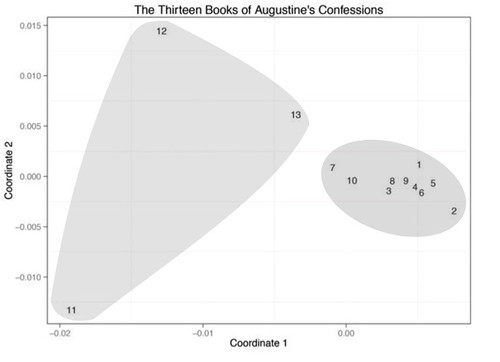
He takes Augustine’s Confessions as his starting point. Augustine puts the story of his conversion near the end of Book 8, of thirteen. Do the chapters prior to the conversion take place in a different region of semantic space from those after the conversion? With chapters (Augustine calls them books) as analytic unit, Piper uses multidimensional scaling (MDS) to find out. I’ve taken his Figure 2 and added the shading (p. 71):

Augustine 1

We can see that books 1-10 occupy a position in semantic space that’s distinctly different from books 11-13 and, further more, that “The later books are not just further away from the earlier books, they are further away from each other” (p. 72). Now, though Piper himself doesn’t quite do so, it is easy enough to imagine each book as a point in a path, and track that path through the space.

Thursday, May 5, 2022

You're looking for theory? I'll give you theory. [What cultural analytics can tell us about the brain.]

Overheard near the water cooler on the Web Tubes:

Deep in the library, among the spiders and potions: 

Later, over lunch:

May I offer a suggestion?

Monday, December 3, 2018

Notes toward a theory of the corpus, Part 2: Mind [#DH]

Way back at the end of September I posted the first of a two, possibly three, post series: Notes toward a theory of the corpus, Part 1: History. I figured the second post would follow within a couple days and perhaps a third a few days after that.

I got delayed, diverted by other matters. But here we are with the second post.

As I said at the beginning of that post, by corpus I mean a collection of texts. The texts can be of any kind, but I am interested in literature, so I’m interested in literary texts. What can we infer from a corpus of literary texts?

Then I was interested in history. This time around I’m interested in the mind. History and the mind, two different, but not unrelated, phenomena. The fact that a given corpus consists of text by many different authors is essential to making historical inferences. The different authors published at different times; we can use a corpus of those different texts to arrive at inferences about historical process. In that earlier post I used Mathew Jockers’ Macroanalysis as my example. He had a corpus of 3300 Anglophone novels from the 19th century.

In this post I’ll be using Matthew Gavin’s work on a passage from Paradise Lost [1]. He uses a corpus of 18,351 documents drawn from Early English Books Online and dating from 1649 to 1699 (which covers the years when Milton wrote and published his epic). I don’t know how many authors are included in the corpus, but it doesn’t matter. Gavin is interested in only one of those authors, John Milton. And while he says nothing about Milton’s mind, he writes only about his text, I will argue that he is, in fact, investigating Milton’s mind. But also the mind of any sympathetic reader of Paradise Lost.

How is that possible? On the contrary, how is it not possible?

The corpus in vector semantics
For reasons I’ll explain shortly, if only superficially, Gavin needed a large body of texts to create a vector semantics model he could use in investigating Milton. I don’t know how many words were in those 18,000+ texts, but if each text were, on average, 10,000 words long, that would be a total of 180 million words; 50K words each would yield a corpus of 900 million words. I figure we’re dealing with 100s of millions if not over a billion words or continuous text. If Milton had written a lot Gavin could have used a corpus consisting entirely of Milton’s own texts. Milton didn’t, so Gavin couldn’t.

However many authors are included in that corpus, each has their own mind. And, at the margin, their own idiolect as well. Still, they hold English as a common tongue; if it wasn’t pretty much the same for each of them it wouldn’t function as a medium for communication. As long as we remind ourselves of what we’re doing, we can treat the lot of them as one somewhat idealized corporate author of the texts in the corpus. It is the semantics of that author that Gavin is applying to Paradise Lost.

Given our corpus, how do we create a semantic model? At this point I am going to more or less assume that you’ve already been through a good explanation of how vector semantics works. But I’d just like to remind you of some aspects of the process.

The process is founded on the assumption that words that occur close together in texts share some aspect of meaning. How can we turn that insight into a usable model? We create a co-occurrence matrix.

Here I’m using an example from Magnus Sahlgren [2]. Consider this text from Wittgenstein, “Whereof one cannot speak thereof one must be silent.” It contains nine word tokens from eight word types, to use terms from logic (one appears twice). Now we need to define what we mean by “close together”. Given two words, are the considered to be close if they are, for example, 1) within they same 1000 word string, 2) immediately contiguous, or 3) something else? For this example let’s choose the second criterion.

Given that, we can produce the following table:


whereof
one
cannot
speak
thereof
must
be
silent
whereof
0
1
0
0
0
0
0
0
one
1
0
1
0
1
1
0
0
cannot
0
1
0
1
0
0
0
0
speak
0
0
1
0
1
0
0
0
thereof
0
1
0
1
0
1
0
0
must
0
1
0
0
0
0
1
0
be
0
0
0
0
0
1
0
1
silent
0
0
0
0
0
0
1
0

It makes no difference whether we read by rows or columns as they are the same, but let’s read it by rows. If the word in a column is next to the target word we place a “1” in the column, otherwise “0”. So, whereof does not occur next to itself; a 0 goes in the first column. It does occur next to ˆ; a 1 goes in the next column. An so it goes for the rest of that row and for the rest of the rows. 

Note that as whereof is the first word in our text it can have only one word next to it. The same is true for silent, the last word. Since one occurs twice it is next to four other words. The remaining five tokens – cannot, speak, thereof, must, be – each have two neighbors, one before and one after. 

Each word is not associated with a string of eight numbers, which we can call a vector. We can now use those numbers to associate each word with a point in a space of eight dimensions, one for each word. In practice we wouldn’t bother with a corpus consisting of only one short text. But the principle remains the same given a corpus of 100s of millions of words constructed of tokens drawn from a population of, say, 100,000 types. Define what you mean by context and construct a co-occurrence matrix for your 100,000 types. Now you can associate each type with a point in a space of 100,000 dimensions – a rather breath-taking notion. 

That’s the general principle. Various methods can be used to reduce the number of dimensions we have to deal with, but regardless of how it is done we still end up with many more than three dimensions, which is the limit of what we can conveniently visualize. None of that matters to us. What matters to us is simply that we can associate the meanings of words with points in space and perform various operations in that space. 

Thus we have what has become the paradigmatic example for vector semantics [3]:
1) king - man + woman = queen
Other kinds of operation are possible:
2) paris - france + poland = warsaw
3) cars - car + apple = apples
All of these are based on analogies where a word is missing:
A : B :: C : ?
Remember, where you and I see a word the computer model sees a point in space, a point defined by a vector, which is a string of numbers. In each of these three cases it starts with a vector (that is, a string of numbers), subtracts a second vector from the first, then adds a third vector to that result, yielding a fourth vector, another point in space. The point is our answer. 

You and I may know the meanings of these words (examples 1 and 2) and the rules for pluralization (example 3), but the computer model knows none of that. It knows only the relations between word types that it can infer from the word-space constructed from the co-occurrence matrix based on the contexts in which word tokens occur. 

Gavin, however, isn’t interested in such analogies. Well, yeah, I rather suspect that he’s very interested in the fact that one can do such things with vector semantics, but that’s not what he does with the model he’s constructed. He uses it to examine a passage from Milton. 

As I mentioned at the outset, his co-occurrence matrix is based on 18,351 documents drawn from Early English Books Online. The structure in each of those documents must necessarily come from the mind of the document’s author. As those authors speak a common language we may, as I’ve argued above, think of the structure in that co-occurrence matrix as coming from the mind of a somewhat idealized corporate author of the corpus. Gavin is, in effect, asking that author to read a passage from Paradise Lost while we look on over their shoulder, as it were. 

That may not be how Gavin thinks of what he’s doing, but it’s how I’ve come to think of it. Call it a virtual reading.