After the Space Shuttle Challenger exploded in January 1986, killing its seven crew members, President Reagan appointed a commission to investigate.
— Philosophy Of Physics (@PhilosophyOfPhy) March 30, 2026
Richard Feynman, already battling cancer and reluctant to join, accepted because a former student asked.
He quickly grew… pic.twitter.com/3EytNZIMcE
Showing posts with label NASA. Show all posts
Showing posts with label NASA. Show all posts
Monday, March 30, 2026
The physicist vs. the bureaucrats: Richard Feynman testifies before Congress about the Challenger disaster
Thursday, May 30, 2024
We'll know we've reached the mythical "AGI" when we can create autonomous industrial facilities on the Moon, Mars, and asteroids
Tyler Cowen recently had a conversation with Michael Nielson, which ranged all over the place, as Cowen's conversations tend to do. Here's snippet:
COWEN: You have reason to think we’re going to last a thousand years in a civilized state. Not every person dead —
NIELSEN: I think getting off planet Earth and establishing a civilization elsewhere is very, very important. Yes. Very hard for economic reasons but utterly crucial.
COWEN: Robots, in a sense, make it harder because you could send robots to Mars to do whatever might be economically useful there, means you never work hard on having humans do it.
NIELSEN: Yes, that’s true. We’re pretty curious.
COWEN: The robot will take perfect footage. Whatever is there, the robot will send back to us. You’ll have your whatever is the current version of Apple Vision Pro on. It will seem very realistic.
NIELSEN: You’re an economist. I’m a romantic, I think.
[laughter]
NIELSEN: Might be the difference.
COWEN: We’d have to settle them at scale, so 20 people on Mars limping along.
NIELSEN: Oh, we’re talking about a million people, not 20 people.
COWEN: If we can do a million, we can do a billion, I would think.
Perhaps we'll colonize Mars, perhaps we won't. That's not what interests me at the moment. What interests me is the possibility of creating and maintaining infrastructure, robots, and manufacturing infrastructure on Mars. Will that one day be possible? I don't know & I don't have a strong opinion either way. I note, however, that at the present we're a long way from having robots that could do all the physical tasks necessary to assemble and maintain manufacturing infrastructure. I'm thinking in particular of bottom-level locomotion and physical manipulation.
Beyond that, there's the business of managing the activity. It's all well and good that we now have LLMs that can craft fluid prose on a wide variety of subjects and are useful in writing computer code. But it will take a lot more than that to run a factory. Among other things, that will require sophisticated planning capabilities, which are currently beyond the capacities of LLMs. But I don't see any reason why we could develop that technology. LLMs are NOT the end of the technology pipeline. There's more to come.
Finally, I note that what Mars is too far away for real-time monitoring and control from earth, it's certainly possible for human operators on earth to perform various high-level analytic and planning tasks if that proves necessary. If we can create and maintain autonomous facilities on Mars, the Moon, and asteroids, that operate a decade or more without on-site human intervention, I'd say that, yes, we've achieve AGI, whatever that is. As for superintelligence, at that point, who cares?
There's been a fair amount of conceptual work on self-replicating factories. In particular, I recommend study undertaken by NASA in the summer of 1980: Replicating systems concepts: Self-replicating lunar factory and demonstration. From the Introduction:
As the cost of fossil-fuel energy continues to escalate and supplies of readily accessible high-grade ores and minerals gradually become depleted, the utilization of non- terrestrial sources of energy and materials and the develop- ment of a nonterrestrial industrial capacity become increasingly desirable. The Moon offers plentiful supplies of important minerals and has a number of advantages for manufacturing which make it an attractive candidate factory site compared to Earth. Given the expense and danger associated with the use of human workers in such a remote location, the production environment of a lunar manufac turing facility should be automated to the highest degree feasible. The facility ought also to be flexible, so that its product stream is easily modified by remote control and requires a minimum of human tending. However, sooner or later the factory must exhaust local mineral resources and fall into disrepair or become obsolete or unsuitable for changing human requirements. This will necessitate either replacement or overhaul, again requiring the presence of human construction workers with the associated high costs and physical hazards of such work.
The Replicating Systems Concepts Team proposes that this cycle of repeated construction may possibly be largely eliminated by designing the factory as an automated, multi- product, remotely controlled, reprogrammable Lunar Manufacturing Facility (LMF) capable of constructing duplicates of itself which would themselves be capable of further replication. Successive new systems need not be exact copies of the original, but could, by remote design and control, be improved, reorganized, or enlarged so as to reflect changing human requirements. Afew of the benefits of a replicative growing lunar manufacturing facility (discussed at greater length in secs. 5.4 and 5.5) include:
(1) The process of LMF design will lead to the develop- ment of highly sophisticated automated processing and assembly technologies. These could be used on Earth to further enhance human productivity and could lead to the emergence of novel forms of large-scale industrial organization and control.
(2) The self-replicating LMF can augment global industrial production without adding to the burden on Earth's limited energy and natural resources.
(3) An autonomous, growing LMF could, unaided, construct additional production machinery, thus increasing its own output capacity. By replicating, it enlarges these capabilities at an increasing rate since new production machinery as well as machines to make new machines can be constructed.
(4) The initial LMF may be viewed as the first step in a demonstration-development scenario leading to an indefinite process of automated exploration and utilization of nonterrestrial resources. (See fig. 5.1.) Replicating factories should be able to achieve a very general manufacturing capability including such products as space probes, plane- tary landers, and transportable "seed" factories for siting on the surfaces of other worlds. A major benefit of replicating systems is that they will permit extensive exploration and utilization of space without straining Earth's resources.
Read the whole thing. It'll give you a decent overview of what's required. While you're at it, read this post from 2017: Summer 1981, When I advised NASA on their computing infrastructure. That's when I learned about that NASA study and made my own contribution to the effort: An Executive Guide to the Computer Age.
Saturday, May 4, 2024
Unfrosted: The Pop-Tarts Story [Media Notes 119 A]
Was it funny? Yes. Worth watching? I suppose. But it wasn’t the laugh-out-loud hilarity fest I was hoping for. It wasn’t Duck Soup for the 21st century.
I like Seinfeld, a lot. I’ve written a bunch of posts about his stuff, mostly Comedians in Cars and assorted stand-up bits, and gathered most of those into two working papers, Seinfeld's Comedy, Jokes are Intricately Crafted Machines (2023), and Jerry Seinfeld & the Craft of Comedy (2016). That Seinfeld is a miniaturist. Unfrosted: The Pop-Tarts Story started life as a stand-up bit. In this clip Seinfeld talks about how he created that bit (with shots of his hand-written notes on a yellow legal pad):
I wonder about that line he mentions (02:36), “chimps in the dirt playing with sticks.” He explains why he likes it, four of the seven words are funny (underlined). It makes me think of the Kubrick’s 2001, which picks up on the space theme Seinfeld had introduced seconds before (02:30 “it was like an alien spacecraft”). Was that connection rattling around in Seinfeld’s mind as well? Who knows? Does it matter? Maybe yes, maybe no. And he’s only halfway through his explanation.
Back to the movie, Unfrosted. It’s bright and cheery, something Seinfeld was aiming for. In one or three of the dozen interview clips I watched over the past week he says that, just as you are greeted with a shelf of brightly colored cereal boxes when you go to fix breakfast in the morning, so this movie about a breakfast pastry needs to be bright and cheery. Bright and cheery? I’ll give it a smile and two chuckles.
Seinfeld also goes on and on about getting to work with Hugh Grant, a hero of his. Hugh Grant is cast as Thurl Ravenscroft, a Shakespearean actor reduced to (the indignity of) playing Tony the Tiger – remember Alan Rickman in Galaxy Quest, “by Grabthar’s Hammer”? In that role he comes up with that famous tag-line, “They’re gr-r-eat!” You know what? Not so great. Add two smiles and a chuckle to the score. And then in the climax, which is a mascot rebellion filmed as a parody of MAGAs storming the Capitol Building on January 6, Hugh “Tony the Tiger” Grant is wearing a horned fur helmet like Jacob Chansley, the QAnon shaman. Why?
The movie’s set in the 1960s, the clothes, the cars, the music – Chubby Checker doing “The Twist” fergodsake! – Khrushchev, JFK, the missile crisis, Walter Cronkhite, NASA & Tang, it’s all there. What’s the MAGA rampage doing in there? It makes no sense. A mascot rebellion? Fine. But all those shots modeled on video footage of the MAGA insurrection? That reference is just a distraction that adds nothing to the story.
The idea seems to be that you take the Pop-Tart comedy bit, turn it into a competition between Kellogg’s and Post, and then frame that competition as a parody of the 1960s space race – I must have heard that line in a half-dozen of those interviews. It sounded promising each time I heard Seinfeld say it. I was intrigued. But on the big screen? Whats the score now, three smiles and three chuckles? And no belly laughs. That seems about right. You can’t take a Godzilla toy, hook it up to an air-pump, and expect to inflate it into a world-destroying comedic monster. That’s not how these things work.

But that seems to be what Seinfeld has done. Here’s what the good folks at Rotten Tomatoes had to say: “Much like a preservative-packed toaster pastry, Unfrosted is sweet and colorful, yet it's ultimately an empty experience that may leave the consumer feeling pangs of regret.” That’s a bit harsh. Me? No pangs of regret, no ultimate anything, not empty. But not particularly filling.
* * * * *
Bonus: I decided to see what kind of scenario ChatGPT could come up with. Here’s a record of a session I had with it. While it’s not gr-r-eat!! it did get a couple of chuckles from me. As always, my prompt is in boldface, the Chatster’s response is plain-face.
Tuesday, May 17, 2022
Being in space for a long time brings about changes in the brain
Peter Rogers, How long-term space missions change the brain, Big Think, May 15, 2022.
According to the 2015 NASA report, astronauts who spent long periods in space described motor-control problems and vision impairment, neither of which are ideal for individuals operating billion-dollar pieces of equipment in outer space.
One particularly common visual impairment, spaceflight-associated neuro-ocular syndrome (SANS), affects up to 70% of NASA astronauts who undergo long-duration missions aboard the International Space Station (ISS). These symptom indicated neurological changes, so it became more common for astronauts to undergo MRIs before and after missions.
These brain scans revealed significant structural changes. The group of international researchers sought to determine whether these changes in the brain are associated with SANS. Donna Roberts, M.D., a neuroradiologist at the Medical University of South Carolina who helped lead the study, explained in a press release:
“By putting all our data together, we have a larger subject number. That’s important when you do this type of study. When you’re looking for statistical significance, you need to have larger numbers of subjects.” [...]
After being in space, all the space travelers exhibited similar brain changes: cerebrospinal fluid buildup and reduced space between the brain and the surrounding membrane at the top of the head. The Americans, however, also had more enlargement in the regions of the brain that serve as a cleaning system during sleep, e.g. the perivascular space (PVS).
Friday, July 23, 2021
Billionaires in Space, Part 5: Is nothing sacred? [What is an engineer mage?]
In my experience that question – Is nothing sacred? – is usually asked in a tone of exasperated irony by someone who, more likely than not, is a thoroughly secular person. I’m a secular person, but I ask the question without irony, which implies that I am also asking whether the category of “the sacred” is a meaningful one in a secular world. Nor am I exasperated, much. More curious, and pondering.
My friend the late Charles Cameron was a deeply religious man, a mystic, and a poet. He feared that, if travel to the moon became routine, that would rob the moon of its value as an attractor for contemplation of the sacred. In my recent article at 3 Quarks Daily I made a remark that points in that direction:
The fact that at long last America had landed on the moon, that changed the valence of the whole man-in-space project. As long as it was out there in the future we could treat it as a blank slate and write anything on it we wished. Now we had been there, three of us at least; it became real in a way it had not been before.
I then went on to mention an episode in The Crown, season 3, episode 7, “Moondust.”
Prince Philip had been feeling a bit depressed over the fact that he’d given up a career as an air force pilot to be, in effect, a jewel in his wife’s crown. The Apollo astronauts, however, were on a tour of Britain and he arranged to have a private meeting with them. It did not go as he’d hoped. They had not somehow become magical larger-than-life beings. They were mere men, like himself, and not particularly articulate about the experience of having landed on the moon.
What I didn’t say is that that episode began with Philip speaking to a cohort of priests who had come to a retreat at an otherwise unoccupied house on one of the royal estates. As they tell him why they’d come to the retreat he gets restless and tells them that they need action, not contemplation. He leaves. Then we have the incident with the astronauts. As the episode closes Philip has returned to the retreat, apologized to the priests, and asked for their help in working though is mid-life issues.
Charles saw the short blog post I did about that episode and remarked in comments:
Okay. If “religion” fails to offer the sense of mystery and wonder, and “science” in the form of going to the moon (dust, mainly, as if a reminder of “ashes to ashes and dust to dust” unfortunately) doesn’t assuage the quest to “meaning” either, something we might term “imagination” or "spirituality" – perhaps falling somewhere between the two, or in triangulation with a meditative “peace”, might still do the trick. Anyway, that's the direction my own “quest” / “questioning” is leading me in...
Notice all the scare quotes and the trailing ellipses. THAT, I believe, is where we are, though just who “we” refers to is an open question, one perhaps best answered by each individual. But in the end we – some very substantial collective – are going to have to agree on some kind of answer and that answer will help guide us through the climate issues facing us and will guide us perhaps into outer space. To what end? That has yet to be determined.
...we need to be involved in and committed to something greater than ourselves.
I don’t think Richard Branson has anything useful to say in this conversation. He’s just a charismatic joy-riding billionaire. Bezos is less charismatic – the cowboy hat did not do the trick – and I doubt that he has much to say either, though he has a lot more money to spend.
And there is the peculiar shape of his rocket, which has been getting a fair amount of attention. I’ve already linked to Joe Rogan’s Instagram comment, which is rather crude, as one can expect from Rogan. But Rogan has the most watched pod-cast on the planet. Then there’s this video on YouTube:
It’s approaching a million views. That’s not Joe Rogan territory, but it’s worth thinking about. How many more views will it get? How many others are or will be satirizing the shape of that rocket.
When I first saw the shape I thought nothing of it. And when people started either hinting at or outright saying it’s a giant dick, I dismissed those remarks. Why? Because the shape of the rocket is largely dictated by physical considerations. It has to have the shape of a cylinder and the top needs to taper. Now I’m beginning to wonder. Does the capsule really need to be wider than the rocket itself in a way that resembles the glans of a human penis? Was that aerodynamically necessary? Didn’t any one in Blue Origin’s PR department point out that that shape could be embarrassing?
Aren’t these questions just a little silly? Maybe yes maybe no. The fact that they arise speaks to the lack of a shared cultural framework through which we can understand this current space race as anything more than billionaires showing off and living out childhood fantasies. Yes, there’s the tech and the possibilities of spin-offs. That’s what NASA said back in the 1960s. It was a thin truth then and it’s thin now. Technology isn’t what’s driving this race now – except, perhaps, in the case of Musk. But let’s finish up with Bezos first.
I don’t know what goes on in the mind of a billionaire who may think he’s some kind of god. I hear Bezos thinks we are or should be an interstellar species. So what? That’s been in science fiction for decades. He gets no credit for thinking such thoughts. Whatever he is, he is no philosopher king. Nor perhaps should he be. I could say more about Bezos – his predatory attitude toward his employees for example, but let’s just leave it there.
And then there’s Elon Musk. I’ve written so much about him I’ve made him a named topic here. As I remarked yesterday, “He’s built an actual [space] business, though one that depends on getting government contracts. He wants to go to Mars. I don’t know what I think about that.” He may well go down in history as the Henry Ford of the electric automobile. He has some strange ideas about direct brain-to-brain communication and apparently he’s not a very nice person. So what? He’s not a philosopher king either.
But he may be something else. A real life Tony Stark? To be honest, I’m not invested enough in the Marvel Universe to know whether or not that judgment is worth spit. But I rather doubt that the Marvel Universe can support what I have in mind, what I’m searching for, what Charles Cameron was searching for. Can Musk support that?
He is an engineer. A designer. He may even be a profound engineer. A builder. Maybe he is an engineer mage.
We’ll see.
There is this idea, at one and the same time a cliché and a profound truth, that we need to be involved in and committed to something greater than ourselves. Does Richard Branson think there is anything greater than Richard Branson? Jeff Bezos? Does cheering them on lift us out of ourselves to something greater?
No.
I’m not sure about Musk.
* * * * *
Why engineers? you ask. Because engineering is about designing and constructing. I have quite a bit to say about engineers and engineering here at New Savanna. In the preface to my book on music, Beethoven’s Anvil, I characterized my method as speculative engineering. One of the important things about Grace Lindsay’s new book, Models of the Mind: How Physics, Engineering, and Mathematics Have Shaped Our Understanding of the Brain, is that she recognizes the importance of engineering. More personally, my father was an engineer, a very good one. It’s in my blood, as they say.
Compared to science and scientists, engineers don't get no respect, as Rodney Dangerfield might say. Engineering is not as deeply implanted in our philosophical superstructure as science is. Philosophy of science is a thriving subject. Philosophy of engineering? Doesn't exist. I suspect there is a class issue here, the gentleman scientist vs. the blue collar engineer, but also calculation vs. manipulation. There's an intellectual issue as well. This bears looking into.
Monday, May 17, 2021
Types of Research, R&D ventures, by ‘guesstimated’ probability of success [Progress]
An email I recently sent to Tyler Cowen, with his succinct response.
* * * * *
Hi Tyler,
I was wondering if any systematic work has been done on classifying (large-scale) research and R&D by ‘guesstimated’ probably of success at the outset. I’m thinking of a brief Mercatus paper from 2016, Graboyes & Stossel, “Curing Cancer Is Not a Moonshot.”
When President John F. Kennedy articulated his moonshot project in May 1961, it was a narrowly focused, clearly defined engineering problem. While costs and timelines were somewhat uncertain, tried-and-true principles of physics informed the engineers and made a successful lunar landing highly likely.
Cancer, in contrast, is many different diseases demanding diverse treatments. Compared with the high-precision physical sciences that reliably guided NASA to the moon, the principles of biology are obscure and agonizingly unpredictable.
That seems to me to be a useful and important distinction to make. And while it’s perhaps easy enough to make in retrospect, I’m not at all sure we can’t make it, or some approximation to it, at the beginning of an enterprise. And it seems to me that if we examine however many cases in retrospect that might help us to make such distinctions in prospect.
It seems to me, for example, that the Manhattan Project was like the moonshot. And it seems to me that a human landing on (and return from) Mars is more like that than like the cancer shot. But what do we make of work toward practical nuclear fusion? It’s been going on a long time and we’re still not there. It seems to me that it’s like the moonshot in that the basic science is (seems to be) is in place. But there’s an awful lot of engineering we haven’t figured out. Is that a third type.
Of course we’ve got the distinction between a scientific venture and an engineering one. One could characterize the cancer boondoggle as treating what is in fact a combined scientific and engineering project, with a large and important scientific component, as purely a matter of engineering (broadly considered as designing and constructing solutions to practical problems, in this case, therapies).
What of brain interfaces? In the case of controlling prosthetic limbs, it seems to me that that’s mostly engineering at this point. After all, it’s been done, though I have no sense of whether or not it’s been reduced to routine. But then you have Elon Musk telling Joe Rogan it’s only ten years until we can share thoughts directly with one another (Rodolfo Llinas made that suggestion over 15 years ago and Christof Koch has made again it now). I think there’s tremendous engineering challenges there, but also scientific. [In fact, I suspect it’s impossible, but that’s another story.]
What about self-driving cars? It’s one of those things that’s been any-day-now for awhile, but still isn’t here. And then there’s AGI. As of May 2019 Rodney Brooks thought fully self-driving cars to be 30-50 years in the future, and AGI? Way way out. I think AGI is so poorly defined that the prospect borders on science fiction, and yet, I note, I also think GPT-3 represents a phase change.
It’s just that the AI space is so very large and who knows how much of it is as yet unexplored. Compare the prospect of landing a human on Mars with that of creating an AGI. Except perhaps for information about what happens to humans under those conditions for that long, the basic science seems to be in place for a Mars mission. We can make plans and have intelligent conversations. But AGI, it’s mostly just words at this point. We’re a long way from understanding the human brain – and such understanding would surely be useful in crafting an artificial brain. Nor do we even understand our best AI engines. We can build them, but what’s going on under the hood, that’s still rather obscure.
Any thoughts?
Best,
BB
Tyler's response: “All radically understudied in my view...”
Friday, June 12, 2020
Ross Douthat on decadence || the Space Age || I've been wrestling with a longish post, working title: From Progress Studies to Progress
And I think I've finally got an overall narrative/logical shape for the piece. Some Ross Douthat's thoughts on decadence have been helpful. I'm thinking they'll get me over the hump. We'll see.
* * * * *
Douthat opens his current book (The Decadent Society) by referencing the first Apollo moon landing:
The peak of human accomplishment and daring, the greatest single triumph of modern science and government and industry, the most extraordinary endeavor of the American age in modern history, occurred in late July in the year 1969, when a trio of human beings were catapulted up from the earth’s surface, where their fragile, sinful species had spent all its long millennia of conscious history, to stand and walk and leap upon the moon.
“Four assassinations later,” wrote Norman Mailer of the march from JFK’s lunar promise to its Nixon-era fulfillment, “a war in Vietnam later; a burning of Black ghettos later; hippies, drugs and many student uprisings later; one Democratic Convention in Chicago seven years later; one New York school strike later; one sexual revolution later; yes, eight years of a dramatic, near-catastrophic, outright spooky decade later, we were ready to make the moon.” We were ready—as though the leap into space were linked, somehow, to the civil rights revolution, the baby boomers coming into their own, the transformation in music and manners and mores, and the hopes of utopia percolating in Paris, Woodstock, San Francisco.
Mailer’s was a mystical take on history, but one well suited to its moment. For the society that made it happen, the Apollo landing was both a counterpoint to the social chaos of the 1960s and the culmination of the decade’s revolutionary promise. It proved that the efficiency and techno-optimism of Eisenhower-era America could persist through the upheavals of the counterculture, and it represented a kind of mystical, dizzy, Age of Aquarius moment in its own right. As much as anything that happened here on earth, the fire on the moon helped make the summer of ’69 seem like a beginning, not a peak—an opening into a new era, in which the frontier would no longer be closed, the map no longer filled in, and human beings would expand their explorations, their empires, their arguments and imaginations and ambitions into the very stars.
This was the space age, which lasted for about thirty years: from Sputnik in 1957 to the space shuttle Challenger explosion in 1986. And we who live in its aftermath have forgotten just how confidently it was expected to continue.
I note that there was no greater evangelist for the Space Age than Walter Elias Disney, aka Walt, who died in 1966.
He goes on to reprise a version for Frederick Jackson Turner's Frontier thesis that America's political, social, and character was formed by pressing against the frontier. That came to a halt at the end of the 19th century. But then, Douthat argues, the Wright brothers first became airborne in 1903 and just under seven decades later we set foot on the moon. And then we stopped. OPEC declared and oil embargo in October of 1973 and America's car culture got a rude shock. And 1973 is when economic growth began to slow down, giving rise to what Tyler Cowen has called The Great Stagnation in his 2011 book of that name.
A bit later Douthat says:
It is not a coincidence that the end of the space age has coincided with a turning inward in the developed world, a crisis of confidence and an ebb of optimism and a loss of faith in institutions, a shift toward therapeutic philosophies and technologies of simulation, an abandonment of both ideological ambition and religious hope.
Of course, this shift might have happened anyway, even if Mars were closer and more habitable or light-speed travel a more realistic possibility. The existence of a frontier does not guarantee that it will be a destination, and past civilizations have given up on exploration for essentially internal reasons, even when new horizons were very much in reach. (The abandonment of major sea voyages by China’s Ming dynasty, in the same era as Columbus, did not come about because the world’s oceans were too wide but because of the empire’s changing intellectual fashions and political priorities.) Already when Neil Armstrong took his first small step, there were many voices making the case for the wastefulness of NASA’s voyages, for the pointlessness of “whitey on the moon,” and some of the turn toward pessimism preceded the realization that we would not be sending astronauts to Jupiter by the year 2001. A great deal of post-1960s thought—postcolonial, environmentalist—is premised on the idea that Western expansion was mostly cancerous, and this critique has been extended even to the idea of galactic colonization, with the exact same sort of ideological language applied. When the nonagenarian space optimist Freeman Dyson wrote hopefully about stellar exploration in a 2016 issue of the New York Review of Books, three letter writers chastised him for not counting the ecological cost and warned that “a human-designed outer space ‘teeming with life and action’ sounds like a nightmare out of Joseph Conrad.”
Still, sometimes this application of anti-imperialist and environmentalist ideas to space travel feels like a kind of excuse making—that like the fox in Aesop’s fable, we enjoy telling ourselves that we wouldn’t want the fruit anyway, or that eating it would be immoral, so as to soothe the pain of knowing that it’s there but out of reach.
Either way, whether the closing of the stellar frontier somehow caused the West’s post-1960s turn toward pessimism or simply interacted with trends already at work, it remains a turning point in the history of the modern world. Before Apollo, it was easy to imagine that “late” was a misnomer for our phase of modernity, that our civilization’s story was really in its early days, that the earthbound empires of Europe and America were just a first act in a continuous drama of expansion and development.
Since Apollo, we have entered into decadence.
And so Douthat goes.
* * * * *
Peter Robinson of the Hoover Institution discusses The Decadent Society with Douthat The discussion begins with Douthat's invocation of the Apollo lunar landing.
This discussion between Robert Wright and Ross Douthat is worth thinking about. Tyler Cowen comes up 10 or 15 minutes in and Douthan references Andreeseen's "Build" manifest in the final section, which is about the Covid-19 pandemic.
Friday, June 5, 2020
Space travel and American myth – "Whitey on the Moon”
Marina Koren, The False Hope of an American Rocket Launch, The Atlantic, June 3, 2020
Over the weekend, SpaceX flew two astronauts to the International Space Station on NASA’s behalf, a first in spaceflight history. NASA officials have spent months hyping the mission as a bright spot in dark times, and pointed to other milestones still to come: Under President Donald Trump, the United States is working to send Americans to the moon again in less than four years.
And while history might not necessarily repeat, it does rhyme. On the day of the SpaceX launch, Vice President Mike Pence touched on these parallels. The Apollo missions, he said, were “a symbol of national strength and unity” that “rose above the tumult and the clamor of their times.”
But the image of a nation united in the common purpose of delivering its people to the heavens is a false memory. Even before the recent demonstrations began, the SpaceX launch wasn’t going to be the center of national attention. That message of unity felt discordant when the biggest story in the country was a pandemic killing thousands of Americans every week, many of them black and Latino Americans, under the watch of a government unequipped to handle the virus. The dissonance has grown even more apparent as protests have sprung up in all 50 states.
Space travel has inspired Americans, but it has never united them—not in the late ’60s, and certainly not in the present moment. The feats of America’s space program, then and now, are a momentary diversion, not a national salve.
[...] In 1968, as the U.S. was rocked by the worst of the Vietnam War, political assassinations, and police brutality against black people, NASA was trying to go to the moon. In 2020, as the country grapples with a deadly pandemic, the worst unemployment crisis since the Great Depression, and police brutality against black Americans, NASA is, once again, trying to go to the moon.
Wednesday, May 27, 2020
A Child of the Space Age
Bumping this to the top in honor of the SpaceX launch that was cancelled today. It might happen Saturday or Sunday.

One evening in the fall of 1957 my father took me outside. He pointed up to the sky and said “That’s Sputnik.” I’m not sure I saw the (moving) speck of light he was pointing to but I believed him. Yes, there was Sputnik up there in the sky. A man-made object going around the earth.
A first.
I was almost ten years old at the time and that's the first time my mind connected with world history. That’s the oldest event I can remember that is important to me as an individual and also important in the history of the world. No doubt I had some awareness of other world-scale events as a young child, but I don’t remember them. This one I do.
From Here to the Moon
Some time in the mid-1990s I was working a trade show in Orlando, Florida. things were slow at the booth so I decided to ditch the last day and head over to Kennedy Space Center. I’d grown up watching satellite launches on TV and was curious about the place they had been staged from.
So I drove east through central Florida, which was much like a desert except that it had lots of plants. I arrived at Kennedy Space Center around noon. I parked the van wherever, walked past a parade of rockets on display, and purchased a ticket for one of the standard tours. The NASA guides took us through some launch pads, around and even up into a couple gantry towers, and we saw a couple control rooms–one, as I recall, mocked up as though a mission were in progress. And then we saw it, a Saturn V suspended from the ceiling of a long, low building. The physical scale was humbling, but it was more than that. Big is big – that Saturn was the length of a football field – but this earth and these buildings birthed journeys that took us to the Moon. There is sacred energy in this soil and these structures where humankind ventured beyond ourselves, not merely into space, but into an almost living presence above and beyond.
That’s what floored me. This ground, this very ground where I was standing, was once tangibly connected to the moon 238,900 miles (384,400 km) away. Men had suited up in a building on this site, gotten into a small capsule atop a large rocket, and four days later got out and walked on the all of a sudden here and now beneath our feet, the moon. And then – How they ever did it I'll never know because when you've been there how do you ever but you have no choice, do you? You want to live, to see your wife and children again – they got back into their landing craft, took off from the moon, and returned to earth in another four days. Eight days from the earth to the moon and back.
Incredible.
And it really happened. In my life time, four decades ago. But there’s no guarantee that it will happen again in my remaining years, much less that we’ll travel to Mars or mine the asteroids.
Dreams and Reality
I don’t know when I first started thinking about space travel. Walt Disney featured it on his evening TV show, which started in 1954; there were science fiction movies, both in the theaters and on TV, and there were comic books. But I have few specific memories of those things.
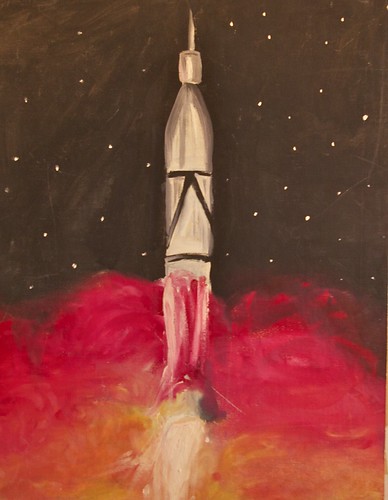
The earliest thing I can put my finger on is this painting I did as a child:
There’s no date on it, but I’d guess I did it when I was eight or nine. I was somewhat older when I did this painting, though it too is undated:
The technique says I was older, as does the medium. This one is in oil paints while the other is in tempera. I used tempera for the first year or two when I took art lessons; then my teacher, Glenn Brougher, moved me to oils.
I’d guess that I painted the second one from a photograph. It depicts a Jupiter-C launch vehicle (compare with the photograph here; notice the painted markings).
Thursday, February 21, 2019
First Man, a remark or two on how it achieves its effects
I saw First Man last fall when it came out. Last night I saw it again, on a large TV. I find it impressive, still. As I argued last year, the film reaches for a sense of the sacred. It’s not an action-adventure film, though there is adventure in it, and action too. It’s more contemplative.
How does it work? That’s what my few remarks are about.
The film opens on Neil Armstrong, the protagonist, in a test flight of an airplane. While we do have some shots of the plane from the outside and at a distance, most of the shots are of the planes cockpit, either from Armstrong’s point-of-view has he looks about the cockpit, often at his hands activating controls, or through the window at the sky. There’s trouble, the image vibrates, a reflection of the plane’s motions. We hear voices (I think). We know Armstrong’s going to pull out of it because, well, after all, he did go to the moon and that’s not yet happened. There’s a strong sense of being enclosed, being trapped, of being at the edge of desperation.
No sense of wide open spaces, no wild blue yonder.
And then it’s over. Armstrong lands the plane, gets out, and the film moves to a different register.
Now we see Armstrong and his wife dealing with Karen’s cancer (his young daughter) – I assume it was cancer, perhaps we’re told, but there’s radiation treatment. We see Neil playing with Karen; we see her playing. And then we hear the sound of a winching lowering a small casket into a grave; we see Armstrong, his wife, and so at the funeral.
And then it’s over. The film moves to a different register. We see Armstrong at work, in his office. His boss offers him time off, which he declines. He wants/needs to work. He scans his desktop, see a NASA newsletter with a story about the Gemini program. He decides to apply.
Was that decision a response to, a way of coping with, his daughter’s death? Who knows – and the scope of that question is strictly within the film itself and has nothing to do with the real Neil Armstrong, though, of course, this is a biopic about him. Armstrong doesn’t say that he’s applying to Gemini because his daughter has died. He says nothing at all about why he applied. He just does.
But the film creates a connection by virtue of its narrative strategy. First we see a dicey test flight. And then we cut to Karen’s illness. No causal connection is asserted or implied there, nor would I think that anyone infers cause. All we have is sequence, juxtaposition.
That’s all we have. Which is the point. Within the imaginative space that is First Man, that’s what we’ve got. Two things: a test flight, a death in the family. And then a third: Armstrong applies to Gemini.
Let’s skip over most of the film. What’s the last thing we see Armstrong do on the moon? He drops Karen’s identity bracelet into a crater. That action asserts a connection between his daughter’s death and his decision to enter the astronaut program. And that connection is how this film asserts the sacred quality of walking on the moon. The next shot has him safely back on earth. And then he’s in quarantine, where he meets his wife. They cannot touch, directly, but they touch the window separating them in the same spot. No talk.
And the film ends.
I skipped a lot, but I don’t intend to fill that in, not here, though I’m inclined to think that there is value in describing what happens all the way through, scene by scene, perhaps even shot by shot. But this is not the place to attempt that.
To a first approximation we see the juxtaposition of Armstrong’s professional life as an astronaut and his private life as husband and father, of (now) two sons. These narrative strands move in parallel.
And they collide just before Armstrong is to go to the moon. He’s packing his bags and hopes to slip out of the house without talking to his sons. His wife won’t allow this. She knows that he might not return, as does he, and wants him to acknowledge that to his sons. He talks with them and acknowledges that, yes, he might not return.
But he does return, after he’s left his daughter’s identity bracelet on the moon. Does he tell anyone about that? Who knows? But likely not.
And that’s how Chazelle, the director, creates a sense of the sacred – where I’m using Chazelle as a figure for the collective entity that created this film. Just why that creates the effect that it does, that’s worth thinking about. But not here, not now.
* * * * *
My other posts on First Man:
Thursday, September 7, 2017
Summer 1981, When I advised NASA on their computing infrastructure
|
Something I painted when I was, oh, nine or ten. See that meteor streaking at the upper right? My teacher, Glenn Brougher painted that. How do I know? The brush strokes. He had a deft hand. I didn't, not at that age. |
It wasn't just me, of course. There was a bunch of us. It happened like this...
Sometime in the spring of 1981 I learned that NASA was offering 10-week summer fellowships for college and university faculty. I was at RPI, in Troy, New York, at the time. Most of the fellowships were to pursue research in some area of interest to NASA; you’d travel to of NASA’s centers and work with their people and their facilities. As I studied literature and cognition those fellowships weren’t relevant to me. NASA did not have a center for the study of extraterrestrial myths, tales, and epics.
Sometime in the spring of 1981 I learned that NASA was offering 10-week summer fellowships for college and university faculty. I was at RPI, in Troy, New York, at the time. Most of the fellowships were to pursue research in some area of interest to NASA; you’d travel to of NASA’s centers and work with their people and their facilities. As I studied literature and cognition those fellowships weren’t relevant to me. NASA did not have a center for the study of extraterrestrial myths, tales, and epics.
But one fellowship was different. It was sponsored by the Goddard Spaceflight Center in conjunction with the University of Maryland and had an intriguing title: Computer Science: Key to a Space Program Renaissance. Man, thought I to myself, I want a piece of that! The idea was to study NASA’s computer infrastructure and make recommendations for improving it. That interested me and, having done a bit of work on an Air Force contract not so long ago (see this recent post, Metagram Software - A New Perspective on the Art of Computation) I figured I had a relevant credential or two – there was my work on knowledge representation as well. So I applied and was accepted.
The University of Maryland had a conference center high on a cliff overlooking the mouth of the Susquehanna River about an hour northeast of Baltimore. I arranged to spend my first week at the conference center and then the other nine weeks in Baltimore, near the Homewood Campus of The Johns Hopkins University, where I’d gone to school. I arranged to get some kind of visiting appointment at Hopkins so I’d be eligible for university housing.
Come the first week of June 1981 I packed my car, including my new NorthStar Horizon computer (I wrote about it here) and headed to Maryland.
The conference center was at an estate that had once belonged to an industrialist named Donaldson Brown. Large rooms, oriental carpets on the floor, decent food, wonderful setting. The stables had been converted into bedrooms and I booked a room there for the first week. Most of the fellowship holders stayed there the whole time.
This was going to be interesting, perhaps even fun.
* * * * *
Full-time study personnel consisted of 19 faculty fellows, a handful of NASA administrators, and eight support staff. In addition to that there was a whole passel of NASA people who showed up for varying periods of time, some for a day or a couple of days, some for a couple of weeks or more. They were from NASA centers across the country and represented all functions, space science, weather and atmospheric science, satellite design and fabrication, spaceflight (vehicle design, fabrication, launch, and tracking), and so forth. NASA brought in academic and industry experts from all aspects of computing who came by for a morning or an afternoon, perhaps a day, to lecture and talk. We also had visits to various to Goddard Spaceflight Center in Maryland and NASA Headquarters in Washington, D.C.
There was A LOT going on. A lot of balls to keep in the air.
To what end?
The previous year a small team of academics, including Marvin Minsky and Carl Sagan, had reviewed NASA’s computing facilities and issued a report, bound in red covers, Machine Intelligence and Robotics: Report of the NASA Study Group. They declared NASA’s computing infrastructure to be below standard. NASA, the folks who landed humans on the moon and brought them back, a computing backwater.
There is more. NASA had been formed for that moon mission; everything else was dross, or gravy, depending on your POV. Along the way NASA had also developed scientific missions – tracking earth’s weather and geography, deep space probes, telescopes – but the moon shot was the heart and soul of the organization. That was over. The Apollo program had ended in 1972. It was a fabulous success of course, but what next?
What next was the Space Shuttle program, "Space Transportation, Inc." That wasn’t so sexy. Important, but it lacked heart, Nietzschean levity.
Consequently, NASA had a morale problem. Some of their best people were leaving. What to do?
The people who’d organized this – Stan Sadin at NASA headquarters, Paul Schneck at Goddard Spaceflight Center, and Raymond Yeh from the University of Maryland – figured that perhaps if NASA were to inject some top-flight computing technology into its programs, including AI, that might help alleviate the morale problem.
That impressed me, it impressed me a lot, that NASA officials had arranged this, really, to address the organization’s morale problem. How intangible. How vital.
And that was our charge, to give these managers the documents they needed to set about improving NASA morale by upgrading NASA’s computing infrastructure. Of course, they never said that in so many words, but it’s clear that that’s what was afoot. That’s what consultants are hired to do, give the people who hire them the ammunition they need to make changes they already more or less know they have to – or, at any rate, want to – make. Sure, we were brought in as faculty fellows to do research, hands across the sea, university faculty working hand-in-glove with NASA researchers advancing human knowledge, that was the pretext. But the mission was straight-up consulting. We all knew it. That’s why we were there.
Friday, December 2, 2016
An Executive Guide to the Computer Age
Another document uploaded to Academia.edu: https://www.academia.edu/30219563/An_Executive_Guide_to_the_Computer_Age
William Benzon, "An Executive Guide to the Computer Age." Raymond T. Yeh and Paul B. Schneck, Co-Directors, Computer Science: Key to a Space Program Renaissance: Final Report of the 1981 NASA/ASEE Summer Study on the Use of Computer Science and Technology in NASA. University of Maryland, Computer Science Technical Report Series, No. 1168, Vol. II: F-1 - F-14, January 1982.
Abstract: Computing technologies have the potential to radically transform the way we live. Such a transformation is not inevitable, nor is it necessarily good. The purpose of this paper is to place this possibility into its proper historical perspective and to consider, in a general way, how one plans for it. The first section considers the place of the "Information Age" in history, suggesting that it is the fourth major transformation in human cultural evolution. The next section develops a five-dimensional metaphor outline certain basic factors which may be considered in a strategic plan for the use of computing technology. The final section discusses a specific aspect of that planning – the relationship between computing and productivity – and suggests that the transforming power of computing technology lies in the possibility of dramatically increasing productivity as intelligent computer becomes routine and reliable.
Subscribe to:
Posts (Atom)