I’m bumping this post from 2013 to the top of the queue, both on general principle, and as a reminder that we need some Buddhist wisdom in the world today.
Tuesday, April 22, 2025
Conjunctions on the Autumn Equinox [Shinnyo-en at St. Bartholomew’s Church]
Saturday, December 7, 2024
They say it's my birthday, and it is. [+ Bertrand Russell]
77
Here’s what I posted on my 76th birthday, an update of a long post I did on my 70th: Reflections on entering my eighth decade and why it portends to be the most productive one of my life. Between now and back then there have been times when I thought that title was nuts. “The most productive one of my life!?” No way. But those periods always pass. FWIW, I had more New Savanna posts last year than in any previous year, 1004. The next highest was 2019, with 910. When this is posted I’ll have 968, and then year isn’t over. Of course, number of blog posts is a superficial measure of productivity. What matters are idea. We’ll see.
* * * * *
Since I’ve been thinking about Bertrand Russell and he was a hero of mine in my youth, I thought I’d post some excerpts from his Playboy interview from March 1963, not half a year after the Cuban Missile Crisis in October 1962. I would have been 15 when that issue was published and may well have discovered Playboy by that time. I’d have to walk, I don’t know, maybe as much as a mile, to get to a store where I could buy it and then sneak it back into the house.
In his introduction to the interview, Norman MacKenzie notes that Russell played a small role in bringing it to a close. This is from the interview itself:
PLAYBOY: What do you believe was the effect of your own personal intervention with Khrushchev via your much publicized cable appealing for Russian prudence in responding to the American blockade of Cuba?
RUSSELL: He carried out the promise he made in the letter replying to my cable -- the promise to do nothing rash that would risk conflict. Within hours of my communication, 12 Soviet ships had turned back from their Cuban destination and Khrushchev had stopped further shipment. This left Cuba illegally blockaded in violation of international law. I believe that if a blockade is defensible when applied to Cuba, then the precedent can be applied also to Berlin and even to Britain, which is an advanced American nuclear base. America should remember the War of 1812 when the United States would not tolerate a British blockade. This is the very heart of what I have been saying for years: If nuclear bases are intolerable in Cuba, then they are intolerable anywhere in the world. Nuclear bases threaten the survival of mankind and the Cuban crisis has shown us how very close we are to annihilation.
Are there any current intellectuals who have such influence? Later in the interview:
PLAYBOY: In 1957 you wrote in The New Statesman, the liberal British journal, an appeal to Premier Khrushchev and then-President Eisenhower for just such a lessening of world tension, to which both the Russian leader and John Foster Dulles responded with public reassurances. Six years have elapsed since then without a noticeable decline in global strife and division. At this critical moment in the cold war, would you care to make another such appeal, perhaps suggesting specific ways in which relations can be improved?to Khrushchev and President Kennedy?
RUSSELL: If I were to make another such appeal, I would have to begin by repeating what I said in 1957. I should say simply to both men: “You seem anxious to destroy the world, to create vast misery and total destruction. All this preparation for war is childish and suicidal. If you could only begin to tolerate each other, you would be perfectly happy.” I would go on to suggest that the overridingly urgent necessity is to come to an agreement. This is far more important than the precise form the agreement takes. Last summer, I sent a message to Moscow in which I expressed the wish that in all negotiations between East and West, the negotiator for the Communists should begin by saying that the universal victory of capitalism would be less disastrous than nuclear war. At the same time, the Western spokesman should start by admitting that the universal victory of communism would be preferable to the destruction of mankind. In a speech last July, Khrushchev singled out this suggestion and said that he entirely agreed. I was rather pleased. I would suggest further that the likelihood of war could be lessened immeasurably if both sides would place a great deal more emphasis on the ghastly destructiveness of war. At present, the major organs of publicity in both East and West are inclined to make the public believe that nuclear war wouldn’t really be so terrible after all. That is why I am opposed to Civil Defense preparations. They are diabolical inventions calculated to tell lies and to deceive. Everyone who knows anything knows that. People may think themselves safe in their deep shelters but they will roast. Governments must be made to give up the habit of lying in order to persuade people to die quietly. Thirdly, I would strongly recommend an agreement on both sides not to teach that the other side is wicked. For Americans, communism is the Devil; for the Russians, capitalism is the Devil. The truth is that neither is wickeder than the other. They are both wicked.
I have lived in the pursuit of a vision, both personal and social. Personal, to care for what is noble, for what is beautiful, for what is gentle, to allow moments of insight to impart wisdom in mundane times. Social, to envision in imagination, an attainable society in which the individual can grow freely, in which hate and greed and envy will die because there is nothing to nourish them. These things I still believe. So you can see that the world, for all its horrors, has left me unshaken.
Friday, November 3, 2023
Jamming for Peace [Iraq in 2003]
I wrote this on March 24, 2003, two days after the event it describes, a protest march in Manhattan. We were protesting invasion of Iraq. In view of the current state of war in the Middle East I thought it worth bumping to the top of the queue.
Thursday, January 5, 2023
The Evolution of Peace
Abstract: While some species have affiliative and even cooperative interactions between individuals of different social groups, humans are alone in having durable, positive-sum, interdependent relationships across unrelated social groups. Our capacity to have harmonious relationships that cross group boundaries is an important aspect of our species’ success, allowing for the exchange of ideas, materials, and ultimately enabling cumulative cultural evolution. Knowledge about the conditions required for peaceful intergroup relationships is critical for understanding the success of our species and building a more peaceful world. How do humans create harmonious relationships across group boundaries and when did this capacity emerge in the human lineage? Answering these questions involves considering the costs and benefits of intergroup cooperation and aggression, for oneself, one's group, and one's neighbor. Taking a game theoretical perspective provides new insights into the difficulties of removing the threat of war and reveals an ironic logic to peace—the factors that enable peace also facilitate the increased scale and destructiveness of conflict. In what follows, I explore the conditions required for peace, why they are so difficult to achieve, and when we expect peace to have emerged in the human lineage. I argue that intergroup cooperation was an important component of human relationships and a selective force in our species history in the past 300 thousand years. But the preconditions for peace only emerged in the past 100 thousand years and likely coexisted with intermittent intergroup violence which would have also been an important and selective force in our species’ history.
Friday, July 29, 2022
Playing for Peace: Reclaiming Our Human Nature
Charlie Keil and I have a new book out (title above). It’s the third book in our series, Local Paths to Peace Today. The first two are: We Need a Department of Peace: Everybody's Business, Nobody's Job and Thomas Naylor’s Paths to Peace: Small is Necessary. Steve Feld thinks it’s the greatest thing since sliced bread:
Who says a peace manifesto can’t be deep fun? The wisdom of collaborative practice rings bells on each page here, inviting us to dance in the streets of a world still within reach. Get with the beat of this drum!
You can buy it here:
Amazon: https://tinyurl.com/4p67bahh
Barnes & Noble: https://tinyurl.com/5vjf3kjt
Google Play: https://tinyurl.com/39rz43vp
Kobo eReader: https://tinyurl.com/5bmkjsme
Contents
Thriving and Jiving Among Friends and Family: The Place of this Volume in the Peace Series
Common Glad Impulse
What’s the Point If We Can’t Have Fun?
Paideia Con Salsa
Dance to the Music: The Kids Owned the Day
Jamming for Peace
The Hungry March Band helps Hoboken Celebrate Public Control of Its Waterfront
Peace & Joy Unlimited: The Festive in Everyday Life
Global Green Basics
Reclaiming our species being: Humo Ludens collaborans
Appendix A: Greening the Population Issue
Appendix B: Organizations Charlie’s supported
Appendix C: A trifecta from Charlie Keil on the need for a Global Organization of Democracies
Brief synopsis of each chapter
Thriving and Jiving Among Friends and Family: The Place of this Volume in the Peace Series – In 1930 John Maynard Keynes famously predicted that we were heading to a world in which people only worked 15 hours a week. That hasn’t happened. Why not? Perhaps it’s because we (adults) have become so used to work, even at meaningless jobs, that we don’t know what else to do with our time. We need to become more involved in active music-making.
Common Glad Impulse – William Henry Hudson is perhaps best known for his 1904 novel, Green Mansions, which was made into the 1959 film starring Audrey Hepburn and Anthony Perkins. The novel was drenched in love for the natural world, which Hudson cultivated in his career as a naturalist. This section contains a passage from The Naturalist in La Plata, in which he asserts that “birds are more subject to this universal joyous instinct than mammals,” an instinct he termed “the common glad impulse.” That common glad impulse is at the heart of this book.
What’s the Point If We Can’t Have Fun? – The late David Graeber argues that fun IS at the heart of animal life, human as well. He asks: “Why does the existence of action carried out for the sheer pleasure of acting, the exertion of powers for the sheer pleasure of exerting them, strike us as mysterious?” He argues that we’ve got it all wrong, from the ground up. Economics – survival of the fit and all that – though important, fails to explain life. Why not reground the whole story on pleasure and play, in freedom. Graeber outlines how we can get started. ”We can understand the happiness of fishes—or ants, or inchworms— because what drives us to think and argue about such matters is, ultimately, exactly the same thing.”
Paideia Con Salsa – Charlie Keil proposes the people need (at least) three layers of cultural awareness, practice, and loyalty: 1) local, the most intense and richly developed, 2) regional, and 3) a thin layer of planetary culture “so that regions or the peoples within regions do not drift back into aggressing, aggrandizing, state-building, and empire expanding.” The local level could be organized around an Afro-Latin music-dance curriculum, a “paideia con salsa,” that could be seeded at the start and then allowed to grow and flourish as it will. To that end he proposes a pilot project oriented toward the “three Ms” – music, motion, morality – that were the foundation of Ancient Greece’s golden age. A curriculum would be developed and deployed in several local schools and the results studied, refined, and further disseminated.
Dance to the Music: the Kids Owned the Day – Bill Benzon: You know about competitive dance, right? Dance studios compete locally and regionally for prizes, trophies and glory. It’s late afternoon at one such competition in suburban New Jersey. The competition is over, the kids are just hanging out, and then suddenly and spontaneously they begin to dance to hip-hop booming on the sound system, kids, tweens, and teens, all of them, in the aisle, between rows of seats, 100, 200 of them. That’s the world of competitive dance at its best.
Jamming for Peace – Bill Benzon: There was a big peace demonstration in New York City on March 22, 2013. I was there with Charlie Keil; he had a cornet, I had my trumpet. Thousands and thousands of people marching down Broadway. Lots of musicians, mostly drumers, but other horn players as well. We moved from place to place hooking up with various musicians. Sometimes spontaneous magic broke out and a thirty yard swath of people became one in the beat. We ended on “All You Need Is Love.”
Peace & Joy Unlimited: The Festive in Everyday Life – Charlie Keil argues for guiding and coaching children in singing and dancing as early in life as possible, as often as possible. They need to develop their “festive skills” – mocking the dark side, identifying with spirits, birds, animals and plants, drumming, singing, dancing the seasons and Nature's cycles, horn tooting, honk festing, joke telling, miming, rhyming, funny walking, looking ashamed, goofy talking. “They don't have to be taught. They just have to be done, for fun, to enhance primary communication in daily life.” Suggestions for things you can do at home, now.
Global Green Basics – Angeliki V. Keil lays out the core of a “green”, that is sustainable, communally responsible, and joyus approach to living with one another, with other species, plant, animal, microbial, and with the Earth. Establish living areas for all, encourage local self-sufficiency, foster democracy at all levels of organization, renounce governmental debt, renounce war, foster the survival of all cultures, East and West, North and South, halt pollution, renounce nuclear technology, encourage scientific inquiry, revamp science education, and facilitate the free flow of individuals and information. Start now. “We only need to commit our hopes, faiths and love, especially in the form of the actual sharing of resources, to help us over the ensuing dislocations.”
Reclaiming our true species being: Humo Ludens collaborans –- Food for Thought – Charlie Keil has created an exploratory listing of thoughts, directions, provocations, wishes, what have you, pointing toward a re-creation of our local social being in terms of our most basic species being: Humo Ludens collaborans.
Appendix A: Greening the Population Issue – Linda Cree lays out the basic rationale for reducing the population as a necessary step to long-term sustainability.
Appendix B: Organizations Charlie’s supported – With links to where you can find them on the web.
Appendix C: Toward the GOOD, a Declaration of Interdependance and An Appeal
Friday, August 6, 2021
Thriving, Jiving, and Jamming Among Friends and Family
I am in the process of preparing the third volume in the peace series that Charlie Keil and I have been publishing: Playing for Peace: Reclaiming our Human Nature. The purpose of this introduction is to place this volume in the context of the series as it exists so far. However, it is a more or less complete statement in itself and so can stand as an independent essay. For that reason I am publishing it here on New Savanna without any edits.
* * * * *
This is the third volume in our series, Local Paths to Peace Today. The series is based on the premise that the tremendous growth that accompanied the Industrial Revolution, starting in the Eighteenth Century, going into the Nineteenth, and continuing up to the present day in a somewhat different (high technology) mode, that growth spurt has taken us as far as we can morally allow, and it is time for us to adopt a new way of being in the world. We acknowledge that, yes, that growth has lifted hundreds of millions of people out of poverty, produced cures for many diseases, and made an unprecedented range of material goods available to many. But it has also ruined large swaths of the Earth’s landmass, polluted the oceans, and is inducing global warming that threatens the lives of many species, not just humans. Lastly, it has produced populations of ‘civilized’ peoples who are rapidly losing the capacity for joyous play with one another.
In our first volume, We Need a Department of Peace: Everybody's Business, Nobody's Job, we addressed the problem of war, which kills and maims millions of people, consumes untold resources, and harnesses millions of people to the war machine, either directly through participation in the military, or indirectly through the manufacture of war materials and support of wars. Setting aside the Korean War, the United States as arguably been the most aggressive nation in the world, fighting destructive and wasteful wars in Vietnam, Iraq, Afghanistan and other places. We argued that the government should create a Department of Peace whose mission is to propose and plan peaceful solutions to international conflict.
Our second volume focused on the work of economist Thomas Naylor: Thomas Naylor’s Paths to Peace: Small is Necessary. Naylor argued that too many organizations in the world, private corporations, but particularly nations, are too large. Largeness breeds inflexibility, where a flaw in one part of a tightly coupled system can threaten the entire system, as happened in the 2008 collapse of the global financial system. Moreover largeness in nations threatens cultural diversity. Thus there are over 200 secessionist movements driven by a desire for cultural autonomy. The former Soviet Union devolved into smaller nations three decades ago. Should the United States do the same? (Naylor suggests that 20 would be about right.)
Now we turn our attention to our fundamental human nature, which is grounded in music and dance: Playing for Peace: Reclaiming our Human Nature. I want to set the problem with a classic essay by the economist, John Maynard Keynes, in which he predicted that by now we would have a 15 hour work week. What happened to that? Then I want to look at music and dance as the fundamental basis of human nature. We can move toward and ending by considering the concept of a moralnet, which cross-cultural anthropologist Raoul Narroll argued was the fundamental building block of human society. We then conclude where we began, with Keynes.
What Happened to the 15-hour Work Week?
Ezra Klein recently interviewed anthropologist James Suzman in The New York Times [1]. Suzman has done fieldwork among hunter-gatherers and had just published a book, Work, A Deep History from the Stone Age to the Age of Robots. Klein begins by mentioning a famous essay John Maynard Keynes published in 1930, “Economic Possibilities for Our Grandchildren [2].” Keynes predicted, among other things, that by 2030 advanced technology would have solved the problem of scarcity so effectively that people would only have to work 15 hours a week. While Keynes wildly underestimated how wealthy people would become in the future (that is to say, now). But, not only are we not working a 15-hour week, but
in an inversion of past history, the more money you make now, the more hours you generally work. It used to be the point of being rich was to not work. And now we’ve built a social value system. So the reward for making a lot of money at work is, you get to do even more work.
How did that happen?
Here’s what Klein says:
And the overarching argument is that the way we work today isn’t driven by what we need. It’s driven by what we want. It’s also driven by how, socially, we regulate or encourage wants, which is part of where [Suzman’s] research on hunter-gatherers and how they approach this comes in. [...] as we’ve gotten richer and built more technology, we’ve developed a machine not for ending our wants, not for fulfilling them, but for generating new ones, new needs, new desires, new forms of status competition.
Klein of course is talking about our ‘keep up with the Jones’s’ consumerist society.
Moreover, as Suzman argues, our society is relentlessly oriented toward the future in a way that robs us of our ability to experience satisfaction in the present. He points out, in the first place, that hunter gatherer’s are fiercely egalitarian. Goods are shared relentlessly among one’s fellows so that no one ever has a material advantage over another and so cannot use that to exercise power.
Paradoxically, it is the very fragile nature of the hunter-gatherer existences that allows them to feel that they live in a generous world. As long as the needs of the day are met, they are satisfied. They see little need to accumulate goods for the future. In contrast, the life of a farmer is very different:
Now the transition to farming was very, very different. Where hunter-gatherers viewed their environments as inherently provident, as almost generous, as something which gave them, farming, you have to view your environment as only potentially provident. For it to be provident, you have to invest your labor into it.
But investing your labor into land in order for it to provide you with something to eat involves a time scale. If we use, for example, the early wheats that were grown in the first populations to embrace agriculture in the Levant, you have a seasonal cycle. You plant the seeds in the spring. You then have to nurture and look after the crop and water it and so on and so forth, nurture it over several months, then process it, and eventually, maybe by New Year’s Eve, you might have a loaf of bread out of it. Everything is focused on future rewards.
Workers of the Industrial Revolution, whether on the factory floor or in the executive suite, have inherited that future orientation. Nor should we forget that it wasn’t until relatively late in the Industrial Revolution that most workers were agricultural workers. It is only in the late nineteenth and early twentieth centuries that masses of people left the country-side to work in cities.
That is the world we live in today, even as automation and robotics take over more and more jobs and will continue to do so for the foreseeable future. We live in a society that has been designed to keep us working so that we can satisfy and unending series of culturally-induced needs. How do we live among plenty? By working ourselves to death? Is that the plan?
We need to get off the treadmill. In the large, we’re killing the earth with this endless panoply of over elaborate and inane goods and services we’re producing and consuming. We’ve got to get off our war economy, in part by creating a Department of Peace, and, following the wise advice of Thomas Naylor, we need to downsize everything. For ourselves, we’ve got to follow the birds and cultivate the “common glad impulse” that William Henry Hudson extoled (see The Common Glad Impulse). We have to remake ourselves into more joyous and generous souls.
Jump for Joy
Musicking, that is to say, music and dance, that is the best way for us to jump for joy. And that, jumping for joy, is how a bunch of clever apes became human beings. At least that’s the argument I advanced in Beethoven’s Anvil: Music in Mind and Culture (2001). The argument is hardly original with me. Darwin believed something like that, and so did Jean-Jacques Rousseau.
At the time I wrote the book it was believed that humans were the only creatures that synchronized their movements in that way. Since then we’ve discovered otherwise. For one thing, videos started showing up on YouTube, which didn’t exist when I was writing the book, where cockatiels could be seen synchronizing to background music. Annirudah Patel took it into the lab and verified that, yes, cockatiels could synchronize to the beat the same way humans did [3]. Score one for William Henry Hudson’s common glad impulse.
A lot depends, of course, on just what we mean by synchronize. Flocks of birds and schools of fish are certainly tightly synchronized when they move almost as one as they the swerve, turn, and swirl. While the neural mechanism is probably not the same as that involved in human drumming and dancing, or cockatiel grooving for that matter, that, in the larger picture, is a secondary matter. The Big Picture is simple: We are creatures of time, all of us. We’ve all got our own grooves and rhythms.
Why, then, you ask, did I bother to argue that grooving is what transformed apes into humans? Because the Big Picture isn’t the only picture. There are many smaller pictures, and they’re all different. Birds may do it, fish may do it, but monkeys and apes do not, not until we came along. Why did we do it? Because we’re smart. And when you’re smart you’re aware. And when you’re aware you sense danger all around you, even when it’s not there. You make up things, your super-smart ever-aware mind makes things up, and likely as not it makes up spooky scaring things. They’re uncomfortable, they make us feel anxious. That’s not good.
Friday, July 9, 2021
Is the era of interstate warfare coming to an end? [We need a department of peace]
John Mueller, War is on the Rocks, War on the Rocks, July 1, 2021.
War, or at least interstate war, is on the rocks. Developed countries have managed to avoid major conflicts with one another now for 75 years — perhaps the longest such hiatus in history. And in recent decades, less developed countries have followed suit. Indeed, over the last 30 years, there have been only four interstate wars, conventionally defined as conflicts with at least 1,000 battle-related deaths per year. One was waged by Ethiopia and Eritrea in the last years of the 20th century. One was waged last year by Azerbaijan and Amenia. And the others were the brief regime-toppling invasions by the United States of Afghanistan and Iraq that then devolved into extended counterinsurgency — or counter-occupation — conflicts.
If this condition continues to hold, it would be one of the most important developments in human history. All the more remarkable, the shift away from interstate war appears to be the result not of changing geopolitical circumstances but of changing attitudes toward war itself. It took two world wars, but aversion to interstate war eventually conquered Europe and now is on track to envelop the world. Civil wars may continue, and states may still grapple with each other at less lethal levels. But the time may have come for us to accept the fact that interstate war is merely an idea, an institution that is scarcely required by international society. As Yale’s Robert Dahl pointed out decades ago, “Most social scientists have turned away from the historical movement of ideas.” But in doing so, they may “leave out an important explanatory variable.”
A Culture of Interstate Peace
The European continent took the lead in the turn away from war. It was once the most warlike of continents — Thomas Jefferson, for example, proclaimed it to be “an arena of gladiators.” But since 1945, Europe has been free from substantial interstate warfare for probably the longest period of time since the continent was invented as a concept some 2,500 years ago. Writing in 1986, historian Evan Luard suggested that this was “perhaps the single most striking discontinuity that the history of warfare has anywhere provided.”
That discontinuity has continued, and it demands explanation. In my opinion, it primarily reflects the fact that over the course of the 20th century, a significant shift has taken place in attitudes toward interstate war. Before World War I, it was common, even routine, for serious writers, analysts, and politicians in Europe and North America to exalt war between states as beautiful, honorable, holy, sublime, heroic, ennobling, natural, virtuous, glorious, cleansing, manly, necessary, and progressive. At the same time, they declared peace to be debasing, trivial, empty, bovine, and rotten, characterized by crass materialism, artistic decline, repellant effeminacy, rampant selfishness, base immorality, petrifying stagnation, sordid frivolity, degrading cowardice, and corrupting boredom. After 1918, however, such claims were scarcely ever voiced.
It is not completely clear why World War I was such a turning point. There had been plenty of massively destructive wars before, often fought to the point of complete annihilation. Many of these were equally futile, stupid, and disgusting as well — mud, leaches, and dysentery were not invented in 1914. One possibility is that World War I was the first war in history to be preceded by substantial, organized agitation against interstate war. At times, people in this growing movement even thought it was on the verge of success. In 1911, for example, the distinguished British historian G. P. Gooch concluded hopefully, “We can now look forward with something like confidence to the time when war between civilized nations will be considered as antiquated as the duel.” However, this was still very much a minority movement, and it was largely drowned out by those who exalted war. Nonetheless, its gadfly arguments were persistent and unavoidable, and this may well have helped Europeans and North Americans to look at the institution of international war in a new way after the massive conflict of 1914 to 1918. At any rate, within half a decade, opponents of interstate war, once a derided minority, became a decided majority.
There were, however, two countries that, in different ways, did not get the message. One was Japan — a less developed but increasingly powerful state that had barely participated in World War I. Many people there could still enthuse over war in a manner than had largely vanished in Europe. It took a cataclysmic war for Japan to learn the lessons almost all Europeans had garnered from World War I. The second country was Germany. In contrast to Japan, however, it appears that only one person there was willing to embrace international war, but he proved to be crucial. As military historian John Keegan argues, “Only one European really wanted war: Adolf Hitler.” For historian Gerhard Weinberg, Hitler was “the one man able, willing, and even eager to lead Germany and drag the world into war,” while William Manchester observes that the war Hitler started was one “he alone wanted.” Indeed, Hitler was successful in the 1930s in part because no one else on the continent could imagine that anyone could possibly be so stupid as to desire war. That is to say, but for Hitler, the massive war there would likely never have come about.
World War I, then, shattered what some have called the “war-like spirit” in Europe and North America. It made large majorities there into unapologetic peace-mongers — at least with regard to interstate war. World War II, it appears, reinforced that lesson in those places, probably quite unnecessarily, and it converted the previously militaristic Japanese in Asia. And of late, the aversion to interstate war has been embraced even more widely in international society.
Among the many consequences of this is a changing perception of power itself. “All historians agree,” observed Leo Tolstoy in 1869, “that states express their conflicts in wars and that as a direct result of greater or lesser success in war the political strength of states and nations increases or decreases.” That notion, it appears, has become passé. Prestige now comes not from prowess in armed conflict but from economic progress, maintaining a stable and productive society, and, for many, putting on a good Olympics, sending a rocket to the moon, or successfully managing a pandemic. The post-war success enjoyed by Germany and Japan provides further evidence that the culture of peace has transformed the very idea of “power” in international affairs.
There is more at the link.
Check out the book Charlie Keil and I put together: We Need a Department of Peace: Everybody's Business, Nobody's Job.
Wednesday, January 8, 2020
Johnny Don't Study War No More
Time to break out the anti-war/peace music.The New York Path to Peace has another video out, based on a traditional tune, When Johnny Comes Marching Home. Arranged by Steve Swell, it features Roswell Rudd on solo trombone. The photographs are from the Library of Congress and depict the battlefield at Gettysburg. A good many of these photographs were prepared in stereo-pairs, implying that they were intended for home viewing. Given the often grisly subject matter in these photos, that, I believe, makes them “war porn.”
Sunday, September 15, 2019
The way to peace is for American to give up the role of global bully
Four years ago, President Barack Obama denounced “the idea of endless war” even as he announced that ground troops would remain in Afghanistan. In his last year in office, the United States dropped an estimated 26,172 bombs on seven countries.
President Trump, despite criticizing Middle East wars, has intensified existing interventions and threatened to start new ones. He has abetted the Saudi-led war in Yemen, in defiance of Congress. He has put America perpetually on the brink with Iran. And he has lavished billions extra on a Pentagon that already outspends the world’s seven next largest militaries combined.
Like the demand to tame the 1 percent, or the insistence that black lives matter, ending endless war sounds commonsensical but its implications are transformational. It requires more than bringing ground troops home from Afghanistan, Iraq and Syria. American war-making will persist so long as the United States continues to seek military dominance across the globe. Dominance, assumed to ensure peace, in fact guarantees war. To get serious about stopping endless war, American leaders must do what they most resist: end America’s commitment to armed supremacy and embrace a world of pluralism and peace. [...]
In theory, armed supremacy could foster peace. Facing overwhelming force, who would dare to defy American wishes? That was the hope of Pentagon planners in 1992; they reacted to the collapse of America’s Cold War adversary not by pulling back but by pursuing even greater military pre-eminence. But the quarter-century that followed showed the opposite to prevail in practice. Freed from one big enemy, the United States found many smaller enemies: It has launched far more military interventions since the Cold War than during the “twilight struggle” itself. Of all its interventions since 1946, roughly 80 percent have taken place after 1991.
Why have interventions proliferated as challengers have shrunk? The basic cause is America’s infatuation with military force. Its political class imagines that force will advance any aim, limiting debate to what that aim should be. Continued gains by the Taliban, 18 years after the United States initially toppled it, suggest a different principle: The profligate deployment of force creates new and unnecessary objectives more than it realizes existing and worthy ones. [...]
Despite Mr. Trump’s rhetoric about ending endless wars, the president insists that “our military dominance must be unquestioned” — even though no one believes he has a strategy to use power or a theory to bring peace. Armed domination has become an end in itself. Which means Americans face a choice: Either they should openly espouse endless war, or they should chart a new course.
On its own initiative, the United States can proudly bring home many of its soldiers currently serving in 800 bases ringing the globe, leaving small forces to protect commercial sea lanes. It can reorient its military, prioritizing deterrence and defense over power projection. It can stop the obscenity that America sends more weapons into the world than does any other country. It can reserve armed intervention, and warlike sanctions, for purposes that are essential, legal and rare.
Shrinking the military’s footprint will deprive presidents of the temptation to answer every problem with a violent solution. It will enable genuine engagement in the world, making diplomacy more effective, not less. As the United States stops being a party to every conflict, it can start being a party to resolving conflicts.
Friday, February 15, 2019
The efficacy of nonviolent resistance
Recent research suggests that nonviolent civil resistance is far more successful in creating broad-based change than violent campaigns are, a somewhat surprising finding with a story behind it.
When Erica Chenoweth started her predoctoral fellowship at the Belfer Center for Science and International Affairs in 2006, she believed in the strategic logic of armed resistance. She had studied terrorism, civil war, and major revolutions — Russian, French, Algerian, and American — and suspected that only violent force had achieved major social and political change. But then a workshop led her to consider proving that violent resistance was more successful than the nonviolent kind. Since the question had never been addressed systematically, she and colleague Maria J. Stephan began a research project.
For the next two years, Chenoweth and Stephan collected data on all violent and nonviolent campaigns from 1900 to 2006 that resulted in the overthrow of a government or in territorial liberation. They created a data set of 323 mass actions. Chenoweth analyzed nearly 160 variables related to success criteria, participant categories, state capacity, and more. The results turned her earlier paradigm on its head — in the aggregate, nonviolent civil resistance was far more effective in producing change.
The Weatherhead Center for International Affairs (WCFIA) sat down with Chenoweth, a new faculty associate who returned to the Harvard Kennedy School this year as professor of public policy, and asked her to explain her findings and share her goals for future research. Chenoweth is also the Susan S. and Kenneth L. Wallach Professor at the Radcliffe Institute for Advanced Study. [...]
Based on the cases you have studied, what are the key elements necessary for a successful nonviolent campaign?
CHENOWETH: I think it really boils down to four different things. The first is a large and diverse participation that’s sustained.
The second thing is that [the movement] needs to elicit loyalty shifts among security forces in particular, but also other elites. Security forces are important because they ultimately are the agents of repression, and their actions largely decide how violent the confrontation with — and reaction to — the nonviolent campaign is going to be in the end. But there are other security elites, economic and business elites, state media. There are lots of different pillars that support the status quo, and if they can be disrupted or coerced into noncooperation, then that’s a decisive factor.
The third thing is that the campaigns need to be able to have more than just protests; there needs to be a lot of variation in the methods they use.
The fourth thing is that when campaigns are repressed — which is basically inevitable for those calling for major changes — they don’t either descend into chaos or opt for using violence themselves. If campaigns allow their repression to throw the movement into total disarray or they use it as a pretext to militarize their campaign, then they’re essentially co-signing what the regime wants — for the resisters to play on its own playing field. And they’re probably going to get totally crushed.
Sunday, February 3, 2019
Why is Switzerland so peaceful? – Good boundaries.
Abstract: We consider the conditions of peace and violence among ethnic groups, testing a theory designed to predict the locations of violence and interventions that can promote peace. Characterizing the model’s success in predicting peace requires examples where peace prevails despite diversity. Switzerland is recognized as a country of peace, stability and prosperity. This is surprising because of its linguistic and religious diversity that in other parts of the world lead to conflict and violence. Here we analyze how peaceful stability is maintained. Our analysis shows that peace does not depend on integrated coexistence, but rather on well defined topographical and political boundaries separating groups. Mountains and lakes are an important part of the boundaries between sharply defined linguistic areas. Political canton and circle (sub-canton) boundaries often separate religious groups. Where such boundaries do not appear to be sufficient, we find that specific aspects of the population distribution either guarantee sufficient separation or sufficient mixing to inhibit intergroup violence according to the quantitative theory of conflict. In exactly one region, a porous mountain range does not adequately separate linguistic groups and violent conflict has led to the recent creation of the canton of Jura. Our analysis supports the hypothesis that violence between groups can be inhibited by physical and political boundaries. A similar analysis of the area of the former Yugoslavia shows that during widespread ethnic violence existing political boundaries did not coincide with the boundaries of distinct groups, but peace prevailed in specific areas where they did coincide. The success of peace in Switzerland may serve as a model to resolve conflict in other ethnically diverse countries and regions of the world.H/t Tyler Cowen.
Friday, January 4, 2019
The Japanese Take Manhattan, Protest Nukes
Another bump, just as a reminder: Give Peace a Chance!
As it's the season for peace I thought I'd bump this one to the top of the queue.Yesterday (May 2010) I marched in my umpteenth protest march. This one was organized by United for Peace and Justice and took place in mid-town Manhattan, starting in Times Square and ending up near the United Nations building. As things would have it, this march turned out to be my first Japanese anti-nuke demonstration. It wasn't planned by the Japanese, nor was it planned to be Japanese, though Japanese organizations were intimately involved, e.g. the Japanese Trade Union Confederation (RENGO), and Mayors for Peace, an international organization started by the mayors of Hiroshima and Nagasaki. I expected this demonstration be like every other protest march I've been in these past few years – though, not, for example, on the scale of the March 2003 anti-war protest, the one that didn’t prevent the invasion of Iraq under the pretext that it harbored nukes. That is, I expected to be marching with mostly North American descendants of European immigrants, but with the visible presence of the Japanese and Koreans, among others.
At one point a block’s worth of marchers were singing "Peace Now!" along with us. Of course we didn’t know it – we were told by one of the dozen or so people who hooked up with us along the way – because we were in the middle of the crowd playing our keesters off. The most gratifying moment, however, came when a Japanese group passed us (we were playing from the sidewalk at that point) singing “We Shall Overcome.”
We joined them. Of course.
That’s music.
Saturday, May 26, 2018
Peace in our time?
This photo says it all. Leaders from North and South #Korea meet, embrace, talk. Trump can join or not. The peace train has left the station. #KoreaSummit @WomenCrossDMZ pic.twitter.com/dPw1qkUbtU— Medea Benjamin (@medeabenjamin) May 26, 2018
Friday, February 9, 2018
The Dalai Lama: Prayer isn't enough, we must act
Although I am a Buddhist monk, I am skeptical that prayers alone will achieve world peace. We need instead to be enthusiastic and self-confident in taking action.— Dalai Lama (@DalaiLama) February 9, 2018
Tuesday, August 16, 2016
The trouble with PEACE is FEAR
Tuesday, July 26, 2016
Ralph Nader endorses "We Need a Department of Peace"
Meanwhile, in the Twitterersphere:
@hipbonegamer @bbenzon @zenpundit I like what George Will said about this years ago: we have several institutes of peace: USMA, USNA& USAFA— Timothy Furnish, PhD (@Occidentaljihad) July 26, 2016
@bbenzon @hipbonegamer @zenpundit Either way, what they do is far more useful than the abstract, chimerical "study of peace."— Timothy Furnish, PhD (@Occidentaljihad) July 26, 2016
@bbenzon @hipbonegamer @zenpundit Right. Because the US has done so poorly in conflict the last 230 years.— Timothy Furnish, PhD (@Occidentaljihad) July 26, 2016
@bbenzon @hipbonegamer @zenpundit No one said anything about "bombing the world." Stop putting words into my mouth, er, Tweets.— Timothy Furnish, PhD (@Occidentaljihad) July 26, 2016
@Occidentaljihad @hipbonegamer @zenpundit What else have we got? Our ground game is not working. It's blowing us back to the Middle Ages.— Bill Benzon (@bbenzon) July 26, 2016
Purchase at Amazon.com (paperback, Kindle), or Barnes and Noble (paperback, NOOK Book).
Monday, July 25, 2016
Peace Now! War is Not a Natural Disaster
Monday, December 14, 2015
The Time Has Come for a Department of Peace
1. An office for butchering the human species.2. A Widow and Orphan making office.3. A broken bone making office.4. A Wooden leg making office.5. An office for creating public and private vices.6. An office for creating public debt.7. An office for creating speculators, stock Jobbers, and Bankrupts.8. An office for creating famine.9. An office for creating pestilential diseases.10. An office for creating poverty, and the destruction of liberty, and national happiness.
Tuesday, February 10, 2015
An Appeal to the Pope on Behalf of the Creatures in the Cosmos
Charlie Keil: Nice nesting and contexting Bill Benzon! ... I'll spread your commentary and the proposal around as far as I can reach into social media.Some comments:A big YES, to all those Firsts for Francis you list: First Jesuit, First Latin American, etc.And another big YES to making this appeal to people of all religions who will need to form an ecumencal alliance if humans are to turn away from war once and for all.A correction: be clear about the difference between "nations" (ethnic groups, tribes, those sharing values & traditions, peoples, who have a right to self-determination) and "states" (often, but not necessarily, the war-making enemy of anarcho-pacifists like myself and/or the enemy of nations trapped within states).Correcting myself in the light of your highlighting the original St. Francis as putting the Creation, the speciation, before us as God's other "book" to be praised and interpreted constantly. Just as "children's liberation" and full expression can not be accomplished without peace, neither can the diversity of species by saved, strengthened, praised and interpreted properly without ending wars, banning weapons of mass destruction, creating Peace in all meridiens.Bill Benzon: Thanks, CK. I was aware of the "nation" issue when writing the piece. Should have used "nation state" at every point.
Charlie Keil: I'd have to go back to each sentence to see if that would work. I think it is safest, from anthropological, self-determination of peoples, classless society, and human rights points of view to just talk about states as states, because there are so few states made up of just one nation. Even homogeneolus Japan has the Ainu up north, the Okinawans down south, and a long hidden Korean underclass or caste. Whenever you're tempted to use the phrase 'nation state' think of the Kurds existing in the corners of Turkey, Iraq, Iran, Syria and looking for self-determination since before the 1920s, or think of the 200 plus peoples caught in the trap that Lady Lugard named Nigeria.On Behalf of the Future, your phrase keeps me thinking of all the ways that a Papal Peace Initiative opens the key doors to preserving species integrity and diversity, increasing awareness of Children's Rights (European Network of Masters in Children's Rights), and reviving the very essence of Christianity and all the other major religions.Bill Benzon: Ah, but Charlie, THAT's why I use the "nation state" phrase. It's because the USofA was conceived as a nation-state that a large and important class of its inhabitants were defined as 3/5 of a person in the founding documents. Nation-states and nationalism go hand-in-hand. And this leads to a whole conversation about how people locate themselves in the world, aka identity, and that's larger than will fit in these little FB text blocks.
Friday, May 16, 2014
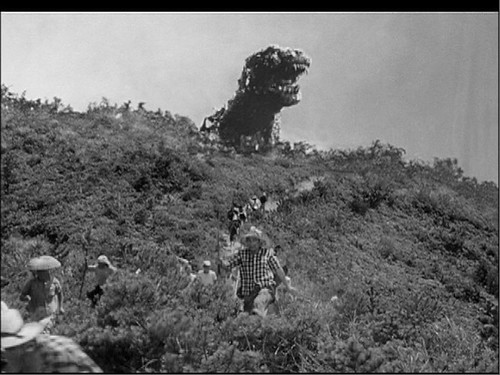
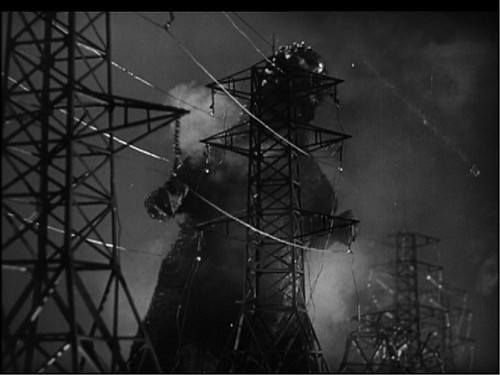
Over six decades ago - Gojira 1954
In honor of the latest Godzilla film, here's a blast from the past, a review of Gojira which I published in The Valve several years ago. This is the Japanese original of a film that appeared in America in 1956 as Godzilla, King of the Monsters, and scared the stuffing out of me when I was a kid. The Japanese original is richer. It came out less than 10 years after the end of WWII and about a century after Commodore Perry goaded the Japanese into investigating Western ways and refitting them into Japanese ways. Gojira has two interlinked storylines: the story about the monster from the sea and a story about love vs. arranged marriage. The second one was dropped from the American re-edit. In this essay I suggest — but no more than that, suggest — that the two storylines are, deep down, but one storyline. Here's a working paper on Gojira.
A review of Gojira, Ishiro Honda, dir. Toho Co, Ltd. 1954; reissued by Classic Media 2006.