Showing posts with label pinckney. Show all posts

Thursday, September 8, 2022

Obama’s Eulogy for Clementa Pinckney 1: The Circle of Grace

Another bump to the top. I wrote several posts on Obama's Eulogy for Clementa Pinckney and gathered them into a working paper, Obama’s Eulogy for Clementa Pinckney: Technics of Power and Grace, along with some other posts on the Black church. This is the first of those posts. I argue that the eulogy exhibits ring-form composition. I conclude with the complete text of the eulogy.
* * * * *
 
Make no mistake, it was a remarkable performance. Nominally a eulogy, very much a eulogy. But also a sermon on the past and future of race relations in America.

Though Rev. Pinckney’s funeral was held on June 26, and I heard of Obama’s eulogy shortly thereafter, and heard about it again, and again, I didn’t bother to watch it until a couple of days ago when I was reflecting on some remarks the economist Glenn Loury and linguist John McWhorter made about the ‘authenticity’ of Obama’s performance. After all, Obama wasn’t raised in the church. And yet he chose to don the vestments of a black preacher, the rhetorical and oratorical style, to deliver his eulogy.

I’ll get around to Loury and McWhorter in a later post. In this one I want to look at the eulogy itself, which pretty much took the form of a sermon addressed to the nation. In my preliminary analysis that sermon has five basic parts as follows:
1. Prologue: Address to his audience, quoting of a passage from the Bible.

2. Phase 1: Moves from the Clementa Pinckney’s life to the significance of the black church in history.

3. Phase 2: The murder itself and presence of God’s grace.

4. Phase 3: Looks to the nation, the role racism has played, and the need to move beyond it.

5. Closing: Amazing Grace.
In the course of this analysis I will be referring to specific paragraphs by number. I have appended the entire text to this post and have numbered the paragraphs. Furthermore, I have uploaded an analytical table I am using as I think about the text. Each paragraph appears in the table along with comments here and there. You may view or download this document here:

* * * * *

I want to begin by quoting from an article Michiko Kakutani published on July 4, Obama’s Eulogy, Which Found Its Place in History:
A draft of the Charleston eulogy was given to the president around 5 p.m. on June 25 and, according to Mr. Keenan, Mr. Obama spent some five hours revising it that evening, not merely jotting notes in the margins, but whipping out the yellow legal pads he likes to write on — only the second time he’s done so for a speech in the last two years. He would rewrite large swaths of the text.

Mr. Obama expanded on a short riff in the draft about the idea of grace, and made it the central theme of the eulogy: the grace family members of the shooting victims embodied in the forgiveness they expressed toward the killer; the grace the city of Charleston and the state of South Carolina manifested in coming together in the wake of the massacre; the grace God bestowed in transforming a tragedy into an occasion for renewal, sorrow into hope.
First, I would love to be able to compare Keenan’s draft with the eulogy that Obama delivered. Did that draft open with “Giving all praise and honor to God”? Did it quote Scripture at the beginning (Hebrews 11:13), as is typical of sermons? That is to say, did Keenan know he was drafting a sermon, or did that happen as Obama devoted five hours and who knows how many pieces of 8.5 by 14 lined yellow paper to the rewrite?
 
Kakutani is quite right to single out grace as the sermon’s theme. But Obama did more than use the word a lot – 35 times by my count. The word didn’t appear until about 1300 words in to this 3000 word sermon, that is, a bit before the mid-point. Roughly speaking, then, we can divide the sermon into two movements, 1) before “grace” and 2) after “grace”. Once we’ve done that the eulogy’s overall logic begins to reveal itself.

Let’s set the prelude and closing aside for a moment. Each is short and both are formulaic. The bulk of the sermon is in between, roughly 2700 words.

Let’s skip to the middle, the part that I’ve called the transition. It starts with paragraph 21:
We do not know whether the killer of Reverend Pinckney and eight others knew all of this history. But he surely sensed the meaning of his violent act. It was an act that drew on a long history of bombs and arson and shots fired at churches, not random, but as a means of control, a way to terrorize and oppress. (Applause.) An act that he imagined would incite fear and recrimination; violence and suspicion. An act that he presumed would deepen divisions that trace back to our nation's original sin.
This is the first time that Dylann Storm Roof is mentioned, but not by name, never by name. Obama establishes that this action was not a personal one. It was not aimed at individuals as individuals. In the killer’s mind it was a symbolic act. He was attacking a group of people and an institution. The paragraph ends by referencing “our nation's original sin”, by which, I assume, Obama meant slavery, but/and of course the phrase “original sin” has deep Biblical resonance.

In paragraph 22 Obama says, “God works in mysterious ways”. Utterly standard, a cliché. But in this context, in this eulogy, we ARE immersed deep in mystery, that of the violent willful senseless deaths of nine people. The next paragraph, 23, has the first use of “grace” and references the “alleged killer” twice.

We are now poised at the mid-point of our trajectory, our oratorical and ritual journey.

Let us skip to paragraph 28, which begins: “As a nation, out of this terrible tragedy, God has visited grace upon us, for he has allowed us to see where we've been blind.” At this point we’ve moved through grace and are now prepared to contemplate that original sin – “allowed us to see where we've been blind” – and what we must set out to do.

What’s astonishing is how Obama got us there. Let us look at the opening of paragraph 23: “He [the alleged killer] didn't know he was being used by God. (Applause.)” Repeat: “He didn't know he was being used by God.”

Didn’t know he was being used by God.

What does that say; what does it imply? Was Dylann Roof’s murderous act willed by God? That’s what Obama’s words can be taken to imply, but it’s not quite what Obama is actually saying. His formulation – “being used by” – distances him and us from that implication – and remember, this is being delivered and comprehended in real time during which there is no time (nor inclination to) reflective second guessing. Roof does something and God takes it up and uses it.

And now we must take it up and use it. That’s what this sermon is about, taking it up and using it.

God works in mysterious ways.

We are deep in the thicket of what I’ve elsewhere termed “myth-logic.” Myth logic is rigorous in its own way, but those ways are not those of science. They are the ways of the heart.

Obama’s job is to say something that will be uplifting, that will allow people to leave the service feeling good about themselves and the world they live in, feeling ready to go out and change things. And he has to do that in the middle of terrible tragedy, when people are grieving for their lost husbands, wives, sons and daughters, relatives and friends, and for their nation. How do you create joy from grief? That’s a job for myth logic, not for rational deduction.

* * * * *

There’s much more to be said about this text, and perhaps I’ll devote another post to analysis. But I’ll close with some remarks about the prelude and the closing.

In the third paragraph Obama quotes Scripture:
"They were still living by faith when they died," Scripture tells us. "They did not receive the things promised; they only saw them and welcomed them from a distance, admitting that they were foreigners and strangers on Earth."
That sets up a template for the rest of the sermon. We are those who “did not receive the things promised” and yet we are too live by faith until we die, as those nine others did. And it sets up the theme of not being able to see (God’s mysterious ways) that is central to “Amazing Grace”. Divine grace itself is a mystery, coming as it does through no act or will of our own. That word “grace” pervades the second half of the eulogy, which ends in that hymn.

Thus Obama, in choosing his Scripture at the beginning, was also setting us up for the end. It is the song, which everyone sang along with him, that provided the salving grace people sought in that funeral.

* * * * *

Those who have been following New Savanna for awhile know that I have a particular interest a kind of textual symmetry known as ring-composition or ring-form. Such texts unfold as follows:

A, B, C … X … C’, B’, A’

A’ echoes A, B’ echoes B and so forth, with X being structurally central. Is Obama’s eulogy/sermon a ring-form text? Perhaps it is, and perhaps I’ll make an explicit argument in a later post. For now I note only that its structural center is that section where Obama talks about the murder, the only place he does so, and where he first invokes God’s grace.

Wednesday, August 31, 2016

Description, Interpretation, and Explanation in the Case of Obama’s Eulogy for Clementa Pinckney

I want to continue the discussion in my previous two posts, Yet Another Brief for Description (and Form), and, Why Ethical Criticism? or: The Fate of Interpretation in an Age of Computation. I want to take a quick and dirty look at description, interpretation, and explanation with respect to Obama’s eulogy for Clementa Pinckney as I discussed it in “Form, Event, and Text in an Age of Computation” [1]. In that (draft) article I first present a (toy) model of the computational analysis of a literary text (Shakespeare’s Sonnet 129) and then discuss form, arguing for a computational conception. Then I take a look at Obama’s performance (which is readily available in video form) followed by a demonstration that the text is a ring-composition [2].

The ring-composition analysis is fundamentally descriptive. To be sure, I have to do some low-level interpretation to divide the text into sections. For example, I assert that in paragraph 17 the topic shifts from Rev. Pinckney and his relations to the nation and the black church’s role in it. How do I know that? Because that’s the first paragraph where the word nation occurs; then paragraph 18 talks of the role of the black church in the Civil Rights Movement. This sort of thing seems obvious enough.

But what’s there to explain? I can imagine that, in principle, the kind of computational model I created for the Shakespeare sonnet could be created for the eulogy. That might help us to explain just how the eulogy works in the mind. But I can’t see creating such a model now; we just don’t know how. That is to say, the eulogy’s ring-form design is something that needs to be explained by an underlying psychological model. And computation will be an aspect of the model.

What I don’t do is invoke the special terminology of some interpretive system: deconstruction, Lacanian analysis, Foucaultian genealogy, and so forth. I don’t offer a “reading” of the eulogy. I don’t, for example, offer remarks about the underlying theology, which seems to invoke the notion of the Fortunate Fall in its central presentation of the mysterious was of God’s grace.

* * * * *

Nor do I address an observation Glenn Loury made in conversation John McWhorter [3]. Loury is remarking on the fact that Obama took on the role of a black preacher and drew on the tropes and stylistic moves of black vernacular preading. They are remarking that, of course, this was a performance. But not an inauthentic one, though Obama was not himself raised in the black church. Loury says:

A mask, a face has to be made. A way of being has to be fashioned. It’s gotta’ be practiced. You could see him standing in front of the mirror. John, we should write the novel John. […]
It just resonates in my mind so deeply. Because what does it mean for a people, I speak now of black Americans 30-40 million, to have the embodiment of their generational hopes, personified by a person who must adopt artifice, and manufacture, in order to present himself as being of them. What does it say of such a people.

No no no. I think this is historic profound. Excuse me if I, you know, I mean I’m just saying, here we are. Because think about it, think about it, OK, the stigma of race, slavery, OK, Orlando Patterson just brilliantly analyzes this, I think. Slavery has to be, you’re putting the slave down. The slave must be a dishonored person. OK so honor, honor becomes central to the whole quest for equality.

And having the Chief Executive of State, be of you, or at the very least, be a person who when in a position of choice, chose to be of you, is countering the dishonor in a very deep way. But perhaps the only way that the state’s symbolic power could be married to your quest for honor is through the President of someone who wasn’t quite fully of you. Your stigma still resonates even in the workings of history, that are intended to elevate you.
Those remarks are certainly worth elaboration, and that elaboration will necessarily be interpretive in the fullest sense of the word.

Wednesday, August 26, 2015

The Poverty of Literary Cognitivism 3: The key to the treasure IS the (form of the) treasure

As I was planning this series of posts I thought I’d follow my personal history by returning to the standard-issue cognitivism in Richardson’s essay-review and say a bit more about it than simply that it fails to deal with computation, and therefore yadda yadda. Then I’d move on to say a bit more about how the analysis of literary form relates to computation without, however, requiring that the analyst spend a couple of years reading the psychological literature before digging in. I’ve decided to reverse that order.

In this post I give three abbreviated examples of descriptive work. I pick up “Kubla Khan” from the previous post and say a few words about how that analysis relates to computation. I follow with some remarks about Heart of Darkness, and offer President Obama’s eulogy for Clementa Pinckney as my third example. I chose that text – despite the fact that it’s not what we ordinarily think of as a literary text, much less being a canonical text – because it has strong formal similarities with the other two texts and because we have a videotape of it and so can examine the ebb and flow of audience response. Despite their different genres, a lyric poem, a narrative, and a sermon, these texts share profound formal similarities. Perhaps those similarities are a clue to nature of the underlying mental processes. I conclude with some general remarks about literary form.

“Kubla Khan” – Three in Three

While the poem has been published with two, three, and four stanzas (as in the appendix I’ve attached), a cursory examination reveals it to consist of only two large movements. The first consists of 36 lines; is set in an exotic Orientalist landscape and has only four personal pronouns. The second, which has only eighteen lines; has no clear physical locus, but consists of a sequence of mental acts (remembering, hypothecating, imagining) and has sixteen personal pronouns. Despite these differences, both movements have the same overall structure.

While discovering these structure trees took care and attention to detail, it wasn’t rocket science. Much of the structure falls out of line-end punctuation, where periods dominate a colon (where present), colons (where present) dominate semicolons, and semicolons dominate commas. That will get you most of the tree structure, especially in the first movement.

Here’s the first movement:

1 tree

Note first of all the red-colored tree branches. The movement consists of three components (which are sometimes printed as separate stanzas); the middle of those in turn consists of three components; and the middle of those, again, has three components. Kubla Khan is introduced into the poem in the first line and his decree dominants the first 12 lines of the poem. The fountain appears in the middle (ll. 17-24) of the middle of the middle of first movement; it provides the agency that dominates that section of the poem. Neither Kubla nor the fountain is directly present in the last six lines of the first movement, which ends with the emblematic line: “A sunny pleasure-dome with caves of ice!”

Wednesday, August 19, 2015

Coates, Baldwin, Obama and Expressive Culture 2

My previous post in this series didn’t go quite where I wanted it to go. Scratch that, as I didn’t really know where I was going – which happens a lot and is a feature of the process, not a bug. But, though I like what I wrote and stand by it, there’s something more I was looking for. Time to try again.

First I want to drop in a passage from an interview with Ta-Nehisi Coates where he tells us why he decided to write his book. Then I want to present passages from the three pieces by Baldwin, Obama, and Coates:
James Baldwin, “Letter from a Region of My Mind” (New Yorker Nov 17, 1962)

Ta-Nehisi Coates, The Case for Reparations, The Atlantic, June 2014.

Barack Hussein Obama, Eulogy for Clementa Pinckney, Delivered June 26, 2015.
Finally, I offer some remarks on the rhetorical machinery behind the scenes.

Coates on Why He Wrote the Book

"Between the World and Me": Ta-Nehisi Coates' Extended Interview on Being Black in the US, Wednesday, 22 July 2015 00:00.
AMY GOODMAN: You write it as a letter to your son, Samori. Tell us why.

TA-NEHISI COATES: Well, I hate to disappoint you guys, but mostly as a literary technique, I began Between the World and Me after I finished the draft of "The Case for Reparations," and I was actually somewhat frustrated with that piece, because it’s a very, very empirical piece, very, very much based in the tools of journalism, reportage, very, very evidence-based. But I thought, at the same time, it made what it meant to live under a system that made reparations essential in the first place abstract. There was a distancing effect about talking about people as numbers, you know, about talking about people across history.

And what I wanted to do with this book is to give the reader some sense of what it meant to live under a system of plunder as an individual, to express that, to take it out of the realm of numbers and to take it directly into, you know, individual people. How does it feel every day in your life to live under such a system? How do you cope with that? How is it warping? What is it perverse? What sort of effects does it ultimately have on you? And how do you, you know, as much as possible, make your peace with it?
In the context of this post, what Coates is saying, in effect, is that he wanted to write like James Baldwin. He wanted to write personal observations about being black in America in the 21st Century, CE.

Monday, August 10, 2015

Coates, Baldwin, Obama and Expressive Culture

A couple of weeks ago I had a post in which I used game theory and the story of the emperor’s new clothes to talk about Ta-Nehisi Coates, Malcolm X, Game Theory, and Expressive Culture. In that post I suggested that Coates is like the boy who pointed out that the emperor is in fact naked, a comparison I’d also used in an open letter to Steven Pinker in which I suggested that, in general, imaginative literature plays that role in social groups.

The function we are talking about is that of providing common or mutual knowledge, knowledge that everyone has and moreover everyone knows that everyone else knows it. In the case of the story of the emperor’s new clothes the mutual knowledge is a simple fact, the emperor is naked (despite his pretense to the contrary). Coate’s The Case for Reparations is not so simple.

In this post I want to compare Coates on reparations with James Baldwin’s “Letter from a Region of My Mind” (New Yorker Nov 17, 1962) and Obama’s eulogy for Clementa Pinckney. None of them are works of fiction, but they are quite different documents.

Double-Consciousness

Before that discussion, however, I want to look at a paragraph from W. E. B Du Bois. This is from his essay “Strivings of the Negro People” and it was published in the magazine where Coates is now a senior editor, The Atlantic Magazine, but it was published over a century ago, in August 1897. This is the paragraph where Du Bois introduced his concept of double-consciousness:
After the Egyptian and Indian, the Greek and Roman, the Teuton and Mongolian, the Negro is a sort of seventh son, born with a veil, and gifted with second-sight in this American world,—a world which yields him no self-consciousness, but only lets him see himself through the revelation of the other world. It is a peculiar sensation, this double-consciousness, this sense of always looking at one's self through the eyes of others, of measuring one's soul by the tape of a world that looks on in amused contempt and pity. One feels his two-ness,—an American, a Negro; two souls, two thoughts, two unreconciled strivings; two warring ideals in one dark body, whose dogged strength alone keeps it from being torn asunder. The history of the American Negro is the history of this strife,—this longing to attain self-conscious manhood, to merge his double self into a better and truer self. In this merging he wishes neither of the older selves to be lost. He does not wish to Africanize America, for America has too much to teach the world and Africa; he does not with to bleach his Negro blood in a flood of white Americanism, for he believes—foolishly, perhaps, but fervently—that Negro blood has yet a message for the world. He simply wishes to make it possible for a man to be both a Negro and an American without being cursed and spit upon by his fellows, without losing the opportunity of self-development.
How does this double-consciousness inform and frame the three pieces we’re examining?

James Baldwin

Let’s start with Baldwin’s piece. It’s an autobiographical essay in which he opens with his adolescence in Harlem and moves to a visit he had with Elijah Muhammad as a mature adult. That is to say, this is one man speaking about his personal experience. To be sure, this one man is brilliant, perceptive, and a wonderful writer, but it is one man’s view of the world. That’s what we’re participating in when we read this essay.

Sunday, August 2, 2015

Felix Culpa: The Judeo-Christian Underpinnings of Coates’ Reparations Argument

Yes, I understand that Coates is an avowed atheist. But he was born and raised in a culture that has been formed by Christian thought and ritual practice. It is easy enough to disavow both Christian scripture and ritual practice. But there is no way to escape patterns of mind that have seeped into the culture through centuries of practice.

The particular pattern that Coates is enacting in The Case for Reparations is the Fortunate Fall, felix culpa in Latin. The idea is (not so) simple: When Adam and Eve exercised their free will and ate of the tree of knowledge, they fell into sin. By taking physical form as Jesus Christ, God gave humankind the opportunity to transcend original sin and thereby to reach a higher level of existence than that enjoyed by prelapsarian Adam and Eve.

What’s Going On?

Coates’ article is a long one and unfolds in ten chapters. Near the end of the third chapter, “We Inherit Our Ample Patrimony”, he mentions a bill, HR 40, that has been repeatedly introduced into Congress over the last quarter century. It calls for a study of the reparations issue:
That HR 40 has never—under either Democrats or Republicans—made it to the House floor suggests our concerns are rooted not in the impracticality of reparations but in something more existential. If we conclude that the conditions in North Lawndale and black America are not inexplicable but are instead precisely what you’d expect of a community that for centuries has lived in America’s crosshairs, then what are we to make of the world’s oldest democracy?

One cannot escape the question by hand-waving at the past, disavowing the acts of one’s ancestors, nor by citing a recent date of ancestral immigration. The last slaveholder has been dead for a very long time. The last soldier to endure Valley Forge has been dead much longer. To proudly claim the veteran and disown the slaveholder is patriotism à la carte. A nation outlives its generations. We were not there when Washington crossed the Delaware, but Emanuel Gottlieb Leutze’s rendering has meaning to us. We were not there when Woodrow Wilson took us into World War I, but we are still paying out the pensions. If Thomas Jefferson’s genius matters, then so does his taking of Sally Hemings’s body. If George Washington crossing the Delaware matters, so must his ruthless pursuit of the runagate Oney Judge.
Observe two things about this passage: 1) it begins in Congress with HR 40 and 2) it ends with the founding fathers, in this case, two of them who are explicitly implicated as slave-holders.

Near the end of very last chapter, “There Will Be No ‘Reparations’ From Germany” there is another passage that is framed the same way:
A crime that implicates the entire American people deserves its hearing in the legislative body that represents them.

John Conyers’s HR 40 is the vehicle for that hearing. No one can know what would come out of such a debate. Perhaps no number can fully capture the multi-century plunder of black people in America. Perhaps the number is so large that it can’t be imagined, let alone calculated and dispensed. But I believe that wrestling publicly with these questions matters as much as—if not more than—the specific answers that might be produced. An America that asks what it owes its most vulnerable citizens is improved and humane. An America that looks away is ignoring not just the sins of the past but the sins of the present and the certain sins of the future. More important than any single check cut to any African American, the payment of reparations would represent America’s maturation out of the childhood myth of its innocence into a wisdom worthy of its founders.
This time the founders are mentioned as a group and there is no recognition that they had permitted slavery in the new nation, had permitted the Three-Fifths Compromise in the Constitution, much less that some of them were slave owners. What happened? Why the inconsistency?

Wednesday, July 29, 2015

Obama’s Eulogy for Clementa Pinckney: Technics of Power and Grace

I've uploaded a new working paper. Links etc. below:

Abstract: President O'bama’s eulogy for Clementa Pinckney took the form of a sermon in the black vernacular tradition. This particular sermon exhibits ring-form composition; as such it is symmetrical about a structural midpoint. It opens with the recitation of a scriptural passage and closes with the hymn, “Amazing Grace”. Grace is introduced as a theme in the middle section, which is also where Obama mentions the killer. The sermon is placed in a traditional of black performance going back to 19th century camp-meetings. Finally it is suggested that the performance takes place in an emerging discursive space that is neither religious nor political, but partakes of both.

C O N T E N T S

Introduction: Confluence 2
Obama’s Pinckney Eulogy and the Place of Religious Discourse in Civic Life 4
The Circle of Grace 9
Performing Black, Three Discussions 12
The Technics of Grace 16
To Redeem a Nation 21
Appendix 1: Black Preaching, the Church and Civic Life 28
Appendix 2: Text of the Eulogy 31
Appendix 3: Loury and McWhorter on Ta-Nehisi Coates 36

Introduction: Confluence

The posts in this document lie at the confluence of three streams of inquiry. Two are obvious: 1) African-American culture and 2) literary form and mechanism. And one is not so obvious: 3) the future. Let us consider them in turn.

My interest in African-American culture centers on music and, within music, predominantly jazz. Just how I became interested in jazz is not entirely clear. While there was music in the house when I was growing up, my father liked classical music, Beethoven in particular; there was no jazz. I found that by myself but the mystery is where and how.

The only thing I’m sure is that Disney had something to do with. He had two shows on TV, the Mickey Mouse Club, which aired on weekday afternoons, and his omnibus show which aired on Sunday evenings. Both would occasionally feature a Dixieland band called The Firehouse Five Plus Two. I heard them and loved them. And somehow I found my way to jazz records at the local discount department store: Louis Armstrong, Maynard Ferguson, Miles Davis, Dizzy Gillespie, and others – I favored trumpet players because I was myself learning trumpet at the time.

From the music itself I became interested in the musicians and began reading jazz biographies. Somewhere along the line I learned that this music had roots in the black church. And that, as they say, blew my mind. There was no music remotely like that in the church I’d attended as a child. And so my interest in the music and the musicians became an interest in the culture and its interaction with and influence on American culture in general.

I suppose my interest in literature is grounded ultimately in the fact that I loved to read. But I didn’t go to college to study literature. I went to study philosophy;I figured that was where you got to put everything together. Wbat I discovered is that while academic philosophy had its points of interest, it was not a discipline where one worked on broad intellectual synthesis.

But literature, that turned out to be more a promising arena for synthesis, particularly as it was taught by Richard Macksey at Johns Hopkins, where I did my undergraduate work. The story of how I went from an interest in literature to a specific interest in form and mechanism is more complex than we need entertain here. Suffice it to say that it happened.

And then three decades or so after that, early in this millennium, I entered into correspondence with Mary Douglas, the great anthropologist. She got me interested in ring-composition, in which the sections of the text are symmetrically arrayed about a mid-point (I explain this more fully later). It’s a form mostly studied by Biblical scholars and classicists, but Douglas was attempting to broaden attention to the form and, to that end she gave a series of lectures at Yale which became her last academic book, Thinking in Circles.

Once Douglas had gotten me interested in the form I found examples in modern texts – Tezuka’s Metropolis, Conrad’s Heart of Darkness – and films – three episodes in Disney’s Fantasia, the original Japanese Gojira, (as opposed to the American re-edit and re-shoot as Godzilla, King of the Monsters) and Apocalypse Now. I wasn’t looking for another example when I starred working on Obama’s Pinckney eulogy, but indicators quickly appeared (e.g. the distribution of the word “grace” in the text) and, with a bit of work, the pattern became clear.

That’s all well and good, you say, but what has any of that to do with the future? Consider this paragraph near the end of the eulogy:
Reverend Pinckney once said, “Across the South, we have a deep appreciation of history – we haven't always had a deep appreciation of each other's history.” What is true in the South is true for America. Clem understood that justice grows out of recognition of ourselves in each other. That my liberty depends on you being free, too. That history can't be a sword to justify injustice, or a shield against progress, but must be a manual for how to avoid repeating the mistakes of the past – how to break the cycle. A roadway toward a better world. He knew that the path of grace involves an open mind – but, more importantly, an open heart.
“A roadway toward a better world.” A better world, in the future.

At the same time I’ve been thinking about Pope’s recent encyclical, Laudo Si’, a religious document with tremendous political implications, that put it in the same place in my mind as Obama’s eulogy, and that looked to the future as well. As tenuous as it is, that’s really it, this look to the future.

But there’s one more thing. As I began thinking about the post for 3 Quarks Daily that became the first section of this document I listened to a discussion that Glenn Loury and John McWhorter had about the journalist Ta-Nehisi Coates as a quasi-religious figure. But their remarks struck me as being reasonable. And what their remarks did was lead me to postulate the emergence of a liminal space, an undefined region of discursive possibility, that is emerging in contemporary discussions. That’s where we also find Obama’s eulogy and Laudo Si’.

Is this where we begin to forge the outlines of new ways of being in the world, of 21st Century society and culture? I don’t know, but that’s what’s on my mind these days.

* * * * *

About the rest of this document:

Obama’s Pinckney Eulogy and the Place of Religious Discourse in Civic Life: This is the last post I wrote in this series. This is where I suggest, as I’ve already stated, that we’re seeing the emergence of a new future oriented-dialog.

The Circle of Grace: I lay out the possibility that the eulogy is a ring-form and concentrate on the mid-section, where Obama mentions the murders and where grace becomes a theme.

Performing Black, Three Discussions: Here I trascribe sections of three interviews: 1) Glenn Loury and John McWhorter discussing Obama, 2) Barack Obama and Marc Maron discussing comedians, and 3) Ike Turner and Sam phillips discussing Elvis Presley.

The Technics of Grace: Here I discuss the rest of the eulogy, how Obama moves two and then frum the middle section, and clinch the ring-form analysis. I also remark on audience interaction, which we can judge from the video tape.

To Redeem a Nation: Here I discuss Obama’s choice to deliver this address in a specifically black style and say a bit about the history of black expressive style.

Appendix 1: Black Preaching, the Church and Civic Life: This is an older post about the potential of black preaching to enrich our civic life in general.

Appendix 2: Text of the Eulogy: This is the entire text, to which I have added paragraph numbers for ease of reference during analysis and description.

Appendix 3: Loury and McWhorter on Ta-Nehisi Coates: This is a large part of the discussion of Coates as a quasi-religious figure and, in general, of the emergence of antiracism as a secular religion.

Finally, when working on the eulogy I created a set of analytic and descriptive tables, President Obama’s Eulogy for Clementa Pinckney, Analytic and Descriptive Tables. Here’s the link where you can download them: 

Monday, July 27, 2015

@3QD: Obama’s Pinckney Eulogy, Ta-Nehisi Coates as “Priest”, Laudato Si’

The topic: The place of religious discourse in civic life.

Initially prompted by some remarks by Glenn Loury and John McWhorter from June 29, I took a close look at Obama’s eulogy for Rev. Clementa Pinckney and was stunned. The particular question that attracted my attention was the issue of Obama’s ‘authenticity’ as he enacted the role of a black preacher and transformed the eulogy into a sermon on race relations in the USA. So I transcribed part of their conversation and started thinking.

And I thought that I really ought to write a blog post addressing the authenticity issue. I ended up writing four posts. I devoted two posts to a close analysis of Obama’s eulogy, discovering – to my delight and surprise – that is exhibited ring-composition, one of my particular interests. Another post consists of transcribed conversation, the Loury-McWhorter conversation that got me started, a conversation between Pres. Obama and Marc Maron, and one between Ike Turner and Sam Phillips (the producer who discovered Elvis Presley). And my final post took up the authenticity issue, with a look into the past through Duke Ellington, Elvis Presley, and 19th Century camp meetings, and concluding with some remarks on the quasi-political quasi-religious nature of the President’s remarks.

As I was working into, through, and beyond that last post I began to think of the Pope’s recent encyclical, Laudo Si’, a religious document with tremendous political implications. That put it in the same place, in my mind, that I had just created for Obama’s eulogy. And these two statements came within a month of one another.

Is something afoot, I wondered, something between and around religion and politics?

As I was thinking about that, and thinking about what I’d write for my up-coming 3 Quarks Daily column, I listened to another Loury-McWhorter discussion, this one was about Ta-Nehisi Coates as a quasi-religious figure. I’ve read a few pieces by Coates, but nothing in the last year or so. But their remarks struck me as being reasonable. What’s more, it seems to me that they were defining this liminal space where we find Obama’s eulogy and Laudato Si’.

And that became my 3QD column, where I place those documents in evidence for a discussion of the role of religious discourse in public life. You can find that colunn HERE. Below the asterisks I've placed my transcription of Loury and McWhorter on Ta-Nehisi Coates.

* * * * *

Here’s the Blogginheads.tv conversation:

Friday, July 24, 2015

Obama’s Eulogy for Clementa Pinckney 4: To Redeem a Nation


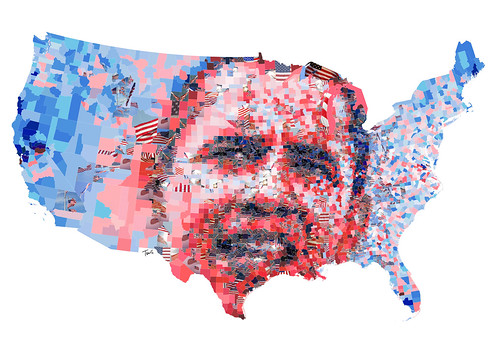
Barack Obama: The red, the blue and the United States of America.
Barack Obama: The red, the blue and the United States of America by Charis Tsevis

* * * * *

I know what I’m doin’ and I’m fearless.

– Barack Obama, June 22, 2015
One of my regular stops on the Internet is Bloggingheads.tv, a series of online discussions produced and curated by Robert Wright, author of Nonzero, and several other books. The format is simple: two people talk about this that and the other. The people are not in the same physical location, so their conversation is mediated by appropriate web-tech.

While Wright himself is a party to many of these conversations, most of them feature others. My favorite host is Glenn Loury, an economist at Brown University, and his most frequent, though not only, interlocutor is John McWhorter, a linguistic at Columbia. On June 29, 2015, they had a conversation that started with the terrorist murders in Charlston, moved onto the Confederate flag, to Al Sharpton, and then to Obama’s Eulogy for the Rev. Clementa Pinckney. Loury initiates that discussion at roughly 38:14:


Loury’s point was that not only was Obama eloquent, as one would expect of a President (who, after all, has speech writers, though Loury didn’t say this), but that Obama delivered his eulogy in the voice and persona of a black preacher working in the vernacular tradition (and he mostly re-wrote the speech he was handed by his chief writer, though Loury didn’t say this either). His whole presentation was recognizeably African-American, which was certainly appropriate for the occasion and the audience. But when was the last time an American President ever did that?

McWhorter agreed, pointing out that we have seen “a browning of the culture […] America's all about vernacular […] He really was, in that setting, a national spokesman in a way that many other people could not be, and that he would not have been as recently as 30 years ago. We're a very different place than we used to be.” Nor could a black man have been elected to the Presidency 30 years ago, though McWhorter didn’t say that.

Wednesday, July 22, 2015

Obama’s Eulogy for Clementa Pinckney 3: The Technics of Grace

The Eulogy was not merely a text, but a performance: what does it do? How does it work?

My purpose here is not to engage in the job of hunting for hidden meaning in Obama’s text, for everything is there for us to see. Rather, I only wish to call attention to the obvious and therefore to highlight patterns that may not be so obvious.

Here’s the major sections of Obama’s speech as I laid them out in my first post:
1. Prologue: Address to his audience, quoting of a passage from the Bible.

2. Phase 1: Moves from the Clementa Pinckney’s life to the significance of the black church in history.

3. Phase 2: The murder itself and presence of God’s grace.

4. Phase 3: Looks to the nation, the role racism has played, and the need to move beyond it.

5. Closing: Amazing Grace.
As before, I’ve attached a copy of Obama’s text to the end of this post, with the paragraphs numbered; you can also access an analytical table of the text HERE. You can view the complete performance HERE.

The Beginning and the End

Let’s start with the beginning, which is simple and straight forward:
1. Giving all praise and honor to God.

2. The Bible calls us to hope. To persevere, and have faith in things not seen.

3. “They were still living by faith when they died,” Scripture tells us. “They did not receive the things promised; they only saw them and welcomed them from a distance, admitting that they were foreigners and strangers on Earth.”

4. We are here today to remember a man of God who lived by faith. A man who believed in things not seen. A man who believed there were better days ahead, off in the distance. A man of service who persevered, knowing full well he would not receive all those things he was promised, because he believed his efforts would deliver a better life for those who followed.

5. To Jennifer, his beloved wife; to Eliana and Malana, his beautiful, wonderful daughters; to the Mother Emanuel family and the people of Charleston, the people of South Carolina.
Note that while paragraphs 2 and 3 are connected by a logical progression, as are 3 and 4. That is not the case between 1 and 2 nor between 4 and 5.

What’s going on?

Obama opens with a straightforward assertion: “Giving all praise and honor to God.” Right away he is telling us that this is not going to be an ordinary Presidential speech: Presidential speeches do not ordinarily begin that way. Moreover, while as President he is the highest authority in the land – note that he has the power to pardon people of crimes and (in practice) the power to commit the nation to war (if not in Constitutional law) – he is here acknowledging a higher power than even he possesses.

Not only is there a higher power, but there is a higher order. And that order is not visible to us. That is our (hidden) link from the first to the second paragraph, where we are enjoined to “have faith in things not seen.” That in turn takes us to the third paragraph, a Bible verse (Hebrews 11:13) telling us to have faith and that we are “strangers on Earth.”

Only then does Obama introduce Pinckney, though not by name, and he introduces him in terms he set out in paragraphs 1, 2 and 3. He is “a man of God” (1) who “lived by faith” (2 & 3). Obama picks up the theme of distance – “better days ahead, off in the distance” – and closes on perseverance. These connections, of course, are crucial, for Obama will spin out his sermon in the space between the Biblical verse – which is the key to the hidden order, the sacred order – and the now deceased man who followed its promptings.

Saturday, July 18, 2015

Obama’s Eulogy for Clementa Pinckney 2: Performing Black, Three Discussions

My interest in President Obama’s eulogy for Clementa Pinckney was sparked by a conversation between Glenn Loury, an economist at Brown University, and John McWhorter, a linguist at Columbia University. That conversation raised issues of authenticity and artifice: Is the practiced nature of (Obama’s) performance compatible with sincerity? It’s a deep issue.

But I’m not going to discuss it in this post. Rather, my purpose here is to lay the question before in the form of three discussions, which I have transcribed:
• Loury and McWhorter on Obama
• Marc Maron and Barack Obama on performance
• Ike Turner and Sam Phillips on Elvis Presley
I’ll comment on those discussions, and the issue in general, in my next post. My first post: Obama’s Eulogy for Clementa Pinckney 1: The Circle of Grace.

Glenn Loury and John McWhorter

Loury and McWhorter have their discussion on Blogging Heads TV, June 29, 2015. They’ve had many discussions there, and so are familiar with one another’s interests, attitudes, and moves. The discussion starts at roughly 46:14, after they’d discussed the eulogy itself.

* * * * *


JM: You have to wonder how authentic the President’s rootedness in this kind of thing is.

GL: Oooo! Oooo! You raised a deep question.

JM: I mean this is a tough one. We’ll never know. We don’t know him. He wasn’t raised in this, at all. In terms of his history we know that even by the time he was in his early twenties, he was not that. He was kind of an interesting mutt. Even the black speech patterns, (as) I think about it, he didn’t grow up with those, he learned them later. And after the age when most people are good at learning new ways to talk. And the black church, he had to be told, he had to be told when he was being a black politician in Chicago that if you’re really gonna’ make you way in the black community, you have to belong to a church. He didn’t belong to one already; he didn’t join one as soon as he hit the city. He had to be told. And now here he is, and he seems to be a man in full as far as this goes.

GL: Oh, John...

JM: But it’s interesting, he’s a, he’s a very, I don’t wanna’ call him fake, but he’s a very . good . performer. I don’t know if I’ve ever known any body

GL: Ah, John...

JM: who came into this sort of thing so late, and does it so convincingly.