Showing posts with label free range kids. Show all posts

Sunday, March 22, 2026

Stand by Me and the demise of free-range childhood [like I had] [Media Notes 176]

Sarah Wildman, The End of the Free-Range, Device-Free ‘Stand By Me’ Childhood, NYTimes, Mar. 22, 2026.

Wildman took her 12-year old daughter to see Stand by Me. Much to her surprise her daughter was fascinated:

After first seeing the film, my daughter asked my father, who spent his childhood in a small city in the Berkshires, if the freedom the film depicts was the freedom he had, if childhood once looked and sounded like that. She wondered if this sort of unobserved life was as he remembered it, if he might, just as these boys did, have set off for days without parental concern. He told her, with amusement, that he was, in fact, expected to be home for dinner, but beyond that, yes, he could roam, without surveillance. (He quibbled with the 12-year-olds’ smoking.)

The central premise of the film is, essentially, a postwar, middle grade “Odyssey.” The boys of “Stand by Me” — played by Wil Wheaton, Jerry O’Connell, Corey Feldman and River Phoenix — encounter obstacles: brutal or absent parents, a purportedly terrifying dog, bloodsucking leeches and a set of drag-racing teenage hoodlums who wield as weapons pocketknives and lit cigarettes. News arrives via overheard gossip (one boy learns the location of the dead body from his brother) or hand-held transistor radio. They live almost entirely outdoors. Along the way, they come to realize their friendships far outrank the prize of their discovery.

I, too, was struck by the sheer wildness once permitted children. The autonomy of the boys in “Stand by Me” is vastly different from the freedoms allowed a child living in 2026, when each is practically AirTagged, when we can track a car or a person’s phone across a map on a device in our palms, when we can know each moment of every day where each and every person in our home can be found. A gathering of children is more likely to be in front of a screen than with a rucksack and a deck of cards, as in the movie. Children are all too often found languishing alone in their bedrooms, direct messaging their friends, which not only reduces the likelihood of them being covered in leeches but also vastly decreases their chances of discovering anything at all.

There's much more at the link.

Saturday, August 16, 2025

Quarantine Kids playing Funky Music

Youtube:

Hey guys! Bellamy got a new sequin jacket at Goodwill this week so we thought we would play a song worthy of the glitz. She was super excited to play the breakdown by herself, and I had to give her a little holler of admiration. 😊 We hope you enjoy it! This is Colt Clark and the Q

uarantine Kids playing, “Play That Funky Music” by Wild Cherry.

Wednesday, April 23, 2025

Kidz these days seem stripped of agency, don't know how to build

Akim Reinhardt, Fly, Be Free, 3 Quarks Daily, April 23, 2025.

Reinhardt starts by complaining about over-parenting in the contemporary world, something I've been reading about for at least a decade if not two. He's concerned about the consequences:

The point here is not to criticize modern middle class parents or make them feel bad. That would be hypocritical as I have no children of my own. But as someone who has been teaching college students for a quarter-century, it seems to me that the overprotective parenting style along with other factors, such as modern K-12 education and near constant attention to screens, have had a profound effect. Ask any long time college instructor. They will tell you. Things have changed.

Today’s 18–22 year olds are nowhere nearly as competent as their predecessors. Note: I did not write “smart.” Today’s students are plenty smart. But they are less competent. And they know it. Their ability to do has been crippled. Denied a childhood of self- and peer-directed discovery, problem solving, dispute resolution, and genuine play, many young adults no longer know how to make their way through the world in basic ways.

They’re well aware of this and it causes many of them great anxiety. It has also engendered many of them with very unrealistic expectations about what others will do for them. Because the parents and other adults in their lives constantly directed them in nearly all endeavors, they expect that direction to continue as they themselves become adults.

In the classroom, they now require detailed instructions for every assignment. When I began teaching, I didn’t even bother giving them an assignment sheet, and they were fine with that. They knew what to do when I said “write a paper.” Now my assignment sheets can run as long as a double-sided, single spaced page, and some of them still complain that it’s not enough direction.

Alas, it’s not just in college.

I know dozens of people in management positions in industries as varied as entertainment, software, and auto repair. Absolutely all of them, when I ask, complain about how their new, young workers can’t seem to figure out basic tasks by themselves, or even think it reasonable that they should, instead expecting their superiors to explain everything for them.

Here's my response:

Color me sympathetic, Akim, deeply sympathetic. I grew in Western PA in the 1950s and 60s in a neighborhood that was suburban on the edge of rural. One good friend lived on a one acre lot. As I recall there was a small cornfield in the middle of the lot and plots for various vegetable. At the rear of the lot, away from the street, and next to a small wooded area there was a place where we tunneled into the ground a bit and built a small underground chamber which was central to many of the games we played. I can almost remember shoveling some dirt out of the hole and putting it elsewhere.

There was another spot in the wood where we cleared a small area and carpeted the ground with moss. We would find patches of moss, lift them from the ground very carefully so they didn't break and them move these "tiles" to where we wanted them. In another place we piled rocks across a small stream to dam the water. We then saw the water build up behind our small dam and become a small pool. In middle school we had shop class where we learned to build things with hand tools. We also had mechanical drawing, where we learned how to make precise engineering drawings that could be used in building things.

Johnstown was a steel town. My friends had fathers who worked in the steel mills. When they became old enough, some of them went into the mills as well. The mills themselves were large physical structures that I saw often.

Now, I've spent most of my life thinking about very abstract things, and exploring abstract worlds. But that intellectual activity rests on a childhood of experience where I moved freely about the physical world, worked on it and with it, changed it.

I can't help but think that a lot of the hype and craziness that surrounds AI – something I know a thing or two about because that's a world in which I think – is the result of not having a strong enough grasp of the physical world. I don't know how often I've heard a complaint that we're not a nation of builders. Some of that complaint is directed at the plethora of regulations which makes is much easier to NOT-BUILD than to build. But I fear some of it is the result that too many adults never learned how to build during childhood and so they can't do it as adults. Rather, they want the machines to do it for them.

This is not a formula for a propitious future.

Friday, January 3, 2025

Fer Chrissake! Let kids move, plan, and act.

Jenny Anderson and Rebecca Winthrop, Giving Kids Some Autonomy Has Surprising Results, NYTimes, 1.2.25.

In a polarized nation, one point of agreement deserves more attention: Young adults say they feel woefully unprepared for life in the work force, and employers say they’re right.

In a survey by Gallup and the Walton Family Foundation of more than 4,000 members of Gen Z, 49 percent of respondents said they did not feel prepared for the future. Employers complain that young hires lack initiative, communication skills, problem-solving abilities and resilience.

There’s a reason the system isn’t serving people well, and it goes beyond the usual culprits of social media and Covid. Many recent graduates aren’t able to set targets, take initiative, figure things out and deal with setbacks — because in school and at home they were too rarely afforded any agency.

Giving kids agency doesn’t mean letting them do whatever they want. It doesn’t mean lowering expectations, turning education into entertainment or allowing children to choose their own adventure. It means requiring them to identify and pursue some of their own goals, helping them build strategies to reach those goals, assessing their progress and guiding them to course-correct when they fall short.

Learning to "drive":

No adult can force a student to be self-driven. Children develop the skill the way they learn anything else: with practice. The act of setting the goal makes it more meaningful. When we visited Carmen Arellano, a teacher at Arthur Kramer Elementary School in Dallas, she had students set learning goals for every class she taught, and when they met them, “they chase me down in the hallway to tell me,” she said. “I think it just really makes them proud of what they’ve accomplished.” [...]

As the developmental psychologist Aliza Pressman says: “Let kids do for themselves what they can already do. And guide and encourage them to do things they can almost do. And then teach and model for them the things that they can’t do.” This is how parents can help their children build agency.

Change the goal of eduction:

Maybe it’s time to define a higher ideal for education, less about ranking and sorting students on narrow measures of achievement and more about helping young people figure out how to unlock their potential and how to operate in the world. Amid the drumbeat of evolving artificial intelligence, wars, rising authoritarianism, political polarization and digital disconnection, they need to learn a lot more than how to follow instructions.

Saturday, February 24, 2024

Why snow days are good for kids

Michael Venutolo-Mantovani, What kids lose without snow days, Vox, Feb. 24, 2024.

With the proliferation of virtual learning, do kids even get to enjoy the magic of an unexpected snow day anymore? Are true snow days an endangered species?

Earlier this month, nearly 1 million students in New York City’s public school system learned that their schools would remain open, despite the threat of a predicted half-foot of snowfall (in the end, estimates ended up being a bit high, with John F. Kennedy International Airport reporting just over 4 inches of accumulation). Classes would be held virtually, they were told — even though there was a network outage that prevented smooth proceedings. There was plenty of pushback, even including some reports of teachers telling parents to ignore the edict from Mayor Eric Adams.

But the point remained: Access to virtual learning was robbing kids of one of the premier highlights of youth (at least in those geographical sweet spots like New Jersey, where snow falls sometimes in the winter).

Adams’s comments that New York City had to “minimize how many days our children are just sitting at home making snowmen,” completely disregarded the social needs of a generation of overworked and overstressed children.

Because there’s nothing wrong with a day or two spent sitting at home, making snowmen. At least not according to Melanie Killen, a professor of human development and quantitative methodology at the University of Maryland.

“Snow days need to be sledding days,” she said. Snow days offer “a different kind of learning ... an important kind of learning.” [...]

“I wouldn’t necessarily call it a ‘brain break,’” Killen said. “Kids are out there using their brains in different ways on snow days. It’s a break from the traditional teacher-children dissemination, which kids need.”

Killen likened the typical snow day of the past to something like an extended recess, highlighting how during that less structured playtime, kids continue to learn. She added that almost everything about playing in the snow offers some sort of quantifiable lesson about the world.

YES! There's more at the link.

Monday, September 25, 2023

Let kids run free; it's better for their mental health.

Peter Gray, David F. Lancy, David F. Bjorklund, Decline in Independent Activity as a Cause of Decline in Children’s Mental Well-being: Summary of the Evidence, The Journal of Pediatrics, Volume 260, 113352, September 2023, DOI: https://doi.org/10.1016/j.jpeds.2023.02.004

The opening paragraphs:

It is no secret that rates of anxiety and depression among school-aged children and teens in the US are at an all- time high. Recognizing this, the American Academy of Pediatrics, American Academy of Child and Adolescent Psychiatry, and Children’s Hospital Association issued, in 2021, a joint statement to the Biden administration that child and adolescent mental health be declared a “national emergency.”

Although most current discussions of the decline in youth mental health emphasize that which has occurred over the past 10-15 years, research indicates that the decline has been continuous over at least the last 5 or 6 decades. Although a variety of causes of this decline have been proposed by researchers and practitioners (some discussed near the end of this Commentary), our focus herein is on a possible cause that we believe has been insufficiently researched, discussed, and taken into account by health practitioners and policy makers.

Our thesis is that a primary cause of the rise in mental disorders is a decline over decades in opportunities for children and teens to play, roam, and engage in other activities independent of direct oversight and control by adults. Such independent activities may promote mental well-being through both immediate effects, as a direct source of satisfaction, and long-term effects, by building mental characteristics that provide a foundation for dealing effectively with the stresses of life.

Saturday, February 8, 2020

Wild Child

The hill was covered with strange grassy mounds about the size of molehills. The adults had no idea what they were — which was very exciting to me, realizing that there were things in the world that not even the adults understood. So I filled in the blanks for myself and decided they must be burial mounds for fairies. This was the magical landscape that inspired my book “The Wizards of Once.”

For the wildwood in that book, I took particular inspiration from the ancient wood of Kingley Vale in Sussex. Its trees have gnarled, expressive faces, and roots that embed into the earth with an almost visceral power. The more you learn about trees, the more magical you realize they are. Did you know, for example, that trees can communicate with each other through their roots, even when they are many miles apart?

Trees grow throughout children’s books. From “Peter Pan” to “A Monster Calls,” “The Lord of the Rings” to “Harry Potter,” trees are refuges, prisons and symbols of nature’s potency. They can be a friendly home, like the Hundred Acre Wood in “Winnie-the-Pooh,” or give a sense of menace, like the snowy forest in “The Lion, the Witch and the Wardrobe.” They can also be symbolic, like the cement-filled dying tree in “To Kill a Mockingbird.” The writers I loved when I was a child were similarly inspired by magical landscapes and nature: Ursula K. Le Guin, J.R.R. Tolkien, L. Frank Baum, Diana Wynne Jones, Lloyd Alexander, Robert Louis Stevenson, T.H. White — and so many others.

Today, children have much less unsupervised access to the countryside. I worry that they may never know the magic of the wilderness, the power of trees and the thrilling excitement of exploring nature without an adult hovering behind them. And so I write books for children who will never know what the freedom of my childhood was like.

Sunday, August 18, 2019

Are we having fun yet?

What happened to childhood?

Kim Brooks, We Have Ruined Childhood, NYTimes, 17 August 2019:
According to the psychologist Peter Gray, children today are more depressed than they were during the Great Depression and more anxious than they were at the height of the Cold War. A 2019 study published in the Journal of Abnormal Psychology found that between 2009 and 2017, rates of depression rose by more than 60 percent among those ages 14 to 17, and 47 percent among those ages 12 to 13. This isn’t just a matter of increased diagnoses. The number of children and teenagers who were seen in emergency rooms with suicidal thoughts or having attempted suicide doubled between 2007 and 2015.
Children's lives are too regimented:
No longer able to rely on communal structures for child care or allow children time alone, parents who need to work are forced to warehouse their youngsters for long stretches of time. School days are longer and more regimented. Kindergarten, which used to be focused on play, is now an academic training ground for the first grade. Young children are assigned homework even though numerous studies have found it harmful. STEM, standardized testing and active-shooter drills have largely replaced recess, leisurely lunches, art and music.

And so for many children, when the school day is over, it hardly matters; the hours outside school are more like school than ever. Children spend afternoons, weekends and summers in aftercare and camps while their parents work. The areas where children once congregated for unstructured, unsupervised play are now often off limits. And so those who can afford it drive their children from one structured activity to another. Those who can’t keep them inside. Free play and childhood independence have become relics, insurance risks, at times criminal offenses.

Friday, March 8, 2019

Free range kids in New Zealand, and lessons from the Māori

From March 2015, a glimpse at a different world.
Daniel Davies, blogger at Crooked Timber, is going around the world with his family for a year (he made a bit of money in investment banking). They've just spent a couple of months in New Zealand.
Part of the whole purpose of bringing the children round the world – god knows, it wasn’t the sheer joy of home-schooling – was to let them see that different ways of doing things are possible, and the way that children live in New Zealand really contrasted with how things were in London.

The kids have much more independence, and a much more outdoor lifestyle. When there isn’t so much traffic on the roads and there’s more empty space, they can play in it. My ten-year-old nephew was able to go out alone into the bush to look after his father’s possum traps (it’s considered civically responsible to take care of a few traps in the local bush, because possums and rats eat kiwi eggs). After school, kids would arrange to meet up, parent’s absent, and “jump off the wharf”. (Jumping off things is actually the national sport, as far as I can tell – it doesn’t get as much TV coverage as rugby, but has many more participants. In the course of a fifteen minute lift I gave to a hitch-hiker who had missed his bus back home from one of the higher local wharves, I was given a pretty comprehensive run down of all the tall objects with bodies of water beneath them in the surrounding district. There’s a sign on the bridge over the Whakatane River saying “Do not jump off this bridge”, but I don’t know why they bothered).

On enrolling our five-year old at her infants’ school we were pretty much immediately handed a piece of paper with details of the two-day camp that the tots would be going on. It’s a totally different world.
He also has some observations about the Māori:
How does a basically tribal society adapt to a modern industrial lifestyle? That, in my view, is a really important question for the world at the moment, as it’s the key to the Afghanistan conflict, among other things. The Pashtun tribes who make life so difficult for any and all occupiers of that territory are not stupid, and they are aware of what happened to the Khoi-San, the Native Americans, the Aborigines, and more or less any tribal society that has ever adopted any position other than one of strictly “no compromise, no retreat, nothing except trade in firearms and textiles” with respect to the modern world. Economic development in that region is more or less impossible if it has to be attempted in the context of a society which is basically the largest surviving tribal society in existence and wants to stay that way. For that reason, if no other, I think it’s a good idea for the rest of us to look at New Zealand and see if there’s anything to learn.

Wednesday, October 19, 2016

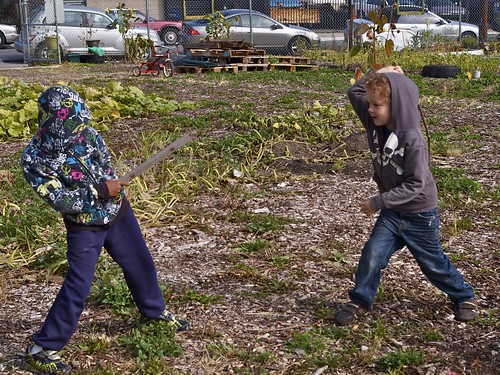
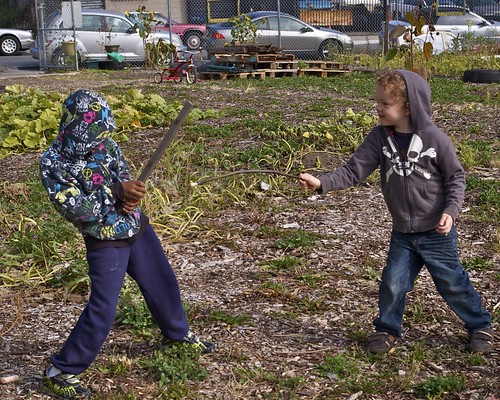
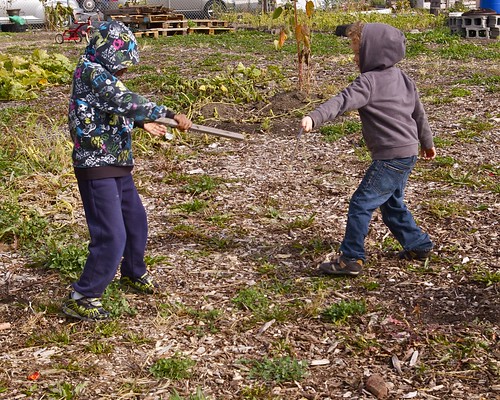
Kids these days...need to have sword fights

IMGP4527

IMGP4528

IMGP4532

Kids these days...need a place to play

When I was a kid I lived in a suburban neighborhood that was on the border of a semi-rural area. A neighbor up the road had a small wheat field. If I walked a quarter of a mile in one direction I cam to a small wooded ares, but large enough so we could go in there and get lost, build hide-outs and stuff. A mile in another direction there was a much larger and more mysterious wooded area, right next to the mink farm. And I was allowed to roam the neighborhood freely. We all were.

Yes, there were rules. I had to be home for dinner, get my homework done, and get into bed at the proper time. And there were restrictions as to where I could go, restrictions that got loosed as I grew older. And that was true for my friends as well.

I keep reading, though, that that's over, that kids these days are scheduled and regulated in a way I find, well, borderline pathological. Anyhow, the NYTimes addresses this in an interesting story:
The Anti-Helicopter Parent’s Plea: Let Kids Play! 
A Silicon Valley dad decided to test his theories about parenting
by turning his yard into a playground where children can take
physical risks without supervision. Not all of his neighbors were thrilled. 
The whole thing's worth reading. Here's one representative passage:
As part of Mike’s quest for a playborhood, he began doing research and visiting neighborhoods in different parts of the country that he thought might fit his vision. The first place he visited was N Street in Davis, Calif., a cluster of around 20 houses that share land and hold regular dinners together. Children wander around freely, crossing backyards and playing in the collective spaces: Ping-Pong table, pizza oven and community garden. Mike told me the story of Lucy, a toddler adopted from China by a single mom who lived on N Street. When Lucy was 3, her mother died of cancer. But before she died, her mother gave every house a refrigerator magnet with a picture of Lucy on it. While the founders of N Street formally adopted Lucy, the entire community supported her. Mike pointed out that the childhood Lucy was having on N Street may be akin to one she might have enjoyed in a village in rural China, but it was extraordinary in suburban America. Lucy could wander around fearlessly, knowing she had 19 other houses where she could walk right in and expect a snack.

Mike spent some time in the Lyman Place neighborhood in the Bronx, where grandmothers and other residents organized to watch the streets — so dangerous that children were afraid to play outside — and block them off in the summer to create a neighborhood camp, staffed by local teenagers and volunteers. Mike also found his way to Share-It Square in Southeast Portland, Ore., a random intersection that became a community when a local architect mobilized neighbors to convert a condemned house on one corner into a “Kids’ Klubhouse”: a funky open-air structure that features a couch, a message board, a book-exchange box, a solar-powered tea station and toys.

Saturday, April 4, 2015

Kids: tickle danger, tinker, learn, and grow

If we want to raise kids to be independent thinkers and change-makers, one of the best things we can do is give them the tools to figure stuff out for themselves. And a terrific manual for that is “50 Dangerous Things (You Should Let Your Children Do),” by Gever Tulley, a self-taught software engineer.

“There are not enough opportunities in a child’s life to be taken seriously, to be given autonomy and to learn authentically,” says Tulley. “I think they need learning opportunities that respect and incorporate their ideas.”

Tulley’s book presents 50 challenges (with instructions), each utterly at odds with today’s rampant helicopter parenting, such as Stand on a Roof, Taste Electricity (by licking a 9-volt battery), Dam a Creek and (I’ll admit I’m not ready to allow this one yet) Cross Town on Public Transportation.

“50 Dangerous Things” emphasizes the importance of introducing risk, facilitating autonomy and letting kids know that with danger comes discovery. This book comes to life at The Tinkering School, a program Tulley started here in San Francisco in 2000. (There is also a K-12 school, Brightworks, and a sleepaway camp down the coast; the program has recently expanded to Los Angeles, Chicago, Austin and Buffalo.)
Tulley created a school in San Francisco based on tinkering, The Tinkering School:
This isn’t just a bunch of kids messing around with stuff. Behind the chaos you can see the gears turning. There is no template, no set of instructions (and no screens). They need to be attentive, engaged and curious. As they begin a project, they’re learning how to collaborate, identify the skill sets of their group and deploy those talents accordingly, and problem-solve creatively. “The use of real tools dramatically increases agency,” says the Tinkering School’s manager, Joshua Rothhaas. “It’s like learning Spanish and suddenly realizing you can talk to about 400 million more people in the world than you could before you knew Spanish. It fundamentally changes the way your kid thinks about the world, how it works, and what they are capable of.”

Tuesday, March 24, 2015

Kids These Days: Media Use and Parental Fear

My colleague Charlie Keil is worried that kids these days spend too much time with media of one sort or another (as detailed, e.g. in this report) – TV, computer, video games, whatever – and not enough time interacting directly with one another (in particular, not enough time engaging in music and dance). Meanwhile danah boyd has been researching teen media use and discovers that one reason they spend so much time online is that they can’t easily get together physically. Their lives are tightly scheduled and meeting places are few and far between.

So, is children’s media-use the result of adult micro-management? That is, kids aren’t over-using media because they’re so seductive, but because their parents won’t let them play out-doors and play together.

Meanwhile, there’s a growing movement in favor of so-called “free-range childhood”. As far as I can tell that means growing up like I did. As long as I was home for dinner, for bed, practiced my trumpet, and got my homework done, I could roam the neighborhood as I wished. And I could take public transportation wherever I needed to go. Of course, this was calibrated to my age. I had more freedom at ten than at five, and more at fifteen than at ten. Still, within fairly generously limits, I could wander at will.

Over the past several years I’ve been reading that this kind of childhood is disappearing in favor of one where kids are taken everywhere by their parents and are slotted into all kinds of activities where they are supervised by adults, having less time for free play among themselves.

I have no sense of how prevalent such restrictions are. Over at Free Range Kids I found this: “Today, only 13 percent of U.S. children walk to school. One study found that only 6 percent of kids age 9-13 play outside in a given week.” I haven’t tried to track down that first number, but following the link for the second didn’t get me to the source document. If true, it’s shocking.

Once in a while I see question like this on Facebook, "At what age is it safe to let your children play outside alone?" Without fail, many parents will answer, "After 13 years," and "After 15 years," and most alarmingly, "Never." You always see a few parents who disagree, but not many. The fact that the majority of parents on Facebook think that kids require adult supervision at all times, matches up with national statistics. Surveys collected by Christie Barnes, author of The Paranoid Parents Guide, found that the biggest worry among parents is kidnapping. Another study by pediatricians at the Mayo Clinic, showed that nearly 3/4 of parents said they are afraid that their children may be abducted. In fact, parents in the Mayo Clinic study were more worried about kidnapping than car accidents, sports injuries, or drug addiction. Many other surveys show that as many as half of American parents worry about kidnapping often, which in turn prevents these moms and dads from letting their kids go outside to play.
And that takes us back to danah boyd, who is concerned that exaggerated fears of online sexual predation distorts our sense of real dangers.

So, we keep kids indoors because we fear what will happen to them outdoors and, once we’ve driven them to media, we worry about what will happen to them there.

Meanwhile another bunch of folks are concerned about not getting enough contact with nature:
Although human beings have been urbanizing, and then moving indoors, since the invention of agriculture, social and technological changes in the past three decades have accelerated that change. Among the reasons: the proliferation of electronic communications; poor urban planning and disappearing open space; increased street traffic; diminished importance of the natural world in public and private education; and parental fear magnified by news and entertainment media. An expanding body of scientific evidence suggests that nature-deficit disorder contributes to a diminished use of the senses, attention difficulties, conditions of obesity and overweight, and higher rates of emotional and physical illnesses. Research also suggests that the nature deficit weakens ecological literacy and stewardship of the natural world. These problems are linked more broadly to what health care experts call the “epidemic of inactivity,” as well as to a devaluing of independent play. Nonetheless, we believe that society’s nature-deficit disorder can be reversed.
What’s going on?

Friday, March 20, 2015

Are we ruining our children by micromanaging their lives?

Clemens Wergin and his family had just moved from Germany to America, where he'd taken a new job. On the family's first day here his 8 year-old daughter slipped out to explore the neighborhood. Writing in The New York Times, he tells us that, when she'd returned, "Beaming with pride, she told us and her older sister how she had discovered the little park around the corner, and had made friends with a few local dog owners." It seems, though, that their new American friends "are horrified by the idea that their children might roam around without adult supervision." He goes on to point out that:
In Berlin, where we lived in the center of town, our girls would ride the Metro on their own — a no-no in Washington. Or they’d go alone to the playground, or walk a mile to a piano lesson. Here in quiet and traffic-safe suburban Washington, they don’t even find other kids on the street to play with. On Halloween, when everybody was out to trick or treat, we were surprised by how many children actually lived here whom we had never seen.

A study by the University of California, Los Angeles, has found that American kids spend 90 percent of their leisure time at home, often in front of the TV or playing video games. Even when kids are physically active, they are watched closely by adults, either in school, at home, at afternoon activities or in the car, shuttling them from place to place.

Such narrowing of the child’s world has happened across the developed world. But Germany is generally much more accepting of letting children take some risks. To this German parent, it seems that America’s middle class has taken overprotective parenting to a new level, with the government acting as a super nanny.

Just take the case of 10-year-old Rafi and 6-year-old Dvora Meitiv, siblings in Silver Spring, Md., who were picked up in December by the police because their parents had dared to allow them to walk home from the park alone. For trying to make them more independent, their parents were found guilty by the state’s Child Protective Services of “unsubstantiated child neglect.” What had been the norm a generation ago, that kids would enjoy a measure of autonomy after school, is now seen as almost a crime.
Danah boyd discusses the same phenomenon in It’s Complicated: The Social Lives of Networked Teens (Yale UP 2014), where it's the flip side of intense use of social media by teens.

Is that where the modern world is headed, to lives controlled by authority where action is limited to choosing which media channel to consume? Are we preparing to turn ourselves over to our computer overlords?

* * * * *

Addendum: Here's a website advocating for Free-Range Kids.

Sunday, February 1, 2015

Huck Finn and Anxiety about children

A new book, Huck Finn’s America: Mark Twain and the Era that Shaped His Masterpiece, argues that The Adventures of Huckleberry Finn was not primarily about race. Reviewing the book in Salon, Laura Miller writes that
... nobody, including Twain himself, considered race to be the primary theme of “Huckleberry Finn.” Rather, the novel emerged from and spoke to a society that was obsessed with wayward children, particularly boys, and most typically lower-class boys spurred to delinquency by the violent stories they read in dime novels. The papers were full of “stories of children committing crimes or dying young or killing each other,” to a degree that, Levy remarks, a modern reader would find “simply numbing.” In response to this perceived crisis, Americans were, for the first time, seriously discussing the establishment of a system of public education.
"Childhood in crisis" is, of course, a theme much still with us:
It’s easier to look back at the public conversation about bad boys when “Huckleberry Finn” was published and recognize it as an early incarnation of conversations we have right now. “Condemning the newest media because it markets violence to children is one of the oldest tropes in American politics,” Levy writes. “We forget that reading was the Xbox of the Victorian age, and dime novels their equivalent of violent video games,” but being reminded of this repetition is not that troubling.
However, Miller continues:
Race is another matter. Levy believes that Twain arrived at a conclusion that most Americans refuse to entertain. Huck might have experienced an epiphany about his kinship with Jim, but the novel ends with Tom Sawyer using both of them, and their lives, as a form of entertainment, then paying off the long-suffering Jim with the symbolically fraught sum of $40. Not much has changed in the course of “Huckleberry Finn” beyond the understanding of one wild heart, and that, as Twain himself realized in his old age, looking back on the failure of Reconstruction and railing about colonialism and King Leopold, does not actually amount to much. “Mistaking a dark comedy about how history goes round for a parable about how it goes forward is a classic American mistake,” Levy observes.

Monday, December 8, 2014

It’s Complicated 1: Escaping on a Raft in Cyberspace


Farewell to freedom on the Adriatic and to days of wild abandon. – Hayao Miazaki


Are we heading toward a world in which our activities in the physical world are totally institutionalized so that our only “free” time is the time we spend online? That’s what I’ve been thinking as I read danah boyd’s new book, It’s Complicated: The Social Lives of Networked Teens (Yale UP 2014). But before I get to that – I’m only three chapters in, anyhow – let me tell you about my childhood. It’s not that my childhood was particularly interesting or significant, but simply that in one crucial way it was quite different from the lives of the 150+ teens boyd interviewed for the book: within broad limits, I could go where I wanted, when I wanted; these teens cannot.

From there I follow boyd to a discussion of the social management of anxiety and then shift gears and end up patrolling the backwoods in the antebellum South, looking for escaping slaves and other miscreants. That’s when we meet up with Huck and Jim riding the bit stream to freedom, thereby returning me to dana boyd. You’ll see, it’ll all work out in the end.

Sorta.

Confined to Quarters

I grew up in the 1950s and 60s in Richland Township, a suburb of Johnstown in Pennsylvania about 70 miles east of Pittsburgh. My neighborhood bordered on small farms and forest. As a teenager I had to be home for dinner, be home before dark, get my homework done, and practice my trumpet. I had various activities as well, scouts, school clubs (band and others) that took time, but they didn’t fill my schedule. I could, and did, roam freely about the neighborhood. I had to tell my mother generally where I was going, but that was it.

As I’ve indicated, that’s not the case with the teens that boyd interviewed. This is important, for it is the main reason many of them spend so much time online. Cyberspace is the only place they can hangout with their friends without adult intrusion into their lives (pp. 20-21):
The social media tools that teens use are direct descendants of the hangouts and other public places in which teens have been congregating for decades. What the drive-in was to teens in the 1950s and the mall in the 1980s, Facebook, texting, Twitter, instant messaging, and other social media are to teens now. Teens flock to them knowing they can socialize with friends and become better acquainted with classmates and peers they don’t know as well. They embrace social media for roughly the same reasons earlier generations of teens attended sock hops, congregated in parking lots, colonized people’s front stoops, or tied up the phone lines for hours on end. Teens want to gossip, flirt, complain, compare notes, share passions, emote, and joke around. They want to be able to talk among themselves—even if that means going online.
While boyd has a great deal to say about just what they do, I want to leave that aside for now. Much of what she says is generally about life online, written for people who don’t spend much time online. I do, so the world she describes is familiar to me even though I’m old enough to be a grandfather to the people she’s interviewed.

Here’s a bit about one of boyd’s subjects (p. 89):
My interview with Myra, a middle-class white fifteen-year-old from Iowa, turned funny and sad when “lack of time” became a verbal tick in response to every question I asked her about connecting with friends. From learning Czech to track, from orchestra to work in a nursery, she told me that her mother organized “98%” of her daily routine. Myra did not like all of these activities, but her mother thought they were important. She was resigned to them. Lack of freedom and control over her schedule was a sore topic for Myra. At one point, she noted with an exasperated tone that weekends were no freer than weekdays: “Usually my mom will have things scheduled for me to do. So I really don’t have much choice in what I’m doing Friday nights. . . . I haven’t had a free weekend in so long. I cannot even remember the last time I got to choose what I wanted to do over the weekend.” Myra noted that her mother meant well, but she was exhausted and felt socially disconnected because she did not have time to connect with friends outside of classes.

Thursday, August 22, 2013

Urban Kids Afraid of Nature

From a NYTimes interview with Maria Conroy, founder of the "Rory Meyers Children’s Adventure Garden, an eight-acre, $62 million, mostly open-air learning center" at the Dallas Arboretum:
I WAS STRUCK BY A PUBLIC REMARK YOU MADE : “MANY CHILDREN ARE AFRAID OF NATURE.” WHY DO YOU BELIEVE THAT?

We see a lot of children here, and we have watched many times a butterfly come flying at a group of 10-years-olds, and they scream and duck because they’re afraid it’s going to sting or bite them. If you don’t live where there are flowers, you don’t see butterflies. They’re afraid of the squirrels running around. And they’re terrified of the bees. They don’t know why they’re on that flower and the difference between themselves and that flower, as far as that bee is concerned.