Showing posts with label bell. Show all posts
Tuesday, December 6, 2022
Tuesday, February 26, 2019
Musician's Journal: The Magic of the Bell
This experience has had a profound effect on how I think about music. I used a reworked version to open the second chapter of Beethoven's Anvil: Music in Mind and Culture. One of my all time favorites.
Introduction: Together on the One
Interpersonal synchrony, moving, precisely, to the same beat as your fellows, is the core of social experience. The thrusts and jerks of an infant’s limbs, the timing of glances and twists of the body, will follow the speech rhythms of someone talking to the infant. Couples casually strolling in the park walk in step. People at a ball game make a “wave” in support of their team. All societies have rituals where people gather together and synchronize their movements, and thereby their hearts and minds, in affirmation of the central values of their culture.
I want to consider an example which is immediately familiar to me. This happened when I was living in upstate New York, which is as familiar to me as Africa was to the original African-Americans. It involves bell playing based on traditional African techniques.
The Craft
However, before getting to the magic, you need to understand a little about the craft. Few physical tasks are easier than getting a sound from a bell by hitting it with a stick. But that doesn’t mean that you can play your bell in a mood of casual somnambulance. No, you must be sensitive to small details, for nuance matters.
Generally you hold the bell in your left hand and the stick in your right—if you are right-handed. When you hit the bell with a stick the stick will bounce back. You need to learn to work with the rebound, not against it. If you hold the stick too firmly your grip will damp out the rebound and you will thereby waste the energy the bell has imparted to the stick. Rather, you want to hold the stick lightly and learn simply to redirect the stick’s energy back to the bell. You want to “cooperate” with the stick and the bell rather than “dominate” them.
Further, you need to attend to just where you hit the bell. The sound of a bell is complex and varies depending on just where you hit it. Thus, by hitting a bell in different places you can get several distinctly different sounds from a single bell. The different sounds you get from the bell will blend with other bell sounds in different ways. You have to be conscious of these blending possibilities when playing your bell.
By hitting the bell with sensitivity to the elastic properties of stick and bell you become one with the bell. By hitting the bell with sensitivity to the way your bell tones blend with other bell tones you become one with the group. While thus “becoming one with” has a mystical aura about it, you need to understand that this mystical aura is grounded in the subtleties of physical technique.
Sunday, August 27, 2017
Instrument Matter in the Musician’s Mind: Part 2, How to Construct a Spirit
Culture has produced some strange things. Supernatural spirits is one of them. I'm bumping this post to the top of the queue just to get it on my mind, as I need to think about these things a bit more while I contemplate writing a book on cultural evolution.
* * * * *
Call it “animism” if you wish, but it will no longer be enough to brand it with the mark of infamy. This is indeed why we feel so close to the sixteenth century, as if we were back before the “epistemological break,” before the odd invention of matter.
—Bruno Latour, An Attempt at a “Compositionist Manifesto”
In lieu of an environment that surrounds culture . . . picture an ontological field without any unequivocal demarcations between human, animal, vegetable, or mineral.
—Jane Bennett, Vibrant Matter: A Political Ecology of Things
About two weeks ago I posted some remarks on how one thinks about and plays very simple percussion instruments, claves and bells, and told a story about some mysterious tones that sometimes arise in bell choirs. I also promised a post in which I “attempt to construe those sounds as spirit voices.” This is that post.
The Magic of the Bell, Recap
The phenomenon that interests me is that of certain high frequency (around 2000 Herz and above) ‘twitters’ that arose during a certain rehearse I attended some years ago. As I explained in that post, there were four of us, each playing a different bell. Three of us play set patterns, time and again, while the fourth improvised freely over those patterns.
At a certain point, when energy was high and the music was rocking, we all heard these high twittering sounds. None of us was playing them. That is, they didn’t coincide with the patterns any of us were playing. Rather, they somehow arose through the interaction of the patterns the four of us played. We’d played together many times before, and many times since, but that was the only time we heard those sounds.
What were they? The purpose of this post is to explore what’s involved in asserting that they were some kind of ‘spirit.’
What phenomenon are we trying to name and explain?
This is a matter of drawing a boundary. Perhaps the easiest play to draw the boundary, dare I say it? the natural place, is around the sound itself. If we had had a recorder playing during that session, bounding the phenomenon in this way would be very easy. What we’re interested in would be what’s on the recording; nothing more, nothing less.
Then we could examine the recording to determine just what those pitches were like, their dominant frequency, just when they happened, and so forth. That is to say, we would be treating those sounds as nothing but mechanical vibrations, which we are examining in the standard ways. This is, of course, an entirely legitimate thing to do. It’s done all the time.
But THAT’s not the phenomenon that interests me. That’s not where I want to draw the boundary. That’s only one aspect of the phenomenon that interests me. It’s the aspect that tells me that THERE’S SOMETHING ELSE GOING ON.
Remember my description? I said that this happened when the energy was high and the music rocked. That doesn’t always happen. It’s not rare, but it’s not automatic, and for some purposes it’s neither necessary nor desired. So high rocking energy, that’s within the boundary of the phenomenon I’m talking about.
But drawn that way, the boundary isn’t tight enough, it’s not precise enough. For those twitterings didn’t always happen when the music rocked. They happened only that one time, though, as I indicated in the earlier post, Ade (the leader) recognized the phenomenon. He’d experienced it before, but the others of us had not. Ade was (and is) a very experienced percussionist. He’d toured and performed professionally in his youth and has a wide circle of musician friends, including drummers expatriated from West Africa. He knew those sounds, and simply called them “the magic of the bell.”
Other than the sounds themselves, what’s the difference between rocking music and magic music? Whatever that difference it, I’m going to call it spirit.
So, what do I think REALLY happened? Well, I don’t think some ghostly beings from another dimension entered our bodies and guided our playing. But I don’t have a positive account to offer. I think the place to look is in the micro-timings of our movements and in the neural activity in subcortical regions of our brains, perhaps even in the core of the core of the brain, the reticular activity system and, certainly, in the cerebellum. That’s where I think the action is, but that’s no more than an educated guess.
So in saying that those twitterings are manifestations of spirit, I am, in effect, projecting some subtle group-level neuro-muscular activity onto those sounds that serve as a diagnostic indicator of the phenomenon. To say that those twitterings are spirits, or voices of spirits, is to speak figuratively, where the figure is synecdoche, using the part (the twitter sounds) to stand for the whole (group locked in very intense musical activity).
This is pretty much what I’m doing when, in another context I talk of graffiti as manifestations of the spirit, or kami (in Japanese) of the site. When I do that, I’m NOT asserting that some being from another dimension comes through the wall, enters the graffiti writer, and directs his activity. Rather I’m saying that we cannot understand how and why graffiti ends up in this or that particular place without taking into account, not only the nature of the surface itself, but lines of sight and access, general location and neighborhood traffic, legal status (e.g. is it posted as no trespassing) and past history. All of that is important to the sight and I want to treat all of it as an indivisible gestalt. The easiest way to do this is to talk of the spirit of the site.
There are, of course, differences. The spirit of the graffiti site is, by definition, resident at the site. The twitter spirits don’t seem to have any residence at all. They just come and go. But there’s an overall similarity in the mode of construction, both are assemblages of heterogenous components: walls, paints, footpaths, laws, writers and viewers in one case; bells, strikers, and musicians in the other.
Monday, April 6, 2015
Bell Magic and Spirits at 3 Quarks Daily
My intellectual life has tended to revolve around various specific examples that I examine closely and revisit from time to time. Coleridge’s “Kubla Khan” is perhaps the most important literary example but of course there are others, most recently Conrad’s Heart of Darkness.
My thinking about music has been strongly influenced by a particular incident that occurred in rehearsal sometime in the 1980s. I was playing bells with three others and “magic” happened: the appearance of high twittering sounds that no one was playing. I used that incident to open the second chapter of Beethoven’s Anvil; I’ve blogged about it; and elaborated it into a 10,000 word working paper: The Magic of the Bell: How Networks of Social Actors Create Cultural Beings (see below).
I’ve now taken part of the working paper and revised it into my most recent post for 3 Quarks Daily: The Magic of the Bell and a Glimpse of Spirits. I’ve listed the working paper below along with its abstract and table of contents.
* * * * *
The Magic of the Bell: How Networks of Social Actors Create Cultural Beings
Academia.edu: https://www.academia.edu/11767211/The_Magic_of_the_Bell_How_Networks_of_Social_Actors_Create_Cultural_Beings
Abstract: It is well known that music can engender altered states of consciousness that are difficult to interpret scientifically except as odd malfunctions in the nervous system. In this paper I report a phenomenon known among some musicians as “the magic of the bell”: the emergence of high-pitched twittering sounds when a group is playing interlocking rhythms on different bells. These sounds cannot be attributed to any of the musicians and they emerge only when the group is a group is playing bells with passion and precision. I argue that those sounds arise through interpersonal coupling among the musicians and that the ‘naïve’ temptation to attribute them to a ‘spirit’ or ‘spirits’ can be reconciled with a close description that does not presuppose non-physical entities. Those spirits should be conceived as the embodiment of non-mysterious and physically coherent group process. This argument has ramifications for how we think of time and how we think of longer cycles of group life.
Introduction: Composing Strange Objects
Instrument Matter in the Musician’s Mind
Time and Again, the Curse of Linear Time
How to Compose a Spirit
Explain or Explain Away? Composition and Cultural Beings
Bibliographical References
Sunday, September 25, 2011
Instrument Matter in the Musician’s Mind: Part 1, Loosen Up
The “sex appeal” of the inorganic, like life, is another way to give voice to what I think of as a shimmering, potentially violent vitality intrinsic to matter.
—Jane Bennett, Vibrant Matter
We all know that B.B. King’s guitar is named Lucille. Why? No, not ‘why “Lucille”’? Why is it named at all?
Perhaps it’s a gesture of affection. The guitar, after all, is very close to him. It’s one of his voices, it is, in some sense, part of him.
It may be more than that. The name may well reflect the subtle intricacy of King’s relationship to his guitar, his instrument. To play an instrument well, one must learn to yield to its physicality, to blend with it. You can’t dominate it. Well, you can try, and you CAN succeed. But you pay a cost. You musicianship suffers.
As I’m not a guitar player, however, I can’t tell you what it means to yield to a guitar. Of sure, I can guess, I can make up stories, and you might find those stories convincing. If you’re not a guitar player. But guitar players, the thoughtful ones at least, will know that I’m faking it.
I suppose I could talk about the trumpet—I’ve been playing for half a century—but that’s just a little complex. And my point really isn’t about complexity. It’s about subtlety.
The Claves
So let’s talk about the claves. The claves are a pair of short sticks that tend to be roughly eight inches long and an inch in diameter. They’re used in Latin music, indeed, they’re central to many genres, to produce a sharp penetrating percussive sound. They’re usually made of hard dense wood. Mine are made of fiberglass:
You hold one clave in your left hand and then strike it with the other one, held in your right hand (if you’re right handed). Simple, no? Well, yes. And no.
It’s more like you cradle the one clave (it doesn’t matter which one) in your left hand. You hold your hand palm-up, lay the clave across it, and grip it only so much as needed to keep it in place. You don’t need to grip it tightly, nor do you even WANT to grip it tightly. If you do that, then your hand will dampen the vibrations and dull the sound. The ‘crack!’ will no longer be sharp and crisp.
Monday, August 9, 2010
Musician's Journal: On Learning to Play the Cowbell
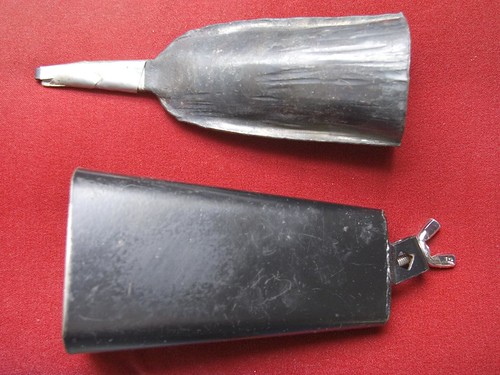
Yes, a cowbell, a standard Latin Percussion timbale cowbell. It’s 8” long, and the mouth measures 4 1/2” by 2 3/8”. It’s painted matte black and has a mounting bracket for attaching it to a drum kit. But I don’t have a drum kit. I hold it in my left hand and beat it with a drum stick.
I’ve been learning to play this bell for, say, 25 years. With any luck I’ll still be learning the day I die. Why so long to learn to play the bell? That’s probably not quite the right question.
Let me explain. In the first place, when I set out to learn a musical instrument five decades ago, the cowbell wasn’t what I set out to play. I set out to play trumpet. The musical role I cherished as a trumpet-player was that of improvising soloist. In time I became quite good in that role, good enough to open for BB King in one band, and for Dizzy Gillespie in another.
The soloist role is very up-front. It’s a role that allows for, and often calls for, a lot of flash and dash. You’re the center of attention, and you have to deliver.
The cowbell isn’t like that. Oh, I suppose it can be, if you’ve got more technical skill than I’ve got. But percussionists with the skill to solo generally don’t do so on cowbells. They’re more likely to use a jazz-type drum kit, or timbales, congas, bongos, djembe, or some other drum. Cowbell solos are rare.
The cowbell is an anchor instrument, a foundation instrument. It’s responsible to the basic rhythmic framework, whether a simple regular beat in rock and jazz or the more subtle 3/2 clave in Latin and African musics. The foundation has to be rock solid, unwavering, there.
And that, the role, is what I’ve been learning above all else. The foundational role is entirely different from the solo role. The soloist is a peacock, spreading his tail and strutting for the peahens. The bell is the ground on which the peacock and the peahens walk. The soloist needs good time, but that time can flex and change quite a bit – ever listen to Louis Armstrong? The cowbell’s time cannot flex and change, for it is the background against which, the framework within which, any flexing and changing is done.
By the time I’d started to play cowbell I’d been flexing and changing for 25 years. Learning NOT to do that, learning to be rock steady, that’s a process.
A tricky process. For you see, the time of a group is not mechanically perfect. It’s a steadiness built on a shifting framework of micro-, no nano-, flexing. There are little perturbations that give life to the time. Those perturbations exist in relation to the time of everyone playing. You’ve got to absorb all those time streams and drive your own time down the middle.
Subscribe to:
Posts (Atom)