Showing posts with label mhacks. Show all posts

Saturday, January 6, 2024

Meditation, Psychedelics, Computers, and the Mind

Early in the millennium I had an idea for a book, tentatively entitled, Mind Hacks R Us: Computing & Tripping to the Millennium's End, and I wrote a formal proposal under that title. I was unable to find a taker, but I kept the proposal around.

The rest of this post consists of two sections. The first is the prose introduction to the proposal. The second is a series of queries I put to ChatGPT about meditation, psychedelics, the computers, and the mind. What I’ve got on my mind, obviously, is what the future could hold:

Beyond AI displacing workers, creating new kinds of jobs, and solving all sorts of puzzles and problems, what are the possibilities for the general development of and flourishing of minds?

I’ve written about a Fourth Arena beyond the three arenas that the universe has so far evolved: inanimate matter, life, and culture. That’s where this post is headed. Note that I have a variety of posts under the tags, mhacks, and Arena.

Mind Hacks R Us

During the last half of the 20th century various groups of insiders and outsiders adopted mind-altering drugs and computer technology to create cultural spaces in which we imagined and realized new venues for the human mind. These spaces engaged fundamental issues of freedom and control, of emotion and reason, which have bedeviled humans everywhere, and elaborates them in the through modern science and technology. The psychoactive drugs which, in some sense, free us, have been synthesized through laboratory techniques we have invented, but only recently. The computers which extend our powers of control and order in often surprising ways embody logical forms that date back to Aristotle but where only recently brought to fruition in the late nineteenth century work of George Boole and others. Science and technology thus provide us with objective physical touchstones for the otherwise abstract powers and activities of our hearts and minds.

Taken together with that great Victorian invention, childhood innocence, the technologies of drugs and computers would constitute a cultural arena which served as incubator, nursery, and playground for some of the major lines of development in late twentieth century culture. For, if a society is to progress it needs cultural playgrounds where new ideas can be conceived, tested and developed. Psychedelic drugs and computing – and their associated cultures – functioned as such playgrounds in the latter half of the 20th century. They were, in fact, among the most important cultural playgrounds in America.

Given the fundamental differences between drugs and computers – what they are and how people use them, between Dionysian drugs and Apollonian computers – it is not surprising that different groups of people have been most interested in one or the other. What is most curious is that these people, and their creations, have often interacted, either directly or indirectly. In some cases, drug people and computer people are one and the same, as was the case in the San Francisco-Silicon Valley area during the 1970s.

Well before that, back in the 1950s, the Josiah Macy Foundation sponsored one series of high profile conferences about psychoactive drugs and another about computers. The cybernetics conferences – a series of about a half dozen of them – were chaired by MIT’s Grand Old Man of neuroscience, Warren S. McCulloch, and included such scientific luminaries as John von Neumann, Norbert Wiener, Claude Shanon, Gregory Bateson and Margaret Mead. Late in the decade, with the help of money from the CIA, the Foundation sponsored conferences on LSD; Bateson and Mead figured in those conferences as well. Both drugs and computers promised to reveal, in their different ways, the material basis of mind. And both were new in the 1950s, and so held forth only promise – but promise of what?

The answer to that questions depends, of course, on what people were looking for, what they wanted beyond what they knew and understood. In one way or another people looked to drugs and computers for powers beyond the ordinary, for transcendence of the human condition, and, more rarely, for insight into that condition. Thus if we are to understand the way in which drugs and computers have affected our culture over the last 50 years, we have to start with the aspirations we brought to drugs and computers.

Back in 1940s – and before – and continuing through the present. Animated films directed specifically at children (with their parents in tow) is the matrix in which these forces were brought together, a “universal kid space” in which fancy and fantasy are given full-rein. Walt Disney is the key catalytic figure. The images themselves came to depict human movement with a gravity-defying fluid grace heretofore realized only in the abstract designs of music, though shamans have imagined themselves in such flights while under the ritual influence of sacred drugs and sacred music. But the technology required to create those images embodied a relentless assembly-line logic that was new in the scope and precision of its repetitive actions. By directing these animated pictures specifically at children, film-makers freed themselves from the bonds of reality and allowed themselves freely to imagine idealized worlds quite unlike any places that humans had actually seen and inhabited. Disney’s Fantasia is the apotheosis of this cultural movement. It represents a fully-adult imaginative achievement that would have been impossible to those particular adults, raised as they were, without the facilitating guise of a commercial product aimed at children.

Fantasia, then, is the starting point for my main narrative. Psychedelic drugs take the mind to a different dimension, one that is often as more real than the mundane world. So it was with Fantasia. But Fantasia was constructed in a technological matrix which would soon give birth to the digital computer and, along with it, another series of idealized versions of human possibility, of a future in which machines relieved us of further work and toil. That too was part of the Disney vision.

From there I follow the development of computers and the emergence of psychedelic drugs as people use them to explore different ways of solving the same socio-cultural problem: How do you take the best aspects of the child-oriented world of animated films and make it the basis of a way of life? We have to drop the posture that this fantasy world is only for children and find a way to accept and rework selected aspects of it into lived adult reality.

Psychedelic culture dealt with this problem by trying out an ethic of in-the-moment hedonism that also included strains of romantic pastoralism, on the one hand, and Eastern mysticism on the other. Computer culture dealt with the same issues by offering a workplace ethic of libertarian entrepreneurship and dreams of a future where everyone can achieve a technologically-supported nirvana. These lines of cultural development have converged on science fiction, fantasy, and games as common venues for cultural exploration and expression. In either case, life is conceived along different lines than those described in the buttoned-down middle-class combat zone depicted in William Whyte, The Organization Man, David Riesman, The Lonely Crowd, or Vance Packard, The Status Seekers.

This cultural reworking is by no means complete. Nor has it been an easy matter. On the contrary, it has often been confusing, difficult, and painful. As such things always are. Always.

ChatGPT on meditation, psychedelics, the computers, and the mind

What can you tell me about the various styles and practices of meditation?

Meditation encompasses a wide range of practices and styles, each with its unique techniques, goals, and cultural origins. Here are some of the most popular styles and practices of meditation:

  1. Mindfulness Meditation (Vipassana):
    • Originating from Buddhist traditions, mindfulness meditation involves paying attention to the present moment without judgment. It often focuses on breath awareness and observing thoughts and sensations.
  2. Transcendental Meditation (TM):
    • TM is a mantra-based meditation technique. Practitioners repeat a specific mantra to achieve a state of relaxed awareness, promoting inner calm and stress reduction. TM has its roots in ancient Vedic traditions.
  3. Loving-Kindness Meditation (Metta):
    • This form of meditation emphasizes the cultivation of love and compassion. Practitioners focus on sending positive intentions and well-wishes to themselves and others, gradually expanding the circle of compassion.
  4. Zen Meditation (Zazen):
    • Rooted in Zen Buddhism, Zazen involves sitting in a specific posture and focusing on the breath or a koan (a paradoxical question or statement). The goal is to develop insight and experience a direct, unmediated awareness of existence.
  5. Yoga Nidra:
    • Also known as yogic sleep, Yoga Nidra is a guided meditation that induces a state of conscious relaxation. It's often used for deep relaxation and stress reduction, allowing practitioners to explore the inner world through guided imagery.
  6. Guided Meditation:
    • In guided meditation, a teacher or a recording leads participants through a series of visualizations or mental exercises. It can be tailored for various purposes, such as stress relief, personal growth, or healing.
  7. Body Scan Meditation:
    • This mindfulness-based practice involves systematically bringing attention to different parts of the body. It helps increase body awareness and release tension.
  8. Chakra Meditation:
    • Derived from Indian spiritual traditions, chakra meditation involves focusing on energy centers (chakras) within the body. Practitioners aim to balance and align these energy centers for overall well-being.
  9. Mantra Meditation:
    • Beyond TM, various meditation practices involve repeating specific sounds, words, or phrases (mantras). This repetition can help quiet the mind and deepen concentration.
  10. Movement-Based Meditation (Tai Chi, Qigong):
    • Practices like Tai Chi and Qigong combine meditation with gentle, flowing movements. These aim to cultivate mindfulness, balance, and harmony between mind and body.
  11. Breath Awareness Meditation:
    • Focusing on the breath is a common element in many meditation practices. Techniques range from simple breath awareness to more structured practices like Anapanasati in Buddhist traditions.

It's important to note that the effectiveness of meditation can vary from person to person, and individuals may find that different styles resonate with them at different times in their lives. Experimenting with various techniques can help you discover what works best for your preferences and goals.
Thursday, July 14, 2022

How to Change Your Mind [Media Notes 75b] – Psilocybin brings depth to the series.

As I’ve already indicated, I found the first episode in Michael Pollan’s series, about LSD, to be disappointing. The second one, about psilocybin, is much better. Or at least I found it so.

It was natural to begin the series with LSD, for that’s the drug that brought psychedelics to public consciousness. The story’s simple: 1) Swiss chemist accidentally discovers it, 2) Timothy Leary turns on, tunes in, and urges the world to drop out, and 3) HIPPIES! I more or less lived through this story – I’m a bit older than Michael Pollan, who missed it – so the history wasn’t new to me, and this episode was mostly the history.

The second episode has history as well, the story of how Gordon Wasson, a J.P. Morgan banker and amateur mycologist, traveled to Oaxaca, Mexico, to meet María Sabina, a curandera, and thereby brought knowledge of psilocybin to the 20th century Western world. This brings a new dimension to the story. The story of LSD is a story of 20th century pharmaceuticals. But psilocybin is a naturally occurring substance that has been used by humans for centuries and centuries around the world to take these journeys, these trips, these investigations, making them a facet of humanity that has been sidelined by Western culture.

But that’s not how the episode opened. It opened with the story of an older woman who had been diagnosed with cancer. She took psilocybin (in a clinical setting) to help her overcome her fear of death, which it did. Here we see special effect used to present us with her trip, convincingly but not flamboyantly. This is done, I believe, three more times in the series. Once with Paul Stamets, a mycologist, once with a man suffering from obsessive-compulsive disorder (OCD), and finally with Pollan himself. I thought this was quite effective. We also learned about the work done on psychedelics at the Spring Grove Clinic in Baltimore – I was aware of it at the time.

Taken in conjunction with the first episode, on LSD, we now have a much more rounded and fully realized picture of psychedelics. In particular, the first episode makes a connection between psychedelics and computer culture through the figure of Steward Brand, best-known as the creator of the Whole Earth Catalogue. Brand had settled in San Francisco, which was an important center of counter-cultural activity (Haight Ashbury was legendary), but the surrounding area, Silicon Valley to the southeast, was important in computer culture as well. Thus these two pivotal movements matured in close proximity.

In one sense they are very different. Computers are highly complex technology used to facilitate things in the external world. Whatever the chemical complexity of psychedelic drugs, anyone can ingest them, and take an inward journey. Both, however, are mind technologies, one a set of devices for externalizing mental activities, the other a group of drugs for re-ordering one’s own mind. Their physical conjunction is thus important. If we are to understand the course of cultural growth and change since the middle of the 20th century, we need to track the parallel evolution of these two movements.

Here's a brief chronology indicating some of the conjunctions of these two movements. It is derived from a book proposal I’d created, but failed to sell, about the interaction of these developments.

Wednesday, July 13, 2022

Mind Hacks R Us – Computing & Tripping to the Millennium’s End

I'm bumping this to the top of the queue so it can accompany my ongoing posts on artificial intelligence and my recent post on How to Change Your Mind. Perhaps I'll do another one or two on the series. I'm most of the way through the second episode, on psilocybin, and I like it better than the first. Perhaps the third will be even better. Addendum: It was different.

* * * * *

IMG_2884bw

A bit earlier in this millennium I thought it would be interesting to write a book on the parallel evolution of computer culture and psychedelic culture in the United States from mid-century to the end of the millennium. I wrote up a proposal, called it Dreams of Perfection, and it went nowhere. Subsequently John Markoff and Fred Turner each published parts of the story. Now I’m publishing a slightly revised portion of that old book proposal as an independent document. I’ve cut the marketing portions of the proposal, leaving only the conceptual overview and the chapter summaries. I’d envisioned five longish chapters, one for each decade, each chapter keyed to a different film: Fantasia, Forbidden Planet, 2001: A Space Odyssey, Tron, and The Matrix. I’ve retained that structure in this précis and concluded it with a consolidated chronology is significant dates.

Downloadt Academia.edu: https://www.academia.edu/37206924/Mind_Hacks_R_Us_Computing_and_Tripping_to_the_Millenniums_End

Here's the consolidated chronology:

1936: Alan Turing publishes “On Computable Numbers, with an application to the Entscheidungsproblem.” This paper established that some computations were, in principle, impossible to perform.

1936: Avant-garde playwright Antonin Artaud travels to Mexico to try mescaline. Artaud’s writings were very influential among the people who created the “happenings” of the 1960s and 1970s.

1938: LSD was first synthesized at Sandoz Pharmaceuticals in Switzerland, though its mind altering properties were not discovered until 1943. LSD, of course, was the major “drug” of the psychedelic 60s.

1945: Vannevar Bush published “As We May Think,” in the Atlantic Monthly. This article, written by a government research administrator, is often regarded as a harbinger of the personal computer revolution of the 1980s.

1945: Hungarian emigrant and polymath John von Neumann wrote “First Report on the Development of EDVAC,” the document that defined the basic scheme used to implement software in digital computers.

1953: Watson and Crick publish the double helix structure of DNA and thus initiate the age of microbiology, initiating biology into the information paradigm.

1954: J. R. R. Tolkein publishes The Fellowship of the Ring, The Two Towers.

1954: Thorazine, the first major tranquilizer, is marketed.

1956: The Bathroom of Tomorrow attraction opens at Disneyland.

1959: John McCarthy proposes time-sharing to MIT’s director of computing; time-sharing would make computers much more accessible.

1960: Robert Heinlein publishes Stranger in a Strange Land, which would become a major point of literary reference in the drug and mystical counter-culture of the 1960s.

1966: LSD and other psychedelics are outlawed, making it illegal for people to take trips.

1966: Original Star Trek series debuts on television, starting an entertainment franchise that would produce offspring for the rest of the century.

1967: The Beatles release Sgt. Pepper’s Lonely Hearts Club Band, a triumph of high-tech electronics and the psychedelic imagination.

1968: President Nixon declares war on drugs.

1969: Herbert Simon publishes The Sciences of the Artificial, a collection of essays that makes fundamental insights of the artificial intelligentsia accessible to a larger audience.

1969: Man lands on the moon, the first time we have traveled to another world from ours – in physical reality.

1969: The Defense Department’s Advanced Research Projects Agency (ARPA) establishes a nationwide network linking computer researchers to one another. This is the original seed of the internet.

1977: Star Wars became a motion-picture blockbuster, wedding martial arts mysticism with a space opera story and high tech special effects.

1981: William Bennett appointed to head the National Endowment of Humanities, his first government post. This positioned him to declare and lead a culture war. Later he would become “Drug Czar” under President Bush.

1981: Ted Nelson publishes Computer Liberation, in which he describes an elaborate hypertext system he called Project Xanadu (after the kingdom described in Coleridge’s “Kubla Khan”).

1984: Apple Computer advertised their new Macintosh in a Super Bowl advertisement that pitched IBM in the role of Big Brother and the Mac as humankind’s liberator.

1984: William Gibson combines video game imagery with reggae music and mythology and sets it in the future, thus placing psychedelia and computing on equal terms in the cyberpunk world of Neuromancer.

1985: Steve Jobs purchases Pixar, from George Lucas, and establishes it as an independent computer graphics company. Pixar would go on to produce the first completely computer-generated motion pictures.

1990: The world-wide-web was proposed by Swiss researchers.

1991: Desert Storm, the first war televised live and in real-time. Now real war is at our fingertips, just like a video game.

1994: Netscape was founded, with its IPO in 1995. This is the first company created by the world-wide-web, and it started the dotcom bubble that was to burst in 2001.

1999: Inventor and businessman turned futurist guru Raymond Kurzweil publishes The Age of Spiritual Machines, a manifesto about a future in which machines will surpass the accomplishments of their human creators.

2000: Detroit Electronic Free Music Festive draws 1.5 million people in its first year and is dedicated to genres of music which cultivate trance states.

2003: Anti-war organizers used the world-wide-web to organize world-wide protests against the American-led war against Iraq.

2003: Two major books about psychedelic drugs and mysticism are published, Rational Mysticism, and Breaking Open the Head.

How to Change Your Mind [Media Notes 75a] – LSD for serious people: Mind-changing is asserted, not shown.

How to Change Your Mind is a four episode miniseries on Netflix based on Michael Pollan’s book of the same name. It has four episodes, each named after a different psychedelic drug: LSD, Psilocybin, MDMA, Mescaline. I’ve watched the first episode. Color me underwhelmed.

Pollan serves as an on-screen guide and narrator, and is appropriately serious. He’s very clear that LSD is a potentially mind-changing and therefore very important drug. But, to be honest, he’s also a bit boring.

Before I get going, however, let me quote from a review of the episode published by James Hallifax in Psychedelic Spotlight News:

Episode 1 of Netflix’s How to Change Your Mind is a great introduction to the topic of LSD for those who don’t already know a lot about the subject. Narrated by Michael Pollan, the show takes us on a journey through the history of the powerful compound, from its discovery and its early medical use, to secret CIA mind-control studies, the counterculture and its banning, and finally to our current renaissance.

From amazing clips of LSD’s inventor Albert Hofmann describing his “Problem Child,” to powerful personal testimonies of individuals who have healed their suffering through LSD, episode 1 is a fun and entertaining refresher on the topic of LSD for even experts in the field.

In short, How to Change Your Mind’s first episode is definitely worth the watch.

My favorite segment came when psychedelic researcher James Fadiman was discussing an early LSD study on its effects on creativity, held at Stanford University in 1960. They recruited 48 senior scientists from various fields, all of whom had been working on a scientific problem to no avail for at least three months. In the study, each scientist was dosed with 100 micrograms of LSD, which can be considered a medium-sized dose.

As Fadiman describes it, “out of the people who came, we had 48 problems and 48 satisfactory solutions.” In other words, the LSD study was a stunning success. The fact that all 48 scientists —who had all been working on their problem for at least 3 months!!!— credited their LSD experience with solving their problem is nothing short of a miracle. True, perhaps this study would not meet the rigid rules of today’s clinical trials, but the results speak for themselves. According to Fadiman, “We had patents, we had publications, and because most of these people worked in industry, we also had products. And eventually the computer world emerged here.”

Despite this amazing story — and many more held within the one-hour premiere — the debut episode was not without its faults. Primary among them is its over-reliance on anecdotal stories, weaving a narrative that is not necessarily always backed up by current scientific study. The best example of this comes towards the end of the episode when Michael Pollan turns towards the subject of microdosing LSD.

About that last paragraph, I’m neither here nor there.

My problem with the episode is a bit different. It’s serious and, on the whole, dull. There’s some nifty special effects used to recreate the legendary bicycle ride taken by Albert Hoffman after he’d taken a substantial dose of LSD, 250 micrograms. There are some special effects scenes as well, and footage from some of Ken Kesey’s Acid Tests from the 1960s. But there was nothing like this:

The Apocalypse Mural, Egypt Wall - Dr. Bob Hieronimus

The Apocalypse Mural, Eagle Wall - Dr. Bob Hieronimus

That’s a mural painted by Bob Hieronimus in Levering Hall on the campus of Johns Hopkins University in 1968-1969. I was a student at Johns Hopkins at the time; I saw that mural being painted. I listened to music played in that room, which functioned as a coffee house on the weekends. I rehearsed with a rock and roll band in a room next to that. That’s what I think of when I think about when I think about LSD.

Mind you, I am not now nor have I ever been an acid head. I’ve only taken LSD twice – which I’ll get to in a minute – but I was there and, if not exactly immersed in the culture, I spent a lot of time at its edges. I read a lot of the scientific literature on LSD and other psychedelics, not to mention a wide variety of material on mystical experience, I listed to the music, wore the clothes. And whatever THAT is, it’s missing from this episode.

The problem is one of technique, of aesthetics. How do you convey THAT while at the same time making it clear that you are not stoned out of your freaking mind? It’s clear that Pollan thinks psychedelics are important, that it’s important that we investigate them, and learn how to use them. He’s also aware that The Establishment, if you will, freaked out and made LSD illegal in 1968, shutting down all research on it. I mean, Pollan writes for The New York Times, fercrissakes, he IS the establishment (almost). He wants to steer clear of all that crazy stuff that freaks people out while at the same time knowing that, considered appropriately, the craziness is the point. It's not crazy, but rather reflects a different order in the universe.

As for my two acid trips, one was in January of 1972 and lasted approximately two weeks and the other was, I believe, in the Spring of 1974 and only lasted several hours. In neither case did I experience the visions and other sensory effects typical of LSD trips. Why, I don’t know. But that first one, that was a trip. Here’s a couple of paragraphs from an article I published in 1975:

What happens on an LSD trip is intimately bound up with one's expectations. I had lots of them. I expected to receive an insight (at least one!) into my study of language which would make it possible to write my masterwork. I had also expected to experience all kinds of nifty sensory effects. None of my expectations were met.

The sensory world remained the same and I spent two weeks living the life of a character in a Thomas Pynchon novel. I was on a quest and every event I faced was a test of my herohood. Nothing was what it appeared to be; everything had a hidden meaning. If I succeeded in my tasks the world would be saved and I would be inducted into the Secret Society of Master Creators (I didn't call it that at the time, but that is what it was) and spend the rest of my life as a Master of Improvisational Musics.

Winter in Baltimore is a dreary rainy affair. But those days in January were like the first days of spring–proof that I had succeeded and the world was being reborn. I received a letter from a friend which was misdated; the year read “1973” rather than “1972.” But I didn't think it was misdated; I merely assumed that self-sacrifice (as in Christ and Oedipus–sometimes I lay in bed at night pressing my palms into my eye sockets wondering if I would be called on to blind myself) had eliminated a year from time and that it was in fact 1973. (I didn't bother checking calendars.)

The account continues in that vein for a half-dozen more paragraphs and concludes:

Many of the people around me surely thought I was going mad. But none of this seemed in the least bit incoherent or confusing to me. And, as my cryptic messages went unanswered, as events refused to follow the course indicated by the signs, I realized that I had been acting out fantasies but that I had not broken free of them. My ego had been inflated, but not transcended. The dance had been exhilarating, but it lacked grace.

During that period I had signed up for trumpet lessons at the Peabody Institute and, as a result, brought my technique up a notch and have continued with the trumpet ever since. As important, perhaps more so, I completed my Master’s Thesis on “Kubla Khan,” and have been pursuing that work ever since. Would I have done those things if I hadn’t taken LSD? I don’t know. The fact is that before that trip I hadn’t played my trumpet in over a year and I was blocked on my thesis.

Pollan surely knows of that. It’s why he wrote the book and undertook this miniseries. I’ve not read the book, though I’ve read a review or two, but something is missing in this first episode. It tends to be strong on the facts, even if only anecdotally, and seems pitched at people who don’t know those facts. If you’ve lived through them, then there’s not much here for you. It jogs your memory, but leaves your imagination untouched.

I’m reminded of some lines from Coleridge’s “Dejection: An Ode”:

Yon crescent Moon, as fixed as if it grew
In its own cloudless, starless lake of blue;
I see them all so excellently fair
I see, not feel, how beautiful they are!

Where’s the feeling? Maybe things will improve in the other episodes. We’ll see.

Wednesday, March 30, 2022

Mind Hacks 3: 1956 – The Forbidden Planet Within [Media Notes 59]

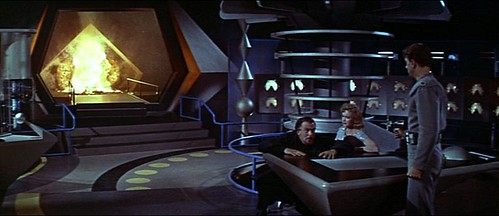
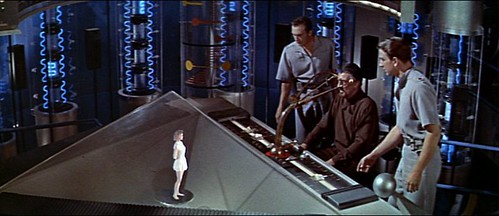
I’m bumping this post from 2010 to the top of the queue as it is relevant to my current thinking about current fears of rogue AI. Those fears are projective fantasy. Just as the Monster from Id in Forbidden Planet is a projection from the mind of a central character, Dr. Morbius. The mechanism is obvious in the movie. Morbius has been hooking himself up to advanced mind technology and it has, in turn, created the monster that stalks the planet.

Skynet in the Terminator films is thus a cultural descendant of that Monster from the Id. The same is true for all that crazy advanced technology that threatens the human race in so many science fiction films. But the same is true about those fears of out-of-control AI that real people have, real people who should know better. I’m thinking of people like Bill Gates, Elon Musk, Bill Joy, Eliezer Yudkowsky, Nick Bostrom, and others. It’s a bit scary to realize that these businessmen and ‘thought leaders’ indulge, are allowed to and even encouraged to, indulge in projective fantasy so openly and transparently.

We are seeing that the development of ‘mind technology,’ that is, artificial intelligence, has this side effect, that the ‘dark side of the mind’ is being projected into policy discussions in the civic sphere.

This thought needs to be refined and developed – as I have done in a post at 3 Quarks Daily, From “Forbidden Planet” to “The Terminator”: 1950s techno-utopia and the dystopian future. I note only, as I indicate in the post below, that Forbidden Planet is based on Shakespeare’s The Tempest and the Monster from the Id is the cultural descendent of Caliban. What is the mechanism through which these creatures of fantasy have been transmuted into real social mechanisms and forces?

* * * * *

 Forbidden Planet, Robbie the Robot on the right.

Based loosely on Shakespeare’s The Tempest, Forbidden Planet takes us on a Freudian trip to another world where we meet Robbie the Robot, the progenitor of Steven Spielberg’s R2D2 and C3PO, and the Monster from the Id, the progenitor of those irrational computers that crop up in science fiction. This use of Shakespeare underscores the point that the imaginative devices used publicly to comprehend and present computers often have old cultural roots. Part of the world that Disney had carved out for an indeterminate audience is now being crafted to fit the needs of young adults through the guise of science fiction and the fantasy fiction of J. R. R. Tolkein. Disney’s abstract imagery becomes the stuff of special effects. Similar imagery would be reported by subjects of the LSD experiments that were conducted by the CIA – in search of truth drugs and agents for psychological warfare – and by various clinicians in the United States and Canada.

Forbidden Planet, the super-hot Monster from the Id melting the door at the left.

The term “artificial intelligence” was coined at a 1956 conference held at Dartmouth; the Russians launched Sputnik a year later. Noam Chomsky vanquished behaviorism and revolutionized linguistics by making the study of syntax into a technical discipline modeled on the notion of abstract computation. The human mind was declared to be fundamentally computational in nature.

In the literary world Aldous Huxley initiates modern writing on drug experiences with The Doors of Perception while Jack Kerouac, Allen Ginsberg, and William Burroughs all published major drug-influenced works. At the same time banker R. Gordon Wasson reaches the general public with an ecstatic article in Life magazine about having discovered that the hallucinogenic mushroom, Amanita muscaria, was the root of much religious experience throughout the world. Psychiatric experts were predicting great things of LSD-aided psychotherapy.

Forbidden Planet, Morbius (seated at the table) in using the mind-amplification technology of an advanced, but dead, civilization.

The Josiah Macy Foundation was funding conferences in both arenas, cybernetics and psychedelics. It seemed as though, at last, we were on the verge of discovering the material basis of the human mind and harnessing it to our will. Yet, however this played out in the press, the “real goods” were restricted to relatively small and elite groups of people. Computers were very large and expensive devices that had to be kept in environmentally controlled rooms; very few people saw or worked directly with them. Similarly, these wonderful psychedelic drugs were not readily available; one had to travel to Mexico, or one had to live in a big city and know the right psychiatrist.

People were wishing upon a distant star, imagining a future world over which they, in fact, had no control and for which they had little responsibility. That safe remoteness was about to change. In the 1960s psychedelics became freely available on many college campuses and in their surrounding neighborhoods while the 1970s would see the emergence of personal computers, computers small enough and cheap enough that individuals could own them.

Selected Milestones:
  • 1953: Watson and Crick publish the double helix structure of DNA and thus initiate the age of microbiology, initiating biology into the information paradigm.
  • 1954: J. R. R. Tolkein publishes The Fellowship of the Ring, The Two Towers.
  • 1954: Thorazine, the first major tranquilizer, is marketed.
  • 1956: Dartmouth hosts the first conference on artificial intelligence. The Bathroom of Tomorrow attraction opens at Disneyland.
  • 1959: John McCarthy proposes time-sharing to MIT’s director of computing; time-sharing would make computers much more accessible.
  • 1960: Robert Heinlein publishes Stranger in a Strange Land, which would become a major point of literary reference in the drug and mystical counter-culture of the 1960s.

Thursday, July 8, 2010

Mind Hacks 6: 1999 – The Matrix

Using imaginative special effects to combine martial arts mysticism with a look of near-future high-tech grunge, The Matrix brings metaphysics to a mass audience, perhaps for the first time in Western history. This particular (solipsistic) metaphysics is quite old, dating back to Descartes; but the film-makers cloaked it in a story that made it accessible to teenagers – the children of baby boomers – out for an evening’s entertainment. What had originated as obscure ideas accessible only to highly educated philosophers working at the limits of their intellectual craft has become transformed into entertainment delivered through the vicarious physical thrills of a scifi action movie.


In the mythology of The Matrix computers represent, not only the oppressive Establishment that has been the object of fear and anger since the counter-cultural sixties, but the fabric of reality itself. Human beings have become prisoners in a giant machine that cultivates them for its own use. Humans need to “trip” – our hero takes a pill prior to being freed from his incubator – to see through the virtual reality illusions the machine spins for them. The object is to break free of the computer-supplied fabric and come to see the world as it really is. Drugs, mystical knowledge, and the martial arts have become a way of escaping and, perhaps ultimately defeating, the machine.

Meanwhile computing has become all but ubiquitous in the world at large. Many households have more than one PC, and many people use them to surf the world-wide web and devoting substantial amounts of time to interacting with other people online. One might thus argue that the world of The Matrix is but an extreme extrapolation from the role that computing does in fact play in the lives of many people. Before dancing down that rabbit hole, however, we should remind ourselves that many citizens of cyberspace use their computers to create conversations and communities that are alternatives to the Establishment symbolized in the movie. The movie uses computing to present a metaphysical fable, but that fable does not necessarily depict how computing technology is actually used by its target audience.


Friday, July 2, 2010

Mind Hacks 5: 1982 – Tron


Sucked into cyberspace.

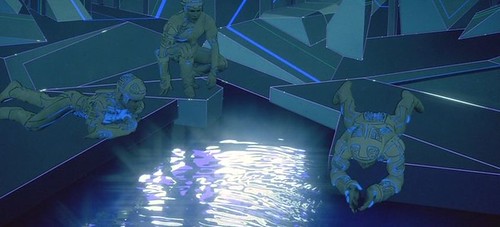
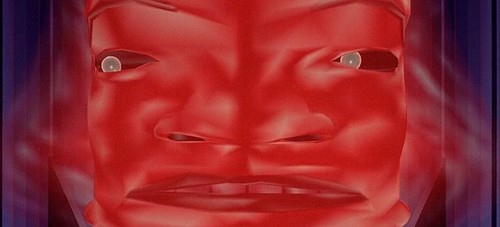
In Tron we have the first major motion picture where the main action takes place inside a computer, in what has become known as cyberspace. This world, of course, has no visual reality. To depict this world in film, then, one must invent a visual language. The language invented for Tron derives from video games, experimental film, and visionary imagery of psychedelia.

Through the wonders of computer graphics, the computer itself now becomes the medium for a Trip. The lead character of Tron was based loosely on computer guru Alan Kay – his wife was one of the screen writers – who is best-known as the developer of the GUI interface that has come to dominate both personal computers and high-end workstations. When Tron was made the personal computer revolution was in full swing, and Apple’s ground-breaking Macintosh computer was only two years away. The Macintosh would change the way people interacted with computers and make them more accessible to adults as well as to children.

Drinking cyberwater.

The counter-cultural sixties were thoroughly over and the high tech world of PCs had absorbed much of the adventurous spirit of youth. In the 1960s and 1970s young people turned on, tuned in, and dropped out to form communes and other collective living arrangements. In the 1980s and into the 1990s bright and adventurous young people formed high-tech companies in hopes of becoming wealthy at an early age. They dressed informally and listened to rock and roll though headsets while programming their way, if not to fame and fortune, then at least to exhaustion and sleep. Just as San Francisco and its hinterlands played a seminal role in the counter-cultural 60s, so the same region, and often the same people, played a seminal role in the personal computer revolution of the 70s and 80s.

Space ship in cyberspace.

New Age this and that became part of the cultural landscape. Yoga and the martial arts were fixtures of shopping malls across the land. While Yoga had been introduced into the West late in the nineteenth century, it owes much of its current popularity to receptiveness engendered in the psychedelic 60s. The martial arts master, with his superior physical prowess and mystical powers of insight and concentration, had become a figure of popular culture. Alternative forms of medical treatment had become more widely available; even the most prestigious medical institutions were teaching meditation to heart attack patients.

Meanwhile the elite world of artificial intelligence had fallen into disarray. The brilliant promises of the 1950s and 1960s went un-kept and the attempt to turn AI into a commercial enterprise went belly-up. The so-called “AI-winter” set in. At the same time the nation’s War on Drugs had kicked into high gear by the moralizing enthusiasm of William Bennett. The post-war baby boomers began moving into middle age.

The tyrant of cyberspace.

Selected Milestones:
  • 1977: Star Wars became a motion-picture blockbuster, wedding martial arts mysticism with a space opera story and high tech special effects.
  • 1981: William Bennett appointed to head the National Endowment of Humanities, his first government post. This positioned him to declare and lead a culture war. Later he would become “Drug Czar” under President Bush.
  • 1981: Ted Nelson publishes Computer Liberation, in which he describes an elaborate hypertext system he called Project Xanadu (after the kingdom described in Coleridge’s “Kubla Khan”).
  • 1984: Apple Computer advertised their new Macintosh in a Super Bowl advertisement that pitched IBM in the role of Big Brother and the Mac as humankind’s liberator.
  • 1984: William Gibson combines video game imagery with reggae music and mythology and sets it in the future, thus placing psychedelia and computing on equal terms in the cyberpunk world of Neuromancer.
  • 1985: Steve Jobs purchases Pixar, from George Lucas, and establishes it as an independent computer graphics company. Pixar would go on to produce the first completely computer-generated motion pictures.
Your interpretation here.

Thursday, June 24, 2010

Mind Hacks 4: 1968 – The Crazy Computer Trips the Light Fantastic, 2001

From the origins of man to the trip leading us to a new world, Stanley Kramer’s Kubrick's 2001 was both a counter-cultural and a mass cultural event. Based on a story by science fiction writer Arthur C. Clark, 2001 features HAL, a computer that goes crazy through being rigorously rational. The film’s final sequence utilizes abstract color imagery – reminiscent of Fantasia, but also of acid trips – ending in an enigmatic image of a cosmic infant. Many of the counter-cultural young were prepared to see that sequence as the Ultimate Trip. It was as though that Final Trip were the only antidote to a computer-induced madness that brings one human epoch to a close and places us at the brink of another one. 2001 was an attempt to create a new mythology of humankind, one thoroughly grounded in the science and technology of the late twentieth century.

 
 On the moon with the Monollith.

Psychedelic drugs broke free of the laboratory and the elite clinic and became available on the street. Many young people experimented freely with these drugs and not a few adopted a lifestyle featuring drug use. Eastern religion, rock and roll, colorful clothes, and back-to-nature utopianism were all part of the formula. However superficial much of this turned out to be, it was quite sufficient to shock and scare people into wondering what was happening in the world. One concrete effect was that psychedelic use and experimentation was made illegal. By that time, however, the cultural cat was out of the middle-class bag. If anything, the prohibition increased the attractiveness of psychedelics as agents of adolescent and generational rebellion and both popular and elite culture in all spheres felt the influence of psychedelia.

HAL speaks and blinks.

This same generation was the first in which many individuals got their hands on computers at a relatively young age. Courses in computer programming entered the college curriculum and departments of computer science were formed. Computers were still large and expensive, but the invention of time-sharing – an outgrowth of the AI movement – made terminals available to many.

 
HAL sees and observes.

Computer culture began to spawn imaginative forms of its own. MIT gave birth to the first video game, Space War, in the 1960s. It ran on a mainframe computer of the time and was the progenitor of those point-and-shoot games that would soon replace pinball machines and invade television sets. In the mid-1970s Stanford University’s Artificial Intelligence Lab gave birth to Adventure, a computer game in which players entered Colossal Cave and went from room to room in search of treasure. This game was played by typing and reading text. There were no graphics; one had to imagine the cave in one’s mind. Adventure became the prototype of the role-playing games which blossomed into elaborate fictional worlds with meticulously constructed visual settings and multiple characters the players could assume. As personal computers became more powerful and graphics techniques advanced, both types of games – and hybrids of the two – became ubiquitous and, when the web emerged, they went online and became communal.

Wednesday, June 16, 2010

Mind Hacks 2: Adventures in Fantasia


Frame grabs from "The Nutcracker Suite" segment of Fantasia. Is this the seed of the glowing pastoral utopia in Cameron's Avatar?


Adventures in Wonderland

When, in her 1967 hit song, “White Rabbit,” Gracie Slick sang that “one pill makes you large and one pill makes you small” she was alluding to the contemporary use of LSD to explore altered states of consciousness. But she was specifically invoking words from Lewis Carroll’s Alice’s Adventures in Wonderland. Carroll’s Alice books are that sort of children’s book that are also, albeit perhaps secretly, aimed at adults. In the guise of providing charming entertainment for children, Carroll wrote metaphysical fables for adults in which the most fundamental aspects of reality – the conformation and behavior of objects in space and time, their identity from moment to moment – are curiously and marvelously fluid. There is some suspicion that Carroll himself experimented with hallucinogenic drugs – the caterpillar in the famous Tenniel illustration is sitting on a hallucinogenic mushroom, Amanita muscaria. Whether or not that is so, drug use and its hallucinogenic effects was not exactly a secret among educated Europeans of the nineteenth and early twentieth centuries. To name only a few obvious examples:
  • Samuel T. Coleridge’s most famous poem, “Kubla Khan,” was supposed to have been composed under the influence of opium .
  • Charles Dickens’ last, and unfinished, novel, The Mystery of Edwin Drood, features an opium den among its settings.
  • Sigmund Freud experimented with cocaine.
  • William James wrote about his experiences with nitrous oxide.
  • Drug use (cocaine and morphine) was part of the cerebral mystery of Conan Doyle’s Sherlock Holmes, known best as a paragon of deductive rationality.
For Alice’s author, an instructor in mathematics and logic, and the adults in his audience, a child’s book was a way to escape the reality-based thinking demanded of Victorian adults. This trio – a dreamland, childhood, and mathematical logic – is the mental venue which hosted the late 20th century dance of drugs and computers.

1940 – Fantasia

First released in 1940, Fantasia was the third animated feature produced by Walt Disney and was a tour de force in the century’s new aesthetic and entertainment medium, film. Disney wanted to break new cinematic ground, to present moving images of a kind that had never been seen before. His animators set non-narrative and even abstract imagery to music, packaging avant-garde visual material as new form of family entertainment. Animation freed image-makers from the bounds of ordinary reality allowing Disney to create worlds beholding only to the idealized patterns and rhythms of the human nervous system. The public, however, was not ready for Disney’s vision and it failed at the box office; it did not find a large audience until the counter-cultural 60s, hardly the audience Disney had originally imagined.

Monday, June 14, 2010

Mind Hacks R Us: The Psychedelic Computer


In scientific prognostication we have a condition analogous to a fact of archery – the farther back you are able to draw your longbow, the farther ahead you can shoot.
– R. Buckminster Fuller

The child is father to the man.
– William Wordsworth


A bit earlier in this millennium I thought it would be interesting to write a book on the parallel evolution of computer culture and psychedelic culture in the United States from mid-century to the end of the millennium. I wrote up a proposal, called it Dreams of Perfection, and it went nowhere. Subsequently John Markoff and Fred Turner each published parts of the story:
John Markoff, What the Dormouse Said: How the Sixties Counterculture Shaped the Computer Industry, 2005.

Fred Turner, From Counterculture to Cyberculture: Stewart Brand, the Whole Earth Network, and the Rise of Digital Utopianism, 2006.
So, now I’m publishing a slightly revised portion of that old book proposal as a series of posts. I’ve cut the marketing portions of the proposal, leaving only the conceptual overview and the chapter summaries. I’d envisioned five longish chapters, one for each decade. Each chapter was to have been named after a thematically relevant mass-market movie that showed (more or less) during that decade. I’ve retained that structure in this series of posts.

The rest of this post consists of the conceptual overview, slightly revised. The next post will have a short prelude and the chapter summary for first chapter, which used Disney’s Fantasia as its point of departure. That will be followed by posts taking off from Forbidden Planet, 2001, Tron, and The Matrix.

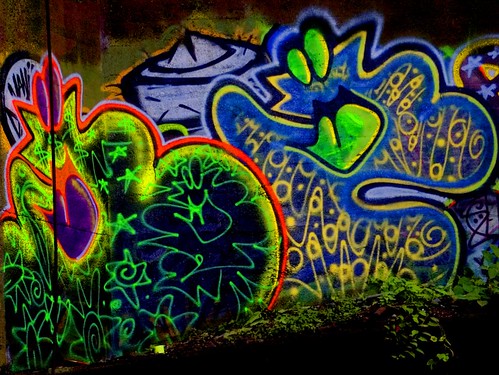
Graffiti by Plasma Slugs, with saturation and contrast boost from Photoshop.

The Dance of Drugs and Computers

During the last half of the 20th century various groups of insiders and outsiders adopted mind-altering drugs and computer technology to create cultural spaces in which we imagined and realized new venues for the human mind. These spaces engaged fundamental issues of freedom and control, of emotion and reason, which have bedeviled humans everywhere, and elaborates them in the through modern science and technology. The psychoactive drugs which, in some sense, free us, have been synthesized through laboratory techniques we have invented, but only recently. The computers which extend our powers of control and order in often surprising ways embody logical forms that date back to Aristotle but where only recently brought to fruition in the late nineteenth century work of George Boole and others. Science and technology thus provide us with objective physical touchstones for the otherwise abstract powers and activities of our hearts and minds.

Taken together with that great Victorian invention, childhood innocence, the technologies of drugs and computers would constitute a cultural arena which served as incubator, nursery, and playground for some of the major lines of development in late twentieth century culture. For, if a society is to progress it needs cultural playgrounds where new ideas can be conceived, tested and developed. Psychedelic drugs and computing – and their associated cultures – functioned as such playgrounds in the latter half of the 20th century. They were, in fact, among the most important cultural playgrounds in America.