Showing posts with label naturalist criticism. Show all posts

Thursday, February 5, 2026

Time for another run at “Kubla Khan”

I became “hooked” on “Kubla Khan” early in my career, somewhere around 1970 or so. I decided it was my intellectual touchstone: “a standard or criterion by which something is judged or recognized.” I would judge my intellectual progress by what I could say about that poem. (That’s why I entitled my first autobiographical essay “Touchstones.”) I wrote a master’s thesis about it in 1972, published my first article about it in 1985, and a later article in 2003. Between 2003 and now I’ve published some exploratory work. I’m thinking it may be time to take another run at the poem and see what I can do.

Preparatory to that effort I’ve moved all of my Coleridge material into a single section at Academia.edu: Coleridge. I’ve listed and linked those articles below:

Metaphoric and Metonymic Invariance: Two Examples from Coleridge, MLN Vol. 96, 1097-1105, 1981.

“Kubla Khan and “This Lime-Tree Bower My Prison” are two very different poems by the same poet. But they share the same two-part structure, and they share imagery as well. The roaring dell of “Lime-Tree” corresponds to the savage chasm of “Kubla Khan.” The concern with sight and sound manifest in “Kubla Khan” shows up in “Lime-Tree Bower” in the image of the creeking rook flying across the sun. And the way in which both Charles and the poet have access to that sight gives it a role similar to the sunny dome and caves of ice in “Kubla Khan,” where both the poet and his audience are linked through the image. These two poems share the same world. But they take radically different paths through it. One path is regulated by metonymy and unfolds though two consciousness moving through different parts of the same landscape. The other path is regulated by metaphor and so unfolds in two different worlds linked by a common image; the path it takes through these worlds is, however, the same.

Articulate Vision: A Structuralist Reading of ”Kubla Khan”, Language and Style, Vol. 8, 3-29, 1985.

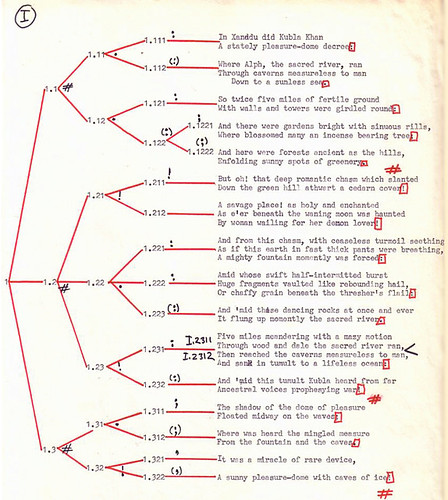
Coleridge's "Kubla Khan" has a highly coherent structure in which the two parts of the poem exhibit the same ternary structure. Each can be divided into three sections, the middle of those three in turn has three subsections and again, the middle of the middle has three subsections. The first section ends with "A sunny pleasure-dome with caves of ice," a line which is then repeated in the middle of the second section. This structure encompasses both semantics and sound, uniting both in a single coherent mental act.

This is considerably reworked from my unpublished Johns Hopkins Master’s Thesis, “THE ARTICULATED VISION: Coleridge's ‘Kubla Khan’” (1972).

“Kubla Khan” and the Embodied Mind, PsyArt: A Hyperlink Journal for the Psychological Study of the Arts, Article 030915, 2003, https://www.psyartjournal.com/article/show/l_benzon-kubla_khan_and_the_embodied_mind

Coleridge's "Kubla Khan" has a very coherent structure. Two movements of the poem are each divided into three sections; in both cases the middle of those three in turn has three subsections and again, the middle of the middle has three subsections. The first movement ends with "A sunny pleasure-dome with caves of ice," a line which is then repeated at the structural midpoint of the second movement. This structure encompasses both semantics and sound, uniting both in a single coherent mental act. The semantics of the poem’s first movement involves a series of cognitive blends in which the neural self provides one input while Xanadu imagery provides the other. The semantics of the second movement involves manipulating the reality status of successive mental spaces. Underlying the entire poem is a “walk” by core brain mechanisms tracing territorial, sexual, and attachment patterns through the poem’s semantics. Coleridge’s 1816 preface embodies an abstract pattern that paradoxically asserts and denies the poem’s validity. On the internal evidence, the poem is whole and complete.

Talking with Nature in “This Lime-Tree Bower My Prison”, PsyArt: A Hyperlink Journal for the Psychological Study of the Arts, Article 043011, 2004, http://www.clas.ufl.edu/ipsa/journal/2004_benzon03.shtml

By recasting Vygotsky's account of language acquisition in neural terms we see that language itself functions as a transitional object in Winnicott's sense. This allows us to extend the Schwartz-Holland account of literature as existing in Winnicottian potential space and provides a context in which to analyze Coleridge's "This Lime-Three Bower." The attachment relationship (between Caretaker and Child) provides the poem's foundation. The poet plays the Child role with respect to Nature and the Caretaker role with respect to his friends. The friends, Charles in particular, play the mediating the role of transitional object in the first movement while Nature becomes a mediator between one person and another in the second movement. The first movement starts with the poet being differentiated and estranged from Nature and concludes in an almost delusional fusion of poet, friends, and Nature. The second movement starts with the poet secure in Nature's presence and moves to an adult differentiation between poet, friends, and Nature.

STC, Poetic Form, and a Glimpse of the Mind, Working Paper, 2013.

"Kubla Khan" and "This Lime-Tree Bower My Prison" are two very different poems by the same poet, Samuel T. Coleridge. Think of them as orthogonal to one another within the overall space of the human mind. This working paper provides descriptive accounts of both poems, compares them, and recounts some of the work in the newer psychologies – cognitive, evolutionary, and neuro- – that has recently been brought to bear on the study of literature and how that work is germane to these poems. It concludes with a brief chronology of the parallel trajectories of cognitive science and literary theory in the last half of the previous century.

The Problem of Form in “Kubla Khan”, Working Paper, 2017.

"Kubla Khan" has two movements. The movements have the same form: each movements segment into three components (where the middle component, in turn, segments into three components and, once again (the middle component segments into three components)). All other divisions are binary. Iif we concentrate on the centers of the two movements we have that seething fountain occupying the same SLOT (middle of the (middle of the (middle))) in the first movement as the dome and the cave occupy in the second movement. And the dome and caves occupy the same SLOT in the first movement as “drunk the milk of Paradise!” plays in the second movement. Notice that the final words of both movements, “ice” and “Paradise” respectively, rhyme.

Calculating meaning in " Kubla Khan " – a rough cut (Version 2), 2017

"Kubla Khan" and "This Lime-Tree Bower My Prison" are constructed on utterly different schemes, though they share some of the same underlying components. "Kubla Khan" is ontological and impersonal in character and makes extensive use of convolution in calculating meanings. It reveals the structure of being. "Lime-Tree Bower" is narrative and personal and makes little or no use of convolution. It reveals the unfolding of subjectivity in time. The two poems also differ in their versification, a differences which is related to their different strategies of meaning.

Note that GPT-3 was released on June 20, 2020. I responded with a working paper, GPT-3: Waterloo or Rubicon? Here be Dragons, on August 5. The current version is #4 and is dated May 7, 2022. On May 11 I issued the next working paper, which reflects how thinking about LLMs has changed my thinking about how the meaning of poems is computed.

Symbols and Nets: Calculating Meaning in "Kubla Khan", Working Paper, 2022.

This is a dialog between a Naturalist Literary Critic and a Sympathetic Techno-Wizard about the interaction of symbols and neural nets in understanding "Kubla Khan," which has an extraordinary structure. Each of two parts is like a matryoshka doll nested three deep, with the last line of the first part being repeated in the middle of the second. They start talking about traditional symbol processing, with addressable memory, and nested loops, and end up talking about a pair of interlinked neural nets where one (language forms) is used to index the other (meaning).

Note, I’ve just had a couple of sessions discussing three of those papers with ChatGPT. I’m pretty sure that, if and when I get around to it, I’ll have something new to say. But first I’ve got to finish my book (Play: How to Stay Human in the AI Revolution).

Saturday, August 23, 2025

Overnight Ramble: Saturday 8.23.25 – Trump as national mood regulator, why the naturalist study of literature, art in the morning, and other things

Before I went to bed last night I put a physical post-it on my monitor listing three intellectual tasks for the next day (that is, today). I wake up early, cruise the web, and now I’ve got a different list of priorities. The new list reflects what I saw on the web, but also the effects of “sleeping on it.”

Trump as national mood regulator

The BIG THING seems to be the idea that President Donald Trump is in the business of regulating the national mood. Various actions he has been taking have certainly affected the national mood – the tariffs have affected the business community, the ICE raids have affected his base in one way, many of the rest of us in a different way, the same with his assault on higher education, this Epstein business, and so on. That’s one thing. What I’m suggesting, what I’m thinking about, is that he does those things, and others, in order to affect the national mood. That’s different.

Of course, DJT is certainly in the business of regulating his own mood, and his mood is directly tied to national events, to the national mood. The scope of his power as President is such that his mood regulation activity has an effect on the nation. Under what circumstances does mood regulation itself become the goal, though perhaps not consciously so, rather than the various ends toward which Trump’s actions are directed?

I think that’s a real question. By was of comparison, see my post from 2018, Trumposaurus Rex @ 3QD – Toward a cybernetic interpretation, and correlated 3QD article: Feed Me Donald! – Trump, Musk, the Internet, and Monsters from the Id.

The naturalist study of literature

To the extent that I’ve got an intellectual home base, it’s the study of literature. Back in 2006 I published a long article in PsyArt: An Online Journal for the Psychological Study of the Arts: Literary Morphology: Nine Propositions in a Naturalist Theory of Form. That’s the closest thing I’ve come to a systematic account of how I’ve come to think about literary study in the 21st century. It’s still reasonably accurate, though if I were to revise it today I’d say something about digital humanities and cultural analytics.

Back in 2010 I posted an informal piece in The Valve, which I then republished here at New Savanna: “NATURALIST” criticism, NOT “cognitive” NOT “Darwinian” – A Quasi-Manifesto. (You can download it here.) Think of it as an extended advertisement for the morphology piece with links to some practical criticism and a nod toward emerging in the digital humanities.

But why do it at all, curiosity aside? What’s it for? Ecological validity, that’s what. And what, pray tell, is ecological validity? The term originated in the behavioral sciences, mostly psychology I believe, and (quoting Wikipedia)

is often used to refer to the judgment of whether a given study's variables and conclusions (often collected in lab) are sufficiently relevant to its population (e.g. the "real world" context). Psychological studies are usually conducted in laboratories though the goal of these studies is to understand human behavior in the real-world. Ideally, an experiment would have generalizable results that predict behavior outside of the lab, thus having more ecological validity.

What’s that have to do with studying literature? Nothing and everything.

Ultimately we want to understand how the human mind works, all of its facilities and capacities, working together as we live our lives. How do we get that, all of it, into the laboratory? We can’t. But literature draws on a rich range of our mental facilities working in concert. If we could understand how the mind works while we read a book, listen to a poem, attendant a play, or for that matter, watch a movie or a TV show, that would show us the whole mind operating in an ecologically valid context. For those are all things that humans do.

That’s why we need the naturalistic study of literature, as opposed to the standard humanistic/interpretive study. Interpretation tells us little or nothing about the mind/brain. But naturalistic study, that’s what it’s about. As far as I know the only place I’ve made that particular argument is in some blog posts which I’ve put together into a working paper: The Brain, the Teleome, and the Movies. Here's the abstract:

Mark Changizi has argued that we will understand the mind/brain only when we have an accurate description and inventory of the tasks it must perform. He calls this the teleome. Until we know what a mechanism is built to do, we have no way of understanding the functioning of its parts. The same is true of the mind/brain. I extend Changizi's argument by noting that the appreciation of works of art calls on a full range of human capacities and is thus a rich source of insight into neuro-mental mechanisms. Moreover we have every reason to believe that we can develop sophisticated ways of describing works of art, verbal art and films are my particular focus and interest. Those descriptions will be invaluable for interpreting observations about the brain activity supporting those aesthetic objects.

Art in the morning

I’ve got a number of posts involving Art Club, an activity where I get together with some friends and we color line drawings (coloring books for adults). Well, I took art lessons for over half a dozen years as a child and make paintings now and then into my fifties. So I decided to return to it. I purchased some colored markers, a pad of paper, and went to it. I’ve done one post on that activity, Dot Paintings (after Jamie Bérubé), but I’ve done some completely different work as well, totally freeform. And I’m now working on some stuff that combines the mechanistic order and precision of the dob paintings with the more freeform. That’s what I’m going to do once I’ve posted this and then showered and had breakfast.

I’ve done 54 paintings since I did the first dot painting on July 16. The freeforms only took twenty to thirty minutes, but the dot paintings took up to an hour. But these recent ones, they take longer.

We shall see.

Other stuff: From my post-it

The big thing for this weekend is to work on my book: Play: How to Stay Human in the AI Revolution. I want to review the material I’ve done so far and then rough out my chapter outline.

But I also want to do some work on my series on the Greatest Literary Critics, NOT. I’ve got one more post to do, on Harold Bloom, and I can wrap it up and turn it into a working paper.

Finally, I’ve been doing some work with ChatGPT-5 on ring-from analysis of literary texts. I want to turn that into a working paper as well.

And, one more thing, the cosmos

I want to make a quick extension to my post, Notes on the Metaphysical Structure of the Cosmos: The recursive nature of the cosmos implies that the cosmos is never complete. It’s always evolving, along with its metaphysical structure. The recursiveness isn’t external to the cosmos. It’s internal. There’s not end to the structure of the cosmos.

Not to mention intelligence

The AI folks seem to think of intelligence as something that’s easily scalable, the intellectual equivalent of horsepower. And to be sure the human mind has that aspect. But there’s more to it. There’s task-specific architecture. That’s important as well, and it’s not scalable.

Why have GPTs had so much difficulty with ordinary arithmetic? They’re got plenty of “horsepower.” That’s not the problem. Architecture is. The single-pass architecture of LLMs is not suited to arithmetic. Guess what? It’s not good at sketching out a semantic network suitable for a given next, it can’t do that either. Nor, it turns out, ring-form analysis. Neither of those tasks is rocket science. But they require a specific orchestration of tasks, one that LLMs can’t support.

That’s one reason symbolic computing is important. LLMs are basically associative memories; that is to say, they’re content based retrieval systems. Symbolic systems, however, are location based retrieval systems. That allows for a much more flexible orchestration of tasks since it allows for the organization of complex tasks using a structure of locations, and that is independent of what is stored at each location.

More later.

Wednesday, February 28, 2024

“NATURALIST” criticism, NOT “cognitive,” NOT “Darwinian” – A Quasi-Manifesto

I've posted a new paper to the web, title above, links and preface below:

Academia.edu: https://www.academia.edu/115553925/_NATURALIST_criticism_NOT_cognitive_NOT_Darwinian_A_Quasi_Manifesto
SSRN: https://ssrn.com/abstract=4742022
Research Gate: https://www.researchgate.net/publication/378549603_NATURALIST_criticism_NOT_cognitive_NOT_Darwinian_A_Quasi-Manifesto

Prefatory Note: What’s in a Name?

This was originally published in The Valve, now defunct, on March 31, 2010. It is an informal manifesto in a quasi-conversational style – pseudo-Socratic? – for my work in literary criticism. Acknowledging that literary criticism has long become a game in which one must have a label for one’s approach, I chose the term “naturalist.” After acknowledging that the term is problematic in a humanities context. I go on to explain why I’ve chosen it to designate my work and, in particular, to differentiate it from “cognitive” criticism and “literary Darwinism,” with which it has superficial affinities.

I could link a lot more into this piece now, but I won't. It's a decent indicator of the directions I’ve been pursuing.

Sunday, May 30, 2021

“NATURALIST” criticism, NOT “cognitive” NOT “Darwinian” – A Quasi-Manifesto

Time to once again bump this to the top of the queue. 

* * * * *

Reposted from The Valve, 31 March 2010, this is an informal manifesto for whatever it is I'm up to, and why I'm come to think of it as naturalist criticism. I could link a lot more into this piece now, especially my recent work on ring composition and digital humanities, but I won't. It's a decent map to my work in literature, a place-holder until I have time to do something a bit more formal.


You mean a quasifesto?

Shoo, get out . . .


Fact is, if I’d known then what I know now, I’d never have thought of myself as being in the business of bringing cognitive science to literary criticism much less represented myself to the world in that way. But I didn’t (know) and I did (represent), so now I seem stuck with the moniker. I’d like to shake if off.

When I finally decided to publish a programmatic and methodological statement, “Literary Morphology: Nine Propositions in a Naturalist Theory of Form,” I adopted naturalism as a label. Fact is, I’d just as soon not think of it as anything but the study of literature. But we live in an age of intellectual brands, so I chose “naturalism” as mine.

Yes, I know that “the natural” is somewhat problematic, but you’ll just have to get past that. No label is perfect and I’m not about to coin a new term. Assuming you can struggle past the word, what does naturalism suggest to you? To me the term conjures up a slightly eccentric investigator wandering about the world examining flora and fauna, writing up notes, taking photos, making drawings, and perhaps even collecting specimens. That feels right to me, except that I’m nosing about poems, plays, novels, films, and other miscellaneous things. Beyond that I’d like the term to suggest some sense of literature as thoroughly in and a part of the world. There’s only one world and literature exists in it.

Beyond that, what does the term suggest? . . . Nothing, that’s what I’d like it to suggest, nothing. But whatever this naturalist criticism is or might become, that it has some kind of name suggests that it’s probably not myth criticism, New Criticism, Marxist criticism, psychoanalytic, deconstructive, archetypal, phenomenological, reader response, or any of the other existing critical brands.

What do the terms “cognitive criticism” or “cognitive rhetoric” suggest? Like many of those other labels, they suggest some body of supplementary knowledge and practice that one brings to the study of literature. Just exactly what the supplementary body is, that may not be terribly clear. But that doesn’t matter. The terms emphasize and draw your attention to the supplement. The same with “Darwinian literary criticism,” only vaguer. The only thing that’s clear about that label is a towering intellectual figure whose work had nothing to do with the study of literature.

None of this should be taken to imply that I’ve lost interest in the newer psychologies, as I like to call them. I haven’t. I believe that future literary studies must take them into account, and other theories, concepts and models as well. I just don’t want to stick those names in my brand label.

Anything else?

Yes, I put the study of form at the center of the enterprise.

So why not label yourself a formalist?

Because that’s already of term of art, and it’s too strongly identified with approaches that treat the text as an autonomous object more or less independent of reader, author, and the larger world. For that matter, many formalist critics are more interested in textual autonomy than in systematically analyzing and describing the manifold formal aspects of literary texts. In the end, they’re as greedy after meaning as most other critics are.

OK, so what do you have in mind with this naturalist criticism that emphasizes form?

Good question. And I’m afraid my best answer is a bit embarrassing. I figure the best way to scope out any literary program is to look at practical criticism. What does it do with an actual text, in some length and detail. And the best examples I know are, umm, err, from my own work. And that, as I said, is embarrassing. I’d rather point out someone else’s work.

Really? There’s nothing else? Your work is de novo, so to speak?

Well, everyone has precursors and models. I was certainly influenced by the structuralists, Roman Jakobson, Edmund Leach, Jean Piaget, and Lévi-Strauss above all. For that matter I should probably know narratology better than I do. And I’ve enjoyed the detailed analytic work that David Bordwell’s posted on his blog, though I’ve not gotten around to reading any of his books except Making Meaning, which is an analysis and critique poststructuralist film criticism. If more people analyzed literary texts like Bordwell analyzes film, that would be good.
[More specifically, check out, e.g. Bordwell’s post on “Tell, don’t show,” or this post on “Kurosawa’s early spring,” other posts tagged as “Film technique,” and this essay, “Anatomy of the Action Picture.”]
OK OK, I get the idea. I’m skeptical, but go on. What’s your best analytic work?

I suppose my recent essays on “Kubla Khan,” and “This Lime-Tree Bower My Prison,” but they’re a bit of a slog, long and detailed, and lots of diagrams. I like this old piece on Sir Gawin and the Green Knight too, and this Shakespeare piece, which looks at three plays, Much Ado About Nothing, Othello, and The Winter’s Tale and even uses evolutionary psychology.

Perhaps the best place to start would my recent post: Two Rings in Fantasia: Nutcracker and Apprentice. It focuses on form and it’s got some nice screen shots too. It’s relatively short and pretty much free of abstract critical apparatus, though there’s an addendum that heads off into the abstractosphere. Yeah, it’s about film, not literature, but that’s a secondary issue that has no bearing on my main point.

As the title suggests, I consider two episodes in Disney’s Fantasia, the Nutcracker Suite and the Sorcerer’s Apprentice. There are three things going on in that post: 1) the analysis and description of so-called ring forms in the two episodes, which is my main focus, 2) a brief characterization of the spatial worlds in the two episodes, and 3) some informal remarks on what those episodes might mean.

A ring form is a text in which episodes mirror one another around a central point or episode, thus: A, B, C . . . C’, B’, A’. One of these episodes has a conventional narrative (Sorcerer’s) while the other does not. But both are rings. Pending strong arguments to the contrary, I regard that as a fact about them. The ring structure really is there; it’s not something I’m reading into the episodes. The core work in the post is to report the relatively straight-forward analytical work needed to establish ring structure as a descriptive fact.

In the course of looking at the ring structure I also offer some remarks on the structure of the visual worlds in the two episodes and how the virtual camera moves through them. This plays no role in my argument about ring structure, but it is a formal feature of the episodes and is important in the larger scope of the hole film. Each of the eight episodes has a different theme and subject matter, and each has a different animation style. Somewhere “between” the style and the subject matter you have visual space and movement through it.

Finally, I offer some interpretive comments, some observations about what these episodes might mean. In the case of Nutcracker those suggestions lean toward the Freudian, though I suppose some might argue it has no meaning at all, that it’s just a bunch of pretty pictures set to music. Sorcerer’s is a different case, because here we have a actual story. I suppose I could’ve gone Freudian and worked on Father and Son, but I got stuck on all those industrious brooms parading across the screen and ended up giving a nod toward the Marxists.

Well, OK, OK. I’ve read the paper and it’s a nice piece of work.

Thank you.

But I don’t see anything new in kind.

Well, yes, I didn’t invent anything, but . . . .

Anyone could do it. It’s well within range of a good undergraduate . . .

And did you notice it’s not jam-packed with a lot of conceptual apparatus?

That’s what I mean, it’s almost as if anyone could do it.

Well, I rather doubt that. You do have to have a “feel” for the job, and that takes time and experience. You have to work with texts (or films) to learn how to work with them. You can’t get it by reading books and articles. But the absence of a lot of apparatus, that’s a feature, not a bug. In any event the thing to notice is that formal analysis and description is at the center of the piece.

But that’s not a central focus of practical criticism in the discipline as it is currently practiced. Nor does it seem to be on radar screen for the cognitivists and the Darwinians. They still treat meaning as the main event.

Sunday, August 2, 2020

August 2, July in review: poetry, GPT-3 and a couple other things

It’s been an exciting, and exhausting two weeks. I’ve been wanting to ramble on for a week now, but kept putting it off because my series on GPT-3 kept calling. It’s still calling me, but I’m at a strange place and so have stepped back from it.

A strange place [of corpus and the mind]

I don’t quite know what I intended when I started this series of GPT-3 posts. Oh, now I recall. I’d made a long comment about GPT-3 at Marginal Revolution on July 19, 2020. I wanted to elaborate on that. I suppose I had three or four or five posts in mind, certainly less than ten.

Nor will it be over ten. But the first three posts have proved complex enough that I decided to break them into two groups so that I can issue a working paper when the first series is done. That series is strictly about GPT-3 and related issue and will be entitled: GPT-3: Waterloo or Rubicon? Here be Dragons. The second series will be about the future of AI and has this working title: GPT-3: And beyond, the future.

I reached a turning point in the series sometime between July 27, when I uploaded the second post, and July 29, when I uploaded the third. In that interval...ah, I found it. And it was July 24 (my sister’s birthday). I’d linked my first post in the series to Facebook. John Lawler made a comment in which he pointed me to a post by Julian Michael, To Dissect an Octopus: Making Sense of the Form/Meaning Debate. That gave me a clue about what’s going on in engines like GPT-3, and that clue turned my head around. It also made this series of posts somewhat more complicated and demanding than it had been when I set out to write it.

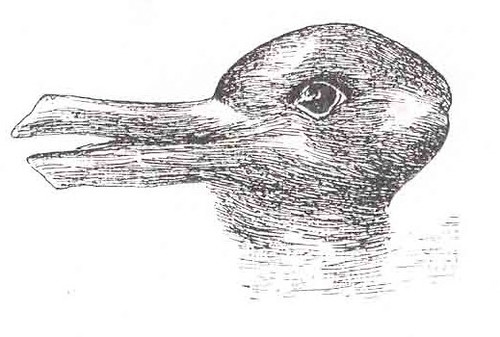
I now have a fundamentally new understanding about what’s going on in these statistical models of bodies of texts. At least I think I do. I’ve now reached the point where I’m wondering if I’ve actually done that, whatever that is. It seems so obvious to me that surely everyone must know it already. And maybe they do, but they don’t recognize it yet. It’s about point of view. From one point of view it’s a duck, from another point of view it’s a rabbit. But the lines and their relations are the same in both cases.
If been chasing this idea for three years or so. This blog post is a good marker:
Borges Redux: Computing Babel – Is that what’s going on with these abstract spaces of high dimensionality? [#DH], New Savanna, blog post, October 2017, https://new-savanna.blogspot.com/2017/10/borges-redux-computing-babel-is-that.html.
I’ve gathered a number of those posts into this working paper:
Toward a Theory of the Corpus, Working Paper, December 31, 2018, 46 pp., https://www.academia.edu/38066424/Toward_a_Theory_of_the_Corpus.
African-American sonnets and literary criticism

It started with the interview I conducted with Hollis Robbins about her new book, out: Forms of Contention: Influence and the African American Sonnet Tradition. We emailed back and forth for two weeks or so and then I edited it into the form of an interview. The last thing we did was to set an African American poet, Marcus Christian, in competition with GPT-3, thus updating the contest between John Henry and the steam drill. The interview was published in 3 Quarks Daily on July 20.

That’s what got me thinking about GPT-3, which I already knew about. By staging a competition – I got GPT-3 to attempt to write a sonnet – I got a little skin in this game and that, I suspect, got me thinking about these language engines in a different way, from a different point of view. It was no longer that strange and interesting technology over there. It was now right here, beneath my nose.

I dealt with it.

As a bonus, I made some progress in conceptualizing the relationship between what I have been calling naturalist literary criticism and the standard criticism that has been practiced since the 1950s or so, On the nature of academic literary criticism as an intellectual discipline: text, form, and meaning [where we are now]. I’ve been chewing on that one for a long time. A long time. The critic has a choice: they can seek meaning in the text (the standard approach) or they can seek to analyze and describe a text’s form (which relatively few choose to do). You can’t do both, not in the same discourse. Oh, I know critics say they’re dealing with form, but they’re not really...And I don’t want to go into that here. Read the post.

Other things: Stagnation, identity, freedom and dignity in music

All this work on sonnets and GPT-3, however, has taken my attention away from a series of posts I’d been working on about Peter Thiel and economic stagnation. Looks like late June was the last I’d posted on that, and the post was a short one presenting a conversation between Thiel and David Graeber.

The conversation with Robbins brought up the issue of cultural identity, another topic I’ve been chewing on for a long time. I’m due for another post on that. Perhaps next week, or the week after. We’ll see.

Finally, I need to do a post about music. When people are absorbed in making music, they cease being old or young, rich or poor, male or female, and so forth. The become, simply, musicians.

Friday, July 31, 2020

On the nature of academic literary criticism as an intellectual discipline: text, form, and meaning [where we are now]

Since the late 1950s and early 1960s the discipline has made interpretation its central focus. The discipline’s job is to determine or at least comment on and explicate the meaning of texts. At the same time the discipline has failed to define just what the text is and has arrived at no consensus about form, though formalism is a central conception. This makes sense. Form is a property of texts. If the discipline doesn’t know what a text is, then it can’t know what form is either.

Correlatively, the distinction between reading, in the ordinary sense of the word, and reading, as explicit interpretation, has become elided so that reading can mean either or both depending on the context. This too makes sense, though we need to think about it and come at it from another angle.

That other angle starts with a straight-forward definition of the text as a string of symbols. Form then becomes a matter of how words and syllables are arranged on the string. That’s my starting point; that’s the starting point for the naturalist study of literary morphology [1]. With that as your starting point, how do you get to meaning?

There are two ways.

The way of the critic

Here’s the standard way, the way of the critic: You can simply read the text, in the ordinary sense of read. This makes you a reader, obviously. To act as a literary critic, using this as your starting point, you go on to interpret the text. That is, you read it, in the sense the word has come to have among critics.

This process renders the text, as a string of symbols, all but invisible, and so obscures form – the arrangement of symbols in the string – as well. There are, of course, exceptions. In poetry rhyme and meter are obvious and so attract comment. But they are obvious that makes it easy to subordinate that comment to interpretive exegeses. In prose we have the distinction by story and plot, which is so prominent in Tristram Shandy. This too is so obvious that it doesn’t threaten the hegemony of interpretive meaning.

The way of the modeler [speculative engineer]

That’s one way. There is another. That’s what I pursued, staring with Lévi-Strauss on myth and, to a lesser extent, Jakobson on poetics. That led me first to “Kubla Khan”, where I ran up against a very elaborate formal structure [2], form in the sense of the arrangement of words and syllables on the string. Despite all the attention that had been given to this poem that formal structure had been missed.

That formal structure seemed computational to me and so I went off to graduate school in search of the computational underpinnings of literary texts. I produced a partial computational model of a single text, Shakespeare’s Sonnet 129 [3]. Take that model, flesh it out in various ways, and then embody in an appropriate computer program and then, yes, the computational engine reads the text. You could then, at least in principle, open the engine and see what it did in the course of reading the text. In a paper I co-authored with David Hays in 1976 we imagined such an engine and I fully anticipated that I would one day be working with it, as would others [4]. That didn’t happen, nor do I expect it to any time in the near future, if ever.

This path leads you to models, but also to the description of form [5]. But you do not end up with interpretations. Those you must forswear.

Which way?

There is a trade off. If you seek meaning, then you take the way of the critic, but subordinate the text and form. If you seek form, then you must subordinate meaning and pursue the say of the modeler. There is no reason, of course, why one individual can’t pursue both paths, sometimes in different investigations, sometimes at different points in the same investigation. I have investigated this trade-off in an open letter I wrote to Daniel Everett, who was an academic dean at the time [6].

I see no reason why academic literary criticism should give up the way of the critic. But it will whither and die if it does not attend more deeply to the way of the modeler.

Note on terms and citations

This short post makes many assertions about literary criticism. I believe that I have discussed all of them in various posts and working papers. But I have decided not to cite those many pieces in this post, which would have turned it into a bit of a slog to write. It’s Friday morning, I’m exhausted from thinking and writing about GPT-3. Enough. If you have a mind to do so you can hunt those pieces down through the links I attach to the post.

I don’t particularly like the term “modeler”, but I can’t offer another at the moment. In the past I’ve talked of “naturalist criticism” and so of the “naturalist critic.” That suffers from the use of “critic”. I’ve taken the term “speculative engineer” from the preface to my book on music, Beethoven’s Anvil (2001), where I describe my method as speculative engineering. I do like that, but I can’t see it being used as a term of art.

That being said, this is pretty much how I see things at the moment. If I changed the tone a bit I could turn it into a manifesto.

References

[1] William Benzon, Literary Morphology: Nine Propositions in a Naturalist Theory of Form, PsyArt: An Online Journal for the Psychological Study of the Arts, August 2006, Article 060608, https://www.academia.edu/235110/Literary_Morphology_Nine_Propositions_in_a_Naturalist_Theory_of_Form.

[2] William Benzon, Articulate Vision: A Structuralist Reading of "Kubla Khan", Language and Style, Vol. 8: 3-29, 1985, https://www.academia.edu/8155602/Articulate_Vision_A_Structuralist_Reading_of_Kubla_Khan_.

[3] William Benzon, Cognitive Networks and Literary Semantics, MLN 91: 1976, 952-982, https://www.academia.edu/235111/Cognitive_Networks_and_Literary_Semantics.

[4] William Benzon and David Hays, “Computational Linguistics and the Humanist”, Computers and the Humanities, Vol. 10. 1976, pp. 265-274, https://www.academia.edu/1334653/Computational_Linguistics_and_the_Humanist.

[5] William Benzon, Description as Intellectual Craft in the Study of Literature, Working Paper, September 2017, 35 pp., https://www.academia.edu/4262467/Description_as_Intellectual_Craft_in_the_Study_of_Literature.

[6] William Benzon, An Open Letter to Dan Everett about Literary Criticism, June 2017, 24 pp., https://www.academia.edu/33589497/An_Open_Letter_to_Dan_Everett_about_Literary_Criticism.

Thursday, October 31, 2019

Why computation, what does it, mostly the idea, bring to literary study?

Connection: It is a means of linking literary investigation to a wider intellectual world.

Bear with me for a moment, I’ll get there.

Let’s start with the so-called New Criticism and its formalist assertion of textual autonomy. That is, these critics were not particularly interested in analyzing and describing for as such. Rather, they invoked it, and gestured at some of its textual features, as a way of severing the text from context, that is, from readers, writers, society, and history. This resulted in a critical practice in which it is just the critic and the text (in conversation), no literary history, no psychology of any stripe, no sociology, or even philosophy, except what is present in common educated discourse. No special intellectual apparatus is needed to do such criticism. (That, incidentally, made it attractive as a pedagogical approach in the mid-20th century; but let’s set that aside.)

And it is precisely for that reason that no special effort was needed to link academic literary criticism to the wider world, not necessarily the academic world, but the world generally. To the extent that the work was carried out with a commonsense critical armamentarium, anyone could read this criticism – most especially, other critics and academics more generally, and link it to the larger world. There was one problem, however. Critics did not agree on their close readings. Could one text mean different things to different people? Was this an objective intellectual activity, or simply high-flown subjectivity on display?

And so that enterprise was put to the test in the 1960s and 1970s and found wanting, at least by many critics. This gave rise to various forms of contextual criticism. The New Historians employed cultural, social, and political history to insert texts into their historical context and Foucault linked their discourse to broader intellectual currents. Theory, as it came to be called, whether via Derrida, Lacan, Habermas, Kristeva, Deleuze, Spivak, and so forth, was a medium through which literary critics could interact with the larger intellectual world. Evolutionary psychology and (second generation) cognitive science served the same role for various critics who emerged in the mid-1990s. None of these critics, of course, needed formalism as a device to authorize a certain critical approach nor, for whatever reason, were they particularly interested in literary form as an object of description and analysis (Jamison notwithstanding).

And yet, literary works do have very interesting formal features, features well worth describing and analyzing. And there have always been critics who focused on those features via poetics and/or narratology. But this work has been secondary in the American academy. Could it be in part because there seemed to be no way to connect these interests with larger intellectual currents? Perhaps.

That is, various critics may well be fundamentally interested in form. But the imperatives of the existing discipline don’t allow the full flowering of those interests. And so they wither and all but die.

* * * * *

In my own case, its clear that I’ve always found formal analysis interesting. In my sophomore year, I believe it was, I took a cue from Lévi-Strauss and used a feature table in one of my papers. And it was an intuition about form that got me interested in “Kubla Khan” in my senior year. It seemed to me somehow that the two parts of the poem, the first 36 lines and the last 18, had the same structure. It took me a couple of years to figure that out, and when I’d done so, it set the general direction my intellectual career would take.

KK-triple-72.jpg
Some formal features in the first 36 lines of “Kubla Khan”

I pursued “Kubla Khan” in that way because it interested me. Once I’d found that form, then I recognized the trace, the smell, of computation in it. That’s when I decided to study the cognitive sciences, and that’s why I apprenticed myself to David Hays in graduate school. I wanted to know where that form came from, and how.

When I’m doing practical criticism, describing and analyzing a text, whether written or film, I’m not thinking about computing. That is, I’m not thinking about Turing machines, algorithms, data structures, flow of control, any of that. I’m thinking about patterns in the text. Computation is how I link those patterns to a larger intellectual enterprise. That’s what I was up to in my major methodological and theoretical paper:
Literary Morphology: Nine Propositions in a Naturalist Theory of Form. PsyArt: An Online Journal for the Psychological Study of the Arts. August 2005, Article 060608. http://www.academia.edu/235110/Literary_Morphology_Nine_Propositions_in_a_Naturalist_Theory_of_Form.
Here are the nine propositions:
  1. Literary Mode: Literary experience is mediated by a mode of neural activity in which one’s primary attention is removed form the external world and invested in the text. The properties of literary works are fitted to that mode of activity.
  2. Extralinguistic Grounding: Literary language is linked to extralinguistic sensory and motor schemas in a way that is essential to literary experience.
  3. Form: The form of a given work can be said to be a computational structure.
  4. Sharability: That computational form is the same for all competent readers.
  5. Character as Computational Unit: Individual characters can be treated as unified computational units in some, but not necessarily all, literary forms.
  6. Armature Invariance: The relationships between the entities in the armature of a literary work are the same for all readers.
  7. Elasticity: The meaning of literary works is elastic and can readily accommodate differences in expressive detail and differences among individuals.
  8. Increasing Formal Sophistication: The long-term course of literary history has been toward forms of increasing sophistication.
  9. Ranks: Over the long-term literary history has so far evolved forms at four successive cognitive ranks. These are correlated with a richer and more flexible construction of the self.
Propositions 3, 4, 5, and 6 are explicitly stated in terms of computation, and computation is implied in 8 and 9, where computation is the means that allows the formal sophistication that, in turn, eventuates in more or less distinct ranks, with the concomitant structuring of the self.

And now we’re back where we began. What does the idea of computation bring to literary study? Connection: It is a means of linking literary investigation, in particular, the description and analysis of form, to a wider intellectual world.

More later.

Monday, October 28, 2019

Enchanted by meaning – That’s been the fate of American criticism, but elsewhere?

Though, to be blunt, in my more polemical moods I’m inclined to think that “besotted” is a better word to characterize academic literary criticism’s engagement with the search for meaning, at least in America. It wasn’t always thus; there is a history here. And in the rest of the world? Has that enchantment taken hold, or is there a bit of distance, even resistance? That’s what I’m wondering about.

This enchantment had all but taken hold by the time I’d become an undergraduate at Johns Hopkins in the mid-1960s. But I did see hints of and hear echoes from other modes of literary study. And I noted the transformation of the meaning of “reading” from common sense word into a term of professional art. As a common sense term it meant simply “to read”, as any literate person does with a text of any kind, whether a greeting card, the daily newspaper, a technical report or user’s manual, or, yes, a literary text. As a term of art it meant “to interpret, to explicate”, a mostly written activity in which one comments on the meanings inherent in (in one formulation) or one finds in (a somewhat different formulation) a literary text. For anyone entering literary study, however, a decade or so later, and whether at the undergraduate or graduate level, those hints and echoes would have been gone. Reading, that is, interpretive reading, had become the focus of literary study and, for all practical purposes, it had always been thus.

But, as I’ve said, there IS a history there. According to Gerald Graff in Professing Literature (1987) interpretive criticism, in the form of so-called close reading, was a response to a demographic shift in higher education after World War II. While close reading has pre-war roots but became particularly attractive as a pedagogical tool when college enrollment increased after the war and it thus became necessary to educate large numbers of undergraduates from disparate backgrounds. This educational imperative was, if anything, more ethical than merely cognitive, where by “ethical” I mean to invoke ethos, which my dictionary glosses as “the characteristic spirit of a culture, era, or community as manifested in its beliefs and aspirations.” Close-reading was a means by which large numbers of undergraduates could be imbued with the values of American culture, indeed, of Western civilization. Close-reading’s assertion of textual autonomy meant that it was not necessary to be steeped in historical knowledge in order to think and write about literary classics. One merely had to learn how to attend to the text.

And if close-reading was to become a pedagogical technique, well then the pedagogues themselves had to master it. So they did, and in the process close reading became the focus of post-war literary criticism. By the mid-1960s, however, critics began to notice and wonder about the fact that different critics arrived at different meanings for the same text. How could this be? If criticism is a form of knowledge, then shouldn’t we all agree on textual meaning? Otherwise criticism would seem to be little more than personal opinion decked out in often high-flown rationalizations. And so the profession entered a period of methodological reflection that lasted, let us say, through the 1970s and into the 80s. It is during this period that both structuralism and linguistics were considered as means of textual commentary that didn’t necessarily focus on decoding textual meaning, but were concerned with techniques and forms of construction.

Both, however, were discarded. Not completely, to be sure, narratology has persisted, and a bit of poetics and even linguistics. But they were not regarded as central to the discipline. They have little presence in mainstream journals such as PMLA, Critical Inquiry, New Literary History, and so forth. During the mid-1990s both cognitive psychology and evolutionary psychology entered the scene, but both were firmly subject to the reigning focus on meaning. They provided new interpretive vocabularies and little more.

And that, more or less, is where the profession is today. Yes, there is computational criticism, which is a whole different ball of wax. But it seems to me that, whatever its potential, it still functions, or valiantly attempts to function, under the sign of meaning.

That’s academic literary criticism in the United States. What’s going on elsewhere? I have the distinct impression that narratology and even linguistics have received more play in (Continental) Europe than they have in the United States. Is that the case, or am I imagining things? What about elsewhere in the world? For example, I’ve got a post where I excerpt an exchange between J. Hillis Miller and Zhang Jiang, a senior critic in the People’s Republic of China. That conversation is about interpretive criticism, specifically deconstruction. I’ve got another short post in which Hollis Robbins talks about Chinese scholars’ knowledge of literary theory, that is, (advanced) interpretive criticism? Is that all that the Chinese have taken Western criticism. What about narratology (from Europe)? And so I wonder about Japan, India, and the rest of the non-Western world. For that matter, what about native intellectual traditions?

All of which is to say: Is interpretive criticism all that there is in the academy? If so, we’re in deep trouble, for interpretive criticism has bottomed out. There’s nothing left but new variations on old themes.

On the other hand, here’s an opportunity. If some body of scholars out there in the wider world were to latch on to the best of computational criticism and combine it what what I have been calling naturalist criticism and within an intellectual generation, perhaps two, they could show those backward Westerner’s a thing or two.

Monday, December 11, 2017

Neuroscience Needs Behavior, and literary behavior is among the richest there is

Not only that, but it leaves records of its unfolding in the form of texts. Our task is to "reverse engineer" the activity by analyzing the texts. Something more easily said than done. My most recent attempt: Calculating meaning in " Kubla Khan " – a rough cut (Version 2).

* * * * *

 2017 Feb 8;93(3):480-490. doi: 10.1016/j.neuron.2016.12.041.

Neuroscience Needs Behavior: Correcting a Reductionist Bias.

Abstract

There are ever more compelling tools available for neuroscience research, ranging from selective genetic targeting to optogenetic circuit control to mapping whole connectomes. These approaches are coupled with a deep-seated, often tacit, belief in the reductionist program for understanding the link between the brain and behavior. The aim of this program is causal explanation through neural manipulations that allow testing of necessity and sufficiency claims. We argue, however, that another equally important approach seeks an alternative form of understanding through careful theoretical and experimental decomposition of behavior. Specifically, the detailed analysis of tasks and of the behavior they elicit is best suited for discovering component processes and their underlying algorithms. In most cases, we argue that study of the neural implementation of behavior is best investigated after such behavioral work. Thus, we advocate a more pluralistic notion of neuroscience when it comes to the brain-behavior relationship: behavioral work provides understanding, whereas neural interventions test causality.
PMID:
  28182904
DOI:
10.1016/j.neuron.2016.12.041

* * * * *

In my 1978 dissertation, Cognitive Science and Literary Theory, I asserted that the project of cognitive science was to investigate a five-way correspondence between: 1) neuroanatomy (micro and macro), 2) behavior, 3) computation 4) ontogeny, and 5) phylogeny. Of course, that's not so much cognitive science as it is psychology, and I knew it at the time.

Tuesday, September 19, 2017

Jakobson’s poetic function as a computational principle, on the trail of the human mind

Not so long ago I argued that Jakobson’s poetic function could be extended beyond the examples he gave, which came from poetry, to other formal features, such as ring composition [1]. I now want to suggest that it is a computational principle as well. What I mean by computation [2]? That’s always a question in these discussions, isn’t it?

When Alan Turing formalized the idea of computation he did so with the notion of a so-called Turing Machine [3]: “The machine operates on an infinite memory tape divided into discrete cells. The machine positions its head over a cell and ‘reads’ (scans) the symbol there.” There’s more to it than that, but that’s all we need here. It’s that tape that interests me, the one with discrete cells, each containing a symbol. Turing defined computation as an operation on the contents of those cells. Just what kind of symbols we’re dealing with is irrelevant as long as the basic rules governing their use are well-specified. The symbols might be numerals and mathematical operators, but they might also be the words and punctuation marks of a written language.

Linguists frequently refer to strings; an utterance is a string of phonemes, or morphemes, or words, depending on what you’re interested in. Of course it doesn’t have to be an utterance; the string can consist of a written text. What’s important is that it’s a string.

Well, Jakobson’s poetic function places restrictions on the arrangement of words on the string, restrictions independent of those made by ordinary syntax. Here’s Jakobson’s definition [4]:

The poetic function projects the principle of equivalence from the axis of selection into the axis of combination. Equivalence is promoted to the constitutive device of the sequence.

The sequence, of course, is our string. As for the rest of it, that’s a bit obscure. But it’s easy to see how things like meter and rhyme impose restrictions on the composition of strings. Jakobson has other examples and I give a more careful account of the restriction in my post, along with the example of ring composition [1]. Moreover, in a working paper on ring composition, I have already pointed out how the seven rules Mary Douglas gave for characterizing ring composition can be given a computational interpretation [5, pp. 39-42].

* * * * *

Wednesday, June 21, 2017

An Open Letter to Dan Everett about Literary Criticism (PDF at Academia.edu)

I’ve finally PDF’ed my Open Letter to Dan Everett and uploaded it to Academia,edu:

https://www.academia.edu/33589497/An_Open_Letter_to_Dan_Everett_about_Literary_Criticism

An Open Letter to Dan Everett about Literary Criticism

Abstract: Literary critics are interested in meaning (interpretation) but when linguistics, such as Haj Ross, look at literature, they’re interested in structure and mechanism (poetics). Shakespeare presents a particular problem because his plays exist in several versions, with Hamlet as an extreme case (3 somewhat different versions). The critic doesn’t know where to look for the “true” meaning. Where linguists to concern themselves with such things (which they mostly don’t), they’d be happy to deal with each of version separately. Undergraduate instruction in literature is properly concerned with meaning. Conrad’s Heart of Darkness has become a staple because of its focus on race and colonialism, which was critiqued by Chinua Achebe in 1975 and the ensuing controversy and illustrates the problematic nature of meaning. And yet, when examined at arm’s length, the text exhibits symmetrical patterning (ring composition) and fractal patterning. Such duality, if you will, calls for two complementary critical approaches. Ethical criticism addresses meaning (interpretation) and naturalist criticism addresses structure and mechanism (poetics).

Dan Everett & Me . . . 1
Haj’s Problem: Interpretation and Poetics . . . 1
Will the Real Shakespeare Stand Up . . . 4
Meaning in Conrad’s Heart of Darkness . . . 8
Pattern in Conrad’s Heart of Darkness . . . 13
Contexts of Understanding: Naturalist Criticism and Ethical Criticism . . . 21

Monday, October 24, 2016

Once More, Why is Literary Form All But Invisible to Literary Criticism? (With a little help from Foucault)

Yes, because literary criticism is oriented toward the interpretation of meaning, and form cannot, in general be “cashed out” in terms of meaning. But why is literary criticism oriented toward this ‘meaning’ in the first place? That’s what we need to know.

And the answer is that “meaning” is couched in terms more or less commensurate with life those we (that is, literary critics) use to understand life itself (how we live). Such a simple thing, you might say, Well duh! It’s the old gestalt switch:

duck-rabbit

All along I’d been looking at it as a duck, but now I can see it as a rabbit. Same stuff, different organization.

The reset came when I decided to examine some passages from Foucault’s The Order of Things that I’d long ago noted, but hadn’t read in years. The passages are in the chapter “Classifying,” which concerns the emergence of natural history in the Early Modern Era (aka Renaissance); a couple of centuries later, of course, natural history evolves into biology.

You see why this is relevant, don’t you? In talking about the need to describe literary form I make a comparison to biology. Biology is built on the meticulous description of life forms and their ways of life. Similarly, my argument goes, we need meticulous descriptions of literary texts. So, why not take a look at how morphological description emerged in intellectual history? That’s what Foucault is going in this chapter.

This is the first passage I spotted when I opened the book – well, I didn’t exactly open a codex, rather I scanned through a PDF (The Order of Things, p. 142-43):
The documents of this new history are not other words, texts or records, but unencumbered spaces in which things are juxtaposed: herbariums, collections, gardens; the locus of this history is a non-temporal rectangle in which, stripped of all commentary, of all enveloping language, creatures present themselves one beside another, their surfaces visible, grouped according to their common features, and thus already virtually analysed, and bearers of nothing but their own individual names. It is often said that the establishment of botanical gardens and zoological collections expressed a new curiosity about exotic plants and animals. In fact, these had already claimed men’s interest for a long while. What had changed was the space in which it was possible to see them and from which it was possible to describe them. To the Renaissance, the strangeness of animals was a spectacle: it was featured in fairs, in tournaments, in fictitious or real combats, in reconstitutions of legends in which the bestiary displayed its ageless fables. The natural history room and the garden, as created in the Classical period, replace the circular procession of the ‘show’ with the arrangement of things in a ‘table’.
That’s it, said I to myself, context! The context has to change. It is only when plants and animals are removed from on-going life and considered only in relation to one another that their forms, and their differences, can become salient. The same is true of texts. We must remove them from life so that they can come into their own as objects for examination. Meaning, after all, is always meaning for life.

That’s why critics talk about texts in the same terms they use to talk about life. That’s why Theory grounds itself in general philosophical and quasi-philosophical texts, texts created to understand life and the world in general, but not literature in particular. That’s why critics talk about fictional characters as though they were just like real live people – when they’re not; they’re puppets.

Monday, October 3, 2016

Theory of Literature and Theory of Criticism, Now Distinctly Different?

One of the things that happened during the 1970s and 1980s is that the distinction between the theory of criticism and the theory of literature collapsed and simply became Theory. In thinking of my recent essay, Sharing Experience: Computation, Form, and Meaning in the Work of Literature [1], I’m wondering if it’s possible to distinguish them. Though I don’t talk of naturalist criticism and ethical criticism in that essay, the distinction is implicit in it [2]. And that distinction, it seems to me, belongs to the theory of criticism.

The three principles–Dynamic Form, Sharability, and Elasticity–from the second section (Form: Macpherson & Attridge to Latour) certainly belong to the naturalist theory of literature. As do the accounts of the text (section 4, Obama’s Pinckney Eulogy as Text) and performance (section 5, Obama’s Pinckney Eulogy as Performance) of Obama’s Pinckney Eulogy, which serves as an example. In the fourth section we see an example of dynamic form while the fifth section has the foundations for sharability and the sixth section (Coda: Form and Sharability in the Private Text) extends sharability to the world of private readers of written texts.

Of course, the account of ring-composition in the eulogy is also practical naturalist criticism, along with the account of the performance. The fragment of the cognitive account of of Sonnet 129 is also practical naturalist criticism. But the sixth section, Meaning, History, and Attachment, is mostly ethical criticism, with the suggested interpretations¬–theological, performance (Loury-McWhorter), attachment–being practical ethical criticism.

The theory of criticism, of course, is not about literature. It’s about how we study literature. When I assert that the literary work is both Latourian intermediary and mediator (second section) that assertion could be considered to be within the theory of literature, but, given the Latourian pedigree, it might be more natural to think of them as belonging to the theory of criticism. Certainly the juxtaposition of the naturalist criticism of sections 4 and 5 against the ethical criticism of section 6 belongs in the realm of theory of criticism.

Would we then say that explicating the distinction between naturalist and ethical criticism is one of the basic, if not the foundational, issues in the theory of criticism? Perhaps, perhaps. The four-way distinction between description, interpretation, explanation, and evaluation that Sharon Marcus makes in her Auerbach essay [2], that too belongs in the theory of criticism. More generally, recent interest in surface reading and description (think of the special issues of Representations) and various discussions of interpretation and critique, all betoken the rise of a new theory of criticism, as does the rise of computational criticism.

[1] Sharing Experience: Computation, Form, and Meaning in the Work of Literature, URL: https://www.academia.edu/28764246/Sharing_Experience_Computation_Form_and_Meaning_in_the_Work_of_Literature

[2] Some, but only some, of my various remarks on naturalist criticism can be found at this link: https://new-savanna.blogspot.com/search/label/naturalist%20criticism

Most of my various remarks on ethical criticism can be found at this link: https://new-savanna.blogspot.com/search/label/ethical%20criticism

Many of those posts will discuss both ethical and naturalist criticism. Here’s two of them:


[3]Sharon Marcus, “Erich Auerbach’s Mimesis and the Value of Scale,” Modern Language Quarterly 77, No. 3 (2016), 297-319.