Showing posts with label 3300 node graph. Show all posts

Monday, December 9, 2019

Some informal remarks on Jockers’ 3300 node graph: Part 2, structure and computational process [#DH]

My previous note was about time and evolution. This one is about mechanism. And like the previous note, it is also about intuition – though I didn’t frame that note in that way. When I’d thought about Jockers’ graph just a bit, I decided it betokened an evolutionary process. That decision reflected an intuitive judgement. It’s not something I reasoned out, it’s something I saw, if you will. It appeared before. Once that intuition had formed, I set about rationalizing it.

This note is about how my early immersion in computational semantics guides my thinking in, well, in many things. I turned to computational semantics when I’d thrown everything I had in the way of literary theory, such as it existed before one talked of Theory with a capital “T”, plus a few other things (Piaget, Merleau-Ponty, Nietzsche, Wittgenstein) at “Kubla Khan” and had it fall apart. If there was a way forward, I thought, computation would be it.

But let’s set that story aside for the moment; we’re return to it later. I want to open by talking about what I believe to be the most immediate effect my computational background had on my perception of Jockers’ graph: I saw it as a manifestation of a process. Then I’ll talk about the broader effects of that experience on my approach to literary criticism.

Diagrams and process

The computational semantics I studied under David Hays at the State University of New York at Buffalo (SUNYAB, or just UB) was and is quite different from anything in computational criticism, though it is perhaps a little like work using vector semantics, but only a little. Of course semantics is only part of such a model, which must also include morphology, syntax, pragmatics, discourse, and speech synthesis and hearing, on the one hand, and character recognition on the other (generation streams of characters is trivial). The objectives of computational critics vary among investigators and from one investigation to another, but no one seeks to the model linguistic processes of reading and writing, listening and talking. Computational criticism isn’t trying to understand language mechanisms at all, not at the level of phrases and sentences and not, I’d argue, at the level of whole texts either.

How does one create such models? Techniques vary, a lot, but the range of techniques is secondary to this discussion, which is about what I’ve brought with me to my understanding of computational criticism in general, and Jockers’ graph in particular. What I’ve brought is a great deal of experience in working with graphs as models of mental processes. Here’s a fragment of the semantic model I developed while working on Shakespeare’s Sonnet 129:


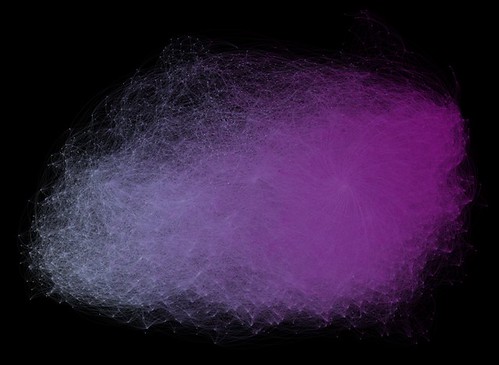
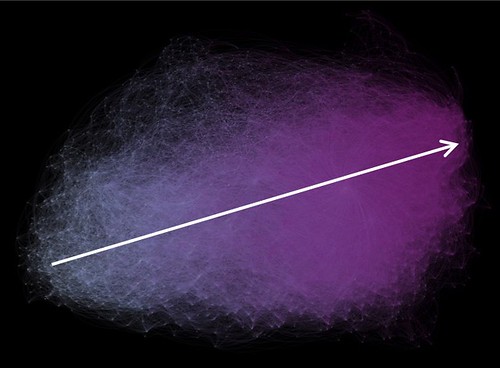
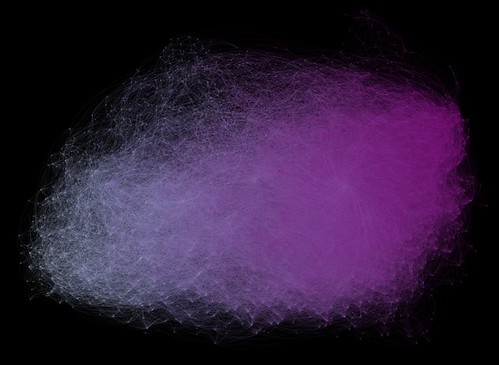
The graph is quite different from Jockers’ graph. For one thing it has fewer nodes, by a considerable margin. But it is otherwise more complex. The nodes in Jockers’ graph represent the same kind of object, a text, and the edges between them are of the same kind, proximity in space. The nodes in that semantic network are of various kinds – objects, events, properties of objects or events, some even represent whole bundles of objects and events ¬– as are the edges. And the space in which a semantic network is embedded has no metric associated with it; the physical distance between nodes is a mere diagrammatic convenience and has no formal significance. Taken together these various kinds of nodes and edges can be used to specify processes in the network. That’s the crucial point, semantic networks may be depicted as static objects on a page, just as one may depict an clock mechanism as a static object, but they function in, are designed to function in, linguistic processes.

That’s what I brought with me to Jockers’ graph, the concept of a graph that embodies or supports some a process. By itself the graph would not have activated that concept, but when I read that the graph ordered the nodes in rough chronological order despite the fact that there was no temporal information in the underlying database, THAT told me there’s a process at work in that graph. I judged the process to be an evolutionary one – what else could it be – and began thinking about it.

Yes, I know, a large scale evolutionary process is very different from a micro scale linguistic process, but these diagrams are very abstract objects. At a high enough level of abstraction a network is a network and a process is a process. Moreover, as I indicated in my earlier remarks on “generic time trends”, I’ve been thinking about evolutionary processes as long, if not longer than I’ve been thinking about linguistic processes. It was thus all but inevitable and natural that I would read that graph as the trace of a process unfolding in time, an evolutionary process.

My break with 'traditional' literary criticism

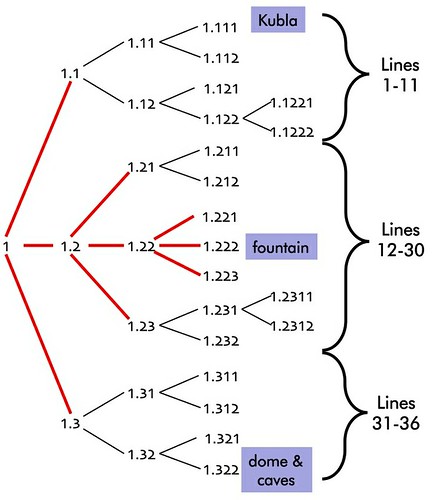
But why, with an background in literary criticism, did I turn to such strange conceptual objects in the first place? As I’ve indicated in my introduction, I had become interested in “Kubla Khan”. I set out to do a structuralist analysis of the poem – this was before structuralism had more or less fallen apart within the literary academy – and it didn’t work. It’s not that I could find binary oppositions in the poem. I could. They’re all over the place – Kubla vs. wailing woman, Kubla vs. damsel with a dulcimer, pleasure dome vs. caves, sound vs. sight, inspired poet vs. those who hear and see, ice vs. Paradise, and on and on – and that was a problem. I couldn’t see any ‘narrative’ order in the profusion of oppositions.

This is not the place to give a blow-by-blow account of what happened, I’ve done that elsewhere [1]. Suffice it say that I’d discovered that the poem had a structure that could be diagrammed like this (first 36 lines):
1 tree

Those nested ternary structures (in red) looked like, smelled like, computation at work. By the time I’d gotten that far in my analytic and descriptive work on the poem I’d become aware of a variety of work in the nascent cognitive sciences – the phrase “cognitive science” wasn’t coined until 1973, after I’d done my initial work on “Kubla Khan” – and so I turned to them.

What I got was a new and I believe quite a valuable way of thinking about language and mental processes, but one not quite up to satisfying my curiosity about “Kubla Khan”. Nonetheless I couldn’t look back, I couldn’t unlearn what I’d learned and thereby return to a more naïve approach to literary criticism. And yes, I regard standard literary criticism, to the extent that there is such a thing, up through new historicism and post structuralist approaches, as naïve, and a bit confused as well [2]. The text is a crucial notion; is there any consensus on what constitutes the text? No. And the same with form, another critical concept about which there is no critical consensus.

The upshot is that I am a native reader and writer of two different discourses focused on language: literary criticism and cognitive science. I remain comfortable with reading a wide variety of literary criticism, and I can write it, at least up to a point. But I can also read and write cognitive science and do so. I find that, for the most part, the world of computational criticism is commensurate with that of cognitive science. To use a crude geographical metaphor, think of the North America as the New World. I’ve spent most of my time, say, exploring the territory along the East Coast and through the Midwest to the Mississippi River. That’s where I’d met these computational critics, who’d come up through Central America and along the Rocky Mountains to the plains states. So, it’s a different kind of territory, but still on the same continent. We’re doing the same kind of thing. Standard literary criticism, on the other hand, that’s the Old World. I’ve been there, they’ve been there, we’ve all been there, but the New World is where we function best.

Crude, yes, but serviceable.

Scale

Let’s drop the analogy and take a brief look at a problem that’s been much discussed in the recent past, though such discussion seems to have subsided. I’m talking of the problem of scale, of so-called distant reading vs. so-called close reading.

From my point of view the issue is miscast. Scale, so far as I know, is not an issue in biology, where they’ve got to deal with individual cells and their components and the evolution of life on earth as well. That’s two very different scales of analysis, but the terms in with the analysis is conducted are mutually commensurate across all scales. The situation in literary criticism is not so clear. The terms of analysis used in computational criticism are quite different from those in any of the standard schools of critical reading, from New Criticism on through the various forms of post-structuralism. Many proponents of close-reading regard the terms of computational criticism as absolutely incommensurate with close-reading and hence computational criticism is either wrong or trades in trivial truisms [3]. Computational critics see it differently. Some may well reject close-reading across the board, though I’ve not seen that position publically articulated. Others admit, yes, the terms are different, but we’re ultimately looking at the same objects, literary texts. It’s just that we’re looking at them in somewhat different ways and, yes, at different scales. But, as I said, this talk of scales is beside the point. It’s those different ways that matter.

For me, there is no issue of scale. I learned computational semantics as a tool to use at the micro scale. I’ve also developed an approach to the analysis and description of form at the micro scale [4]. These concepts are perfectly compatible with those of computational criticism. Their relationship to ordinary “close-reading”, however, that’s problematic. And it’s problematic in the same way that computational criticism itself is problematic.

That issue is more than I want to address in this (relatively) short and informal note. Basically, I think those critics must explicitly embrace aesthetic and ethical values in a full-blown and explicit ethical criticism, which is beyond computational criticism at whatever scale, macro (as in so-called distant reading) or micro (as in computational semantics or descriptive analysis of form). I’ve written a fair bit about ethical criticism here on New Savanna but have yet to formulate a central statement [5].

References

[1] There’s an autobiographical account in William Benzon, Touchstones • Strange Encounters • Strange Poems • the beginning of an intellectual life (1975-2015)
https://www.academia.edu/9814276/Touchstones_Strange_Encounters_Strange_Poems_the_beginning_of_an_intellectual_life.

For a more conceptual account, see my working paper,
Beyond Lévi-Strauss on Myth: Objectification, Computation, and Cognition (2015),
https://www.academia.edu/10541585/Beyond_Lévi-Strauss_on_Myth_Objectification_Computation_and_Cognition. In particular, see section 4, “Into Lévi-Strauss and out through ‘Kubla Khan’”, pp. 20-27.

[2] On my general skepticism about literary criticsm, see my long blog post, Literary Studies from a Martian Point of View: An Open Letter to Charlie Altieri (December 17, 2915)
http://new-savanna.blogspot.com/2015/12/literary-studies-from-martian-point-of.html,  my working paper, An Open Letter to Dan Everett about Literary Criticism (February 19, 2017),
https://www.academia.edu/33589497/An_Open_Letter_to_Dan_Everett_about_Literary_Criticism (PDF), and Rejected! @ New Literary History, with observations about the discipline (February 28, 2017)
https://www.academia.edu/31647383/Rejected_at_New_Literary_History_with_observations_about_the_discipline.

[3] That seems to be the position taken by Nan Z. Da, The Computational Case against Computational Literary Studies, Critical Inquiry 45, Spring 2019, 601-639.

[4] For a methodological and programmatic statement, see William Benzon, Literary Morphology: Nine Propositions in a Naturalist Theory of Form, PsyArt: An Online Journal for the Psychological Study of the Arts, August 2006, Article 060608, https://www.academia.edu/235110/Literary_Morphology_Nine_Propositions_in_a_Naturalist_Theory_of_Form. For a methodological statement about description see, William Benzon, Description 3: The Primacy of Visualization, Working Paper, October 2015, 48 pp., https://www.academia.edu/16835585/Description_3_The_Primacy_of_Visualization.

[5] For example, see my post Ethical Criticism: Blakey Vermeule on Theory, Cornel West in the Academy, Now What?, September 23, 2015, https://new-savanna.blogspot.com/2015/09/ethical-criticism-blakely-vermeule-on.html. More generally, see the posts gathered under the label, “ethical criticism”, https://new-savanna.blogspot.com/search/label/ethical%20criticism.

Wednesday, November 27, 2019

Divergence and Reticulation in Cultural Evolution: Some draft text for an article in progress [#DH]

That's the title of my latest working paper. You can download it here: https://www.academia.edu/41095277/Divergence_and_Reticulation_in_Cultural_Evolution_Some_draft_text_for_an_article_in_progress.

And you can participate in a discussion of it here: https://www.academia.edu/s/9b97738023.

Abstract, Contents, and introductory material below.

* * * * *

Abstract: In a recent review of articles in computational criticism Franco Moretti and Oleg Sobchuk bring up the issue of tree-like (dendriform) vs. reticular phylogenies in biology and pose the question for the form taken by the evolution of cultural objects: How is cultural information transmitted, vertically (leading to trees) or horizontally (yielding webs)? Dendriform phylogenies are particularly interesting because one can infer the phylogenetic history of an ensemble of species by examining the current state. The horizontal transmission of information in webs obscures any historical signal. I examine a few cultural examples in some detail, including jazz styles and natural language, and then take up the 3300 node graph Matthew Jockers (Macroanalysis 2013) used to depict similarity relationships between 3300 19th century Anglophone novels. The graph depicts a web-like mesh of texts but, uncharacteristically of such patterns, also exhibits a strong historical signal. (Just how that is possible is the subject of another draft.)

Contents

What’s Up? 1
The need for theory: Cultural evolution 2
Trees, Nets, and Inheritance in Biology 4
Divergence and reticulation in culture 7
What kind of objects are we dealing with? 12
Jockers’ Graph, a reticulate network 18
Appendix: A quick guide to cultural evolution 22
 
What’s Up?

In the past year we have had two reviews of recent work in computational criticism:
Nan Z. Da, The Computational Case against Computational Literary Studies, Critical Inquiry 45, Spring 2019, 601-639.

Franco Moretti and Oleg Sobchuk, Hidden in Plain Sight: Data Visualization in the Humanities, New Left Review 118, July August 2019, 86-119.
Though both are critical of that work, they are quite different in tone and intent. Da is broadly dismissive and sees little value in it. Moretti and Sobchuk see considerable value in the work, but are disappointed that it is largely empirical in character, failing to articulate a theoretical superstructure that deepens our understanding of literary history.

I’ve been working on a critique of those papers which seems to have expanded into a primer on thinking about literary culture as an evolutionary phenomenon. I’m currently imaging that the final article will have five parts:
  1. Genealogy in literary history
  2. Unidirectional trends in cultural evolution
  3. Jockers’ Graph: Direction in the 19th century Anglophone novel
  4. Expressive culture as a force in history
  5. A quick guide to cultural evolution for humanists
I have already posted draft material for the second part of the article, which centers on a graph from Matthew Jockers’ Macroanalysis (2013) [1].

That graph was my central concern from the beginning. It is the most interesting conceptual object I’ve seen in computational criticism, but it is easily misunderestimated and glossed over – as far as I know Da’s understandable but unfortunate dismissal is the only treatment of it in the referred literature. The problem, it seems to me, is that a proper appreciation of it requires a conceptual framework that doesn’t exist in the literature. My objective, then, is to begin assembling such a framework.

Moretti and Sobchuk didn’t mention it at all as their review was confined to journal articles. But it merits consideration in a framework that did establish in their review, if only barely. The invoke a distinction from evolutionary biology, that between tree-like (dendriform) phylogenies and free-form or web-like phylogenies, and suggest that it is important for understanding the relationship between literary for and history (pp. 108 ff.). Jockers graph is web-like network of texts but it exhibits an important feature of dendriform phylogenies, it displays a strong temporal signal. Thus a discussion of issues raised by Moretti and Sobchuk is a good way to begin constructing the missing conceptual framework.

This document consists of draft material for the discussion, the first part of the planned article, and the fifth part. The fifth part, the appendix is straight forward, and I have included it the end of this document. Once I have discussed the issue of dendriform vs. web-like relationships I introduce Jockers’s graph.

In the second part of the article, unidirectional trends in cultural evolution, I plan to say a few words about time and directionality. I will then take up a number of the examples Moretti and Sobchuk review in their article. While they don’t frame them as evidence for unidirectional trends, that is what they are. From my point of view that’s the most interesting and important aspect of their review, they gather those articles into one place. I will be placing those articles in the context of other work showing unidirectional trends.

I don’t yet know whether I’ll post draft materials on the second and fourth sections before drafting the whole article.

The need for theory: Cultural evolution

Now let us turn to Moretti and Sobchuk. Here is their penultimate paragraph (112-113):
Tree-like, linear, reticulate . . . why should we even care about the shape of cultural history? We should, because that shape is implicitly a hypothesis about the forces that operate within history; the tentative, intuitive beginning of a theoretical framework. ‘Theories are, even more than laboratory instruments, the essential tools of the scientist’s trade’, wrote Thomas Kuhn over a half century ago; too bad we didn’t heed his advice. Although the crass anti-intellectualism of Wired—‘correlation is enough’, ‘the scientific method is obsolete’—has fortunately remained an exception, what seems to have happened is that, as the amount of quantitative evidence at our disposal was increasing, our attempts at in-depth explanations were losing their strength. Disclaimers, postponements, ad hoc reactions, false modesty, leaving inferences ‘for another day’ . . . such have been, far too often, our inconclusive conclusions.
Ah, “the forces that operate within history”, that’s what we’re after, no? And we’re not going to get there without theory, yes?

I believe that that theory will be about culture as an evolutionary phenomenon. It is clear that both Moretti and Sobchuk believe that as well, but they do not introduce or frame their essay that way. They introduce it as a methodological inquiry into the use of visualization. It is only as the essay unfolds that evolution emerges as an ideational engine parallel to if not quite driving their interest in visualization.

Accordingly it is necessary to make some preliminary remarks about cultural evolution. Work in cultural evolution has blossomed in the last quarter century but:
While humanities and social science scholars are interested in complex phenomena—often involving the interaction between behaviour rich in semantic information, networks of social interactions, material artefacts and persisting institutions—many prominent cultural evolutionary models focus on the evolution of a few select cultural traits, or traits that vary along a single dimension [...]. Moreover, when such models do build in more traits, these typically are taken to evolve independently of one another [...]. Within cultural evolutionary theory, this strategy holds that the dynamics and structure of cultural evolutionary phenomena can be extrapolated from models that represent a small number of cultural traits interacting in independent (or non-epistatic) processes. This kind of strategy licences the modelling of simple trait systems, either with an eye to describing the kinematics of those simple systems, or to illuminate the evolution and operation of mechanisms underpinning their transmission [...]. [2]
Hence, if students of literature want to think about culture as a phenomenon of evolutionary processes, we will not find suitable models and methods in existing work on cultural evolution. Though we certainly need to be aware of and conversant with that work, we are going to have to construct models and methods suitable to our material. That is the primary objective of this essay. To that end, then, I will be introducing a several of examples of work on cultural evolution in other domains.

Biologists, of course, has been developing evolutionary theory over the last half century. While they agree on basic issues, many details are still under contention. When we, then, as students of literary culture set out to adapt evolutionary theory to the analysis of literary phenomena, just what do we take from biological thinking and how do we do it? Various approaches exist in the general cultural literature, but this is hardly the place to sort through them – though I have prepared a brief appendix with pointers into those discussions. What Moretti and Sobchuk seem to have taken over is the distinction between tree-like lineages and more chaotic, network-like lineages. So that’s where I will start.

Where I am going, though, is toward an argument which says that that distinction is a reflection of the mechanisms that underlie the evolutionary process and it is to those mechanisms that we must look in adapting evolutionary theory to the study of human culture. Cultural evolution unfolds though collectivities of human minds, and they give cultural evolution a different texture, if you will, and different large scale patterns.

References

[1] On the direction of literary history: How should we interpret that 3300 node graph in Macroanalysis, Version 2, https://www.academia.edu/40550795/On_the_direction_of_literary_history_How_should_we_interpret_that_3300_node_graph_in_Macroanalysis_Version_2.

[2] Buskell, A., Enquist, M. & Jansson, F. A systems approach to cultural evolution. Palgrave Commun 5, 131 (2019) pp. 4-5, doi:10.1057/s41599-019-0343-5 https://rdcu.be/bVNtP.

* * * * *

Addendum 12.10.19: Cultural cross pollination is very old:
According to the Seshat team, the data also clearly undermine another of Jaspers’ key claims: that innovation arose independently in the five core societies, which he referred to as “islands of light”. These societies were engaged in a “ton of cross-cultural exchange,” says historian and Seshat project manager Daniel Hoyer at George Brown College in Toronto, Canada. “The Rabbinical tradition and even Plato’s writings aren’t really conceivable without the Zoroastrianism and Egyptian moral ideals and Hittite legalism that went before.”

Thursday, October 10, 2019

Trajectories in story-telling space [#DH, #Macroanalysis]

This is an explanatory supplement to On the direction of literary history: How should we interpret that 3300 node graph in Macroanalysis?

* * * * *

First we go about visualizing possible trajectories of an abstract particle moving about on a plane. Then we interpret those particles as successive states in a game of ‘whispers’ where A tells a story to B, B tells the story to C, and so forth. The story changes a bit with each telling. Finally, I explain what this has to do with the 3300 node graph in Mathew Jockers’ Macroanalysis.

Visualizing an abstract particle moving about on a plane

Let us imagine an abstract particle moving around on a plane. We are going to take a ‘snapshot’ of the particle at regular intervals and see if there is some lawfulness in its movement or it is just moving about without any particular order. Here we have six successive snapshots of our particle, one after the other, each one showing the particle’s location at a moment in time.

So, there’s where our particle starts:


It then moves to here:


Followed by:


And then:


Next comes:


And at last, the particle arrives here:


Examining the particle’s successive position like this is tricky. It’s difficult to get a sense of the particle’s path. let’s line those snapshots up in a row and see if that helps:


That helps some, but still, it’s hard to see what’s going on.

We need to superimpose these snapshots in order to see the path more clearly. So that we can be sure of their order, let us connect successive positions with an arrow where the direction of the arrow goes from the earlier to the later position. This is what we get:


While there doesn’t appear to be any order there, it looks like the particle’s may be confined to a hill-shaped area in the space. Let us take some more snapshots and superimpose them.


In the above image I have identified the particle’s first and last positions by making the dots red:

Still, no order, but the particle no longer seems confined to that hill-shaped area. It certainly doesn’t look like the particle is following any particular path.

But, of course, it might have worked out some other way. Like this perhaps:


There’s order there. The particle appears to be moving in a circular path. That means we could write an equation approximating the path.

Here is a different, and simpler, kind of order:


The particle is simply moving in an almost straight line with a small upward slope.

Let’s play whispers

Now let’s interpret each of those points as a story. It can be any story, of any kind, it doesn’t matter. Nor does it matter how long it is, but as a practical matter it should be pretty short, because we’re going to imagine people telling it to one another in succession. Frederick Bartlett reporting on this sort of thing in his classic, Remembering: A study in experimental and social psychology (1932), and others have worked on it since.

Let us further imagine that we have some way of measuring each version so that we can establish a measure of similarity between them. I note in passing, that since we’re heading toward Matthew Jockers’ Macroanalysis, we need not worry too much about this as he developed a very sophisticated measurement system for his texts. Finally, assume that our system is a simple one that measures the story in two dimensions.

Wednesday, October 9, 2019

Reading The Human Swarm 3: A digression about an image with an application to human cultural evolution [#DH]

What’s this image represent?


I supposed I’ve you’ve been reading New Savanna for awhile you know what it represents. But imagine you didn’t know. What would you think it is?

Since this is a post about recent book by Mark Moffett, and Moffett’s an expert on ants, you might think it’s a nest, one with 3300 chambers, each represented by a node in the graph. From The Human Swarm, pp. 57-58:
The size of leafcutter settlements can be gargantuan: in the French Guiana jungles I came upon a nest the square footage of a tennis court. A drawback of such a metropolis is the same face by a human city: pulling in enough resources means a lot of communiting. From the far corners of that large nest spring a half-dozen speedways along with the workers doubtless hauled hundreds of pounds of fresh foliage over the course of each year. To unearth just a part of another colony I once hired six men with pickaxes and shovelss near São Paulo. The bloody bites I sustained that week didn’t stop me from feeling like an archaeologist eshuming a citadel. Hundreds of gardens grew in chambers arrayed along meters upon meters of superbly arranged tunnels, some at least six meters below the surface. Scaled to human dimensions, their subway systems would be kilometers deep.
Pretty impressive, no?

If this were Tom Sawyer you might think it’s a map of the cave where Becky Thatcher got lost with Injun Joe.

If this were a post about the brain, you might think it’s a map of some neural system.

And so on.

Of course, it’s none of those things. Each of those nodes represents the text of a 19th century novel, British, Irish, or American. It’s from Matt Jockers, Macroanalysis: Digital Methods & Literary History (2013), a book I’ve written quite a bit about. Matt “measured” each text on each of roughly 600 features – just what I mean by measure and how Matt did it is secondary at this point, but if you dig around in those posts, you’ll find out – and then placed a point for each text in 600 dimensional space (one dimension for each feature). Why’d he do that? Because he wanted to identify books that are similar to one another. If the books are similar, then they will be close together in this 600-dimensional space.

So, he’s got these points (representing texts) in 600D space. Now he calculates the distance between each pair; with 3300 points, that’s a lot of pairs. How’d he do that? The principle’s the same as measuring the distance between, say, two cities, or two windows on a wall. We can treat the earth’s surface as a plane (two dimensions) and, of course, the surface of a wall IS a plane. Since these books have 600 features, we’ve got to embed them in a space of 600 dimensions. Tricky, but the principle’s the same.

Now Jockers made the graph by 1) connecting all the points together and then, 2) pruning away all the links that are longer than some appropriately low value. He then projected the resulting graph onto two dimensions and produced that image. All with the help of a computer, of course.

Easy as pie.

Imagine if ants could dig nests in 600 dimensional space. Yikes!

So what? you ask.

I’m getting there, I’m getting there.

Of course each of those texts have been read by many people, a few of them by millions of people. That graph thus implies the existence of millions of readers over the course of time. Now we’re getting to ant colony numbers, millions and millions.

Now we’re talking about a human swarm. And THAT’s how we have to think about human cultural evolution. That’s why I’m interested in that graph. Because it implies an ant colony we HAVE to think about it in evolutionary thinking. Evolutionary thinking is population thinking. That graph implies a population of people reading a population of texts yielding a population of readings. It boggles the mind.

Imagine millions of ants gathered together moving over the ground in a swath I don’t know how many meters wide – Moffett has described such things, but I can’t put my finger on one of those descriptions at the moment. There it is, a band of red-brown-blackish particles speckled by the sun, moving in a single mass. Well that's how, with the aid of Jockers’ graph, I think about cultural evolution. Millions of humans, their minds linked, moving through history like the Mississippi River over the flood plane of human events.

The human swarm indeed. And it’s culture that makes us a swarm. Without it we’d just be small bands of very clever apes, using twigs to fish for termites. Instead, we’ve stood on the moon.

Monday, October 7, 2019

On the direction of literary history: How should we interpret that 3300 node graph in Macroanalysis? [#DH]

That's the name of a draft I've put on Academia.edu for comment. Here's the link: https://www.academia.edu/40550795/On_the_direction_of_literary_history_How_should_we_interpret_that_3300_node_graph_in_Macroanalysis


Abstract, table of contents, and introduction below.

* * * * *

Abstract: In Macroanalysis (2013) Matthew Jockers created a graph depicting similarity relationships between 3300 19th century Anglophone novels, each characterized by 600 features. The graph is derived from a database that contains no date information. When projected onto two-dimensions and visualized, however, the graph has a gradient that is aligned with time. I 1) interpret the graph as a trace of the activity of complex dynamical system (19th century Anglophone novels), 2) conclude that the system has an inherent temporal direction, and 3) contrast it with systems that evolve through random or through cyclic trajectories. I suggest that as this system evolves the range of design possibilities for novels becomes larger, allowing them to encompass a greater range of human experience. I conclude by asserting that evolving literary culture is itself a force in history.

Contents

What’s Up? 2
3300 Anglophone novels in a graph 2
Da’s critique 6
A trace of a complex dynamical system 9
Trajectories in time: random, cyclical, and linear 10
Change and growth 14
Literary culture is a force in history 17

What’s Up?

I’m currently working on a response to two articles:
Franco Moretti and Oleg Sobchuk, Hidden in Plain Sight: Data Visualization in the Humanities, New Left Review 118, July August 2019, 86-119.

Nan Z. Da, The Computational Case against Computational Literary Studies, Critical Inquiry 45, Spring 2019, 601-639.
The first part of my article will be address an issue raised by Moretti and Sobchuk at the end of their article, namely the general relationship between literary form and history (pp. 108 ff.) in terms taken from evolutionary biology, where tree-like phylogenies are contrasted with reticular phylogenies. I’ll be address that in this piece, which is draft material for the second part of my article.

I plant to center my argument on the 3300 node graph that Matthew Jockers published in Chapter 9 of Macroanalysis (2013, p. 165). Da dismissed it in one rather long paragraph (pp. 610-611) while Moretti and Sobchuk didn’t mention it all, though their article centered on visualization and that graph is one of the most striking visualizations in contemporary computational criticism. Since it clearly demonstrates a reticular pattern of relationships among 19th century Anglophone novelists, it IS germane to their interest in reticular phylogeny, but for some reason they didn’t mention it. Whatever.

It’s not the reticular form of that graph that interests me here. What interests me here is that, while there is no temporal information (e.g. publication dates) in the underlying database, the graph displays an unmistakable temporal gradient, a fact that surprised Jockers, presumably because he wasn’t looking for that at all. He was simply examining similarity between texts. That the graph has a temporal gradient suggests to me that the underlying social process – the creation of 3300 Anglophone novels in the 19th century – can be thought of as a complex dynamical system having an temporal inherent direction that is of a different kind from mere succession. Da seems unaware of such a possibility and dismisses Jockers’ unintended result as trivial. I know from private communication that Moretti dismisses it as well.

The purpose of this draft essay is to indicate why I think they are wrong.

Tuesday, September 10, 2019

Reading Macroanalysis 7.3: Style, Genre, Time, and Influence

This post is from Aug. 31, 2014, but I'm bumping it to the top of the queue as I am thinking about these matters in connection with Moretti and Sobchuk, Hidden in Plain Sight: Data Visualization in the Humanities (New Left Review 118, 2019, 86-119). They don't discuss this visualization, but they should have.
In this post I suggest some studies I’d like to be done. I begin by recalling Moretti’s account of genre succession from Maps, Graphs, Trees in the context of Jockers’ massive graph of literary influence. Then I revisit the “Style” chapter and look at some of the work I passed over when I first posted on that chapter, the work related to Moretti’s generational observation. I then make some suggestions about how we could infer quasi-genres in the data assembled to build the influence graph and thereby extend Jockers’ work on style from his limited corpus of 106 texts to the larger corpus of 3346 texts. I conclude with some vague and tentative remarks about the pattern of reader interest betrayed in the record we’ve been examining, that of book publication.

Influence and Genre Succession

I’ve been thinking a lot about two things: 1) Moretti’s argument in Graphs, Maps, Trees that genres tend to cluster into 30 year cycles, and 2) Jockers’ massive graph in which all 3346 texts in his corpus are linked by relations of similarity, producing a graph that looks like this (which is Figure 9.3, p. 165; color version from the web):

9dot3

As Jockers points out, what’s remarkable about this graph is that the nodes are ordered in time from left (oldest) to right, but there is no temporal information in the data from which it was derived: “Books are being pulled together (and pushed apart) based on the similarity of their computed stylistic and thematic distances from each other” (p. 164).

That temporal ordering is a side effect of ordering by thematic and stylistic similarity. But, in the abstract, it could have been otherwise, no? Why should positioning texts near similar texts result in temporal ordering? (Would the same thing be true of 20th Century texts?) This ordering implies that the evolution of literary culture IS directional, but Jockers himself hasn’t posited any telos, nor do I see any need to do so. That directionality stems from the internal dynamics of the system. Authors, and I assume audiences as well, want to stick with what they know, and what they know was published in the previous years.

It seemed to me that Moretti’s cycles must somehow be in that graph, for all the texts in a given cycle are close together in time, by definition, as well as similarity. Alas, the whole corpus has not been coded for genre (p. 158). Is there some way we can back into genre since we’ve got this massive graph based on similarity relations among texts along 578 dimensions? Aren’t texts within the same genre more likely to resemble one another than texts in different genres?

The other thing on my mind is the fact that what really interests me is what’s on people’s minds and how that evolves over time. Some books will attract few readers, some books many readers; but the mere fact that a book has been published doesn’t speak to that. Moreover, books can be read long after they’ve been published. In the case of Moby Dick, it would seem that, for the most part it was read only long after it was published. Publication history is, at best, an indirect proxy measure of that.

And yet that history IS a history. Assuming that publishers are for the most part rational economic actors who want to turn a profit, their decisions on what to publish must take into account their sense of what people are reading and therefore what they’re buying. And the kinds of books that got published changed from one decade to the next. That record of  changes must reflect changes of reading taste.

Thursday, May 9, 2019

Notes toward a theory of the corpus, Part 1: History [#DH]

The recent discussion of Nan. Z. Da,  The Computational Case against Computational Literary Studies, has me thinking about Matt Jockers' Macroanalysis, in particular, about his high-dimensional graph of his 19th century corpus. Da dissmisses with with two paragraphs (pp. 610-611). Interestingly enough, though, when Critical Inquiry hosted a discussion forum on the article, it used tan image of that graph to head the forum. That, I assume, is because it is visually compelling.

Visually compelling, but nontheless trivial? I think not. I'm bumping this post to the top of the cue. It represents my thinking about the implications of that diagram as of late September of 2018. I've thought a bit more about that diagram in the past month, going over and over and over. I've got a few more thoughts.
That graph, of course, is constructed in a space of roughly 600 dimensions. We can think of that space as, shall we say, a design space, where each point represents a possible novel. Like most such spaces, most of it is empty. What's interesting about his space is that it emerged over time and we can more or less track that emergence. That follows from the fact that the texts in that space are ordered in time, more or less, from left to right. As novels were written in the course of the century, they enlarged the space, rather than moving about in the already existing space. That's what's interesting, new texts enlarged the space. What does that tell us about the history of the novel, and about cultural evolution?
A corpus

By corpus I mean a collection of texts. The texts can be of any kind, but I am interested in literature, so I’m interested in literary texts. What can we infer from a corpus of literary texts? In particular, what can we infer about history?

Well, to some extent, it depends on the corpus, no? I’m interested in an answer which is fairly general in some ways, in other ways not. The best thing to do is to pick an example and go from there.

The example I have in mind is the 3300 or so 19th century Anglophone novels that Matthew Jockers examined in Macroanalysis (2013 – so long ago, but it almost seems like yesterday). Of course, Jockers has already made plenty of inferences from that corpus. Let’s just accept them all more or less at face value. I’m after something different.

I’m thinking about the nature of historical process. Jockers' final study, the one about influence, tells us something about that process, more than Jockers seems to realize. I think it tells us that cultural evolution is a force in human history, but I don’t intend to make that argument here. Rather, my purpose is to argue that Jockers has created evidence that can be brought to bear on that kind of assertion. The purpose of this post is to indicate why I believe that.

A direction in a 600 dimension space

In his final study Jockers produced the following figure (I’ve superimposed the arrow):

direction of 19C lit history


Each node in that graph represents a single novel. The image is a 2D projection of a roughly 600 dimensional space, one dimension for each of the 600 features Jockers has identified for each novel. The length of each edge is proportional to the distance between the two nodes. Jockers has eliminated all edges above a certain relatively small value (as I recall he doesn’t tell us the cut off point). Thus two nodes are connected only if they are relatively close to one another, where Jockers takes closeness to indicate that the author of the more recent novel was influenced by the author of more distant one.

You may or may not find that to be a reasonable assumption, but let’s set it aside. What interests me is the fact that the novels in this graph are in rough temporal order, from 1800 at the left (gray) to 1900 at the right (purple). Where did that order come from? There were no dates in 600D description of each novel, so the software was not reading dates and ordering the nodes according to those dates. By process of elimination, that ordering must be a product of whatever historical process that produced the texts represented in the graph. What else is there? That process must therefore have a temporal direction.

I’ve spent a fair amount of effort explicitly arguing that point [1], but don’t want to reprise that argument here. I note, however, that the argument is a geometrical one. For the purposes of this piece, assume that that argument is at least a reasonable one to make.

What is that direction? I don’t have a name for it, but that’s what the arrow in the image indicates. One might call it Progress, especially with Hegel looking over your shoulder. And I admit to a bias in favor of progress, though I have no use for the notion of some ultimate telos toward which history tends. But saying that direction is progress is a gesture without substantial intellectual content because it doesn’t engage with the terms in which that 600D space is constructed. What are those terms? Some of them are topics of the sort identified in topic analysis, e.g. American slavery, beauty and affection, dreams and thoughts, Greek and Egyptian gods, knaves rogues and asses, life history, machines and industry, misery and despair, scenes of natural beauty, and so on [3]. Others are stylistic features, such as the frequency of specific words, e.g. the, heart, would, me, lady, which are the first five words in a list Jockers has in the “Style” chapter of Macroanalysis (p. 94).

The arrow I’ve imposed on Jockers’ graph is a diagonal in the 600D space whose dimensions are defined by those features and so its direction must specified in terms that are commensurate with such features. Would I like to have an intelligible interpretation of that direction? Sure. But let’s leave that aside. We’ve got an abstract space in which we can represent the characteristics of novels (Daniel Dennett might call this a design space) and we’ve got a vector in that space, a direction.

What’s that direction about? What is it about texts that is changing as we move along that vector? I don’t know. Can I speculate? Sure. But not here and now. What’s important now is that that vector exists. We can think about it without having to know exactly what it is.

A snapshot of Spirit of the 19th century

In a post back in 2014 I suggested that Jockers’ image depicts the Geist of 19th century Anglo-American literary culture [2]. That’s what interests me, the possibility that we’re looking at a 21st century operationalization of an idea from 19th century German idealism. Here’s what the Stanford Encyclopedia of Philosophy has to say about Hegel’s conception of history [4]:
In a sense Hegel’s phenomenology is a study of phenomena (although this is not a realm he would contrast with that of noumena) and Hegel’s Phenomenology of Spirit is likewise to be regarded as a type of propaedeutic to philosophy rather than an exercise in or work of philosophy. It is meant to function as an induction or education of the reader to the standpoint of purely conceptual thought from which philosophy can be done. As such, its structure has been compared to that of a Bildungsroman (educational novel), having an abstractly conceived protagonist—the bearer of an evolving series of so-called shapes of consciousness or the inhabitant of a series of successive phenomenal worlds—whose progress and set-backs the reader follows and learns from. Or at least this is how the work sets out: in the later sections the earlier series of shapes of consciousness becomes replaced with what seem more like configurations of human social life, and the work comes to look more like an account of interlinked forms of social existence and thought within which participants in such forms of social life conceive of themselves and the world. Hegel constructs a series of such shapes that maps onto the history of western European civilization from the Greeks to his own time.
Now, I am not proposing that Jockers’ has operationalized that conception, those “so-called shapes of consciousness”, in any way that could be used to buttress or refute Hegel’s philosophy of history – which, after all, posited a final end to history. But I am suggesting that can we reasonably interpret that image as depicting a (single) historical phenomenon, perhaps even something like an animating ‘force’, albeit one requiring a thoroughly material account. Whatever it is, it is as abstract as the Hegelian Geist.

How could that be?

Monday, December 31, 2018

Toward a Theory of the Corpus [#DH]

I've just posted a new working paper. Title above, abstract, table of contents, introduction and section introductions are below. Download from:

Academia.edu: https://www.academia.edu/38066424/Toward_a_Theory_of_the_Corpus_Toward_a_Theory_of_the_Corpus_-by.
SSRN: https://ssrn.com/abstract=3308601.

Abstract: Recent corpus techniques ask literary analysts to bracket the interpretation of meaning so that we may trace the motions of mind. These techniques allow us to think of the mind as being, in some aspect, a high-dimensional space of verbal meanings. Texts then become paths through such a space. The overarching argument is that by thinking of texts as just ordered collections of physical symbols that are meaningless in themselves we can examine those collections in ways that allow us to recover the motions of mind as it constructs meanings for itself. When we examine a corpus over historical time we can see the evolution of mind. The corpus thus becomes an arena in which we investigate the movements of mind at various scales.

Contents

Meaning, text, and mind: Notes toward a theory of the corpus 2
PART 1: MAPPING A NEW ONTOLOGY OF THE TEXT 4
1. Can you learn anything worthwhile about a text if you treat it, not as a TEXT, but as a string of marks on pages? 6
2. Computational linguistics & NLP: What’s in a corpus? – MT vs. topic analysis 13
3. Why computational critics need to know about constitutive computational semantics 18
PART 2: VIRTUAL READING: PATHS THROUGH THE MIND AND THE MIND OVER HISTORICAL TIME 21
4. Augustine’s Path, A note on virtual reading 23
5. Mapping the pathways of the mind 29
6. Inferring the direction of the historical process underlying a corpus 39

Meaning, text, and mind: Notes toward a theory of the corpus

The set of observations I’ve collected in this working paper has two sources; it was spun out to scratch two conceptual itches. One is my long-standing interest in literary form. The other is the opposition or tension between meaning and, well, computation that has been dogging computational criticism for, I don’t know, a decade. Even computational critics who otherwise refuse to take that opposition as a criticism nonetheless tend to treat their mathematical models as scaffolding to support, or as gadgets for detecting, what really interests them. In the end I spent more time scratching that second itch than the first.

Computational critics have an opportunity to map the human mind that is qualitatively different from what interpretive critics accomplish by uncovering meanings ‘hidden’ in literary texts. But to avail themselves of this opportunity computational critics must understand the broad disciplinary framework in which “meaning” is opposed to “distant reading”. It is not simply that these are two different phenomena, or that “distant reading” is not intended to replace or supplant the explication of “meaning”, but that yoking them together in that opposition makes no more sense than opposing “salt” to “NaCl”.

The first three sections – Part 1: Mapping a new ontology of the text – deal with that kind conceptual difference. The last three sections – Part 2: Virtual reading: Paths through the mind and the mind over historical time – are about those new conceptual possibilities. I’ve provided some introductory material for both parts that is intended to help stitch these various arguments together. The overarching argument is that by thinking of texts as just ordered collections of physical symbols that are meaningless in themselves we can examine those collections in ways that allow us to recover the motions of mind as it constructs meanings for itself. We bracket the interpretation of meaning so that we may trace the motions of mind.

* * * * *

Part 1: Mapping a new ontology of the text – My overall objective here is to outline a way of thinking about language and texts that is centered on form and mechanism (linguistics) rather than meaning (literary criticism).

1. Can you learn anything worthwhile about a text if you treat it, not as a TEXT, but as a string of marks on pages? – Conventional literary criticism talks a lot about the text, but has no coherent conception of it. That is because it is focused on meaning and meaning doesn’t exist in the marks on pages, the physical text. Corpus techniques, topic modeling for example, have nothing but those marks and yet manage to reconstitute something that looks like meaning (but really isn’t, not quite). How is that possible? Moreover, by focusing on certain kinds of patterns in those marks, we can uncover formal structure in texts, structure that is otherwise invisible to conventional criticism, which also talks a lot about form without offering a coherent account of it.

2. Computational linguistics & NLP: What’s in a corpus? – MT vs. topic analysis – Corpora play very different roles in topic modeling and in machine translation. In topic modeling a corpus is the object of investigation while in machine translation a corpus is used to build a tool which then, in turn, does the translation. In MT the corpus allows us to create that Martin Kay calls an “ignorance model”. We would really like to be able to us a robust account of natural language semantics in MT; alas, we don’t have such a model (ignorance), so we use corpus techniques to construct a very crude approximation of semantics.

3. Why computational critics need to know about constitutive computational semantics – Simple, you need to know the lay of the land. That can be expressed in four contrasts: 1) close reading vs. distant reading, 2) meaning vs. semantics, 3) statistical semantics vs. computational semantics, and 4) corpus as tool vs. corpus as object. More often than not, corpus as tool is a substitute for constitutive computational semantics.

Part 2: Virtual reading: Paths through the mind and the mind over historical time – Assuming that we can think of the mind as, in some aspect, a high-dimensional network of verbal meanings, we can use statistical techniques to reveal the paths different texts trace through the mind and, beyond that, follow the mind as it evolves over historical time.

4. Augustine’s Path, A note on virtual reading – If we think of the mind as a high-dimensional space that can be approximated by statistical techniques, including those in analyzing texts, then we can see Andrew Piper’s statistical analysis of conversion texts, chiefly Augustine’s Confessions, as an analysis of mental structure. The statistical structure uncovered in the location of the 13 books of the Confessions can thus be reinterpreted as a pathway in the mind, of Augustine, but also of his readers. What are these different mental regions that are traversed in just this way?

5. Mapping the pathways of the mind – Michael Gavin uses vector semantics to examine a passage from Paradise Lost. After arguing that a word-space model is, after all, a model of the mind, I suggest that vector semantics could be used to map paths through the mind. I illustrate this conjecture by drawing a path for the Milton passage by picking words that had been brought to my attention by Gavin’s analysis. There’s no reason why such a path couldn’t be traced computationally.

6. Inferring the direction of the historical process underlying a corpus – Mathew Jockers’ final study in Macroanalysis (2013) attempted to investigate influence in a corpus of 3300 19th century novels. I argue that what he in fact discovered is that the socio-cultural process that created those novels is inherently directional. Without intending to do so, Jockers had in effect operationalized the 19th century idealist notion of Spirit and provided a way of thinking about “an autonomous aesthetic realm” (in a phrase from Edward Said).

Monday, December 19, 2016

Ontology and Cultural Evolution: “Spirit” or “Geist” and some of its measures

This post is about terminology, but also about things – in particular, an abstract thing – and measurements of those things. The things and measurements arise in the study of cultural evolution.

Let us start with a thing. What is this?

9dot3

If you are a regular reader here at New Savanna you might reply: Oh, that’s the whatchamacallit from Jocker’s Macroanalysis. Well, yes, it’s an illustration from Macroanalysis. But that’s not quite the answer I was looking for. But let’s call that answer a citation and set it aside.

Let’s ask the same question, but of a different object: What’s this?

20141231-_IGP2188

I can imagine two answers, both correct, each it its own way:
1. It’s a photo of the moon.

2. The moon.
Strictly speaking, the first is correct and the second is not. It IS a photograph, not the moon itself. But the second answer is well within standard usage.

Notice that the photo does not depict the moon in full (whatever that might mean), no photograph could. That doesn’t change the fact that it is the moon that is depicted, not the sun, or Jupiter, or Alpha Centauri, or, for that matter, Mickey Mouse. We do not generally expect that representations of things should exhaust those things.

Now let us return to the first image and once again ask: What is this? I want two answers, one to correspond with each of our answers about the moon photo. I’m looking for something of the form:
1. A representation of X.

2. X.
Let us start with X. Jockers was analyzing a corpus of roughly 3300 19th century Anglophone novels. To do that he evaluated each of them on each of 600 features. Since those evaluations can be expressed numerically Jockers was able to create a 600-dimensional space in which teach text occupies a single point. He then joined all those points representing texts that are relatively close to one another. Those texts are highly similar with respect to the 600 features that define the space.

The result is a directed graph having 3300 nodes in 600 dimensions. So, perhaps we can say that X is a corpus similarity graph. However, we cannot see in 600 dimensions so there is no way we can directly examine that graph. It exists only as an abstract object in a computer. What we can do, and what Jockers did, is project a 600D object into two dimensions. That’s what we see in the image.

Monday, April 27, 2015

On the Direction of Cultural Evolution: Lessons from the 19th Century Anglophone Novel

I've got another working paper available (title above):

Most of the material in this document was in an earlier working paper, Cultural Evolution: Literary History, Popular Music, Cultural Beings, Temporality, and the Mesh, which also has a great deal of material that isn’t in this paper. I’ve created this version so that I can focus on the issue of directionality and so I’ve dropped all the material that didn’t related to that issue. The last section, The Universe and Time, is new, as is this introduction.

* * * * *

Abstract: Matthew Jockers has analyzed a corpus of 19th century American and British novels (Macroanalysis 2013). Using standard techniques from natural language processing (NLP) Jockers created a 600-dimensional design space for a corpus of 3300 novels. There is no temporal information in that space, but when the novels are grouped according to close similarity that grouping generates a diagonal through the space that, upon inspection, is aligned with the direction of time. That implies that the process that created those novels is a directional one. Certain (kinds of) novels are necessarily earlier than others because that is how the causal mechanism (whatever they are) work. This result has implications for our understanding of cultural evolution in general and of the relationship between cultural evolution and biological evolution.

1. Introduction: Direction in Design Space, Telos? 2
2. The Direction of Cultural Evolution: The Child is Father or the Man 6
3. Nineteenth Century English-Language Novels 9
4. Macroanalysis: Styles 10
5. Macroanalysis: Themes 13
6. Influence and Large Scale Direction 15
7. The 19th Century Anglophone Novel 18
8. Why Did Jockers Get That Result? 20
9. What Remains to be Done? 21
10. Literary History, Temporal Orders, and Many Worlds 22
11. The Universe and Time 30

Introduction: Evolving Along a Direction in Design Space

In 2013 Matthew Jockers published Macroanalysis: Digital Methods & Literary History (2013). I devoted considerable blogging effort to it 2014, including most, but not all, of the material in this working paper. In Jockers’ final study he operationalized the idea of influence by calculating the similarity between each pair of texts in his corpus of roughly 3300 19th century English-language novels. The rationale is obvious enough: If novelist K was influenced by novelist F, then you would expect her novels to resemble those of F more than those of C, who K had never even read.

Jockers examined this data by creating a directed graph in which each text was represented by a node and each text (node) was connected only to those texts to which it had a high degree of resemblance. This is the resulting graph:

9dot3

It is, alas, almost impossible to read this graph as represented here. But Jockers, of course, had interactive access to it and to all the data and calculations behind it. What is particularly interesting, though, is that the graph lays out the novels more or less in chronological order, from left to right (notice the coloring of the graph), though there was no temporal information in the underlying data. Much of the material in the rest of this working paper deals with that most interesting result (in particular, sections 2, 6, 7, 8, and 10).

What I want to do here is, first of all, reframe my treatment of Jockers’ analysis in terms of something we might call a design space (a phrase I take from Dan Dennett, though I believe it is a common one in certain intellectual circles). Then I emphasize the broader metaphysical implications of Jockers’ analysis.

Wednesday, January 21, 2015

Cultural Evolution: Literary History, Popular Music, Cultural Beings, Temporality, and the Mesh

Another working paper (title above):
Abstract and introduction below.

* * * * *

Abstract: Culture is implemented in a material and biological substrate but has a distinct ontology and its phenomena belong to a distinct order of temporality. The evolution of culture proceeds by random variation among coordinators, the cultural parallel to biological genes, and selective retention of phantasms, the cultural parallel to biological phenotypes. Taken together phantasms and a package or envelope of coordinators constitute a cultural being. In at least the case of 19th century American and British novels, cultural evolution has a direction, as demonstrated by the analytical work of Matthew Jockers (Macroanalysis 2013). While we can think of cultural evolution as a phenomenon that happens in history, it is at the same time a force that influences human life. It is thus a force IN history. This is illustrated by considering the history of the European novel from the 19th century and into the 20th century and in the evolution of popular musical styles in 20th century American music, in which interaction between African American and European American populations has been important. Ultimately, the evolution of culture can be thought of as the evolution of mind.

* * * * *

0. Introduction: The Evolution of Culture is the Evolution of Mind

One of the themes that has been prominent in Western culture is that we humans have a “higher” nature and a “lower” nature. That lower nature is something we share with animals, even plants–I’m thinking here of Aristotle’s account of the soul. That higher nature is unique to us and we have tended to identify it with reason and rationality. We are rational and can reason, animals are not and cannot.

It was one thing to hold such a belief when we could believe that our nature was distinct from that of animals. Darwin made that belief much more difficult to entertain. If we are descended from apes, and so are but animals, then how can we have this higher nature? And yet, by any reasonable account, we are quite different from all the other animals.

For one thing, we have language. Yes, other animals communicate, and, with much painstaking effort, we’ve managed to teach some sign language to chimpanzees, but still, no other species has yet managed anything quite like human language. And the same goes for culture. Yes, other animals have culture in the sense that they pass behavioral traits from one individual to another through social learning rather than through reproduction. But the trait repertoire of animal culture is quite limited in comparison to that of human culture. Nor has any animal species managed to remake their environment in the way we have, for better or worse, not beavers and their dams, nor termites and their often astounding mounds.

In the process of working through the posts I’ve gathered into the this working paper, the original writing and the subsequent reviewing and revising, I’ve come to believe that it is culture, not reason, that is our higher nature. Reason is a product of culture, not the reverse.

That conclusion is not a direct result of the post’s I’ve gathered here. You won’t find it as a conclusion in any of them, nor will I provide more of an argument in this introduction than I’ve already done. It’s a way of framing my current view of culture and human nature. It’s a higher nature. It rules us even as it is utterly dependent upon us.

Conceptualizing Cultural Evolution

This working paper marks the fruition of a line of investigation I began in 1996 with the publication of “Culture as an Evolutionary Arena” (Journal of Social and Evolutionary Systems, 19(4), 321-362). That was not my first work on cultural evolution; but my earlier work, going back to graduate school in the 1970s, was about stages conceived in terms of cognitive systems (called ranks). That work was descriptive in character, aimed at identifying the types of things possible with a given cognitive apparatus. The 1996 paper was my first attempt at characterizing the process of cultural evolution in evolutionary terms.

That paper originated in conversations I’d had with David Hays, who died in 1995, in which he suggested that the genetic material for cultural evolution was in the external world. Why? Because it is public, open for everyone to see. If the genetic material was out there in the world, I reasoned, then the selective environment must be social, something like a collective mind. That made sense because, after all, isn’t that how books and movies and records survive? Many are published, but only a few are taken up and kept in active circulation over the years.

That’s not much of a conception, but I stuck with it. It’s taken almost two decades for me to refine those initial intuitions into a technical conception that feels good. That’s what I managed to achieve in the process of writing the posts I’ve collected and edited into this working paper.

All of which is to say that I’ve been working on two levels. On the one hand I’ve been making specific proposals about specific phenomena. But those specific proposals are in service of a more abstract project: crafting a framework in which to conceptualize cultural evolution. By way of comparison, consider chapter eleven of Richard Dawkins, The Selfish Gene. That’s where he proposes the concept of memes in thinking about cultural evolution: “Memes: the new replicators” (pp. 189-201). He gives a few examples, but mostly he’s focused on the concept of the meme itself. The examples are there to support the concept. None of them are developed very extensively or in detail; he says just enough to give some sense of what he has in mind.

Monday, December 15, 2014

Cultural Beings, the Ontology of Culture, and a Return to Books and Blues

I haven't forgotten my on-going series of posts on the direction of cultural evolution; you know, the one that started with Matt Jockers' Macroanalysis? But I've been busy with other things. Here's another post to add to that pile. I’m not yet burned out on culture, but lordy lordy I’m gettin’ there. But there’s a few more ideas I’ve got to get out there before I can hang up these particular shoes. If only for awhile.
* * * * *

What do I mean by cultural beings? To be honest, I’m not quite sure. Let’s start by being conservative about it – though just what “conservative” means amid this kind of intellectual craziness is a curious question – let’s say that novels, like those Jockers considered, are cultural beings. So are musical performances, like those driving American culture; they’re also cultural beings. Cultural beings are things like THAT, but note that THAT ranges over culture in general and not merely so-called high culture. After all, most of Jockers’ novels and most of those musical performances are not high cultural phenomena. Many are distinctly low and vulgar, while others are merely middlebrow.

I am using “cultural being” as a term of art. It designates not merely the cultural artifact, whether it is a long narrative imprinted in a codex, a musical composition inscribed on score paper, or even a performance merely floating in the air and then gone forever, except for memories of it. Those physical things are just packages or envelopes, other terms of art I’m hereby proposing. And those packages or envelopes “contain” coordinators, the cultural analog to biological genes.

When we read texts or listen to (even participate in) performances, the coordinator packages elicit phantasms in the mind/brain. It is the phantasm that gives pleasure, and so leads to a desire for repetition, or not, in which case the package that elicited it is forgotten. Those phantasms belong to cultural beings as well. If you will, the package of coordinators is the body of a cultural being while the phantasm is its soul.

The Ontology of Culture

When I talk about the ontology of culture, then, I mean these entities and the relations between them: cultural beings, packages or envelopes, coordinators, and phantasms. The relations between them are complex and subtle and I don’t pretend to grasp them, though I’ve been writing and thinking about the at least since my book on music, Beethoven’s Anvil, if not longer.

The overall relationship among them, however, is given by the evolutionary dynamic of blind variation and selective retention:
The evolution of cultural beings proceeds by blind variation among coordinators and selective retention of phantasms.
But what does it mean to retain a phantasm? Phantasms are (collective) mental events. They come and they go. How can they be retained?

They can’t. But they can be remembered and if the memory is compelling, one can re-create the phantasm. How do you do that? You re-experience the package of coordinators that gave rise to the phantasm in the first place. And so we have this modified formulation:
The evolution of cultural beings proceeds by blind variation among coordinators and selective retention of packages or envelopes.
Will that work? Will it do the job? I don’t know. I just thought it up.

Let us remember, however, that phantasms are the cultural analog to the biological phenotype. And what is retained in biological evolution is not the individual phenotypes. They all die and the matter of which they were composed rots. What’s retained is the phenotypic scheme, the Bauplan that emerges from a developmental process regulated by the genotype.

With that in mind, let’s move on.