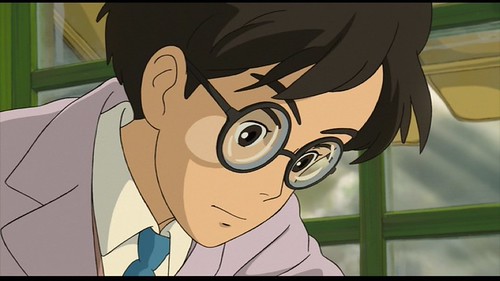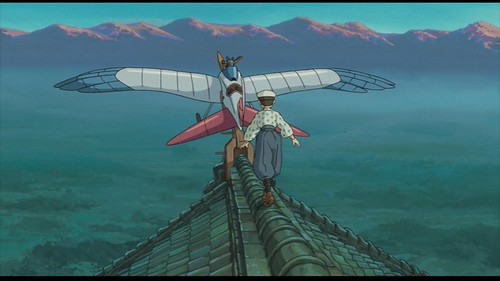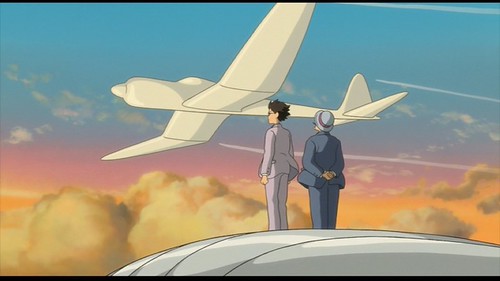
Another working paper. Title above, abstract, TOC and introduction below.
Download at:
- Academia.edu: https://www.academia.edu/27132290/Miyazakis_Metaphysics_Some_Observations_on_The_Wind_Rises
- SSRN: http://ssrn.com/abstract=2812252
Abstract: In The Wind Rises Hayao Miyazaki weaves various modes of experience in depicting the somewhat fictionalized life of Jiro Horikoshi, a Japanese aeronautical engineer who designed fighter planes for World War II. Horikoshi finds his vocation through ‘dreamtime’ encounters with Gianni Caproni and courts his wife with paper airplanes. The film opposes the wind and chance with mechanism and design. Horikoshi’s attachment to his wife, on the one hand, and to his vocation on the other, both bind him to Japan while at the same time allowing him to separate himself, at least mentally, from the imperial state.
CONTENTS
Making Sense of It All: Miyazaki’s The Wind Rises 2
Miyazaki’s The Wind Rises, Some Observations on Life 6
Some Thoughts about The Wind Rises 9
The Wind Rises, It Opens with a Dream: What’s in Play? 10
Horikoshi at Work: Miyazaki at Play Among the Modes of Being 23
The Pattern of Miyazaki’s The Wind Rises 31
From Concept to First Flight: The A5M Fighter in Miyazaki’s The Wind Rises 32
Why Miyazaki’s The Wind Rises is Not Morally Repugnant 40
Horikoshi’s Wife: Affective Binding and Grief in The Wind Rises 49
The Wind Rises: A Note About Failure, Human and Natural 57
Problematic Identifications: The Wind Rises as a Japanese Film 59
How Caproni is Staged in The Wind Rises 67
The Wind Rises: Marriage in the Shadow of the State 89
Miyazaki: “Film-making only brings suffering” 99
Counterpoint: Germany and Korea 100
Wind and Chance, Design and Mechanism, in The Wind Rises 103
Appendix: Descriptive Table 112
Making Sense of It All: Miyazaki’s The Wind Rises
I was going great guns writing about The Wind Rises in November and December of last year. And then the energy ran out while I was drafting “Registers of Reality in The Wind Rises.” Here’s the opening paragraph:
The term, “registers of reality”, is not a standard one, and that’s the point. It’s not clear to me just what’s going on here, and so we might as well be upfront. But it has to do with those “dream” scenes, among other things. And it’s also related to what seems to be a common line on The Wind Rises, namely that while all other Miyazaki films have elements of fantasy in them, often strong ones, this does not.
Many of the reviews casually mention those so-called dream sequences. You can’t miss them. They seem, and are in a way, typical of Miyazaki. But if you look closely you’ll see that they’re not all dream sequences, not quite. Without getting to fussy let’s all them dreamtime with the understanding that sleep is only one of the occasions of dreamtime, that one can enter it under various circumstances–a discussion I open in the posts, “The Wind Rises, It Opens with a Dream: What’s in Play?” and “Horikoshi at Work: Miyazaki at Play Among the Modes of Being.” And they happen only in the first half of the film and at the very end. That’s one thing.
But I had more in mind with the phrase “registers of reality.” A couple paragraphs later in that incomplete draft:
That’s one set of questions. What’s the parallel set of questions we must ask about Horikoshi’s relationship with Naoko Satomi? I ask that question out of formal considerations. As I pointed out in an early post in this series, “The Pattern of Miyazaki’s The Wind Rises”, Horikoshi interacts with Caproni in the first half of the film and with Naoko in the second half. His meetings with Caproni didn’t take place in ordinary mundane reality. What about his meetings with Naoko?
All of those meetings DO take place in mundane reality. The first half of the film alternates between mundane reality and dreamtime (whether waking or sleeping). The second half alternates between work-time and Naoko-time. But the two are, of course, symbolically related. The object of the “registers of reality” post was to make sense out of all this, out of how Miyazaki weaves them together–mundane and dreamtime, work and love–into a life.
But it got too hard, just too hard. And so I stopped. I had other posts planned, including one on “Unity of Being in The Wind Rises.” I’ll get back to it one day. I need to. Perhaps it will take more conceptual apparatus than I can work up in a blog post. Who knows?
That was half a year ago and I’ve not yet gotten back to it. I’ve decided to take the work I’ve done and assemble it into a working paper. Before I do that, however, I can at least indicate something of where I was going, of where I hoped to arrive.