Showing posts with label Joe Rogan. Show all posts
Showing posts with label Joe Rogan. Show all posts
Friday, August 28, 2026
Saturday, September 5, 2020
Mike Tyson and Joe Rogan talk about fighting
What's the difference between merely getting in shape and getting into fighting condition? What's the relationship between sexual arousal and getting ready to fight? This is a fascinating conversation, a look into a fighter's mind.
Wednesday, May 20, 2020
Has Joe Rogan just made a deal with the devil?
As you may know, Rogan has just made a deal to have his podcast distributed exclusively on Spotify. Matt Stoller is worried.
Yesterday audio streaming giant Spotify announced a deal with podcast king Joe Rogan, with the Wall Street Journal reporting that Rogan will be paid more than $100 million over several years in return for making his insanely popular show exclusive to the Spotify service. This is huge news. Investors were pleased; Spotify’s stock was up 8.42%, which is roughly $2.5 billion, or twenty five times what Rogan will be paid. From the perspective of someone who appreciates independent voices and an independent press, however, I’m concerned.
What's up?
As the web used to be, today podcasting is an open market, with advertising, podcasting, and distribution mostly separated from one another. Distribution happens through an open standard called RSS, and there’s very little behavioral ad targeting. I’m asked on fun weird podcasts all the time; podcasting feels like the web prior to the roll-up of power by Google and Facebook, with a lot of new voices, some very successful and most marginal, but quite authentic.
So what is Spotify trying to do?
First, Spotify is gaining power over podcast distribution by forcing customers to use its app to listen to must-have content, by either buying production directly or striking exclusive deals, as it did with Rogan. This is a tying or bundling strategy. Once Spotify has a gatekeeping power over distribution, it can eliminate the open standard rival RSS, and control which podcasts get access to listeners. The final stage is monetization through data collection and ad targeting. Once Spotify has gatekeeping power over distribution and a large ad targeting business, it will also be able to control who can monetize podcasts, because advertisers will increasingly just want to hit specific audience members, as opposed to advertise on specific shows.
What's this mean to Rogan's listeners? (I'm one, I only listen now and then on YouTube, and more often to clips than full shows.) After explaining a bit about anti-trust law, Stoller continues:
...Rogan has made it clear that there are likely to be few consumer benefits. He promised his listeners that “it will be the exact same show. I am not going to be an employee of Spotify. We’re going to be working with the same crew doing the exact same show.” The only difference is consumers won’t be able to get the Rogan show through other channels. It’s purely a restraint of trade. In other words, there’s literally no justification for this deal as anything but a payoff to Rogan from an aspiring monopolist who seeks to force Rogan listeners to use the Spotify app. It’s a leverage of Rogan’s legal monopoly over his own copyrighted material to create a distribution monopoly, which was one of the legal issues at stake in the 1948 Paramount decrees case that ended the monopolistic Hollywood studio system.
Now, I can imagine the argument that targeted advertising brings some sort of benefit I’m leaving out, that Rogan’s ad inventory will bring scale for podcast monetization. But the downside to consumers is quite obvious, while no one has been able to
Spotify isn’t the only bad actor here. The corporation is under heavy pressure from Amazon, Apple, and Google, all of whom have interests in the streaming music and podcast business, and all of whom can cross-subsidize with other streams of revenue. They also have gatekeeping control over Spotify through app stores. Here’s Spotify protesting to one of Congress’s Antitrust Subcommittees how Apple uses its bottleneck power.
Apple operates a platform that, for over a billion people around the world, is the gateway to the internet. Apple is both the owner of the iOS platform and the App Store—and a competitor to services like Spotify. In theory, this is fine. But in Apple’s case, they continue to give themselves an unfair advantage at every turn.If you put Spotify where Apple is, and and change a few words so that this describes streaming instead of apps, this sentence describes Spotify’s strategy. They want to become the gateway to streaming, so they can tax the ecosystem. (It’s admittedly a bit more complex since Spotify is indirectly taxing via ad targeting and has to pay for music rights whereas Apple is directly taxing via an app store fee, but the power dynamics are similar.) show that targeted advertising is a net positive.
There's more at the link, including notes on McKinsey, Softbank, Trump's deal with Phlow, which manufactures chemical precursors to pharmaceuticals, contract tracing.
Monday, August 19, 2019
Joe Rogan and his middle-bro audience
Devin Gordon, Why is Joe Rogan so Popular? The Atlantic, August 2019.
The podcast:
Rogan’s podcast gushes like a mighty river of content—approximately three episodes a week, usually more than two hours per episode, consisting of one marathon conversation with a subject of his choosing. Over the course of about 1,400 episodes and counting, his roster of guests can be divided roughly three ways: (1) comedians, (2) fighters, and (3) “thinkers,” which requires air quotes because it encompasses everyone from Oxford scholars and MIT bioengineers to culture drivers such as the marketing entrepreneur Hotep Jesus and the rapper turned radio co-host Charlamagne tha God all the way across the known intellectual galaxy to conspiracy theorists like Rogan’s longtime buddy and Sandy Hook denier Alex Jones. Also Dr. Phil. And David Lee Roth. And B-Real from Cypress Hill.
It’s impossible to be a Joe Rogan completist, so most of his fans pick a few tributaries. The rest may as well not exist. Who can keep track? Rogan is a key figure in the rise of MMA—Dana White once called him “the best fight announcer who has ever called a fight in the history of fighting”—but I don’t care about fighting, so I didn’t listen to any of Joe’s podcasts with fighters. I also didn’t listen to Dr. Phil, and I’m sure I’m not the only one who skipped it, which is just another way of saying there’s no real way to describe “Joe Rogan fans.” They’re not aligned around any narrow set of curiosities or politics. They’re aligned around Joe.
The audience:
As popular as he seems to be with quote-unquote regular guys, that’s how unpopular Joe Rogan is with the quote-unquote prestige wing of popular culture—Emmy voters, HBO subscribers, comedy nerds. Thought leaders. Thought followers. There are plenty of Joe Rogan fans among them, too, but they tend not to bring it up. [...]Technique and craft:
The bedrock issue, though, is Rogan’s courting of a middle-bro audience that the cultural elite hold in particular contempt—guys who get barbed-wire tattoos and fill their fridge with Monster energy drinks and preordered their tickets to see Hobbs & Shaw. Joe loves these guys, and his affection has none of the condescension and ironic distance many people fall back on in order to get comfortable with them. He shares their passions and enthusiasms at a moment when the public dialogue has branded them childish or problematic or a slippery slope to Trumpism. Like many of these men, Joe grumbles a lot about “political correctness.” He knows that he is privileged by virtue of his gender and his skin color, but in his heart he is sick of being reminded about it. Like lots of other white men in America, he is grappling with a growing sense that the term white man has become an epithet. And like lots of other men in America, not just the white ones, he’s reckoning out loud with a fear that the word masculinity has become, by definition, toxic.
Most of Rogan’s critics don’t really grasp the breadth and depth of the community he has built, and they act as though trying is pointless.
The hard truth for some of Rogan’s critics in the media is that he is much better at captivating audiences than most of us, because he has the patience and the generosity to let his interviews be an experience rather than an inquisition. And, go figure, his approach has the virtue of putting his subjects at ease and letting the conversation go to poignant places, like the moment when Musk reflected on what it was like to be Elon Musk as a child—his brain a set of bagpipes that blared all day and all night. He assumed he would wind up in a mental institution. “It may sound great if it’s turned on,” he said in his blunt mechanical way, “but what if it doesn’t turn off?”Limitations:
And a key thing Joe and his fans tend to have in common is a deficit of empathy. He seems unable to process how his tolerance for monsters like Alex Jones plays a role in the wounding of people who don’t deserve it. Jones’s recent appearance on the podcast came after he was sued by families of children and educators murdered in the Sandy Hook massacre—a mass shooting that Jones falsely claimed was a hoax, which families of the victims say prompted his gang of fans to harass them. (Jones has since acknowledged that the Sandy Hook massacre occurred.) So is Joe really nurturing a generation of smarter, healthier, more worldly men, or an army of conspiracy theorists and alt-right super soldiers? At the very least, he shows too much compassion for bad actors, and not enough for people on the receiving end of their attacks. [...] More revealing is who he invites onto his podcast, and what subjects he chooses to feast on in his stand-up specials. And if you cast a wide enough net, clear patterns emerge. If there’s a woman or a person of color (or both) on Joe’s podcast, the odds are high that person is a fighter or an entertainer, and not a public intellectual.And so:
My Joe Rogan experience ended because he wore me out. He never shuts up. He talks and talks and talks. He doesn’t seem to grasp that not every thought inside his brain needs to be said out loud. It doesn’t occur to him to consider whether his contributions have value. He just speaks his mind. He just whips it out and drops it on the table.
Saturday, October 27, 2018
The toke that took the World Wide Web & smoked the #MSM
The same writer did these in an abandoned, and now totally demolished, building in Jersey City in the late spring of 2012. pic.twitter.com/RXoukYSXbB— Bill Benzon (@bbenzon) October 27, 2018
Monday, September 17, 2018
Trumposaurus Rex @ 3QD – Toward a cybernetic interpretation
That’s what my current piece at 3 Quarks Daily is about, Feed Me Donald! – Trump, Musk, The Internet, And Monsters From The Id. I start with Elon Musk’s conversation with Joe Rogan. For example:
Elon Musk: A company is essentially a cybernetic collective of people and machines. That’s what a company is. There’s different levels of complexity in the ways these companies are formed. ...Joe Rogan: Humans and electronics all interfacing, and constantly now, constantly connected.
And then on to my buddy David’s report of Trump’s performance at AIPAC (American Israel Public Affairs Committee) in 2016:
These were not Trump supporters. It is AIPAC’s tradition to cheer for good rousing lines. Standing ovations are not endorsements. On the other hand, you can see how the cameras may have shown us being turned into a Trump mob. And maybe we were. Maybe you would have stood and cheered, too. Yet at the very moment I became part of the mob, I had this sudden schizoid flash of rational clear sight into Trump. I saw, I mean really saw, the Trumposaur in its naked, primitive state.
And then I toss some lines from Little Shop of Horrors, a 1986 rock horror musical comedy. These lines are being sung by a blood-drinking carnivorous plant with luscious lips and no eyes:
Feed me! Feed me! Feed me!Feed me, SeymourFeed me all night longThat's right, boyYou can do itFeed me, SeymourFeed me all night long‘Cause if you feed me, SeymourI can grow up big and strong
Except that you’re supposed to hear it as “Feed me Donald” and the plant is Trump’s smart phone, the one he uses to issue his tweets, the personal ones that go zinging into the cyberverse at three in the morning where they end up on Fox News and scoot under the skirt of The Gray Lady (aka The New York Times), giving her a vile thrill she experiences as $$$$.
All night, baby, all night long. Just you and me. So good! So good!
And if Trump feeds his smart phone, what’s he get from it? Why satisfaction of course. Just what gives him satisfaction, only he knows, and he probably doesn’t know it all that well, though he’s been feeding it all its life. Word is that he’s got an endless need for praise and approval and he does whatever he can to get it. For the purposes of this piece I’m willing to let it go at that.
Consider this diagram, which is a standard cybernetic diagram I’ve adapted from William Powers, Behavior: The Control of Perception (1973) – a classic, if you haven’t read it, you should:
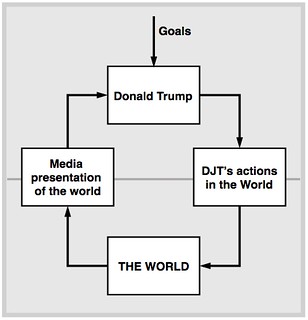
We’ve got Donald Trump at the top; he’s governed by his goals (aka reference levels), endless praise and approval. At the left we’ve got the media’s presentation of the world, which is DJT's Input Function. THAT’s what Trump attends to; that’s what he cares about. Everything he does is intended to have effects there. That’s what he’s trying to control.
He attempts to control them through various actions (aka Output Function), which I’ve grouped together at the right. Those actions in turn have some effect on the world; there it is, at the bottom. The world is big and complicated, lots going on. While Trump, as President of the United States, is undoubtedly one of the most powerful men in the world, if not THE most powerful man in the world, the sorry (or fortunate, depending on your POV) fact is there’s not a lot he can do to affect the world. He can certainly do something, more than you and me, but not a lot.
Whatever it is that Trump does, it scatters and dissipates into the world, the world does what it does, and the media takes note. That brings us back to the box there at the left (aka input function). Of course Trump does pay attention to everything in the media, just a little bit of it.
Let’s add a little detail to the diagram:
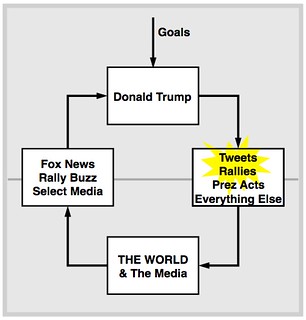
I’ve divided his actions into four categories: 1) Tweets, 2) campaign-style Rallies, 3) Presidential Actions of all kinds, and 4) Everything Else. Over at the left I’ve singled out Fox News, which apparently is his favorite source of media input and grouped his other media into Select Media (of whatever kind, cable TV, print, internet, etc.). That box now contains only the media Trump attends to, nothing else, and I’ve shuffled everything else down there into the world (where it is in any case). But I’ve also added Rally Buzz to Trump’s input function. That’s clearly important to him, and that isn’t mediated by any media at all. He gets that directly.
Trump’s major innovations are those (unofficial) tweets and those rallies. Forget about all those ways he violates presidential norms, including keeping some undisclosed degree of control over his businesses. It’s not that they’re unimportant – certainly they are. But all presidents have bent the rules and gone off the farm now and then. It’s not new, though Trump may well be doing more of it than any others. But none of them have produced flotilla after flotilla of personal tweets and none have done all those campaign-style rallies. Those are new.
Why’s he do it? Isn’t that obvious? The rallies and the tweets are his most direct means of gaining some control over what appears in his input function. The rallies give him precious direct real-time feedback. Alas, he can’t do them every day.
But those tweets, he can do them every day. The effect is not so immediate as the rally buzz, and it is often unpleasant rather than favorable, but it’s fairly predictable. Those tweets show up on Fox and they show up in all sort of media, including that august bastion of FAKE NEWS, The New York Times. In fact, even when the feedback is nasty, that’s OK for Trump as long as he’d anticipated that nasty feedback. Those tweets also reach his Base, and thus primes them for the rallies where they share the mutual satisfactions of direct interaction.
Of course, his tweets have other effects out there in the world, diffuse effects. Those effects he cannot control. As for the various actions he undertakes as president, well, it’s complicated. I’ll leave those complications as an exercise for the reader.
I note that one of the biggest and most important complications is time scale. A tweet may show up on the radar screen (Input Function) within hours, but, depending on its content, it may have effects the diffuse out across days or even weeks. The same is true for everything else Trump does as president. What about those tariffs? He calls for them in a tweet, a speech, whatever, then the chatter. In time the orders are issued. And then, and then the results come rippling in over weeks, months, years.
Sorting all those things out in order to fine-tune the system, that’s tough. Heck, it takes a whole federal bureaucracy to do that. But Trump can always emit another tweet and see what sticks.
Always.
Tweet.
Monday, September 10, 2018
Limbic Resonance: Elon Musk discusses AI with Joe Rogan
The conversation Joe Rogan had with Elon Musk was far ranging, starting out with pseudo-flamethrowers Musk had sold through The Boring Company and ends 25 minutes after that infamous toke with Musk: "People should be nicer to each other". I hope someone transcribes the whole thing. FWIW it currently (8:37 AM EDT, Monday 10, 2018) has 8,500,372 views and 62,472 comments on YouTube.
Here's a segment focussing on AI:
It has the single a fascinating and important bit of conversation starting at roughly 5:17. I was struck by Musk's mention of the limbic system, but then he must know something about the nervous system and think about it a lot. After all, he's got a company, Neuralink, devoted to creating a connection between brains and computers.
* * * * *
Elon Musk: A company is essentially a cybernetic collective of people and machines. That’s what a company is. There’s different levels of complexity in the ways these companies are formed. And there’s sort of a collective AI in the Google sort of search, where we’re all sorta’ plugged in as nodes on the network, like leave on a big tree. We’re all feeding this network with our questions, and answers. We’re all collectively programming the AI. And Google plus all the humans that connect to it are one giant cybernetic collective. This is also true of Facebook and Twitter, and Instagram, and all these social networks. They’re giant cybernetic collective.
Joe Rogan: Humans and electronics all interfacing, and constantly now, constantly connected.
EM: Yes, constantly.
JR: One of the things that I’ve been thinking about a lot over the last few years is that one of the things that drives a lot of people crazy is how many people are obsessed with materialism and getting the latest greatest thing, and I wonder how much of that, well a lot of that is most certainly fueling technology and innovation. And it almost seems like it’s build in to us. It’s like what we like and we want, that we’re fueling this thing. It’s constantly around us all the time. It doesn’t seem possible that people’re going to pump the breaks; it doesn’t seem possible at this stage that we’re constantly expecting the newest cell phone, the latest Tesla update, the newest MacBook Pro. Everything has to be newer and better, and that’s going to lead to some incredible point. And it seems like it’s build into us. Almost seems like it’s an instinct. That we’re working towards this, that we like it.
EM: Um huh.
JR: Our job, just like the ants build the ant hill, our job to somehow fuel this.
[c. 7:43]
EM: Yes, uh, I mean, ... some years ago, it feels like we are the biological boot loader for AI, actively, we are building it. And then we’re building progressively greater intelligence, and the percentage of intelligence that is not human is increasing, and eventually we will represent a very small percentage of intelligence. But the AI isn’t formed strangely by the human limbic system,* it is in large part our Id writ’ large.
JR: How so?
EM: Well you mention all those things, the sort of primal drive...
JR: Um huh.
EM: All the things that we like, and hate, and fear, they’re all there on the internet. They’re a projection of our limbic system.
Musk looking intently, so is Rogan, who starts chuckling.
EM: It’s true.
JR: No, it makes sense. Thinking of corporations and thinking of just human beings communicating on line through these social media networks as some sort of an organism that’s a, it’s a cyborg, it’s a combination, a combination of electronics and biology.
EM: Yeah. ... The success of these is sort of a function of how much limbic resonance they’re able to achieve with people. The more limbic resonance, the more engagement.
JR: Ummh...Whereas like one of the reasons why probably Instagram is more enticing than Twitter...
EM: Limbic resonance.
JR: Yeah.
*I'm not sure what Musk meant with the previous phrase, it's not quite clear and seems in partial contradiction of the phrase that follows, which is clear enough.
* * * * *
Friday, September 7, 2018
Elon Musk gets high on Joe Rogan and Tesla's stock drops – "Wouldn't hurt to have more love in the world."
Neal E. Boudette and Ceylan Yeginsu, "Tesla Shares Shaken by Accounting Chief’s Exit and Musk’s Pot Smoke", New York Times, 7 Sept. 2018. The opening paragrhas:
Tesla shares dropped sharply on Friday after the electric-car company disclosed that its chief of accounting was leaving the company only weeks after coming aboard.The upheaval in the executive ranks emerged hours after the company’s chief executive, Elon Musk, appeared live on YouTube taking a deep drag on what appeared to be a marijuana cigarette during an interview with the comedian Joe Rogan, an advocate for legalizing marijuana.
Near the end of the article, quoting from the Rogan interview:
He appeared at ease, sipping whiskey, and spoke, at one point, about artificial intelligence and how it could not be controlled.“You kind of have to be optimistic about the future,” said Mr. Musk, the head of the private rocket company SpaceX as well as Tesla. “There’s no point in being pessimistic. I’d rather be optimistic and wrong than pessimistic and right.”Mr. Musk explained what it was like to be inside his head, calling it “a mutation” that leads to a constant flow of ideas that makes him invent things.“At first I thought I was insane,” he said.
* * * * *
I've watched the entire interview, though I didn't give it my full attention–I zoned in and out. It was far-ranging and, yes, Musk took a few drags from a blunt, saying that he rarely smoked marijuana. Some snippets:
Elon Musk, Concerning the interaction of humans and machines via the internet: "the more limbic resonance, the more engagement".Concerning future AI: "It's less of a worry than it used to be, mostly due to taking more of a fatalistic attitude...It's going to be very tempting to use AI as a weapon...The danger is more humans using it against each other, I think...It could be terrible, it could be great. One thing for sure, you can't control it."At one point Musk emphasized the importance of fun: "The Tesla is the most fun thing ever...a thing to maximize enjoyment."On flying cars: "too noisy, too much air flow"All we need is love: "That's what we're trying to do, make things somebody loves...Wouldn't hurt to have more love in the world."
FWIW, they smoke the blunt starting at about 2:10:02.
* * * * *
If you're selling your Tesla stock because you're shocked that the guy who makes (a) electric cars, (b) rockets, (c) a mostly imaginary magnetic train and (d) flamethrowers smokes weed, then it's possible you weren't paying enough attention earlier https://t.co/lAe4UgGQwv— Mike Madden (@MikeMadden) September 7, 2018
That's not how the AP is reporting it, though!— Mike Madden (@MikeMadden) September 7, 2018
Sunday, August 12, 2018
Grappling in the Agora with Joe Rogan
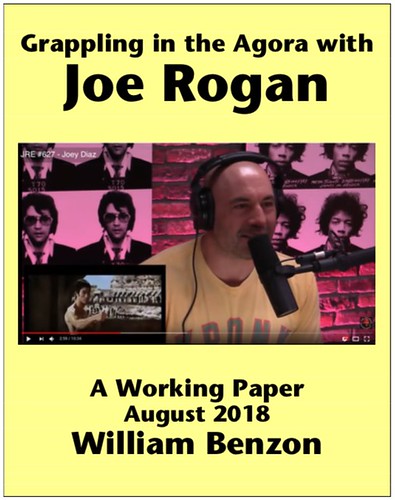
I've posted another working paper to Academia.edu. The title's above. Here's the URL:
https://www.academia.edu/37222120/Grappling_in_the_Agora_with_Joe_Rogan
Abstract, contents, and introduction below.
* * * * *
Abstract: The Joe Rogan Experience is one of the most popular podcasts on the web, reaching 10s of millions of viewers per month. Rogan discusses a wide variety of topics with a variety of guests, some of them friends who appear regularly: martial arts, comedy, nutrition and health, conspiracy theories, psychedelic drugs, and a variety of science topics. In this paper I discuss several specific podcasts, with: Steven Pinker (his latest book, Enlightenment Now), Michael Pollan (psychedelic drugs), Neil deGrasse Tyson (moon landing), Howard Bloom (music, altered states, space program), and Joey Diaz (Bruce Lee and martial arts). I also include an annotated transcription of the Joey Diaz conversation.
Contents
Introduction: Joe Rogan and Socrates in the Agora 2
Grappling at the edges of reality with Joe Rogan 5
The world according to jiujitsu 9
Two notes on psychedelic experience (Michael Pollan on Joe Rogan) 10
Joe Rogan talks with Howard Bloom, Zoooommm! 12
Joe Rogan and Joey Diaz call “Bruce Lee vs. Chuck Norris” – a rough transcript 16
On the conversational construction of cultural reality: Joe Rogan and Joey Diaz discuss Bruce Lee and Chuck Norris in Way of the Dragon 25
Introduction: Joe Rogan and Socrates in the Agora
The idea that Joe Rogan is a modern Socrates is absurd, no? Well...let’s think about it.
Sure, I know, Socrates is the father of Western philosophy, or maybe grandfather, or great uncle, who knows, but one of those ancients. Apparently he’d go into Athens’ public square, the agora, and hold conversations on philosophical matters. I have no idea what mix of strangers and regulars joined in, but there certainly were regulars. Plato was one of them and he modeled his philosophical discourses after Socrates’ mode of talk, thus producing the first substantial body of written intellectual discourse in Western secular thought.
I have no reason to think that Rogan has made or will make any original contributions to contemporary thought, not does Rogan make any such claims for himself. As far as I can tell he thinks of himself as a guy who likes to have rambling conversations on various topics with various people. Some of these people are friends of his, or at least people he knows personally even if he doesn’t routinely hang out with them. He may have these people on the podcast time and again. Of these, some are comedians, others are martial artists, and others, bow hunting, who knows? These conversations typically run two-and-a-half to three hours long and are just casual conversation, though every once in awhile they’ll dig in a bit.
But Rogan also has conversations with guests having substantial intellectual expertise of one kind or another, for example: Steve Pinker (linguistics, psychology), Sean Carroll (physics, cosmology), Dennis McKenna (ethnopharmacology, psychedelic drugs), Debra Soh (neurosciences), Brett Weinstein (evolutionary biology), and Adam Frank (physics, astronomy). These conversations are also casual in manner, where Rogan plays the Everyman who is curious about these topics. And so he learns something from these experts, as do his viewers.
And he has lots of viewers, millions of them. Of course they don’t interact with him in the way Socrates’ interlocutors interacted with him – we simply don’t have any venue like the agora of ancient Greece. But they interact with one another in comments to the podcasts and in online forums like Reddit. And, yes, a lot of that interaction is just chitchat, but some of it is more substantive. There is learning going on, ideas exchanged, opinions validated.
Molly Worthen discussed Rogan and others in a recent column in The New York Times, “The Podcast Bros Want to Optimize Your Life”, noting:
Don’t dismiss the podcast bros merely as hucksters promoting self-help books and dubious mushroom coffee. In this secularized age of lonely seekers scrolling social media feeds, they have cultivated a spiritual community. They offer theologies and daily rituals of self-actualization, an appealing alternative to the rhetoric of victimhood and resentment that permeates both the right and the left. “They help the masses identify the hole in the soul,” Karli Smith, 38, a fan who lives in Tooele, Utah, told me. “I do feel the message is creating a community.”All this continues a long American tradition of self-help and creative, market-minded spirituality. The 19th century brimmed with gurus ready to guide you to other dimensions and prophets of the path from rags to riches. The podcasters’ exhortations to cultivate character and learn from the habits of successful businessmen, scientists and soldiers (whom they invite for interviews that sometimes stretch longer than two hours) could come straight from the pages of Victorian self-improvement manuals.
A bit later:
This is the podcast bro ethos: Ditch your ideologically charged identity. Accept your evolutionary programming. Take responsibility for mastering it, and find a cosmic purpose. “I’m not saying it’s only personal responsibility that matters, but you have to start there,” Mr. Marcus told me.But wait — how does cutting down carbs and tossing kettlebells set me up to serve the universe? Here is where the podcast bros get metaphysical. Many have a strong interest in spirituality, and see practices like Buddhist meditation or consuming hallucinogenic “plant medicine” as not just a way to improve daily performance, but a path to something deeper. Their metaphysical tastes range from Carl Jung’s psychology to ancient Stoic philosophy, which calls for self-control and transcendence of material wealth.
That’s a pretty interesting mix of materials. That kind of range, and his popularity, is what makes Joe Rogan such an interesting and, I believe, important figure.
That’s why I’ve spent a good many hours over the last three months watching Rogan’s podcasts. I’ve watched, I don’t know, a dozen or two dozen all the way through, and many fragments from others. For Rogan’s fans will cut his podcasts into fragments and post them online, as does Rogan himself (more likely Jamie Vernon, his technical aide-de-camp). And from that I’ve made half a dozen posts to my blog, New Savanna, which I’ve gathered into this working paper.
Because that’s what it is, a work in progress, not finished–and maybe never to be finished. Who knows?
Well over half of this paper is devoted to a single 10 minute conversation Rogan had with one of his regulars, comedian Joey Diaz. They’re discussing the fight between Bruce Lee and Chuck Norris at the end of Way of the Dragon, an important martial arts film. Both Rogan and Diaz are martial artists, so Bruce Lee is a hero to them, perhaps Chuck Norris as well, though he doesn’t have the iconic status that Lee does. I watched that segment relatively early in my dive into the Joe Rogan Experience and the conversation struck me as emanating from the center of Rogan’s worldview. So I included it in the article I wrote for 3 Quarks Daily in late May – “Grappling at the edges of reality with Joe Rogan”, where I also discussed conversations with Steven Pinker and Neil deGrasse Tyson. That piece is the first section of this working paper.
The Rogan/Diaz was still with me after two more months of Joe Rogan, so I decided to transcribe it, not for any “deep” philosophical content, no, not that. But just to see how it went, because it’s that kind of conversation that’s made Rogan a star of the podcast world. In the next to last section of this document – “Joe Rogan and Joey Diaz call ‘Bruce Lee vs. Chuck Norris’ – a rough transcript” – I present the transcript without any comments other than a few introductory remarks. In the last section – “On the conversational construction of cultural reality: Joe Rogan and Joey Diaz discuss Bruce Lee and Chuck Norris in Way of the Dragon” – I add extensive interline commentary to the conversation. Just how do these guys build a sense of reality? That’s what I’m curious about.
The shortest piece in this collection, “The world according to jiujitsu”, consists of a transcription of an impromptu speech that Rogan gave when he was awarded a black belt by Eddie Bravo – also a friend and regular guest on the podcast. That speech, so it seems, expresses Rogan’s core values. The other two pieces are based on specific podcasts, one with Michal Pollan and the other with Howard Bloom (whom I know), and have transcripts of short segments from each. Why transcriptions? Because the back-and-forth is important.
It’s the shuttle and the loom.
Tuesday, August 7, 2018
Podcasts for a better life
Molly Worthen, The Podcast Bros Want to Optimize Your Life, NYTimes:
The sales pitches can eat up slightly more airtime than ads for mattresses and grocery delivery services on other podcasts. But the main thing is the philosophy of personal development that goes with them — and it has won a huge following. Tim Ferriss told me his books have sold over four and a half million copies in North America alone. Several of these podcasters say they reach millions of listeners each month. In 2016, Joe Rogan put his figure “in the neighborhood of 30 million downloads per month”; his show is ranked second on the iTunes podcast chart, right behind Oprah’s.Don’t dismiss the podcast bros merely as hucksters promoting self-help books and dubious mushroom coffee. In this secularized age of lonely seekers scrolling social media feeds, they have cultivated a spiritual community. They offer theologies and daily rituals of self-actualization, an appealing alternative to the rhetoric of victimhood and resentment that permeates both the right and the left. “They help the masses identify the hole in the soul,” Karli Smith, 38, a fan who lives in Tooele, Utah, told me. “I do feel the message is creating a community.”All this continues a long American tradition of self-help and creative, market-minded spirituality. The 19th century brimmed with gurus ready to guide you to other dimensions and prophets of the path from rags to riches. The podcasters’ exhortations to cultivate character and learn from the habits of successful businessmen, scientists and soldiers (whom they invite for interviews that sometimes stretch longer than two hours) could come straight from the pages of Victorian self-improvement manuals. When I asked Mr. Marcus about his admiration for his guests on the “Aubrey Marcus Podcast,” he said: “It’s self-mastery of the ego, knowing you have nothing to prove. That’s real strength, real masculinity.”
Joe Rogan:
Most of the time, “The Joe Rogan Experience” consists of pleasantly rambling, profanity-laced conversations with Australian bowhunters, mixed martial arts fighters and celebrities like Steven Tyler, lead singer of Aerosmith. But one of Mr. Rogan’s “all-time favorite guests” is Jordan Peterson, the University of Toronto psychologist whose taste for political street fighting — mainly with the radical left — brought a wave of media attention, launched his best-selling self-help book, “12 Rules for Life” and made him a darling of the podcast bro circuit.In conversations with Mr. Peterson, Mr. Rogan disdained the “the social justice warrior brigade,” but also lamented President Trump’s failure to distance himself from white supremacists. Mr. Rogan has said he’s “mostly on the left.” What troubles him is “when people just ramp up their positions and get more ideologically based, and they’re doing it as a reaction to the other side instead of just being who they are, instead of having some sort of a personal sovereignty,” he said last year. (Mr. Rogan’s website sells T-shirts emblazoned with the political affiliation “Freak Party.”)
And so:
This is the podcast bro ethos: Ditch your ideologically charged identity. Accept your evolutionary programming. Take responsibility for mastering it, and find a cosmic purpose. “I’m not saying it’s only personal responsibility that matters, but you have to start there,” Mr. Marcus told me.But wait — how does cutting down carbs and tossing kettlebells set me up to serve the universe? Here is where the podcast bros get metaphysical. Many have a strong interest in spirituality, and see practices like Buddhist meditation or consuming hallucinogenic “plant medicine” as not just a way to improve daily performance, but a path to something deeper.
Monday, August 6, 2018
On the conversational construction of cultural reality: Comments on Joe Rogan and Joey Diaz discussing Bruce Lee and Chuck Norris in Way of the Dragon
In my previous post in this Joe Rogan series I’d transcribed a conversation Rogan had with Joey Diaz about the final fight scene between Bruce Lee and Chuck Norris in Way of the Dragon. In this post I add extensive interstitial commentary to the transcription. But not enough. That’s one thing I learned in this process, that there’s more that can be done. And maybe I’ll do it one day; but feel free to do it yourself. At the moment my priority is simply to get this bit of work out there.
Keep in mind that this is about the construction of shared reality: How do Rogan and Diaz construct a shared sense of the world, what happens and what’s important? It happens in conversation, so it behooves us to pay attention to how such conversations unfold. That’s why I’ve taken the time to transcribe and comment on this conversation.
The conversation itself
The conversation this post is about took place in the podcast, Joe Rogan Experience #627, from March 2015. It features Joe Rogan talking with his buddy, Joey Diaz, along with Brian Redban. This segment starts at about 1:15:30 into the full podcast. They’d started talking about Bruce Lee at 1:03:35. They’d been talking about movie stunts. Rogan had mentioned how Brandon Lee (Bruce Lee’s son) had died in a freak accident on the set of a film. Diaz contradicts him: “You know what that was? The Triads got ‘im.” The conversation switches to Bruce Lee’s death and the rumors surrounding it. This goes on for eight minutes. Then, and then, they start talking about Bruce Lee’s films – while watching trailers – and the impact they had. It’s in this context that Rogan mentions the final fight scene from Way of the Dragon, thus initiating the conversation in this clip.
Rogan and Diaz play different roles in the conversation. Roughly speaking Diaz provides historical context whereas Rogan provides color commentary. They both comment on cinematic technique, Diaz perhaps a bit more than Rogan.
What’s interesting about this division of conversational labor is that Rogan, in effect, treats Diaz as the voice of cultural history, though he’s only a few years older than Rogan himself; Diaz was born in 1963 while Rogan was born in 1967. Moreover Rogan tells us nothing about his own personal history (though he touches on it in other podcasts), but he does the bulk of the commentary on the fight itself. Given that he is a commentator for the UFC (Ultimate Fighting Championship) that makes sense.
Those form the two poles of this conversation, cultural history going back to the 1970s, and the moves in the fight before us. The conversation starts there and, as it unfolds, other topics are brought in, but always returning to those two. The overall frame of the conversation is that the fight we’re seeing, the imaginary, the fictional, fight we’re seeing IS NOT a street brawl. Rather, it’s conducted with unspoken rules that have the effect of making it a ritual action. Despite its ultimate brutality this is, if you will, a civilized encounter.
Here’s the conversation:
If you want to compare the transcription to the conversation itself – you really should, otherwise, how would you know what they're talking about? – you can open the conversation in a different browser window. Here’s the link:
https://www.youtube.com/watch?v=bWST-xFYCrU
I note that there are four people involved. Most of the conversation is between Joe Rogan and Joey Diaz. Every once in a while Brian Redban says something. Jamie Vernon is off screen running the equipment. He’s the one Rogan is talking to when asks to see something again.
What I’ve done
I’ve transcribed the conversation from beginning to end. The transcription is only approximate. I made no attempt to notate all the disfluencies that are normal to conversation, nor have I indicated laughter and other interjections, and so forth. I’ve only tried capture what they’ve said.
At various points in the conversation I’ve added commentary in italics. These comments are often keyed to numbers that I’ve inserted into the conversation itself using angle brackets [1], [2], etc. I’ve also inserted approximate timings here and there, again with angle brackets.
Finally, I’ve inserted markers consisting of capital letters enclosed in brackets, set in bold type and followed by a number, e.g. [A2]. The number indicates the ordinal occurrence the marker token, e.g. [A2] is the second occurrence of that marker. I added these at the very end of my descriptive and analytic work in order to give myself a better sense of the over all conversational flow. These are keyed to specific topics, as follows, and in the order in which the topics were introduced into the conversation:
[A] Diaz’s personal history and cultural context in which he first saw these films.
[B] Rogan on the fighter’s bodies.
[C] Enter the kitten, a motif in the film.
[D] Rogan, commentary on the fight action. Diaz as well.
[E] Rogan, “they agree to do it the right way”. This is not a street brawl. Diaz toward the end.
[F] Diaz & Rogan, history of martial arts in the USA.
[G] Roman Coliseum, a motif.
[H] Cinematography.
[I] Rogan: Did Lee ever compete?
Some of these topics, of course, recur throughout the conversation. After the transcript I list these topics in the order in which they entered the conversation along with some further commentary.
Saturday, July 28, 2018
Another ramble to figure out what I’m up to: space travel, peace, Joe Rogan, computational lit crit [Ramble 11]
It’s time for a bit of rambling so I can take stock and figure out where I am & where I need to go.
GVMBP 2018

Sunday I posted some photos from Saturday’s Massive Block Party, thrown by Green Villain, Writer’s Workbench, and VYV Apartments. More on went up on Tuesday.
Onward Ho!
On Sunday I uploaded another essay to 3 Quarks Daily: Three Children Of The Space Age: Elon Musk, Freeman Dyson, And Me. That essay, of course, goes deep into my past, up through the present and, who knows, maybe into the future. But I wrote it as kind of an outer out-there bounds to a project I’ve been working on with Charlie Keil, a series of little books, or pamphlets, on the theme: Local Paths to Peace Today. We published the first volume two years ago: We Need a Department of Peace: Everybody's Business, Nobody's Job.
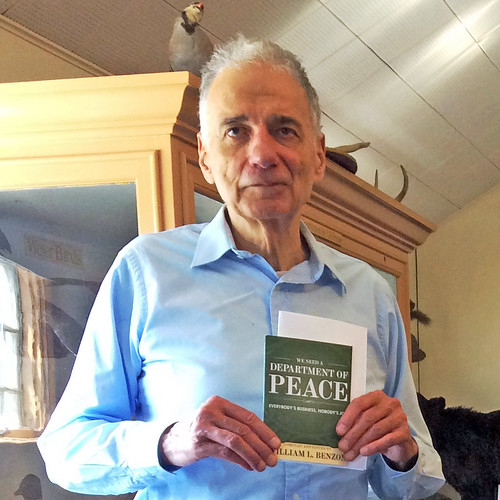 |
| Ralph Nader with his copy of We Need a Department of Peace |
We’ve just sent the second volume off to press: Thomas Naylor’s Paths to Peace: Small is Necessary. That’s about how everything’s too damn big, especially the states we live in. We’re now working on a third volume which doesn’t have a title yet (though CK likely has something he’s thinking about). For the moment let’s call it Where We Want to Go: Cooperation and the Common Glad Impulse.
Well, I figure we need to present some scenario for a different future, the opposite of those dystopian scenarios I wrote for Abbe Mowshowitz two decades ago. Now, you see, CK is something of a Luddite and has no interest in manned space travel, but I’m a bit different. Elon Musk has interesting things to say about where we’re going and how we get there, so I figured that would be a good warm-up.
Moving closer to Where We Want to Go, I’m participating in a group reading of Kim Stanley Robinson’s New York 2140, which is about a future in which the seas have risen 50 feet. Can we live in that world? Robinson says we can. I think so too. My idea is to take KSR’s world and tweak it a bit to meet our requirements, Charlie’s and mine. Of course, I’ve already read and blogged about New York 2140, but Bryan Alexander, futurist and educational consultant, has just kicked off a group reading. I figure that’s a good way for me to see what others think about the future.
This kicked off a series of posts on Musk, the simulation argument, and the Singularity. I’ll likely return here from time to time.
Joe Rogan’s reality club
On Thursday I returned to my interest in Joe Rogan with a long post, Joe Rogan and Joey Diaz call “Bruce Lee vs. Chuck Norris” – a rough transcription of their conversation. The title tells the story. I took a ten minute conversation that Rogan had with his buddy, Joe Diaz, about a scene from a classic martial arts film. Why’d I do that? Because I’m interested in what Rogan does and how he does it. Conversation’s his medium. The next step is to go through the conversation and comment on it, like I did with a paragraph from Heart of Darkness.
I don’t know when I’ll get around to this. Or even if I will. But I really should, shouldn’t I? And then I can wrap up my Rogan posts into another working paper.
Computational Lit Crit
Later on Thursday I published a long post on Michael Gavin’s recent article, Vector Semantics, William Empson, and the Study of Ambiguity. This first post centered on a famous memorandum, Gavin 1.1: Warren Weaver (1949) and statistical semantics. I’ve got two more posts planned for this series:
- Gavin 1.2: Warren Weaver 1949 and compositional semantics
- Gavin 2: Comments on a passage from “Paradise Lost”
Those posts are in an advanced stage of planning and an early stage of drafting. I hope to have Gavin 1.2 up in a day or three, to be followed by Gavin 2 and day or three later. Then I’ll assemble them into a working paper, post it, and then set about turning it into a paper for submission to an appropriate journal, perhaps Cultural Analytics.
The idea is to compare and contrast three distinct approaches to meaning, traditional “close-reading”, statistical semantics (which is well known in the digital humanities), and what I’m calling compositional or constructive semantics, which is not so well-known. Compositional semantics is what I did my doctoral work on. It’s well developed in cognitive science, but also in computational narratology, and computer gaming. Once I’ve got all three on the table (in Gavin 2) I can make a distinction between close reading on the one hand, and statistical and compositional semantics on the other. Close reading is about meaning, and meaning is ontologically subjective (in Searle’s sense). But statistical and compositional semantics are not. The exist in the object realm; they objectify meaning. Close reading is validated through ethical arguments; it is a tool of ethical criticism.
Statistical and compositional semantics are somewhat different and I’ve not yet figured out just how to talk about them. For the moment, let’s say that statistical semantics are assessed with respect to truth. Within cognitive criticism statistical semantics may be used in the context of an argument that is basically about meaning.
Compositional semantics as well can be assessed as to its truth. But it also has engineering uses.
It’s complicated.
* * * * *
And I’ve got to keep all these balls in the air, Green Villain, scenarios for the future, Rogan, and cognitive criticism.
And the photographs. Took several hundred this week.
That’s a lot of work.
Addendum: Oh, I forgot! I've got to start blogging about the segment's of Nina Paley's Seder-Masochism. The first post will be about two segments, This Land is Mine, which is the first one Nina made and is the last one in the film and, God-Mother, one of the last segments she completed and first in the film.
* * * * *
Addendum: Oh, I forgot! I've got to start blogging about the segment's of Nina Paley's Seder-Masochism. The first post will be about two segments, This Land is Mine, which is the first one Nina made and is the last one in the film and, God-Mother, one of the last segments she completed and first in the film.
Thursday, July 26, 2018
Joe Rogan and Joey Diaz call “Bruce Lee vs. Chuck Norris” – a rough transcription of their conversation
Two months ago I posted to 3 Quarks Daily about Joe Rogan’s podcast. I included three video clips, one of them a discussion about a scene from Way of the Dragon, a classic Hong Kong martial arts film from 1972. I chose that clip because it seemed to me at the time – I’d been watching The Joe Rogan Experience for two or three weeks – that it was dead center in Rogan’s universe of discourse. I’ve watched a lot more Joe Rogan since then and that clip still seems to exemplify his interests and his appeal.
So, it’s time to take another look at that clip. It’s from a podcast that originally aired on March 18, 2015. Joey “Coco” Diaz was his guest, along with Brian Redban, who’d been involved in the podcasts from the beginning. Diaz is a comedian who was born in Cuba and emigrated to the United States as a child. He’s a friend of Rogan’s and a frequent guest on the podcast. Jamie Vernon is behind the scenes mixing the audio, operating the cameras, and bringing up video clips for viewing.
The purpose of this post is simply to present a rough transcription of the conversation. I may, I really ought to, do another post where I comment on the conversation in some detail. But not right now. I just want to get it up there.
Reality maintenance
Why this clip? Because it is explicitly about reality maintenance, if you will. Reality maintenance is a routine feature of conversation. There are languages, for example, where one must inflect verbs to indicate how one knows the information being asserted. Did you see it yourself or did someone tell you about it? Is it something you have inferred or even something that happened in a dream? English is not such a language, but that kind of information is easily supplied. My point is simply that this kind of reality maintenance is all but automatic to conversation.
What’s transpiring in this Joe Rogan clip, and through out his podcasts, is more explicit. Quite often the point of a conversation is to work out, affirm, and share (a sense of) what is real, what’s really real. In this clip that is most obvious in those sections where Rogan is commenting on fighting technique or when Rogan or Diaz is commenting on some aspect of film technique. What happened, how, what’s important, why?
Fight technique is a major concern of Rogan’s. He is a martial arts practitioner and he has a continuing gig as commentator on UFC (Ultimate Fighting Championship) bouts. Real fights are one thing, something is at stake for the fighters, a competitive win, physical well-being, or even life itself. Fights in movies are quite different. Nothing’s at stake for the actors. And what’s at stake for the characters is being presented to an audience: what’s at state for them? Movie fights are often not physically realistic, presenting actions that wouldn’t or even couldn’t happen in a situation with real stakes for the fighters. How realistic is the fighting in this scene between Bruce Lee and Chuck Norris?
But there’s more at stake. After all, this is a fictional fight in which one man dies. Though the fight is a private one, there are no spectators, there are aspects to it that bespeak of ritual. Both Rogan and Diaz comment on that. This is about values, about ethics.
They also comment on film technique. The fight takes place in Rome in the remains of the Coliseum. That is, in the story being depicted in Way of the Dragon, that’s where the fight takes place. But that’s not actually where Lee and Norris were when they staged the fight. How can we detect that in the film? Moreover, Diaz calls our attention to the camera work at various points. He also remarks about the cats that show up as a motif in the scene. Feral cats live in the coliseum, and so their presence in the scene is an index that, yes, this IS (supposed to be) the Roman Coliseum. But the cats also punctuate the scene in an interesting way, providing a contrasting thematic resonance. Neither Diaz nor Rogan offer any analysis of this, but they’re clearly aware that it’s going on.
And then we have comments about the importance of this particular film, both in the history of martial arts film, but also, in Diaz’s case, its importance to children watching it, immigrant children in particular. What of Bruce Lee? Rogan and Diaz acknowledge and affirm his importance as a figure in the martial arts and in martial arts cinema and they make specific comments about what he does in the fight, Norris too.
Over the course of his podcasts Rogan is weaving a sense of the world; he is enacting the process of constructing a shared reality. That’s most obvious from his interest in conspiracy theories and psychedelic drugs, but it’s there in other discussions as well. Why else would he provide a list of books mentioned in the podcast, a list of his favorites, his recommendations, how to read more books, and why?
Conversational interaction
I’m just as interested in how the conversation unfolds. There are stretches where one person has the floor for 10, 20, seconds or more, there are other stretches where turns change in short phrases of a word or three, and still other sections where two or three voices overlap. How does that work?
We have a mixture of different modes of discourse. There’s a lot of referential language – about the film, the martial arts, whatever. But there are frequent interjections as the film gets exciting. Just as often Rogan or Diaz will use short phrases or even single words to direct one another’s (and our) attention to what is happening in the film. Various modes–referential, exclamation, attention-setting, will intermix within a two or three second interval. There are also segments where two or even three people will overlap very rapidly, without allowing for proper turn changes, or even talk simultaneously. And there are one or two places where Rogan will ask Jamie Vernon to stop the clip, or even replay a segment.
Except for a few relatively short segments where there audio is muddled, the conversation is easy to follow. And, in a measure, THAT’s the point of this exercise. We, us humans, do this kind of thing all the time. It’s natural for us. But remove yourself from the conversational forum and observe it as an outsider trying to figure out what these creatures are doing, then it becomes bewildering.
Transcription is a first step in figuring out what we do and how we do it.
Friday, June 8, 2018
Anthony Bourdain, R.I.P.
Very sad. He was to me the greatest anthropologist. https://t.co/MlgDzWpjlp— Daniel Everett (@amazonrambler) June 8, 2018
When I got up this morning I thought I’d be writing a post about Joe Rogan. And in that post I figured I’d mention his conversation with Anthony Bourdain. Instead wake to find that Bourdain is dead, an apparent suicide at 61.
I don’t know what to say. You never know, do you?
Bourdain was one of the good ones. Muhammad Ali took boxing beyond boxing into politics. Anthony took food TV beyond food. He took food into adventure and, above all, into culture and society. Food became a way to explore the variety of human life, to explore the multiplicity and richness of human nature.
Food as philosophy?
Food as philosophy?
* * * * *
Thinking about it, for some odd reason I sort of thought about Bourdain as my own secret discovery. He’s mine, mine, mine! And so it’s just a little – but only that, just a little – surprising to see the coverage of his death all over the place, including top of the ‘front page’ of the (digital edition) of The New York Times (did he make that front page of the print edition?). He meant a lot to a lot of people.
Of course, it’s absurd that I should have thought of Anthony Bourdain as my own personal discovery. For one thing, I didn’t know about him until last year, which is rather late in the game. Once I’d discovered him I watched a bunch of his shows on Netflix (mostly the early A Cook's Tour and the more recent Parts Unknown). And I watched scads of interview clips on YouTube. I knew perfectly well that lots of people had discovered him and obviously valued and were touched by his work.
It’s in spite of that knowledge that I thought of him as mine, mine, mine! I wonder of others felt that way as well?
* * * * * *
I suppose my favorite episode of Parts Unknown is the Congo episode. Here’s a brief post on it. If you’ve got Netflix, here’s a link to it.
Wednesday, May 30, 2018
Rogan is going to have Roseanne Barr on his podcast this coming Friday (June 1)
I think moments like this are growing opportunities for our culture. My hope is that we go collectively through each incident like this with a weaker tolerance for racism until ultimately one day in the future we squeeze it out of our civilization entirely.— Joe Rogan (@joerogan) May 30, 2018
Friday, June 1: The Roseanne Barr podcast has been cancelled.
The Roseanne podcast is not happening today. She’s not doing well and doesn’t want to travel, and she’s gone radio silent on me, so I’m just going to step away. The whole thing has been pretty brutal on her, and I hope she can find some peace.— Joe Rogan (@joerogan) June 1, 2018
Monday, May 28, 2018
The world according to jiujitsu, Joe Rogan on 3QD
I’ve got a piece about The Joe Rogan Experience on 3 Quarks Daily, Grappling at the edges of reality with Joe Rogan, in which I argue the show is fundamentally a metaphysical journey. Jiujitsu is Rogan’s “home base” in this journey.
Here’s a clip in which Rogan is awarded a black belt by Eddie Bravo of 10th Planet Jiu-Jitsu. Starting at about 4:22 Rogan tells us what jiujitsu means to him:
Becoming really good at jiujitsu is probably one of the most difficult things a person can do and I think it helps me with everything I do. I think the more I train and the more I meet people who are into jiujutsu...People who are in jiujutsu and train on a regular basis, they’re healthier people. Their egos are healthier, especially men. They’re easier to talk to, they’re easier to hang out with, because they’re facing reality on a regular basis.Now, jiujitsu bouts happen in real time. How does one extend the virtues learned in such bouts to life in general, in which you are necessarily engaged in many lines of activity stretching over days, months, years, and decades?
There’s something my taekwondo teacher told me when I was a little kid, that I never forgot, was that martial arts are a vehicle for developing your human potential. And nothing in my life has ever put me in face with reality better than jiujitsu. In life we can all distort our perception of things in order to make ourselves more comfortable, in order to make ourselves accept where we are. And there’s a lot of people out there that run around full of shit. You can’t be full of shit when you do jiujitsu.
When you do jiujitsu it’s impossible to be full of shit, because reality comes at you in the purest form possible. Life or death struggle using your determination, your focus, your technique, your mind, and your training. Over and over and over again. And it’s reality and if you fuck up and get caught in a triangle you gotta’ tap. End of story.
It’s as real as it can get. And THAT has made me a better person. It’s made me a better man, made me understand myself, my weaknesses, my strengths, the shit I should work on. Jiujitsu has been one of the most valuable tools that I’ve ever had in my life.
Friday, May 25, 2018
Two notes on psychedelic experience (Michael Pollan on Joe Rogan)
Michael Pollan’s just published a book about psychedelic experiences, How to Change Your Mind, and Joe Rogan just had him on his podcast. It’s an interesting and far-ranging conversation. I want to look at two little bits of what Pollan said.
Psychedelics, dreams, and metaphysics
Michael Pollan at about 27:09:
Where do you get the idea of a beyond? Where do you get the idea of a heaven or a hell, if not from some altered state of consciousness? You know, people talk about visiting the underworld in Homer’s time, so how did they do that? Was it dreams? Dreams don’t have the authority that psychedelic experience has. There’s something about psychedelic experience that has this, it’s not just an opinion, it’s not a fantasy. It’s something real, it’s objective truth. William James called this the noetic quality of the mystical experience. And that certitude comes from psychedelics. It seems totally plausible to me that at the earliest stages of humanity if people were indeed taking psychedelics, this might explain how they came up with these ideas.
I want to push back just a little. While Pollan’s right about the noetic quality of (at least some) psychedelic experience, I think he short-changes dreams.
I take my cue from an observation that Weston La Barre made in The Ghost Dance: The Origins of Religion (p. 60):
... the Australian Bushman themselves equate dream-time with the myth-time that is mysteriously brought back in ritual; myth is as timeless as the unconscious mind. It is the delectability of dreams that makes them desirable, and it is their desirability that (along with lowered critical threshold) that gives them their intense “reality” and conviction. The fact that he dreams first forces on man the need to epistemologize.
Our own view of dreams is so thoroughly psychologized that we can easily think of them as just something the mind/brain does. How do dreams appear to people who, lacking the explanatory and theoretical machinery of modern psychology and neuroscience, cannot psychologize them? Why think about dreams at all; why not simply forget about them? What structures and processes must a brain have if it is to remember both dream events and real events, to compare them, note the differences, and wonder about those differences? It seems to me that people lacking the interpretive buffering of this psychologized view of the world might well see dreams as genuine journeys to another realm. When were our ancestors able to do this?
And if they also had the benefit of psychedelics, those experiences would reinforce the metaphysical imperatives of dream experience. The two experiential realms would supplement one another.
The social construction of reality
At about 34:24 ff. Pollan observes:
One of the really striking things, I’ve been on the road now, this is my second week out talking about this book, and I have been struck by how many people have had powerful psychedelic experiences they don’t talk to anybody about. And I come along as a kind of, I don’t know, kind of a credible person who’s interested. And, this is journalists too. They turn of the tape recorder and the say ‘can I tell you a story?’Something happened to them. It might have been in their twenties, or earlier, that changed the course of their life; and, either because there was a stigma attached to it, or it was kind of had this 60’s woo woo thing about it, or there were kids around, they didn’t feel comfortable. So they kept it in a box labeled ‘weird drug experience’.But it’s not just a drug experience. This is your mind. The drug may have started the process, but everything you see in this experience – those are real psychological facts, from your unconscious or your interpretation of your environment. It’s not the molecule that fore-ordained this experience....So you have this big experience and you put it in this box, saying ‘weird drug experience’. But when you take it out sometimes you find that there’s real gold there. There’s fool’s gold too...
It’s become a cliché that reality is a social construction. Crudely put, if we can’t talk about it or otherwise share it with others (thought art, for example), then it doesn’t exist. It’s not real.
Now, once again, we may be talking about these things. We had the counter-cultural 60s, which got quick down pretty quickly. And back in the 19th century we had the fascination that opium held for the British romantics – e.g. Coleridge and “Kubla Khan”. It’s not obvious where this conversation will go.
Thursday, May 24, 2018
Joe Rogan talks with Howard Bloom, Zoooommm!
I couple days ago I was making my regular online rounds when I discovered that Joe Rogan was talking with Howard Bloom THIS VERY MOMENT on The Joe Rogan Experience. “Yeowieee!” said I to myself, “I gotta’ check it out.” Why? Because Bloom is a trip and a half, a force of nature, though just what that nature is, well, that’s not at all clear.
I know Howard. I was in his Paleopsychology Project, corresponded with him for a couple of years and visited him at his Brooklyn apartment a couple of times. He played a crucial role in setting up my book deal, Beethoven’s Anvil: Music in Mind and Culture. But I’m ambivalent about him. He’s very well read, imaginative, and brilliant. But, as my teacher Dave Hays was fond of saying, a great talent requires a great discipline. And Howard lacks discipline. Oh, he works hard–in his own way as hard as James “The Hardest Working Man in Show Business” Brown–but hard work is not the point. It’s how you do that work, the craft and care you put into it, that counts.
Howard lavishes his craft and care on words, phrases, sentences, and paragraphs, on slogans and catch phrases – a number of them turn up in his conversation with Rogan – but he’s not so careful with the underlying ideas. My sense is that Howard has a few underlying themes and ideas that are important to him – everything’s connected; it’s a social world from quarks through galaxies; we long to be part of something bigger than ourselves – and uses those to paper over everything. Or, to switch metaphors, those are his hammers and he uses them to turn everything else into nails. Quarks, Dave Barry, toxoplasmosis, the Yanomami, biological evolution, the 86 billion neurons of the human brain, entropy, the excitement of the crowd at a rock and roll concert (or one of Hitler’s elaborately staged rallies), galaxies, the Big Bang–they’re all nails that Bloom pounds into his grand unified theory of everything. And, at least to some observers, everything turns out to look like the mind of Howard Bloom, a very skillful and industrious Howard Bloom.
Thus, if you look through the comments on his discussion with Rogan–which has almost 580,000 views as I write this and is approaching 4000 comments–you’ll find that a lot of listeners are, shall we say, skeptical, a skepticism often expressed in blunt and nasty terms – as these things go “a narcissistic egomaniac that thinks he’s the modern day Einstein” is rather mild. But you’ll also find some people who are fascinated by Bloom–after all, he drips with fascinating stories, facts, and numbers–and who like him quite a lot. And if you read closely, here and there you’ll find some folks of both minds.
It’s not Bloom that I’m interested in, however, it’s Rogan. But I had to set things up. Like Bloom, Rogan’s an intellectual omnivore, though with a different style and purpose. Bloom is convinced he knows how the world works. Rogan is trying to figure it out. That’s why he talks to all these different folks in his podcasts.
This post is about two points in this long conversation, almost three hours, where Rogan pushes Bloom.
In the Moment
At this point we’re well over an hour into the conversation. Bloom has been talking about how PG Wodehouse and Dave Barry inspired him to write a book about the 60s, then off to quantum physics in Moscow, and then to the “universal brain”–a biggie for Bloom. At roughly 1:23:40 Rogan asks:
JR: “Are you thinking of this while you’re saying it, are you thinking of the vast numbers of people that are listening and watching? Or are you just relaying the information; like are you cognizant?”HB: “Yeah, both.”JR: “Both.”HB: “Because I want...[bit about Einstein giving him is marching orders]... to make good radio for your audience.”JR: “But once you, what I’m trying to get at is once you’ve got it established in your head that nothing is isolated, that everything is connected, when you speak, are you aware when you’re speaking, that everything is connected? I mean are you actually, consciously thinking of all of these different minds, taking into account of all these different mind-blowing things that you’re saying, and then applying them out in the world.”HB: “I think so.”JR: “Yeah.”HB: “I mean, if you hear it coming out of my mouth, that’s what’s churning around in my brain.”JR: “You’re such a bright guy, I’m just tryin’ to understand if you’re in the moment, or if you’re in the moment as well as being consciously aware of the spread of information that you’re...”HB: “Well my obligation is to do both simultaneously.”
“In the moment”, that’s the key phrase. What’s it mean?
Remember, Rogan is a life-long martial arts practitioner and he’s got a decade and a half of experience as a commenter on mixed martial arts. As far as I can tell, MMA is the bedrock of The Joe Rogan Experience, a world of experience Rogan returns to time and again, with many of his guests coming from the MMA world. When Joe Rogan wants to know “What is real?” that’s where he goes.
Being in the moment is the core of that reality. Pure action and sensation, without thought. In the moment.
Music is like that too. I’m a musician, I’ve been there. You aren’t making the music; rather, it manifests through you. Countless other musicians, and listeners too, have been there – I’ve collected a variety of anecdotes in Emotion and Magic in Musical Performance. Bloom also knows it; when he was a publicist in the music business he worked with some of the top acts in the world.
But just what does that have to do with Bloom’s state of mind/being as he talking with Rogan? It’s not clear to me just what Rogan is asking of Bloom, and I don’t think it was clear to Bloom either. No matter. He asked.
However...
It sometimes happens when writing. I wrote one paper, about Shelley, in such a state when I was an undergraduate at Johns Hopkins. It’s certainly not something I set out to do. I didn’t even know it was possible. But, there I was, late at night, with the paper due at noon the next. I was beat–I’m not at all a night person. I sat down at the typewrite and WHAM! It happened. The paper wrote itself over the course of, I don’t know, three, four, five hours or more. I finished it at dawn. And it was a good one.
Never again.
Is that what Rogan was asking of Bloom? Is he asking if Bloom was in some kind of transcendent state as well as “being consciously aware of the spread of information that you’re...”?
Who knows.
Subscribe to:
Posts (Atom)