Showing posts with label interdisciplinary. Show all posts

Monday, March 2, 2026

Pulling things together about creativity & LLMs

Consider these recent posts about AI:

Two Ways to Use AI: Homo Economicus vs. Homo Ludens (2.27.26) 

Chatbots have increased my sense of intellectual agency such that being an intellectual “outsider” becomes a superpower. (2.17.26) 

Three mathematicians are not impressed with the ability of AI to do professional math (2.16.26)

What do they have to do with one another? They are about creativity, interdisciplinary work and, ultimately, about the division of labor between humans and AI, currently represented by LLM-based chatbots. The NYTimes article about mathematicians makes the point that the creative work in mathematics involves creating frameworks in which to present and solve problems. AIs cannot do that currently. They’re better suited to working on well-defined problems.

That’s certainly consistent with observations I’ve been making for a while. All those benchmarks involve well-defined problems. The real problem, in contrast, is to frame such a problem in the first place. I’ve got a working paper where I present three case studies from my own work, cases where I started out with nothing in particular in mind and ended up doing a bit of focused research: Serendipity in the Wild: Three Cases, With remarks on what computers can't do.

The post about my “superpower” is based on the fact that the LLMs are trained on materials published to the web and so “gravitates” toward those ideas. But what if you take up a stance outside the current intellectual ecosystem, but nonetheless are conversant with it and can ground your work in it, at least partially? That’s been my situation since my early work on “Kubla Khan.” In 1978 I filed a doctoral dissertation entitled, “Cognitive Science and Literary Theory.” As far as I know, I was pretty much alone in working that territory. Here’s how I characterized cognitive science (somewhat idiosyncratically):

The basic problem of cognitive science is establishing a five way correspondence between the following:

  1. Brain Geometry: Neuroanatomy is the study of the geometry of the brain. Comparative neuroanatomy is the study of the correspondence between brains of different species.
  2. Computation: Different types of computers can perform different classes of computations and the nature of the computations depends on the geometry of the computer.
  3. Behavior: Much of psychology is the study of the behavior of organisms. The behavior an organism exhibits is determined by the class of computations which its brain can perform which in turn depends on the geometry of the brain.
  4. Phylogeny: Animals at different evolutionary grades have different brain geometries. The brain geometry must be capable of performing the class of computations necessary for survival in the animal’s particular ecological niche. But what is the relationship between moving to a new niche and the emergence of a new brain geometry?
  5. Ontogeny: As a child matures different brain structures develop and permit new classes of computation sustaining new types of behavior. But how does phylogeny exploit differential maturation rates to create a new class of computer?

Those are five distinct intellectual domains. My dissertation was strongest on behavior, literary texts, and computation, cognitive network semantics, but I touched on neuroanatomy and phylogeny (there’s a section on mirror recognition in humans and apes). Offhand I don’t recall anything about childhood development.

A decade later, however, David Hays and I published “The Principles and Development of Natural Intelligence” (1988). The principles themselves were computational. We identified neural structures associated with each, gave examples of behaviors enabled by each principle, and placed them in both phylogenetic and ontogenetic contexts. That’s a large part of the framework I’ve been working with my entire career – there’s also culture and cultural evolution. Am I an expert across that entire domain? Of course not. But I do have a high degree of expertise in some areas, particularly literary and textual analysis and semantic structures, and I’ve read in the technical literatures across that whole range. I’ve got a “feel” for the material, enough so that I can prompt chatbots (Claude and ChatGPT) across the whole range and follow it when it fills in details that I don’t myself command.

That most recent post (2.27.26) contrasts the way I use chatbots (Homo Ludens) versus more conventional usage (Homo Economicus). You might also look at the still more recent post, Why Gemini 3.1 is so good [long chains of reasoning, across disciplinary boundaries]. That title tells half the story. Somewhere in the video Jones makes the point that, while Gemini 3.1 Pro can construct long trains of reasoning that humans cannot, often crossing disciplinary boundaries, humans can very those chains. That’s my situation. I can check the reasoning for ontological consistency. That’s not the same as truth, but it’s a pre-requisite for it.
Friday, February 27, 2026

Two Ways to Use AI: Homo Economicus vs. Homo Ludens

The academy has a problem, and it's been getting worse for over a century.[1]

We organize knowledge into disciplines—history, psychology, neuroscience, linguistics, economics—each with its own journals, conferences, and vocabulary. This structure, inherited from 19th-century German universities, serves one purpose brilliantly: it lets specialists gather details efficiently within well-defined boundaries.

But knowledge doesn't respect boundaries. The most important questions—How does the mind work? What makes us creative? Why do societies change?—require insights from multiple disciplines. The pattern you need to see often spans several "bins" of specialized knowledge.

Here's the paradox: we've been talking about interdisciplinary work for decades. Universities have interdisciplinary centers everywhere. Yet the actual structure of academic life—hiring, promotion, publication, funding—still runs on disciplinary rails laid down 150 years ago.

Now we have large language models. And we face a choice about how to use them.

The Economicus Approach

One path is to use LLMs to amplify and accelerate current arrangements. Let's call this the Homo economicus approach—the economic human, focused on optimizing production.

In this mode, LLMs become tools for:

  • Writing literature reviews faster
  • Reviewing papers for journals more efficiently
  • Generating incremental research at scale
  • Producing more publications per year
  • Staying safely within disciplinary boundaries

This sounds productive. More papers, faster reviews, greater output. But it doubles down on exactly what's broken. We already produce too many narrow specialist papers that too few people read. Using AI to produce more of them faster just amplifies the dysfunction.

The economicus approach treats knowledge production like manufacturing: maximize output, minimize cost, optimize existing processes. Stay in your lane. Don't take risks. Generate the next incremental advance.

The Ludens Alternative

There's another path. Call it Homo ludens—the playing human, focused on exploration and discovery.

In this mode, LLMs become tools for genuine cross-disciplinary integration. Not producing papers, but discovering connections. Not automating existing processes, but enabling new formations.

Here's what this looks like in practice:

Strategic Search Across Disciplines

Say you're investigating how language develops in children. Traditional approach: read the developmental psychology literature, maybe venture into linguistics if you're bold.

Ludens approach with LLMs: "Find work from any field that addresses the relationship between motor development and symbolic capacity."

The LLM doesn't care about departmental boundaries. It surfaces relevant work from neuroscience, evolutionary biology, comparative psychology, and anthropology—connections that specialists, confined to their silos, would miss.

Constraint Satisfaction Across Domains

Rigorous integration requires checking whether your ideas satisfy constraints from multiple fields simultaneously. Is your model of language acquisition consistent with what we know about brain development? Does it align with evolutionary timescales? Does it match observed behavior?

An LLM can rapidly check these cross-domain constraints: "Does this cognitive science claim contradict findings in neurobiology? What about developmental timelines?" It doesn't replace judgment, but it surfaces contradictions and connections that would take months of reading to discover.

Pattern Discovery in Unexpected Places

The most valuable insights often come from recognizing that two fields are studying the same phenomenon with different vocabularies. LLMs excel at this kind of pattern matching across terminological boundaries.

"What work in any discipline addresses hierarchical control systems switching between modes?" The answer might come from neuroscience (neural modulation), robotics (control architectures), or organizational psychology (decision-making frameworks). These aren't citations to pad your bibliography—they're genuinely different perspectives on the same deep problem.

The Center-Out Method

Start with a specific case—a text, an event, a phenomenon—and radiate outward to topics it touches. An LLM can help map these connections systematically: given this particular case study, what frameworks from different disciplines illuminate different aspects of it? [2]

This mirrors how actual insight works: you're wrestling with something specific, and you need whatever intellectual tools help, regardless of which department developed them.

Why This Matters

The difference isn't just practical—it's philosophical.

Economicus treats LLMs as labor-saving devices. Do what we already do, but faster and cheaper. This keeps us trapped in the existing system, just at higher speed.

Ludens treats LLMs as exploration tools. Find patterns we couldn't see before. Make connections that disciplinary blinders obscured. Enable the integrative work that institutions make nearly impossible.

The economicus approach optimizes local maxima—you get better and better at what you're already doing. The ludens approach helps you find new maxima you didn't know existed.

The Play Element

There's a deeper reason the ludens approach matters: genuine discovery requires play.

Not play as opposed to serious work, but play in the sense of free exploration before commitment. Trying unusual combinations. Following tangential connections. Seeing what emerges without knowing in advance what you're looking for.

This is how children learn, how scientists make breakthroughs, how jazz musicians create. You need freedom to explore widely before you settle on what's worth pursuing seriously.

The economicus approach eliminates this exploratory freedom in the name of efficiency. It optimizes production, but production of what? More of what we already have.

The ludens approach embraces exploration. You're not trying to write the next incremental paper. You're trying to discover what you don't yet know you're looking for.

The Current Moment

Right now, institutions are moving toward the economicus approach. Using LLMs to review more papers, generate more text, process more grant applications. It's understandable—they're under pressure to handle increasing volume.

But this is a catastrophic missed opportunity.

LLMs are genuinely good at working across disciplinary boundaries. They don't have careers to protect or departments to represent. They can pattern-match across the entire literature without caring which journal it appeared in. They're natural tools for the kind of integrative work that the current system makes nearly impossible.

Using them instead to accelerate existing processes is like using the internet purely to send faxes faster.

Tuesday, July 23, 2019

The Hunt for Genius, Part 5: Three Elite Schools [RIP #RichardAMacksey]

Once more I'm bumping this to the top of the queue, this time in remembrance of Dick Macksey, who has just died, three days shy of his 88th birthday.  In 1999 he sat down with Mame Warren and talked about the history of Johns Hopkins. The material is online, voice recordings and a transcript.

* * * * *
[From Sept. 2018] 
Over the last two weeks or so I've read more than I can stand about the sad case of Avital Ronell, Nimrod Reitman, and NYU. It doesn't have to be like that, and at many places it isn't. I'm reposting this from five years ago. Note my account of graduate school at SUNY Buffalo. These accounts are of times past, over three decades ago. Adjunctification hadn't set in yet.


* * * * *
[From Oct. 2013]
The Three: The Johns Hopkins University, the English Department at SUNY Buffalo back in the 70s (hottest department in the country), and Renssalaer Polytechnic Institute.

I grew up in western Pennsylvania in a suburb of Johnstown, a small steel-making city. My father was from Baltimore and he worked with Bethlehem Mines, the mining subsidiary of the now-defunct Bethlehem Steel Corporation. My mother was a native of Johnstown, had been there for the 1937 flood, and was a full-time housewife and mother. That was typical for the time, the 1950s and into the 60s.

Mother loved gardening and she was an excellent cook and seamstress. Father was more intellectual than most engineers. In addition to playing golf, collecting stamps, and woodworking, he liked to read, both fiction and nonfiction. Both parents played the piano a bit and enjoyed playing contract bridge.

I spent many hours happily immersed in books from my father’s library (which contained many books from his father’s library): Arthur Conan Doyle, Rafael Sabatini, Rider Haggard, Charles Dickens, and Mark Twain among them. I went to school in Richland Township. The schools were above average, but not special. They did not regularly send students to elite schools.

I’d applied to three Ivies, Harvard and Yale, which turned me down, and Princeton, which wait-listed me. I’d also applied to The Johns Hopkins University, my father’s alma mater. They accepted me. That my father had gone there no doubt weighed in the decision.

A classmate of mine, quarterback of the football team, was accepted to Princeton. I believe he was the first student from the school to go to an Ivy League school. I don’t think he was very happy there.

I can’t say that I was happy at Hopkins either. But then I didn’t go there for happiness. I went there to get an education, which I did.

The Johns Hopkins University

Hopkins is probably the most distinguished of the elite schools I’ve been associated with. I did my undergraduate work there between 1965 and ’69 and then completed a Master’s degree in Humanities between 1969 and ’72 while at the same time working in the Chaplain’s Office as an assistant. This was at the tail end of the Vietnam War era and I was a Conscientious Objector to military service. I thus had to perform civilian service instead of being drafted into the military. That’s why I worked in the Chaplain’s Office.

After a so-so high school outside a small city in western Pennsylvania the intellectual life at Hopkins came as a welcome revelation to me. Ideas seemed important. Well, sorta’.

At the same time it was clear that coursework had its limitations. If a course clicked, then I tended to lose interest in assigned coursework for the last half or third of the semester. Instead, I’d immerse myself in whatever had attracted my interest. If a course didn’t click, well, I managed to stick it out.

What made Hopkins work was finding Dr. Richard A. Macksey, a polymath who taught comparative literature (in English translation for those who couldn’t read French, German, Italian, or Russian) through the interdisciplinary Humanities Center. I took several courses with him, an independent study, and subsequently did my Master’s under him. Other individual faculty were important as well, particularly Mary Ainsworth, Arthur Stinchcombe, Neville Dyson-Hudson, and Earl Wasserman.

But Macksey was the guy. Without him I’d have had a more difficult time graduating from Hopkins. He provided relief from the “system” and he knew that. Other students were attracted to him and studied with him for the same reason. He was particularly important to students interested in film since he taught a film workshop thereby enabling them to get academic credit for their passion. At least two students slightly older than me went on to distinguished careers in Hollywood (Caleb Deschenel and Walter Murch) and there may well have been others as well.

In terms of sheer brilliance I’ve never worked with anyone superior to Macksey and very few his equal. For whatever reason, he chose to work with and develop others rather than develop a large body of his own research. He taught many courses, more than required of him, and always had a group of students whom he worked with independently.

It would be interesting to compare his record as a talent scout with the record of the MacArthur Fellows Program. There would, of course, be a calibration problem. Macksey went at it for six decades or so (he only retired a couple of years ago) whereas the MFP has only been around for just over three decades. On the other hand the MFP has had more resources at its disposal.

Macksey is most-widely known, however, as the long-term editor of the comparative literature issue of MLN (Modern Language Notes) and as one of the organizers of the in/famous structuralism symposium of 1966: The Languages of Criticism and the Sciences of Man. While Jacques Derrida is perhaps the best-known figure that spoke at the symposium, he was a relative unknown at the time. In fact, he wasn’t even supposed to be there. He was invited as a last-minute replacement for Luc de Heusch. The paper Derrida delivered, “Structure, Sign, and Play in the Discourse of the Human Sciences,” undercut structuralism as a movement and made him a star.

Though I was on campus at the time I didn’t attend the symposium – it wouldn’t have done me any good as it was delivered in French. But Macksey distributed an English translation of Derrida’s paper in one of his classes and I devoured it. It became one of my central texts for a while, though it didn’t diminish my enthusiasm for Lévi-Strauss.

At the time, of course, no one foresaw the consequences of the intellectual currents that organized themselves through that conference. For one thing, the conference was organized as a new beginning, a beginning in the New World, for structuralism as an interdisciplinary mode of investigation. Instead, it functioned as the beginning of the end.
 
* * * * *

And then there is Chester Wickwire. When I entered Hopkins he was the Executive Secretary of the Levering Hall YMCA. The YMCA subsequently decided to withdraw from the campus, at which time the University took over the building and Wickwire became University Chaplain.

Wickwire was an activist. He was central to both the civil rights and anti-war movements in Baltimore. In the spring of 1966 he brought Bayard Rustin to campus, which inspired the Ku Klux Klan to burn a cross next to Levering Hall. He also ran a tutorial program in which inner city (aka ghetto) kids were brought to campus on Saturday mornings where Hopkins undergraduates helped them with schoolwork. These activities made him suspect among the more conservative folks at Hopkins.

I volunteered at the coffee shop Wickwire ran in Levering Hall, The Room at the Top, and in two film series he ran, one for classic American films and the other for foreign films. Dick Macksey advised Wickwire on films for both series and often held late-night discussions of the films at his house after the evening showing.

One summer Wickwire decided to book some films into the main campus auditorium, Shriver Hall, to raise some money. Chet was forever raising money, because, well, his programs needed it. We picked films that we thought would fill a 1000+ seat auditorium for two shows.

One of those films was John Waters’ Pink Flamingos. This was in the early 1970s before Waters had developed much of a national reputation, but he was well-known in the Baltimore area. As Pink Flamingos had never before been shown in Maryland it had to go before the Maryland Board of Censors for approval – the only such state-level board in the nation. One scene in particular was in notorious bad taste, even by Waters’s standards: a small dog defecates in front of Divine, the film’s transvestite star, and she scoops the feces up so as to deliver a ****-eating grin.

In order to provide a bit of intellectual cover for this cheapest of cheap tricks, we – I forget just who – decided that Macksey should sign a brief but edifying essay about the film. Without ever having seen the film, I drafted the essay, Macksey OKed it, and we included it in the package that went before the censors. They approved the showing and the film played to a packed house. Chet made his money and we all had some fun.

* * * * *

Finally, I should mention Lincoln Gordon. A former United States Ambassador to Brazil, he succeeded Milton Eisenhower (Ike’s brother) as university president in 1967. He introduced coeducation to the undergraduate program in 1970 and was forced out of office by the faculty in 1971. The Wikipedia says that financial problems forced him to cut budgets and that displeased the faculty. No doubt. What I remember is that for some reason the faculty thought him arrogant. Whatever.

The point is simply that faculty displeasure did force him to resign. Universities are like that, at least some of them.

Faculties are by and large intellectually conservative. Academic research and scholarship are not “boldly go where no man has gone before” kinds of business. Library stacks are finite in length and someone has always been over every inch of them at one time or another. Thus I’m pretty sure that intellectual life at Johns Hopkins is still dominated by the walls between departments that Macksey found so troublesome.

At the same time faculty members tend to be prickly and independent minded. The faculty at Hopkins forced Lincoln Gordon out; years later the faculty at Harvard would force Lawrence Summers out.

There is a certain looseness about such institutions that allows interesting people to survive here and there in little nooks and crannies. Some of them may well be geniuses, but that’s not by institutional design. It’s merely accidental.

The English Department at SUNY Buffalo

Not so long before I’d arrived there in the fall of 1973 the State University of New York at Buffalo had been a private university, the University of Buffalo, and it was still known by those initials, “UB”. The State University of New York (SUNY) system had acquired it with the intention of transforming it into a Berkeley of the East. Student riots in the early 1970s, however, scared the local gentry and they put the breaks on any massive upgrading.

But not before the Department of English had been turned into the finest experimental program in the nation and not before David Hays was able to establish an eclectic Department of Linguistics. I did most of my coursework in English, as that was the department in which I was enrolled. However, as I’ve explained elsewhere (e.g. in this essay on computational linguistics and literary study), I got my real education with David Hays. The English Department was fully aware of that and had no problems with it.

It was an extraordinary intellectual environment, as Bruce Jackson has explained in this essay:
For at least a decade, the UB English department was the most interesting English department in the country. Other universities had the best English departments for history or criticism or philology or whatever. But UB was the only place where it all went on at once: hot-center and cutting-edge scholarship and creative writing, literary and film criticism, poem and play and novel writing, deep history and magazine journalism. There was a constant flow of fabulous visitors, some here for a day or week, some for a semester or year. The department was like a small college: 75 full-time faculty teaching literature and philosophy and film and art and folklore, writing about stuff and making stuff. Looking back on it from the end of the century, knowing what I now know about other English departments in other universities in those years, I can say there was not a better place to be.
I have no reason to contradict that judgment.

Tuesday, March 28, 2017

On the conduct of interdisciplinary work (& memes)

A few years ago I had a post in which I featured an article by Jeremy Burman on the the history of the meme concept, "The misunderstanding of memes" (PDF). The MIT Press blog now has an interview with Burman in which he talks about that article and how he came to write it. In this interview he asserts:
By citation count, Blackmore’s book is the primary text of the popularized meme; the expansion of the bricolage presented in The Mind’s I, in turn made possible—and then endorsed for its “courage”—by Dawkins himself. Indeed, its publication is why the date range in my article runs until 1999 when it could easily have extended further. The peer-reviewed Journal of Memetics was still actively publishing at that time, the secondary literature was growing by leaps and bounds, Dawkins’ The God Delusion and Dennett’s Breaking the Spell had not yet been published, etc.

Briefly put, though, I think a case can be made that the popularized view of memes satisfies the criteria for what Lakatos referred to as a degenerating research program. This is supported by a number of observations beyond the sequence of three different meanings. For example: the journal failed in 2005, there are no graduate programs now training students specifically in memetics, and the contemporary meaning of the term—relating to cat pictures with funny captions—is in no way related to the original source.
I agree with Burman that the popular view is "a degenerating research program," which is one reason I eventually decided to drop the term in my own work. If you're interested in this business, by all means read Burman's interview.

But that's not the main reason why I'm linking to it. The last part of the interview is about interdisciplinarity, where he says:
Although I accept that the word is used, I’m not fully convinced that “interdisciplinarity” actually exists either. What we actually have is a kind of openness that has been institutionalized to a greater or lesser degree in individual departments, faculties, and schools. And that’s a good thing. But it’s not identical with the use of the word; it requires action, support, and sustained effort—by people.

One important driver of this institutionalized interdisciplinarity is a good and careful editor who is supported by good and careful reviewers. This makes it possible for scholars in more conservative places to produce texts—perhaps even on their own time—that are deemed by a recognized disciplinary institution (the journal) to be of sufficient quality to merit continued recognition and support. In this way, new niches can then be constructed.

Misunderstandings are inevitable when moving across boundaries, but openness can serve as a shield against this too. It simply requires good faith on all sides. And the careful appreciation of different perspectives.

If reviewers assume that something doesn’t make sense to them because it’s bad, then rejections will result (false negatives). This is the opposite of openness; risk aversion run amok. The danger, though, is on the other side: if an author acts in bad faith, and submits rubbish that nonetheless hits the right notes, then some material will be published that shouldn’t be (false positives).

I don’t know how to strike the right balance, unfortunately, except to do as my father has always suggested: “walk softly and carry a big committee.” If you ensure that you have access to a diversity of voices, and empower everyone so that they’re properly heard, then the odds are much better that someone will flag a potential problem before it becomes an embarrassment.
Yes.

Wednesday, January 25, 2017

How insular is literary criticism?

One reason I became a literary critic is that the discipline seemed like a good arena for intellectual synthesis. Moreover, I had the example of Richard Macksey [1], who had a broad and wide-ranging intelligence that he brought to bear on literature.

It was thus with some distress that I read an article in nature that indicated that literary criticism was, in comparison with other disciplines, quite insular [2]. The study was published in Nature, which is of course a science journal, and the raw citation data came from the Thomson Reuters Web of Science [3]: “The analysis shown here used journal names to assign more than 35 million papers in the Web of Science to 14 major conventional disciplines (such as biology or physics) and 143 specialties.” The Web of Science includes journals listed in Arts & Humanities Citation Index® and Current Contents®, Arts & Humanities. I don’t know this world well enough to have a serious opinion about how complete those lists are, but I did poking around in the journal lists and found the half dozen or so journals I searched for (PMLA, Critical Inquiry, Style, MLN, NLH, & one or two others), but it wasn’t easy to get a quick take on what was there. I’d guess 100s to maybe a 1000+ of literary journals.

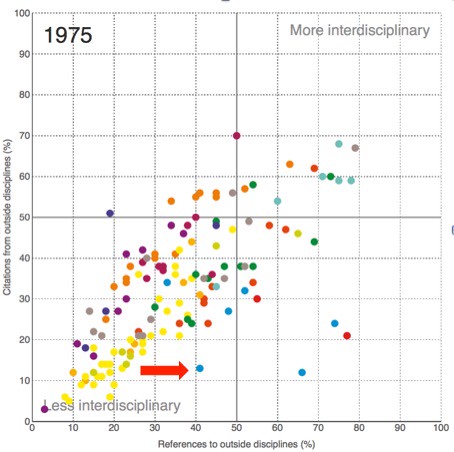
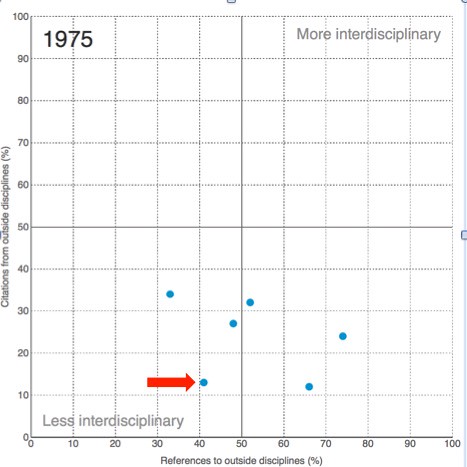
The study has a number of aspects, one of which is citation practices: How often does a discipline cite articles outside the discipline? How often are articles in a discipline cited by articles outside the discipline? This is depicted in an interactive graph that shows all 143 specialties from 1950 to 2014. Literature doesn’t even show up as an independent specialty until 1975.

This chart shows all specialties for 1975. Humanities disciplines are light blue; the red arrow points to literature:

1975 all

The horizontal axis runs, left to right, from few citations going outside the home discipline to many citations going outside the home discipline. Articles in those disciplines left of center, such as literature, are citing more sources within the discipline than outside it. The vertical axis runs, bottom to top, from a low percentage of citations coming from outside the discipline to many citations coming from outside the discipline. Articles in those disciplines below the center, such as literature, thus receive fewer of their citations from outside the discipline.

This chart shows 1975, but only with humanities disciplines. Again, the red arrow points at literature:

1975 hum

Thursday, January 19, 2017

What? The Humanities Center WON'T be closed!

What? The Humanities Center, NOT closed? I didn't even know it had been threatened with closure.

The Humanities Center in question is, of course, the one at Johns Hopkins, where I did my undergraduate work. This is the Humanities Center that launched a thousand chattering Frenchmen into orbit. Well, not exactly. But in 1966, its inaugural year, the Humanities Center sponsored the symposium on structuralism that now, for better or worse, serves as the notional inflection point for the revolution in literary criticism that had become Theory two decades later.

I found out about its non-closure when I visited the site of my alumni magazine and read: "An interdisciplinary committee tasked with making recommendations about the future of Johns Hopkins University's Humanities Center has advised against closing the half-century-old academic center—a possibility that had prompted protests on campus and from alumni." The article didn't even mention Dick Macksey, who ran it for years and who was my undergraduate mentor. That absence strikes me as being a bit conspicuous, but I'm not really in touch with things at Hopkins. I was there 50 years ago, a different world, lots has changed, Macksey gave up the directorship years ago and has now been retired from the full-time faculty for a few years.

One thing that hasn't changed, though, is the fact that "interdisciplinary" work functions mostly as a beacon off there in the distance, beckoning us to a better future, rather than as a source of light in the present. I was only a sophomore when the Center was founded and its mission struck me as common sense. But then, what did I know? I was only a sophomore. I actually expected the academy to change. When I left Hopkins I went to the English Department at SUNY Buffalo, which was all but a small liberal arts college unto itself and apprenticed myself to David Hays in linguistics, who taught a course, "Linguistics as a Focus of Intellectual Integration." Disciplinary myopia never appealed to me  – one reason, no doubt, the academy eventually extruded me.

What I'd like to know is why these folks keep yammering about interdisciplinarity as a Good Thing when they clearly do not mean it. Is the institutional purpose of these humanities centers mostly to serve as a credible threat to the departments? If you don't toe the line, we'll dissolve you – something like that.

In any event, I suppose it's a good thing that Hopkins isn't closing the old Humanities Center. That gives them two interdisciplinary humanities centers, as they established a new one last year, The Alexander Grass Humanities Institute. No doubt the administration intends to play them off against one another, with the threatened closure of the ancient and venerable center of '66 as a credible threat of collapse into disciplinary monoculture if they don't toe the line.

* * * * *

See my old posts, Interdisciplinarity is the Utopian Dream of an academic culture whose time is rapidly running out, and Interdisciplinary Research.

Friday, January 13, 2017

"Renaissance man", the learned and practical traditions, and crossing social barriers

This article, alas, behind a paywall, looks interesting and important.

J. V. Field, The Unhelpful Notion of ‘Renaissance man’, Interdisciplinary Science Reviews, Volume 41, 2016 - Issue 2-3: Some Significances of the Two Cultures Debate, pp. 188-201.

Abstract: The current journalistic use of the term ‘Renaissance man’ to describe someone whose work straddles boundaries between today's specialisms is a hindrance to understanding almost any aspect of the culture of the Renaissance — a culture within which both ‘art’ and ‘science’ had meanings different from those they have now, the most significant intellectual division being between the learned and the practical traditions. We look first at the learned tradition of the universities (where teaching was in Latin). The people considered include William Harvey, Johannes Kepler, Galileo Galilei, Nicolaus Copernicus, Regiomontanus and (very briefly) Isaac Newton. Within the practical tradition, centred on workshops, we consider the state shipyards in Venice (where Galileo claimed to have learned much), workshop practices in general and the emergence of the notion of ‘Fine Arts’. The individuals considered include Piero della Francesca, Leonardo da Vinci, Michelangelo Buonarroti and Raphael, as well as the famous clockmaker Jost Bürgi (who taught Kepler about algebra). We conclude by considering the transfer of skills between these two traditions. There are several areas of overlap, but here we concentrate attention on the story of algebra. Algebra was invented by al-Khwarizmi (whose name gives us the term ‘algorithm’) in the ninth century, within learned mathematics, in Baghdad. In the West, elementary algebra, derived from al-Khwarizmi's work but in the simplified form of problems, became part of ‘practical mathematics’. Slowly, from the fifteenth to the eighteenth centuries, developed forms of algebra crossed over into the learned tradition. This is as much a matter of crossing social barriers as of crossing intellectual ones. Eventually, the practical tradition as a whole became absorbed as an elementary part of the learned one.

Monday, July 11, 2016

The Humanities? What’s That? (w/ a look at Pamela Fletcher in LARB)

I don’t know when I first heard about “the humanities,” perhaps college, but maybe before. But if before, well, the phrase wasn’t meaningful until college, and after. And ever after it’s been a burden, always in crisis and, always: Am I a humanist or not? Of course I’m not talking about the humanities as in humanism, such as “Renaissance humanism” – from the dictionary: “an outlook or system of thought attaching prime importance to human rather than divine or supernatural matters.” I’m talking about a group of academic disciplines (philosophy, literature, history, etc.) or perhaps – and here things begin to get murky – a way of approaching the subject matter within those disciplines.

For one can approach literature and art as a psychologist. And philosophy departments harbor experts in symbolic logic, which looks and feels an awful lot math. Come to think of it, I used a philosophy course in logic to fulfill the math requirement for my B.A.

My problem, you see, is that while I study literary texts and films, I’ve spent an awful lot of time looking at them through cognitive psychology, neuroscience, and computational linguistics. And then there’s all those diagrams I use (and love). They just break the discursive flow, yet often they carry the argument.

And speaking of diagrams, what about all those charts and graphs that turn up in computational criticism (aka “distant reading”)? They may be about literary texts, but they come out of computers and statistics and data munging. Humanities?
I think not! 
And just who, may I ask, are you?
Could it been that 19th century disciplinary categories don’t fit 21st century conceptual practices and possibilities? Just what ARE the humanities NOW?

And that brings me to Melissa Dinsman’s interview with Pamela Fletcher in her excellent series at the Los Angeles Review of Books. Fletcher casts doubt on the category, “the humanities,” though not necessarily in the way I have just been doing. Here’s some remarks from the interview.

* * * * *

What is it about a liberal arts college (or Bowdoin specifically) that makes “digital humanities” an unproductive or not very meaningful label?

Your question gives me pause, and makes me wonder if this is really a good description of liberal arts colleges, or even of Bowdoin, or if it is just my own perspective. I should say that many liberal arts colleges (Hamilton comes to mind) have used the Digital Humanities category very productively, and my own colleagues at Bowdoin have put together a course cluster on that topic. I guess what I meant is that we are such a small — and collegial — place that limiting our conversations about digital and computational work to scholars in the humanities ultimately seemed limiting. And students simply do not divide themselves into those categories: there are plenty of art history majors who double major in physics or biology. And probably even more of the students in my class — or any humanities class — are also fully immersed in work across the curriculum no matter what their major might be. So that particular way of dividing human knowledge into three broad categories — humanities, natural sciences, social sciences — just doesn’t map onto my experience of liberal arts very well.

Tuesday, May 17, 2016

For the Historical Record: Cog Sci and Lit Theory, A Chronology

Another reprint from The Valve, though slightly revised. I'm bumping this to the top of the queue in view of this interesting post in which Scott Enderle meditates on loose conjunctions between perceptrons, post-structuralist thought, and data mining.
Back in the ancient days of the Theory's Empire event at The Valve I contributed a comment paralleling the rise of Theory with that of cognitive science. That parallel seems - at least to me - of general interest. So I decided to dig it out from that conversation and present it here, in lightly edited form. The parallel I present does not reflect extensive scholarship on my part, no digging in the historical archives, etc. Rather, it is an off-the-top-of-my-head sketch of the multifaceted intellectual milieu in which I have lived much of my intellectual life.

I take 1957 as a basic reference point. That's when Northrop Frye published his Anatomy and that's when Noam Chomsky published Syntactic Structures. 1957 is also when the Russians launched Sputnik, the first artificial satellite to circle the globe. The Cold War was in full swing at that time and Sputnik triggered off a deep wave of tech anxiety and tech envy in America. One consequence was more federal money going into the university system and a move to get more high school students into college. So we see an expansion of college and university enrollments through the 60s and an expansion of the professorate to accommodate. Cognitive science (especially its AI side) and, perhaps to a lesser extent, Theory rode in on this wave. By the time the federal money began contracting in the early 70s an initial generation of cognitivists and Theorists was becoming tenured in, and others were in the graduate school and junior faculty pipe-line. Of course, the colleges and universities couldn't simply halt the expansion once the money began to dry up. These things have inertia.

We may take cognitive science for granted now, but the fact is that there are precious few cognitive science departments. There are some, but mostly we've got interdisciplinary programs pulling faculty from various departments. These programs grant PhDs by proxy; you get your degree in a traditional department but are entitled to wear a cog sci gold seal on your forehead. As Jerry Fodor remarked somewhere (I forget where) in the last year or three, most cognitive psychologists don't practice cognitive science. They do something else, something that most likely was in place before cognitive science came on the scene.

Friday, September 18, 2015

Interdisciplinary Research

Nature has a special set of articles devoted to interdisciplinarity (16 Septermber 2015). Ii've offer excerpts and comments on two of the articles.

INTERDISCIPLINARY RESEARCH IS ON THE RISE

Since the mid-1980s, research papers have increasingly cited work outside their own disciplines. The analysis shown here used journal names to assign more than 35 million papers in the Web of Science to 14 major conventional disciplines (such as biology or physics) and 143 specialities. The fraction of paper references that point to work in other disciplines is increasing in both the natural and the social sciences. The fraction that points to another speciality in the same discipline (for example, a genetics paper pointing to zoology) shows a slight decline.
Judging from the graphs, in the social sciences 40% of the papers referenced other disciplines in 1950, dropping to 33% in the early 1970s, and then rising to just below 50% in 2010.
INTERDISCIPLINARY RESEARCH TAKES TIME TO HAVE AN IMPACT

Whether interdisciplinary research gains more citations than disciplinary research is contentious. Over three years, papers with diverse references tend to pick up fewer citations than the norm, but over 13 years they gain more. Some studies suggest that a little interdisciplinarity is better than a lot: papers that combine very disparate fields tend to earn fewer citations. But interdisciplinary work can have broad societal and economic impacts that are not captured by citations.
Perhaps the most interesting feature of the article is an intereactive chart that allows you to explore the interdisciplinary tendencies of various disciplines between 1950 and 2014. Each disciplinary area is represented on a graph where the X axis indicates how percentage of references to outside disciplines while the Y axis represents citations from outside disciplines. This chart is worth exploring.

Literature doesn't show up as a recognizeable area until about 1975, w/ 41% references to other disciplines and 13% citations from outside. By 1990 references to outside have dropped to 23% while citations from outside have risen to 21%. In 2010 literature has 37% references out and 29% citations from outside. Compared to other humanities disciplines (religion, language and linguistics, philosophy, history, and miscellaneous), literary studies is a bit more insular, both in its citation practices and in citations received.

* * * * *

Sunday, December 7, 2014

Beyond Interdisciplinarity #2: The Seven Liberal Arts Aren't Disciplines Either

For reasons I can’t quite articulate, I remain convinced that INTERDISCIPLINARITY is a lost cause. It’s the utopian desire of disciplinarity, whatever that is, and its pursuit can only lead to the reinforcement of disciplinarity. The fact is, I NEVER sought to be interdisciplinary. And I’ve never really thought of myself as crossing boundaries or being particularly daring in that respect. I’ve just been trying to get the job done.

But the job had NEVER been defined in disciplinary terms. And, for that matter, I doubt that any intellectual task within a discipline is so defined either. The only thing that’s defined in disciplinary terms is policing the boundaries.

But where do those boundaries come from in the first place? Yeah, sure, they come from an ontology. What’s the principle behind THAT ontology? Because I’m operating from a different principle, whatever it is.

And, sure, we’ve got an institutional problem. We’ve defined our institutional org structure in terms of disciplines. But that disciplinary structure came first. And it’s got to go. It’s not a matter of new disciplines, nor of getting rid of disciplines. It’s a matter of SOMETHING ELSE that simply WALKS AWAY from disciplines.

* * * * *

Clue #1: Why have biophysics and psycholinguistics worked, while semiotics and systems theory haven’t?

Tuesday, November 25, 2014

Policy, Strategy, Tactics: Intellectual Integration in the Human Sciences, An Approach for a New Era

Roughly three decades ago, in my final year on the faculty at the Rensselaer Polytechnic Institute, I participated in an exercise to rethink the School of Humanities and Social Sciences. I took that as an opportunity to, you know, actually rethink how education was done. So I designed a modular approach to structuring an introductory interdisciplinary course in the humanities and social sciences.

At that time online learning didn't exist. But the modular approach I developed back then could certainly be applied to connected learning and co-learning could certainly be incorporated into course design as well. It is in that spirit that I direct you to that document, Policy, Strategy, Tactics: Intellectual Integration in the Human Sciences, An Approach for a New Era. I've appended the 21st century introduction I wrote for that 20th century document.

* * * * *

Remarks from the 21st Century

My first and only faculty appointed was in the Department of Language, Literature, and Communication at the Rensselaer Polytechnic Institute in Troy, New York, a very good engineering school, the oldest in the country. During the summer of 1985 the school of Humanities and Social Sciences embarked on one of those periodic soul-searching exercises academic units undertake in order to revitalize their mission and–hope! hope!–increase the budget. Accordingly, the school offered a number of faculty small stipends to develop innovative brand-spanking new courses that they would present at a faculty retreat.

I took one of those stipends despite the fact that I would not be returning in the Fall and developed, not a course, but an approach to curriculum design which is camouflaged as a strategy for designing a large lecture-based introductory course. I understand that such courses have been getting a bad rap, and I even understand why, I think. Nonetheless if I had to do it again in this new millennium I would. But that’s neither here nor there.

What’s important is the method I used. It’s a method that could be used in designing any course in the human sciences whatsoever, though its interdisciplinary nature is particularly suited to the large introductory course as that’s the kind of course the could most readily command the participation of faculty from a half-dozen or more disciplines. But the method could also be used in planning a suite of modules to be offered online and which individual students could organize into individualized programs that nonetheless met a coherent set of overall curricular goals.

The scheme is designed to organize materials according to three high-level criteria:
  • interpretive (hermeneutic), social and behavioral scientific, and structural (in the style of linguistics) approaches are all represented,
  • historical (diachronic) and structural/functional (synchronic) approaches are represented,
  • material from other, preferably non-Western, cultures is presented.
Thus each module would employ either an interpretive, a social scientific, or a structural methodology and would be either historical or structural/functional in character. A student’s suite of modules would have to represent each of the three methodological styles, include both diachronic and functional topics and include materials from a range of different cultures.

This, I know, is all rather abstract. But I flesh it out in the full report by designing two versions of a course, Signs and Symbols, having 12 modules. I call one-version of the course “top-down” because it is organized in a fairly conventional way as a selection of different topics under the general rubric of sign systems and communications. That is, it proceeds from some conception of how knowledge is structured and generates topics from that, top-down. Obviously there are a zillion ways of designing such a course and no double half of them have already been offered at one time or another. What’s important is the overall distribution of topics, not the specific topics themselves.

The other version of the course is rather different. I selected a specific text, Shakespeare’s Romeo and Juliet, and generated the 12 modules from that text. The modules are somewhat different from those in the top-down version of the course but they satisfy the same distribution requirements, covering the three methodologies (interpretive, social scientific, structural), both diachronic and functional topics, and a variety of cultures. Were I to redesign that course today I’d be inclined to swap Disney’s Fantasia for Shakespeare’s Romeo and Juliet. The collection of different topics would change, of course, but the same design criteria would be met.

Saturday, November 22, 2014

Interdisciplinarity is the Utopian Dream of an academic culture whose time is rapidly running out

I was looking around over at danah boyd’s joint, apophenia, and came across an old post: identity crisis: the curse/joy of being interdisciplinary and the future of academia. Ah yes, by all means interdisciplinary, what’s not to like?

The Romance of Interdisciplinarity

Here’s the penultimate sentence of her first paragraph: “The last big explosion was really the French scholars circling around in 1968.” Well for me the year is 1966, that’s when much the same group of French scholars landed at Johns Hopkins in Baltimore at the (in)famous structuralism conference. While I didn’t attend the conference – wouldn’t have done me any good, as I don’t speak French – I was at Hopkins at the time and one of the conference organizers, Dick Macksey – though in those days it was “Dr. Macksey” – was my mentor.

And here’s the opening sentence of boyd’s last paragraph: “So, if i think about what the next revolution in academia will be, it will have to be interdisciplinary.” But, you see, that 1966 structuralism conference was sponsored by Ford Foundation money and that money was specifically interested in interdisciplinarity. That’s what that conference was about. And that’s what the newly-founded Humanities Center, which hosted those Frenchmen, was about.

How is it, then, that forty years after that conference danah boyd is looking to the ever-lovin’ future for interdisciplinarity? If interdisciplinarity really was the future, as seen from 1966, why is it still the future, both in 2005 (when boyd published that post) and even near the end of 2014 as I sit here at 6AM writing this post?
Question: What happened to the interdisciplinary future?

Answer: It’s floated down the river Styx into the 19th century past.
There has in fact been a great deal of interdisciplinary work since 1966, but it’s just not reflected in the names of academic departments. What you have are interdisciplinary centers of all kinds. Each draws on faculty from several departments and picks up funding wherever spare change drops off departmental tables here and there. But these “centers” don’t have the power to confer degrees. That power still remains with the academic departments, and they’re a legacy of 19th century academia.

What we have, then, is departments that are still committed to traditional avenues of investigation and still, for the most part, cranking out scholars most of whom see little choice but to color within those lines. But you also have folks like boyd, or Mark Changizi, or even a Steven Pinker who don’t play by those rules and consequently are frustrated. Boyd’s not in academia – or only marginally so – Changizi left a couple of years ago; and Pinker spends half his time writing for the general educated public.

Of course, boyd knows this.

Saturday, September 14, 2013

Interdisciplinary work must be, well, interdisciplinary

This is an excerpt from a comment I made at the current Language Log discussion of computational linguistics and literary scholarship:

Some time ago, in connection with curriculum design, I took a look at the human sciences and concluded that there were roughly three broad conceptual styles: 1) qualitative: interpretive/hermeneutic and narrative, 2) behavioral or social scientific, with an emphasis on statistically controlled observations, and 3) structural/constructive: linguistics, cognitive science, where the idea is to construct a grammar or machine that generates the observed behavior. The humanities concentrate on the first and almost all interdisciplinary work in the humanities is confined to qualitative disciplines. Thus literature and psychology is mostly qualitative psychology. Classically, if I may, that's Freud or Jung. More recently there's been interest in cognitive science, but almost entirely on the qualitative side of work with cognitive metaphor, conceptual blending, other minds, and such. All of the interdisciplinary work associated with Theory, so-called, is qualitative.

But NLP (natural language processing, a branch of CL (computational linguistics)) is in the other two camps. The data gathering, preparation, and analysis is statistical; but there is, I believe, an underlying motivation in the structural/constructive camp. Working across the boundary between the qualitative methods of traditional humanities and the more mechanistic methods in the other two camps is much harder. That will require cooperation between researchers, some of whom have internalized qualitative methods, while others have internalized mechanistic methods. Getting that discourse up and running, that's where the real excitement and deep intellectual potential lies.

Wednesday, November 28, 2012

Academic Publishing, A Personal History, Part 2: To the Blogosphere and Beyond

Rather than pick up the story of my involvement in academic publishing where I left off in the first post, in 2006 or so after having published several long articles in PsyArt, I want to go back to the 1990s and pick up some email action. That was quite important, both for the conversations, and the people I met through those conversations. It remains an important part of my digital mix, though not so important in the overall flow of things.

Listserves: Memetics and Evolutionary Psych

Judging from the email I’ve got stashed on my computer, I joined a memetics listserve in the middle of 1997. As you may know memetics is the study of memes. I don’t know who coined the term “memetics” but Richard Dawkins coined the term “meme” as the cultural analogy to the biological gene. As I was and remain very interested in cultural evolution it was natural that I join that listserve.

An email list is not, of course, a formal means of academic publication nor is it even informal publication comparable to blogging. It’s a conversation, or can be, but not like face-to-face or telephone. On a listserve you typically have many people who receive messages but do not themselves make comments. And that means that, when you do make a comment to the list, you have no idea what most of your audience is thinking—which, of course, is just like ordinary print publication or, for that matter, digital publication as well. But the overall dynamic is one of interaction, so you and your interlocutors are, in effect, putting on a show for an undisclosed population of lurkers. Listserve conversation are also notorious for degenerating into flame wars, but that’s neither here nor there for the purposes of this post. It’s just something that happens.

But you can also have useful conversations. The memetics list gave me a good sense of the state of play in the memetics world, which is a peculiar one. Though the idea was hatched by a card-carrying academic of high order, Richard Dawkins, and has a small following in the academy (e.g. Daniel Dennett among others), it hadn’t gained traction in the academy back then—the late 1990s—and still hasn’t. Perhaps it’s a superb idea that’s just too “out there” for hide-bound academics, or perhaps it’s not such a good idea. Myself, I’m somewhere between those two views.

Monday, November 19, 2012

Policy, Strategy, Tactics: Intellectual Integration in the Human Sciences, an Approach for a New Era

This is the introduction to a report that I've placed at my SSRN page. You may download the PDF there: http://ssrn.com/abstract=2177965
Abstract: The human sciences encompass a wide variety of disciplines: literary studies, musicology, art history, anthropology (cultural and physical), psychology (perceptual, cognitive, evolutionary, Freudian, etc.), sociology, political science, economics, history, cultural geography, and so forth. In this paper I process to organize courses and curricula aso as to include: 1) material from three different methodological styles (interpretive, behavioral or social scientific, and structural/constructive: linguistics, cognitive science), 2) historical and structural/functional approaches, and 3) materials from diverse cultures. The overall scheme is exemplified by two versions of a course on Signs and Symbols, one organized around a Shakespeare play and the other organized around traditional disciplines.
My first and only faculty appointed was in the Department of Language, Literature, and Communication at the Rensselaer Polytechnic Institute in Troy, New York, a very good engineering school, the oldest in the country. During the summer of 1985 the school of Humanities and Social Sciences embarked on one of those periodic soul-searching exercises academic units undertake in order to revitalize their mission and–hope! hope!–increase the budget. Accordingly, the school offered a number of faculty small stipends to develop innovative brand-spanking new courses which they would present at a faculty retreat.

I took one of those grants despite the fact that I would not be returning in the Fall and developed, not a course, but an approach to curriculum design which is camouflaged as a strategy for designing a large lecture-based introductory course. I understand that such courses have been getting a bad rap, and I even understand why, I think. Nonetheless if I had to do it again in this new millennium I would. But that’s neither here nor there.

What’s important is the method I used. It’s a method that could be used in designing any course in the human sciences whatsoever, though its interdisciplinary nature is particularly suited to the large introductory course as that’s the kind of course the could most readily command the participation of faculty from a half-dozen or more disciplines. But the method could also be used in planning a suite of modules to be offered online and which individual students could organize into individualized programs that nonetheless met a coherent set of overall curricular goals.

Friday, October 28, 2011

Seven Sacred Words: An Open Letter to Steven Pinker

Back in 2007 Pinker was touring to promote The Stuff of Thought. I heard him at a Barnes and Noble in Manhattan and, as I explain below, decided to elaborate some of his remarks into an account of why we tell stories. I put that account into a letter and added some remarks on the recent history of literary criticism (starting with the 1966 structuralism conference at Johns Hopkins) with a view to helping him understand why it wasn't the work of willful fugitives from rationality. I then posted the letter to The Valve and sent Pinker a link. He responded with a brief note, and gave me permission to publish it, which I did. Note that he expresses despair at the fate of interdisciplinary work in the university. I wonder if he's changed his mind on the score?

I'm now republshing both my original letter and Pinker's reply.
Last Friday I went to hear Steven Pinker speak about his new book, The Stuff of Thought. On the way home I began thinking about that talk and about his recent essay-review of The Literary Animal (PDF). In that review he expressed deep skepticism about various suggestions that have been made about how and why the arts are biologically adaptive. He pointed out that such an account “can't be a kind of psychology; it must be a kind of engineering - an attempt to lay down the design specs of a system that can accomplish a goal (specifically, a subgoal of reproduction) in a particular world (specifically, the ancestral environment)” (170). It seemed to me that his talk contained the seeds of just such an account of literature, though he doesn't appear to have had that in mind.

I decided to write him a note and email it to him. As I began to think about it, however, the note, like Topsy, just grew and grew. I then decided it made more sense to publish it as an open letter. Here's a downloadable version, with several new attachments: An Open Letter to Steven Pinker: The Importance of Stories and the Nature of Literary Criticism.

* * * * *
Dear Steven,

First, I'd like to reiterate how much I enjoyed your talk at Barnes and Noble last Friday. I must confess, however, that I suspect that you wrote The Stuff of Thought primarily so you had good reason to tour around saying George Carlin's seven words - and their many variants and synonyms - in public places surrounded by mixed company.

More seriously, as I was riding the subway home, I began to think that, between the cuss-words portion of your talk and the last, on language and social relations, you had the seeds of an account of why we tell stories. Not just any stories, however, but only those particular stories one finds in the literary and sacred traditions of all cultures. The purpose of those stories is to create mutual knowledge of fundamental matters that are otherwise difficult to talk about, either because they are taboo - as in the excretory, sexual, and sacred things you talked about - or because they are difficult to verbalize under any circumstances. But I'm getting a little ahead of myself, as that's not how my thinking began.

I began by wondering whether or not a story told in a public setting - similar to your talk, for example - constitutes shared knowledge or mutual knowledge. It is certainly shared knowledge, as everyone present now knows the story. But does that make it mutual in your sense? As I understand it, where knowledge is held mutually among people, not only is the knowledge shared but, additionally, everyone knows that everyone else knows.