Showing posts with label psychoanalysis. Show all posts

Tuesday, June 2, 2026

Splash! [Media Notes 183]

I’m pretty sure that I saw Splash when it appeared in theaters in 1984 but I certainly didn’t imagine that it would popularize “Madison” as a name for girls. The Wikipedia entry notes:

According to the Social Security Administration, the name Madison was the 216th most popular name in the United States for girls in 1990, the 29th most popular name for girls in 1995, and the third most popular name for girls in 2000. In 2005, the name cracked the top 50 most popular girls' names in the United Kingdom, and articles in British newspapers credit the film for the popularization.

In the movie “Madison” is the name taken by a mermaid, played by Daryh Hannah, when she emerges on land to attach herself to a forlorn Allen Bauer, played by Tom Hanks.

The first 10, 15, 20 minutes or so of the movie are about how this situation comes about, but let’s just take that as a given. This is a story about how a human male and a female mermaid meet, fall in love, and, why not? I’ll give the ending away. They swim away to, presumably, live happily ever after, under the sea.

I’m interested in the elaborate contraption that’s constructed around them. As far as I can tell that contraption exists to conceal an interpersonal problem that’s been kicking around for a long time, one identified by Sigmund Freud (e.g. ”A Special Type of Choice of Object made by Men,” 1910), played out on stage by William Shakespeare [1], and that’s been kicking around in stories and poems since forever: Men have trouble dealing with the fact that women can be both sexual and loving, passionate and beloved. Splash deals with this by presenting us with a creature that’s both human and not human (i.e. a mermaid).

Young Allen Bauer is despondent because his girlfriend’s just moved out without giving any him any inkling that she was going to do that. He just wants a woman he can love and marry and be happy with. That’s all he wants. True Romance.

And then this woman shows up. We know she’s really mermaid, but he doesn’t. He picks her up at the police station – I know, you want to know how that came about, but it doesn’t really matter, it’s just staging – takes her home and she goes to bed with him. Simple as that. No teasing or pleading, nothing resembling courtship. Just what happened in there, we get to imagine whatever we wish. But we do see her waken in the middle of the night, fill a bathtub with salt water and then luxuriate in it, tail and all. Allen then wakes up a follows her to that bathroom. He knocks on the door, wants to see her, but she tells him to keep out. He breaks down the door and she has barely enough time to transition back to human form.

I mean, she’s really a mermaid! And she’s only got six more days, until the full moon, and then she’s got to return home. But she doesn’t tell Allen where home is or what she is. But she does take the name “Madison.”

Then things get complicated, and painful – in several senses. I was all but squirming as I watched how Madison was treated in the laboratory. Allen isn’t the only man involved. There’s a bizarre scientist, Walter Kornbluth, who gets wind of all this and realizes, “Ah hah! I’ll bet she’s really a mermaid.” He’s seen her before. Don’t ask. He manages to douse her with water, at a dinner for the President of the USA (don’t ask), and she’s taken by Kornbluth’s rival scientist, locked up in a lab, and subjected to tests. When Kornbluth learns that she’s going to be dissected the next day, he decides to spring her and return her to Allen.

By this time Allen knows that he’s slept with and is in love with a mermaid. Now what? Well, she’s got to return to the sea or she’ll die. If he’s willing to leave with her and never return to dry land, that can happen. He decides, no. She dives into the water and starts swimming away. He changes his mind, jumps in after her, and they swim away as the credits role.

And this point you may be thinking: “That’s crazy.” I know, and it’s even crazier. Read the Wikipedia plot summary (linked above), you’ll see. My point is that this elaborate contraption is a way of dealing with that problem that Freud named and analyzed, that men have this split image of women as both mothers and whores (if you will). Splash transforms that duality into humans and mermaids and erects an elaborate fantastical contraption to deal with it.

Given that you accept all that, I’ve got one problem with the movie. Allen should have stayed on the pier and let the mermaid go. That wouldn’t have given the audience the feel-good ending for which a movie like this is concocted, but it would have been a minimal way of acknowledging the preposterous nature of it all.

* * * * *

ADDENDUM [a day later]: Some things were bugging me, so I watched it again.

In the prelude, Allen, his parents, and his brother are on a boat tour off Cape Cod. His older brother Freddie is dropping coins on the deck near women so he can look up their skirts as he retrieves the coins. Allen is entranced by the water. He jumps in. Pandemonium on the boat.

He meets a young girl. They hold hands. He’s retrieved. She’s sad to see him leave. We see that she’s a mermaid.

One the one hand it adds little or nothing to the plot. But it establishes that Allen has established some kind of link with this mermaid during his preadolescent childhood and the contrast between his behavior and that of his older brother reinforces our sense of the innocence of that link. Note that this kind of childhood link occurs in a number of anime series, though I can’t recall any title names off the top of my head.

Then the movie abruptly shifts ahead to the present, where Allen is being hassled by a customer at the family’s produce business. Freddie comes wheeling in in his sports care and is ecstatic because Penthouse magazine printed his letter.

This and that, Allen’s drunk over his girlfriend leaving, so decides to go to Cape Cod, where he met that girl/mermaid when he was eight, Now we see the crazy scientist...this that that other & Allen’s bonked in the head by a rogue motorboat, he sinks...and then next we see him he’s lying on the beach. An adult mermaid is watching him. He speaks to her, she’s naked. She walks up to him and kisses him, and then she disappears into the sea. We see her swimming under water and she no longer has legs; she’s got a fishtail. And she’s spotted by that crazy scientist.

She finds Allen’s wallet, looks at the papers, swims to a wreck, finds a chart....and we’re back in Manhattan. Allan’s head is bandaged....naked mermaid at the Statue of Liberty...she’s arrested. He picks her up at the police station. He’s transfixed when he sees her. She kisses him. She’s all over him and he doesn’t (quite) know how to deal with her. He tries to leave for work. But returns and grapples with her. He leaves for work. She learns English from watching TV. Decides to go shopping.

And so forth and so on. I could go on and on with this, but this will have to do....for now.

* * * * *

[1] I analyze this dynamic in some detail in my essay, At the Edge of the Modern, or Why is Prospero Shakespeare's Greatest Creation? Journal of Social and Evolutionary Systems 21(3): 259-279, 1998, https://www.academia.edu/235334/At_the_Edge_of_the_Modern_or_Why_is_Prospero_Shakespeares_Greatest_Creation

Friday, November 29, 2024

More Cobra Kai: Freud, Girard, and History [Media Notes 143b]

I wanted to follow up on my earlier post about Cobra Kai. Here’s my point of departure:

So, what do we have? A conflict between two teenage boys gets reignited in their early middle age where it becomes amplified into a war for dominance of the karate world. On the one hand, it is rather ridiculous, adults using their dojos as vehicles for working out their conflicts. How Freudian! [Indeed. Think about that for a minute, think about it very seriously.] The series is aware of this and indicates that awareness in various ways.

Freud was interested in how our early life influenced, strongly influenced, our behavior as adults. His theory of psychosexual development placed a lot of emphasis on the early years, especially the first six years, but also – but also of course, especially of course – dealt with the emergence of sexuality in puberty.

Cobra Kai centers on Johnny Lawrence and Daniel LaRusso, but their story originates in their middle-to-late adolescence in The Karate Kid and its sequels. That’s a bit late for the really deep Freudian stuff to kick in, but the causal dynamic is nonetheless clear and Freudian in kind. The attitudes, feelings, and actions of these middle-age adult men follow patterns set in place in their adolescence. Not only are we told about this past, but we see scenes from the early films.

But the Freudian dynamic goes deeper than that. For it also explores the earlier life of the men who taught Lawrence and LaRusso, John Kreese and Mr. Miyagi respectively. We see scenes from Kreese’s experience during the Vietnam War and before and are led to understand how they have made him the bitter man he is today. LaRusso travels to Okinawa and learns things about Miyagi that he hadn’t known, including something about his early experience with competitive karate the full nature of which has yet to be revealed (we’re two-thirds of the way into the final season). Moreover, when Terry Silver is brought into the film, another bad guy from the past, we learn more about the origins of the Cobra Kai school of karate, strengthening the shows depiction of the pull of the past.

Cobra Kai is also shot through with mimetic desire and sacrifice. The original conflict between LaRusso and Lawrence centers on a mimetic conflict over a woman, Lawrence’s ex-girlfriend who becomes attracted to LaRusso. In the present, LaRusso’s decision to start a dojo is a mimetic answer to Lawrence starting a new Cobra Kai studio – notice that it is that form of karate which gives the series its name. And mimetic dynamics play out in the relationships among the teenagers at the center of the series, LaRusso’s daughter, Samantha, Lawrence’s son, Robby, and his young protégé, Miguel, and a young Cobra Kai student, Tory Nichols.

The sacrifice dynamic is a bit trickier, but the series features a number of karate tournaments and a number of gang battles between the rival dojos. Kenny Payne and “Stingray,” among others, emerge as sacrificial victims in those battles, and then we have the grand melee that ends episode ten on the sixth season. This takes place the Sekai Taikai, an international karate tournament to determine, in effect, the dojo of dojos and anoint the best karate style. The tournament breaks down in a free-for-all battle involving, not only the karate students, but their teachers as well. [Spoiler alert] The battle comes to a dramatic end when one of the student fighters, Kwon, a particularly arrogant fighter, accidentally kills himself with a knife he’d picked up off the floor. The knife had been dropped by Kreese, who’d intended to kill Silver. We’ll have to wait until February to find out what happens next.

Think of the scope covered in the series: from Vietnam, Okinawa, Korea, and America in the mid 20th century through to an international tournament three decades into the middle of the 21sr century. That’s a big chunk of recent history, albeit centered on actions involving only a group of individuals. No nation-states take part in the conflict. This is no War and Peace, but it is, nonetheless history, and it is history displayed in patterns analyzed by Freud and Girard.

Thursday, March 14, 2024

First Knight [Media Notes 115]

Watched it over two sessions on the previous two days. First Knight (1995) is yet another retelling of the King Arthur story. Sean Connery is a middle-aged-growing-old Arthur of Camelot. Julia Ormond is a young-enough-to-be-his-daughter Guinevere of Lyonese. and Richard Gere is a handsome young Lancelot. In a departure from tradition, however, this Lancelot is not born an aristocratic knight. Instead, he’s a ronin warrior, one of the original free-lances, a hired gun (so to speak), of a murky background. Ben “Chariots of Fire” Cross is the evil Malagant, rogue fugitive from the Knights of the Round Table.

I’ll give you the whole Wikipedia plot summary because you need to know the whole sorry story and I don’t want to waste keystrokes making up my own summary:

King Arthur of Camelot, victorious from his wars, has dedicated his reign to promoting justice and peace and now wishes to marry. However, Malagant, a former Knight of the Round Table, desires the throne for himself.

Lancelot, a vagabond and skilled swordsman, duels in small villages for money. He attributes his skill to his lack of concern whether he lives or dies. Guinevere the young ruler of Lyonesse, decides to marry King Arthur out of admiration and for security against Malagant, who has been raiding local villages under the guise of "upholding the law."

While traveling, Lancelot chances by Guinevere's carriage on the way to Camelot, and spoils Malagant's ambush meant to kidnap her. He falls in love with her, but she refuses his advances. Though Lancelot urges Guinevere to follow her heart, she remains bound by duty. She is subsequently reunited with her escort. Later, Lancelot arrives in Camelot and successfully navigates an obstacle course on the prospect of a kiss from Guinevere, though he instead kisses her hand. He also wins an audience with her husband-to-be, Arthur. Impressed by his courage and struck by his recklessness and freewheeling, he shows him the Round Table, symbolizing a life of service and brotherhood, and warns him that a man "who fears nothing is a man who loves nothing".

That night, Malagant's henchmen arrive at Camelot and kidnap Guinevere. She is tied up and carried off to his headquarters, where she is held hostage. Lancelot follows, posing as a messenger from Camelot. He requests to see Guinevere alive before he delivers the message, then overpowers the guards and escapes with her. Once again, Lancelot tries to win her heart, but is unsuccessful. On the return journey, it is revealed that he was orphaned and rendered homeless after bandits attacked his village, and has been wandering ever since.

In gratitude, Arthur offers Lancelot a higher calling in life as a Knight of the Round Table. Amidst the protests of the other Knights (who are suspicious of his station) and of Guinevere (who struggles with her feelings for him) he accepts and takes Malagant's place at the Table, saying he has found something to care about.

Arthur and Guinevere subsequently wed. However, a messenger from Lyonesse arrives, with news that Malagant has invaded. Arthur leads his troops to Lyonesse and successfully defeats Malagant's forces. Lancelot wins the respect of the other Knights with his prowess in battle. He also learns to embrace Arthur's philosophy, moved by the plight of villagers.

Lancelot, guilty about his feelings for the queen and loyalty to Arthur, privately announces his departure to her. Not able to bear the thought of his leaving, she finally asks him for a kiss. It turns into a passionate embrace, just in time for the king to interrupt. Though Guinevere loves both Arthur and Lancelot – albeit in different ways – they are charged with treason. The open trial in the great square of Camelot is interrupted by a surprise invasion by Malagant, ready to burn Camelot and kill Arthur if he does not swear fealty.

Instead Arthur commands his subjects to fight, and Malagant's men shoot him with crossbows. A battle ensues, and Lancelot and Malagant face off. Disarmed, Lancelot seizes Arthur's fallen sword and kills Malagant, who falls dead on that same throne he so desired. The people of Camelot win the battle, but Arthur dies of his wounds.

On his deathbed, he names Lancelot his successor and asks him to "take care of her for me" – referring to both Camelot and Guinevere. The film closes with a funeral pyre raft carrying Arthur's body floating out to sea.

What the plot summary doesn’t say is that the punishment for treason is death. Lancelot does not deny the kiss, nor does Guinevere. Good fellow that he is, Lancelot pleads with Arthur to let him take the fall. Just then Malagant saves the day by invading Camelot. Arthur is saved from having to pass sentence on his wife [daughter] and valiant warrior [romantic rival] and Guinevere gets to wed her young stud while still treasuring the memory of her father [husband].

Of course, that’s not how the story frames Malagant’s arrival. It frames it as unambiguous evil, which it is, of course. But I’m talking about the underlying psychodynamics, which is about fathers and sons and fathers and daughters and husbands and wives and how those roles are so easily mixed-up, confused, and conflated. First Knight brings the whole mess to a head, then sweeps it away through this invasion in which Arthur gets killed. Problem solved. Arthur gets a grand send-off at sea and Guinevere and Lancelot hustle off to the bedroom at Camelot.

The Wikipedia entry notes: “The film is noteworthy within Arthurian cinema for its absence of magical elements [...] and the substantial age difference between Arthur and Guinevere.” A big YES to that last. As for the first, perhaps it’s that very lack of magical elements that makes Arthur’s speechifying about the ideals of Camelot seem like pious hokum. I liked Connery much better as Danny Dravot in The Man Who Would Be King. Heck, I liked him better as Bond, James Bond, where he didn't have to mouth any nonsense, just get the bad guys and bed the ladies.

On the whole, a most peculiar film.

Thursday, August 26, 2021

The devastating effects of trauma [and the return of Freud, albeit unnamed?]

Ezra Klein, This Conversation Will Change How You Think About Trauma, NYTimes, Aug 24, 2021.

Klein interviews Bessel van der Kolk about his book, The Body Keeps the Score (2014). I've not yet read the interview, but Klein's introduction makes the book sound very Freudian without mentioning that (dreaded) name.

I’ll be honest of my own history of it here. “The Body Keeps the Score” is one of those books people have told me to read for a long time. But I thought I knew what it was about. I’d heard it discussed so many times, and I’d read it written about. So even though I hadn’t read it, I thought I knew it: trauma lodges in the body, we carry a physical imprint of our psychic wounds, it’s all very hard to heal. Got it.

But I was really wrong about that. The core argument is — I want to use the word “subversive” here. Certainly subversive in how it will leave you thinking about yourself and those around you. It is about traumatic experiences: sexual assault, incest, emotional physical abuse, war and much, much more. They can disconnect our body and our mind. That is when an experience becomes a trauma — when it disconnects us.

And this is a part I didn’t understand from the way the book is talked about. The devastating argument it makes is not that the body keeps the score, it’s that the mind hides the score from us. The mind — it hides and warps these traumatic events and our narratives about them in an effort to protect us. Human beings are social animals. And our minds evolve to manage our social relationships.

So when we face an event that could rupture our relationship with the community or the family, particularly for children of the family that we depend on, the mind often talks us out of it. It obscures the memories or convinces us our victimization was our fault or it covers the event in a shame so thick, we refuse to discuss it. But our body — and that’s an imprecise term here. But the parts of us that are more automatic that manage and respond to threat — our body doesn’t forget that. Our mind can’t talk that part of us into feeling safe again. And it’s this disconnection of mind and body where trauma lives.

From the beginning of the interview:

EZRA KLEIN: You have this very powerful line in the book from the writer Jessica Stern where she says, quote, “Some people’s lives seem to flow in a narrative. Mine had many stops and starts. That’s what trauma does — it interrupts the plot.” Tell me a bit about how trauma interrupts the plot.

BESSEL VAN DER KOLK: Well, trauma is really a wound that happens to your psyche, to your mind, to your brain. Suddenly you’re confronted with something that you are faced with horror and helplessness. That nothing prepares you for this and you go like, oh, my God. And so something switches off at that point in your mind and your brain. And the nature of trauma is that you get stuck there. So instead of remembering something unpleasant, you keep reliving something very unpleasant.

So the job of overcoming trauma is to make it into a memory where your whole being knows this happened a long time ago, it’s not happening right now. But the nature of traumatic stress is that you keep reacting emotionally and physiologically as if these events are happening right now.

More later, possibly.

Later:

EZRA KLEIN: Tell me a bit about the conditions under which an event that could be traumatic becomes a trauma. And in particular, I was very struck by how much of your research suggests that trauma is an event plus a kind of instigated social crisis. There are objectively catastrophic events, like 9/11, that were less likely to cause trauma because they were shared by the community. Where, on the other hand, things like child sexual abuse is very reliably traumatic because it disconnects you from your family. So could you talk a bit about the social structure of trauma?

BESSEL VAN DER KOLK: Yeah. So what we tend to leave out of most of our discussions about human functioning is to what degree we are primates. We have brains in order to get along with each other, to be with other people, to connect with other people. That’s really what we are fundamentally all about. And so, much of trauma is about a rupture of the safety of the people who are supposed to protect you and the people who are supposed to come to your help.

So basically, the way that we are wired is that we are wired to not be able to do everything by ourselves, but to be able to look for help and for other people to take over when we can no longer do the job ourselves. And that’s perfectly normal. But if, at that point, the people you can count on most are not there for you, let you down, have been killed, or whatever, then it’s entirely up to you. It’s a much harder thing to deal with terrible situations. [...]

And sometimes, in order to survive, you need to keep your realities [INAUDIBLE] the people around you. And so when you go through a terrible reality like 9/11 in New York or terrible natural disasters, oftentimes people get very close together because it’s out there, everybody can see it, people help each other. Part of our nature is to be altruistic and to be generous when people are in distress.

But if your feelings conflict with your loyalty — let’s say, if your own mom or dad beat you up and you don’t feel safe with them — you cannot tell other people about it either because you’re supposed to love your mom or dad. And so you need to keep it to yourself. And then it starts festering inside of you. So the reason why you do psychotherapy is mainly to help people to find words for the reality that they have dealt with. And oftentimes, those are realities that are not acceptable for the people around you. [...]

So the issue there is that we need our parents or caregivers to take care of us. And so the moment we give up on our caregivers as little kids, we’re done for. And so the way the child is wired is to stay as close to the people who are supposed to take care of them as possible. And with that, they will deny the reality of being beaten. Or the imprint is very much like, I’m being beaten or I’m being molested because I’m a bad person. I must deserve it.

So your identity becomes basically, I’m fundamentally a bad and flawed human being. And if I had been a nicer child, people would have loved me and taken care of me.

A bit later Van Der Kolk mentions John Bowlby, who was trained as a psychoanalyst:

But the great hero here is John Bowlby, attachment researcher, who really showed how children really need to cling to their caregivers and will do anything they can to keep a semblance of connection going so they don’t die or get totally abandoned. And the price they pay for that is very much this very profound sense of self loathing, oftentimes despising yourself, getting into a lot of difficult behaviors because I’m no good anyway. And it’s a deep sense of, I may as well put myself in danger, I may as well take drugs because I’m no good anyway.

Therapy:

EZRA KLEIN: We’re going to go through a bunch of these therapies. But one thing I want to ask about them as a group is that one thing lurking around your book, and certainly that I felt reading it and that I felt in my own life as I’ve looked at various modalities for things that I’ve struggled with, is that there’s a hierarchy of status to different treatments. So it’s very accepted at this point, very rational, to take a pill for depression or anxiety. Talk therapy has a very long history. Nobody looks askance at that. That’s something intellectuals do in New York, and they sit in a chair and talk about feelings. And I don’t want to say anything bad about either of those. But then you start looking some of these other things, like E.M.D.R. which we can talk about, or dance therapy or yoga. And it feels soft. You’re like, well, that’s silly, that’s holistic, that’s — and something I think the book is trying to get at is that maybe we have come to overweight certain kinds of approaches to how we feel and underweight others. So before we get into how these therapies work, can you talk about that meta level of coming to respect therapies that maybe don’t have a lot of social status right now?

BESSEL VAN DER KOLK: Very important point you make. It’s a cultural issue. You hear from my accent, I’m northern European, and North America is still very northern European. The world and northern Europe developed two ways of dealing with bad stuff. One of them was to drink. And so taking a pill is a respectable thing in Western culture to do, and normal people ingest stuff to make themselves feel better.

Nobody feels bad about it. Other places in the world may say, that’s weird. Then the other thing that Western people are very good at is talking. We’re not very good in singing together and moving together. You go to China after a disaster and people are doing qigong together, and so that’s interesting, or tai chi.

And you go to Brazil in [INAUDIBLE] area, and you see people practice capoeira. You go, are they practicing capoeria because it looks good to the tourists, or are they practicing capoeira because it does something to the way they relate to their bodies and their sense of self-control?

So I think to some degree, we are trapped in this post- alcoholic paradigm that the only way to change is through taking pills or by talking. But of course, once you raise kids and you hang around with kindergarten teachers, they don’t do a lot of talking. They’d also do a lot of singing together, and a lot of moving together, and a lot of tossing balls together. And a lot of things that help you get in tune and in rhythm with each other.

And that’s not really the strong point of Western culture. So it all depends on the cultural assumptions you have about what’s helpful to people.

EZRA KLEIN: This part of the book made an interesting connection for me. I had the journalist Anna Sale on the show a couple of months ago for her book about having difficult conversations, and something she says in that book is that we used to have more institutions, and rituals, and conventions, and structures that guided us through the hard conversations, and hard parts of life.

I mean, things like churches and civic organizations. There is a lot of singing in those places, there is a lot of dancing in those places. I mean, you go to a Jewish synagogue, a lot of singing and dancing. And one point she was making is that as some of these institutions have faded in American life, we’ve been left without a template for these conversations.

But reading your book made me think of it on another level, too. I mean, a bunch of the modalities you just talked about, like capoeira or qigong, I don’t want to suggest they don’t have therapeutic roles, but they’re not primarily seen as therapeutic. They’re just a bigger part of those cultures.

And I wonder if you think that one of the issues with trauma in America is that we have lost institutions that were comfortable with ways of being embodied, even if they didn’t frame them in a “the body keeps the score” kind of framework that we used to have. And so they were playing roles that maybe they framed themselves as religious, or civic, or something else, or communal or ritual, but they were also doing things for how we process difficult issues or allowed us to get in touch with our emotions, that they had these side benefits that we didn’t understand and never knew how to measure.

Thursday, August 17, 2017

In defense of Freud

George Prochnik reviews Frederick Crews, Freud: The Making of an Illusion, in the NYTimes. Crews, as you may know, is a literary critic who was a Freudian early in his career, but then decided that psychoanalysis was deeply mistaken. He has since devoted considerable time and effort to debunking it.

From Prochnik's review:
Here is a fascinating conundrum: The creator of a scientifically delegitimized blueprint of the human mind and of a largely discontinued psychotherapeutic discipline retains the cultural capital of history’s greatest playwright and the erstwhile Son of God.

Crews is right that the matter demands further investigation, but this is not the book he has written. Instead “Freud: The Making of an Illusion” focuses on the man — specifically how a reflective young scientist with high ambitions and gifted mentors lost perspective on his “wild hunches,” covered up his errors and created “an international cult of personality.” In practice, this translates into 700-plus pages of Freud mangling experiments, shafting loved ones, friends, teachers, colleagues, patients and ultimately, God help us, swindling humanity at large. Here we have Freud the liar, cheat, incestuous child molester, woman hater, money-worshiper, chronic plagiarizer and all-around nasty nut job. This Freud doesn’t really develop, he just builds a rap sheet.

There is value in Crews’s having synthesized the full roster of Freud’s blunders between 1884 and 1900, the period his book concentrates on. Almost all of this material has been covered before, but not compiled in one volume — and Crews has brought a new level of detail to some of these accounts.
However:
Crews is so invested in denying Freud primacy for any of the ideas associated with psychoanalysis that have retained a jot of credibility, and offers such a paucity of larger sociohistorical context for a study of this scale, that in reading his account it is easy to imagine humanity’s understanding of sexuality and psychology as such was advancing quite admirably until Freud came along and thrust us all into the lurid dungeon of his own ugly obsessions. Stefan Zweig’s account of sexual life in pre-Freud Vienna provides a different perspective: “The fear of everything physical and natural dominated the whole people, from the highest to the lowest with the violence of an actual neurosis,” Zweig wrote in his autobiography. Young women “were hermetically locked up under the control of the family, hindered in their free bodily as well as intellectual development. The young men were forced to secrecy and reticence by a morality which fundamentally no one believed or obeyed.” The cruelty of this social paradigm was equally pernicious across the Atlantic, contemporary observers noted, where New England’s code of civilized mores was often crippling for women and morbidly confusing for men.

By identifying sexual desire as a universal drive with endlessly idiosyncratic objects determined by individual experiences and memories, Freud, more than anyone, not only made it possible to see female desire as a force no less powerful or valid than male desire; he made all the variants of sexual proclivity dance along a shared erotic continuum. In doing so, Freud articulated basic conceptual premises that reduced the sway of experts who attributed diverse sexual urges to hereditary degeneration or criminal pathology. His work has allowed many people to feel less isolated and freakish in their deepest cravings and fears.
And so:
The idea that large parts of our mental life remain obscure or even entirely mysterious to us; that we benefit from attending to the influence of these depths upon our surface selves, our behaviors, language, dreams and fantasies; that we can sometimes be consumed by our childhood familial roles and even find ourselves re-enacting them as adults; that our sexuality might be as ambiguous and multifaceted as our compendious emotional beings and individual histories — these core conceits, in the forms they circulate among us, are indebted to Freud’s writings. Now that we’ve effectively expelled Freud from the therapeutic clinic, have we become less neurotic? With that baneful “illusion” gone, and with all our psychopharmaceuticals and empirically grounded cognitive therapy techniques firmly in place, can we assert that we’ve advanced toward some more rational state of mental health than that enjoyed by our forebears in the heyday of analysis? Indeed, with a commander in chief who often seems to act entirely out of the depths of a dark unconscious, we might all do better to read more, not less, of Freud.
As you may know, I continue to find psychoanalytic ideas useful, as I assert in Neural Weather, an Informal Defense of Psychoanalytic Ideas. As an undergraduate at Johns Hopkins I read John Bowlby's Attachment and Loss, Vol. 1. Attachment while it was still in typescript. I was guided in this by Mary Ainsworth, who had studied with Bowlby. In that work Bowlby began reconstructing (some) psychoanalytic ideas using ideas from systems theory (Miller, Galanter, and Pribram, Plans and the Structure of Behavior, 1960) and observations from ethology. That seemed to me to be the way to go, and still does: reconstruct the ideas in contemporary terms. That project is on-going.

Sunday, September 20, 2015

Literary Form, the Mind, and Computation: A Brief Note (Boiling It Down)

They’re intimately related. To a first approximation, the form of a literary work reflects the full economy of mental faculties working together, cooperatively and in conflict, to produce the work. It is NOT the result of some literary module that is but one mental faculty among 10s and 100s even 1000s. That form is to be understood computationally because computation is the only kind of (physical) process that organizes all those resources (‘emergently’, natch).

* * * * *

I’ve been thinking about the deficiencies, the absences, of the newer psychologies for literary study, and the corresponding poverty of abundance (so much to read! so much to do!) that shows up in the literary schools incorporating them (cognitive criticism, literary Darwinism). I’ve used the metaphor of a building, a cathedral to indicate the problem. As literary critics, we have to understanding the design of the whole cathedral and how the components function to support and realize the design. But the newer psychologies study only components, and the materials and processes for understanding them. They give us no ‘purchase’ on the whole.

Hence the paradox of poverty amid abundance. Through these newer psychologies these critics bring a whole lotta’ stuff to the table: abundance. But not what we need: poverty.

And then there’s psychoanalysis, which I’ve defended. It’s been used extensively in literary criticism, and successfully too. Psychoanalysis is, I submit, about the whole mind. And that’s why it’s been useful to literary critics. Psychoanalysis deals in fantasy, dreams, and stories, the stuff of which literature is made. It is thus commensurate with literature/literary criticism.

Psychoanalysis has pleasure and anxiety in opposition (note: anxiety, not pain). In Beethoven’s Anvil I argued that pleasure and anxiety are whole brain processes. Music dispels anxiety. So does literature.

* * * * *

Literary form is about dispelling anxiety by bringing the brain’s capacities into harmony. There can be no grammar of literary forms in the sense that there can be a grammar of language. Language is only a single, albeit complex, capacity. Literature is something else.

We can see literature’s emergent economy by comparing Coleridge’s “Kubla Khan” with his “This Lime-Tree Bower My Prison.” “Lime-Tree Bower” is a simple narrative about an afternoon’s experience. Its versification is simple. “Kubla Khan” is not a narrative, and doesn’t cohere in such a straight-forward way. It needs its complex versification – multiple meters, elaborate rhyme – to hold it together in the mind.

That’s the economy of one literary mind. I sketch it out in a working paper: STC, Poetic Form, and a Glimpse of the Mind. No grammar. Just the mind.

And its in the form that the mind is most directly manifest. It’s the form the mind regulates. And that form is computational in kind.

But what does that mean, computational? Explain that and we’re home free. Well, not free, as the intellectual expense will have been high. But we’ll be in a position to begin understanding how literature works (in) the mind.

It’s computation that weighs and balances the competing interests imperatives mental faculties. Only a metaphor at this point. But it’s the right metaphor. When the result is right – satisficing? – it feels good (like sugar and spice, now).

Jakobson’s poetic function? Is that it? For his poetic function is one of the most obscure notions that’s every strayed into literary theory: the projection of equivalence from the axis of selection to the axis of combination.

What does that mean? Is that what literary form is about? Is that what literary computation is attempting?

Questions, questions.

Thursday, June 25, 2015

Can psychoanalysis survive neuroscience? In search of transference

The NYTimes has an interesting article about research attempting to reconstruct psychoanalytic ideas with neuroscientific support.

Annealing?
While working on his Ph.D., Gerber began a research project that tried to make sense of this mysterious process. He recruited psychoanalysts to fill out an extensive weekly questionnaire, documenting what was happening inside their offices, in as much detail as possible, including patient outcomes. Over the decade it took to complete this study, Gerber saw a pattern in the patients who progressed the most. They didn’t move in a linear way from worse to better, from neurotic to not neurotic, as Gerber had supposed at the outset. Rather, roughly in the middle of their treatment, they went through a period of intense flux, oscillating between extremes of behavior, before they began to improve. Gerber uses a term from chemistry to capture what he saw: ‘‘annealing,’’ the act of heating something so that all its molecules dance around wildly and then slowly cooling it back down so that it assumes a new and more stable state.

‘‘But it also left me with a question,’’ he said. ‘‘Where do you go with this next?’’ He decided to attend medical school and in 1997 enrolled at Harvard. Throughout the 2000s, after he graduated, a spate of brain-­imaging studies was published, demonstrating that a course of psychotherapy — even without medication — had measurable, physical consequences in the brain.
Transference?
In Anderson’s joint project with Gerber and Peterson, the subjects lie in an M.R.I. machine while they are given descriptions of fictional characters. Unknown to the subjects, some characters are designed to evoke their particular significant other, in order to simulate a transference effect. Some of the descriptive language that the subjects supplied during the earlier interviews is used.

After the learning phase, the subjects are asked to remember the descriptions of all the fictional characters. The subjects tended to attribute traits to the significant-­other characters that they had not been told, but that they had earlier used to describe their own real-life significant other. […] So far, Gerber has identified areas of the brain — the left and right insula, the motor cortex and the right caudate — that react differently when subjects are learning about fictional significant-other characters instead of the other more neutral ones. With the proviso that it is still very early in the research, Gerber speculates that these brain regions, which are known to be integral to the brain’s "error circuitry," are galvanized by the effort to make sense of this partly intimate new character. She is so familiar — and yet, the brain notices, in some ways she is not. Gerber speculates that it may require more of an effort to engage with the idea of her than it does with the others.
Revising Freud in major ways?

Monday, July 21, 2014

Body and Spirit: A Story of Fathers and Sons

David Hays and I talked of many things, not all of them intellectually serious. But intellectual seriousness was at the heart of conversations between us. Discussing intellectual matters with Dave had been a part of my weekly routine since graduate school. I want to share with you an almost-idea I had wanted to discuss with Dave at about the time he went into surgery, the surgery from which he never recovered.

This idea originated in introspection, as did many of the ideas we discussed. I had wanted to discuss it with Dave, first on general principle, but second because it seemed to have some relevance to a question he had pondered for a decade or more:
How is it that seeing ballet well-performed can have such a favorable effect on a person?
One could, of course, abstract from this question a more general one about the psychological effects of aesthetic experience. It would not be unfair to say that it is this more general question that “really” interested us. However, neither of us could see any way of getting to that more general question without analyzing particular kinds of aesthetic experience. Dave was drawn to the ballet while I was more drawn to literature and music.

The line I wanted to take up with Dave was prompted by the experience I had in writing a piece called “Fore Play: A Lesson in Jivometric Drummology” (and republished at New Savanna) The piece was in the style of, say, John Barth meets Richard Pryor, or Jorge Borges meets Lord Buckley, and purported to be about how golf was created by the ancient Egyptians. It started out as a satire of then current Afrocentric scholarship demonstrating that the ancient Egyptians were black in skin and culture, that the ancient Greeks were heavily indebted to those Egyptians, and therefore that Civilization originated in Africa. I don't command the scholarly literature on this issue and don't much care about it one way or the other. But the thinkers advancing the case for a black Egypt have something more at stake than simply correcting the historical record.

And my response to that “something more at stake” was to create a historical fantasy in which black Egyptians are the creators of golf, a notion which is far afield from anything which is, so far as I know, being argued seriously. In this fantasy golf is the creation of one Pharaoh Ramses Golfotep MCXLVII of the `N Baa Dynasty. He was inspired in this endeavor by a trumpeter named Daniel Louis Satchotep II, also known as King Toot. I leave it as an exercise to the reader to ponder the implications of some autobiographical facts: my father was an excellent golfer; I never took up the game; but I’m a pretty good trumpet player.

Writing this piece on the Egyptian origins of golf had a very strong effect on me. It is a short piece which went through a series of revisions over the course of about a week. During that week I was often convulsed in laughter, even awakening in the middle of the night to think about this absurd story and to laugh.

That is not all.

Monday, November 11, 2013

Freud Does Disney

Pastoral spiral3

I've now created a working paper out of two long posts offering psychoanalytic insights into Fantasia and Dumbo. The SSRN link is here. Abstract and introduction are below.
Abstract: Dumbo tells a coming of age story about a young elephant who must gain psychological independence from his mother; Fantasia consists of eight episodes on various subjects, but they are strung together with the image of the conductor, Leopold Stokowski, and his (famous) hands. Two of the episodes (Nutcracker Suite and Night on Bald Mountain) dramatize the use of hands in controlling the actions of others. I elaborate on these issues using the psychoanalytic work of Erik Erikson, Ernst Kris, John Bowlby, and Norman Holland and introduce material on the neuropsychology of motor control.
Unity of Being in Disney?

I wrote the two essays in this working paper while heading toward a post on “Unity of Being in Fantasia and Dumbo.” But I’ve not gotten there yet, not do I intend to jam that paper into these introductory remarks. But I’ll WILL try to explain why I wanted to write that paper and why I had to write these two pieces on the way there.

The phrase is obviously philosophical, and I am using it as such, but I have no particular doctrine attached to it. The Wikipedia tells me it is of Sufi originWahdat al-Wujud – but I claim no specific Sufi influence beyond having read, and taken seriously, a bunch of Idries Shah’s Nasrudin stories back in the 1960s and 1970s. I have adopted the phrase because I find its connotations and implications useful. If my use in fact is consistent with Sufi tradition, give credit there. If my use differs considerably, I mean no disrespect.

I adopted the term while I was working out a philosophical scheme inspired by Bruno Latour, Paul Feyerabend, and Graham Harman, among others. I needed a way to distinguish between two kinds of literary criticism. The kind I’m most interested in for myself I’ve come to call naturalist criticism. The aim of naturalist criticism is objective knowledge of literature, and film as well, and of any other aesthetic object.

What do I call the other kind of criticism and what’s it about? Well, Rohan Maitzen, a colleague of mine from The Valve, brought Wayne Booth’s The Company We Keep: An Ethics of Fiction to my attention and he gave me a term for the other kind of criticism, ethical criticism. Unity of being is what ethical criticism is about. If beauty is what art is about, then the aim of works of art is to bring about unity of being in people who apprehend those works.

Sunday, August 25, 2013

Neural Weather, an Informal Defense of Psychoanalytic Ideas

I’ve been wrestling with a post on unity of being, of all things, in two films, Fantasia and Dumbo, of all films, and I round myself thinking psychoanalytic thoughts. Not particularly deep thoughts, and certainly not up on the latest ideas, whatever they might be, but psychoanalytic nonetheless. There’s nothing else in my conceptual repertoire that can do the job those ideas do.

IMGP0791rd

I first found Freud in the basement of the house on Luther Road. There was a small closet in the corner and my father had a box or two of paperback books in it. I don’t remember but a few titles; in fact, I’m only sure of two: Wodehouse on Golf, which I never read, and 1984, which I most certainly did read, as it had a pulpy cover that promised sex – a buxom brunette in a tight blue jumpsuit emblazoned with “Women’s Anti-Sex League” – in THAT costume! Yowzah! Of course, the book wasn’t quite what the cover advertised, but that was OK. I may also have found Brave New World there, I’m not sure. Come to think of it though, that probably IS where I found War of the Worlds. So that’s three titles I’m pretty sure of.

I probably found some Bertrand Russell, too, though just exactly what, I can’t recall. I went on to buy a bunch of Russell, including his history of Western philosophy. I also found something by Theodore Reik, and went on to buy more of THAT. And I found Freud, perhaps Three Essays on the Theory of Sexuality; after all, it has that magic word in the title: s e x.

In the summer between my freshman and sophomore years at Johns Hopkins I read The Interpretation of Dreams. Somewhere in there I picked up a five-volume set of The Collected Papers from my book club. I’ve still got them, though they’re in storage along with some other Freud. But I’ve still got Totem and Taboo, Civilization and It’s Discontents, and The Future of an Illusion on the shelves in my apartment. They’re slender volumes and so don’t take up much space & Civilization plays to my interest in cultural evolution.

But the book that really sold me on psychoanalysis was Erik Erikson’s Childhood and Society. I read him in a developmental psych course taught by Mary Ainsworth. I found his account of the developmental unfolding (epigenisis) of the organ modes (oral, anal, etc.) quite compelling. Ainsworth also introduced me to the work of John Bowlby. I read the first volume of his Attachment and Loss series in typescript in 1967 or ’68, before it came out in 1969. His reworking of object relations theory using primate ethology and systems theory, I found that very compelling. And his remarks on defense and information processing in the final volume, Loss (which didn’t appear until 1980), seem and seemed quite promising.

There’s something in all this that’s indispensible and foundational. Just what, though, I’m not sure. If you look at my published work you won’t find much psychoanalytic thinking there – e.g. in At the Edge of the Modern, or Why is Prospero Shakespeare’s Greatest Creation? or Talking with Nature in “This Lime-Tree Bower My Prison” – but it plays an essential role in those few publications and it pervades my thought in areas where its influence is too diffuse for meaningful citation
 
* * * * *

What’s important about psychoanalytic thought, what makes in indispensable, is that it is a theory of mind. Not of the brain, but of the mind. Yes, I understand that neuroscience is careening its rough way toward an understanding of the brain, and yes, I understand that there’s a good deal of work being done on the neural underpinnings of psychoanalysis, but it is the mind that interests me. And it is the mind that I see at work in Fantasia and Dumbo, and in Much Ado About Nothing, Wuthering Heights, “Kubla Khan” and many other texts.

The mind. Not the brain.

In thus distinguishing mind and brain I do not mean to elevate (or is it lower?) the mind to some ethereal realm mysteriously apart from yet causally implicated in the material brain. The mind IS what the brain does. And the brain does it more subtly that we can imagine.

It’s that subtlety that we’ve got to attend to.

The brain consists of some 100s of neurofunctional areas. Enormous time and effort has gone into figuring out just what each area does and how it relates to what goes on in other areas. Much of this thinking seems like it follows from a vision of a Kafkaesque bureaucracy in which each neurofunctional area is a separate office. These offices receive messages written on scraps of paper sent around through pneumatic tubes. A functionary receives a bunch of such scraps at his desk, reviews them, and writes this or that on fresh scraps which he then sends out through tubes taking them to other anonymous functionaries. This is called information processing.

The thing is, those 100s of neurofunctional areas are each composed of millions upon millions of neurons, each of which is directly connected to 10,000 or so other neurons. Some of those neurons are connected to immediately adjacent neurons; others are connected to more distant neurons in the same neurofunctional area; and many others are connected to neurons in other neurofunctional areas, some close by, some quite distant. If two neurons don’t share any direct connections, chances are they are indirectly connected by multiple chains, some of them of only two or three links, others of five or six links.

Whatever the brain IS, it IS NOT an information-processing bureaucracy.

In my own work I’ve used the metaphor of weather, the mind as neural weather. Think of the brain as a complex landscape and the mind as the swirls and eddies of air, water, and dust blowing through it. And think of defense mechanisms as forms of neural weather. Denial, projection, dissociation, repression, sublimation, and all the rest, they’re complex patterns of activity each involving the whole brain. This, it seems to me, is one area where psychoanalytic thought is going to prove out.

Don’t ask me just how that’s going to go, because I don’t know. But if I were to make the reconstruction of psychoanalytic theorizing a central concern, that’s one of the things I’d concentrate on, that and the organ modes, which I’d investigate through Warren McCulloch’s concept of behavioral mode. (Curiously enough, McCulloch was bitterly opposed to psychoanalysis and inveighed against it in “The Past of a Delusion,” published in Embodiments of Mind, 1965, pp. 276-306.)

* * * * *

Wednesday, August 11, 2010

Mode & Behavior 2: McCulloch’s Model

Yesterday I introduced the concept of behavioral mode through a discussion of Shakespeare’s Sonnet 129. Now I want to present a more theoretical discussion, one which is rewritten from a paper David Hays and I published over two decades ago: Principles and Development of Natural Intelligence, Journal of Social and Biological Structures, 1988, pp. 293-322. To facilitate presentation I’ve stripped out almost all of the citations, but you can find them in the original paper.

Our object in that was to get some basic theoretical “purchase” on the brain. To that end we reviewed a wide range of observations and thinking in cognitive and neuroscience, developmental biology, and comparative psychology and arrived a five principles we thought of as governing the integration of perceptual and cognitive operations. We argued that the principles had an intrinsic ordering “such that implementation of each principle presupposes the prior implementation of its predecessor.” The modal principle is the most basic one and we regarded it as intrinsic to all vertebrate nervous systems.

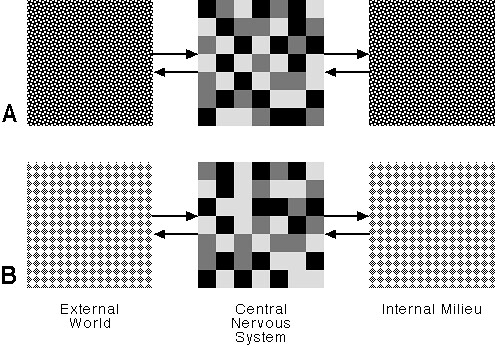
Our explication began with a simple observation: the nervous system operates in two environments, an inner and an external one.

Figure 1: Action in Two Environments

It must direct the organism to act in the external environment so as to meet demands set and sensed in the inner environment; this activity is mediated by the external senses and by the skeletal muscle system. The nervous system also acts on the inner environment, sometimes directly through immediate control over respiration, heart beat, etc. and sometimes indirectly through its control of the endocrine system. Control over behavioral mode is the nervous system's basic means of coordinating activity in inner and outer environments. The brain is part of the inner environment.

The concept of modal control was originally explicated by Kilmer, McCulloch & Blum (1969) in an account of the reticular formation. They argued that animals must always be in one of several mutually exclusive modes of behavior and that the reticular formation, with its extensive afferent and efferent connections to the rest of the nervous system, is the obvious structure for implementing that commitment. The reticular formation facilitates activity in those brain regions which are most important for the current mode, while the actual behavior of the organism when it is in the mode will be regulated by other brain centers and systems.

Thus, if the animal is in eating mode, the reticular system will keep that mode active until the animal’s hunger is satisfied. But just what the animal will eat, and how it will eat it, that’s not determined by the reticular system, which ‘knows’ nothing of such things. The execution of the behavior will be handled by other, ‘higher,’ systems.

Figure 2 presents this in a highly schematic way. Here we see the organism in two situations, A and B. The external physical environment may well be the same in each case, but the organism’s priorities are different, hence a different pattern of activation in the central nervous system (center column).

Figure 2: Two Behavioral Modes

Tuesday, May 25, 2010

Race in the Symbolic Universe 6: Cultural Evolution?

Cross-posted at The Valve.
As I’d originally planned it, this series of posts ended with the one on The Cosby Show (where you can find links to the earlier posts). However, I’ve decided to add one last post in which I briefly think about what it would mean to consider this succession of texts – The Winter’s Tale, Huckleberry Finn, A Passage to India, Light in August, Who Framed Roger Rabbit, and The Cosby Show – as being the product of cultural evolution. That, of course, links this post with my ongoing series on cultural evolution (here, here, and here).

Let me begin by noting that, in a private email, Jeb suggested that we consider Caliban as an instance of the Medieval trope of the Wild Man. That makes sense to me. Now consider my last comment in that discussion, which loosely follows from a conception of cultural evolution:
Let’s think of literary texts as indicators of the cultural psycho-social dynamics existing in the population in which the texts circulate. Other dynamics may also be circulating in those populations. And, of course, it’s quite possible that there are similar dynamics in populations which pay no attention to these particular texts of interest.

So, on the one hand there’s a certain dynamic of projection in the relationship between Prospero and Caliban in The Tempest, a text that is known to a certain population which we’ll call X. Just what this population X might be, that’s a tricky question, as that particular text has been read far and wide (and acted on the stage) for four centuries or so. Are we interested in that whole population, smeared as it is all over geographical space and historical time? Well, I don’t want to try to come up with a precise answer to that, not here and now. Not so much because this is merely a comment to a blog post, but because I simply don’t know how to do it. Let’s say that we’re particularly interested in the subpopulation of X that existed in early modern England in the early 17th century.

Imagine, then, that we find a similar dynamic in some other text or texts, texts that circulate in some different population Y. Under what circumstances does it make sense to argue for a historical and causal connection between the underlying psycho-social dynamics of population X and population Y? I think, for example, that there is a projective psycho-social dynamic in A Light in August that is similar (but not the same) to the one in The Tempest. Is there some kind of causal connection between the cultural psychodynamics operating in that early modern English population X (in the case of the Shakespeare) and the cultural psychodynamics operating in that mid-20th century American population Y (in the case of the Faulkner)?

Consider a similar, but different question. That early modern population X spoke some version of English. That language is similar, but not the same, as the version of English spoken by the mid-century American population Y. Those versions of English are similar enough that people in the two populations could converse with one another and have some degree of mutual understanding, though there certainly would be difficulties. Is there some causal connection between the English spoken by X and that spoken by Y? If so, how does that causal connection work? There certainly isn’t any direct influence (there’s that word) between early modern England and mid-20th century America. But there is something. What is it and how does it work?