Showing posts with label McCulloch. Show all posts

Friday, January 24, 2025

Three modes: Search, Inference, Exploration [a quickie]

Computer science knows a great deal about search and inference. What about exploration? That’s what I’ve been tracking down these last few weeks. That’s what I’ve been noticing as I go over my photos.

In search you’ve got a specific goal. You’re looking through a collection of objects and you have a good characterization of what you’re looking for. But there are different kinds of collections, different sizes, and this affects the procedure you use to conduct the search.

Inference is different. You’re starting with something you know and looking for something else, something that follows from, depends on, what you already know. So you make inferences. Of course, there are various kinds of inference. Analogy is different from (strict) deduction. Etc.

Exploration is a distinctly different mode. I note that it’s one of the basic modes that McCulloch identified in his reticular activation system paper. You aren’t looking for anything in particular. But something might turn up. If and when it does, you need to search “around it” and draw inferences to figure out what it is. This, I think, is where the DMN (default mode network) comes into play.

Computationally, what does exploration look like? That’s the mode we need to deal with unstructured and open-ended situations. That’s a mode that isn’t tested by these benchmarks. Benchmarks are about search and inference.

More later.

Monday, June 17, 2024

Affective Technology @ 3QD

I’ve decided to do a three-part series at 3 Quarks Daily. The topic is affective technology, affective because it can transform how we feel, technology because it is an art (tekhnē) and, as such, has a logos. The first article is now posted:

Affective Technology, Part 1: Poems and Stories https://3quarksdaily.com/3quarksdaily/2024/06/affective-technology-part-1-poems-and-stories.html

In this first article I present the problem, followed by some informal examples, a poem by Coleridge, a passage from Tom Sawyer that echoes passages from my childhood, and some informal comments about underlying mechanism. The idea is simple. Although we do not have direct control over our emotions, that is, we cannot will them into existence nor extinguish or diminish them at all, we can manipulate them indirectly through art. In this series, at least in the first two articles, I’ll be concerned with literary texts.

The second article has a working title: Affective Technology, Part 2: Emotion recollected in tranquility. The title phrase is from Wordsworth’s well-known preface to the Lyrical Ballads:

I have said that poetry is the spontaneous overflow of powerful feelings: it takes its origin from emotion recollected in tranquility: the emotion is contemplated till by a species of reaction the tranquility gradually disappears, and an emotion, kindred to that which was before the subject of contemplation, is gradually produced, and does itself actually exist in the mind.

I expand on Wordsworth’s idea with two ideas: 1) Warren McCulloch’s concept of behavioral mode, which is a theory about the function of the reticular activating system, one of the oldest portions of the nervous system, and 2) an idea from the early 1970s, Charles Tart’s concept of state-specific learning. I illustrate this with an analysis of Shakespeare’s well-known Sonnet 129, Th’Expense of Spirit, which depicts the anguish of a man who cannot prevent himself from abusing women sexually even though he is inevitably overcome with recrimination afterward.

In the third article, Affective Technology, Part 3: Coherence in the Self, I’ll open with dissociative identity disorder (DID), in which an individual mind is fractured in two or more quasi-independent personalities. I will argue that that possibility is inherent in the structure and processes of a nervous system that operates according to McCulloch’s model. Artistic works, however, help us keep a unified personality by providing an affectively ‘neutral’ ground – the Wordsworthian space of tranquil recollection – in which the various modes can coexist.

Some of these ideas have been worked out in further detail in the following papers:

Lust in Action: An Abstraction, Language and Style 14, 1981, 251-270, https://www.academia.edu/7931834/Lust_in_Action_An_Abstraction.

The Evolution of Narrative and the Self, Journal of Social and Evolutionary Systems, 16(2): 129-155, 1993, https://www.academia.edu/235114/The_Evolution_of_Narrative_and_the_Self.

Talking with Nature in "This Lime-Tree Bower My Prison." PsyArt: A Hyperlink Journal for the Psychological Study of the Arts, November, 2004, https://www.academia.edu/8345952/Talking_with_Nature_in_This_Lime-Tree_Bower_My_Prison_.

Saturday, January 6, 2024

Meditation, Psychedelics, Computers, and the Mind

Early in the millennium I had an idea for a book, tentatively entitled, Mind Hacks R Us: Computing & Tripping to the Millennium's End, and I wrote a formal proposal under that title. I was unable to find a taker, but I kept the proposal around.

The rest of this post consists of two sections. The first is the prose introduction to the proposal. The second is a series of queries I put to ChatGPT about meditation, psychedelics, the computers, and the mind. What I’ve got on my mind, obviously, is what the future could hold:

Beyond AI displacing workers, creating new kinds of jobs, and solving all sorts of puzzles and problems, what are the possibilities for the general development of and flourishing of minds?

I’ve written about a Fourth Arena beyond the three arenas that the universe has so far evolved: inanimate matter, life, and culture. That’s where this post is headed. Note that I have a variety of posts under the tags, mhacks, and Arena.

Mind Hacks R Us

During the last half of the 20th century various groups of insiders and outsiders adopted mind-altering drugs and computer technology to create cultural spaces in which we imagined and realized new venues for the human mind. These spaces engaged fundamental issues of freedom and control, of emotion and reason, which have bedeviled humans everywhere, and elaborates them in the through modern science and technology. The psychoactive drugs which, in some sense, free us, have been synthesized through laboratory techniques we have invented, but only recently. The computers which extend our powers of control and order in often surprising ways embody logical forms that date back to Aristotle but where only recently brought to fruition in the late nineteenth century work of George Boole and others. Science and technology thus provide us with objective physical touchstones for the otherwise abstract powers and activities of our hearts and minds.

Taken together with that great Victorian invention, childhood innocence, the technologies of drugs and computers would constitute a cultural arena which served as incubator, nursery, and playground for some of the major lines of development in late twentieth century culture. For, if a society is to progress it needs cultural playgrounds where new ideas can be conceived, tested and developed. Psychedelic drugs and computing – and their associated cultures – functioned as such playgrounds in the latter half of the 20th century. They were, in fact, among the most important cultural playgrounds in America.

Given the fundamental differences between drugs and computers – what they are and how people use them, between Dionysian drugs and Apollonian computers – it is not surprising that different groups of people have been most interested in one or the other. What is most curious is that these people, and their creations, have often interacted, either directly or indirectly. In some cases, drug people and computer people are one and the same, as was the case in the San Francisco-Silicon Valley area during the 1970s.

Well before that, back in the 1950s, the Josiah Macy Foundation sponsored one series of high profile conferences about psychoactive drugs and another about computers. The cybernetics conferences – a series of about a half dozen of them – were chaired by MIT’s Grand Old Man of neuroscience, Warren S. McCulloch, and included such scientific luminaries as John von Neumann, Norbert Wiener, Claude Shanon, Gregory Bateson and Margaret Mead. Late in the decade, with the help of money from the CIA, the Foundation sponsored conferences on LSD; Bateson and Mead figured in those conferences as well. Both drugs and computers promised to reveal, in their different ways, the material basis of mind. And both were new in the 1950s, and so held forth only promise – but promise of what?

The answer to that questions depends, of course, on what people were looking for, what they wanted beyond what they knew and understood. In one way or another people looked to drugs and computers for powers beyond the ordinary, for transcendence of the human condition, and, more rarely, for insight into that condition. Thus if we are to understand the way in which drugs and computers have affected our culture over the last 50 years, we have to start with the aspirations we brought to drugs and computers.

Back in 1940s – and before – and continuing through the present. Animated films directed specifically at children (with their parents in tow) is the matrix in which these forces were brought together, a “universal kid space” in which fancy and fantasy are given full-rein. Walt Disney is the key catalytic figure. The images themselves came to depict human movement with a gravity-defying fluid grace heretofore realized only in the abstract designs of music, though shamans have imagined themselves in such flights while under the ritual influence of sacred drugs and sacred music. But the technology required to create those images embodied a relentless assembly-line logic that was new in the scope and precision of its repetitive actions. By directing these animated pictures specifically at children, film-makers freed themselves from the bonds of reality and allowed themselves freely to imagine idealized worlds quite unlike any places that humans had actually seen and inhabited. Disney’s Fantasia is the apotheosis of this cultural movement. It represents a fully-adult imaginative achievement that would have been impossible to those particular adults, raised as they were, without the facilitating guise of a commercial product aimed at children.

Fantasia, then, is the starting point for my main narrative. Psychedelic drugs take the mind to a different dimension, one that is often as more real than the mundane world. So it was with Fantasia. But Fantasia was constructed in a technological matrix which would soon give birth to the digital computer and, along with it, another series of idealized versions of human possibility, of a future in which machines relieved us of further work and toil. That too was part of the Disney vision.

From there I follow the development of computers and the emergence of psychedelic drugs as people use them to explore different ways of solving the same socio-cultural problem: How do you take the best aspects of the child-oriented world of animated films and make it the basis of a way of life? We have to drop the posture that this fantasy world is only for children and find a way to accept and rework selected aspects of it into lived adult reality.

Psychedelic culture dealt with this problem by trying out an ethic of in-the-moment hedonism that also included strains of romantic pastoralism, on the one hand, and Eastern mysticism on the other. Computer culture dealt with the same issues by offering a workplace ethic of libertarian entrepreneurship and dreams of a future where everyone can achieve a technologically-supported nirvana. These lines of cultural development have converged on science fiction, fantasy, and games as common venues for cultural exploration and expression. In either case, life is conceived along different lines than those described in the buttoned-down middle-class combat zone depicted in William Whyte, The Organization Man, David Riesman, The Lonely Crowd, or Vance Packard, The Status Seekers.

This cultural reworking is by no means complete. Nor has it been an easy matter. On the contrary, it has often been confusing, difficult, and painful. As such things always are. Always.

ChatGPT on meditation, psychedelics, the computers, and the mind

What can you tell me about the various styles and practices of meditation?

Meditation encompasses a wide range of practices and styles, each with its unique techniques, goals, and cultural origins. Here are some of the most popular styles and practices of meditation:

  1. Mindfulness Meditation (Vipassana):
    • Originating from Buddhist traditions, mindfulness meditation involves paying attention to the present moment without judgment. It often focuses on breath awareness and observing thoughts and sensations.
  2. Transcendental Meditation (TM):
    • TM is a mantra-based meditation technique. Practitioners repeat a specific mantra to achieve a state of relaxed awareness, promoting inner calm and stress reduction. TM has its roots in ancient Vedic traditions.
  3. Loving-Kindness Meditation (Metta):
    • This form of meditation emphasizes the cultivation of love and compassion. Practitioners focus on sending positive intentions and well-wishes to themselves and others, gradually expanding the circle of compassion.
  4. Zen Meditation (Zazen):
    • Rooted in Zen Buddhism, Zazen involves sitting in a specific posture and focusing on the breath or a koan (a paradoxical question or statement). The goal is to develop insight and experience a direct, unmediated awareness of existence.
  5. Yoga Nidra:
    • Also known as yogic sleep, Yoga Nidra is a guided meditation that induces a state of conscious relaxation. It's often used for deep relaxation and stress reduction, allowing practitioners to explore the inner world through guided imagery.
  6. Guided Meditation:
    • In guided meditation, a teacher or a recording leads participants through a series of visualizations or mental exercises. It can be tailored for various purposes, such as stress relief, personal growth, or healing.
  7. Body Scan Meditation:
    • This mindfulness-based practice involves systematically bringing attention to different parts of the body. It helps increase body awareness and release tension.
  8. Chakra Meditation:
    • Derived from Indian spiritual traditions, chakra meditation involves focusing on energy centers (chakras) within the body. Practitioners aim to balance and align these energy centers for overall well-being.
  9. Mantra Meditation:
    • Beyond TM, various meditation practices involve repeating specific sounds, words, or phrases (mantras). This repetition can help quiet the mind and deepen concentration.
  10. Movement-Based Meditation (Tai Chi, Qigong):
    • Practices like Tai Chi and Qigong combine meditation with gentle, flowing movements. These aim to cultivate mindfulness, balance, and harmony between mind and body.
  11. Breath Awareness Meditation:
    • Focusing on the breath is a common element in many meditation practices. Techniques range from simple breath awareness to more structured practices like Anapanasati in Buddhist traditions.

It's important to note that the effectiveness of meditation can vary from person to person, and individuals may find that different styles resonate with them at different times in their lives. Experimenting with various techniques can help you discover what works best for your preferences and goals.

Wednesday, November 15, 2023

A dialectical view of the history of AI, Part 1: We’re only in the antithesis phase. [A synthesis is in the future.]

The idea that history proceeds by way of dialectical change is due primarily to Hegel and Marx. While I read bit of both early in my career, I haven’t been deeply influenced by either of them. Nonetheless I find the notion of dialectical change working out through history to be a useful way of thinking about the history of AI. Because it implies that that history is more than just one thing of another.

This dialectical process is generally schematized as a movement from a thesis, to an antithesis, and finally, to a synthesis on a “higher level,” whatever that is. The technical term is Aufhebung. Wikipedia:

In Hegel, the term Aufhebung has the apparently contradictory implications of both preserving and changing, and eventually advancement (the German verb aufheben means "to cancel", "to keep" and "to pick up"). The tension between these senses suits what Hegel is trying to talk about. In sublation, a term or concept is both preserved and changed through its dialectical interplay with another term or concept. Sublation is the motor by which the dialectic functions.

So, why do I think the history of AI is best conceived in this way? The first era, THESIS, running from the 1950s up through and into the 1980s, was based on top-down deductive symbolic methods. The second era, ANTITHESIS, which began its ascent in the 1990s and now reigns, is based on bottom-up statistical methods. These are conceptually and computationally quite different, opposite, if you will. As for the third era, SYNTHESIS, well, we don’t even know if there will be a third era. Perhaps the second, the current, era will take us all the way, whatever that means. Color me skeptical. I believe there will be a third era, and that it will involve a synthesis of conceptual ideas computational techniques from the previous eras.

Note, though, that I will be concentrating on efforts to model language. In the first place, that’s what I know best. More importantly, however, it is the work on language that is currently evoking the most fevered speculations about the future of AI.

Let’s take a look. Find a comfortable chair, adjust the lighting, pour yourself a drink, sit back, relax, and read. This is going to take a while.

Symbolic AI: Thesis

The pursuit of artificial intelligence started back in the 1950s it began with certain ideas and certain computational capabilities. The latter were crude and radically underpowered by today’s standards. As for the ideas, we need two more or less independent starting points. One gives us the term “artificial intelligence” (AI), which John McCarthy coined in connection with a conference held at Dartmouth in 1956. The other is associated with the pursuit of machine translation (MT) which, in the United States, meant translating Russian technical documents into English. MT was funded primarily by the Defense Department.

The goal of MT was practical, relentlessly practical. There was no talk of intelligence and Turing tests and the like. The only thing that mattered was being able to take a Russian text, feed it into a computer, and get out a competent English translation of that text. Promises was made, but little was delivered. The Defense Department pulled the plug on that work in the mid-1960s. Researchers in MT then proceeded to rebrand themselves as investigators of computational linguistics (CL).

Meanwhile researchers in AI gave themselves a very different agenda. They were gunning for human intelligence and were constantly predicting we’d achieve it within a decade or so. They adopted chess as one of their intellectual testing grounds. Thus, in a paper published in 1958 in the IBM Journal of Research and Development, Newell, Shaw, and Simon wrote that if “one could devise a successful chess machine, one would seem to have penetrated to the core of human intellectual endeavor.” In a famous paper, John McCarthy dubbed chess to be the Drosophila of AI.

Chess isn’t the only thing that attracted these researchers, they also worked on things like heuristic search, logic, and proving theorems in geometry. That is, they choose domains which, like chess, were highly rationalized. Chess, like all highly formalized systems, is grounded in a fixed set of rules. We have a board with 64 squares, six kinds of pieces with tightly specified rules of deployment, and a few other rules governing the terms of play. A seeming unending variety of chess games then unfolded from these simple primitive means according to the skill and ingenuity, aka intelligence, of the players.

This regime, termed symbolic AI in retrospect, remained in force through the 1980s and into the 1990s. However, trouble began showing up in the 1970s. To be sure, the optimistic predictions of the early years hadn’t come to pass; humans still beat computers at chess, for example. But those were mere setbacks.

These problems were deeper. While the computational linguistics were still working on machine translation, they were also interested in speech recognition and speech understanding. Stated simply, speech recognition goes like this: You give a computer a string of spoken language and it transcribes it into written language. The AI folks were interested in this as well. It’s not the sort of thing humans give a moment’s thought to; we simply do it. It is mere perception. It was proving to be surprisingly difficult. The AI folks also turned to computer vision: Give a computer a visual image and have it identify the object. That was difficult as well, even with such simple graphic objects as printed letters.

Speech understanding, however, was on the face of it intrinsically more difficult. Not only does the system have recognize the speech, but it must understand what is said. But how do you determine whether or not the computer understood what you said. You could ask it: “Do you understand?” And if it replies, “yes,” then what? You give it something to do.

That’s what the DARPA Speech Understanding Project set out to do in over five years in the early to mid 1970s. Understanding would be tested by having the computer answer questions about database entries. Three independent projects were funded; interesting and influential research was done. But those systems, interesting as they were, were not remotely as capable as Siri or Alex in our time, which run on vastly more compute encompassed in much smaller packages. We were a long way from having a computer system that could converse as fluently as a toddler, much less discourse intelligently on the weather, current events, the fall of Rome, the Mongol’s conquest of China, or how to build a fusion reactor.

During the 1980s the commercial development of AI petered out and a so-called AI Winter settled in. It would seem that AI and CL had hit the proverbial wall. The classical era, the era of symbolic computing, was all but over.

Thursday, February 16, 2023

The Long Story of How Neural Nets Got to Where They Are

This is a fascinating discussion between Stephen Wolfram and Terry Sejnowski. These guys, Sejnowski especially, are pulling names from all over the place. There are lots of isolated and semi-isolated figures in this story. But it’s (the beginnings of) a map of where all this came from. Should probably check it against Grace Lindsey's wonderful little book, Models of the Mind. Note that the early stuff about computational linguistics is messed up. Chomsky had nothing to do with it.

And so forth and so on. 

After about 3:00:31 Wolfram and Sejnowski make that point that, while the field of neural networks started with a small group of "true believers," as most intellectual enterprises do, in the case of neural nets (Wolfram) "there were all these separate little pockets, I think that's not so common." In many cases "the tree grows from one trunk, so to speak." To which Sejnowski responds, "Ah, OK, that's an interesting observation."  Wolfram notes that, for example, in the case of "quantum mechanics there were not multiple trunks." He goes on to say that, in a sense, it all grew from the initial McCulloch-Pitts 1943 paper, "and yet there were all these separate branches, same seed but it wasn't a single trunk from that." Moreover, "the time scale from the initial seed to  fruition is extremely long. Many generations." Sejnowski agrees "that it was very diverse. But one possible explanation is that you have a much bigger search space to explore." 

Tuesday, April 26, 2022

Neural connectivity during various activities [behavioral mode]

Here's the first two tweets in a stream of 8 tweets:

Here's the abstract and author's summary from the article, Latent functional connectivity underlying multiple brain states:

Abstract

Functional connectivity (FC) studies have predominantly focused on resting state, where ongoing dynamics are thought to reflect the brain’s intrinsic network architecture, which is thought to be broadly relevant because it persists across brain states (i.e., is state-general). However, it is unknown whether resting state is the optimal state for measuring intrinsic FC. We propose that latent FC, reflecting shared connectivity patterns across many brain states, better captures state-general intrinsic FC relative to measures derived from resting state alone. We estimated latent FC independently for each connection using leave-one-task-out factor analysis in seven highly distinct task states (24 conditions) and resting state using fMRI data from the Human Connectome Project. Compared with resting-state connectivity, latent FC improves generalization to held-out brain states, better explaining patterns of connectivity and task-evoked activation. We also found that latent connectivity improved prediction of behavior outside the scanner, indexed by the general intelligence factor (g). Our results suggest that FC patterns shared across many brain states, rather than just resting state, better reflect state-general connectivity. This affirms the notion of “intrinsic” brain network architecture as a set of connectivity properties persistent across brain states, providing an updated conceptual and mathematical framework of intrinsic connectivity as a latent factor.

Author Summary

The initial promise of resting-state fMRI was that it would reflect “intrinsic” functional relationships in the brain free from any specific task context, yet this assumption has remained untested until recently. Here we propose a latent variable method for estimating intrinsic functional connectivity (FC) as an alternative to rest FC. We show that latent FC outperforms rest FC in predicting held-out FC and regional activation states in the brain. Additionally, latent FC better predicts a marker of general intelligence measured outside of the scanner. We demonstrate that the latent variable approach subsumes other approaches to combining data from multiple states (e.g., averaging) and that it outperforms rest FC alone in terms of generalizability and predictive validity.

This article speaks to an idea that was, I believe, first articulated by Warren McCulloch. He argued that for each specific behavioral mode (and here)– hunting, eating, sex, sleep, etc. – there is a particular pattern of brain activity, some regions are more active than others. That is, the brain doesn't have specific modules for each activity, but rather specific patterns of activation over the whole brain.

Friday, April 8, 2022

To Model the Mind: Speculative Engineering as Philosophy

New working paper. Title above, abstract, contents, and introduction below. Download at:

Abstract: Are brains computers? Some say yes, some say no. Does it matter? Ideas about computing have certainly proven fruitful in understanding how brains give rise to minds. That’s what this paper is about. The central section is a review of Grace Lindsey’s wonderful book Models of the Mind: How Physics, Engineering, and Mathematics Have Shaped Our Understanding of the Brain (2021). I precede it with a bit of philosophy and follow it with brief notices about five books, each proposing computationally inspired models of the mind.

Contents

Introduction: Brains, machines, and computation 2
Speculative Engineering as Philosophy 4
To Understand the Mind We Must Build One, A Review of Models of the Mind – Bye Bye René, Hello Giambattista 9
Five Good Books 15

Introduction: Brains, machines, and computation

I remember when electronic digital computers were sometimes called electronic brains. The following graph from Google Ngram shows the rise and fall of the terms “electronic brain” and “electric brains.”

Why the quick rise and fall? I’d guess that’s when these remarkable machines first gained public attention. It wasn’t clear what kind of beast they were. How do we refer to them? For a while, we tried out the idea that they were a kind of brain. After all, they did the kinds of things that brains did. They tabulated, sorted, and calculated.

But they also inspired. During the interval of that peak the study of artificial intelligence was inaugurated at a conference at Dartmouth in 1956. Machine translation, the use of a computer to translate text from one language to another arose in the 1950s and then collapsed, alas, in the mid-1960s for lack of practical results. Noam Chomsky conceived of grammar in computational terms. Warren McCulloch and Walter Pitts conceived of neurons as tiny logic engines in the early 1940s and computational ideas began taking hold in neuroscience and philosophy.

Are brains computers? Some say yes, some say no. Does it matter? For ideas about computing have certainly proven fruitful in understanding how brains give rise to minds. That’s what this paper is about. The central section is a review of Grace Lindsey’s wonderful book Models of the Mind: How Physics, Engineering, and Mathematics Have Shaped Our Understanding of the Brain (2021). I precede it with a bit of philosophy and follow it with brief notices about five books, each proposing computationally inspired models of the mind.

* * * * *

Speculative Engineering as Philosophy: Engineering is about how things are designed and constructed. I am interested in how the brain works, how it constructs a mind. When we theorize about that, thinking about models, experiments, or simulations, we are speculating about the engineering principles on which the brain operates. I argue that that is a form of philosophy, in the broadest sense of the term, though not necessarily as philosophy exists as an academic discipline.

To Understand the Mind We Must Build One, A Review of Models of the Mind – Bye Bye René, Hello Giambattista: Descartes believed that truth is verified through observation. Vico had a different view, believing that “What is true is precisely what is made.” Grace Lindsey ‘s Models of the Mind is Viconian in spirit. Its subtitle tells the story: How Physics, Engineering, and Mathematics Have Shaped Our Understanding of the Brain. Lindsey traces the history of the of a wide variety of models and techniques, often back into the 19th and even 18th centuries, in a simple and direct way. I turn my review on a few cases: 1) the 1943 McCulloch and Pitts model of neurons as logical operators, 2) Frank Rosenblatt’s Perceptron from the late 1950s, and 3) Jerome Lettvin’s 1959 work on the frog’s visual system, which Nicholas Humphrey parlayed in a 1970 article on the monkey’s visual system. That last brings in an evolutionary angle. The whole thing is wrapped up by Joyce’s Finnegans Wake, and its Latin translation.

Five Good Books: Short notices for five books, each about the mind and/or brain, each in a different style: 1) John von Neumann (1958), The Computer and the Brain, 2) Herbert A. Simon (1981), The Sciences of the Artificial, 3) William Powers (1973), Behavior: The Control of Perception, 4) David G. Hays (1981), Cognitive Structures, and 5) Valentine Braitenberg (1999), Vehicles: Experiments in Synthetic Psychology.

Monday, October 21, 2019

Whole-brain network topology, the ascending arousal system, and information processing dynamics

Li M, Han Y, Aburn MJ, Breakspear M, Poldrack RA, Shine JM, et al. (2019) Transitions in information processing dynamics at the whole-brain network level are driven by alterations in neural gain. PLoS Comput Biol 15(10): e1006957. https://doi.org/10.1371/journal.pcbi.1006957
Abstract

A key component of the flexibility and complexity of the brain is its ability to dynamically adapt its functional network structure between integrated and segregated brain states depending on the demands of different cognitive tasks. Integrated states are prevalent when performing tasks of high complexity, such as maintaining items in working memory, consistent with models of a global workspace architecture. Recent work has suggested that the balance between integration and segregation is under the control of ascending neuromodulatory systems, such as the noradrenergic system, via changes in neural gain (in terms of the amplification and non-linearity in stimulus-response transfer function of brain regions). In a previous large-scale nonlinear oscillator model of neuronal network dynamics, we showed that manipulating neural gain parameters led to a ‘critical’ transition in phase synchrony that was associated with a shift from segregated to integrated topology, thus confirming our original prediction. In this study, we advance these results by demonstrating that the gain-mediated phase transition is characterized by a shift in the underlying dynamics of neural information processing. Specifically, the dynamics of the subcritical (segregated) regime are dominated by information storage, whereas the supercritical (integrated) regime is associated with increased information transfer (measured via transfer entropy). Operating near to the critical regime with respect to modulating neural gain parameters would thus appear to provide computational advantages, offering flexibility in the information processing that can be performed with only subtle changes in gain control. Our results thus link studies of whole-brain network topology and the ascending arousal system with information processing dynamics, and suggest that the constraints imposed by the ascending arousal system constrain low-dimensional modes of information processing within the brain.

Author summary

Higher brain function relies on a dynamic balance between functional integration and segregation. Previous work has shown that this balance is mediated in part by alterations in neural gain, which are thought to relate to projections from ascending neuromodulatory nuclei, such as the locus coeruleus. Here, we extend this work by demonstrating that the modulation of neural gain parameters alters the information processing dynamics of the brain regions of a biophysical neural model. Specifically, we find that subcritical dynamics in the phase space of neural gain parameters are characterized by high Active Information Storage, whereas supercritical dynamics in this phase space are associated with an increase in inter-regional Transfer Entropy. Our results suggest that the modulation of neural gain via the ascending arousal system may fundamentally alter the information processing mode of the brain, which in turn has important implications for understanding the biophysical basis of cognition.
Note that the locus coeruleus is part of the reticular activating system (RAS), which suggests that these results are relevant to Warren McCulloch's concept of behavioral mode, which was about the role of the RAS in modulating activity of the whole brain.

Monday, June 25, 2018

McCulloch, computers, and new forms of abstraction

Leif Weatherby, Digital Metaphysics: The Cybernetic Idealism of Warren McCulloch, The Hedgehog Review, Vol. 20, No. 1 (Spring 2018)
McCulloch never thought the real would yield to data; nor did he ever think humans would defer to their machines. Instead, he saw that the machines would make new principles of abstraction—new kinds of cognition—available. It was a kind of mutated Kantian question. Kant had wanted to know how much mind is in the world, and McCulloch thought the sum might shift. That is, the shape of the relation between abstraction and the real might change with the new machines.

Friday, November 25, 2016

Flexible Hubs and Behavioral Mode

This sort of thing is on my mind at the moment, so I thought I'd bump it to the top of the queue, just to cement it in my mind (temporarily). Plus I've added abstracts from and links to the original research.

* * * * *

From Medical Xpress:
Now, research from Washington University in St. Louis offers new and compelling evidence that a well-connected core brain network based in the lateral prefrontal cortex and the posterior parietal cortex – parts of the brain most changed evolutionarily since our common ancestor with chimpanzees – contains "flexible hubs" that coordinate the brain's responses to novel cognitive challenges.

Acting as a central switching station for cognitive processing, this fronto-parietal brain network funnels incoming task instructions to those brain regions most adept at handling the cognitive task at hand, coordinating the transfer of information among processing brain regions to facilitate the rapid learning of new skills, the study finds.
"Flexible hubs are brain regions that coordinate activity throughout the brain to implement tasks – like a large Internet traffic router," suggests Michael Cole, PhD., a postdoctoral research associate in psychology at Washington University and lead author of the study published July 29 in the journal Nature Neuroscience
This is consistent with the concept of behavioral mode that David Hays and I adopted and adapted from Warren McCulloch.

This is in contrast to concepts of rigid modularity, where the brain is said to consist of quasi-autonomous behavioral modules, each dedicated to a specific perceptual, cognitive, or behavioral activity. These modules are conceived as being wired-in and universal across humans in a manner similar to, say, the skeletal system or the muscles. Barring pathology and injury, everyone's got the same set in the same arrangement. The notion of modes, and of behavioral hubs, allows for an open-ended arrangement of task specific configurations. The patterns of configuration are not wired-in, though many of the configured components would be.

Note: McCulloch was specifically interested in the reticular activating system, which is in the core of the brain and brain stem and is phylogenetically old. The structures pinpointed by Dr. Cole are in the cerebral cortex, which is a much newer structure. Beyond citing McCulloch's model Hays and I had no specific suggestions about other neural mechanisms that might be involved in modal organizing, though we talked informally about the need for such mechanisms.

* * * * * *

Monday, November 24, 2014

From Multiple Personalities to Dissociative Identity Disorder


Below the asterisks I've copied some remarks about this disorder from my article, First Person: Neuro-Cognitive Notes on the Self in Life and in Fiction, PSYART: A Hyperlink Journal for Psychological Study of the Arts, August 21, 2000.

* * * * *

There is another aspect of the neural self, one that has to do with the continuity and coherence of the representation. We can approach this issue by considering dissociative identity disorder (DID), an extreme pathology in which the neural self is fractured. In DID, also known as multiple personality disorder, one biological individual exhibits several different identities, each having different memories and personal style. In Thigpen and Cleckley's (1957) classic study Eve had three personalities; Schreiber's (1973) Sybil had sixteen (see also Rappaport 1971, Stoller 1973). Although there has been some controversy over whether or not DID is real or simply the effect of zealous therapeutic invention and intervention, there is no doubt that at least some cases are genuine (Schachter 1996, 236-242, Spiegel 1995, 135-138).

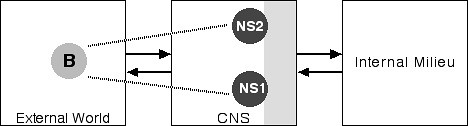
These different identities have different personal histories. The events in one personal history typically are unknown to the other histories. Each identity will have blank periods in its history, intervals, obviously, where another identity was being enacted. And the different "persons" are often unaware of one another. Further, the different identities seem to have different personal styles, different modes of speech, of movement, of dress, and so forth. Thus both the core and autobiographical selves seem to be riven. Using the conventions we employed above, Figure 7 is a simple depiction of DID:

Fig 7 DID

Figure 7: Dissociative Identity Disorder

Notice that we now have two neural selves, NS1 and NS2, corresponding to two different identities. Of course, these two selves exist in the same body, so we have only one corresponding body in the external world.

We do not, so far as I know, understand why or how DID happens. It is not, however, the result of the sort of gross destruction of brain tissue that underlies anosognosia. One might imagine, for example, that the different selves reside in distinctly different patches of neural tissue, a speculation that Damasio (1999b, 355) himself has suggested for the autobiographical self (though he presents no evidence). This suggestion, however, has at least one problem: How does the nervous system switch from one identity to another? There is another way of explaining DID, equally speculative and equally without specific evidence, that eliminates this particular problem.

Wednesday, August 1, 2012

Mode and Behavior, a Working Paper

I've collected seven posts on behavioral mode and made them into a working paper, Mode and Behavior, which I've uploaded to SSRN, here (PDF) and to Academia.edu, here (PDF). I've copied the introduction below and then listed and linked the individual posts below that.

* * * * *

This document collects a number of blog posts on the theme of behavioral mode. In this form the idea originates with Warren McCulloch, one of the grand old men of neuroscience and cybernetics. This conception would also give basic credence to the psychoanalytic conception of organ modes—oral, anal, and genital—though, ironically, McCulloch had little use for Freud—he entitled one of his papers “The Past of a Delusion” as an allusion to Freud’s The Future of an Illusion.

McCulloch’s idea is simple: The most basic decision any vertebrate can make is to commit to some mode of behavior—such as exploring, eating, courting, fighting, playing, etc. Any more specific direction is elaborated from within one of these modes. What gives McCulloch’s idea its force is his argument (and accompanying model) that modal commitment was mediated, not by the most sophisticated and evolutionarily advanced brain tissue, but by the most elementary and evolutionarily old brain tissue. This tissue, known as the reticular formation or the reticular activating system, is at the core of the brainstem. In effect, it has veto power over the cerebral cortex, but also, the power to activate the cortex.

The seven posts in this document explore the implications of McCulloch’s conception of behavioral mode. In particular, these seven posts explore the implications of mode for our understanding of art and our construction of the self. They also lay the foundations for a pluralist view of the world.

Sunday, October 23, 2011

The Anarchic Brain

One notion that persists in various accounts of mind and brain is the notion of an executive, a highest-level function that controls all the rest. That such a function seems necessary, that it is logical to interpret this or that brain system (e.g. the prefrontal cortex) as being the executive, this, I suggest, has more to do with a culturally driven bias toward hierarchy than with the requirements of behavioral organization, much less with the ‘natural’ and ‘obvious’ way of interpreting observations about this or that brain system.

It is just as ‘natural’ to conceive of behavioral control as anarchic and opportunistic. Moreover, the age-old struggle between passion and reason tells as that, if there IS an executive, it’s NOT reason, because reason gets constantly over-ridden by passion. No, the top-down brain is an ideological fantasy, not a behavioral necessity.

The purpose of this post is to outline a somewhat different view of these matters that David Hays and I cooked up some years ago.

Warren McCulloch’s Heterarchical Brain

But let me start with one of the grand old men of neuroscience, the late Warren McCulloch. Back in 1945 he published a paper, “A Heterarchy of Values Determined by the Topology of Nervous Nets” in which he argued for a structure in which one can have behavioral sequences and neural structures such as: A controls B, B controls C, and C controls A. If you will, rock breaks scissors, scissors cuts paper, and paper covers rock. Some years later he collaborated with W. L. Kilmer on a model of the reticular formation that embodied such a heterarchical system, “A Model of the Vertebrate Central Command System.” In this model there is no one behavioral mode that dominates all others and thus is in a position to be an executive planner. [1]

When Hays and I incorporated McCulloch’s model into our a scheme for neuro-behavioral organization (Principles and Development of Natural Intelligence), we called it the modal principle and explained it as follows:
Definition. Modal choice feeds the results of calculation back into the biological realm, activating brain regions and selecting programs of operation which commit the organism to an interpretation of its world.

The concept of modal control has been explicated by Kilmer, McCulloch & Blum (1969) in an account of the reticular formation. They argue that animals must always be in one of several mutually exclusive modes of behavior and that the reticular formation, with its extensive afferent and efferent connections to the rest of the nervous system, is the obvious structure for implementing that commitment. The reticular formation facilitates activity in those brain regions which are most important for the current mode (see Fig. 1), while the actual behaviour of the organism when it is in the mode will be regulated by other brain centres and systems.

Kilmer et al. list 15 different modes, including, for example, sleeping, eating, fighting, hunting and grooming (see also MacLean, 1978). We are not interested in attacking or defending this particular list; what is important is recognizing that there is some small finite list of behavioural modes.
The thing about the reticular formation is that it is all-but the most primitive structure in the brain. You may be familiar with Paul McLean’s metaphor in which a reptilian brain is overlain by an old mammalian brain which is in turn overlain by the new mammalian brain. Well the reticular formation is, in effect, the chordate (worm) core of the reptilian brain. It is the oldest of the old.

Wednesday, August 11, 2010

Mode & Behavior 2: McCulloch’s Model

Yesterday I introduced the concept of behavioral mode through a discussion of Shakespeare’s Sonnet 129. Now I want to present a more theoretical discussion, one which is rewritten from a paper David Hays and I published over two decades ago: Principles and Development of Natural Intelligence, Journal of Social and Biological Structures, 1988, pp. 293-322. To facilitate presentation I’ve stripped out almost all of the citations, but you can find them in the original paper.

Our object in that was to get some basic theoretical “purchase” on the brain. To that end we reviewed a wide range of observations and thinking in cognitive and neuroscience, developmental biology, and comparative psychology and arrived a five principles we thought of as governing the integration of perceptual and cognitive operations. We argued that the principles had an intrinsic ordering “such that implementation of each principle presupposes the prior implementation of its predecessor.” The modal principle is the most basic one and we regarded it as intrinsic to all vertebrate nervous systems.

Our explication began with a simple observation: the nervous system operates in two environments, an inner and an external one.

Figure 1: Action in Two Environments

It must direct the organism to act in the external environment so as to meet demands set and sensed in the inner environment; this activity is mediated by the external senses and by the skeletal muscle system. The nervous system also acts on the inner environment, sometimes directly through immediate control over respiration, heart beat, etc. and sometimes indirectly through its control of the endocrine system. Control over behavioral mode is the nervous system's basic means of coordinating activity in inner and outer environments. The brain is part of the inner environment.

The concept of modal control was originally explicated by Kilmer, McCulloch & Blum (1969) in an account of the reticular formation. They argued that animals must always be in one of several mutually exclusive modes of behavior and that the reticular formation, with its extensive afferent and efferent connections to the rest of the nervous system, is the obvious structure for implementing that commitment. The reticular formation facilitates activity in those brain regions which are most important for the current mode, while the actual behavior of the organism when it is in the mode will be regulated by other brain centers and systems.

Thus, if the animal is in eating mode, the reticular system will keep that mode active until the animal’s hunger is satisfied. But just what the animal will eat, and how it will eat it, that’s not determined by the reticular system, which ‘knows’ nothing of such things. The execution of the behavior will be handled by other, ‘higher,’ systems.

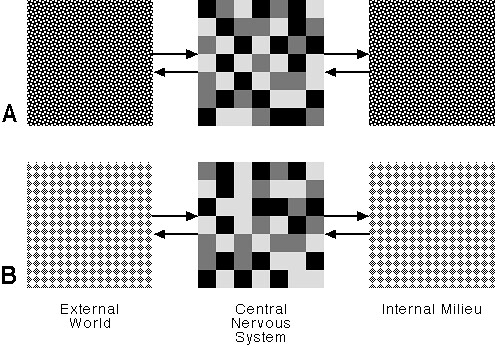
Figure 2 presents this in a highly schematic way. Here we see the organism in two situations, A and B. The external physical environment may well be the same in each case, but the organism’s priorities are different, hence a different pattern of activation in the central nervous system (center column).

Figure 2: Two Behavioral Modes