Showing posts sorted by relevance for query McCulloch. Sort by date Show all posts

Wednesday, August 11, 2010

Mode & Behavior 2: McCulloch’s Model

Yesterday I introduced the concept of behavioral mode through a discussion of Shakespeare’s Sonnet 129. Now I want to present a more theoretical discussion, one which is rewritten from a paper David Hays and I published over two decades ago: Principles and Development of Natural Intelligence, Journal of Social and Biological Structures, 1988, pp. 293-322. To facilitate presentation I’ve stripped out almost all of the citations, but you can find them in the original paper.

Our object in that was to get some basic theoretical “purchase” on the brain. To that end we reviewed a wide range of observations and thinking in cognitive and neuroscience, developmental biology, and comparative psychology and arrived a five principles we thought of as governing the integration of perceptual and cognitive operations. We argued that the principles had an intrinsic ordering “such that implementation of each principle presupposes the prior implementation of its predecessor.” The modal principle is the most basic one and we regarded it as intrinsic to all vertebrate nervous systems.

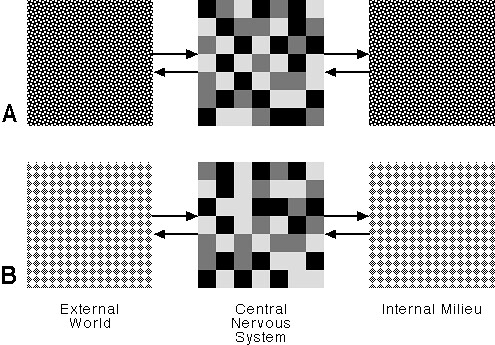
Our explication began with a simple observation: the nervous system operates in two environments, an inner and an external one.

Figure 1: Action in Two Environments

It must direct the organism to act in the external environment so as to meet demands set and sensed in the inner environment; this activity is mediated by the external senses and by the skeletal muscle system. The nervous system also acts on the inner environment, sometimes directly through immediate control over respiration, heart beat, etc. and sometimes indirectly through its control of the endocrine system. Control over behavioral mode is the nervous system's basic means of coordinating activity in inner and outer environments. The brain is part of the inner environment.

The concept of modal control was originally explicated by Kilmer, McCulloch & Blum (1969) in an account of the reticular formation. They argued that animals must always be in one of several mutually exclusive modes of behavior and that the reticular formation, with its extensive afferent and efferent connections to the rest of the nervous system, is the obvious structure for implementing that commitment. The reticular formation facilitates activity in those brain regions which are most important for the current mode, while the actual behavior of the organism when it is in the mode will be regulated by other brain centers and systems.

Thus, if the animal is in eating mode, the reticular system will keep that mode active until the animal’s hunger is satisfied. But just what the animal will eat, and how it will eat it, that’s not determined by the reticular system, which ‘knows’ nothing of such things. The execution of the behavior will be handled by other, ‘higher,’ systems.

Figure 2 presents this in a highly schematic way. Here we see the organism in two situations, A and B. The external physical environment may well be the same in each case, but the organism’s priorities are different, hence a different pattern of activation in the central nervous system (center column).

Figure 2: Two Behavioral Modes

Sunday, October 23, 2011

The Anarchic Brain

One notion that persists in various accounts of mind and brain is the notion of an executive, a highest-level function that controls all the rest. That such a function seems necessary, that it is logical to interpret this or that brain system (e.g. the prefrontal cortex) as being the executive, this, I suggest, has more to do with a culturally driven bias toward hierarchy than with the requirements of behavioral organization, much less with the ‘natural’ and ‘obvious’ way of interpreting observations about this or that brain system.

It is just as ‘natural’ to conceive of behavioral control as anarchic and opportunistic. Moreover, the age-old struggle between passion and reason tells as that, if there IS an executive, it’s NOT reason, because reason gets constantly over-ridden by passion. No, the top-down brain is an ideological fantasy, not a behavioral necessity.

The purpose of this post is to outline a somewhat different view of these matters that David Hays and I cooked up some years ago.

Warren McCulloch’s Heterarchical Brain

But let me start with one of the grand old men of neuroscience, the late Warren McCulloch. Back in 1945 he published a paper, “A Heterarchy of Values Determined by the Topology of Nervous Nets” in which he argued for a structure in which one can have behavioral sequences and neural structures such as: A controls B, B controls C, and C controls A. If you will, rock breaks scissors, scissors cuts paper, and paper covers rock. Some years later he collaborated with W. L. Kilmer on a model of the reticular formation that embodied such a heterarchical system, “A Model of the Vertebrate Central Command System.” In this model there is no one behavioral mode that dominates all others and thus is in a position to be an executive planner. [1]

When Hays and I incorporated McCulloch’s model into our a scheme for neuro-behavioral organization (Principles and Development of Natural Intelligence), we called it the modal principle and explained it as follows:
Definition. Modal choice feeds the results of calculation back into the biological realm, activating brain regions and selecting programs of operation which commit the organism to an interpretation of its world.

The concept of modal control has been explicated by Kilmer, McCulloch & Blum (1969) in an account of the reticular formation. They argue that animals must always be in one of several mutually exclusive modes of behavior and that the reticular formation, with its extensive afferent and efferent connections to the rest of the nervous system, is the obvious structure for implementing that commitment. The reticular formation facilitates activity in those brain regions which are most important for the current mode (see Fig. 1), while the actual behaviour of the organism when it is in the mode will be regulated by other brain centres and systems.

Kilmer et al. list 15 different modes, including, for example, sleeping, eating, fighting, hunting and grooming (see also MacLean, 1978). We are not interested in attacking or defending this particular list; what is important is recognizing that there is some small finite list of behavioural modes.
The thing about the reticular formation is that it is all-but the most primitive structure in the brain. You may be familiar with Paul McLean’s metaphor in which a reptilian brain is overlain by an old mammalian brain which is in turn overlain by the new mammalian brain. Well the reticular formation is, in effect, the chordate (worm) core of the reptilian brain. It is the oldest of the old.

Wednesday, August 1, 2012

Mode and Behavior, a Working Paper

I've collected seven posts on behavioral mode and made them into a working paper, Mode and Behavior, which I've uploaded to SSRN, here (PDF) and to Academia.edu, here (PDF). I've copied the introduction below and then listed and linked the individual posts below that.

* * * * *

This document collects a number of blog posts on the theme of behavioral mode. In this form the idea originates with Warren McCulloch, one of the grand old men of neuroscience and cybernetics. This conception would also give basic credence to the psychoanalytic conception of organ modes—oral, anal, and genital—though, ironically, McCulloch had little use for Freud—he entitled one of his papers “The Past of a Delusion” as an allusion to Freud’s The Future of an Illusion.

McCulloch’s idea is simple: The most basic decision any vertebrate can make is to commit to some mode of behavior—such as exploring, eating, courting, fighting, playing, etc. Any more specific direction is elaborated from within one of these modes. What gives McCulloch’s idea its force is his argument (and accompanying model) that modal commitment was mediated, not by the most sophisticated and evolutionarily advanced brain tissue, but by the most elementary and evolutionarily old brain tissue. This tissue, known as the reticular formation or the reticular activating system, is at the core of the brainstem. In effect, it has veto power over the cerebral cortex, but also, the power to activate the cortex.

The seven posts in this document explore the implications of McCulloch’s conception of behavioral mode. In particular, these seven posts explore the implications of mode for our understanding of art and our construction of the self. They also lay the foundations for a pluralist view of the world.

Monday, May 24, 2010

Moffett & the Ants: Mode, Embedding & Emergent Complexity

Rather than read Mark Moffet, Adventures Among Ants, from beginning to end and only then write a review, I thought I’d post notes in the process of reading. Why? To see how it goes, that’s why.

As Moffett’s title tells us, the book’s about ants. I understand that ants are quite important in the world, and I have no problem understanding why someone would be fascinated by them, or, for that matter, by many other things as well. But I’m not myself fascinated by them.

I’m interested in human behavior and culture. So, what do ants have to tell us about ourselves? Moffett promises a lot on that score: the dust jacket copy talks of them “displaying behaviors strikingly like those of humans – yet on a different scale and at a faster tempo . . . warriors, builders, big-game hunters, and slave owners.” We’ll see.

Mode and the Reticular Formation

Let’s start with a passage on page 18:
Regardless of species, once an ant detects food, her searching behavior stops and is replaced by a series of very different harvesting activities: tracking, killing, dissecting, carrying and defending. In the majority of species, an ant can mobilize others to assist her. This communication practice is known as recruitment and usually involves chemical signals called pheromones. Often a wayfaring ant releases a scent from one of a battery of glands in her body, a mixture that serves to stimulate or guide her nestmates.
This reminds of Warren McCulloch’s concept of behavioral mode. The idea is that an animal must always be in one of several mutually exclusive modes of behavior. In a classic paper* McCulloch lists 15 different modes, including, for example, sleeping, eating, fighting, hunting and grooming. That seems roughly in the same ball park as Moffett’s list: searching, tracking, killing, dissecting, carrying, defending, and recruitment. Is ant behavior modal in the sense the McCulloch was arguing for vertebrate behavior? Perhaps.

McCulloch was specifically arguing about one of the most primitive structures in the vertebrate nervous system, the reticular formation, which is at the central core of the nervous system. The reticular formation has reciprocal connections with the rest of the brain, giving it a broad and pervasive influence on the global state of the nervous system. It’s that pervasive influence that McCulloch is thinking of as modal control. The ant’s nervous system is considerably smaller than that of even the most primitive vertebrate, so it’s not clear to me just how applicable McCulloch’s concept of control is, but . . . let’s not worry to much about that. Let’s just note the issue and press on.

Moffett tells us that ants use pheromones – bioactive chemical signals – to recruit the help of other ants to the cause. So reticular system uses biochemical signals to recruit the rest of the nervous system to a behavioral mode. It’s not just that neural transmission is electro-chemical in nature, but that specific neurotransmitters are keyed to specific behavioral modes and that those neurotransmitters are chemically the same as hormones that circulate through the blood system and are associated with specific behaviors.** Just as ants use chemical signals to recruit other ants, so the reticular formation uses chemicals to recruit the rest of the brain. Now consider the notion that the human brain is, in effect, 600,000 busy bees buzzing around inside the cranium. So, we have the reticular bees using pheromonal “trails” (“laid” in axons) to signal bees elsewhere in the brain.

Mere analogy? Perhaps. Let us continue on.

Monday, June 25, 2018

McCulloch, computers, and new forms of abstraction

Leif Weatherby, Digital Metaphysics: The Cybernetic Idealism of Warren McCulloch, The Hedgehog Review, Vol. 20, No. 1 (Spring 2018)
McCulloch never thought the real would yield to data; nor did he ever think humans would defer to their machines. Instead, he saw that the machines would make new principles of abstraction—new kinds of cognition—available. It was a kind of mutated Kantian question. Kant had wanted to know how much mind is in the world, and McCulloch thought the sum might shift. That is, the shape of the relation between abstraction and the real might change with the new machines.

Monday, November 24, 2014

From Multiple Personalities to Dissociative Identity Disorder


Below the asterisks I've copied some remarks about this disorder from my article, First Person: Neuro-Cognitive Notes on the Self in Life and in Fiction, PSYART: A Hyperlink Journal for Psychological Study of the Arts, August 21, 2000.

* * * * *

There is another aspect of the neural self, one that has to do with the continuity and coherence of the representation. We can approach this issue by considering dissociative identity disorder (DID), an extreme pathology in which the neural self is fractured. In DID, also known as multiple personality disorder, one biological individual exhibits several different identities, each having different memories and personal style. In Thigpen and Cleckley's (1957) classic study Eve had three personalities; Schreiber's (1973) Sybil had sixteen (see also Rappaport 1971, Stoller 1973). Although there has been some controversy over whether or not DID is real or simply the effect of zealous therapeutic invention and intervention, there is no doubt that at least some cases are genuine (Schachter 1996, 236-242, Spiegel 1995, 135-138).

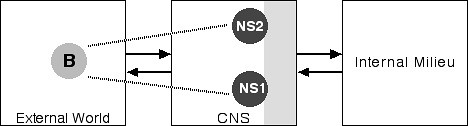
These different identities have different personal histories. The events in one personal history typically are unknown to the other histories. Each identity will have blank periods in its history, intervals, obviously, where another identity was being enacted. And the different "persons" are often unaware of one another. Further, the different identities seem to have different personal styles, different modes of speech, of movement, of dress, and so forth. Thus both the core and autobiographical selves seem to be riven. Using the conventions we employed above, Figure 7 is a simple depiction of DID:

Fig 7 DID

Figure 7: Dissociative Identity Disorder

Notice that we now have two neural selves, NS1 and NS2, corresponding to two different identities. Of course, these two selves exist in the same body, so we have only one corresponding body in the external world.

We do not, so far as I know, understand why or how DID happens. It is not, however, the result of the sort of gross destruction of brain tissue that underlies anosognosia. One might imagine, for example, that the different selves reside in distinctly different patches of neural tissue, a speculation that Damasio (1999b, 355) himself has suggested for the autobiographical self (though he presents no evidence). This suggestion, however, has at least one problem: How does the nervous system switch from one identity to another? There is another way of explaining DID, equally speculative and equally without specific evidence, that eliminates this particular problem.

Monday, May 27, 2013

Watch Out, Dan Dennett, Your Mind’s Changing Up on You!

I want to look at two recent pieces by Daniel Dennett. One is a formal paper from 2009, The Cultural Evolution of Words and Other Thinking Tools (Cold Spring Harbor Symposia on Quantitative Biology, Volume LXXIV, pp. 1-7, 2009). The other is an informal interview from January of 2013, The Normal Well-Tempered Mind. What interests me is how Dennett thinks about computation in these two pieces.

In the first piece Dennett seems to be using the standard-issue computational model/metaphor that he’s been using for decades, as have others. This is the notion of a so-called von Neumann machine with a single processor and a multilayer top-down software architecture. In the second and more recent piece Dennett begins by asserting that, no, that’s not how the brain works, I was wrong. At the very end I suggest that the idea of the homuncular meme may have served Dennett as a bridge from the older to the more recent conception.

Words, Applets, and the Digital Computer

As everyone knows, Richard Dawkins coined the term “meme” as the cultural analogue to the biological gene, or alternatively, a virus. Dennett has been one of the most enthusiastic academic proponents of this idea. In his 2009 Cold Spring Harbor piece Dennett concentrates his attention on words as memes, perhaps the most important class of memes. Midway through the paper tells us that “Words are not just like software viruses; they are software viruses, a fact that emerges quite uncontroversially once we adjust our understanding of computation and software.”

Those first two phrases, before the comma, assert a strong identification between words and software viruses. They are the same (kind of) thing. Then Dennett backs off. They are the same, providing of course, that “we adjust our understanding of computation and software.” Just how much adjusting is Dennett going to ask us to do?
This is made easier for our imaginations by the recent development of Java, the software language that can “run on any platform” and hence has moved to something like fixation in the ecology of the Internet. The intelligent composer of Java applets (small programs that are downloaded and run on individual computers attached to the Internet) does not need to know the hardware or operating system (Mac, PC, Linux, . . .) of the host computer because each computer downloads a Java Virtual Machine (JVM), designed to translate automatically between Java and the hardware, whatever it is.
The “platform” on which words “run” is, of course, the human brain, about which Dennett says nothing beyond asserting that it is there (a bit later). If you have some problems about the resemblance between brains and digital computers, Dennett is not going to say anything that will help you. What he does say, however, is interesting.

Notice that he refers to “the intelligent composer of Java applets.” That is, the programmer who writes those applets. Dennett knows, and will assert later on, that words are not “composed” in that way. They just happen in the normal course of language use in a community. In that respect, words are quite different from Java applets. Words ARE NOT explicitly designed; Java applets ARE. Those Java applets seem to have replaced computer viruses in Dennett’s exposition, for he never again refers to them, though they figured emphatically in the topic sentence of this paragraph.
The JVM is “transparent” (users seldom if ever encounter it or even suspect its existence), automatically revised as needed, and (relatively) safe; it will not permit rogue software variants to commandeer your computer.
Computer viruses, depending on their purpose, may also be “transparent” to users, but, unlike Java applets, they may also commandeer your computer. And that’s not nice. Earlier Dennett had said:
Our paradigmatic memes, words, would seem to be mutualists par excellence, because language is so obviously useful, but we can bear in mind the possibility that some words may, for one reason or another, flourish despite their deleterious effects on this utility.
Perhaps that’s one reason Dennett abandoned his talk of computer viruses in favor of those generally helpful Java applets.

Friday, November 25, 2016

Flexible Hubs and Behavioral Mode

This sort of thing is on my mind at the moment, so I thought I'd bump it to the top of the queue, just to cement it in my mind (temporarily). Plus I've added abstracts from and links to the original research.

* * * * *

From Medical Xpress:
Now, research from Washington University in St. Louis offers new and compelling evidence that a well-connected core brain network based in the lateral prefrontal cortex and the posterior parietal cortex – parts of the brain most changed evolutionarily since our common ancestor with chimpanzees – contains "flexible hubs" that coordinate the brain's responses to novel cognitive challenges.

Acting as a central switching station for cognitive processing, this fronto-parietal brain network funnels incoming task instructions to those brain regions most adept at handling the cognitive task at hand, coordinating the transfer of information among processing brain regions to facilitate the rapid learning of new skills, the study finds.
"Flexible hubs are brain regions that coordinate activity throughout the brain to implement tasks – like a large Internet traffic router," suggests Michael Cole, PhD., a postdoctoral research associate in psychology at Washington University and lead author of the study published July 29 in the journal Nature Neuroscience. 
This is consistent with the concept of behavioral mode that David Hays and I adopted and adapted from Warren McCulloch.

This is in contrast to concepts of rigid modularity, where the brain is said to consist of quasi-autonomous behavioral modules, each dedicated to a specific perceptual, cognitive, or behavioral activity. These modules are conceived as being wired-in and universal across humans in a manner similar to, say, the skeletal system or the muscles. Barring pathology and injury, everyone's got the same set in the same arrangement. The notion of modes, and of behavioral hubs, allows for an open-ended arrangement of task specific configurations. The patterns of configuration are not wired-in, though many of the configured components would be.

Note: McCulloch was specifically interested in the reticular activating system, which is in the core of the brain and brain stem and is phylogenetically old. The structures pinpointed by Dr. Cole are in the cerebral cortex, which is a much newer structure. Beyond citing McCulloch's model Hays and I had no specific suggestions about other neural mechanisms that might be involved in modal organizing, though we talked informally about the need for such mechanisms.

* * * * * *

Friday, August 18, 2017

Mode & Behavior 1: Sonnet 129

I'm bumping this to the top of the queue because it's useful in an argument I want to make about the importance of descriptive literary criticism to the sciences of man. 
* * * * * 
Justly is shame very specially connected with this lust; justly, too, these members themselves, being moved and restrained not at our will, but by a certain independent autocracy, so to speak, are called "shameful." Their condition was different before sin. . . . because not yet did lust move those members without the will's consent; not yet did the flesh by its disobedience testify against the disobedience of man. For they were not created blind, as the unenlightened vulgar fancy; . . . Their eyes, therefore were open, but were not open to this, that is to say, were not observant so as to recognize what was conferred upon them by the garment of grace, for they had no consciousness of their members warring against their will. But when they were stripped of this grace, that their disobedience might be punished by fit retribution, there began in the movement of their bodily members a shameless novelty which made nakedness indecent.
— St. Augustine, The City of God, Book 14, Chapter 17.
This is the first in a series of posts about the concept of behavioral mode that David Hays and I adopted (and further developed) from one of the grand old men of neuroscience, Walter McCulloch. Rather than start from McCulloch, I want to motivate the concept by discussing one of the best-known and most discussed sonnets in the English language, Shakespeare’s Sonnet 129, “The expense of spirit.” The discussion is revised and adapted from two by now ancient papers of mine, “Lust in Action: An Abstraction” (1981) and “The Evolution of Narrative and the Self” (1993), and from an old post, Emotion Recollected in Tranquility. You might also want to look at my article, First Person: Neuro-Cognitive Notes on the Self in Life and in Fiction, which also talks about the neurochemical dynamic I discuss in this post.

Here’s the sonnet, with modernized spelling:
1 The expense of spirit in a waste of shame
2 Is lust in action, and till action, lust
3 Is perjured, murderous, bloody, full of blame,
4 Savage, extreme, rude, cruel, not to trust;
5 Enjoyed no sooner but despised straight,
6 Past reason hunted, and no sooner had,
7 Past reason hated as a swallowed bait
8 On purpose laid to make the taker mad:
9 Mad in pursuit and in possession so,
10 Had, having, and in quest to have, extreme;
11 A bliss in proof, and proved, a very woe,
12 Before, a joy proposed, behind, a dream.
13   All this the world well knows; yet none knows well
14   To shun the heaven that leads men to this hell.
Let’s set the final couplet aside for a moment and consider only the first twelve lines. These direct our attention back and forth over the following sequence of actions and mental states:
Desire: Protagonist becomes consumed with sexual desire and purses the object of that desire using whatever means are necessary: "perjur'd, murderous, bloody . . . not to trust" (ll. 3-4).

Consummation: Protagonist gets his way, having "a bliss in proof" (l. 11)

Shame: Desire satisfied, the protagonist is consumed with guilt: "despisèd straight" (l. 5), "no sooner had/ Past reason hated" (ll. 6-7).
Just to solidify the point, let’s look at some lines. Line 4 looks at Desire (“not to trust”), then line 5 evokes Consummation followed by Shame. Line 6 begins in Desire then moves to Consummation, followed by Shame at the beginning of line 7, whose second half begins a simile derived from hunting. Now line 10, which begins by pointing to Shame, then to Consummation, then to Desire, and concludes be characterizing the whole sordid business as “extreme.”

The poem’s final couplet asserts, in effect, that reason is powerless in this situation. Knowing that rancid meat can make you ill will prevent most people from eating rancid meat, but the knowledge that sexual desire will lead you to guilt and disgust is not powerful enough to prevent you from walking to the trap.

The question I want to ask is: Why, why is reason powerless? How could it be that foreknowledge is powerless? One might offer the observation that, when one is in the pursuit of sex, one simply doesn’t think about the guilt-driven aftermath. Accepting that as true, it explains nothing. Why does sexual pursuit make it difficult or even impossible to imagine consequent guilt and recrimination? That’s the question.

Thursday, December 10, 2015

My Take on Neuroscience and Literature

If someone interested in neuroscience and literature was to take a look at my work, what would they find? Quite a bit, but it’s scattered across a lot of publications written over the course of – yikes! – almost four decades. It’s something that’s been on my mind a long time, but I’ve never really gone at it, front and center. It’s always been attached to some other line of thought, most likely some species of cognitive science.

Perhaps the place to start is with two informal working papers, one on Mode and Behavior [10] and the other on Literature, Emotion, and Unity of Being [13]. The second ends by linking Wordsworth’s notion of poetry as recollection in tranquility to the biochemistry of mind, which is also a central feature of Mode and Behavior, where it is linked to Shakespeare’s Sonnet 129, The Expense of Spirit – some of my earliest publications used that poem as an example ([1] and [2]). 

Beyond this, my 2001 book on music, Beethoven’s Anvil [6], has quite a bit on the nervous system and anticipates a line of research in interpersonal coupling and synchrony that’s been popular over the last decade and a half. We you consider the fact that oral delivery preceded written texts, those ideas are relevant to literature as well. That book also has a conception of pleasure that has implications for aesthetics.

Finally, there’s a very long paper, “Kubla Khan” and the Embodied Mind [7]. The early sections update the work I did at Johns Hopkins between, say, 1969 and 1972; they’re mostly descriptive in character. A later section, Low Down and Abstract, speculates on how that structure is embodied in the brain.

* * * * *

Here’s an annotated list of the most relevant work, with formal publications first and then some informal pieces I’ve self published. I’ve listed them in chronological order.

Wednesday, June 19, 2019

Has the computer metaphor for the mind run out of steam?

In May of this year John Brockman hosted one of those high-class gab fests he loves so much. This one was one the theme of Possible Minds (from this book). Here's a talk by Rodney Brooks, with comments by various distinguished others, on the theme "The Cul-de-Sac of the Computational Metaphor". Brooks opens:
I’m worried that the crack cocaine of Moore’s law, which has given us more and more computation, has lulled us into thinking that that’s all there is. When you look at Claus Pias’s introduction to the Macy Conferences book, he writes, "The common precondition of the three foundational concepts of cybernetics—switching (Boolean) algebra, information theory and feedback—is digitality." They go straight into digitality in this conference. He says, "We considered Turing’s universal machine as a 'model' for brains, employing Pitts' and McCulloch’s calculus for activity in neural nets." Anyone who has looked at the Pitts and McCulloch papers knows it's a very primitive view of what is happening in neurons. But they adopted Turing’s universal machine.

How did Turing come up with Turing computation? In his 1936 paper, he talks about a human computer. Interestingly, he uses the male pronoun, whereas most of them were women. A human computer had a piece of paper, wrote things down, and followed rules—that was his model of computation, which we have come to accept.
[Note that Turing came up with his concept of computational process by abstracting over what he observed humans do while calculating. It's an abstracted imitation of a human activity.– B.B.]
We’re talking about cybernetics, but in AI, in John McCarthy’s 1955 proposal for the 1956 AI Workshop at Dartmouth, the very first sentence is, "We propose a study of artificial intelligence." He never defines artificial intelligence beyond that first sentence. That’s the first place it’s ever been used. But the second sentence is, "The study is to proceed on the basis of the conjecture that every aspect of learning or any other feature of intelligence can in principle be so precisely described that a machine can be made to simulate it." As a materialist reductionist, I agree with that.

The second paragraph is, "If a machine can do a job, then an automatic calculator can be programmed to simulate the machine." That’s a jump from any sort of machine to an automatic calculator. And that’s in the air, that’s what we all think. Neuroscience uses computation as a metaphor, and I question whether that’s the right set of metaphors. We know computation is not enough for everything. Classical computation cannot handle quantum information processing.
Note the opposition/distinction between classical computing and quantum information processing: classical|quantum, computing|information processing. Of course quantum computing is all the rage in some quarters as it promises enormous through-put.

Various people interrupt with observations about those initial remarks. Note this one from Stephen Wolfram: "The formalism of quantum mechanics, like the formalism of current classical mechanics, is about real numbers and is not similar to the way computation works."

What's computation? Brooks notes:
Who is familiar with Lakoff and Johnson’s arguments in Metaphors We Live By? They talk about how we think in metaphors, which are based in the physical world in which we operate. That’s how we think and reason. In Turing’s computation, we use metaphors of place, and state, and change of state at place, and that’s the way we think about computation. We think of it as these little places where we put stuff and we move it around. That’s our vision of computation.
One example where, Brooks claims, the computer metaphor doesn't work very well:
Here’s another example: Where did neurons come from? If you go back to very primitive creatures, there was electrical transmission across surfaces of cells, and then some things managed to transmit internally in the axons. If you look at jellyfish, sometimes they have totally separate neural networks of different neurons and completely separate networks for different behaviors.

For instance, one of the things that neurons work out well for jellyfish is how to synchronize their swimming. They have a central clock generator, the signal gets distributed on the neurons, but there are different transmission times from the central clock to the different parts of the creature. So, how do they handle that? Well, different species handle it in different ways. Some use amazingly fast propagation. Others, because the spikes attenuate as they go a certain distance, there is a latency, which is inversely proportional to the signal strength. So, the weaker the signal strength, the quicker you operate, and that’s how the whole thing synchronizes.

Is information processing the right metaphor there? Or are control theory and resonance and synchronization the right metaphor? We need different metaphors at different times, rather than just computation. Physical intuition that we probably have as we think about computation has served physicists well, until you get to the quantum world. When you get to the quantum world, that physical intuition about stuff and place gets in the way.
A bit later Brooks notes: "A lot of what we do in computation and in physics and in neuroscience is getting stuck in these metaphors."

A bit later Brooks notes:
I pointed out in the note to John [Brockman] about a recent paper titled "Could a Neuroscientist Understand a Microprocessor?" I talked about this many years ago. I speculated that if you applied the ways neuroscientists work on brains, with probes, and look at correlations between signals and applied that to a microprocessor without a model of the microprocessor and how it works, it would be very hard to figure out how it works.

There’s a great paper in PLOS last year where they took a 6502 microprocessor that was running Donkey Kong and a few other games and did lesion studies on it, they put probes in. They found the Donkey Kong transistors, which if you lesioned out 98 of the 4,000 transistors, Donkey Kong failed, whereas different games didn’t fail with those same transistors. So, that was localizing Donkey Kong-ness in the 6502.

They ran many experiments, similar to those run in neuroscience. Without an underlying model of what was going on internally, it came up with pretty much garbage stuff that no computer scientist thinks relevant to anything. It’s breaking abstraction. That’s why I’m wondering about where we can find new abstractions, not necessarily as different as quantum mechanics or relativity is from normal physics, but are there different ways of thinking that are not extremely mind-breaking that will enable us to do new things in the way that computation and calculus enables us to do new things?

Friday, April 8, 2022

To Model the Mind: Speculative Engineering as Philosophy

New working paper. Title above, abstract, contents, and introduction below. Download at:

Abstract: Are brains computers? Some say yes, some say no. Does it matter? Ideas about computing have certainly proven fruitful in understanding how brains give rise to minds. That’s what this paper is about. The central section is a review of Grace Lindsey’s wonderful book Models of the Mind: How Physics, Engineering, and Mathematics Have Shaped Our Understanding of the Brain (2021). I precede it with a bit of philosophy and follow it with brief notices about five books, each proposing computationally inspired models of the mind.

Contents

Introduction: Brains, machines, and computation 2
Speculative Engineering as Philosophy 4
To Understand the Mind We Must Build One, A Review of Models of the Mind – Bye Bye René, Hello Giambattista 9
Five Good Books 15

Introduction: Brains, machines, and computation

I remember when electronic digital computers were sometimes called electronic brains. The following graph from Google Ngram shows the rise and fall of the terms “electronic brain” and “electric brains.”

Why the quick rise and fall? I’d guess that’s when these remarkable machines first gained public attention. It wasn’t clear what kind of beast they were. How do we refer to them? For a while, we tried out the idea that they were a kind of brain. After all, they did the kinds of things that brains did. They tabulated, sorted, and calculated.

But they also inspired. During the interval of that peak the study of artificial intelligence was inaugurated at a conference at Dartmouth in 1956. Machine translation, the use of a computer to translate text from one language to another arose in the 1950s and then collapsed, alas, in the mid-1960s for lack of practical results. Noam Chomsky conceived of grammar in computational terms. Warren McCulloch and Walter Pitts conceived of neurons as tiny logic engines in the early 1940s and computational ideas began taking hold in neuroscience and philosophy.

Are brains computers? Some say yes, some say no. Does it matter? For ideas about computing have certainly proven fruitful in understanding how brains give rise to minds. That’s what this paper is about. The central section is a review of Grace Lindsey’s wonderful book Models of the Mind: How Physics, Engineering, and Mathematics Have Shaped Our Understanding of the Brain (2021). I precede it with a bit of philosophy and follow it with brief notices about five books, each proposing computationally inspired models of the mind.

* * * * *

Speculative Engineering as Philosophy: Engineering is about how things are designed and constructed. I am interested in how the brain works, how it constructs a mind. When we theorize about that, thinking about models, experiments, or simulations, we are speculating about the engineering principles on which the brain operates. I argue that that is a form of philosophy, in the broadest sense of the term, though not necessarily as philosophy exists as an academic discipline.

To Understand the Mind We Must Build One, A Review of Models of the Mind – Bye Bye René, Hello Giambattista: Descartes believed that truth is verified through observation. Vico had a different view, believing that “What is true is precisely what is made.” Grace Lindsey ‘s Models of the Mind is Viconian in spirit. Its subtitle tells the story: How Physics, Engineering, and Mathematics Have Shaped Our Understanding of the Brain. Lindsey traces the history of the of a wide variety of models and techniques, often back into the 19th and even 18th centuries, in a simple and direct way. I turn my review on a few cases: 1) the 1943 McCulloch and Pitts model of neurons as logical operators, 2) Frank Rosenblatt’s Perceptron from the late 1950s, and 3) Jerome Lettvin’s 1959 work on the frog’s visual system, which Nicholas Humphrey parlayed in a 1970 article on the monkey’s visual system. That last brings in an evolutionary angle. The whole thing is wrapped up by Joyce’s Finnegans Wake, and its Latin translation.

Five Good Books: Short notices for five books, each about the mind and/or brain, each in a different style: 1) John von Neumann (1958), The Computer and the Brain, 2) Herbert A. Simon (1981), The Sciences of the Artificial, 3) William Powers (1973), Behavior: The Control of Perception, 4) David G. Hays (1981), Cognitive Structures, and 5) Valentine Braitenberg (1999), Vehicles: Experiments in Synthetic Psychology.

Friday, August 13, 2010

Mode & Behavior 3: Music, Language, and Beyond

Introduction and Recap

In the first post in this series I introduced the concept of behavioral mode through a brief analysis of the situation Shakespeare scrutinized in Sonnet 129, “The expense of spirit.” The central point was that our thoughts and memories are realized in neural tissue that is sensitive to neurochemical state. What you can think about and remember depends on the chemical state of the tissue that, in effect, is doing the thinking. Lust and moral reflection are facilitated by different neurochemical substrates, making it difficult to achieve a coherent and consistent point of view on one’s own activity.

In the second post I located modal control in the reticular formation , as modeled by Warren McCulloch in 1969. The reticular formation is a phylogenetically old structure, one with extensive connection to and from the rest of the brain. It is, therefore, in a position where it can affect the operational state of the entire brain. This implies, in turn, that the brain is subject to control from ‘below’ as well as from ‘above’ (in a so-called executive often located in the frontal lobes).

In McCulloch’s view behavioral mode is affects the state of the entire brain, with some areas more active than others as appropriate to the mode. David Hays and I took his conception and related it to the brain imaging studies that were then becoming more common (the late 1970s and early 1980s). Those studies showed that activities such as speaking or doing arithmetic corresponded to patterns of differential arousal across the whole brain rather than to arousal of discrete and independent cortical ‘modules.’

The human modes

But how are these specifically human modes – speech, calculating, writing, etc. – regulated? It seems unlikely that they are driven primarily from below, by the reticular system. Nor is it obvious to me that they are regulated in any simple way.

In Beethoven’s Anvil, and recounted in this review-essay, I argued that a form of proto-music making preceded speech in human phylogeny, and that it arose more or less spontaneously and fortuitously is small groups that started synchronizing their movements and so coupling their nervous systems (cf. this post on synchronized clapping). Whatever mode the group members were in, that’s the link between the specifically human and animal sociality. Perhaps such synchronization is possible from within a number of animal modes, after all, we use speech for a variety of purposes, simply reporting events, emotional expression, directing the activity of others, and so forth.

The hallmark of music-making and of speech is the fact of neural coupling between nervous systems, of synchronization. It is the fact of that coupling, I suggest, that stabilizes the brain’s mode. One brain supports another; the brains of individuals in a group become mutually reinforcing. In Chapter 9 of Beethoven’s Anvil I argued, in effect, that the specifically human aspect of our sociality is grounded in this neural coupling and so is not simply an amplification or extension of higher primate sociality. It is, rather, a new form of sociality. With the emergence of full-blown language, the entire human life-world becomes reconstructed in, inscribed in, this specifically human social realm, giving us the world of myth, folktales, ritual, taboo, and so forth.
[Subsequent to writing Beethoven’s Anvil I discovered the work of Christopher Boehm, Hierarchy in the Forest (Harvard 1999), who also argued for specifically human sociality, though he didn’t ground it in music or neuro-behavioral coupling.]
And one aspect of the life-world that receives specific attention is its modal structure. Thus we have the Winnebago Trickster tales with stories of defecation and wandering, of eating and adventuring, of courtship and childbirth (Paul Radin, The Trickster, Schocken 1972). And taboos governing what’s to be eaten, who can say what to whom, and so forth, through a long list.

The larger question is: just how many specifically human behaviors are modal in this sense, how many differentiated and stable patterns of cortical arousal are possible? I surely don’t know. Speaking and music-making appear to be modal, with some overlap in cortical involvement (cf. the review in Steven Mithen, The Singing Neanderthals). Does food preparation require its own mode? What about carving wood? Or throwing pots, weaving? All of these activities requires concentrated attention if it is to be done well, that suggests to me that they may be modal. If so, then the number of specifically human modes may be legion.

Note that only some of these modes require neural coupling with others. One can prepare a meal or throw a pot alone. Though such activities are often done in the company of others, and that may often involve chatting, the company and the chatting don’t seem intrinsic to the activity itself.

Monday, June 17, 2024

Affective Technology @ 3QD

I’ve decided to do a three-part series at 3 Quarks Daily. The topic is affective technology, affective because it can transform how we feel, technology because it is an art (tekhnē) and, as such, has a logos. The first article is now posted:

Affective Technology, Part 1: Poems and Stories https://3quarksdaily.com/3quarksdaily/2024/06/affective-technology-part-1-poems-and-stories.html

In this first article I present the problem, followed by some informal examples, a poem by Coleridge, a passage from Tom Sawyer that echoes passages from my childhood, and some informal comments about underlying mechanism. The idea is simple. Although we do not have direct control over our emotions, that is, we cannot will them into existence nor extinguish or diminish them at all, we can manipulate them indirectly through art. In this series, at least in the first two articles, I’ll be concerned with literary texts.

The second article has a working title: Affective Technology, Part 2: Emotion recollected in tranquility. The title phrase is from Wordsworth’s well-known preface to the Lyrical Ballads:

I have said that poetry is the spontaneous overflow of powerful feelings: it takes its origin from emotion recollected in tranquility: the emotion is contemplated till by a species of reaction the tranquility gradually disappears, and an emotion, kindred to that which was before the subject of contemplation, is gradually produced, and does itself actually exist in the mind.

I expand on Wordsworth’s idea with two ideas: 1) Warren McCulloch’s concept of behavioral mode, which is a theory about the function of the reticular activating system, one of the oldest portions of the nervous system, and 2) an idea from the early 1970s, Charles Tart’s concept of state-specific learning. I illustrate this with an analysis of Shakespeare’s well-known Sonnet 129, Th’Expense of Spirit, which depicts the anguish of a man who cannot prevent himself from abusing women sexually even though he is inevitably overcome with recrimination afterward.

In the third article, Affective Technology, Part 3: Coherence in the Self, I’ll open with dissociative identity disorder (DID), in which an individual mind is fractured in two or more quasi-independent personalities. I will argue that that possibility is inherent in the structure and processes of a nervous system that operates according to McCulloch’s model. Artistic works, however, help us keep a unified personality by providing an affectively ‘neutral’ ground – the Wordsworthian space of tranquil recollection – in which the various modes can coexist.

Some of these ideas have been worked out in further detail in the following papers:

Lust in Action: An Abstraction, Language and Style 14, 1981, 251-270, https://www.academia.edu/7931834/Lust_in_Action_An_Abstraction.

The Evolution of Narrative and the Self, Journal of Social and Evolutionary Systems, 16(2): 129-155, 1993, https://www.academia.edu/235114/The_Evolution_of_Narrative_and_the_Self.

Talking with Nature in "This Lime-Tree Bower My Prison." PsyArt: A Hyperlink Journal for the Psychological Study of the Arts, November, 2004, https://www.academia.edu/8345952/Talking_with_Nature_in_This_Lime-Tree_Bower_My_Prison_.

Monday, December 14, 2020

Jerry Seinfield on his career and craft [Progress in harnessing the mind]

Skip the first 7:35; the host, Tim Ferriss, reads advertisements for his sponsors. The rest (except for another commercial interruption at about 30:50) is a fascinating conversation with Jerry Seinfield, who's just published a new book about his career and craft, Is This Anything? One of the most interesting lines of discussion is about how Seinfield 'trains' is brain to write. Yes, he's a stand-up comedian performing for a live audience, but he creates his material through writing.

He repeatedly uses talks of the brain as a dog that needs to be trained. The training must be systematic, and the system(s) must be simple. THe first talks about writing at about 12:30 or so, though the dog metaphor doesn't show up until somewhat later.

First of all he emphasizes that writing is difficult, very difficult. There are two phases (c. 15:00 or so): 1) free-form creative, 2) polish and construction. Writing is 95% rewriting. Once he's polished a bit to the point where it sounds pleasing to his (inner) ear, he takes it on stage. He registers audience response and uses it to guide more rewriting. C. 17:42:

Creating, fixing, jettisoning, it's extremely occupying, it's never boring, it's, the frustration I'm so used to it at this point I don't even notice it, And, it's just work time.... I like the way athletes talk about "I gotta' get my work in."

A bit later he uses the phrase, "the systemization of the brain and creative endeavor." That's clearly something Seinfield has thought about a lot, and over his whole career. And then 18:34: So basically it's on stage and off stage, the desk and then the stage, and then back to the desk, and then back to the stage, and that's endless." So we've got two desk phases, creative and rewriting, and then back and forth between desk and stage. Seinfield then does on to talk about being cranky and irritable. That's the source of those little insights around which he builds his bits.

Skipping over various material, including his TV show, his younger years when he looked into (c. 30:00), "yoga, Zen, a little Scientology, Transcendental Meditation, Buddhism, I read a lot of stuff...I was looking for a working philosophy" and from that he created his own "operating system" his term. "It's very pragmatic. It's not faith-based in any way."

Seinfield then starts talking about his daughter, who has a "creative gift." (c. 33:57): "When you have a creative gift, it's like someone just gave you a horse. Now you have to learn how to ride it...You either learn to ride this thing, or it's going to kill you." And now we get back to writing (c. 33:41):

If you're going to writing, make yourself a writing session What's the writing session? I'm going to work on this problem. Well, how long are you going to work on it? Don't just sit down with an open-ended "I'm gonna work on this problem." That's a ridiculous torture to put on a human being's head... You've got to control what your brain can take... You have to have an end time to your writing session. If you're gonna sit down at a desk with a problem and do nothin' else, you gotta' get a reward for that. And the reward is the alarm goes off and you're done. You get up and walk away a go have some cookies and milk...That's the beginning of a system.

He goes on and gets around to exercise, mentioning a book, Body for Life, by Bill Phillips, which he praises for the way it systematizes exercise. And now we come to it, the dog, (c. 38:10): "You gotta' treat your brain like a dog you just got. You got it; it's so stupid. The mind is infinte in wisdom. The brain is a stupid little dog that is easily trained....Do not confused the mind with the brain."

Though it is obvious enough, notice Seinfield's distinction between mind and brain. Though he no doubt knows that the mind is somehow in the brain, he doesn't talk about it. He talks about the brain. And he talks about training is as though one trains one's body or as one trains a stallion or a "stupid little dog." This training is being executed by an operating system. His instructions about writing remind me of the routine of Anthony Trollop, the Victorian novelist, who set himself to writing 250 words every 15 minutes for three hours a day between 5:30 and 8:30 each morning. Following this routine he wrote more than a novel a year for 30 years.

Let's return to Seinfeld. He tells us that we should never tell anyone about what we wrote on the day we wrote it. Why? Because they might criticize it and that would rob you of the satisfaction of having done your writing for the day. That satisfaction is very important. It's your reward. (c. 40:34): "The key to being a good writer is to treat yourself a baby, very extremely nurturing and loving, and then switch over to Lou Gossett in Officer and a Gentleman and just be a harsh prick ball-busting son-of-a-bitch about that is just not good enough." You switch back and forth between these two modes, which Seinfeld likens to two "quadrants" of the brain.

Ferriss then asks him about performing and whether or not, when he's just finished a (killer) set, he asks for feedback from other comics. Before Ferriss finished Seinfeld remarks that "you just got feedback" (the audience's reaction); you don't need anything more: "You don't have to ask anyone anything."

About performance, Seinfeld goes on (c. 42:44):

There's no greater reward than that state of mind you're in when that set is working. If you can extricate yourself from your Self, which is the goal in all sports and performance arts, if you get out of your mind, and are able to just function ... there is no greater reward. But, you know, if you want to have an ice cream Sunday, go ahead. It's going to pale in comparison.

We're now only about halfway through the interview, but it's time for me to wrap this up. Feel free to listen to the whole thing.

It seems to me that Seinfeld is talking about behavioral modes, in the sense that I've written about them in many posts here at New Savanna. The idea of behavior mode comes from Warren McCulloch and it refers to distinct pattern of global brain activity that supports a particular kind of behavior. McCulloch is was interested in such things as hunting, sleeping, exploration, courtship and so forth. Seinfeld talks 1) creativity (generating ideas0, 2) critiquing, editing, and rewriting, and 3) performing. His operating system moves the brain (a stupid little dog) from one mode to another. Notice his emphasis on boundaries. The writing session has a definite beginning and a definite ending. So does a performance. The trick is to learn how to move the brain from one mode to another.

Finally, I note that being able to talk and write about the mind-brain in these terms, for a general audience and without mystification, counts a human progress as surely as DeepMind's recent breakthrough in protein folding. Why? Because, ultimately, a human behavior and hence all progress depends on the mind. Learning to harness the mind's activities is the deepest and most difficult task before us. Without that, little else can happen.

* * * * *

Addendum: Somewhat later in the discussion the Seinfeld raises the subject of depression, nothing that he still gets depressed, saying nothing about how often, for how long, nor how severely. Ferriss notes that he too gets depressed. Seinfeld mentions that about 20 years ago he read that depression seems to accompany creativity; that gave him a sense of relief. He does not, however, belief that creativity comes out of depression (as he said before, it comes from irritability and crankiness). You might want to take a look at this post from August, Perhaps these conditions aren't mental disorders at all (anxiety, depression, PTSD).

Sunday, August 25, 2013

Neural Weather, an Informal Defense of Psychoanalytic Ideas

I’ve been wrestling with a post on unity of being, of all things, in two films, Fantasia and Dumbo, of all films, and I round myself thinking psychoanalytic thoughts. Not particularly deep thoughts, and certainly not up on the latest ideas, whatever they might be, but psychoanalytic nonetheless. There’s nothing else in my conceptual repertoire that can do the job those ideas do.

IMGP0791rd

I first found Freud in the basement of the house on Luther Road. There was a small closet in the corner and my father had a box or two of paperback books in it. I don’t remember but a few titles; in fact, I’m only sure of two: Wodehouse on Golf, which I never read, and 1984, which I most certainly did read, as it had a pulpy cover that promised sex – a buxom brunette in a tight blue jumpsuit emblazoned with “Women’s Anti-Sex League” – in THAT costume! Yowzah! Of course, the book wasn’t quite what the cover advertised, but that was OK. I may also have found Brave New World there, I’m not sure. Come to think of it though, that probably IS where I found War of the Worlds. So that’s three titles I’m pretty sure of.

I probably found some Bertrand Russell, too, though just exactly what, I can’t recall. I went on to buy a bunch of Russell, including his history of Western philosophy. I also found something by Theodore Reik, and went on to buy more of THAT. And I found Freud, perhaps Three Essays on the Theory of Sexuality; after all, it has that magic word in the title: s e x.

In the summer between my freshman and sophomore years at Johns Hopkins I read The Interpretation of Dreams. Somewhere in there I picked up a five-volume set of The Collected Papers from my book club. I’ve still got them, though they’re in storage along with some other Freud. But I’ve still got Totem and Taboo, Civilization and It’s Discontents, and The Future of an Illusion on the shelves in my apartment. They’re slender volumes and so don’t take up much space & Civilization plays to my interest in cultural evolution.

But the book that really sold me on psychoanalysis was Erik Erikson’s Childhood and Society. I read him in a developmental psych course taught by Mary Ainsworth. I found his account of the developmental unfolding (epigenisis) of the organ modes (oral, anal, etc.) quite compelling. Ainsworth also introduced me to the work of John Bowlby. I read the first volume of his Attachment and Loss series in typescript in 1967 or ’68, before it came out in 1969. His reworking of object relations theory using primate ethology and systems theory, I found that very compelling. And his remarks on defense and information processing in the final volume, Loss (which didn’t appear until 1980), seem and seemed quite promising.

There’s something in all this that’s indispensible and foundational. Just what, though, I’m not sure. If you look at my published work you won’t find much psychoanalytic thinking there – e.g. in At the Edge of the Modern, or Why is Prospero Shakespeare’s Greatest Creation? or Talking with Nature in “This Lime-Tree Bower My Prison” – but it plays an essential role in those few publications and it pervades my thought in areas where its influence is too diffuse for meaningful citation
 
* * * * *

What’s important about psychoanalytic thought, what makes in indispensable, is that it is a theory of mind. Not of the brain, but of the mind. Yes, I understand that neuroscience is careening its rough way toward an understanding of the brain, and yes, I understand that there’s a good deal of work being done on the neural underpinnings of psychoanalysis, but it is the mind that interests me. And it is the mind that I see at work in Fantasia and Dumbo, and in Much Ado About Nothing, Wuthering Heights, “Kubla Khan” and many other texts.

The mind. Not the brain.

In thus distinguishing mind and brain I do not mean to elevate (or is it lower?) the mind to some ethereal realm mysteriously apart from yet causally implicated in the material brain. The mind IS what the brain does. And the brain does it more subtly that we can imagine.

It’s that subtlety that we’ve got to attend to.

The brain consists of some 100s of neurofunctional areas. Enormous time and effort has gone into figuring out just what each area does and how it relates to what goes on in other areas. Much of this thinking seems like it follows from a vision of a Kafkaesque bureaucracy in which each neurofunctional area is a separate office. These offices receive messages written on scraps of paper sent around through pneumatic tubes. A functionary receives a bunch of such scraps at his desk, reviews them, and writes this or that on fresh scraps which he then sends out through tubes taking them to other anonymous functionaries. This is called information processing.

The thing is, those 100s of neurofunctional areas are each composed of millions upon millions of neurons, each of which is directly connected to 10,000 or so other neurons. Some of those neurons are connected to immediately adjacent neurons; others are connected to more distant neurons in the same neurofunctional area; and many others are connected to neurons in other neurofunctional areas, some close by, some quite distant. If two neurons don’t share any direct connections, chances are they are indirectly connected by multiple chains, some of them of only two or three links, others of five or six links.

Whatever the brain IS, it IS NOT an information-processing bureaucracy.

In my own work I’ve used the metaphor of weather, the mind as neural weather. Think of the brain as a complex landscape and the mind as the swirls and eddies of air, water, and dust blowing through it. And think of defense mechanisms as forms of neural weather. Denial, projection, dissociation, repression, sublimation, and all the rest, they’re complex patterns of activity each involving the whole brain. This, it seems to me, is one area where psychoanalytic thought is going to prove out.

Don’t ask me just how that’s going to go, because I don’t know. But if I were to make the reconstruction of psychoanalytic theorizing a central concern, that’s one of the things I’d concentrate on, that and the organ modes, which I’d investigate through Warren McCulloch’s concept of behavioral mode. (Curiously enough, McCulloch was bitterly opposed to psychoanalysis and inveighed against it in “The Past of a Delusion,” published in Embodiments of Mind, 1965, pp. 276-306.)

* * * * *

Tuesday, December 24, 2019

How does the architecture of the mind differ from the anatomy and physiology of the brain? [Notes on mind-culture co-evolution 2]

In my first post in this series, What is the Darwinian individual in the evolution of expressive culture? – which, incidentally, wasn’t a series when I posted it, and who knows how long it will be one, not very long? – I commented on a preprint by Daniel Nettle.

In particular, I asserted:
Biological evolution is about bodies. Cultural evolution is about minds. And yes, the mind is what the brain does and so the mind can never be free of the body. Ultimately, the cultural development of minds must at the very least not harm the biological integrity of bodies. But, over the long term, minds can evolve independently of bodies and that is what we see in the history of human societies. Brains are much the same everywhere, but cultures differ and so, I argue, do the minds that support those cultures.
What do I mean by that: “minds can evolve independently of bodies and that is what we see in the history of human societies.”

I’m talking about mental architecture. The fact of literacy, for example, means that the minds of people in a society possessing a literate culture have a different mental architecture from those on people in a pre-literate society. The brains of people in the people in both those societies will be pretty much the same. Oh, literate people have neocortical specializations that pre-literate people will not have. But that’s NOT a matter of genetically specified physical structure. We know that neocortical specialization is affected by the kinds of experience a person is exposed to. People maturing in a literate society have the various experiences of reading and writing. They need to be able to read fluently, and to write.

And when you write, what are you doing? You are addressing yourself to someone who isn’t there. You may have a specific someone in mind or it may just be a generalized other, as they say. Pre-literate people don’t do that, not in the same way, with the same intensity and requirements of continuity. And certainly not with visible marks on some surface carrying the linguistic signal.

This requires a different pattern of neural activation. To a first approximation, everyone neurofunctional area (NFA) is connected to every other NFA. Some connections may be direct, others indirect. Consider: NFA-q <> NFA-d <> NFA-t. NFA-Q and NFA-d are directly connected, as are NFA-d and NFA-t. NFA-q and NFA-t are only indirectly connected (through NFA-d). Incidentally, wouldn’t a diagram make that easier to understand? You could see those relations at a glance.

Such patterns are what David Hays and I have called behavioral modes [1], following Warren McCulloch [2]. If you will, think of the mind as neural weather. Physical topography remains constant – mountains, valleys, plains, rolling hills, and so forth – but the weather drastically can vary. I used this metaphor in Beethoven’s Anvil (72-73) [3]:
Thus in this view the mind is like the weather. The same environment can have very different kinds of weather. And while we find it natural to talk of weather systems as configurations of geography, temperature, humidity, air pressure etc., no overall mechanism regulates the weather. The weather is the result of many processes operating on different temporal and spatial scales.

At the global level and on a scale of millennia we have the long-term patterns governing the ebb and flow of glaciers which, in one commonly accepted theory, is a function of wobble and tilt in the earth’s spin axis and the shape of the earth’s orbit. At the global level and operating annually we have the succession of seasons, which is caused by the orientation of the earth with respect to the sun as it moves through the year. We can continue on, considering smaller and smaller scales until we are considering the wind whipping between the twin towers of the World Trade Center or the breeze coming in through your open window and blowing the papers off your desk.

Weather is regular enough that one can predict general patterns at scales of hours, days, and months, but not so regular that making such predictions is easy and routinely reliable. Above all, there is no central mechanism governing the weather. It just happens. [...]

So it is with the brain. The overall state is not explicitly controlled, at least not at a high degree of precision. Rather, that overall state reflects activities at various levels within the whole system. At the smallest level we have the individual neurons. Neurons are living cells and, as such, act to maintain their existence. Individual neurons, in turn, are grouped into functional units at several levels, with many neurons connected to others at distances ranging from fractions of a millimeter to several centimeters or more. Many of these functional units are coupled together into systems that explicitly control something else—whether it be another system within the nervous system, or something external to it, either elsewhere in the body (the muscles or the viscera) or in the external world. But there is no component of the brain that regulates all of this activity in detail. The overall activity just happens. That overall activity is what I am calling the mind.
The brain is a physical structure with parts, whose parts have parts, and so on down to individual neurons. These parts have many and various connections with one another. Does the mind have parts? I don’t know. Those different modes don’t strike me as being different parts of an overall mind. Their interrelations are different. What IS clear is that you cannot divide the mind into parts such that those parts align with the parts of the brain. That’s not how it works.

Moreover, it is not only that literacy affords different patterns of neural weather, but it remakes in external world in a very particular way. Now the world contains surfaces on which things are written; those surfaces become, in effect, part of one’s mental architecture – some talk of such media as encompassing an extended mind. What of arithmetic calculation? That requires a different pattern of neural activation, one that requires a great deal of drill and practice over a period of years if it is to be used comfortably and reliably.

THAT’s what I mean when I say that the evolution of culture supports the evolution of minds, while the underlying body, with its brain, remains much the same. And so we have a theory of mind-culture co-evolution. Biological evolution is about the body. Cultural evolution is about the mind.

References

[1] I have many posts on behavioral mode, collected under this URL, https://new-savanna.blogspot.com/search/label/behavioral%20mode.

Benzon, W. L. and Hays, D. G. (1988). Principles and Development of Natural Intelligence. Journal of Social Biological Structures 11, 293-322, https://www.academia.edu/235116/Principles_and_Development_of_Natural_Intelligence.

[2] Kilmer, W. L., McCulloch, W. S. & Blum L. (1969). A Model of the Vertebrate Central Command System. International Journal Man-Machine Studies 1, 279-309.

[3] William Benzon, Beethoven’s Anvil: Music in Mind and Culture, Basic Books, 2001. Final drafts of chapters 2 and 3 can be downloaded from the web, https://www.academia.edu/232642/Beethovens_Anvil_Music_in_Mind_and_Culture. For a shorter version of mind-as-weather, see William Benzon, NEURAL WEATHER, An Informal Defense of Psychoanalytic Ideas, Working Paper, August 25, 2013, 6 pp., https://www.academia.edu/37605450/NEURAL_WEATHER_An_Informal_Defense_of_Psychoanalytic_Ideas.

Monday, June 14, 2021

Speculative Engineering as Philosophy [Models of the Mind]

I am in the process of preparing a working paper based on my review of Grace Lindsey’s recent book, Models of the Mind. This is draft material that will go in the working paper just before that review.

* * * * *

Reality is not perceived, it is enacted – in a universe of great, perhaps unbounded, complexity.[1]

This started, well, I don’t know, maybe way back when I was six or seven and thought the world was actually a movie projected on a giant screen for the enjoyment of the Baby Jesus, or perhaps when I was a bit older and wondered what there was before the universe came into existence, maybe still order when I thought, as a poem about poetry, “Kubla Khan” held the secret to literary criticism, but really, forget all that. It’s there to be sure, but has no direct bearing. This particular project started with a book, Grace Lindsay’s Models of the Mind, which I reviewed for 3 Quarks Daily. That review constitutes the next section of this working paper. The purpose of this section is to provide a context for that review.

Philosophical beginnings

I saw Lindsay’s book, and to some extent reviewed it, as a work of philosophy, though not philosophy as it exists in philosophy departments. I’m using the word in a different sense, one that I did in fact pick up from a philosopher, Peter Godfrey-Smith.[2] In this view philosophy is a way of making sense of the world in the broadest possible conspectus. That is what philosophy was in the ancient world, but as we developed and accumulated knowledge, philosophers became specialists of various kinds, some became social and behavioral scientists, others became natural scientists, while still others practiced a humanities discipline. Philosophy itself became a humanities discipline, and, as such, became narrowly focused.

But we still need to be able to make sense of the world, all of it, in some way or another. And so in the last several decades we have seen intellectual specialists of one sort or another write books for a general audience – Richard Dawkins, E.O. Wilson, Stephen Mithen, Jared Diamond, Stephen Hawking, and Murray Gell-Mann come to mind, but there are many others (see my post on John Brockman’s Third Culture [3]). While these books may be directed at the general audience, I suspect that they are written to serve their authors’ need to see how things fit together. That is to say, they are written out of philosophical hunger, if you will. As such, they are works of philosophy in this extended sense.[4]

It is in that sense that Models of the Mind, is a work of philosophy. I might even hazard the assertion that it betokens a new philosophy of mind, but that might confuse it with the philosophy of mind that exists in philosophy departments. If I did that I’m afraid I’d be asking the little word “new” to do an awful lot of work. Maybe Lindsay took a course in the philosophy of mind at some point, maybe she even reads around in it, but this book certainly didn’t come out of the questions raised in that discipline. Where does this book come from? Look at the subtitle, How Physics, Engineering, and Mathematics Have Shaped Our Understanding of the Brain. That’s where it comes from. That is to say, it doesn’t come from any one, two, or three, or even five or eight academic disciplines. It comes from many and none. I see this book as part of a larger intellectual development, one not well-defined (which is probably a good thing), that will replace the traditional philosophy of mind, and a few other disciplines as well, with a more adequate approach to understanding the mind and the brain.

The most fruitful conversations about mind and brain have been those between students of neural wetware, on the one hand, and software and hardware (digital and analog) on the other. In particular, it seems to me that those conversations have been far more consequential that philosophical discussions of whether or not computer can think or the brain is a computer (which I take up later in this document). It is time to liberate those conversations from constraints imposed by our Cartesian legacy. That, in effect, is what Lindsay proposes. And that is how I framed my review.

Speculative Engineering and the problem of design

I coined the term “speculative engineering” in the preface to my book on music, Beethoven’s Anvil: Music in Mind and Culture. Here is what I said (p. xiii):

Engineering is about design and construction: How does the nervous system design and construct music? It is speculative because it must be. The purpose of speculation is to clarify thought. If the speculation itself is clear and well-founded, it will achieve its end even when it is wrong, and many of my speculations must surely be wrong. If I then ask you to consider them, not knowing how to separate the prescient speculations from the mistaken ones, it is because I am confident that we have the means to sort these matters out empirically. My aim is to produce ideas interesting, significant, and clear enough to justify the hard work of investigation, both through empirical studies and through computer simulation.

That book is speculative a way that Lindsay’s is not. I aimed for an account of how music works, from the nervous system, in performance, to the social group, from human origins to the present.

Lindsay makes no pretense of presenting a theory about the mind or brain. Rather she offers a review of models, many models, that have been and are being used in studying the brain. But as her subtitle indicates, How Physics, Engineering, and Mathematics Have Shaped Our Understanding of the Brain, she understands that an engineering perspective is important.

As I said, engineering, unlike physics, but perhaps not so unlike mathematics, is about design and construction. If we want to understand how the mind works, we must understand it from an engineering perspective. We want to see how things function, what the parts are and how they fit together to achieve a particular end. Consider this passage where Newell and Simon talk about computer science:

Computer science is an empirical discipline. We would have called it an experimental science, but like astronomy, economics, and geology, some of its unique forms of observation and experience do not fit a narrow stereotype of the experimental method. None the less, they are experiments. Each new machine that is built is an experiment. Actually constructing the machine poses a question to nature; and we listen for the answer by observing the machine in operation and analyzing it by all analytical and measurement means available. Each new program that is built is an experiment. It poses a question to nature, and its behavior offers clues to an answer. Neither machines nor programs are black boxes; they are artifacts that have been designed, both hardware and software, and we can open them up and look inside. We can relate their structure to their behavior and draw many lessons from a single experiment.[5]

“They are artifacts that have been designed,” that’s a crucial statement. The human brain has been designed as well, but not by engineers. Rather it was ‘designed’ and ‘constructed’ in a process of biological evolution taking place over hundreds of millions of years of years. But we must think like engineers if we are to understand how it works.

In my review of Models of the Mind I pick out two models that are particularly important in understanding how the mind and brain have been engineered. One is the 1943 model that McCulloch and Pitts proposed for the function of neurons: think of them as logic elements in an electronic circuit. The other is the Perceptron that Frank Rosenblatt constructed in the late 1950s.

As you may know, McCulloch and Pitts proposed that neurons were logical units in brain-based electrochemical circuits (see p. 10). Their proposal was all but ignored by neuroscientists, found some favor among philosophers – Daniel Dennett was quite struck by it [6] – but researchers in the emerging study of artificial intelligence loved it, for it squared with their preconceptions about the nature of higher mental functioning. Those researchers thought of the mind as processing symbols. This resulted in a great deal of research, at least one Nobel Prize – yes, Herbert Simon’s 1978 prize was awarded in economics but, really, everyone knows he got it for his work in psychology and AI – a lot of hope for useful systems, but not much practical success. The research enterprise, now known as GOFAI (good old-fashioned artificial intelligence) collapsed in the mid-1980s.

What happened? The systems were brittle, failing catastrophically without warning, and required many hours of meticulously crafted knowledge representation (KR), as it came to be known, knowledge generally grounded in some version of logic – many versions were tried. Unlike human or, for that matter, animal minds, GOFAI systems were explicitly designed by humans.

Rosenblatt’s legacy was different (see p. 10). Perceptrons were learning machines. Their initial promise was high, but they failed to deliver. However, Rosenblatt’s ideas were revived and supplemented in the 1980s, as GOFAI was going down, under the guise of connectionism and eventually gave rise to the very powerful systems we see today, which are based on artificial neural nets (ANN). Researchers design a learning architecture ¬– there must be at least as many such architectures as there were schemes for KR during the GOFAI era, programmers implement it, and it computes over some database, of text, images, speech, what have you, and ‘learns’ the structure of objects in the database. Just what it learns, and how, that is somewhat obscure, but it works, after a fashion, but generally much better than the GOFAI systems.

The important point is that these systems teach themselves. AI researcher Yann LeCun has made some remarks that seem relevant to me. This is from a podcast quoted by Kenneth Church and Mark Liberman in a recent article, The Future of Computational Linguistics: On Beyond Alchemy:

All of AI relies on representations. The question is where do those representations come from? So, uh, the classical way to build a pattern recognition system was . . . to build what’s called a feature extractor . . . a whole lot of papers on what features you should extract if you want to recognize, uh, written digits and other features you should extract if you want to recognize like a chair from the table or something or detect...

If you can train the entire thing end to end—that means the system learns its own features. You don’t have to engineer the features anymore, you know, they just emerge from the learning process. So that, that, that’s what was really appealing to me.[7]

That second paragraph is the important one. The system that performs the task at hand, the performing system – whether it is classifying images, translating from one language to another, playing chess, whatever – is not designed by humans. Rather it is designed by an architecture and that architecture is in turn designed by humans.

None of those architectures so far look much like the human brain. That is one thing, and very important. Just as important, however, is the fact that some of them produce very powerful systems, some of practical value. They do so because the design of the performing system has be displaced from human designers and onto a machine.

I take it then, that the problem of design is central to speculative engineering. And it is central, not just as an abstract issue, but as an inquiry into how the design process is implemented in a physical device, whether organic or artificial. How, specifically, does a system fit itself to, learn from, the environment in which it must function?

A timely book

Lindsay didn’t foreground the problem of design in Models of the Mind, but it is there, along with many other issues, or problematics as many humanists like to say. She lays them out for you, one after the other, chapter after chapter. I’ve been reading and thinking about mind and brain for half a century, but I’ve never seen a book quite like this.

It is a timely book, a book we need. It feels foundational. Certainly, students of neuroscience need to encounter it early in their education. But so should students of psychology, of artificial intelligence, and of the mind more generally, even literary critics. That's where I started half a century ago, with questions about the structure of a poem “Kubla Khan,” a structure that somehow smelled of computation.[8] I still haven’t figured out that structure. Possibly I never will. But I am content to leave that task to others, confident that that puzzle is more likely to be resolved in the conceptual universe implied by Models of the Mind than in the universe available to me back in the Jurassic Era. I call that progress.

References

[1] That statement is taken from William Benzon and David G. Hays, A Note on Why Natural Selection Leads to Complexity, Journal of Social and Biological Structures 13: 33-40, 1990, https://www.academia.edu/8488872/A_Note_on_Why_Natural_Selection_Leads_to_Complexity.

[2] See my post “What is Philosophy?” New Savanna, May 17, 2013, https://new-savanna.blogspot.com/2013/05/what-is-philosophy.html.

[3] “Brockman’s Third Culture and the emergence of a new philosophical regime,” New Savanna, May 4, 2021, https://new-savanna.blogspot.com/2021/05/brockmans-third-culture-and-emergence.html.

[4] I have used the label “philosophy new” to tag relevant posts at New Savanna. This is a link to those posts, https://new-savanna.blogspot.com/search/label/philosophy%20new.

[5] Allen Newell and Herbert A. Simon, Computer Science as Empirical Inquiry, Communications of the ACM, 19(3), p. 114.

[6] See his informal remarks, “The Normal Well-Tempered Mind,” Edge, May, 2013, where he also speculates about memes coming to tame neurons that have become “a little bit feral,” https://www.edge.org/conversation/daniel_c_dennett-the-normal-well-tempered-mind.

[7] Front. Artif. Intell., 19 April 2021 | https://doi.org/10.3389/frai.2021.625341.

[8] I tell that story in Touchstones • Strange Encounters • Strange Poems • the beginning of an intellectual life, November 2015, https://www.academia.edu/9814276/Touchstones_Strange_Encounters_Strange_Poems_the_beginning_of_an_intellectual_life.