I'm bumping this to the top of the queue on general principle – and – to remind myself that, to the extent that I have a home discipline, it is the study of literature. I originally published this in October of 2015. I've written considerably more about literary study since then.
* * * * *
It appears that I’ll be publishing a working paper on the profession of academic literary criticism sometime in the next week or three, depending on what other projects I’m working on. This is a topic I’ve written quite a bit on, so much that it seemed to me that there should be a section in that working paper that serves as a guide to much, if not quite all, of that work.
This is a trial run on that section. As such it is a lightly annotated bibliography, where the annotations mostly consist of the abstracts I prepared for each working paper. I’ve divided them into four sections: Bridges, Description, Psychology, and Computational Criticism.
Bridges
How you get from here to there. The first one is how you get (how I got) from Lévi-Strauss’s practical work on myth to cognitive science. The second one seeks to justify the ways of literature and of humanists to Steven Pinker. The third places my conception of (the potentialities of) literary criticism in the context of Bruno Latour’s actor networks and his modes of being.
* *
Beyond Lévi-Strauss on Myth: Objectification, Computation, and Cognition (2015) 30 pp.
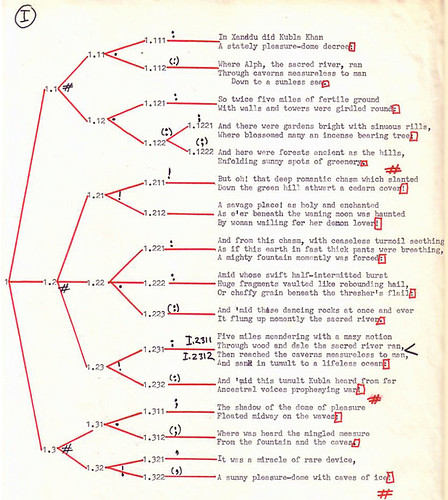
Abstract: This is a series of informal notes on the structuralist method Lévi-Strauss used in Mythologiques. What’s essential to the method is to treat narratives in comparison with one another rather than in isolation. By analyzing and describing ensembles of narratives, Lévi-Strauss was able to indicate mental “deep structures.” In this comparing Lévi-Strauss was able to see more than he could explain. I extend the method to Robert Greene’s Pandosto, Shakespeare’s The Winter’s Tale, and Brontë’s Wuthering Heights. I discuss how Lévi-Strauss was looking for a way to objectify mental structures, but failed; and I suggest that the notion of computation will be central to any effort that goes beyond what Lévi-Strauss did. I conclude by showing how work on Coleridge’s “Kubla Khan” finally led me beyond the limitations of structuralism and into cognitive science.
* *
An Open Letter to Steven Pinker: The Importance of Stories and the Nature of Literary Criticism (2015) 20 pp.
Abstract: People in oral cultures tell stories as a source of mutual knowledge in the game theory sense (think: “The Emperor Has No Clothes”) on matters they cannot talk about either because they resist explicit expository formulation or because they are embarrassing and anxiety provoking. The communal story is thus a source of shared value and mutual affirmation. And the academic profession of literary criticism came to see itself as a repository of that shared value. Accordingly, in the middle of the 20th century it turned toward interpretation as its central activity. But critics could not agree on interpretations and that precipitated a crisis that led to Theory. The crisis has quited down, but is not resolved.
* *
Literary Criticism 21: Academic Literary Study in a Pluralist World, Revised September 2014 (2014) 42 pp.
Abstract: At the most abstract philosophical level the cosmos is best conceptualized as containing various Realms of Being interacting with one another. Each Realm contains a broad class of objects sharing the same general body of processes and laws. In such a conception the human world consists of many different Realms of Being, with more emerging as human cultures become more sophisticated and internally differentiated. Common Sense knowledge forms one Realm while Literary experience is another. Being immersed in a literary work is not at all the same as going about one's daily life. Formal Literary Criticism is yet another Realm, distinct from both Common Sense and Literary Experience. Literary Criticism is in the process of differentiating into two different Realms, that of Ethical Criticism, concerned with matters of value, and that of Naturalist Criticism, concerned with the objective study of psychological, social, and historical processes.
Description
The description of literary form is the foundation of a revivified literary criticism. But description as I’ve come to understand it, both from doing and from theorizing about it, is more subtle and difficult that traditional criticism warrants. It is also more important, far more important. Without four centuries of painstaking naturalistic description available to him, Darwin would have had no empirical basis for his work. That’s where literary criticism is now: Lacking careful and detailed descriptions of the texts we’re entrusted with, we lack the basis for objective accounts of textual phenomena. Producing these descriptions should be a prime intellectual priority.
* *
Description as Intellectual Craft in the Study of Literature (2013) 33 pp. https://www.academia.edu/4262467/Description_as_Intellectual_Craft_in_the_Study_of_Literature
Abstract: This is a series of notes in which I argue that better descriptive methods are a necessary precondition for more sophisticated and objective literary criticism. Description, though it does not give unmediated access to texts, requires methods for objectifying texts, methods which must be discovered in the doing. By way of comparison I discuss the role of description in biology and I discuss the use of images and diagrams as descriptive devices. Lévi-Strauss on myth and Franco Moretti on distant reading, though quite different, are up to the same thing: objectification.
* *
Description 2: The Primacy of the Text (2013) 41 pp. https://www.academia.edu/4866743/Description_2_The_Primacy_of_the_Text
Abstract: These notes consist of five posts discussing the description of literary texts and films and five appendices containing tables used in describing to manga texts (Lost World, Metropolis) and two films (Sita Sings the Blues, Ghost in the Shell 2: Innocence). The posts make the point that the point of description is to let the texts speak for themselves. Further, it is through descriptions that the texts enter intellectual discourse.
* *
Description 3: The Primacy of Visualization (2015) 48 pp. https://www.academia.edu/16835585/Description_3_The_Primacy_of_Visualization
Abstract: Describing literary texts requires a mode of thought distinct from the discursive interpretation of them. It is a mode of thought in which various visual devices are central. These devices include: tables, trees and mental spaces, directed graphs and “sketchpads”. Visualization facilitates the objectification of literary form and objectification is necessary for objectivity. With objectivity comes the possibility of cumulative knowledge.