Showing posts with label Lafayette_Garden. Show all posts

Sunday, May 12, 2024

A source of blue dye in rural China

Around the corner at Language Log Victor Mair quotes from a recent paper, E.J.W. Barber, "Of Salt Men and Cloth: The Remarkable Textile History Preserved in Eurasian Salt-beds," Sino-Platonic Papers, No. 345, My 2024.

Sinologists have long wondered why the words for “blue” and “cabbage” in Chinese are homonyms: both 藍 lán in Mandarin. But just recently, perusing dye information about woad [VHM: a common plant dye for blue] from Richard Laursen, Victor Mair noticed that woad is actually in the cabbage family, Brassicaceae (earlier called Cruciferae), and that rural people have long found ways to get blue coloring out of a number of types of cabbage (Mair 11/22/2023), especially the purple kind. Hence the unexpected homonyms. Thus, from all these textiles preserved in salt, we even have the solution of an interesting etymological conundrum.

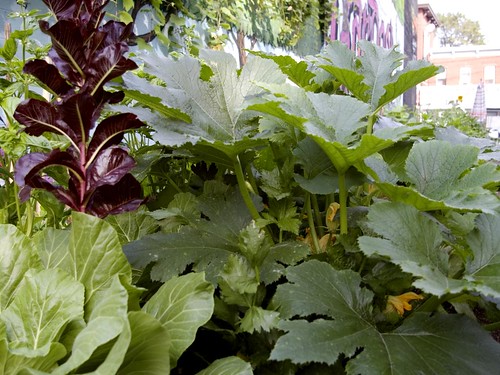
The cabbage in the photo above is from the Lafayette Community Learning Garden in Jersey City, started by June Jones of the Morris Canal Redevelopment Area CDC. It ran for two years, 2011-2012. The post at the following link has more shots of purple cabbage.

Monday, October 17, 2016

Michelle Obama and the Stealth Transition: Gardens Across America

Just a reminder about the out-going First Lady. Originally posted on 8.31.12.
IMGP8746rd

The way I see it, the smart money is on First Lady Michelle Obama, not to do a Hillary and go for the Big One in a later Presidential Ritual Contest (aka election). No, to do an Eleanor (Roosevelt) and have a major effect on the nation while her husband does the military strut.

How, pray tell, will she do this? you ask. With her garden, says I, with her garden.

Veggies for Health

As you may know, she’s very much interested in gardening, in particular, growing vegetables. She’s set up a garden on the Whitehouse lawn, grown veggies, had them served in the Whitehouse and has recently published a book on gardening and nutrition.

That’s her angle on gardening. Vegetables are good and good for you. They’re essential to a proper diet, and a proper diet is necessary to prevent childhood obesity.

Her interest in and commitment to gardening is deep, predating her husband’s nomination:
"Back then, it was really just the concept of, I wonder if you could grow a garden on the South Lawn?" Michelle Obama says. "If you could grow a garden, it would be pretty visible and maybe that would be the way that we could begin a conversation about childhood health, and we could actually get kids from the community to help us plant and help us harvest and see how their habits changed."

She was a city kid from Chicago's South Side who had never had a garden herself, though her mother recalls a local victory garden created to produce vegetables during World War II. One childhood photo included in the book shows Michelle as an infant in her mother's arms — the resemblance between Marian Robinson in the picture and Michelle as an adult is striking — and another depicts a young Michelle practicing a headstand in the backyard.

... After the election, she broached her idea to start the first vegetable garden on the White House grounds since Eleanor Roosevelt's victory garden in the 1940s.

Since the garden's groundbreaking in 2009 — just two months after the inauguration — she has hosted seasonal waves of students from local elementary schools that help plant the seeds. Groundskeepers and dozens of volunteers weed and tend the garden. Charlie Brandts, a White House carpenter who is a hobbyist beekeeper, has built a beehive a few feet away to pollinate the plants and provide honey that Michelle Obama says "tastes like sunshine."
So, the First Lady has a garden on the Whitehouse lawn and she’s preaching the garden gospel. Good enough.

Gardens in the Transition

The thing is, regardless of why a family or a community decides to grow a vegetable garden, the moment they start doing so, they’re also participating in the Transition Movement. By that I mean the movement started by Rob Hopkins in England and that now has groups all over the world:
The Transition Movement is comprised of vibrant, grassroots community initiatives that seek to build community resilience in the face of such challenges as peak oil, climate change and the economic crisis. Transition Initiatives differentiate themselves from other sustainability and "environmental" groups by seeking to mitigate these converging global crises by engaging their communities in home-grown, citizen-led education, action, and multi-stakeholder planning to increase local self reliance and resilience. They succeed by regeneratively using their local assets, innovating, networking, collaborating, replicating proven strategies, and respecting the deep patterns of nature and diverse cultures in their place. Transition Initiatives work with deliberation and good cheer to create a fulfilling and inspiring local way of life that can withstand the shocks of rapidly shifting global systems.

Sunday, August 19, 2012

What’s a Community Garden Community?

Two questions, closely related, but not the same:
What’s a community garden?

What’s a garden community?
So, what IS a community garden? I suppose it’s a garden that, in some sense, belongs to a community rather than belonging to a private individual or organization.

In what sense CAN a garden belong to the community? There is the legal sense. This requires that the community form itself into a legally recognized organization and that that organization, in turn, owns the land on which the garden is created. But, legal ownership of the land is not necessary nor sufficient. The land can be donated, and it need not be donated to anyone or any group in particular. It need only be made available.

IMGP6737rd

Gardens require labor. This IS necessary. Where does that labor come from? Why, from the community. People donate their labor to the garden, creating the beds, planting, weeding, watering, aerating, and harvesting. Where do the fruits go, the vegetables, flowers, herbs, and, yes, fruits? To the community.

And so it is with the Lafayette Community Learning Garden. While is has been organized out of the Morris Canal Community Development Corporation, MC CDC doesn’t own the land. The land has been donated, if only for a couple of years, by a local developer. Local businesses provided materials, supplies, food and drink on work days, and plants. The community itself has been providing the labor. Some people knew about the garden before ground-breaking and signed up ahead of time. Others pitched in when they saw things happening.

Wednesday, August 15, 2012

A Community Garden Builds Itself

Not, mind you, that the rocks just up and cleared themselves out of the way, nor did lumber arrange itself into planter boxes, much less did the dirt leap into the boxes followed in close order by seeds, seedlings, shoots, and sprouts. Nothing like that. But the garden wasn’t planned by spreadsheet and Gant charts, nor was it built by highly organized teams working against the clock, on time and on budget. Fact is, if you’d been on site any Saturday—and a few weekdays here and there—from mid-April through May and into mid-June it’s not clear to me just what you’d have seen. And I was there.

IMGP6126rd

It all depends on just when you showed up. You might have seen people building things, planting things, watering the plants, and painting the wall. But you might have seen some women and girls tossing rocks over a wall, or a young boy burying himself to his neck in a mound of dirt, or a middle-aged man taking photographs of a plush-toy frog lounging in the lettuce, or men women boys girls and dogs chillin’ around the barbecue listening to hip-hop and Rnb on the radio.

Not a high-energy task-oriented workforce at all. But they built the garden. We, we built the garden—I’m the guy who photographed the toy frog. Also shoveled some dirt. And ate some barbecue.