STEAMBOAT WILLIE REMIX pic.twitter.com/BwQPU0A6sD
— Eclectic Method ♻️ (@EclecticMethod) January 1, 2024
Showing posts with label copyright. Show all posts
Showing posts with label copyright. Show all posts
Saturday, January 20, 2024
Free at Last
Saturday, July 15, 2023
Do AI companies have the right to harvest anything anyone uploads to the web and use it for training their engines? [& invention?]
Sheera Frenkel and Stuart A. Thompson, ‘Not for Machines to Harvest’: Data Revolts Break Out Against A.I., NYTimes, July 15, 2023. From the article:
Ms. Loffstadt also helped organize an act of rebellion last month against A.I. systems. Along with dozens of other fan fiction writers, she published a flood of irreverent stories online to overwhelm and confuse the data-collection services that feed writers’ work into A.I. technology.
“We each have to do whatever we can to show them the output of our creativity is not for machines to harvest as they like,” said Ms. Loffstadt, a 42-year-old voice actor from South Yorkshire in Britain.
Fan fiction writers are just one group now staging revolts against A.I. systems as a fever over the technology has gripped Silicon Valley and the world. In recent months, social media companies such as Reddit and Twitter, news organizations including The New York Times and NBC News, authors such as Paul Tremblay and the actress Sarah Silverman have all taken a position against A.I. sucking up their data without permission.
Their protests have taken different forms. Writers and artists are locking their files to protect their work or are boycotting certain websites that publish A.I.-generated content, while companies like Reddit want to charge for access to their data. At least 10 lawsuits have been filed this year against A.I. companies, accusing them of training their systems on artists’ creative work without consent. This past week, Ms. Silverman and the authors Christopher Golden and Richard Kadrey sued OpenAI, the maker of ChatGPT, and others over A.I.’s use of their work. [...]
“The data rebellion that we’re seeing across the country is society’s way of pushing back against this idea that Big Tech is simply entitled to take any and all information from any source whatsoever, and make it their own,” said Ryan Clarkson, the founder of Clarkson.
Eric Goldman, a professor at Santa Clara University School of Law, said the lawsuit’s arguments were expansive and unlikely to be accepted by the court. But the wave of litigation is just beginning, he said, with a “second and third wave” coming that would define A.I.’s future.
What about A.I. invention? See Steve Lohr, Can A.I. Invent? NYTimes, July 15, 2023.
Sunday, July 15, 2018
Jordan Peterson interviews Nina Paley
Nina Paley is an animator and artist who makes unbelievably beautiful films. We discussed her life, her views, and her work, interspersing her animation throughout. Nina has done a particularly brilliant job of animating Exodus as a feature length film (see www.sedermasochism.com, as well as her Vimeo channel https://vimeo.com/user2983855
BTW, Nina has a prayer to her muse. She recites it at about 50:20:
Our idea, which art in the ether, that cannot be named, thy vision come, thy will be done, on earth as it is in abstraction. Give us this day, our daily spark, and forgive us our criticism, as we forgive those who critique against us. And lead us not into stagnation, but deliver us from ego; for thine is the vision, the power, and the glory forever. Amen.
Peterson remarks:
I would interpret that as a mantra that opens up the gateway between you and this transcendent force that allows people religious inspiration. And you're doing something like clearing out your ego. And I think it is very interesting that it is associated with something like The Lord's Prayer.
Tuesday, January 16, 2018
Barbie, Bratz, IP, and #MeToo
Jill Lepore has a fascinating article in The New Yorker about an IP (intellectual property) squabble over Barbie and Bratz dolls, which do billions of dollars in business. Yes, tells us a bit about the history of copyright, which is at issue in several law suits she discusses. But the article also discusses sexual harassment and feminism. Here's two paragraphs near the end:
The final sentence: "Mattel owns Barbie. MGA owns Bratz. And corporations still own the imaginations of little girls."Empowerment feminism is a cynical sham. As Margaret Talbot once noted in these pages, “To change a Bratz doll’s shoes, you have to snap off its feet at the ankles.” That is pretty much what girlhood feels like. In a 2014 study, girls between four and seven were asked about possible careers for boys and girls after playing with either Fashion Barbie, Doctor Barbie, or, as a control, Mrs. Potato Head. The girls who had played with Mrs. Potato Head were significantly more likely to answer yes to the question “Could you do this job when you grow up?” when shown a picture of the workplaces of a construction worker, a firefighter, a pilot, a doctor, and a police officer. The study had a tiny sample size, and, like most slightly nutty research in the field of social psychology, has never been replicated, or scaled up, except that, since nearly all American girls own a Barbie, the population of American girls has been the subject of the scaled-up version of that experiment for nearly six decades.#MeToo arises from the failure of empowerment feminism. Women have uncannily similar and all too often harrowing and even devastating stories about things that have happened to them at work because men do very similar things to women; leaning in doesn’t help. There’s more copying going on, too: pornography and accounts of sexual harassment follow the same script. Nobody writes anything from scratch. Abandoning structural remedies and legislative reform for the politics of personal charm—leaning in, dressing for success, being Doctor Barbie—left women in the workplace with few choices but to shut up and lean in more and to dress better. It’s no accident that #MeToo started in the entertainment and television-news businesses, where women are required to look as much like Barbie and Bratz dolls as possible, with the help of personal trainers, makeup artists, hair stylists, personal shoppers, and surgeons. Unfortunately, an extrajudicial crusade of public shaming of men accused of “sexual misconduct” is no solution, and a poor kind of justice, not least because it brooks no dissent, as if all that women are allowed to say about #MeToo is “Me, too!” The pull string wriggles.
Sunday, January 13, 2013
Aaron Swartz, Depression, and Prosecution
Writing at Question Copyright, Karl Fogel observes:
There are many remembrances [of Aaron Swartz] already on the Internet, but two in particular stand out: Rick Perlstein's and Lawrence Lessig's. Both are personal remembrances, but both make the point (Rick even more directly in a separate Facebook post) that it would be a mistake to reflexively pathologize this and blame it simply on Aaron's occasional depression. In Rick's words, from a Facebook conversation: "I would downplay the depression angle. The big piece he wrote about his depression came when he was 17. When I talked to him about my own depression a year ago, he really didn't respond as a fellow-traveler. I can't say precisely, but I don't think it was a huge part of his life. Having his soul gnarled down to a nub by a Javert had much more to do with it, I think." You'd be depressed too if the might of the U.S. federal judicial system seemed dedicated to sending you to jail for most of your life over an essentially altruistic act that harmed no one. I can't read Aaron's mind and don't know what he was thinking, but the relentlessness of that system bearing down on him was there, every day, with no sign of respite. Whether one is prone to depression or not, that's a hard, hard road. And your friends and allies may defend you till they're blue in the face, but they're not going to be there in the jail cell with you.
Sunday, November 18, 2012
Copyright May be in Play
The House Republicans want to rein it in. And the Mouse is pissed!
There's one discussion at Crooked Timber and another at Marginal Revolution.
Saturday, October 8, 2011
Bleg: The Social Responsibility of Artists
Lately I've been having vague thoughts about an artist's responsibility to the culture from which they draw their 'memes.' These vague thoughts have arisen specifically in the context of current thinking about how copyright has gotten out of control and should be trimmed back, if not entirely abolished. This post is a vague and rambling toss in that general direction. It’s thinking outloud.
* * * * *
So, if one is going to make an ethical case for releasing piles of materials from bondage to copyright, as people are doing these days, one needs to think about one’s obligations to make ethical use of that material. Perhaps the issue will take care of itself, whatever the issue is. But, if we drop the notion of the artist as protean creator, then it’s NOT simply an issue for the artist. And it’s not at all clear to me that we can simply say that the artist’s use will be ‘taken care of’ in post facto reception of their work.
* * * * *
As far as I can tell, the culturally dominant idea of the artist is still the romantic one of the protean creative genius. Such geniuses are obligated ONLY to their protean creativity, to which they must be true. As that two-faced SOB Polonius says in Hamlet: "To thine own self be true." The genius gets nothing from his culture and owes nothing to it.
What happens when you drop the notion of the creative genius while at the same time acknowledging the artist's dependence on existing cultural practices?
Sunday, September 11, 2011
Network Awesome Features Sita Sings the Blues
On Monday 12 September 2011 Network Awesome will feature Nina Paley’s Sita Sings the Blues.
Network Awesome? Never heard of it.
You’ve never heard of Network Awesome!#? What rock have you been sleeping under?
No rock, sheesh! Don’t get cranky on me. It’s a big world, you know, awesome. I’m busy, already flying on information overload. So chill out.
Well, to be honest, I didn’t know about Network Awesome ‘till about a month ago, when Michael Sporn hipped me to it. Well, not just me, but anyone who read his blog. Newtwork Awesome had programmed some classic Japanese animation, which interested him because he’s an animator—and, incidentally, runs one of the best animation blogs in Greater Blogistan. And it interests me because I’m interested in Japanese animation.
So I virtually hauled my virtual ass over there and took a look. Yep, there they were, old Japanese cartoons. Even better, interesting commentary, such as this piece by Cory Gross about Mitsuyeo Seo’s Divine Sea Warriors, which was Japan’s first feature-length animated film, and also war propaganda.
That’s the formula, interesting material intelligently curated coupled with compelling commentary. Where else can you find that?
Awesome!
See, I told you.
Network Awesome was founded in January of 2011 by Jason Forrest, an electronic musician and entrepreneur, who wants to make the best of an almost forgotten past available to us now and for the future. That is to say, he wants to keep culture alive, a mission that is particularly important as we face the daunting task of creating a new ways of living on this planet, not to mention an outpost on Mars one of these days.
Friday, June 24, 2011

Saturday, June 4, 2011
Lawyers Using Bots to Hassle Busy People, or: How I had to waste time giving myself permission to quote and paraphrase myself, really
It's all just so bleepin' INSANE.
Here's the deal. Two, no three, years ago a buddy of mine, who shall nameless so he’s not associated with this mini-quagmire, asked me to contribute a chapter to a book he's editing on a subject near and dear to me. Fine. Glad to. A couple months later I get a contributor’s agreement in which, among other things, I hand over copyright to the publisher and affirm that my essay doesn’t infringe on anyone else’s copyright. Standard stuff. I sign it and that’s that.
Meanwhile, I’ve been thinking, writing up notes, drafting prose. The usual. Then, something over a year ago I put some of my work in progress online at The Valve, a group blog where I have privileges, in order to get feedback on my ideas.
Which I did. Thank you very much, interwebs.
Time goes by, I turn in my final chapter. My buddy likes it, his editor likes it. And then the publisher sends some bots out on the web to compare text in their book-in-progress to whatever's on the web. What happens? My chapter gets flagged because, hey! some of my prose is out there on the web.
And you know why some of the prose in my chapter is out on the web you clueless bot-masters? Because I put it there! That's why.
Anyhow, my buddy sends me a note explaining the situation and asking me to send him a note explaining that, yes, I put that stuff out there on The Valve. Here’s my exact message: “Some of the prose in my [book name redacted to protect the innocent] chapter first appeared online at The Valve — where, for example, I’m quoting [some worthy]. So I’m just re-using my own prose.”
My buddy passed that on to his handlers and we figured that was the end of it. But, no, not good enough. His handlers got back to him, this time with the very passages the bots had swiped from the web.
Monday, April 11, 2011

Sunday, November 7, 2010
Graffiti on the IP Tip
Here's a link sent to me by Nina Paley, a very simple bit of graffiti clearly marked with copyleft.
Thanks, Nina!
Thanks, Nina!
Thursday, September 23, 2010
Copycats Are Us
I was over at ARCADE reading through comments on a post about something called object-oriented ontology. Timothy Morton, the writer of that post, slipped a reference to Marcus Boon, In Praise of Copying, into a comment. The title got my attention, so I zipped over to Amazon.com and read this in the produce description:
In spite of the laws, stigmas, and anxieties attached to it, the word “copying” permeates contemporary culture, shaping discourse on issues from hip hop to digitization to gender reassignment, and is particularly crucial in legal debates concerning intellectual property and copyright. Yet as a philosophical concept, copying remains poorly understood. Working comparatively across cultures and times, Marcus Boon undertakes an examination of what this word means—historically, culturally, philosophically—and why it fills us with fear and fascination. He argues that the dominant legal-political structures that define copying today obscure much broader processes of imitation that have constituted human communities for ages and continue to shape various subcultures today.
Wowie Zowie! And it seems Boon somehow bundles this all up with Buddhism.
That we are born copycats is hardly a new idea – remember ‘monkey see, monkey do’? – but I’ve been hearing a lot of this recently. For one thing, I hang out with copyright activists associated with QuestionCopyright.org, and they’re all about copying, copying as an essential facilitating and driving engine of culture. They’ve got Nina Paley on board doing advocacy videos for them, such as this one, “All Creative Work is Derivative.” And Paley, who is a fantastically inventive artist and film-maker, tends to go overboard in downplaying her originality while, at the same time, emphasizing how very much she’s borrowed from others going back, like, zillions of years (see this interview, for example).
The mythology of the individual creative genius is coming under sharpe critique and heavy assault. Here’s cognitive anthropologist Dan Sperber blogging about recent articles on creative pairs (e.g. Lennon and McCartney). And, of course, remix culture is all around us on the web, and is proclaiming itself to be so.
I suppose the concept of collective creativity first hit me back in 1987 in the wake of James Lincoln Collier’s biography of Duke Ellington, in which he emphasized the fact that Ellington frequently took ideas from his musicians and incorporated them into his compositions and arrangements. While this was hardly new information to the jazz community, it caused a minor uproar, as though it somehow diminished Ellington’s accomplishment. At the time I told myself that, if we knew as much about Shakespeare’s life and practices as we know about Ellington’s, we’d find that his plays are full of ideas from his actors in addition to all the material he’d taken from the literary tradition. That’s just how creativity works. Lots and lots of borrowing and stealing. Yes, you have to know how to put it all together, but you’ve got to have the source material.
But 1987, that’s a long time ago, practically the Dark Ages. Independently of indigenous intellectual changes in how we think about culture and creativity, other things have changed, too. And these other things are driving the current conversation, hard.
There is, of course, the internet, and all the swapping and sharing and circulating that takes place online. And not only the activity itself, but our awareness of it, down to the level of browser displays that show us all our Facebook friends. We see the connections before our very eyes. Any number of folks are busy visualizing them for us, throwing up pictures of the connectivity. And there’s been years of chatter about ‘six degrees of separation’ and networks.
Networks networks networks.
And, as a direct consequence of all this networking, we’ve got COPYRIGHT issues pushed in everyone’s face, week by week, day by day, and even hour by hour. I don’t need to run the litany of issues and annoyances, you’ve got your own list. The point is simply that they’re out there, and that there’s lots of push and shove on them. And because they’re legal issues, and the law has to justify itself, the intellectual and conceptual foundations of copyright are being dredged up, stirred around, and rethought.
While legal action is very much about POWER, the nature of that action requires that the power be rationalized. The rationalization may be thin and hackneyed, but it still must be there. Of course, Mr. Thin and Ms. Hackneyed are mostly on the side of monopoly restrictions. They aren’t going to think new thoughts. But the folks who’re fighting them, they will think new thoughts. They have to.
Judging from the publisher’s blurb for In Praise of Copying, the driving force of those legal issues has worked its way deep into the fabric of academic discussions. Buddhism? I’m sure Boon makes it make sense. I’m just struck at how far-reaching this discussion has become that Buddhism is being invoked.
Just how deeply are we going to rethink the Western cultural project?
On a more mundane note, I wonder if Harvard is publishing Boon’s book with the standard copyright restrictions or if they’ve decided to copyleft it. Whaddaya think?
Wednesday, August 18, 2010
REVS in Jersey
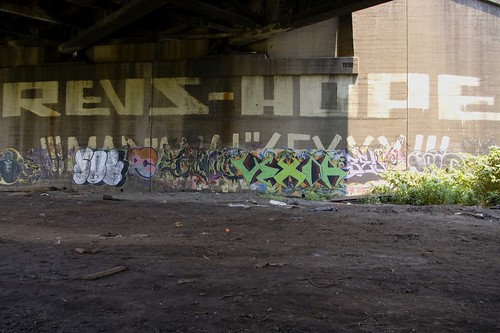
"To me, once money changes hands for art, it becomes a fraudulent activity."
— New York Times, 18 April 2005
 |
| [same as above, different POV] |
"We think art should be dangerous. Everybody's into safe art, doing safe things in their studio. We're bringing danger back into it. It's got to be on the edge, where it's not allowed."
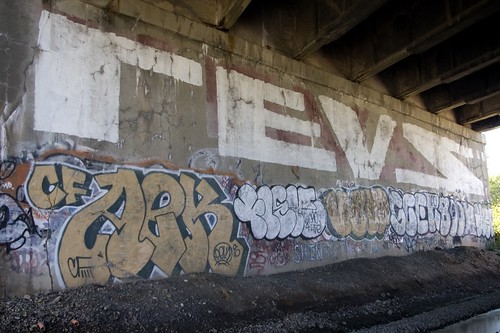
Hmmm . . . I wonder what REVS thinks about copyright?
 |
| [same as above, different POV] |
Monday, June 21, 2010
Where're you gonna’ be when the asteroid hits?
I’m speaking metaphorically, of course. And the asteroid is a mega-change in culture that’s coming.
Of course, we’ve all been seeing something coming since when? the 60s? Whenever. The Information Age, the age of Aquarius, globalization, post-industrial capitalism, whatever. It’s been heading at us at a mighty clip.
I don’t think the current asteroid is something else. Is it the Big Tipping point coming? The one where we can’t go back? Heck, we already can’t go back.
What’s the pattern? I don’t know how to connect the dots. But here’s some of them, in no particular order.

OTW: Organization for Transformative Works – A non-profit dedicated to preserving fan culture, with archiving projects, legal advocacy, a peer-reviewed scholarly journal, and a blog.
Fan culture, yes. But the institutionalization of fan culture in this way, yes, that’s new.
QCO: Question Copyright Organization – A non-profit dedicated to free culture (on the model of open software, another dot in the pattern). Restrictive copyright laws are harming culture, taking private would should be public.
When copyright disappears, what happens to the difference between fan culture and professional culture?

Face-o-Matic: A deck of cards created by cartoonist and animator, Nina Paley. Half of them are the upper parts of (cartoon) heads, half are the lower parts of heads. The idea is to mix them up and see what you get. She created them to get people into drawing faces depicting emotion. Could you use them in a game? Think of them as a metaphor for all of culture. (I bet Nina’s got a million ideas like this.)
Graffiti: The stuff that started on walls and subway cars in Philadelphia and New York City. Since then it’s spread around the world. The interesting thing is that most of it is done for free and some of the best stuff is in little known places where only other graffiti artists can see. Them and the homeless people who live there.
Sunday, April 25, 2010
Bleg: Copyright (over-extension) as rent-seeking
I've merely glanced at the Wikipedia article on "rent seeking," a phrase which I've read dozens upon dozens of times in the past two or three years without knowing what it means. I found this sentence very interesting in the copyright context: "Rent-seeking behavior is distinguished in theory from profit-seeking behavior, in which entities seek to extract value by engaging in mutually beneficial transactions."
Note that Adam Smith divided income into three categories: wages, profit, and rent.
Here's an article that brings game theory into the discussion.
My question: Has anyone used the concept of rent-seeking in analyzing the current highly-conflicted status of copyright" Or IP generally?
Subscribe to:
Posts (Atom)