Showing posts with label altieri. Show all posts

Monday, December 21, 2015

Attridge and Staten 1: What is Minimal Reading?

A professor of mine from graduate school, Charlie Altieri, just suggest I might like:
Dereck Attridge and Henry Staten, The Craft of Poetry: Dialogues on Minimal Interpretation, Routledge 2015.
I’ve ordered it and plan, provisionally at least, to blog my way through it. The first chapter, however, was published online in 2008:
Dereck Attridge and Henry Staten, “Reading for the Obvious: A Conversation”, World Picture 2, Autumn 2008, http://www.worldpicturejournal.com/WP_2/Attridge_Staten.html
So I don’t have to wait for the book to arrive before I begin commentary.

I figure this first chapter is good for two blog posts. In this first one I’ll comment on observations they’ve made about what they’re calling “minimal reading”. In the second post I’ll extend some of the observations they’ve made about their example text, William Blake’s, The Sick Rose.

I apologize ahead of time if my comments seem a bit picky. I have a great deal of sympathy for minimal reading as its austerity brings it close to my own hobbyhorse, the description of form. But there is a difference in emphasis and, ultimately I suspect, direction. I want to bring that out.

The article seems to be an actual dialogue, undertaken through email. Thus I will be indicating who said what by using their initials. Occasionally there is an ellipsis in their text, indicated in the usual way. In those cases where I introduce an ellipsis into a quoted passage I’ll indicated that by enclosing the ellipsis dots by angle brackets, thus: […].

It’s Not About The Critic’s Ingenuity

Late in the dialogue Henry Staten observes:
[…] I’ve found that most good poems (including The Waste Land, as Eliot himself belatedly realized) don’t need a great deal of the associational icing that we literary critics bring to them. Their power can be reconstituted from the ground up, out of the common language and common experience, together with a quite minimal and general cultural literacy.
To that I would add that the profession has come to regard that “associational icing” as comfortably ensconced in the Great Big Always-Already, as though people have been interpreting literary texts since the dawn of time and that such interpretation is an inherent aspect of literary culture. I’ve quoted a few passages illustrating that assumption in a recent post, Literary Criticism and Spiritual Crisis (?) [1]. The assumption, of course, is wrong. Interpretation only became common practice after WWII and even then there was a battle over it. Thus you have J. Hillis Miller giving an interview where he says his teachers at Harvard in the early 1950s couldn’t give a decent reading of a poem [2].

Now let’s go to the beginning of the article, with Derek Attridge writing to Staten:
As you know, I’ve been trying for a while to articulate an understanding of the literary critic’s task which rests on a notion of responsibility, derived in large part from Derrida and Levinas, or, more accurately, Derrida’s recasting of Levinas’s thought, one aspect of which is an emphasis on the importance of what I’ve called variously a “literal” or “weak” reading. That is to say, I’ve become increasingly troubled by the effects of the enormous power inherent in the techniques of literary criticism at our disposal today […] The result of this rich set of critical resources is that any literary work, whether or not it is a significant achievement in the history of literature, and whether or not it evokes a strong response in the critic, can be accorded a lengthy commentary claiming importance for it. What is worse, the most basic norms of careful reading are sometimes ignored in the rush to say what is ingenious or different. (The model of the critical institution whereby the critic feels obliged to claim that his or her interpretation trumps all previous interpretations is clearly part of the problem here, and beyond this the institutional pressure to accumulate publications or move up the ladder.) We may be teaching our students to write clever interpretations without teaching them how to read...
I agree with the spirit, but I’ve got some problems with specific details. It’s not clear to me just what kind of restriction Staten has in mind when he, quite correctly, points out that we’re got the tools to write commentary on any literary work regardless of cultural significance or personal resonance. In my pose as a Martian, which I asserted in my recent open letter to Charlie Altieri [3], everything human is foreign to me and thus I do not assign a priori privilege to any set of texts, artifacts, or practices, though I recognize that earthlings make such distinctions and I have examined so-called canonical texts, some with considerable care.
Thursday, December 17, 2015

Literary Studies from a Martian Point of View: An Open Letter to Charlie Altieri

I of course, am the Martian, a conceit I’ll explain in due course.

I took a course in modern poetry with Charlie Altieri in the fall of 1974, my second year at SUNY Buffalo. I don’t know why I signed up for Charlie’s course, probably for the exposure. I’d come to Buffalo for a very specific purpose and with only a weak background in English and American literature. I picked my courses in part to remedy that.

That same semester I was also studying with David Hays in linguistics. On the one hand I was enrolled in a course, Linguistics as a Focus of Intellectual Integration, in which we read books by William Powers (control theory and psychology), Talcott Parsons (sociology), Northrup Frye (literary criticism), Ernst Gombrich (art history), Gregory Bateson (systems, mind, ecology), and most likely someone else. But Hays, a computational linguist, was also tutoring me in his semantic model.

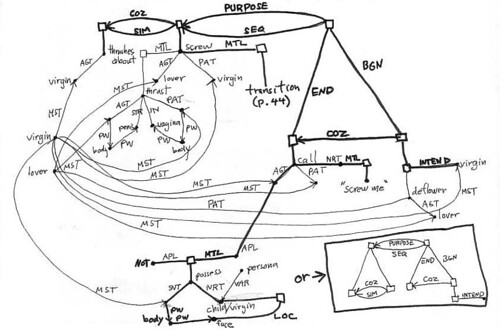
I used that semantic model to examine some passages from William Carlos Williams, Patterson, Book V, and submitted that (rather long) paper to both Altieri and Hays. That’s the kind of place Buffalo was in those days. Here’s one of the many diagrams from that paper:

deflower-virgin-crop

Looking at it now I’m appalled at how sloppy it is. But I’m sure I was proud of it at the time, and even thought it a bit stylish. I’d bought a set of technical fountain pens (Rapidograph) just so I could draw such diagrams. These days I’d use the computer, probably Omnigraffle, to draw something that complex.

I remember Charlie making two verbal comments to me about it (above and beyond what he wrote in the margins): 1) that I was using literature as a vehicle for elaborating other interests, and 2) like I. A. Richards I had moved beyond literature to a more general interest in language and the mind. The second was flattering, but I bridled at the first, though it was true. However, it is by no means clear, then or now, in just what the proper study of literature consists.

Anyhow, here’s an open letter to Charlie. Why Charlie? That I studied with him at a critical point in my career is sufficient reason. But there is one other thing: Charlie takes a philosophical approach and is conversant in both Continental and Anglo-American idioms. Despite a spate of dumb remarks from prominent physicists, philosophy remains intellectually necessary.

I start by recounting, for the 4th time I believe [1], my early intellectual history. After that I talk about my analytic work on ring-composition and then on to other things.

* * * * *

Hi Charlie,

I’ve been looking at some of the stuff on your website and notice that you’ve taken to posing as an old scholar reflecting on the profession. That’s a pose I know well, and have explored it myself in this and that, except that here and now I’m pretending to be a Martian. It’s a metaphor of course, but not, as I’ll explain, a mere metaphor. And like you I’m suspicious about the “materialist” allegories that have come to dominate the field, though I’m not so bothered by the erasure of authors – but that particular issue would take me a bit far afield.

From Johns Hopkins to Buffalo

I’ve spent a great deal of time thinking about the profession, by which I mean academic literary criticism, and wondering about its future. On the one hand I’m amazed at the variety of work done in the name of (academic) literary criticism. I certainly can’t get a grip on the full range. Can anyone? Someone who’s chaired a large and diverse department, or served as editor for a generalist journal, they’d have seen a wide range of work parade before them over the years. But really grasp it all?

Moreover I look at the discipline as an outsider. I’m an outsider in the sense that I don’t hold an academic appointment and haven’t had one since I failed to make tenure at RPI back in 1985. But I’m hardly the only capable scholar – or whatever it is that I am – to operate outside the academy. I’m an outsider in a deeper and more fundamental sense and have been, I realize in retrospect, ever since I completed my MA degree at Hopkins in 1972, ever since I wrote that MA thesis on “Kubla Khan”.

That is to say, I was an intellectual outsider when I arrived at Buffalo in the fall of 1973 for the purpose of getting the credential, the PhD, that is the all but necessary requirement for an academic post. At that time it was obvious that my MA thesis was a very unusual piece of work. I had a sense that, though it was my work – I’d written the thing, hadn't I? – I didn’t really know what I’d done. For knowledge is ineluctably social – there are no private languages – and it wasn’t at all clear just which intellectual community could accommodate that work.

It was quite unlike anything that had been written about “Kubla Khan”. And while it had obvious antecedents in structuralism and in linguistics, in various respects it was quite different from what Jakobson, Lévi-Strauss, and others had done with poetry. What was it, a duck or a swan? Who knew how to answer the question?

When I arrived at Buffalo I was apprehensive about whether I’d be able to do the work I wanted to do, not that I had any clear idea of what that was. All I knew is that I wanted to somehow make sense of the structure I’d found in that poem. So I showed the thesis around, to Mac Hammond, my advisor, to Al Cook who was, well, Al Cook, and in my second year, to you. Everyone accepted it as well, I don’t know what, but it was in some way accepted. And, with the help of another graduate student, Ralph Henry Reese, who’d worked with David Hays, I managed to find my way to the Linguistics Department where I joined Hays’s research group in computational linguistics.

Back then, the world seemed wide open – “it was the age of wisdom, it was the age of foolishness, it was the epoch of belief, it was the epoch of incredulity, it was the season of Light, it was the season of Darkness, it was the spring of hope, it was the winter of despair, we had everything before us” – and who knew how the discipline would develop. It was worth a shot.

Saturday, December 5, 2015

What’s Miyazaki Constructing? More Lit Crit [Ramble 2]

Almost a month ago I put up something I called “weekly ramble”, thinking that I might do more such columns, possibly weekly. The idea was to ramble over things that have been on my mind without trying for anything “tight” or “conclusive”. Just ramblings.

For various reasons I did get around to rambling the next three weekends. But now I’m feeling the need. I want to write something, but I don’t really want to focus.

My current Miyazaki project – The Wind Rises – is beginning to weigh on me. I thought I’d be done by now. I didn’t have anything definite in mind when I started posting about the film, and the idea of doing a longer than usual run of posts on The Wind Rises wasn’t on my mind as I did a second or even a third post. I supposed it was about the time I did the 3QD post that I realized I was going long on this one.

But not this long. I’m a dozen posts in, though some are rather short, I’ve started drafting a 13th, and I can easily imagine one or two after that before wrapping up. It feels like those are going to take forever, and yet even when I wrap up I know there’s more I could do with the film.

And then all of a sudden Scott McCloud’s Understanding Comics has come to mind. It’s about how comics are constructed and I regard it as the best introduction to cognitive criticism, though it’s about comics and though it is itself in the form of a comic. I’m feeling that, though I’ve described a lot about Miyazaki’s film, I’m not sure what I’ve learned about how it’s constructed. What’s the point of all this description if it doesn’t add up to something else?

What it’s supposed to add up to is A LIFE. But how does it do that? What’s the principle? It seems to me that Miyazaki is trying to come to terms with Japan and Japanese history, but also with his own life, and what do the two have to do with one another? What kind of satisfaction did he achieve at the end, an end after all, with Japan in ruins and his protagonist walking off into dreamtime?

And then there are the ongoing struggles with literary criticism and computation and description. I’ve had a few brief email exchanges with an old professor of mine from Buffalo days, Charlie Altieri. I studied modern poetry with him. He’s a philosopher and works both sides of the aisle, Continental and Anglo-American, and so thinks about literature very differently from me. Which is why it’s been useful chatting with him. I’ve already posted a bit about him (HERE and HERE) and may end up writing an open letter.

And then there’s next year’s graffiti project with Green Villain. Things are slowly coming together. But it’ll be a slog.

I guess that’s my watchword for the week: I’ll be a slog.

Wednesday, December 2, 2015

Literary Criticism and Spiritual Crisis (?)

One of the things I keep thinking about is the sense of professional narcissism that had academic literary critics writing as though their activity were essential to literary culture (see examples below). They do this even though such criticism only has a small relatively small audience, other critics, and despite the fact that literary culture managed without interpretive criticism for centuries. The methods of interpretive criticism now taken for granted didn’t become common in the academy until after World War II, though they have pre-war origins. Yet literary culture managed to struggle along without benefit of interpretive criticism.

Of course, the interpretation of sacred texts is much older and is, in fact, one of the precedents for method in the interpretation of secular texts. It’s in this context that I find the following phrase most interesting: “...a sense of spiritual crisis forcing literature to play roles once reserved for theology and philosophy.” The phrase was written by Charlie Altieri and is in an essay he’s written about aesthetic issues in modernist poetry [1]. The essay centers on two books written in the mid-1960s, one by J. Hillis Miller and the other by Irving Howe, and refers specifically to Howe’s thoughts about modernist literature. That’s also when “Death of God” theology was making national news, with Time magazine plastering the question – “Is God Dead” – on the cover of its April 8, 1966 edition [2].

By that time interpretive criticism had become the center of academic literary study, displacing though not necessarily eliminating literary history and philology. So, God dies; literature displaces theology and philosophy; and literary criticism slips right in there with theological commentary on sacred texts. Interpretive criticism had also become controversial, not because of that displacement – that controversy took place in the 50s – but because critics didn’t agree in their interpretations. Given the cultural work it was being summoned to do – take over from sacred commentary – one can see why such disagreement would be problematic.

That issue has never really been resolved, but it’s no longer front and center. What seems to be front and center, if anything, is “oh woe is us!”, but I don’t want to comment about that.

The upshot is that critics now adopt whatever methodology suits their fancy and at least some of them write as though their critical reflects are extensions of the texts they explicate, even necessary extensions. I present some examples below the asterisks.

Thursday, September 10, 2015

Some Notes on Ethical Criticism, with Commentary on J. Hillis Miller and Charlie Altieri

Most of my work in literary studies, whether focused on the analysis of texts or on theory and method, has been concerned with achieving objective knowledge. It has long been clear to me that that excludes much of what literary critics do. Moreover it seems to me that many critics are motivated to study literature precisely because they seek a kind of knowledge that is not, in principle, objective.

What, then, of this other knowledge and this other quest? Is it simply to be discarded as, well, um, err, superstition or some such, comparable to astrology or alchemy? I think not.

For one thing, while my work has come to focus on the possibility of objective knowledge, that is not what I was after when I first became interested in literary study as an undergraduate. Nor, for that matter, does it exhaust my interest in literary study. That Other, whatever it is, still draws me. It’s just not the center of my attention.

That Other I will call ethical criticism, while the search for objective knowledge of literary phenomena, that I am calling naturalist criticism. I’ve thought a great deal about naturalist criticism and have well articulated thoughts about it. My thinking about ethical criticism is more primitive.

The Interpretive Matrix

While interpretation has been the name of the critical game for the last half century or more, it seems to me that the work done under the aegis of interpretation sometimes leans toward naturalist criticism and is at other times ethical in force. I think that, going forward, the profession has to distinguish the two. That is to say, I regard interpretation (as it was taught to me) as the matrix from which both naturalist and ethical criticism are emerging.

Just as the distinction between the color blue and the color green is not a sharp one, so the distinction between naturalist and ethical criticism is not sharp. Yet, even as there are colors that could be green or blue, there are also colors that are unambiguously one or the other. So, I suspect, it is with literary investigations. Some will be clearly either naturalist or ethical in kind, but some will partake of both. These distinctions will have to worked out in practice.

In the post that follows I begin by offering a few words in definition of ethical criticism. Then I offer light commentary on two articles by somewhat different critics, Charles Altieri and J. Hillis Miller. I have chosen these two because 1) they ARE different; 2) I have studied with both of them. The second qualification is, in a sense, irrelevant, a matter of mere personal history. But there are so very many critics I could have chosen that the personal connection is something I can invoke in making this choice. Though I’ve not seen either man in decades, I nonetheless have a sense of the mind beyond the words. I conclude by considering the necessity of ethical criticism in this, the 21st Century, CE.

Why ‘Ethical’?

When I talk of ethical criticism I don’t mean it in the narrow sense of moralizing, though I have no reason to exclude that either. I’m thinking of it in the sense of ethos, a way of life. Ethical criticism is concerned with how we live, now and in the future.

Ethical criticism necessarily encompasses aesthetics. Put a bit crudely, it is ethics when lived out in the world, it is aesthetics when expressed in a text. Our response to a text is a matter of aesthetics, but the projection of that response onto the world engages ethics.

As one touchstone text I offer this passage from J. Hillis Miller ([1] p. 63):
We need to make every effort to defend, in changed circumstances, the tradition that makes the humanities in the university the place especially charged with the combination of Bildung and Wissenschaft, ethical education and pure knowledge.