Showing posts with label underbelly. Show all posts

Saturday, November 17, 2012

Graffiti Aesthetics: The Space of Writing

Note, November 2010: With The Underbelly Project still reverberating on the web I thought I'd reprint an old post I wrote on space in graffiti. I published it in 2007 in The Valve. Note that while the Underbelly Project included both graffiti and street art, this article is specifically about graffiti. I may also pertain to some street art, but certainly not all. The post points out that major advances in Western art have involved reconceptualizing pictorial space. In this post I argue that graffiti provides the basis for another such reconceptualization and thus holds out the opportunity for fundamental aesthetic innovation. What I didn't say is that graffiti is the only form of abstract / non-representational art that that has gotten popular acceptance around the globe.
Note, November 2012: What I didn't say, either in the post below, or in the prefatory note above, is what I hope graffiti can and will do. This has to do with graffiti's commitment to, well I don't quite know what to call it, the name-based space that's at heart of graffiti. But whatever it is, it seems to be able to accept and absorb any form of imagery. The cartoon-based characters that showed up, mostly as embellishments, in the New York subways in the 70s and 80s persist, of course. But they've also become elaborated, both toward pictorial realism, but also toward other forms of imagery. In some cases the characters and other imagery have pushed the names aside so that graffiti has morphed into something else.
So, while "traditional" piecing (including wild style) tends to dominate graffiti, just about any sort of imagery has become absorbed into the culture – some of which can be seen on the ever-changing walls of the Green Villain, just around the corner and down the block from me. And that imagery includes comic book imagery and strange machines, futuristic machines, and just plain weird stuff.  So, could graffiti absorb and articulate scientific imagery, from the micro world of quarks and biomolecules through the macro world of planets, star systems, galaxies and, well, the whole universe? What would a graffiti-based Powers of Ten be like?
Awesome is what. Freakin' awesome. That is could graffiti become the art form for articulating the invisible worlds of post 19th-century science? That's something the must happen. Disney took a run at it in the Rite of Spring episode of Fantasia and, in a different way, in the intermission interlude; it's there on the pages of countless comic books and in science fiction films. But it's not really there in art galleries. Graffiti could put it there.

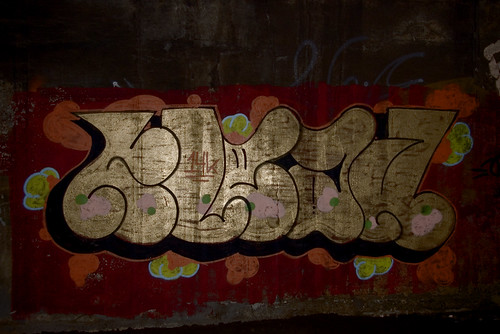
The artists who work in this particular tradition call themselves writers. The rationale is obvious enough as the tradition is grounded in the practice of getting one's nickname up on the wall in the form of tags, throw-ups, and pieces. Piecing is the most complex of these practices and often involves creating the illusion of three-dimensionality through two devices. Drop shadows create the illusion that the letters are suspended or floating over a surface and their shadows are projected on to that surface; the use of drop shadows, of course, implies a light source. The other device is to treat the letters as though they have thickness and to show this by rendering their edges in depth; this presupposes some specific projection of the letters onto the picture plane.

And thus we arrive at my subject, that of the pictorial space implied by graffiti. Have graffiti writers made any discoveries about pictorial space? I don't have an answer for it. But I can tell you why I believe it's an important question to ask and why I believe that writers may already have discovered something new, or are likely to do so in the future.

Representational Space

Consider the tradition of Western representational art from the Renaissance through the Nineteenth Century. All of those paintings and drawings and prints are inscribed within the projection of 3D Euclidian geometry onto the pictorial plane. The discovery and deployment of that projection is fundamental to Western art. It opened up a whole new world.

And when that world started to seem old and stuffy, artists moved beyond it, not by painting new subject matter - though there was some of that - but by proposing new conceptions of pictorial space. The cubists weren't happy with the Euclidian projection and, in effect, tried to treat the picture plane as though it were a 3D space, or was it that they tried to project a 4D space onto the plane? Whatever. Kandinsky used the 2D image plane to depict a two and a half-dimensional pictorial space (the notion is from the visual perception work of the late David Marr) filled with lines and surfaces in motion, but no solid objects. Jackson Pollock painted motion in fractal space while Mark Rothko gave us colored luminosity in spaces of undefined dimensionality.

Wednesday, November 7, 2012

RJ Rushmore on the Underbelly

Writing at Vandalog:
There’s a certain group of street artists, a group whom I tend to admire, who make art to give a gift to the rest of the world. These artists create spectacles. These artists attempt to make the world a better place by putting their art into it. These artists increase the amount of wonder in our everyday lives. This group includes artists like Swoon, Mark Jenkins and the performers in Improv Everywhere.
And then later on:
Maybe the angle of Underbelly as a “street art” project is all wrong. The Underbelly Project is not really a street art project or a mural project. Workhorse and PAC know how to organize mural projects. They know what large street art mural projects look like: lots of artists painting in daylight in very public spaces, usually over the course of a few days, and interacting with curious members of the public. The Underbelly Project is something else. If it’s something else, it should be held to a different (but not necessarily higher or lower) standard. 
The Underbelly Project should be compared to the work of the street artists and graffiti writers who paint in abandoned factories. Very few people will ever see those murals in the flesh, but that does not make them any less impressive. Murals in abandoned factories are not gifts to the world in the same way that it is a gift when Swoon commands a flotilla down the Mississippi, but there’s still something valuable about them. 
Aren’t artists allowed to enjoy themselves? It is selfish on the part of fans to say that street artists can only paint outdoors in spaces where lots of people will see the work. The Underbelly Project, like murals in abandoned spaces, was a space for artists to experiment and be free. That’s where the project was an astounding success: In a culture where artists are constantly under pressure to perform and sell and promote, The Underbelly Project stripped all that away and brought the artists back to making art for the sake of making art, which is just as much a part of the street art spirit as giving gifts to the public. Street art is about anybody being able to make art and just getting out and doing it for the love of making, rather than for the sake of a paycheck.


Monday, December 5, 2011

Underbelly Links

Jasper Rees was the journalist tasked with breaking The Underbelly Project in The New York Times and The Times of London. Now he tells the tale of going down there to get the story, The Underbelly Project: New York:
My pulse starts to race. This kind of excitement is not normally available to arts journalists (the PRs see to that). The surface underfoot suddenly turns rough and damp. My hand-torch – we’ve got two between four – picks out puddles among the loose cement. We clamber over various obstacles – details of what and how withheld – until we are in an empty space. In the dark, lit by our torches, it’s more like a concrete cave. I get the impression that pretty much nobody has been down here in decades.
Juxtapose Magazine goes to The Underbelly Project @ Art Basel Miami 2011.

Jeff Stark set a table for two in the Underbelly project in November 2011, and left the table behind. Now he sets a table in an abandoned marine park in Miami as part of the Underbelly festivities at Art Basel.

Wednesday, November 9, 2011

The Underbelly Project, Big Art or What?

It’s only been a year since The Underbelly Project sprang from the pages of the The New York Times and the Times of London. From a certain point of view what’s interesting is that it embraced both graffiti and street art. That’s but secondary to the question of whether or not tUP is a PR stunt intended to set-up a nice cash payout or whether it is, for lack of a better word, real. [My posts on tUP are here.]

As someone who feels the mystery of dark places, hidden away, even illegal, I think it was conceived and executed in the grandest style of the The Real. Until the day of the Big Reveal. Then all hell broke loose and tUP ceased to be the property of PAC and Workhorse, the founders and curators, and the many artists who participated.

Just who put what down there in the hole and why, that’s become secondary to what gets made of it in our minds. That is, what gets made of the knowledge that it’s there and of whatever tangible evidence we have of it, photos, videos, and the like. Well, it seems that we’re in for an exhibition at Art Basel in Miami, a special edition book, and a serf’s edition of the same book to be released in February.

From my point of view, what matters most, and it’s almost the only thing that matters, is whether or not the importance of the site itself somehow survives this assault by Big Art. It’s the site itself that spawned the project, as though those abandoned tunnels called Workhorse and PAC into the ground so they’d conceive and execute the project. And it’s the site itself that’s effectively beyond reach.

Tuesday, November 8, 2011

The Underbelly Rising

The Underbelly Project is coming up for air, and, I suppose, a spot of cash and glory too. I just got an email from the project (you can sign-up on the web, here). Here’s the scoop:
After taking time to reflect on The Underbelly Project, we felt it was important to share what it was like in the abandoned subway station. To show the work being created, to show the life that was happening on the dust lined tracks. To do this we will be holding an exhibition during Art Basel Miami. For this exhibition, time lapse videos will be shown of each artist creating their work, a video walkthrough of the station will show the entire station right after the work was completed, and photo documentation will help illuminate how the artists created their work . Unique artifacts from the abandoned station will give viewers insight into the process. It is our hope that this show will help convey what it was like in our dark corner of the world for that brief time.

In addition to the documentation of the project, we thought it was important to showcase new works created by artists from The Underbelly, outside of the physical limitations of the tunnel. To showcase work that was created in favorable conditions without the fear of being arrested or discovered. For this a sampling of the painters, sculptures and installation artists from the tunnel were chosen to represent the variety of talents that left their mark in this abandoned subway station.
That opening phrase—“after taking time to reflect . . .”—is, of course, bullshit. Which may well be OK depending on all sorts of things, including what actually happens at the installation at Art Basel in Miami this year.

Here’s more:

Thursday, June 16, 2011

Graffiti Reset: Through the Streets and Beyond

You may have read about the Underbelly Project, who knows, depending on just who YOU are, you may even have seen it. During 2009 and 2010 over a hundred artists were escorted into an abandoned subway station in New York City where they then proceeded to create a work – most, thought not all, made paintings. When they were done – they only had a night – they were escorted out. When all the work was done the curators closed up the ‘gallery’ and that was that.

Except for the big-splash articles in The New York Times and The Times of London. And then the urban explorers and the wannabes figured out where the gallery was, and started trooping in. Arrests were made. And this and that. It was all over the graffiti and street art blogospheres, including a few posts right here on New Savanna.

All that’s just by way of introduction, because this post isn’t yet another perambulation on tUP. I mention it because of the artists in it, some were graffiti writers and some were street artists. THAT was most interesting.

For most ‘civilians’ the two terms – graffiti, street art – are interchangeable. They mean ‘stuff on walls that isn’t supposed to be there and that pretends to be art but may or may not be, depending, but regardless, it surely IS vandalism’. The difference between the traditions is obvious enough, though the line between the two is, like many such lines, a fuzzy one. “Graffiti”, as the writers understand the term (and as I’m using it) is the name-based work that’s mostly done with spray paint and that originated in Philadelphia and New York City in the late 1960s, etc. Roughly speaking, street art is everything else put on public walls in the name of art; it is NOT name based and includes stencil work, posters, stickers, installations, yarn, and installations of various kinds.

The graffiti writers tend to think of street artists as gutless arrivistes encroaching on their territory who are just using the street as a backdoor into the gallery scene – a charge lodged against tUP by graffiti bloggers all over (see also the Banksy vs. Robbo war). Street artists don’t seem to be quite so exercised over the difference.

Saturday, November 27, 2010

Monday, November 22, 2010

Underbelly 9: A Documentary in the Works

As some of you know, some folks are making a documentary about public reaction to The Underbelly Project. They spent Sunday afternoon (yesterday) interviewing people at a Chelsea studio. I was among them.

I showed up at 2PM expecting to see, say, a half dozen or more people sitting around waiting to get interviewed. It wasn’t like that. I guess I over-estimated how many people would be interested – through, for what it’s worth, Google’s now giving me upward of 500K hits when I search on “the underbelly project.” It was 200K hits two weeks ago.

In any event, I was the only one there just at that moment to get interviewed. So I got miked up and started talking. While Stephanie was interviewing me, some more folks showed up.

I stuck around for about an hour afterward and listed to four or five more interviews. One woman hadn’t known anything about graffiti and street art until she’d read about Underbelly. Except for one ex-writer from Staten Island, most of people tended to treat it all as graffiti and didn’t recognize street art as a different movement. But then, the Project itself didn’t make any distinction, did it?

From what I heard in that one hour, they’ve got an interesting range of views. Everyone was positive about it.

Stay tuned.

Thursday, November 18, 2010

Virtual Underbelly

SmallWorlds is a 3D virtual worlds space. One of the folks there, Kota Phillips, has created a virtual Underbelly Project:
I've been wanting to create a graffiti art space for the past year.
The NY Underbelly Project with all it's controversy and attempt to regrasp the original intent and experience of street art is a wonderful inspiration.

So I'm checking to see if there are artists out there who would want to participate in this.

This is what i propose:
To make it more fun and Underbelly-like the artists would paint in the actual space, in the dark. They would bring their own canvas (up to 3 or 4), pick their area of the "subway" and work at their convenience over the next few weeks. Graffiti art only please.
And here's some virtual underbelly pieces by Hallusinosis Dreams.

And so it grows. Where will it end, this underbelly?

Wednesday, November 10, 2010

Underbelly 8: How Teach the Mystery and the Beauty?

I continue to read the web about and to think about The Underbelly Project. Basically, I don’t know what to make of it, and perhaps that’s the point. I don’t know.

My initial reaction, on reading the NYTimes article and seeing the photos was: COOL! I wanna see it! The article made it clear, of course, that I couldn’t see it – not for me the adventure of sneaking into a hidden space likely to be guarded by police by the time I get there. The article also indicated the contradiction inherent in framing the project as a protest against the absorption of the street into the gallery and then broadcasting the hidden art to the world. I read about that, nodded OK and moved on, propelled by the basic coolness of what Workhorse, PAC, and all the others had done.

And my sense of that coolness was rooted in the time and effort I’ve put into photographing graffiti over the past four years, mostly in a small area in Jersey City. As I said in an earlier post, I know what it’s like to encounter graffiti in a dark enclosed space. That experience is very real, very compelling to me. I felt like I was an explorer in an exotic land, perhaps the first ever to visit those ruins. And the experience certainly was real and compelling to the curators, Workhorse and PAC, and, I would imagine, to all the artists who participated.

The problem, of course, is that The Underbelly Project doesn’t make that experience available to others. It is hidden and inaccessible. It is in accessible mostly because it is illegal to go onto the property and, secondarily, because access is physically awkward. To be sure, Workhorse and PAC took steps to see that no one actually knew where the place was, but, as we’ve seen, that didn’t last long – a matter I’ll return to at the end.

Let’s set that aside for a moment and imagine, instead, that Workhorse and PAC were funded by a billionaire – make it a mysterious billionaire – who’d arranged to buy the site and to fit it out so access was easier. Now what? It all depends. But much of the mystery would be gone, even if the interior space remained much as it is. And if twenty or thirty or more people go in there at a time, well then, still more mystery is gone. Now it’s become a somewhat funky museum, or, horror of horrors! a sophisticated fun house.

It would seem, then, that the experience can’t be domesticated. It has to be wild. Not guns blazing in Afghanistan wild, or even let’s go rafting down the Colorado River wild, but somehow wild. The thing is, that’s how art itself is supposed to be, no? Wouldn’t the art on the walls do that? I don’t know, I’ve not seen it, only photos.

And now you’re beginning to see how and why I’m tying my brain in knots when I try think through this. No matter how I start thinking it through, I always end up stepping all over myself.

Out on the web I find various reactions. Some people just think it’s cool. A few of those have even made their way there. Some have come back with photos. Others have gotten arrested.

There are others for whom the only thing that matters is that the project involved a lot of trespassing over a long period of time. It’s trash. Lock ‘em up.

And then there’s the graffiti writers who are pissed at the so-called hipsters invading their turf. This particular beef is not new. It’s been around as long as street art has been getting up on walls next to graffiti. So The Underbelly Project is just another occasion to exercise this particular resentment.

One thought the writers have is that the curators shouldn’t have blabbed. They should have just done it and kept quiet. After all, the writers have their secret spots, and they don’t broadcast the locations to the world. Why can’t these hipsters do likewise?

But: could this project have been done on this basis? 

Monday, November 8, 2010

Underbelly 7: Host18 Speaks

host18.jpg

Host18 is skeptical about the underbelly:
My beef with this project isn’t that they painted some shit in a tunnel and put it online for everyone to see, shit, you’re looking at my website where I do nearly the same thing. What is so wack about this is abortion is that it claims to be doing something brand new. I have been in plenty of tunnels in this city and I can tell you that people have been painting in them for 30 plus years. The fact that you have out-of-towners exploiting something that is held close to the heart by the people who did and still do participate in what these johnny-come-latelys are ultimately using as a marketing ploy is a kick in the balls.

host tenz.jpg
Host18 Tenz

Sunday, November 7, 2010

Underbelly 6: The Experience

There is meaning, expressed in words. And there is experience, which is just that, experience. How do we convey experience from one person to another? Art, you say.

Yes, art.

Here are some words about art.

“Freeze!”

So, you’re in a strange place. It’s isolated and dark. You don’t know what’s there. You’re on edge. And then you see a creepy-looking figure sitting against the wall. What do you do?

Matt Troy is one of the people who went into The Underbelly Project after it had been sealed up. He went with some police and transit officials (see comment near bottom) and he took some photos, including this one, showing a Mark Jenkins sculpture huddled in front of a Con piece. He remarked that when “vandal squad cops ran into this they drew there wepons and told it to freeze not knowing it was a dummy.” RJ at Vandalog had a similar experience: “Damn you Mark Jenkins! You can’t put a sculpture like that at the end of a darkened hall. I thought it was a person!”

Luna Park (Street Art Photographer)
Stepping into the station was like stepping into a space outside of time. Utterly devoid of light, there was no way to mark the passage of time except for the occasional dull roar of a train in the distance. I had only a flashlight to light my way, yet it only barely cut into the inky blackness of the station. The air was cool and damp. My every step kicked up swirls of the rail dust that blanketed every surface. If it hadn’t been for the reassuring presence of familiar art adorning the walls, I might have quickly succumb to the illusion that I’d arrived amidst the remnants of a forgotten city.
PAC and Workhourse (the curators)

PAC was introduced to the station by an urban explorer, that is, someone seeks out obscure and hidden places in urban environments. He kept coming back to it (from the NYTimes):
The place was pitch black, but standing with a powerful flashlight on a platform, PAC said, he had been able to make out a landscape of several more platforms, each lined with rows of columns, alternating with sunken track beds. The station, about the size of a football field, had clearly never been completed: no track had been laid in those beds, no escalators or staircases met the gaping holes in the platforms, and there was no electricity.

“I would hang out here for hours,” PAC said, enjoying “the solitude of being underground” and the architecture.
PAC introduced Workhorse to the space, and they began planning and dreaming.
But Workhorse said: “There is a certain type of person that the urban art movement has bred that enjoys the adventure as much as the art. Where else do you see a creative person risking themselves legally, financially, physically and creatively?”

In recent years, he said, as the vogue for street art has led to “anything that could possibly appreciate in value being ripped off the street by those looking to cash in,” the old sense of adventure and punk-rock energy has faded. The change isn’t all bad, he said: the runaway market for stars like Banksy has had a nice trickle-down effect for artists like him. But he said he feels strongly that something fundamental has been lost.

PAC and Workhorse saw the Underbelly Project as a way to recapture that feeling and evade the whims of the marketplace. Workhorse called it “an eternal show without a crowd.” (He waved away the idea that there might be something perverse about creating art that normally revels in visibility for an audience of just a few. “We just see it as art, not street art,” he said, adding he had never felt a need to take all his drawings, for example, “and shove them in someone’s face.”)
Us, You and Me

We have to be content with photographs, some videos, and some words. We’re never going down there.

But then that’s how we know most of the art that we know, though photos, perhaps videos, and verbal commentary. The number of people who’ve seen photos of the Mona Lisa is quite large, in the 100s of millions, if not a billion or more. The number who’ve actually seen the painting is rather smaller. And then number who’ve really seen it, smaller still. For one doesn’t really see such a thing by walking past it at an exhibition or even pausing for a minute or three in an art gallery.

So, when we read of The Underbelly Project, and see the photos and videos, what experiences of our own do we call on?

And then there's the arrest experience.

Friday, November 5, 2010

Underbelly 5: Trends

Here's a graph from Google Trends showing interest in "the underbelly project":


Note that the numbers are scaled, not absolute. The maximum number of searches on "the underbelly project" took place on 1 Nov. So that value was scaled to 100. The the values are then relative to that.

The trend so far is obvious. There was maximum interest the day after the story was published in The New York Times and The Sunday Times. Interest has been going down since then.

Note, however, this is different from the "hits" I've been noting in earlier posts. Those hits count webpages that have the phrase ("the underbelly project") on them. That number is cumulative and has been growing over time. At the moment it seems to have leveled off at around 68,000, where it was Wednesday evening. That leveling-off would seem to indicate that interest has peaked. Those who want to say something have pretty much said it.

It looks like the first phase of this story is over. What'll happen next? If something like this had been done 25 years ago, would it have made The New York Times?

ADDENDUM: Whoops! I spoke too soon. Now (8:44 AM) Google's giving me 82,000 hits, 14,000 more than 15 minutes ago.

ADDENDUM, 7:42 PM: Google's back to roughly 68K hits. I've noticed this kind of instability before. Don't really know what's going on.

Thursday, November 4, 2010

Underbelly 4: Mystery vs. Crap

Last evening I made some notes for today’s post on The Underbelly Project and, as I went to sleep, I thought my way through a draft. The general theme was Underbelly-as-socio-cultural engine. What’s the engine do, where’s it get its energy, where’s it going? – stuff like that.

I woke up this morning and THAT piece had dissolved. It’s not that I’d forgotten what I wanted to say, but that what I’d wanted to say had dissolved into more general reflections about where’s the world headed and how do we change the direction, something I’ve been thinking about a lot, for a long time.

flanking movement.jpg
Note: None of these photos were taken in The Underbelly Project.

Somewhere in there the phrase “tipping point” popped up. A cliché, yes. Could this project be a tipping point? In what? How would we know? More graffiti and street art, in more places? Perhaps that’s what’s ahead. If so, any reason to attribute an upswing to the Underbelly? Dunno. When Picasso painted women with faces like African masks, he wanted to change the imagery that gets painted, framed, and hung on walls. Is the Underbelly about imagery? Or about where the imagery goes? Both?

IMGP3475rd.jpg

It’s certainly about commercialization and commodification. Of street art, or art in general? Is it mostly about the forces that make Banksys worth six-figures? Does the critique extend to Damien Hirst gulling mega-rich money-magicians for mega-bucks on pickled sharks and diamond-encrusted skulls? And then there’s that Modigliani that just sold for $69,000,000. I understand that the painting is a wonder. But I don’t understand the sale price at all. That price is not just about the painting, it’s about the whole world in which that painting exists. And if THAT’s the target, well, you see how my thinking dissolves into where’s the world headed and how do we change the direction.

IMGP1061rd

Meanwhile, there’s the art itself, which only a few have seen and will ever see. For the rest of us it’s the photos and the ideas. Whatever those ideas are. Whatever ideas we conjure up, individually and collectively.

I know that reproductions are inadequate representations of originals. And when the originals span a wall, even worse. Scale matters. And when those originals are in a space that’s large, dark, and deserted? Whoa! How can looking at photos on the screen or, perhaps one day, between the pages of a book, how can that be anything like the experience of art looming up on you as you walk the Underbelly?

That context is HUGE. The place of encounter is central to graffiti and street art. It’s environmental art. Photos that crop out the context make the art unintelligible.

gold conviction.jpg

I’ve not seen the Underbelly art, likely never will. Though I’ve ridden the subway often enough, I’ve not walked the tunnels. But I have walked tunnels, and seen art in space dark enough that you don’t know what the colors are. Really.

How do you mobilize that experience against the worshipers of diamond-encrusted skulls?

Is THAT what this is about?

Mystery vs. everything else.

IMGP1346rd.jpg


As of 6PM today the Google hit count was 68,800, only marginally larger than yesterday's 65,000.

All the photos were taken in tunnels in Jersey City, two rivers and an island west of The Underbelly Project.

Wednesday, November 3, 2010

Underbelly 3: The Frenzy Continues

The verdict on this project, it seems to me, is something that we will  work out over the next few weeks, months, or perhaps years or, who knows? even longer.

Google now gives me about 65,000 hits for “the underbelly project” vs. 35,000 hits 24 hours ago. Will we be at 95K in another 24 hours?

Some photos have cropped up (w/ comments here) depicting the damage done by some vandals, though I’ve not read anyone commenting on the irony of the vandals being vandalized. I suppose that’s mostly because the comments I’ve read are by people who, by and large, approve of, or at least are intrigued by the project. At some level they accept the baseline premise of the project and so view the defacing of the work as vandalism, pure and simple.

The vandalism seems to be grafsters vs. hipsters (the street artists). And that, of course, is one of the interesting things about The Underbelly Project. It includes work from the graffiti world and the street art world, worlds that have a somewhat testy relationship. I’ve seen a fair number of comments expressing grafster resentment of street artists, but relatively little so far in the opposite direction. FWIW, while I have no reason to believe I’ve been sampling comments in a random way, I’ve certainly not taken pains to seek out sites that would favor grafsters. Mostly I read sites that come near the top of Google searches.

A number of people have been intrigued by the idea of a trove of art hidden away in the earth where no one can see it. And as many, if not more, have said that, now that the word’s out, the site will be found directly. And they’ve been right. The sight HAS been found, and vandalized.

What I’m wondering is why Watchman and PAC ever thought, as they apparently did, that the site would remain hidden once its existence was made known and photos available. Didn’t they realize that lots of people know Hidden New York fairly well and that some of them would surely find the site? Of course, they also knew that the site was pristine despite having been abandoned for decades. If no one had marked it before they found it, what reason did they have to believe they’d seek it out AFTER they’d populated it with hidden art?

And, if they hadn’t broken the news to The New York Times, The Sunday Times (in the UK), and a few insider photographers, perhaps the project site would have remained hidden. But they broke the story, and the world came to know. Once the world knew, really, it was inevitable that someone would find the site. There just aren’t that many places in New York where one can hide a subway station.

What has happened so far, the discovery, the destruction, and the subsequent photos, all that seems inevitable. What happens next, though, doesn’t seem so obvious to me. I assume that Watchman and PAC have some plans to release some documentation of the project. After all, they’ve already provided photographs and videos to the two newspapers. Presumably they have more, most likely much more. Will they release it on their project website for free? Do they have a book in the works, a DVD? Who knows. Will they be identified by the police and MTA and prosecuted?

One line of chat, of course, is that this is all a stunt calculated to create demand for books and limited edition photos and so forth. On this line, the expressed purpose of creating an art exhibit entirely outside the commercial claws of the art world, that’s all just a come-on, a way to hype interest in The Big Reveal. I’m willing to give them the benefit of the doubt on this. I think they’re sincere in wanting to make a strong statement about art that’s outside the legit gallery world, which they assert on their website and in their remarks to Jasper Rees, the journalist they choose to break their story. I certainly believe that such a statement needs to be made and thus I'm biased on the matter, and I'm certainly not unusual in that regard. At the same time, what’s the point of making such a statement if the World At Large doesn’t know about it? None as far as I can tell. To keep silent is simply to walk away from the world, to refuse any responsibility for that world.

They had no choice but to make plans to get the word out and to do they best they could to control the process. The process is now in motion; it’s out of their hands. But not entirely. They’ve got moves to make. Let’s see what they do.

The verdict on this project, it seems to me, is something that we, the world, will work out over the next few weeks, months, or perhaps even years or, who knows? even longer. That meaning must be negotiated. And the outcome of those negotiations is not at all certain.

ADDENDUM: More photos, some amazing stuff.

Tuesday, November 2, 2010

The Underbelly Project 2

I've been having a little fun following The Underbelly Project on the web. Here's a few notes.

Google Hits

Yesterday evening at, say, 9 PM I googled “the underbelly project” and got somewhere between 1000 and 2000 hits – I didn’t write down an exact number. Earlier today about 8:00 PM I did the same thing and got almost 35,000 hits. What’ll the number be tomorrow? When will the number more or less max out and what will that number be?

And remember, the number of Google hits is just an index of the number of people who decided to take active notice of the project by mentioning on the web. The number of people who’ve heard about the project, whether by reading about it or through word of mouth, is considerably larger.

IMGP2774rd

This is by Kid Zoom, one of the artists in The Underbelly Project. This, obviously, is very much above ground.

Some Comments at the NYTimes

The NYTimes article is currently the second most-emailed article in the paper. It's attracted a few comments (58 so far) and I've excerpted some of them. Read the first two comments with close attention for sociological and anthropological detail. Who are these people and why would they be saying what they’re saying? What are their interests in this work?

Bruiser, Brooklyn, 2 Nov 2010, 11:40 AM:
It makes me sick to see graffiti's last true stronghold be invaded by a bunch of blood sucking tourists and fame seeking toys. Whenever the Times writes about graffiti, I literally cringe. It's always deplorable and hideous. I don't care where 'this reporter' got a college degree from, you are NOT QUALIFIED to write about graffiti and especially not the tunnels. Next time, refer to a real graffiti writer before publishing trash. This project is a total sham. . . . There are good stories to be told about art and graffiti and the tunnels, but this is not one of them. This is a hack attempt by fame seekers going about it the quick, cheap way. . . . RIP NYC, it's all just disneyland now. Big up to all the former contributors to real subway tunnel graffiti.
artloverfinder, New York, 2 Nov 2010, 11:41 AM:
My NYU roommates and I after finding this article today and doing some online research were able to narrow down the actual location to one of two possible open abandoned subway stations; one remains inaccessible so we tried for the accessible one. We got it right. We discovered the art, and it is indeed beautiful, but alas in some parts has even already been destroyed and tagged over by other graffiti "artists." A single chair of the dining set remains. . . . By the time we were finished, we had already helped a freelance photographer and another small crew up, and saw another group headed in as we left. I wouldn't be surprised if this place was mobbed or blocked off in a day or two. We got some great pictures and video. Thanks so much for this wonderful article.
IMGP0463rd.jpg
This is a then-unfinished piece by Ceaze, one of the writers in the project.

One reader, Ann from Connecticut, while loving the concept, was worried about the security implications: “They could have been setting bombs.” I can’t say that that exactly worries me, but I do wonder. These folks made a lot of trips down there over an extended period of time, and didn’t get caught. Or was it that they were, in fact, noticed, but no one was worried? Lots of room for paranoid conspiracy theorizing.

Absurdiscus Jonez from West Point, VA, wonders: “. . . where are the sc-fi writers who could use this as a futuristic discovery or a safe haven during a apocalyptic disaster?” I wonder if someone’s pitching this to HBO, perhaps as movie, or perhaps as an ongoing series. Maybe someone in Japan’s working on an anime series about a street art hit squad from the future. Who knows, maybe that’s exactly what they are.

What next?

What’s going to happen with this site? When will we see photos of the trashed state? What’s the MTA going to do? Will Workhorse and PAC cash-in with a book deal? Who knows.

underminer

From The Incredibles: “Behold, the Underminer. I am always beneath you, but nothing is beneath me.”


ADDENDUM, 3 Nov: c. 65,000 hits on Google. Here's a set of photos (taken with a phone) that shows some of the trashing that's been done to the work. Comments on the photos.

Monday, November 1, 2010

The Underbelly Project

So I wake up this morning, go on the web, and WHAM! It hits me, the Underbelly Project. As the article in the NYTimes says, it
defies every norm of the gallery scene. Collectors can’t buy the art. The public can’t see it. And the only people with a chance of stumbling across it are the urban explorers who prowl the city’s hidden infrastructure or employees of the Metropolitan Transportation Authority.
Which means, in a certain sense, it’s REAL. Though I don’t want to worry that too much.

What is the Underbelly Project? Of course, at this point, everyone with an ounce of interest and an internet connection already knows, but I’ll say anyway, just for verification purposes. It’s graffiti and street art hidden away in an abandoned subway station in New York City. Workhorse and PAC put it together over about a year and a half or so, leading 100 or so writers and artists into the space and giving them a night to paint, paste, or install as they see fit. The rationale:
But Workhorse said: “There is a certain type of person that the urban art movement has bred that enjoys the adventure as much as the art. Where else do you see a creative person risking themselves legally, financially, physically and creatively?”

In recent years, he said, as the vogue for street art has led to “anything that could possibly appreciate in value being ripped off the street by those looking to cash in,” the old sense of adventure and punk-rock energy has faded. The change isn’t all bad, he said . . . But he said he feels strongly that something fundamental has been lost.

PAC and Workhorse saw the Underbelly Project as a way to recapture that feeling and evade the whims of the marketplace. Workhorse called it “an eternal show without a crowd.”
Just so.

Much of the stuff that I’ve been photographing in Jersey City over the last few years is hidden from public view, but not so deeply inaccessible as this underbelly art. Still, that work, like this, is quite different from Old School graffiti on subway cars. Getting up on those cars was, of course, tricky, dangerous, and illegal, but once the writing was there, tens of thousands of people could see it. Until, of course, it got buffed. The underbelly art exists only for those who made it and for those few who were escorted through the space.

The rest of us will have to be content with photographs. The NYTimes has some. As does LTV Squad, Vandalog (with commentary & partial list of artists), Luna Park (blog, Flickr), and Gothamist. Though hidden and all but inaccessible, the whole world knows about it.

Meanwhile, Second Ave. Saga has identified the spot as South 4th & Broadway in Brooklyn. So who knows, maybe it’ll be open for tourists in a few weeks. Maybe the MTA will charge billionaire bankers $100K a pop for an escorted tour of the spot. How about throwing in a catered meal for a party of, say, ten, for an extra quarter-mil. And an overnight stay on a king-sized bed, with champagne and soft lights, make it half a megabuck.

No doubt Streetsy will stay abreast of developments.

I leave it as an exercise for the reader to compare this project with the rather different history-thru-graff project that the Times reported last week.

And next week, what will it bring?

The BIG QUESTION, of course, is whether or not the coupling between street and web is the savanna on which a new trans-national aesthetic will be founded. Or, has it been founded all ready and all we’re waiting for is the recognition? But just WHO is going to do the recognizing? ET?

ADDENDUM, Nov 1: FWIW, the very best cave art, the most refined and elaborated, is deepest in the cave and thus hardest to get too. Why?

ADDENDUM2, Nov 2: Rumor has it that the space has been found and trashed. See comment by Groncho. Looks like the MTA isn't going to be scoring big bucks by charging TARP beneficiaries for an exclusive look-see.