Showing posts with label Millennium_Park. Show all posts

Wednesday, March 25, 2026

Who makes the photo, the subject or the photographer?

Of course it’s the photographer. I’m speaking somewhat metaphorically. Take a look at this photo:

Rather striking, dramatic, no? That’s a photo where the subject makes the shot. What do we have? A well-known skyline, Lower Manhattan, an iconic building, One World Center, and dramatic light, what photographers call the Golden Hour. A trained monkey standing where I stood could have gotten that shot.

This shot’s a bit different.

It’s still dramatic, with strong geometry converging toward the center and some dramatic light. But the subject is quite ordinary, a bar at a standard-issue middle-tier restaurant. It takes a photographer to see that as a proper subject for a photography.

And then we have this:

WTF? What’s in the center of the shot, where the subject should be? There’s a doorway with “Soulcycle” above it and a clock above that. If that’s the subject, then why’s it obscured by that tree right of center, the pole to the left, and the car in front? Why? Because I took that photo and that’s what I wanted. It’s not a mistake. It’s intention. It makes you aware of the space between you and the ostensible subject.

Here’s a similar shot:

If you look closely at the enter you’ll see an iconic building, the Empire State Building, no less, the best-known building in New York City. But it’s got all those trees in front of it, and then there’s the hedge in the foreground, and the people. All intended. Not, mind you that I posed anything. I’m basically a street photographer, I walk around and shoot what I see, though on occasion I may take some pains to stand in just the right place.

Finally, this shot, one of my oldest:

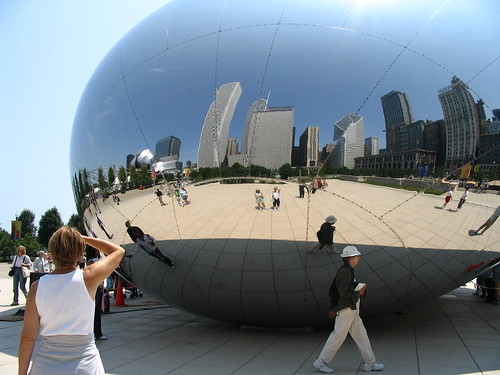
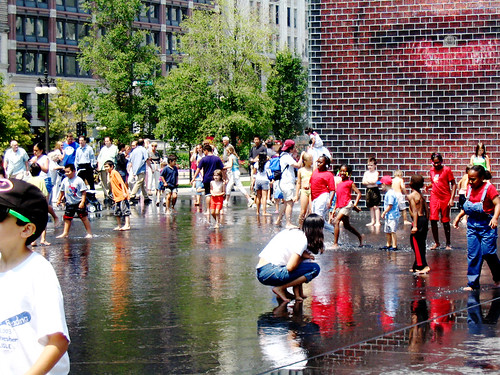
It’s from the summer of 2004. I was scheduled to deliver a speech at a conference in Chicago when I saw, in The New York Times, that Millennium Park had just opened. I decided that I needed some photos of it for a project I was working on at the time: World Island, “for a world that’s permanently fair”. So I bought a cheap point-and-shoot camera, a Canon Powershot, and took a bunch of photos. That’s one of them.

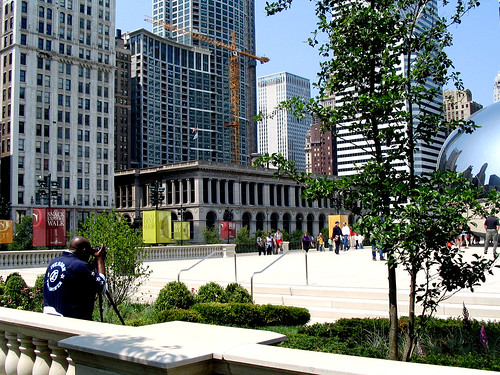
What’s the subject? Well, if you look to the center there’s not much of anything there, just some people milling around on the plaza, which is in the park. You’ve probably looked at the lower left where you see a photographer photographing something off to the right, that silver thing, Cloud Gate by Anish Kapoor. There’s a spindly little tree at the right and a bunch of buildings in the background. That center space is surrounded, which is the point. After I’d taken that photo and had a chance to think about it, I decided that THAT’s what I’m about as a photographer, space, space and light.

That’s what those photos are about.

Saturday, June 22, 2024

Another Diebenkorn photo, my first

Almost two weeks ago I posted a photo that I’d entitled “Diebenkorn on the table-top.” It was shot looking through two screen-covered windows taken from a camera resting on the top of a table (where I was having breakfast). Richard Diebenkorn was not a photographer. He was a painter who worked mostly in the San Francisco Bay area. I became acquainted with his work in the Summer of 2004 when I was in Chicago. I was there to give a keynote address for the Linguistic Association of Canada and the United States (LACUS), but I also took a bunch of photographs of Millennium Park, which had just opened. Since the Art Institute of Chicago was nearby, I visited it. That’s where I became acquainted with Diebenkorn.

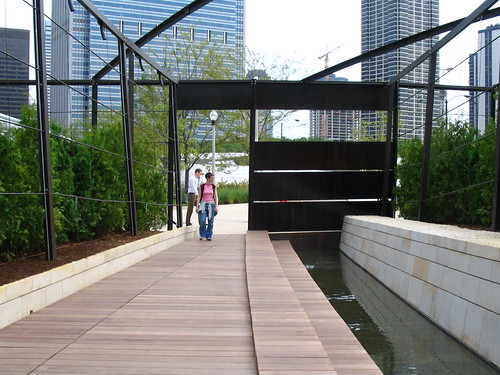
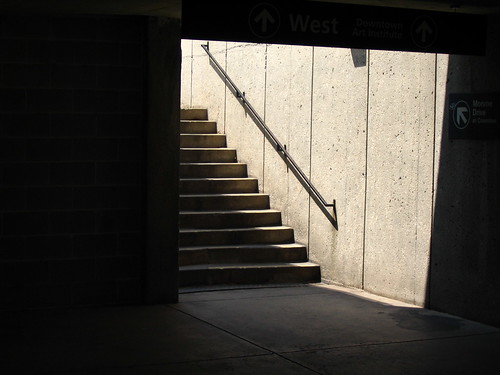
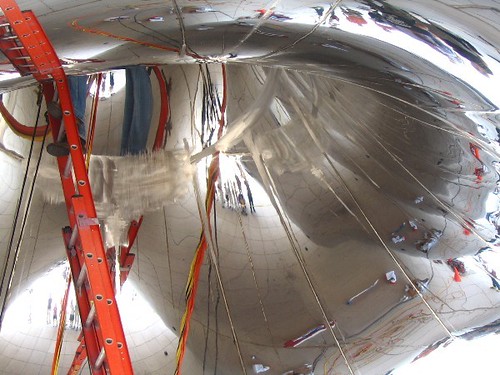
I took this photograph while standing in the garage beneath Millennium Park, which is built over a garage and railroad yards. I didn’t have a car, but I went down into the garage more or less so I could take photos like this. When I got that photo out of my camera, I said to myself: “That looks like a Diebenkorn.” It still does, as does that previous photo. They’re of very different subjects, but, when flatted out, their compositions resemble Diebenkorn’s composition.

Friday, June 21, 2024

Friday Fotos: Chicago, Summer 2004

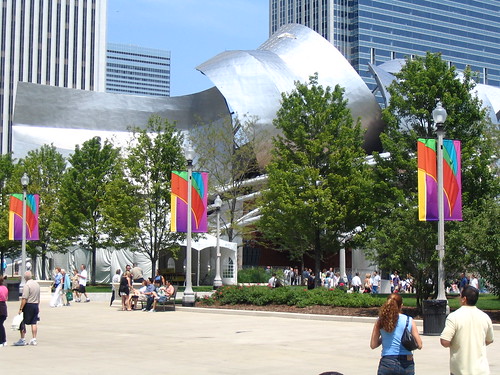
I bought my first camera, a Canon Powershot A75, to take photos of Chicago's Millennium Park, which had opened in the summer of 2004. But I also took photos of Chicago. These are some of those Chicago shots, though one of the structures in the park is just visible left of center in the background of the second photo.

Friday, July 19, 2019

Friday Fotos: The NOTHING Photograph, Again (for Peter)

I’ve written about NOTHING photos before*. But I love them, so why not again? Moreover, I took all but one of these when I was on a photo safari with an old friend of mine, Peter Barnett, whom I’ve known since college. We went to Liberty State Park, at the southern end of Jersey City.

This is a “nothing” photo (click on the photo to enlarge it):


What do I mean by that? What’s the subject of this photo? Where’s the focal point, what’s at the center? Can you point to it, name it? Look closely. To the left and along the bottom we can see some leaves of grass, bending this way and that, and out of focus. To the lower right there’s trees in the distance, apparently in focus. Somewhere in between, particularly to the right of center, branches and leaves, a bit out of focus. And the sky, with clouds, more or less center and right. If the photo is about anything, it’s about all those things in their relationships with one another. Not nothing, to be sure, but not a ready-graspable subject either.

Now look at this photo. I didn’t take in on my walk with Peter. It’s 15 years old and I took in in Millennium Park in Chicago, which had just opened. What’s at the center?


You can probably name something, perhaps that building with the high arched windows. Perhaps some people standing in the plaza. But it’s a stretch. Those things are in the photo, but it isn’t about them. Perhaps its about the photographer in the lower left. Really, with his back to us, about him? He’s photographing something, perhaps that silvery thing to the right, and sculpture (aka “the bean”) that’s not quite finished – the joints between the plates must still be removed. But it’s not about that. I figured that it’s about relationships. Yes, we’re drawn to the photographer because he’s the largest human in the photo, and humans are always salient. We follow his line of sight into the photo and see that polished metal, the people in the plaza, that building. This is a precursor to that nothing photo.

Here’s another nothing photo. We’re back in Liberty State Park with Peter. He was telling me about clouds, so I took a photo of clouds (not for the first time I might add):


I suppose you can think of the clouds in the center as being framed by the foliage. Why not? But if the foliage is a frame, well isn’t it as interesting as the clouds? I think so. One could as easily say that the clouds illuminate the greenery. BTW, notice the leaves of grass at the bottom center.

What about this? Yes, the tree trunk. Is anything in focus or is it all just at bit off? Let’s call it soft focus and pretend that I knew what I was doing.


What’s that almost-white sprig of grass doing shooting up the left edge? It exerts a pull, as do the leaves coming at us from the upper right. Really, everything else “hangs” from them, propped up by those tree trunks.

I really like this one, so I’ll give it to you in two versions:


We’re looking at the same tree as in the previous photo, but a slightly different angle and a bit further out. Just look at the variety. You can fill in the rest.

And these?


This last one, however, it a bit different. Is it nothing, or is it texture? What about the hint of color in the lower left?


* * * * *
* In these posts:

Friday, April 10, 2015

Friday Fotos: Chicago's Millennium Park

I bought my first camera about a decade ago to take photos of Chicago's Millennium Park the summer it opened. Here are some of those photos.

who r u

mother and child

over the rise rise over

inside cloud gate

triangulation

Monday, July 15, 2013

How I Found a Home in Jersey City and Got Steve Fulop Elected Mayor, Part 1

On that last, not really. I voted for him and made a small contribution to his campaign and I did one or two others things. But I didn’t spend 10, 20 or more hours a week volunteering for the campaign nor did I bundle big bucks for his campaign war chest. Still...

* * * * *

What is home? That’s a tricky one. I think of Johnstown, Pa. as my hometown. I was born in Pittsburgh, but that’s only where the hospital was located. I spent the first three or four years of my life in Ellsworth, Pa., but I don’t remember those years at all. Johnstown is the place I remember. Actually, a suburb in Richland, Twp. just outside Johnstown proper.

That’s where I went to primary and secondary school and that’s where I returned during summers when I was at college in Baltimore (Johns Hopkins). When I graduated with my BA I remained in Baltimore, summers too, getting a master’s degree and working out my alternative service (those were the Vietnam years) in the Chaplain’s Office at Hopkins. At the same time my father’s job moved the family to Allentown, Pa. No more returning to Johnstown. My hometown could no longer serve as my home.

From Baltimore I moved to Buffalo to pursue a Ph.D. I was as comfortable living there as I’d been since living in Johnstown, and it’s only recently that I’ve felt that kind of comfort here in Jersey City.

Why? There’s an easy and obvious explanation for my comfort in Buffalo. Though I was studying in the English Department at SUNY (the State University of New York), and liked the department, my real intellectual home was in a running seminar hosted by Prof. David G. Hays, in linguistics. Hays and I clicked as I’ve never clicked with any other thinker.
 
When I’d finished my Ph.D. I left Buffalo to take a job at the Renssalaer Polytechnic Institute in Troy, New York, starting in the Fall of 1978. It was, and is, a good school, with good students. But I was never comfortable there nor, do I believe, was RPI comfortable with itself, though that may have changed in the last 25 years.

I lost a bloody tenure battle at RPI, but elected to stay in Troy, free-lancing on this and that, and working at MapInfo, a high-tech startup, for a while. I also played trumpet in The Out of Control Rhythm and Blues Band and in the New African Music Collective. Still, Troy never really felt like home to me. I was there, but my heart wasn’t.

My heart was in my intellectual life. Though I was no longer in the academic world, I continued to think and to publish, both scholarly articles and a coffee table book on computer graphics and image processing (Visualization: The Second Computer Revolution). That, if you will, was my home. It was a virtual one, but not a physical one.

I hadn’t married, nor had children. I was thus not rooted in Troy in the way that having a family and raising children requires one to put down roots.

In the late 1990s I left Troy to live in Jersey City. A friend had started a company that was headquartered in nearby Hoboken. Jersey City rents were cheaper, so that’s where I moved. When the company bit the dust in the dot-com bust I decided to stay in Jersey City.

By that time the worldwide web had become firmly established and afforded me an intellectual life I hadn’t had before, especially as I wasn’t connected to a university. I could follow the scholarly literature online and could contact anyone whose work interested me. That made it possible for me to write my next book, Beethoven’s Anvil: Music in Mind in Culture, and to continue publishing in the academic literature. In particular, I published a series of four long articles in a new online journal, PSYART: An Online Journal for the Psychological Study of the Arts.

But Jersey City didn’t feel like home. I lived there, but I wasn’t rooted there. I hadn’t yet figured out how to do that.

Rooting came about almost by chance. In the summer of 2004 I went to Chicago to deliver a paper at the Thirty-first LACUS Forum on “Music, the Social Mind, and Language”. I bought a point-and-shoot camera so I could photograph Millennium Park, which was opening that summer. That’s how I ended up with a camera I otherwise had no use for.

But it was to be two years before I decided to photograph graffiti. That, in turn, is what gave me the means to make Jersey City my home. It was in that process that I met Steve Fulop, a young reform-minded Councilman.

I’ll tell that story in Part 2 of this essay.

Thursday, June 27, 2013

Xanadu on the Lake: Chicago’s Millennium Park

triangulation

Conceived in 1997, Millenium Park was officially opened on 16 July 2004. Occupying 24.5 acres in the northwest corner of Chicago’s Grant Park, this new park is a garden on a roof. It was built over an automobile garage and railway lines and cost a half-billion in dollars and likely as much in egos accommodated and backs scratched.
 
Like all gardens, it is set-off from ordinary life, a place of refuge, celebration, play, conversation, or simple rest. Judging by what I saw and heard the two times I was there – Tuesday afternoon, 27 July and Friday noon 29 July, 2004 – Chicago has done well. Children splashed, mothers watched over, lovers held hands, locals bathed in the sunlight, the symphony rehearsed, tourists snapped photos, and photographers steadied their cameras on tripods.

I don’t know whether historians will score this as the first grand public space of the Twenty-First Century (in the common Western reckoning of dates). “Grand” is not the right word, as it implies intimidation just barely contained; and that is not the park’s mood. Cross “grand” with “playful” and “inviting” and you come closer to the mark. Its defining structures – Frank Gehry’s Pritzker Pavilion, Jaume Plensa’s Crown Fountain, and Anish Kapoor’s Cloud Gate – are not “pedestal” structures. They cannot be appreciated as though in a universe alone. They interact with and through you, making the park’s space plastic and alive.

As someone who lives and works within sight of the air space that once was the World Trade Center, I cannot but think of this joyous new space in the terrible context of 9/11. Millennium Park is what those buildings never were, an artistic and architectural marvel on a scale at once individually human and collectively urban. Though not so intended, Millennium Park is also a proper answer to 9/11’s hateful destruction. It is a testament to the human spirit that both exemplifies our aspirations and accommodates our frailties, for its existence embraces and intermingles both.

Monday, October 24, 2011

The Philosophical Photo

triangulation.jpg

Over at Ecology without Nature Tim Morton references Graham Harman's suggestion that we need philosophy installations. In an interview with Tom Beckett at ASK/TELL Harman observes:
For me, art in general is a special way of breaking the bond between an object and its own qualities, and I believe it is now the central mission of philosophy to theorize the deformations and breakdowns in this bond. As I see it, they come in either four or ten forms, depending on how you count them. In this sense, aesthetics is first philosophy; aesthetics is not lipstick and jewelry worn by sober truths that can otherwise be stated as discursive propositions. ... But in fact, not even science or philosophy are doing their jobs properly if they dish out nothing but straight literal propositions. The world is not made of propositions, but of animals, chemicals, sports teams, and bombs.

None of these things can be translated into words or perceptions without significant energy loss.
 And here comes Harman's call for philosophy installations:
Different personality types dominate philosophy in different eras, as new needs come to the fore. The dominant personality type of recent decades has been the precise and assertive arguer who speaks clearly and likes to call people out on “nonsense.” It’s a personality that holds itself not to believe in very much, but to undercut the gullibility of other people’s beliefs.

My view is that the era of this personality has now run its course, and has become a pestilence of sorts. What we need now is something more like the artist type, given to new ways of staging problems. We need to find the equivalent of “philosophy installations,” whatever that might be.
Now, the thing is, in some ways, though not a philosopher, I am very much a thinker of the "precise" and "clear" type. That's one aspect of my early break from thinking about literature through continental thought and my flight to cognitive science. But I am also a musician and, back then, a painter and drawer.

These days I take photographs. It started when, in the summer of 2004, I was going to Chicago to give a paper at the LACUS meeting (Linguistic Association of Canadu and the United States, I believe, is how you unpack it). I was looking through the NYTimes and noticed the Millennium Park had just all but opened. "Freakin' awesome," says I to myself, "I gotta' see it."