Showing posts with label #HEX01. Show all posts

Friday, November 24, 2017

Sometimes the thing to do is declare the problem solved – and then, and only then, solve it: Is the REAL Singularity at hand? [#HEX01]

First you declare the problem solved and then figure out whether or not you’re right. The order is important, for the declaration is necessary to the set the stage for solving the problem. You can’t (usually don’t) do it the other way around.

What’s remarkable is that it seems to work. It’s worked for me several times, though only two specific occasions come to mind. One is quite recent, when I declared the “Kubla Khan” problem solved (yeah, I know, I know, there’s still work to be done proving it out). The other is years ago when I was working on my dissertation and I declared, yes, I’ve figured out Sonnet 129 – of as much of it as I needed to. But I’m sure it’s happened several times in between, though I can’t come up with specific occasions.

But why does it work?

Solving the large complex unknown

The problems are relatively large and complex and I have no model to guide me to a solution. I don’t know what I’m looking for.

Let’s step outside and imagine we’ve got transcendental knowledge of these sort of problems. We see the problem to be solved, and we in fact know how to solve it. We also see the investigator working on it and we know what he knows. There comes a time when he has all the pieces to hand. He can solve the problem at any time simply by putting the pieces together...in the right way. That is, he’s got all the components, but lacks a plan for their proper assembly.

One can wonder whether or not such a concrete metaphor is very useful in understanding such an abstract matter. I’m aware of the problem. There is a crucial distinction between components and a plan for their assembly. But is that a real distinction? Let’s go ahead as though it is.

What does he do? It depends. If he thinks more components are needed ¬– though he’s not likely to be thinking in terms of components and assembly plan – he’ll go on looking for more components and miss the opportunity to assemble the missing ones in the proper way. If however he decides, for whatever reason, that he’s got all that he needs, then it becomes possible to intuit the assembly plan, though it may take a bit of fiddling. That is, the plan itself is not a big deal. It’s knowing when you’ve reached the state where all you need is a scheme for assembling the parts you’ve got. Once you’ve reached that point, the components will “tell” you how they go together.
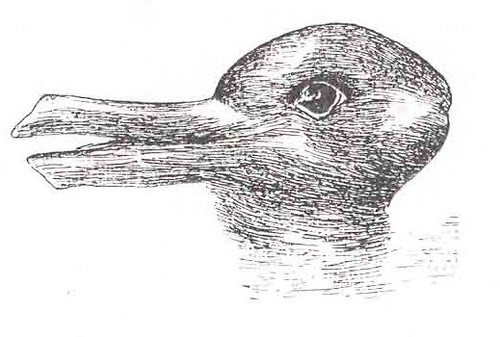
What happens, in effect, if that you figure out how to see a duck, rather than a rabbit:

duck-rabbit

And thinking about ducks allows you to move ahead.

We’re living the Singularity

Well, I’m beginning to think we’ve got all the components for the next step in an understanding of, simulation of, and imitation of mind. I’ve been blogging around and about this for some time, but I’ll give particular notice to Wednesday’s post, Explain yourself, Siri, or Alex or Watson or any other AI that does interesting/amazing things and we don't know how it does it. I smell that the game is afoot. Beyond this I offer the concluding paragraphs from the paper I prepared for HEX01, Abstract Patterns in Stories: From the intellectual legacy of David G. Hays, which takes a historical look at relevant technical issues:
As a child my imagination was shaped by Walt Disney, among others. Disney, as you know, was an optimist who believed in technology and in progress. He had one TV program about the wonders of atomic power, where, alas, things haven’t quite worked out the way Uncle Walt hoped. But he also evangelized for space travel. That captured my imagination and is no doubt, in part, why I became a fan of NASA. I also watched The Jetsons, a half-hour cartoon show set in a future where everyone was flying around with personal jetpacks. And then there’s Stanley Kubrick’s 2001: A Space Odyssey, which came out in 1969, which depicted manned flight to near-earth orbit as routine. In the reality of 2017 that’s not the case, nor do we have a computer with the powers of Kubrick’s HAL. On the other hand, we have the Internet and social media; neither Disney, nor the creators of The Jetsons, nor Stanley Kubrick anticipated that.

The point is that I grew up anticipating a future filled with wondrous technology. By mid-1950s standards, yes, we do have wondrous technology. Just not the wondrous technology that was imagined back then. One bit of wondrous future technology has been looming large for several decades, the super-intelligent computer. I suppose we can think of HAL as one instance of that. There are certainly others, such as the computer in the Star Trek franchise, not to mention Commander Data. For the last three decades Ray Kurzweil has been promising such a marvel under the rubric of “The Singularity”. He’s not alone in that belief. 

Color me skeptical.

But here’s how John von Neumann used the term: “The accelerating progress of technology and changes in the mode of human life, give the appearance of approaching some essential singularity in the history of the race beyond which human affairs, as we know them, could not continue”. Are we not there? Major historical movements are not caused by point events. They are the cumulative effect of interacting streams of intellectual, cultural, social, political, and natural processes. Think of global warming, of international politics, but also of technology, space exploration – Voyager 1 has left the solar system! – and the many ways we can tell stories that didn’t exist 150 years ago. Have we not reached a point of no return?

The future is now. Oh, I’m sure there are computing marvels still to come. Sooner or later we’re going to figure out how to couple Old School symbolic computing with the current suite of machine learning and neural net technologies and trip the lights fantastic in ways we cannot imagine. That day will arrive more quickly if we concentrate on the marvels we have at hand rather than trying to second guess the future. We are living in the singularity.

Tuesday, November 21, 2017

Been down so long a change is gonna’ come [#HEX01] [Ramble 9]

Been Down So Long It Looks Like Up to Me, by Richard Fariña, 1966: “coming on like the Hallelujah Chorus done by 200 kazoo players with perfect pitch... hilarious, chilling, sexy, profound, maniacal, beautiful and outrageous all at the same time”–Thomas Pynchon.
I’m not going to try summarizing the novel. Just think about the title. What could that possibly mean? Well, I’m thinking it’s the story of my life.

Isn’t it the story of everyone’s life, up to a point, which you may not have yet arrived at, who knows?

I’ve lived under a cloud most of my adult life. The clouds, I think, are breaking up. The sun is shining through. & it’s not that the light hurts, because it doesn’t, but that it’s disorienting. I don’t know the world from this POV.

* * * * *


* * * * *

Are you familiar with the sociological concept of a reference group? It’s a group which you use as a standard for judging your behavior and accomplishments. When I got my PhD in English Literature, those people, academic literary critics, became my reference group. I started out strong, with good articles in good publications, and then that came to an end. I knew, of course, that my work was very different from standard literary criticism, and that caused problems, for me, not for them.

But I worked on literature, and they work on literature, no one else, so what choice have I had. They’re my reference group.

But maybe not. As I said yesterday, at last, someone’s interested in the technical work I did 40 years ago. And they’re not literary critics. They’re gamers.

Maybe I can stop worrying about academic literary criticism. They’re certainly not interested in my technical world, even those interested in cognitive criticism and computational criticism (two very different groups, BTW) have little use for it. And I can’t see making much headway with the descriptive folks, either. They seem more interested in theorizing description than in actually doing it. So we really don’t have anything to talk about. They’re not going to tumble to my ring-composition work. It’s actual description rather than theoretical throat-clearing in preparation for description at some later date.

So, let’s just bracket academic literary criticism for awhile. That profession is no longer a reference group for me. Let’s see if I can get somewhere with the gamers.

* * * * *

That’s one thing. And, in a way, it’s secondary. The big thing is that I think I’m finally going to be able to deliver on a task I set myself four and a half decades ago: to come to terms with, to understand, in some sense, the mechanisms underlying Coleridge’s “Kubla Khan”.

I talked about “Kubla Khan” in the presentation I delivered at HEX01 (First Workshop on the History of Expressive Systems), only a week ago today (early in the morning). At the end James Ryan, one of the organizers, asked me whether I would get back to “Kubla Khan”. I forget exactly what I said, but it was something like “maybe/I hope to/someday/yes”. That was the short answer. The long answer isn’t really that long, but it was too long to give in that context.

The long answer is that I long ago made “Kubla Khan” my touchstone, my personal reference point, my North Star. I judge my intellectual progress by what it tells me about “Kubla Khan”. So I’ve thought about the poem – and it’s relation to “This Lime-Tree Bower My Prison” – off and on for most of my adult life. I did my MA thesis on it in 1972, published an updated version of that in 1985 (“Articulate Vision: A Structuralist Reading of “Kubla Khan”), and a considerably more sophisticated account in 2003 (“Kubla Khan” and the Embodied Mind). I count that last as considerable progress, but still, a way to go with no sense of just how far or even in what direction. In 2013 I put up a working paper, STC, Poetic Form, and a Glimpse of the Mind, in which I did a comparison between “Kubla Khan” and “This Lime-Tree Bower My Prison” that was considerably more detailed and sophisticated than the one I’d published way back in MLN in 1981, “Metaphoric and Metonymic Invariance: Two Examples from Coleridge” (obviously, my first formal publication on “Kubla Khan”). So, I’ve been through the poem five times in my career, including my unpublished master’s thesis. And, yes, to answer Ryan’s question, I hope to get to it again. But just when, I don’t know.

Well, a day or two later I got back to it. And I’ve declared the problem to be solved. Of course, there’s something of a gap between the declaration and the actual solution. I know that. And it’s not so much the solution that I’m after, but a sure sense of the terms in which a solution is likely to be found. That’s where I’m at.

Friday, November 17, 2017

“King Kong” as a ring-form game: Some preliminary notes [#HEX01]

I’m thinking about what would be involved in making a game that would play-out as a ring composition. Given that ring composition is a specific form of plot it is possible that it could not be adapted to open-ended gameplay. But that is by no means obvious to me. Ring-composition narratives have a an internal logic that is oriented toward certain kinds of problematics, if you will. I’ve spent enough time dealing with ring composition that I’m beginning to get a sense of how they work & what they’re for. The idea would be to set up a game world so that successful play would take the form of a ring, but no tightly specified sequence of actions is required. What’s important is the high-level pattern.

Why King Kong?

Because it’s there?

No, seriously. I’ve developed a pretty sophisticated understanding of the 1933 film. I’ve seen the 2005 Peter Jackson remake and the 1976 remake, but I don’t remember much about either, which is mostly a statement about what I remember, not an aesthetic judgment. I’ve also seen Kong: Skull Island, which is a different kind of beast. For that matter, I’ve seen a bunch of Planet of the Apes films and, of course, a whole bunch of action-adventure films in jungle settings involving big animals. It’s a world I’m comfortable with.

But it’s the 1933 film that interests me. That’s the one that started the whole business. It’s an astonishing film. And it’s ring form. It’s not, as I’ve observed in several posts, that I believe there’s some special magic in ring-composition – a key to all mythologies, an Open Sesame! that will lay the wonders of the world before my feet – rather, it’s something specific to look for. And, having found various examples, I can compare and contrast them to get a sense of what’s going on.

I am aware that various games have been based on the character and even one or more of the specific films (e.g. Peter Jackson’s King Kong). I may well want to investigate one or may of them at some point. But I need to do some thinking before I get to that point. Just what thinking I need to do...

... THAT’s what I’m trying to figure out.

Policy, Strategy, Tactics and cultural psychodynamics

In On War Carl von Clauswitz made a tripartite distinction between policy, strategy, and tactics.  National political policy established the objectives to be achieved by military strategy; strategy established the objectives to be achieved by tactics; and tactics governed the actual deployment of troops and equipment on a day-by-day basis. I find this a generally useful way of thinking about a variety of things. One might, for example, think of an action-adventure game (like Jackson’s Kong) as a strategic level adventure realized, at various points, though tactical level actions.

But what of policy? Northrop Frye has observed that a certain kind of comedy has a three-part plot: “One is the period of preparation . . . Another is the period of license and confusion of values . . . Third is the period of festivity itself” (A Natural Perspective, p. 73). If you drop the third part, you get a tragedy.

Well, the 1933 King Kong more or less follows that model, where the Skull Island sequence is that “period of license and confusion of values”. What would happen if Kong failed to defeat T-Rex and, consequently, R-Rex killed Darrow? The possibility of the existing happy ending, in which Darrow and Driscoll are destined to be married, disappears. Are we left with a tragic ending?

This, it seems to me, is a very high-level consideration. The battle between Kong and T-Rex is a tactical-level action, but the consequence is up there at the policy level, which is where I’d put the difference between tragedy.

That’s something I have in fact investigated [1] in the case of three Shakespeare plays, Much Ado About Nothing (a comedy), Othello (a tragedy), and The Winter’s Tale (a romance). In all these plays the shape of the dramatic action follows from the same situation, a man mistakenly believes that his beloved has betrayed him. These plays differ systematically in the types of characters they have in various roles, their age, social position, and temperament. I’m inclined to think that, if this is what you want of a game, then you need to give the user Sims-like powers of set-up at the very beginning.

Wednesday, November 15, 2017

Vehicularization & Ring-Form: Remarks on some issues raised at #HEX01

Edit 11.16.17: I've added some new material to the section on ontological mismatch. I've marked it by highlighting it.
I enjoyed presenting to HEX01: First Workshop on the History of Expressive Systems. I wish I’d had more time (don’t we all?), I wish I’d been there in person to talk with people and play with the exhibits. We do what we can.

I’ve been thinking about these issues for years. And will continue doing so. Indeed, between the time I submitted a draft paper (Abstract Patterns in Stories: From the intellectual legacy of David G. Hays)...


And the time I put the last touches on the PowerPoint I used for the talk ...


I had a few ideas that pushed the work forward here and there. I continue the push in these notes, which are rather informal. I’m just trying to get the ideas down on (virtual) paper.

Of course, the workshop was about history, so what was I doing presenting new ideas? Continuing the history. Oh yes, I presented some history, the computational ideas worked out by David Hays and his students in the mid-1970s, and how I, a student of literature, came to them. But streams of intellectual development don’t stop just because they’re always disappearing into the past.

More importantly, things change, deeply. I went into the 1970s with one set of ideas – call it paradigm in Kuhn’s sense, an épistème in Foucault’s – which I used to think about how language and literature work. I encountered a very specific issue (problematic?) within that paradigm, the structure of “Kubla Khan”, and my efforts to deal with that issue forced me to think in terms outside that paradigm, to start cobbling together a new paradigm (if I may). Am I there yet? Who knows?

That’s what I address in the first of these notes, about ontological mismatch in our thinking. Then I take a look at the triune model of the brain, as Hays and I recast it in terms of control hierarchy. I then use that recasting to think about ring-form in King Kong. I conclude with some remarks about Heart of Darkness.

A half-century of ontological mismatch (beyond the singularity)

I mean ontology in the sense it has come to have in computer and cognitive science, the organization of different types of objects in some domain. Prior to my work on “Kubla Khan” [1] I had internalized a certain ontology for dealing with literary phenomena. But the moment I decided to interpret line-end punctuation like parentheses, brackets, and braces in a mathematical expression (or like nested parentheses in a LISP expression) I moved out of that ontology and into a different one. It’s worth noting that, when I made that decision, I specifically thought about the computer programming course I had taken, and how, in THAT world, if you place a comma where a colon is expected, it won’t work.

The problem, then, is how to think about literary texts in a world where LISP expressions are ‘native’ objects.

Of course, we–me, my teachers, others–didn’t realize that that’s what had happened. (Of course, we didn’t think in terms of conceptual ontologies at all.) We just thought I was doing something strange and interesting within the existing (or perhaps emerging) ontology. The same with my 1976 paper on Sonnet 129 [2]. To be sure, it looked very different from every other article in the special issue of MLN. It had all those diagrams, while the other papers had no diagrams at all.

It wasn’t until much later that I realized that, when I did that work on “Kubla Khan”, I had irreversibly left the conceptual world of academic literary criticism. “Irreversible” because I can’t go back, though I can do good imitations.

Contemporary work in computational criticism presents the same problem. The desire to call it “distant reading” reflects a commitment to the standard ontology, an ontology is which the text is only incidentally marks on paper. In the standard ontology the text is, well, that’s hard to say. It’s that thing that you read, it’s somehow tethered to those marks on the page, but it’s more than those marks.

Well of course its more than those marks, but I can’t think of a better way to characterize that “more” than to think of it as come kind of computational process. And that’s what computational critics are scrupulously avoiding. On the one hand thinking of the mind as somehow fundamentally computational is of little practical value in their computational work. But also, they need to deflect the criticism of their more traditional colleagues who are wont to think of the notion of the mind as computational as, you know, the work of the devil.

Yet, in their own work, computational critics are working within an ontology in which the text is just marks on paper. The (miraculous? not really, but very artful (rare device)) craft in computational criticism is to analyze massive collections of such (mere) marks in a way that reveals the traces of mind, thousands and tens of thousands of minds reading. Think of it, from mere marks to the mind. That’s what computational criticism allows.

THAT ontology is different from, incommensurate with, the ontology of ordinary lit crit. There’s a deep tension that that is being glossed over. On the one hand, computational critics call it “deep reading” and note that, no, it’s not in competition with “close reading”. They’re complementary activities, complementary perhaps, but not ontologically compatible. On the other hand, traditional critics see “computer” and give a shudder–“There be dragons! Weave a circle around them thrice, and then lock ‘em up and throw away the key!” It’s not that bad; really, it isn’t. 

But still, THAT conversation has no happy ending. But no one’s dealing with that ontological gap. It can’t be bridged. Rather, it signals a need to rethink the discipline from top to bottom.

Which brings us to The Singularity. I figure that dreams and/or nightmares of the day when computers will become super-intelligent, those fantasies are rooted in a 19th century worldview. As such there’s an ontological mismatch between them and computing technology.

More later.