Showing posts with label #DH. Show all posts

Monday, July 27, 2026

Behavioral similarities in the way chatbots and oral poets perform

Kush R. Varshney, An Annotated Reading of ‘The Singer of Tales’ in the LLM Era, https://arxiv.org/html/2502.05148v1 Feb. 2025.

Abstract. The Parry-Lord oral-formulaic theory was a breakthrough in understanding how oral narrative poetry is learned, composed, and transmitted by illiterate bards. In this paper, we provide an annotated reading of the mechanism underlying this theory from the lens of large language models (LLMs) and generative artificial intelligence (AI). We point out the the similarities and differences between oral composition and LLM generation, and comment on the implications to society and AI policy.

Varshney develops his argument by interlacing passages from Albert Lord's The Singer of Tales with comments on LLMs. This is a very interesting way of reviewing your understanding of LLMs in relation to a specialized kind human language performance.

You might want to consider two of my blog posts:

GPT-3, the phrasal lexicon, Parry/Lord, and the Homeric epics, July 16, 2022.

In some ways, some contexts, LLMs may provide a useful model for human language, March 24, 2026.

In this more recent post I discuss empirical evidence about human memory for F.C. Bartlett's classic book, Remembering: A Study in Experimental and Social Psychology (1932), David C. Rubin, Memory in Oral Traditions: The Cognitive Psychology of Epic, Ballads, and Counting-out Rhymes (Oxford 1995).

Wednesday, June 19, 2024

The Lives of Literary Characters [digital humanities #DH]

From the project site:

The goal of this project is to generate knowledge about the behaviour of literary characters at large scale and make this data openly available to the public. Characters are the scaffolding of great storytelling. This Zooniverse project will allow us to crowdsource data to train AI models to better understand who characters are and what they do within diverse narrative worlds to help answer one very big question: why do human beings tell stories?

In the nineteenth-century heyday of the novel, there were over 1.5 million literary characters invented just in English alone. Today, with the continued growth of literary markets around the world and the explosion of creative writing on the internet through fan communities, that number is orders of magnitude higher.

How on earth can we possibly understand all of this creativity?

This is where you, the reader, come in. We need your help to build better, more transparent AI models to understand human storytelling. To be clear: our goal is not to build AI to generate stories or create smarter chatbots. Our aim is fundamentally academic: we want to develop models to help us understand stories and thus learn more about this essential human activity. Most AI development is happening inside of black boxes behind closed doors. Our models will be open to the public as will all of the annotations made by readers like you. You are a key participant in how we will understand the future of stories.

There's much more HERE.

Monday, May 6, 2024

Description as Redesign: Carving Nature at the Joints

I'm bumping this to the top because I think it's good to be reminded that it was Plato who coined the trope of carving nature at its joints.
In reply to my open letter Willard McCarty made an observation I want to look at: “So an act of description is creative, or more accurately, an act of redesign under constraints which are very difficult to be exact about but which are hard as rocks.” To which I replied: “’Redesign’ – yes. After all, we ARE trying to figure out the design. We're attempting to reverse engineer it. And it is exacting, but the constraints are not obvious.”

Still, we need to be careful. To be sure, in my experience, description is not easy, not obvious, and, I suppose, creative. I’m not following a set of explicit guidelines; there are things I look for, but it’s not the sort of thing I could reduce to a checklist and then give it to anyone who can read.

But also, the “creativity” of literary criticism has been much extoled in the mainstream literature and I’m a bit wary of that. For that’s what underwrites the multiplicity of often-incompatible interpretations for any given text. That’s fine for interpretation, but not so good for description. I want mutual compatibility of descriptions.
 
Turkeys, for example, are fairly complex objects and any given turkey will admit of many descriptions, all true and mutually consistent. But a turkey cannot have both two legs and only one, the other having been lost in an accident) – well, yes, turkeys exist in time and a description that’s apt at one moment may contradict one that’s apt at some other moment; that’s no problem.

But then McCarty re-characterizes description as qualification as redesign. And I like that, comparing it to reverse engineering – which I may say more about in another post. And that led me to that old cliché about carving Nature at its joints. We owe that one to Plato’s Phaedrus. Socrates has likened a well-formed speech to an animal with its various appropriately arranged parts and is now examining two different speeches on love (265e-266a):
... we are not to attempt to hack off parts like a clumsy butcher, but to take example from our two recent speeches. The single general form which they postulated was irrationality; next on the analogy of a single natural body with its pairs of like-named members, right arm or leg, as we say, and left, they conceived of madness as a single objective form existing in human beings. Wherefore the first speech divided off a part on the left, and continued to make divisions ...
The vehicle of Plato’s simile, butchering, is worth thinking about. When you carve meat, you want to do so cleanly. You don’t want bones to stick out, which means you’ve got to cut right into the joint, not to either side of it.

The problem, though, is you can’t see the joint when it is covered with muscle and skin. It’s hidden and its location is not apparent on the carcass’s surface. That’s where the comparison gets its power.

And so it is with describing texts. The “joints” are not apparent in the surface. It takes skill to find them.

And what of the computational mindset that I regard as essential to literary criticism (see, for example, Computational Thinking and the Digital Critic: Part 1, Four Good Books)? That’s what tells you where the joints are, or at least gives you clues. As I’ve argued in my long paper on literary morphology, literary form is computational form. Ultimately we want to understand how those computational processes work. To do that we must begin by identifying their traces in the text.

Tuesday, February 6, 2024

Vesuvius scrolls are now being deciphered! A win for machine learning and human ingenuity. [#DH]

About the scrolls.

About the Vesuvius challenge.

H/t Tyler Cowen.

Monday, November 27, 2023

Fabula and Syuzhet in the Tristram Shandy Handbook

Sean Yeager has just published an article in J. of Cultural Analytics that's germane to this post, “Time Maps: Theory and Method.” It is about time maps, “the graphs which are produced by plotting a narrative’s fabula against its syuzhet.” Consequently, I'm jumping this post (from 2015) to the head of the queue.
To my knowledge there is no Tristram Shandy Handbook, nor a handbook for any other literary text. What do a mean by handbook? I’m imagining a single source containing consensus information about a given text. That source might be hardcopy or, these days, online. In the case of minor texts, texts that have received little study, the amount of information would not warrant a single volume of its own and so would be bound into a volume with such information about other texts.  This issue, of course, does not exist for online texts, which can be of any magnitude. Tristram Shandy, of course, is not a minor text.

It is one of the central texts of the Western canon and had been subject to decades of study. Students new to the work can select from I don’t know how many casebooks and study guides, and many of those study guides are online. Some of the materials that belong in this hypothetical handbook can be found in those casebooks and study guides. The idea of a handbook is to collect those materials in one place that is accessible to all.

One thing that I would like to see in a Tristram Shandy Handbook would be a complete mapping between the events Sterne narrates listed in chronological order and the actual order in which they appear in the text. In many narratives these two orderings are the same. But not in Tristram Shandy. Early in the 20th century the Russian Formalist critics used the terms fabula (chronological) and syuzhet (textual) to designate these two orders. Tristram Shandy is an extreme example of their divergence [1].

The ordering of events is a standard topic in Tristram Shandy criticism and, judging by what I’ve found through a bit of Googling, bits and pieces of chronology have been worked out here and there and perhaps, perhaps the whole thing. But the relationship between that text and the chronology is nonetheless obscure. Can anything be done to clarify it?

A Problem of Description

This is a problem of description, one of my favorite hobbyhorses [2]. What does it mean to describe the relationship between fabula and syuzhet in a text as complicated as Tristram Shandy? I don’t know.
 
Let me explain. I have found, but not really read, an article from 1936:

Baird, Theodore. “The Time-scheme of Tristram Shandy and a Source”. PMLA 51.3 (1936): 803–820. DOI: 10.2307/458270

After a page and a half of introduction Baird runs through the chronology, from 1689 (Trim joins the army) to 1750 (Yorick’s sermon on conscience), saying more or less what happens in the year. References to the text of TS are given by volume and chapter in footnotes. I found that article in a recent dissertation:

Duncan W. Patrick. Libertinism and Deism in Tristram Shandy and Other Writings of Laurence Sterne. Dissertation. Department of English, Leicester University, 2002. URL: https://lra.le.ac.uk/bitstream/2381/30274/1/U162249.pdf

That dissertation includes a chronology as a five-page appendix running from 1509 (Shandy family ranked high at the time of Harry VIIIth) through 1768 (Stern’s death). The chronology is in the form of a table with the dates on the left and the gloss, including references to the text, again by volume and chapter. I assume that Patrick’s chronology includes Baird’s.

First, given a table like Patrick’s, I think, as a matter of principle, that it would be useful to have the same information organized in a table by textual order so that we can examine the temporal structure of each volume independently. Second, these chronologies give no sense of the detailed structure of the text. THAT’s the big descriptive problem, and I don’t know how to solve it. It’s not merely that I don’t know what such a thing would look like, how it would work, but I don’t know what kind of effort would be required to create such a facility.

For I pretty much assume that that’s what it would be, some kind of online facility based on the complete texts. Beyond that… I have this vague idea that, if I were on the faculty of some appropriate graduate school, me and a half dozen graduate students, some with computer skills that I don’t have, could get a sense of the problem in a semester’s work. We might even be able to produce a crude prototype of such a facility.

At this point you might be wondering: If it’s going to take that much work, will the results be worth the effort? I feel pretty sure that they will, but of course there’s no guarantee. At this point my confidence is based on a fair amount of experience in describing literary texts and films. Something interesting always turns up, always. Still, as I’ve said, there’s no guarantee. Given that I’ve already written a great deal about description, I see no need to repeat that here [2].

Instead, I thought I take a small step toward dealing with the first problem I mentioned, ordering the dates by order of appearance in the text. There’s quite a bit of Shandy material online [3], including the University of Milan’s Tristram Shandy Web, which contains an online facsimile text along with supporting materials of various kinds [4]. Among those is a relatively short chronology, URL: http://www.tristramshandyweb.it/sezioni/TS/johnson.htm

I have taken that chronology and 1) placed it into a table and then, 2) sorted the table into order by volume and chapter. Those tables constitute the next two sections of this post, with a short list of references at the end. Given that second table it was an easy matter to produce the following list:

Volume 1:       1658-1761
Volume 3:       1713
Volume 5:       1689-1723
Volume 6:       1706-1717
Volume 7:       1762-1764
Volume 8:       1693-1695
Volume 9:       1713-1766

Notice the Volumes Two and Four don’t appear at all and Volume One has the widest range, but that both Volumes Six and Nine contain dates more recent than the most recent one given for Volume 1. None of the other volumes give a date earlier than the earliest one in Volume One. Moreover, I assume that the dates are only those for events directly related to Tristram and his close associates. For there are earlier incidents recounted in the book.

Given the sparseness of the data I don’t think much of anything can be concluded from this. I’m just trying to get a feel for the material by doing what I can.

Thursday, September 8, 2022

Some Thoughts on the Discipline [Literary Criticism]

I'm bumping this to the top of the queue on general principle – and – to remind myself that, to the extent that I have a home discipline, it is the study of literature. I originally published this in October of 2015. I've written considerably more about literary study since then.
* * * * *
 
It appears that I’ll be publishing a working paper on the profession of academic literary criticism sometime in the next week or three, depending on what other projects I’m working on. This is a topic I’ve written quite a bit on, so much that it seemed to me that there should be a section in that working paper that serves as a guide to much, if not quite all, of that work.

This is a trial run on that section. As such it is a lightly annotated bibliography, where the annotations mostly consist of the abstracts I prepared for each working paper. I’ve divided them into four sections: Bridges, Description, Psychology, and Computational Criticism.

Bridges


How you get from here to there. The first one is how you get (how I got) from Lévi-Strauss’s practical work on myth to cognitive science. The second one seeks to justify the ways of literature and of humanists to Steven Pinker. The third places my conception of (the potentialities of) literary criticism in the context of Bruno Latour’s actor networks and his modes of being.

* *

Beyond Lévi-Strauss on Myth: Objectification, Computation, and Cognition (2015) 30 pp.

Abstract: This is a series of informal notes on the structuralist method Lévi-Strauss used in Mythologiques. What’s essential to the method is to treat narratives in comparison with one another rather than in isolation. By analyzing and describing ensembles of narratives, Lévi-Strauss was able to indicate mental “deep structures.” In this comparing Lévi-Strauss was able to see more than he could explain. I extend the method to Robert Greene’s Pandosto, Shakespeare’s The Winter’s Tale, and Brontë’s Wuthering Heights. I discuss how Lévi-Strauss was looking for a way to objectify mental structures, but failed; and I suggest that the notion of computation will be central to any effort that goes beyond what Lévi-Strauss did. I conclude by showing how work on Coleridge’s “Kubla Khan” finally led me beyond the limitations of structuralism and into cognitive science.

* *

An Open Letter to Steven Pinker: The Importance of Stories and the Nature of Literary Criticism (2015) 20 pp.

Abstract: People in oral cultures tell stories as a source of mutual knowledge in the game theory sense (think: “The Emperor Has No Clothes”) on matters they cannot talk about either because they resist explicit expository formulation or because they are embarrassing and anxiety provoking. The communal story is thus a source of shared value and mutual affirmation. And the academic profession of literary criticism came to see itself as a repository of that shared value. Accordingly, in the middle of the 20th century it turned toward interpretation as its central activity. But critics could not agree on interpretations and that precipitated a crisis that led to Theory. The crisis has quited down, but is not resolved.

* *

Literary Criticism 21: Academic Literary Study in a Pluralist World, Revised September 2014 (2014) 42 pp.

Abstract: At the most abstract philosophical level the cosmos is best conceptualized as containing various Realms of Being interacting with one another. Each Realm contains a broad class of objects sharing the same general body of processes and laws. In such a conception the human world consists of many different Realms of Being, with more emerging as human cultures become more sophisticated and internally differentiated. Common Sense knowledge forms one Realm while Literary experience is another. Being immersed in a literary work is not at all the same as going about one's daily life. Formal Literary Criticism is yet another Realm, distinct from both Common Sense and Literary Experience. Literary Criticism is in the process of differentiating into two different Realms, that of Ethical Criticism, concerned with matters of value, and that of Naturalist Criticism, concerned with the objective study of psychological, social, and historical processes.

Description


The description of literary form is the foundation of a revivified literary criticism. But description as I’ve come to understand it, both from doing and from theorizing about it, is more subtle and difficult that traditional criticism warrants. It is also more important, far more important. Without four centuries of painstaking naturalistic description available to him, Darwin would have had no empirical basis for his work. That’s where literary criticism is now: Lacking careful and detailed descriptions of the texts we’re entrusted with, we lack the basis for objective accounts of textual phenomena. Producing these descriptions should be a prime intellectual priority.

* *

Description as Intellectual Craft in the Study of Literature (2013) 33 pp. https://www.academia.edu/4262467/Description_as_Intellectual_Craft_in_the_Study_of_Literature

Abstract: This is a series of notes in which I argue that better descriptive methods are a necessary precondition for more sophisticated and objective literary criticism. Description, though it does not give unmediated access to texts, requires methods for objectifying texts, methods which must be discovered in the doing. By way of comparison I discuss the role of description in biology and I discuss the use of images and diagrams as descriptive devices. Lévi-Strauss on myth and Franco Moretti on distant reading, though quite different, are up to the same thing: objectification.

* *

Description 2: The Primacy of the Text (2013) 41 pp. https://www.academia.edu/4866743/Description_2_The_Primacy_of_the_Text

Abstract: These notes consist of five posts discussing the description of literary texts and films and five appendices containing tables used in describing to manga texts (Lost World, Metropolis) and two films (Sita Sings the Blues, Ghost in the Shell 2: Innocence). The posts make the point that the point of description is to let the texts speak for themselves. Further, it is through descriptions that the texts enter intellectual discourse.

* *

Description 3: The Primacy of Visualization (2015) 48 pp. https://www.academia.edu/16835585/Description_3_The_Primacy_of_Visualization

Abstract: Describing literary texts requires a mode of thought distinct from the discursive interpretation of them. It is a mode of thought in which various visual devices are central. These devices include: tables, trees and mental spaces, directed graphs and “sketchpads”. Visualization facilitates the objectification of literary form and objectification is necessary for objectivity. With objectivity comes the possibility of cumulative knowledge.

Friday, September 2, 2022

On Revising Prospero Yet Again [and again]

I thought I'd bump this to the top more or less on general principle. I've done another version of Prospero since the version posted below. This one dates from 2018 and incorporates ideas based computational techniques that didn't exist in 2014, of that just barely existed. It's called Virtual Reading: The Prospero Project Redux, where the idea of virtual reading replaces the type of computational reading I'd imagined in the old Prospero.

* * * * *
 
By Prospero I mean a thought experiment that David Hays and I proposed back in 1976 in a review article, Computational Linguistics and the Humanist, we published in Computers and the Humanities. Sometime in the last decade or so, when I began thinking about doing a book on naturalist criticism, I took that old idea, of a computer program capable of a non-trivial simulation of a reader of Shakespeare, and elaborated it more or less as a stand-alone piece. In particular, I contextualized it with some remarks Stanley Fish had made about stylistic analysis in Is There as Text in This Class? I posted that piece about half a year ago, then revised and reposted it about a month ago.

I’ve now done yet another revision, this time incorporating the notion of a tabula rasa interpretation from Alan Liu’s article, “The Meaning of the Digital Humanities” (PMLA 128, 2013, 409-423). I’ve posted that version at my Academia.edu page. I’ve appended the abstract to this post.

Why yet another revision?

It would seem that this notion, this Prospero, has become a touchstone, something through which I gauge the state of my thinking on certain possibilities of literary analysis. But that’s not quite what it was when Hays and I advanced it almost 40 decades ago. Then it was a way of conveying something to an audience we presumed to be unfamiliar with current ideas in computational linguistics.

At that time, the mid-1970s, semantics was the Big New Thing. Computational linguistics was born in the early 1950s under the rubric of machine translation. The US Federal Government needed to translate a lot of Russian documents into English. Perhaps that could be done with computers?

And so a variety of investigators went to work recasting phonology, morphology, and syntax into computational form appropriate to machine translation. By the late 1960s it became apparent, both in computational linguistics and artificial intelligence, that it would be necessary to tackle meaning. Thus was born the computational semantics of natural language.
 
THAT’s what Hays was interested in when I began working with him in the spring of 1974. That’s what everyone was interested in. By the time we wrote that essay I’d completed and published preliminary work on Shakespeare’s sonnet “The Expense of Spirit”, which we discussed in the article. But we couldn’t go into any of the details in that article. So, to give our readers some sense of what that work portended we concocted Prospero.

The idea was straightforward: Code the Elizabethan worldview into a computer using formalisms then being developed, have a computer “read” a Shakespeare play, and then examine what it did in the process. For bonus points you could also program the computer with the knowledge needed to crank out Freudian, Marxist, feminist, and other interpretations. Who wouldn’t be excited at the prospect of working on such a project, even if it were a long-term (decades) project?

I don’t know what Hays thought about the real possibility of such a thing – he’d already lived through the institutional collapse of machine translation when it failed to deliver on some rather extravagant promises – but I figured that I’d be working on Prospero in my lifetime. Certainly not in the near-term future, but 20, 30 years out...?

It didn’t happen. Nor is there any immediate prospect of such a thing. IBM’s Watson is the state of the art, and it’s nowhere near the capability needed to implement Prospero.

What would it take to implement Prospero? I don’t know.

Oh, sure, it’s easy enough to say that it would require a good model of how the human brain operates, including conversation with others. But what would THAT require? We don’t know.

By way of comparison, the folks who want to send a manned mission to Mars know a great deal about what that would require. After all, we’ve already sent humans to the moon and brought them back. And we’ve sent probes that have landed on Mars and beamed back information about what’s there. All that’s directly relevant to the task of a manned mission to Mars. It may not be sufficient – it doesn’t tell us how the human body will adapt to months of weightlessness in transit, nor the mind to those months being bound to a very small group – but it IS a lot.

It is much more than we know about simulating the human brain or coding up the Elizabethan worldview.

So, if Prospero is not possible, then why think about it at all?

Let me put that more personally. What can you learn from me by reading about Prospero? To some extent that depends on what you already know about things such as cognitive science, AI, and computational linguistics, and how much you are willing to trust my knowledge of such things. And what could I learn from you through conversing about Prospero? And that depends on what you already know and on my willingness to trust in your knowledge.

That is to say, Prospero is a set of ideas for organizing a conversation, a conversation about what computers bring to the study of literature.

For example, in one of the essays in Is There a Text in This Class? (1980) Stanley Fish asserts that Michael Halliday, a linguist, is one of many lured on by “the promise of an automatic interpretive procedure” (p. 78). Though I can’t be sure of this, I rather doubt that Halliday himself had any such idea, certainly not as Fish attributes it to him. The idea’s a straw man. Thinking about Prospero is a way of thinking about why the idea IS a straw man. It may even get you to the edge of thinking about why Stanley Fish posits such a thing.

I suppose what Fish had in mind was that you “feed” your text into “the automatic interpretive procedure” and it “spits out an interpretation.” Given such a device, why should you trust the interpretation? Wouldn’t you have to know what it does? And if you know that, do you need the device?

Prospero is useful for thinking about that. So, we’ve got Prospero and we feed it, say, Much Ado About Nothing. How do we know that Prospero understood the play in some meaningful way? Of course we could ask: Did you understand it? But what would we know once Prospero answers Yes? Not much. And if Prospero were to tell us that, no, he didn’t understanding the play, would THAT tell us anything useful? We could ask Prospero questions about the play: Who is Hero? What’s her relationship to Beatrice? And when Prospero answers correctly (or not) then what do we know?

As I say in my various versions of this little thought experiment, what’s important is that knowledge that goes into building Prospero. But Prospero could give reasonable answers to those questions without understanding much about the play, no? After all, aren’t there students like that?

I’ve also said that, given that Prospero is a reasonable simulation (as determined by some as yet unspecified set of procedures), what we really want to do is examine what Prospero does internally in the process of reading a play. That, surely, would tell us a lot.

And now we’ve got a problem, one I’ve been aware of but chose not to bring up. Assume that Prospero IS a fairly robust simulation of a human mind. Isn’t there an ethical problem in opening it/her/him up and examining what happens while reading? Don’t we have to ask permission and, if permission is not granted, go no farther?

If I was aware of this issue, why didn’t I bring it up? I don’t quite know. The matter seems both obvious and beside the point. It exists in some other thought-world, one that impinges on the Prospero world, but that’s outside the actual business of creating a Prospero machine.

Perhaps that’s what Prospero is, a boundary marker, or a guardian spirit.


Revision 3, May 2014

Abstract: Prospero is a thought experiment, a computer program powerful enough to simulate, in an interesting way, the reading of a literary text. To do that it must simulate a reader. Which reader? Prospero would also simulate literary criticism, and controversies among critics. The point of Prospero, if we could build it, is the knowledge required to build it. If we had it, we could examine its activities as it reads and comments on texts. But our knowledge of Prospero is of a different kind and order from our knowledge of the world and of life, though those things are central to literary texts. The point of this thought experiment is to clarify that difference, for that is what we will have to do to build a naturalist literary criticism grounded in the neuro-, cognitive, and evolutionary psychologies. Though contemplation of this experiment we can see that, whatever computing promises literary study, it will not yield automatic interpretive procedures.

I don’t give a crap about science

Time for another bump to the top of the queue, on principle. (9.2.2022)

* * * * *

I originally published this in The Valve, 25 March 2010. I republished it once before at New Savanna and I think it's worth republishing again, this time in the context of my extensive posting on digital humanities, which is sometimes subject to an unproductive discussion of humanistic vs. scientific method. In these discussions the opposed methods are ideological formations more than actual procedures real people use to arrive at more or less reliable knowledge.
Let me repeat that: I don’t give a crap about science. And again, just so you know I mean business: I don’t give a crap about science. Though just what kind of business I mean, well...

From which it follows, as the night the day, that I’m not interested in making the study of literature more scientific. I certainly want to see literary studies change in certain ways, use new ways of thinking—and of organizing and publishing our work. But making it “more scientific” is not part of the program.

Still, when I say “I don’t give a crap about science,” what do I mean? Anyone who has more than a casual acquaintance with my work knows that I frequently cite work in, e.g. cognitive science, neurobiology, and actually use those ideas in the body of my text. Until few years ago I only got three academic journals, PMLA, Science, and Nature. Then I dropped PMLA (not all that interesting), a year later I dropped Nature (too expensive), and finally, alas, Science (not as expensive as Nature, but still too much). It thus seems unlikely that I intend “I don’t give a crap about science” to have its most obvious meaning, that is: I don’t give a crap about science.

I mean something else.
 
Most intimately, most closely at hand, I mean that I don’t worry about whether or not my work is sufficiently scientific. I worry about whether or not it is interesting, about rigor and coherence, about whether the prose is clear and, as appropriate, elegant. But is it scientific? Not an issue. Nor is it an issue I worry about in the work of others.

Another thing I worry about is objectivity. Something I find deeply obscure.

As I walk about my apartment there are all these things that clearly are objects, existing apart from me. Much philosophical ink has been spilled on that issue, but it is not that ink and its intended meanings that I mean to evoke here and now. Just the ordinary experience and those real objects out there in the world. So that is one thing.

Then there is scientific objectivity, over which much philosophical ink has also been spilled. I believe such objectivity is real, though our understanding of it is obscure and contested.

What about the objectivity of journalists? That is different from the objectivity of scientists. How does it work? Some might wonder whether it is possible at all. Can the notion of “objectivity” be given useful meaning with respect to the situations on which journalists must report?

I also recognize that some matters are ineluctably subjective. Among those, some may be relentlessly idiosyncratic and specific to individuals. But I’m not sure that beauty is among those. Nor the good. It is often possible to reach substantial intersubjective agreement on matters that are subjective. Society would be impossible without such agreement. And we may well mistake widespread intersubjective agreement on subjective matters for objectivity. Or is that a mistake? Sometimes, often, always, never?

Objectivity, how to achieve it, that has perhaps been my main methodological concern in literary studies. These days I am particularly interested in the ways in which we can extend the reach of objective analysis and description of literary works (cf. this post on how "Kubla Khan" kicked my intellectual training into oblivion, of this article on literary morphology).

What about intersubjective agreement on subjective matters? What role does it play in literary studies? Note that I believe genuine critical activity, aesthetic or ethical evaluation of texts, is subjective and so criticism in this sense is about securing intersubjective agreement.

I further suspect that in many cases where we talk of humanistic knowledge being subjective we really mean something more like informal or unformalized.

(What about objectivity and intersubjective agreement?)

* * * * *

Ergo, I tend to regard much-most humanities vs. science discussion as ideologically-driven wanking and I regard Snow’s Two Cultures and its spawn as children of the Devil.

Wednesday, August 24, 2022

Patterns as Epistemological Objects [2495]

Pattern-matching is much discussed these days in connection with deep learning in AI.  Here's a post from July, 2014, where I discuss patterns more generally. [I was also counting down to my 2500th post. I'm now over 8600.]

* * * * *

When I posted From Quantification to Patterns in Digital Criticism I was thinking out loud. I’ve been thinking about patterns for years, and about pattern-matching as a computational process. I had this shoot-from-the-hip notion that patterns, as general as the concept is, deserve some kind of special standing in methodological thinking about so-called digital humanities – likely other things as well, but certainly digital humanities. And then I discovered that Rens Bod was thinking about patterns as well. And his thinking is independent of mine, as is Stephen Ramsay’s.

So now we have three independent lines of thought converging on the idea of patterns. Perhaps there’s something there.

But what? It’s not as though there’s anything new in the idea of patterns. It’s a perfectly ordinary idea. THAT’s not a disqualification, but I think we need something more if we want to use the idea of pattern as a fundamental epistemological concept

From Niche to Pattern

In my previous patterns post, “Pattern” as a Term of Art, I argued that the biological niche is a pattern in the sense we need. It’s a pattern that arises between a species and its sustaining environment. Organisms define niches. While biologists sometimes talk of niches pre-existing the organisms that come to occupy them, that is just a rhetorical convenience.

That example is important because it puts patterns “out there” in the world rather than them being something that humans (only) perceive in the world. But now it’s the human case that interests me, patterns that humans do see in the world. But we don’t necessarily regard all the patterns we see as being “real”, that is, as existing independently of our perception.

When we look at a cloud and see an elephant we don’t conclude that an elephant is up there in the sky, or that the cloud decided to take on an elephant-like form. We know that the cloud has its own dynamics, whatever they might be, and we realize that the elephant form is something we are projecting onto the world.

But that is something we learn. It’s not given in the perception itself. And that learning is guided by cultural conventions.

We see all kinds of things in the world. Not only does the mind perceive patterns, it seeks them out. What happens when we start to interact with the phenomena we perceive? That’s when we learn whether or not the elephant we saw is real or a projection.
 
With this in mind, consider this provisional formulation:
An observer defines a pattern over objects.
The parallel formulation for ecological niche would be:
A species defines a niche over the environment.
The pattern, the niche, exists in the relationship between a supporting matrix (the environment, an array of objects) and the organizing vehicle (the species, the observer). Just as there’s no way of identifying an ecological niche independently of specifying an organism occupying the niche, so there’s no way of specifying a (perceptual or cognitive) pattern independently of specifying a mind the charts the pattern.

As a practical matter, of course, we often talk of patterns simply as being there, in the world, in the data. And our ability to understand how the mind captures patterns is still somewhat limited. But if we want to understand how patterns function as epistemological primitives, then we must somehow take the perceiving mind into account.

The point of this formulation is to finesse the question of just what characteristic of some collection of objects makes them a suitable candidate for bearing a pattern. We can understand how patterns function as epistemological primitives without having to specify, as part of our inquiry, what characteristics an ensemble must have to warrant treatment as a pattern. We as epistemologists are not in the business of making that determination. That’s the job of a perceptual-cognitive system.

Our job is to understand how such systems come to accept some patterns as real while rejecting others. How does that happen? Through interaction, and the nature of that interaction is specific to the patterns involved.

Two Simple Examples: Animals and Stars

Let us consider some simple examples. Consider the patterns a hunter must use to track an animal, footprints, disturbed vegetation, sounds of animal movement, and so forth. The causal relationship between the animal and the signs in the pattern is obvious enough; the signs are produced by animal motion. The hunter knows that the pattern is real when the animal is spotted. Of course, the animal may not always be spotted, yet the pattern is real. In the case of failure the hunter must make a judgment about whether the pattern was real, but the animal simply got away, or whether the perceived pattern was simply mistaken.

Constellations of stars in the sky are a somewhat more complex example. That a certain group of stars is seen as Ursa Major, or the Big Dipper, is certainly a projection of the human mind onto the sky. The set of stars in a given constellation do not form a group organized by internal causal forces in the way that a planetary system does. The planets in such a system are held there by mutual gravitational attraction. The gravitational force of the central star would be the largest component in the field, with the planets exerting lesser force in the system.

But the stars in the Big Dipper are not held in that pattern by their mutual gravitational forces. Whatever that pattern is, it is not evidence of a local gravitational system among the constituents of the pattern. Rather, that pattern depends on the relationship between the observer and those objects. An observer at a different place in the universe, near one of the stars, for example, wouldn’t be able to perceive that pattern. And yet the stars have the same positions relative to one another and to the rest of the (nearby) universe.

Our knowledge of constellations is quite different from the hunter’s knowledge of tracking lore. One cannot interact with constellations in the way one interacts with animals. While one can pursue and capture or kill animals, one can’t do anything to constellations. They are beyond our reach. But we can observe them and note their positions in the sky. And we can use them to orient ourselves in the world and thus discover that they serve as reliable indicators of our position in space.

These two patterns attain reality in a different way. The forces that make the animal’s trail a real pattern are local ones having to do with the interaction between the animal and its immediate surrounding. The forces “behind” the constellations are those of the large-scale dynamics of the universe as “projected” onto the point from which the pattern is viewed.

A Case from the Humanities

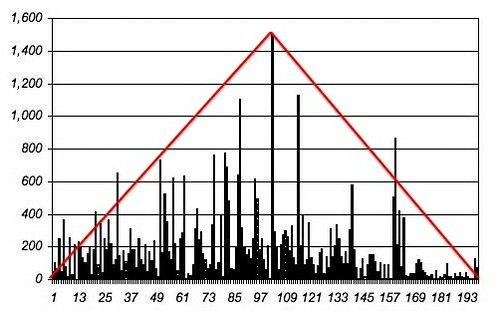
Now let’s consider an example that’s closer to the digital humanities. Look at the following figure:

HD whole envelope

The red triangle is the pattern and I am defining it over the vertical bars. That is, I examined the bars and decided that they’re approximating a triangle, which I then superimposed on those bars. The bars preexisted the triangle.

I also created those bars, but through a process that is different and separate from that from the informal and intuitive process through which I created the triangular pattern. Each bar represents a paragraph in Joseph Conrad’s Heart of Darkness; the length of the bar is proportional to the number of words in the paragraph. The leftmost bar represents the first paragraph in the text while the rightmost bar represents that last paragraph in the text. The other bars represent the other paragraphs, in textual order from left to right.

The bars vary quite a bit in length. The shortest paragraph in the text is only two words long while the longest is, I believe, 1502 words long. In any given run of, say, twenty paragraphs, paragraph lengths vary considerably, though there isn’t a single paragraph over 200 words long in the final 30 paragraphs or so.

But why, when the distribution of paragraph lengths is so irregular, am I asserting the overall distribution has the form of a triangle? What I’m asserting is that that is the envelope of the distribution. There are a few paragraphs outside the envelope, but great majority are inside it.

The significant point, though, is that there is one longest paragraph and it is more or less in the middle. That paragraph is considerably longer (by over 300 words) than the next longest paragraphs, which are relatively close to it. The paragraphs toward the beginning and the end, the end especially, tend to be short.

What we’d like to know, though, is whether this distribution is an accident, and so of little interest, or whether it is an indicator of a real process. In the first place I observe that, in my experience, paragraphs over 500 words long are relatively rare – this is the kind of thing that can be easily checked with the large text databases we now have. Single paragraphs of over 1000 words must be very rare indeed.

And that longest pattern is quite special. It is very strongly marked. If you know Conrad’s story, then you know it centers on two men, Kurtz, a trader in the Congo, and Marlow, the captain of a boat sent to retrieve him. Marlow narrates the story, but it isn’t until we’re well into the story that Kurtz is even mentioned. And then we don’t learn much about him, just that he’s a trader deep in the interior and he hasn’t been heard from in a long time.

That longest paragraph is the first time we learn much about Kurtz. It’s a précis of his story. The circumstances in which Marlow gives us this précis are extraordinary.

His narrative technique is simple; he tells events in the order in which they happened – his need for a job, how he got that particular job, his arrival at the mouth of the Congo River, and so forth. With that longest paragraph, however, Marlow deviates from chronological order.

He introduces this information about Kurtz as a digression from the story of his journey up the Congo River to Kurtz’s trading station. Some of what he tells us about Kurtz happened long before Marlow set sail; and some of what we learned happened after the point in Marlow’s journey where he introduces this paragraph as a digression.

What brought on this digression? Well, Marlow’s boat was about a day’s journey from Kurtz’s camp when they were attacked from the shore. The helmsman was speared through the chest and fell bleeding to the deck. It’s at THAT point that Marlow interrupts his narrative to tell us about Kurtz – whom he had yet to meet. Once he finishes this most important digression he returns to his bleeding helmsman and throws him overboard, dead. Just before he does so he tells us that he doesn’t think Kurtz’s life was worth that of the helmsman who died trying to retrieve him.

That paragraph – its length, content, and position in the text – is no accident. That statement, of course, is a judgement, only based only on my experience and knowledge as a critic, which have been shaped by the discipline of academic literary criticism. But it’s not an unreasonable judgement; it is of a piece with the thousands of such judgements woven into the fabric of our discipline.

Conrad may not have consciously planned to convey that information in the longest paragraph in the text, and to position that paragraph in the middle of his text, but whatever unconscious cognitive and affective considerations were driving his craft, they put that information in that place in the text and at that length. The apex of that triangle is real, not merely in the sense that the paragraph is that long, but in the deeper sense that it is a clue about the psychodynamic forces shaping the text.

Just what are those psychodynamic forces? I don’t know. The hunter can tell us in great detail about how the animal left traces of its movement over the land. Astronomers and astrophysicists can tell us about constellations in great detail. But the pattern of paragraph lengths in Heart of Darkness is a mystery.

* * * * *

Why do I consider this example at such length? For one thing, I’m interested in texts. Patterns in text are thus what most interest me.

Secondly, that example makes the point that description is one thing, explanation another. I’ve described the pattern, but I’ve not explained it. Nor do I have any clear idea of how to go about explaining it.

There’s a lot of that going around in the digital humanities. Patterns have been found, but we don’t know how to explain them. We may not even know whether or not the pattern reflects something “real” about the world or is simply an artifact of data processing.

Third, whereas much of the work in digital humanities involves data mining procedures that are difficult to understand, this is not like that. Counting the number of words in a paragraph is simple and straightforward, if tedious (even with some crude computational help). And yet the result is strange and a bit mysterious. Who’d have thought?

Note that I distinguish between the bar chart that displays the word counts and the pattern I, as analyst, impose on it. When I say that the envelope of paragraph length distribution is triangular, I’m making a judgement. That judgement didn’t come out of the word count itself. And when I say that that pattern is real, I’m also making a judgement, one that I’ve justified – if only partially – by discussing what happens in that longest paragraph and that paragraph's position in the text as a whole.

My sense of these matters is that, going forward, we’re going to have to get comfortable with identifying patterns we don’t know how to explain. We need to start thinking about, theorizing if you will, what patterns are and how to identify them.

* * * * *

I’ve written a good many posts on Heart of Darkness. I discuss paragraph length HERE and HERE. I’ve called that central sentence the nexus and discuss it HERE. Here’s a downloadable working paper that covers these and other aspects of the text.

* * * * *
I’m on a countdown to my 2500th post. This is number 2495.
Tuesday, July 5, 2022

Virtual Reading: The Prospero Project Redux [#DH]

I'm bumping this 2017 post to the top of the queue because, 1) I think the concept of virtual reading proposed here may be of some use in thinking about and evaluating the written output of large language models, such as GPT-3, and 2) the concept of literary form implicit the section, "In search of a small-world net," is relevant to my arguments about the value of symbols as being, in part, a vehicle for moving about in mental space in a way that "outside" the "standard" landscape of mental space (see my post earlier today, Why Are Symbols So Useful to Us?).
 
* * * * *
 
I've uploaded another working paper. Title above, abstract, table of contents, and introduction below. Note that it's a long way through the introduction, but there's some good stuff there.

Download at:

* * * * *
Abstract: Virtual reading is proposed as a computational strategy for investigating the structure of literary texts. A computer ‘reads’ a text by moving a window N-words wide through the text from beginning to end and follows the trajectory that window traces through a high-dimensional semantic space computed for the language used in the text. That space is created by using contemporary corpus-based machine learning techniques. Virtual reading is compared and contrasted with a 40 year old proposal grounded in the symbolic computation systems of the mid-1970s. High-dimensional mathematical spaces are contrasted with the standard spatial imagery employed in literary criticism (inside and outside the text, etc.). The “manual” descriptive skills of experienced literary critics, however, are essential to virtual reading, both for purposes of calibration and adjustment of the model, and for motivating low-dimensional projection of results. Examples considered: Heart of Darkness, Much Ado About Nothing, Othello, The Winter’s Tale.
Contents

Introduction: Prospero Redux and Virtual Reading 2
In search of a small-world net: Computing an emblem in Heart of Darkness 8
Virtual reading as a path through a multidimensional semantic space 11
Reply to a traditional critic about computational criticism: Or, It’s time to escape the prison-house of critical language [#DH] 17
After the thrill is gone...A cognitive/computational understanding of the text, and how it motivates the description of literary form [Description!] 23
Appendix: Prospero Elaborated 30

Introduction: Prospero Redux and Virtual Reading

In a way, this working paper is a reflection on four decades of work in the study of language, mind, and literature. Not specifically my work, though, yes, certainly including my work. I say in a way, for it certainly doesn’t attempt to survey the relevant literature, which is huge, well beyond the scope of a single scholar. Rather I compare a project I had imagined back then (Prospero), mostly as a thought experiment, but also with some hope that it would in time be realized, with what has turned out to be a somewhat revised version of that project (Prospero Redux), a version which I believe to be doable, though I don’t alone posess the skills, much less the resources, to do it.

The rest of this working paper is devoted to Prospero Redux, the revised version. This introduction compares it with the 40 year-old Prospero. This comparison is a way of thinking about an issue that’s been on my mind for some time: Just what have we learned in the human sciences over the last half-century or so? As far as I can tell, there is no single theoretical model on which a large majority of thinkers agree in the way that all biologists agree on evolution. The details are much in dispute, but there is no dispute that world of living things is characterized by evolutionary dynamics. The human sciences have nothing comparable (though there is a move afoot to adopt evolution as a unifying principle for the social and behavioral sciences). If we don’t have even ONE such theoretical model, just what DO we know? And yet there HAS been a lot of interesting and important work over the last half-century. We must have learned something, no?

Let’s take a look.

Prospero, 1976

Work in machine translation started in the early 1950s [1]; George Miller published his classic article, “The Magical Number Seven, Plus or Minus Two” in 1956; Chomsky published Syntactic Structures in 1957; and we can date artificial intelligence (AI) to a 1956 workshop at Dartmouth [2]. That’s enough to characterize the beginnings of the so-called “Cognitive Revolution” in the human sciences. I encountered that revolution, if you will, during my undergraduate years at Johns Hopkins in the 1960s, where I also encountered semiotics and structuralism. By the early 1970s I was in graduate school in the English Department at The State University of New York at Buffalo, where I joined the research group of David Hays in the Linguistics Department. Hays was a Harvard-educated cognitive scientist who’d headed the mamachine translation program at the RAND Corporation in the 1950s.

At that time a number of reasearch groups were working on cognitive or semantic network models for natural language semantics. It was bleeding edge research at the time. I learned the model Hays and his students had developed and applied it to Shakespeare’s Sonnet 129 (which I touch on a bit later, pp. 21 ff.). At the same time I was preparing abstracts of the current literature in computational linguistics for The American Journal of Computational Linguistics. Hays edited the journal and had a generous sense of the relevant literature.

Thus when Hays was invited to review the field of computational linguistics for Computers and the Humanities it was natural for him to ask me to draft the article. I wrote up the standard kind of review material, including reports and articles coming out on the Defense Department’s speech understanding project, which was perhaps the single largest research effort in the field (I discuss this as well, pp. 20 ff.). But we aspired to more than just a literature review. We wanted a forward-looking vision, something that might induce humanists to look deeper into the cognitive sciences.

We ended the article with a thought experiment (p. 271):
Let us create a fantasy, a system with a semantics so rich that it can read all of Shakespeare and help in investigating the processes and structures that comprise poetic knowledge. We desire, in short, to reconstruct Shakespeare the poet in a computer. Call the system Prospero.

How would we go about building it? Prospero is certainly well beyond the state of the art. The computers we have are not large enough to do the job and their architecture makes them awkward for our purpose. But we are thinking about Prospero now, and inviting any who will to do the same, because the blueprints have to be made before the machine can be built. [...]

The general idea is to represent the requisite world knowledge – what the poet had in his head – and then investigate the structure of the paths which are taken through that world view as we move through the object text, resolving the meaning of the text into the structure of conceptual interrelationships which is the semantic network. Thus the Prospero project includes the making of a semantic network to represent Shakespeare’s version of the Elizabethan world view.
But a model of the Elizabethan world view was “only the background”. We would also have to model Shakespeare’s mind (p. 272):
A program, our model of Shakespeare’s poetic competence, must move through the cognitive model and produce fourteen lines of text. [...] The advantage of Prospero is that it takes the cognitive model as given – clearly and precisely – and the poetic act as a motion through the model. Instead of asking how the words are related to one another, we ask how the words are related to an organized collection of ideas, and the organization of the poem is determined, then, by the world view and poetics in unison. [3]
We declined to predict when such a marvel might have been possible, though I expected to see something within my lifetime. Not something that would rival the Star Trek computer, mind you, not something that could actually think in some robust sense of the word. But something.
 
What we got some 35 years later was an IBM computer system called Watson that defeated humans in playing Jeopardy [4]. Watson was a marvel, but was and is nowhere near to doing what Hays and I had imagined for Prospero. Nor do I see that old vision coming to life in the forseeable future.

Moreover, Watson is based on newer kind of technology that is quite different from that which Hays and I had reviewed in our article and which we were imagining for Prospero. Prospero came out of a research program, symbolic computing, that all but collapsed a decade later. It was replaced by technology that had a more stochastic character, which involved machine learning, and which, in some increasingly popular versions, was (somewhat distanctly) inspired by real nervous systems. It is this newer technology that runs Google’s online machine translation system, that runs Apple’s Siri, and that is behind much of the work in computational literary criticism.

Before turning to that, however, I want to say just a bit more about what we most likely had in mind – I say “most likely” because that was a LONG time ago and I don’t remember all that was whizzing through my head at the time. We were out to simulate the human mind, to produce a system that was, in at least some of its parts and processes, like the parts and processes of the mind. One could have Prospero read and even write texts while keeping records of what it does. One could then examine those records and thus learn how the mind works. Ambitious? Yes. But the computer simulation of cognitive tasks is quite common in the cognitive sciences, though not on THAT scale. In contrast, Watson, for example, was not intended as a simulation of the mind. It was a straight-up engineering activity. What matters for such systems, and for AI generally, is whether or not the system produces useful results. Whether or not it does so in a human way is, at best, a secondary consideration.

Why didn’t Prospero, or anything like it, happen? For one thing, such systems tended to be brittle. If you get something even a little bit wrong, the whole thing collapses. Then there’s combinatorial explosion; so many alternatives have to be considered on the way to a good one that the system just runs out of time – that is, it just keeps computing and computing and computing [...] without reaching a result. That’s closely related to what is called the “common sense” problem. No text is ever complete. Something must always be inferred in order to make smooth connections between the words in the text. Humans have vast reserves of such common sense knowledge; computing systems do not. How do they get it? Hand coding – which takes time and time and time. And when the system calls on the common sense knowledge that’s been hand-coded into it, what happens? Combinatorial explosion.

The enterprise of simulating a mind through symbolic computing simply collapsed. In the case of something like Prospero I would specially add that it now seems to me that, to tell us something really useful about the mind, such a system would have to simulate the human brain. Hays and I didn’t realize it at the time – we’d just barely begun to think about the brain – but that became obvious some years later in retrospect.

Friday, August 13, 2021

A cautionary note about "distant reading" [#DH]

Sunday, July 25, 2021

Historical language records reveal a surge of cognitive distortions in recent decades [#DH]

Significance of linked article:

Can entire societies become more or less depressed over time? Here, we look for the historical traces of cognitive distortions, thinking patterns that are strongly associated with internalizing disorders such as depression and anxiety, in millions of books published over the course of the last two centuries in English, Spanish, and German. We find a pronounced “hockey stick” pattern: Over the past two decades the textual analogs of cognitive distortions surged well above historical levels, including those of World War I and II, after declining or stabilizing for most of the 20th century. Our results point to the possibility that recent socioeconomic changes, new technology, and social media are associated with a surge of cognitive distortions.

Abstract from linked article:

Individuals with depression are prone to maladaptive patterns of thinking, known as cognitive distortions, whereby they think about themselves, the world, and the future in overly negative and inaccurate ways. These distortions are associated with marked changes in an individual’s mood, behavior, and language. We hypothesize that societies can undergo similar changes in their collective psychology that are reflected in historical records of language use. Here, we investigate the prevalence of textual markers of cognitive distortions in over 14 million books for the past 125 y and observe a surge of their prevalence since the 1980s, to levels exceeding those of the Great Depression and both World Wars. This pattern does not seem to be driven by changes in word meaning, publishing and writing standards, or the Google Books sample. Our results suggest a recent societal shift toward language associated with cognitive distortions and internalizing disorders.

H/t Tyler Cowen.

CORRECTION – Alas, the study is deeply flawed [7.26.21]

Check out the whole thread on Twitter.

Thursday, July 1, 2021

Is digital humanities a discipline unto itself? [#DH]

Monday, June 14, 2021

Sampling the Space: Disney’s Fantasia [is it time for a 21st century re-realization, one that evokes the current space?]

Bumping this to the top of the queue because, well, because it's about time. The world's changing. We need a new realization of the Fantasia idea. This realization should sample the world's musics rather than remaining confined to Western Classical music. What should the visual subjects be? Perhaps choose the same general topics as the original Fantasia, from 1941, but realized in different ways.

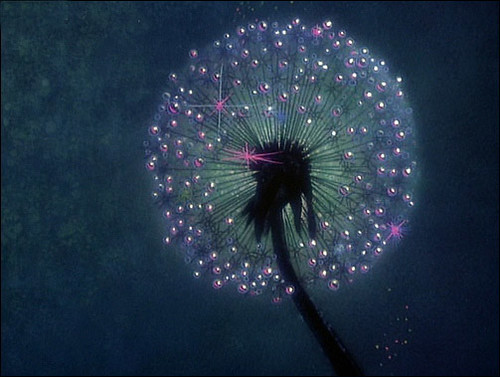
dandilion

The following notes are an addendum to my original conjecture that Fantasia is encyclopedic in scope. That is, that it spans our knowledge of the cosmos, not by exhaustive listing, but by strategic indication. Each of the eight episodes, plus the interlude, depicts a different aspect of the cosmos – think, e.g. Rite of Spring for the cosmos large and small, Pastoral Symphony for domesticity, and so forth. If you then ask yourself, what’s the most compact subject area that embraces all of Fantasia, you’re left with nothing smaller than the cosmos as a whole.

How’d Disney do it? It was a group effort. Sure, good old Uncle Walt had the final say. But tens and hundreds of people were involved in coming up with ideas. Each searched their individual minds and offered ideas into the complex evolving system that was the production of Fantasia.

For those in digital humanities, note that I employ a mathematical metaphor, that of a space. But I don’t think of it as a mere metaphor. Done properly, it’s a model.

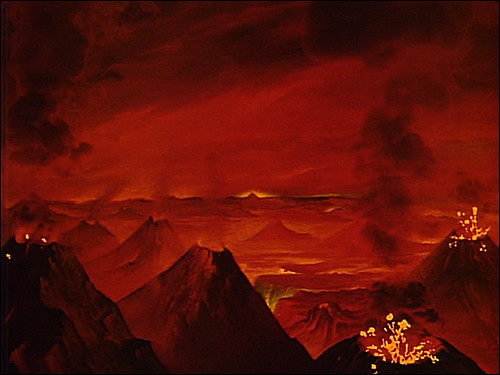
volcanos.jpg

I’ve been thinking about this encyclopedia notion. I like it, I think it works, but I also think it’s a bit vague. What’s it mean to “cover/imply the world”? How many and what distribution of topics does a real encyclopedia have to have in order to qualify, good and proper, as an encyclopedia? How is it that Mendelson and Moretti know that those texts are encyclopedic? Sure, they give reasons and examples – as I did for Fantasia. But that’s all after-the-fact rationalization. What’s the original “aha!” recognition about?
 
I’ve asserted that Fantasia is encyclopedic in the way that Allegro Non Troppo and Fantasia 2000 are not. I’m sure I can argue the point – though I’d want to watch them again, while taking notes, rather than work from, e.g. the Wikepedia summaries (which seem adequate to me BTW). And that argument will be a comparison and contrast talking about the sorts of things I mention in the summaries of the Fantasia episodes. There’s nothing wrong with that, but I’m looking for something more precise, more quantitative. Or, perhaps a better formulation, something that's tractable in a different way, even objective.

What I’m thinking is that encyclopedic works have to “sample the space” in a certain way. What space? It’s a metaphor, obviously, and a common one. Color space is well known and has been extensively explored by artists, physicists, and perceptual psychologists. So, imagine a space that displays all the colors in the world – somewhere on your computer you’ve got color-pickers that allow you to navigate through various color spaces. Pick three colors. Three shades of red will be relatively close together in the space while a red, an orange, and a yellow will be further apart. But a red, a blue, and a yellow will be still further apart. That red, blue, and yellow “cover” more of color space than your three reds.

That’s the sort of thing I’m looking for. Color is well understood and the little story I told in the previous paragraph can be told in fairly precise mathematical terms. Can we do the same thing for all of human knowledge?

We’re working on it. Psychologists and cognitive scientists map all sorts of things onto abstract spaces. The classic semantic differential maps the connotative meaning of words onto three dimensions, goodness, strength, and activity. The five-factors personality model maps personality onto five dimensions. Computational semanticists map texts onto spaces of relatively high dimensionality – 100s or 1000s of dimensions. That’s what’s doing on in the text-mining software that Matt Kirschenbaum talked about during the Moretti-fest.

What could this possibly mean for literary texts? Well, we’re used to analyzing texts in terms of binary oppositions: male-female, nature-culture, rural-urban, good-evil, Caucasian-Other, ancient-modern, mechanical-organic, and so on. Think of each opposition as indicating the positive and negative poles of a continuum. We can now think of each of these oppositions as a dimension in semantic space. How many such dimensions do we need to characterize the semantic space of a given text? I’m thinking that the dimensionality of an encyclopedic text will be higher than that of an ordinary narrative.

Let’s consider 19th century American novels. Moby Dick is Mendelson’s designated encyclopedic text. So we take the that text and those of other 19th century American novels, analyze them with text mining software, and arrive at something we might call the “space of minimum covering dimensionality.” The space for Moby Dick should be higher than that for any other novel. And I’d guess it would be higher by a considerably margin rather than just a bit higher.

So, the value for MD would be, say, 2364, while the values for the other texts would range between, say, 937 and 1272. The numbers aren’t important, what’s important is that there’s a big gap between value for MD and the highest value for any non-encyclopedic narrative.

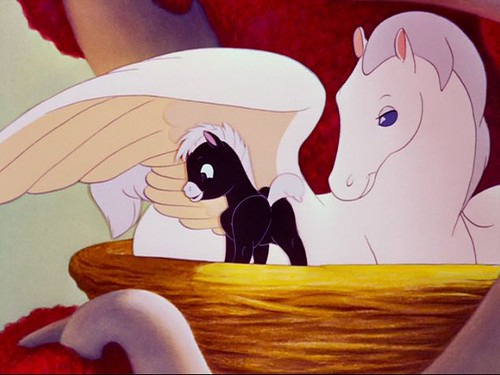
Pastoral 2 Pegasus and child

How do I know this? I’m just guessing, making it up as I go along. Why do I care about this sort of thing? Because I do. I’m just playing. Don’t I think this line of investigation will, er, harm literature? No, not in the least. The texts won’t feel a thing.

ave maria

In contrast, we might say that, e.g. Oliver Twist, covers more area in some abstract space than, e.g. Hard Times, in the way that a quarter covers more area than a dime. But that’s not about dimensionality; that’s just spatial extent. Dimensionality is about the nature of the space, its structure. The difference between an encyclopedic and an ordinary narrative is like that between a sheet of paper (2D) and a cube (3D).

x5 ignition.jpg

One of the things Moretti noted (p. 5) is that these works “do not really work all that well,” are perhaps “semi-failures”. Some measure of failure, it seems to me, follows from the singular nature of these works. If you are inventing a form as you go along, you are in no position to learn from previous examples, either your own or those of others.

But these (peculiar) failures might also be the result of the dimensionality requirements of encyclopedic coverage. There’s only so much “stuff” that can be packed into a coherent narrative. High narrative coherence puts limits on the dimensionality of the space. If you want to exceed those limits, then you have to use intrusive devices or various sorts – like long passages on whale taxonomy. If you are going to break the narrative once in such a way, well, that’s a flaw, straight-up. The flow is broken, but you don’t get much in return. So, do it once, do it 37 times, a different time each way, and be clever so that the whole becomes more than the sum of these multiple narrative interruptions.

SC22 skull in hell

Why write such narratives at all? Because we need to bring the entirety of the world within the scope of a single imaginative vision. Why do we need to do that? Because that’s the way the brain is?

2 0 onstage.jpg

Conducting this kind of investigation for written texts is one thing. We’ve got very sophisticated tools for handling them. How would we do it for movies?

For certain movies, screen plays might be adequate proxies for the films themselves. For Fantasia, I don’t know. We might be able to work from the cue sheets used to indicate the relationships between the animation and the music. More likely, we’d have to devise a coding scheme and devise methods to analyze the codings, not only of Fantasia, Fantasia 2000, and Allegro Non Troppo, but also of ordinary narrative feature-length animated films.

9 glory