Showing posts with label Latouor-modes. Show all posts

Thursday, April 30, 2026

A Quick Ramble: Computational Compressibility (order in the universe), Religion & Signaling, Silicon Valley vs. Pope Leo [+Latour]

I’m thinking there’s a relationship between computational compressibility (as an index of order in the universe) and my current interest in religion, which is what the other two items are about.

Computational Compressibility and order in the universe

I’ve been particularly pleased by my recent working paper: On Method: Computational Compressibility in Complex Natural and Cultural Phenomena. I’m not quite sure why I find it so pleasing. That it crosses disciplines, that’s nice: weather, microbiology, chess (AI), finance economics (asset pricing), film studies (Hollywood Economics), and cultural evolution (Macroanalysis, 19th century novel). But it’s the specific mode of the argument; it’s about description, about what kinds of things exist.

I began by framing the discussion in terms of Stephen Wolfram’s distinction between computational reducibility and computational irreducibility. I think we’ve got to look at that distinction in terms of Miriam Yevick’s 1975 distinction between holographic or Fourier logic and sequential logic. I think Wolfram’s notion of computational reducibility implies Yevick’s sequential logic. As far as I can tell, her notion of holographic logic doesn’t register with respect to Wolfram’s distinction. But it may be that what I’m calling computational compressibility (within the realm of irreducibility) resonates with her notion of holographic logic.

A random system would of course be irreducible, but that is an extreme case. The systems I looked at in that paper are not random, but the order they exhibit allows them to occupy only a relatively small region of the state space potentially open to them. Given appropriate data about the behavior of the system, that region can be identified through a computational process. Thus they are computationally compressible. The phenomenon of computational compressibility indicates order, but order of a kind that’s different from reducible order. Generative order? 

Religion & Signaling

Glenn Loury has a recent video where he distinguishes between what we might call the propositional content of an utterance and its signal value. Explains that at some length in a recent lecture he gave at Stanford, Self-Censorship, Social Information, and the Conditions of Public Reason. In the lecture he examines three cases: race in America, academic life, and Israel and Gaza. His point is that in public discourse on these topics (and others) the signal value of what one is saying often eclipses the propositional value of one’s assertions. This often results in self-censorship where a person withholds their (propositional) views for fear of signally the wrong values.

Thus, in racial discourse:

A key question in this discourse is why racial inequality persists. In this domain speech is saturated with moral meanings. Claims about inequality, education, crime, family structure, or historical responsibility are rarely heard simply as attempts to explain social outcomes. They are taken also as signals of moral orientation—of sympathy or indifference, solidarity or hostility, compassion or disdain. For many audiences, answers to that question relying on structural causes are regarded more favorably than accounts emphasizing cultural factors. Speakers adapt accordingly—many by holding their tongues.

I think lots of discourse is like that. It seems to me that much religious discourse is like this. The conservative Christian arguments against biological evolution never made much sense to me as propositional assertion, nor did the accompanying belief about the age of the earth, but as signaling, those beliefs make more sense.

I'm thinking this signaling business is about coordination, about establishing a rock-bottom level of interpersonal coordination, of common knowledge. I need to think about this some more. 

Addendum, May 2, 2026: This post about Bruno Latour's conception of modes of existence is relevant here, each with it own “felicity conditions,” as he calls them.

Silicon Valley vs. Pope Leo

I’ve only recently learned that Pope Leo XIV has decided to make AI a central concern of his papacy. Given that I think that the common Silicon Valley view of AI is idolatrous, or at best straddles the border, I’m wondering if we’re going to see a grand debate and battle between the Pope and Silicon Valley apologists. When I put the question to Claude, here’s how it responded:

Your instinct is well-founded, and Leo XIV has already moved aggressively on this front. Let me lay out what's emerged so far.

Who he is and what he's signaling

Leo XIV — born Robert Prevost in Chicago, the first American pope — identified AI as a central challenge from his very first formal address to the cardinals after his election in May 2025. His choice of the name Leo was itself a signal: Pope Leo XIII confronted the industrial revolution with Rerum Novarum (1891), defending workers' rights and the common good. By taking that name, the new pope announced that the Church would face today's technological upheaval with similar clarity.

The specific critique — and it maps closely onto your "idolatry" framing

This is where it gets interesting for your purposes. In what has been called a programmatic document on AI for World Communications Day, Leo warned that "behind this enormous invisible force that involves us all, there are only a handful of companies — those whose founders have recently been presented as the creators of the 'Person of the Year 2025.'" He expressed "serious concern regarding the oligopolistic control of algorithmic and artificial intelligence systems capable of subtly shaping behaviors and even rewriting human history."

That last phrase — rewriting human history, including the history of the Church — is remarkable. He's naming a power claim that goes beyond economic disruption.

His core argument is that "the challenge is not technological, but anthropological. Safeguarding faces and voices ultimately means safeguarding ourselves." He described face and voice as "sacred," given by God, "the constitutive element of every genuine encounter."

At a Vatican gathering that included representatives from Google, OpenAI, Anthropic, IBM, Meta, and Palantir, he said: "The person is not a system of algorithms: he or she is a creature, relationship, mystery."

The "data is not wisdom" theme

He has repeatedly insisted that "the ability to access vast amounts of data and information should not be confused with the ability to derive meaning and value from it," and that "authentic wisdom has more to do with recognizing the true meaning of life than with the availability of data." This is a direct counter to the implicit epistemology of Silicon Valley — the notion that intelligence is fundamentally information processing, that more data equals more understanding.

Where this connects to your book

Your framing of the dominant Silicon Valley attitude as idolatrous is theologically precise in a way that Leo XIV would likely recognize. The classic definition of idolatry isn't crude statue-worship — it's the attribution of ultimate value and salvific power to something that is not God. When figures like Altman, Musk, or Kurzweil speak of AI as the path to immortality, the transcendence of human limitation, the solution to death — that's structurally idolatrous in the theological sense. It substitutes a human artifact for the divine.

Leo has the resources of the entire tradition of Catholic social teaching to bring to bear on this — not just as ethics but as a rival anthropology. The Church's claim that the person is "creature, relationship, mystery" is not compatible with the claim that the person is, at bottom, a computational process that can be replicated, extended, or superseded by a sufficiently powerful machine.

Whether this becomes a genuine face-off rather than parallel talking depends on whether Silicon Valley feels the need to respond. So far, the tech executives seem to be treating Vatican engagement as a reputational opportunity — showing up in Rome, being photographed, nodding about "human dignity" — without conceding much. The more interesting question is whether Leo pushes beyond dialogue into something more like confrontation. The Rerum Novarum precedent suggests he might: that encyclical didn't merely express concern about the industrial revolution, it made specific demands.

Wednesday, June 22, 2022

Latour's Modes of Existence [the return of LSD to discourse]

I'm bouncing this from 30 May 2012 to the top of the queue because the subject came up today in the Twitterverse, more or less.  

FWIW I've recounted my own adventure in Touchstones • Strange Encounters • Strange Poems • the beginning of an intellectual life.

* * * * * 
 
Ornstein's Tart's State-Specific Sciences, and a Note on Work, Love, Play, and Adventure

Graham Harman has just posted a link to a Latour draft: Biography of an Investigation: On a Book about Modes of Existence (PDF).

An Ethnographer from Mars

Here's one passage, about his days in Africa:
In the Abidjan of 1973-75, I discovered all at once the most predatory forms of capitalism, the methods of ethnography, and the puzzles of anthropology. And one puzzling question in particular that has never left me: why do we use the ideas of modernity, the modernizing frontier, the contrast between modern and premodern, before we even apply to those who call themselves civilizers the same methods of investigation that we apply to the “others” – those whom we claim, if not to civilize entirely, then at least to modernize a little? ...

There was a flagrant asymmetry here: the Whites anthropologized the Blacks, yes, quite well, but they avoided anthropologizing themselves. Or else they did so in a falsely distant, “exotic” fashion, by focusing on the most archaic aspects of their own society – communal festivals, belief in astrology, first communion meals – and not on what I was seeing with my own eyes (eyes educated, it is true, by a collective reading of L’Anti-Oedipe): industrial technologies, economization, “development,” scientific reasoning, and so on: in other words, everything that makes up the structural heart of the expanding empires.

Whence the idea of applying the methods of the social sciences, ethnography in particular, to the most modern practices.
Indeed, why not? Why not, in effect, take up the role of the mythical Martian ethnographer and use it as a vehicle to study the Modern World at the very heart of Modernity and height of its Powers?
 
Of his mid-70s work in the neurological laboratory of Roger Guillemin at the Salk Institute:
How could one explain that, here too, the appeal to an abusive transcendence had been able to dissimulate the layer of texts, of documents, that had to be continuously rewoven in order to produce a truth that could not be based, try as one might, on a firmer foundation? Was it possible that scientific veridiction was as far away from Double-Click information as the latter is from religious truth – in which case we would find ourselves faced with three types of veridiction, each entirely distinct from the others and true in its own genre and its own fashion?
Peak Experiences and Alternate Realities

At roughly the same time a rather different group of investigators was attempting to make sense of the experiences afforded by psychedelic drugs and by meditation. One of them, a psychologist named Robert Ornstein Charles Tart, talked of "state-specific sciences"–alas, the book in which he used the term is no longer on my shelf and I cannot remember its name, much less a page number. The idea was this: When you take a psychedelic drug you (may well) have a (so-called) peak experience in which deep truths are revealed to you. Those truths often seem like trite nonsense to those who've not experienced a psychedelic peak. Let's posit that those deep truths are, in fact, specific to one's biochemical neural state and can ONLY be judged and appreciated from within that state. Those who've not taken the drug, and had the trip, are in no position to pass judgment on the truths revealed in the trip. They don't know what they're talking about.

Work, Love, Play, Adventure

I don't remember when I read Ornstein Tart, but it was probably in the early 1970s. While I didn't take his notion of state-specific science at face value, I did feel it pointed at a truth that needed to be worked out. And I've been working at it off and on ever since. David Hays and I often talked of Work, Love, Play, and Adventure as specific and more or less independent modes of human action, each in effect having its own modes of veridiction, to use Latour's word. We never saw our way to writing these thoughts out in a systematic exposition, though bits and pieces managed to show up here and there. My various posts on behavioral mode contribute to this line of thinking, in particular, see Q. Where’s Reality? A. Which One?

* * * * *

It does seem to me that Latour is following the same scent, though perhaps though a different territory. We shall see. At this point I'm only on page 6 of a 20 page article, and there's his book to come: An Inquiry Into Modes of Existence. We shall see.

More later.

ADDENDUM: A link to a summary of Latour's modes-of-existence project. Website for the digital version of the project, with short characterizations of the fifteen modes.

Wednesday, June 1, 2022

Living with Abundance in a Pluralist Cosmos: Some Metaphysical Sketches

Bumping to the top to mark the profusion of creativity pouring out of machine learning and deep learning. We're heading into the 4th Arena!
 
* * * * *
 
You can download a PDF of the main exposition of my pluralist metaphysics from my online  repositories:
The PDF, of course, includes the introduction which I published here a few days ago: From Literary Criticism to Pluralist Metaphysics, an Introduction. You can also download PDF's of secondary documents. I've listed the currently available ones after the eight propositions in the main document.

Eight Propositions in a Pluralist Metaphysics

This main exposition sketchs a pluralist metaphysical system variously inspired by the ideas of Bruno Latour, Paul Feyerabend, Graham Harman, J. J. Gibson and William James.

1. Objects: Individual entities of many different scales are the ultimate stuff of the cosmos.

2. Abundance: These entities enter into relations with other entities but are never exhausted by any of their relations or even by the sum of all possible relations.

3. Realms of Being: In the large objects exist in patterns of relatively stable interactions among multiple objects. These are relations of indirect or vicarious causality. Analytically, we need to separate the roles from the entities that assume them. This is the core of what will become a distinction between culture and society.

4. Unity of Being: Humans desire the ability to access and reflect on memories of events in one’s life. The extent that that is achieved is called Unity of Being.

5. Life Way: A Latourian collective, with human and non-human members, is considered to participate in all the Realms in which any member of the collective plays a role. The ‘envelope’ of those Realms is called a Life Way.

6. Latourian Negotiation: Collectives having different Life Ways have been interacting through a process of negotiation in which differences among Life Ways are resolved and commonalities created or not depending on the desire to extend the boundaries of the larger more inclusive collective. The outcome cannot be predicted or foreseen.

7. Realms of Abundance: Realms of Being are organized into Realms of Abundance, of which three have appeared to far: Matter, Life, and Culture.

8. The Fourth Arena: The current global Latourian negotiation brings us to the edge of a fourth Arena of Abundance. If it goes well, that’s where our successors will dwell.

Pluralism Papers


Abstract: At the most abstract philosophical level the cosmos is best conceptualized as containing various Realms of Being interacting with one another. Each Realm contains a broad class of objects sharing the same general body of processes and laws. In such a conception the human world consists of many different Realms of Being, with more emerging as human cultures become more sophisticated and internally differentiated. Common Sense knowledge forms one Realm while Literary experience is another. Being immersed in a literary work is not at all the same as going about one's daily life. Formal Literary Criticism is yet another Realm, distinct from both Common Sense and Literary Experience. Literary Criticism is in the process of differentiating into two different Realms, that of Ethical Criticism, concerned with matters of value, and that of Naturalist Criticism, concerned with the objective study of psychological, social, and historical processes. Note: Most, but not all, of the pieces in this document are in the main pluralist exposition. There is a introduction specific to this set of documents and a four-part 'program' for literary studies.


Abstract: By substituting Paul Feyerabend’s rhetoric of abundance for Graham Harman’s rhetoric of withdrawal one can establish the basis for pluralist ontology organized around Realms of Being. This paper traces the steps by which I made that substitution. The crucial step involved J.J. Gibson’s account of how one can determine whether or not one is perceiving real objects: Real objects yield more information upon further scrutiny; imaginary objects do not.


Abstract: Notes on Bruno Latour, Reassembling: An Introduction to Actor-Network Theory, with some consideration of compositionism. These ideas are developed with ideas and concepts from cognitive science, literary studies, music, and extensive examples from the world of contemporary graffiti.


Ontological cognition is about the cognitive apparatus we use to organize the world into different kinds of things according to their powers and capacities: animal, vegetable, mineral; living, non-living; human, non-human; etc. As such it differs from the philosophical discipline of ontology, which is about the world itself, not our thoughts about the world. As ontological cognition snakes through many disciplines these reflections run from Wittgenstein through literature and the Great Chain of Being to computation and knowledge representation (KR).


Abstract: Graham Harman has proposed a counter-factual literary criticism based on his object-oriented ontology. I argue: 1) that this proposed practical criticism collapses into the existing process of literary culture and is therefore empty, 2) that it implies a Platonic conception of the literary text, 3) that it follows from a rejection of Lévi-Strauss’s empirical work on myth that dates back to the mid-1970s and 4) that that rejection defended an intentionalist conception of the text, rather than a mechanistic one. As a counter-proposal I examine Pandosto and The Winter’s Tale using a method inspired by Lévi-Strauss, arguing that the differences between the plots of these two texts can be attributed to different cultural constructions of the family.


Abstract: The contemporary conception of mere matter that we have from quantum mechanics is so very different from that available to Descartes and so many others that the distinction between living and non-living that they in part founded on the distinction must be re-thought. The purpose of such a rethinking is not to assert that difference between a rock and an acorn, for example, is not so great as it once was. In this new dispensation they are still very different kinds of things, but the whole conceptual world in which that difference is inscribed and traced is itself a new and by no means complete one.

I plan to issue three more sets of supporting documents, one on the explicit construction of spirits (directed at Jane Bennett), a miscellaneous set of posts, and one collecting some of my criticisms of Levi Bryant.

Saturday, February 12, 2022

Of Factish Gods and Modes of Existence

Angus Fletcher's odd argumentation on computers and reading (see my recent post, Can computers do narrative?) has gotten me thinking about Latour's notion of felicity conditions, so I'm boosting this post to the top of the queue as it is the first post where I discuss them. Perhaps my problem with Fletcher's argument is that I don't know what his felicity conditions are.

* * * * *

Including a brief excursion into the Black Church and concluding with a sighting of the nature/culture riff(t), the cosmic background radiation of our intellectual tradition
 
IMGP2480rd
Bruno Latour (2010) On the Modern Cult of the Factish Gods. Duke University Press.
A short book in three chapters. From the back cover: “In this concise work, Latour delves into the ‘belief in naïve belief,’ the suggestion that fetishes, objects invested with mythical powers, are fabricated, and that ‘facts’ are not. . . While the fetish-worshipper knows perfectly well that fetishes are man-made, the Modern icon-breaker inevitably erects new icons.”

In the first chapter Latour discusses an animist ceremony and so forth and so on, but I want to skip over all that and look at some passages in the third chapter, for that leads us to the modes of existence Latour promises in his next book. They’re what I’m interested in. What does Latour have in mind here?

Felicity and Truth

p. 100:
Truth production in science, religion, law, politics, technology, economics, etc. is what I have been studying, over the years . . . Systematic comparisons of what I call “regimes of enunciation” or “modes of existence” are what I am after, and if there is any technical argument in what follows, it is from this rather idiosyncratic comparative anthropology that they will come from. In a sort of weak analogy with speech-act theory, I’ve devoted myself to mapping out the “conditions of felicity” of the various activities that in our cultures are able to elicit truth. . .my problem concerns how to become attuned to the right conditions of felicity of those different types of “truth-generators.”
I take it that truth here does not (necessarily) mean a Tarskian correspondence between some proposition(s) and some state in the world, though it may mean that for this or that mode of existence. The point is that there is no ONE mode of existence with one TRUE DISCOURSE devoted to it (along with many untrue ones). There are many modes of existence, each with its own discourse (or perhaps no discourse at all?). Each mode has its own felicity conditions, its own indices of validity. This is a PLURALIST view of the world.
 
It would, presumably, be a mistake to attempt to interrogate or inhabit one mode using the rhetorical forms crafted for a different one. Would this be a category mistake, or an error even deeper? Are these modes ontologically different, without any, however, having privilege over others? Or is talk of ontology beside the point?

Latour talks of religion in this chapter and tells us that he is writing as though delivering a sermon. I’m glad he told us for otherwise I wouldn’t have guessed. His point, though, is that in thus writing he is DOING something rather than POINTING AT something.

Religious Sentences

Of religious talk Latour says (p. 102):
. . . such sentences are judged, not by their content—their number of bytes—but by their performative abilities. These are mainly evaluated only by this question: do they produce the thing they talk about, namely lovers? I am not so much interested here in love as eros, which often requires little talk, but in love as agapè to use the traditional distinction. In love’s injunction, attention is redirected not to the content of the message, but to the container itself, the person-making. One does not attempt to decrypt the sentence as if it transported a message, but as if it transformed the messengers themselves.
And so the felicity conditions of such language are not those of science, nor history, nor journalism, each of which aims to transport a message that corresponds to the world, a world somewhere over or out there, or perhaps just around the corner.
[For extra credit, compare this to Jakobson’s discussion of the six functions of language. Does it align with any of the six? Why or why not?]
p. 103:
...what happens to you, would you say, when you are addressed by love-talk? Very simply put: you were far away, and now you are closer...This radical change concerns not only space but also time: you just had the feeling of inflexible and fateful destiny...and suddenly, a word, an attitude, a query, a posture, a je ne sais quoi, and time flows again, as if it were starting from the present, with the capacity to open the future and reinterpret the past...
So religious talk aims at transforming the listener and, I presume, the speaker as well. It is not about informing, but about changing. And it warps both time and space—a Wordsworthian spot in time, perhaps?

Next, some words of clarification, explaining why he uses this love talk (remember, he’s performing his argument) that seems so strange in talk of religion (though it is well to remind ourselves that the medieval poets of courtly love drew upon religious rhetoric for their secular ends), pp. 104-105:
I use the template of lovers’ speech in order that we may rehabituate ourselves to a form of religious talk that has been lost, unable to represent itself again—to repeat itself—because of the shift from religion to belief.
Thus reminded, we may continue on.

Double-Click, Modal Degree Zero

Now Latour introduces the notion of double-click communication (p. 106):
...it wants us to believe that it is feasible to transport, without any deformation whatsoever, some accurate information about states of affairs that are not present to us. In most ordinary cases, what people have in mind when they ask “is this true,” or “does this correspond to a state of affairs,” is just such a double-click gesture, allowing immediate access to information: tough luck, because this is also what undermines ways of talking that are dearest to out heart.
This would seem to be something of a mode of communication degree zero, “the benchmark by comparison with which all the other modes are shown to lie” (see below). The name itself derives, I believe, from mouse-clicking and perhaps connotes the off-hand and apparently direct nature of the action. You click and SHAZAM! it happens.

Wednesday, May 5, 2021

Reality is not perceived, it is enacted

Reality is not perceived, it is enacted – in a universe of great, perhaps unbounded, complexity.

David Hays and I published that in a little article, we called it a note, we published over thirty years ago (see below). It was Hays’s formulation, but I liked it then. And I still like it?

But what does it mean? Forget the stuff after the dash, it’s that first part I’m thinking about. It clearly implies that without actors there’s no reality. Since we humans are the actors does that mean that before us, there was no reality? That’s absurd. The earth and the universe existed before we did, no?

Yes. Perhaps it means that they weren’t real. You mean they were imaginary, or illusions? No, more like the difference between the real and the not-real had no meaning.

That seems a little better. Let’s try something else. Let’s go the Latour route and say that everything is an actor, not just us humans. That leaves plenty of actors to enact reality prior to us.

That’s beginning to make sense.

It seems to me that we’re haunted by an old picture that we might as well attribute to Descartes, though it’s likely older. In this picture we are over here and the (external) world is way way over there somewhere. Our problem is to figure out what that’s like. How do we do that? By perception.

But that’s never really worked out. There’s always the problem of figuring out whether or not perception really matches the world. It never does or, what amounts to the same thing, there’s no place where we can stand to verify the match. The only way out of that bottle is to stop playing that game. We drop the convention of assigning agency only to humans and all the creatures get to enact reality.

We still have to verify our perceptions and theories, etc. But we accept that they’re always going to be provisional. But as long as we can use them to act effectively in the world, we’re OK.

Where does that leave the foundations of physics, with all that fancy mathematics and no way to test it with empirical observation? It means that the foundations of physics is no longer enacting science, which requires empirical verification. It’s doing something else. Ironic science, as John Horgan has it?

Let’s consider a very different example, “The Rite of Spring” from Disney’s 1941 Fantasia. It depicts an enactment of the solar system and the earth prior to human habitation. It’s certainly not a perception. You can call it an artistic imagining, with considerable license taken, if you will – for example, the T. Rex and the Stegosaurus couldn’t have fought because they lived a hundred million years apart (and Disney knew that). But that’s an action, no? Yes. Disney isn’t doing science, though it obviously interests him a great deal in this episode. He’s doing art.

Science and art are two different ways of enacting reality. Two different modes. Which brings us back to Latour again, who has advanced a theory of modes. Note, however, that I have decided to take a somewhat different view of modes and have offered a preliminary sketch: Living with Abundance in a Pluralist Cosmos: Some Metaphysical Sketches, Working Paper, January 2013,
https://www.academia.edu/4066568/Living_with_Abundance_in_a_Pluralist_Cosmos_Some_Metaphysical_Sketches.

I could go on and on, and probably should. But not now. Later. Meanwhile here’s the paper where Hays and I offered that formulation along with the immediate context.

* * * * *

Thursday, January 18, 2018

New York 2140: What IS fiction, anyhow?

I slipped over to Manhattan yesterday for a panel discussion about artificial intelligence that was held – wouldn’t you know? at the New York Yacht Club, an honorable establishment with old money written all over it, not to mention a handsome stash of full and half-hull ship models – and was delighted with the Times Square area at night. It’s like something from the future, all bright and slithering lights. Next time I’ll take my camera.

Would the New York of Kim Stanley Robinson’s 2140 be like that? Time Square itself, of course, would be under water, but many of the tall buildings would still be sticking around, their middle and upper floors rising above the water. And that’s where a lot of the electronic signage was. That would be quite a sight, to see all those animated lights reflecting in the water.

So, I ask you: Does New York 2140 exhibit a distinctive mode of fictional being? That’s perhaps not the best way to put the question, but there’s no really good way. What I have in mind is the way Robinson combines rich array of details about New York’s past – something Adam Roberts reminded me of on Facebook – with a richly imagined future. We’ve got the real and the imaginary combined into one seamless extended novelistic present. I could almost have said “the real past–as Robinson imagines it–and the future–as Robinson imagines it”, for the imagination is a faculty we use for everything, not just fantasy and fiction. It’s all imaginable, and some is real, some not so real.

What’s real?

Indeed.

Back in the 1960s and 1970s there was something called “the new journalism”, in which writers like Tom Wolfe, Norman Mailer, and Hunter Thompson wrote about real events using literary techniques. They gave up the conventions of journalistic objectivity and entered into the events they chronicled. At the same time E. L. Doctorow was earning praise for his “fictionalized history”. What about alternate history, for example, P. K. Dick’s The Man in the High Castle, set in a world where Japan and Germany won World War II? How does New York 2140 fit into that, whatever that is?

This, it seems to me, is something for Latour’s world of modes of existence, where each mode has its own truth conditions. What is the mode for New York 2140, versus, say, The Tale of Genji, The Rise and Fall of the Roman Empire, The Interpretation of Dreams, or On the Origin of Species, and what are the respective truth conditions for each?

For extra credit: What about Donald Trump’s Twitter stream?

Saturday, January 14, 2017

Rejected @NLH! Part 2: What I got out of writing the article

So, I ended the previous episode of Rejected @NLH! circling the periphery the discipline, thinking about sending an article in over the transom. Well, of course, I did so, and here it is:

Sharing Experience: Computation, Form, and Meaning in the Work of Literature,

What did I get out of it beyond – sigh – rejection? What did the writing do for me independently of its reception?

What’s in the article

For the most part the article was assembled from existing materials. Here’s a list of the section headings from the typescript I submitted:
Introduction: Speculative Engineering
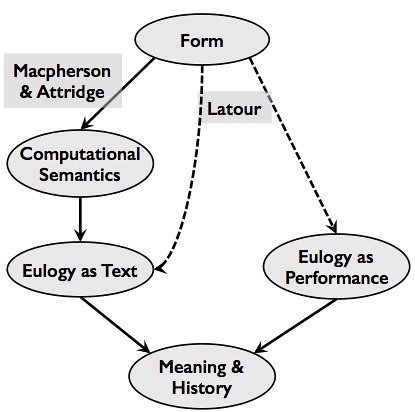
Form: Macpherson & Attridge to Latour
Computational Semantics: Network and Text
Obama’s Pinckney Eulogy as Text
Obama’s Pinckney Eulogy as Performance
Meaning, History, and Attachment
Coda: Form and Sharability in the Private Text
If I had to I could go through that typescript section by section and identify pre-existing stretches of text that contributed to any given section. It would be a bit of a stretch to say that I simply edited the final piece out of those pages, paragraphs, and sentences – as though someone else could have done pretty much the same thing given those materials. But, except perhaps for the section on form, it would also be a bit of a stretch to say that I had to develop any new ideas or conceptualizations for any section.

No, what I got from the article emerged from seeing those various materials assembled in one place. What is it that holds them together? That’s a tricky question, as each section has its own distinct character. Whatever this article is, it is not a single argument sustained within a single conceptual framework.

If it’s not a continuous argument, what is it?

Let’s go through the list again, this time with brief commentary on each one. Here’s a list of the section headings from the article:
Introduction: Speculative Engineering – Engineering is about design and construction, form and function.

Form: Macpherson & Attridge to Latour – Macpherson and Attridge are literary critics who have addressed themselves to form. Latour is an anthropologist and philosopher, shall we say, whose work is increasingly interesting to a variety of humanists, but he has little to say about literature or form. I argue that form is an intermediary (between individuals) in Latour’s sense while meaning is a mediator (between individuals).

Computational Semantics: Network and Text – Hardcore cognitive science about the relationship between (computational) models of the mind and the process of reading a text. I use Shakespeare’s Sonnet 129 as an example text.

Obama’s Pinckney Eulogy as Text – Describes the overall form of Obama’s text and characterizes it as a ring-composition. Note, however, that such description is not a standard activity for literary critics.

Obama’s Pinckney Eulogy as Performance – Gathers a variety of material from recent work in the cognitive and neurosciences and applies it to Obama’s performance of the eulogy (which we have on video tape).

Meaning, History, and Attachment – This centers on remarks Glenn Loury and John McWhorter made about Obama’s eulogy and performance. This is the kind of material that constitutes current literary and cultural criticism.

Coda: Form and Sharability in the Private Text – Since Obama’s eulogy was a public performance I concluded with some remarks about how arguments about that public situation can be extended to the situation of individuals reading shared texts in private.
Leaving out the introduction and the coda, this is how I see those pieces fitting together:

article flow 2

Monday, April 6, 2015

Bell Magic and Spirits at 3 Quarks Daily

IMGP4137rd

My intellectual life has tended to revolve around various specific examples that I examine closely and revisit from time to time. Coleridge’s “Kubla Khan” is perhaps the most important literary example but of course there are others, most recently Conrad’s Heart of Darkness.

My thinking about music has been strongly influenced by a particular incident that occurred in rehearsal sometime in the 1980s. I was playing bells with three others and “magic” happened: the appearance of high twittering sounds that no one was playing. I used that incident to open the second chapter of Beethoven’s Anvil; I’ve blogged about it; and elaborated it into a 10,000 word working paper: The Magic of the Bell: How Networks of Social Actors Create Cultural Beings (see below).

I’ve now taken part of the working paper and revised it into my most recent post for 3 Quarks Daily: The Magic of the Bell and a Glimpse of Spirits. I’ve listed the working paper below along with its abstract and table of contents.

* * * * *

The Magic of the Bell: How Networks of Social Actors Create Cultural Beings


Abstract: It is well known that music can engender altered states of consciousness that are difficult to interpret scientifically except as odd malfunctions in the nervous system. In this paper I report a phenomenon known among some musicians as “the magic of the bell”: the emergence of high-pitched twittering sounds when a group is playing interlocking rhythms on different bells. These sounds cannot be attributed to any of the musicians and they emerge only when the group is a group is playing bells with passion and precision. I argue that those sounds arise through interpersonal coupling among the musicians and that the ‘naïve’ temptation to attribute them to a ‘spirit’ or ‘spirits’ can be reconciled with a close description that does not presuppose non-physical entities. Those spirits should be conceived as the embodiment of non-mysterious and physically coherent group process. This argument has ramifications for how we think of time and how we think of longer cycles of group life.

Introduction: Composing Strange Objects
Instrument Matter in the Musician’s Mind
Time and Again, the Curse of Linear Time
How to Compose a Spirit
Explain or Explain Away? Composition and Cultural Beings
Bibliographical References

Friday, August 1, 2014

Terence Blake on Latour's Modes of Existence

Terence Blake (Agent Swarm) has been following the online progress of Latour's Modes of Existence project, blogging about the ideas and critiquing the process, and he attended the two-day evaluation conference that was just concluded. He's now uploaded his evaluation of the ideas to Academia.edu.
ON THE EXISTENCE OF BRUNO LATOUR’S MODES:
FROM PLURALIST ONTOLOGY TO ONTOLOGICAL PLURALISM 
by Terence Blake

Abstract: In this article I take a critical look at the origins and sources of Bruno Latour's pluralism as it is expressed in his book AN INQUIRY INTO MODES OF EXISTENCE and compare it to other similar projects (Wittgenstein, Feyerabend) Badiou). I consider the accusations of reductionism and of relativism) and demonstrate that Latour's "empirical metaphysics" is not an ontological reductionism but a pluralist ontology recognising the existence of a plurality of entities and of types of entities. Nor is it an epistemological relativism but an ontological pluralism affirming the existence of a plurality of types of existence. These two strands, pluralist ontology and ontological pluralism, mutually reinforce each other to produce at least the outlines of a robust pluralist realism.
I've taken a quick look through the essay. It is a substantial piece of work. I note only that Blake is conversant with both Continental and analytical philosophical thought and evaluates Latour in that context.

Saturday, July 13, 2013

Constructing Spirits: An Exercise in Pluralist Composition

This working paper is available at my SSN site, HERE (PDF).
Abstract: It is well known that music can engender altered states of consciousness that are difficult to interpret scientifically except is odd malfunctions in the nervous system. In this paper I report on a phenomenon known among some musicians as “the magic of the bell,” the apparent emergence of spirits while a groups is playing bells with passion and precision. I argue those sounds arise through interpersonal coupling among the musicians and that those twittering “spirits” should be considered as embodiments of non-mysterious and physically coherent group consciousness.
This working paper is grounded in an experience I had some years ago while rehearsing with three friends. We were each of us playing bells and, at some point, we heard high-pitched twittering sounds that none of us were playing. Where did they come from? What were they?

Friday, January 4, 2013

Realms and Modes, Toward a Robust Understanding of Culture

Latour has only 15 Modes of Existence, though he says that the number and identity of them is provisional. Nonetheless, that notion strikes me as being roughly comparable to what I have been calling Realms of Being, of which there must be 10s of thousands so far.

How could that be, 15 or so vs. 10s of thousands? One thing that’s going goes like this. Latour, for example, has a Mode for religion (which he abbreviates as REL). I’m going to have a Realm for each distinct religion, which must number in the thousands is you count the supernatural belief system of each hunter-gatherer, nomadic, and horticultural society as a religion. If so, then it’s possible that my notion of Realms of Being is not necessarily incompatible with Latour’s notion of Modes of Existence. Perhaps many of my Realms will map onto a single one of Latour’s Modes.

Now the question for religion becomes: does each of those Realms operate according to the same “felicity conditions” (Latour’s term for the operating ‘envelope’ of a Mode)?

I don’t know. It’s a serious question, and an empirical one. An attempt to answer it will move us toward a deeper understanding of culture than we now have.

Saturday, August 4, 2012

Latour Video on Modes of Existence

A lecture, "Ecological Crises, Digital Humanities and New Political Assemblies," at Azim Premji University in Bangalore on 23 March 2012:


45:45: "Ecology is not about nature."

About the Talk (from YouTube):
Ecological crises in contemporary times have created problems for political representation. Existing political assemblies cannot handle these crises due to their scale, the esoteric character of the scientific knowledge necessary to apprehend them, and the intensity of conflicts of values that they generate. Digital resources suggest new possibilities for mapping the heterogeneous networks which link scientists, decision makers, media, citizens and other participants in public debates over ecological issues. They can create political assemblies where contending world views and modes of reasoning engage each other.
Early in the lecture Latour quickly sketches three modes, science, law, and "double-click." At 34:15 he does a quick recap and then at 34:48 sketches the religious mode in the form of Christianity, to roughly 36:55.

At 43:00 he undertakes a discussion of 'diplomacy', which lasts until 48:23 or so. He talks of diplomacy as the way in which spokesmen for the various modes come together and negotiate a common reality. Diplomacy and negotiation because there is no common arbiter. One cannot appeal, for example, to Nature or to Science, to settle matters. In the absence of an ultimate court of appeal the various collectives must negotiate a common world among themselves.

This process was an abstract idea as described in Politics of Nature. Latour now proposes to begin it as a real process. To that end he and his team are constructing an online component to his project, An Inquiry into Modes of Existence. Latour discusess that online and interactive component at the end of his talk, which is followed by discussion.

Tuesday, July 3, 2012

Something Big this Way Comes—Do We Live in a Pluriverse?

In the course of the recent discursive eruption over the relationship between speculative realism and objected-oriented ontology on the one hand, and ethics on the other, Ian Bogost posted a plea for “less blogging, and more working.” He worked his way around to this:
Sometimes I regret having gotten back into the "traditional humanities" after spending the last ten years in a weird hybrid of liberal arts and engineering at a technical institute. For it deals with the greatest irony of conservatism: a conservatism whose hallowed tradition is a purported progressive radicalism. Things are changing in philosophy, and that change is terrifying to some and liberating to others—perhaps it should be both. This conflict, if that's really what it is, is evidence of something big.
“Something big”—yes, that’s what got me interested in object-oriented ontology last year, the scent of something big. Perhaps it was OOO itself, or a close conceptual kin, or perhaps they were/are but a symptom of something else. In some sense, surely the latter.

That is, to the extent that SR/OOO are types of academic philosophy, and they are that, an eruption in academic philosophy that is confined to academic philosophy, that doesn’t interest me. But if these forms of academic philosophy are symptoms of something larger than that philosophy, well then, I’m curious.

And these philosophical movements do seem to resonate outside philosophy departments. So I’ve been curious.

But, though my knowledge of SR/OOO is sketchy, I’ve seen enough that I must gather my thoughts, if only as a way of plotting out my next moves. This post sets out the terms in which I’m thinking these matters through. First, by way of calibrating bigness, I introduce some metaphors of geographical exploration. Then I look back at two movements that launched in the 1960s and 1970s as points of comparison. I conclude by taking a WAG on The Next Big Thing.

Sunday, June 24, 2012

Background to Pluralism

I have been interested in pluralist ideas for some time, though have never attempted to develop them in a systematic way, nor do I have any immediate plans to do so. But, in anticipation of the 2013 publication of the English translation of Latour’s An Inquiry Into Modes of Existence (I can't read French), I DO intend to devote more casual effort to the matter. Latour brought the subject to my attention through his use of the term “pluriverse” in Politics of Nature, a term he attributed to William James. Then, only a week or two ago when Terence Blake introduced me to some papers by Paul Feyerabend, papers that seemed very Latourian to me.

This post, however, does not propose any arguments. I just lay out some material. First I list some excerpts from the Stanford Encyclopedia of Philosophy.

As Latour had referenced William James, I begin with excerpts from the William James article. I follow with excerpts form the articles on Pluralist Theories of Truth and concluding with the article on The Unity of Science. The SEP also had articles on Value Pluralism and Religious Diversity, but they didn’t seem to bear very directly on the metaphysical issues that capture my attention. In the last section I list the abstracts of two of my papers from the 1990s. While neither paper uses the term “pluralism,” but the abstracts should give a useful indication of my own intellectual commitments on the matter.

Wednesday, August 31, 2011

Reading Latour 8: Some Conjunctions in the Pluriverse

Bruno Latour. Assembling the Social: An Introduction to Actor-Network Theory. Oxford UP, 2005. From the chapter “Fourth Source of Uncertainty: Matters of Fact vs. Matters of Concern,” pp. 87-120.

Back in post six in this series, Recouping Constructivism, I commented on some passages early in this long chapter. In the post I’m going to comment on a passage or two near the end of the chapter. As for the middle, as for how Latour got from there to here, briefly and crudely, it’s like this:

Traditionally, classically, the social sciences have proposed accounts of people’s behavior that are quite different from those proposed by people themselves. Thus, Jack buys a BMW because he likes its style and engineering. Mr. Sociologist, however, asserts that Jack buys the BMW to one-up his neighbors, who drive Toyotas and Fords. And so on. In the extreme, one might even say that Mr. Sociologist substitutes his account for Jack’s, making it clear that, as far as he, Mr. Sociologist is concerned, Jack doesn’t know jack---- about his own motives. These deeper motives derive, of course, from ‘the social’.

Well, the sociologists of science did the same thing for science, The scientists, unlike ordinary folks, protested: “You guys are crazy. Your ‘the social’ plays no role in our laboratories. What you see is what you get.” Latour choose to believe the scientists, though many chose not to.

And so Latour was motivated to drop the, or is it ‘a’?, standard distinction between the natural and the social. And so (pp. 111-112):
To our great surprise, once the artificial boundary between social and natural was removed, non-human entities were able to appear under an unexpected guise. For instance, rocks might be useful to knock an idealist back to his senses, but rocks in geology seemed to be much more varied, much more uncertain, much more open, and deploy more types of agencies than the narrow role given to them in empiricist accounts. . . . . Empiricism no longer appears as the solid bedrock on which to build everything else, but as a very poor rendering of experience. This poverty, however, is not overcome by moving away from material experience, for instance to the ‘rich human subjectivity’, but closer to the much variegated lives materials have to offer. It’s not true that one should fight reductionism by adding some human, symbolic, subjective, or social ‘aspect’ to the description since reductionism, to begin with, does not render justice to objective facts.
Latour ends up with what he calls a second empiricism (p. 115): “its science, its politics, its esthetics, its morality are all different from the past. It is still real and objective, but it is livelier, more talkative, pluralistic, and more mediated than the other.”