Showing posts with label Gombrich. Show all posts

Friday, March 7, 2025

Claude and I discuss the idea of progress in the arts, from Hazlitt to Bloom on Shakespeare, and concluding with Arthur Danto and Ernst Gombrich

This is from an ongoing discussion I have been having with Claude. For this discussion I had uploaded the paper that David Hays and I wrote on cognitive evolution, which is our basic paper of cultural ranks, and Max Tabarrok’s post, Romae Industriae, which poses the question of why Rome didn’t have an industrial revolution. I have posted earlier segments of this conversation: 1) Why didn’t Rome have an industrial evolution? and 2) where I argued that the printing press did not play the role in cultural history that is usually assigned to it.

The general idea of cultural ranks came out of my undergraduate years at Johns Hopkins. I took a course on the Scientific Revolution, where we read Thomas Kuhn’s famous book, The Structure of Scientific Revolutions. In another course I learned that the novel emerged as a literary form in roughly the same time frame. In yet another course I read Centuries of Childhood, by Philippe Aries. He argued that the conception of childhood that is familiar to us, a distinct phase in human development, was not a “natural” concept, but rather emerged, yes, again within roughly the same time period. In a course on the theatre, taught by Dick Macksey, I read Nietzsche’s The Birth of Tragedy, which concocted a story about the historical emergence of tragedy in ancient Greece which made it seem as though the Athenians had “swallowed” an older society and put it on the stage. Ritual celebrants in the older social formation became the principle characters in tragedies while the general popular of that formation became the chorus.

During my sophomore year I’d taken a course in developmental psychology where I was introduced to the work of Jean Piaget. Piaget theorized that children’s mental development progressed through a series of more or less distinct stages, where each stage is characterized by specific cognitive capabilities, with later stages building on earlier ones. He also applied this concept to the history of ideas, e.g. in Genetic Epistmology, which read while working on an MA thesis. That’s also when I read Walter Wiora’s The Four Ages of Music. It was a slim volume in which Wiora argued that the first age emphasized rhythm, the second added an intense development of melody, then came harmony (emerging in Europe) and the contemporary phase, which involved exploration of new forms and methods. I read that and posed a question: Isn’t everything like that, four stages?

I took that question with me to SUNY Buffalo, where I enrolled for a PhD in the English Department, but also spent a great deal of time discussing computational linguistics, cognitive science, and cultural evolution with David Hays in Linguistics. That’s where we developed the idea of cultural ranks. I included an account of narrative development in my 1978 dissertation, “Cognitive Science and Literary Theory.”

I note, then, that while the scientific revolution certainly played an important role in my thinking about cultural evolution, the arts played perhaps an even more important role in developing the idea. However, the ranks idea only accounts for the overall shape of development. What about development within a given rank? I have some preliminary notes about that in a recent post, Confabulation, Dylan’s epistemic stance, and progress in the arts: “I’ll let you be in my dreams of I can be in yours.”

The rest of this post consists of a conversation I had with Claude 3.7 on March 3, 2025. As always, my comments are set in bold type while Claude’s are plain.

* * * * *

Hazlitt on progress in the arts

While it is common to say that there is progress in the sciences and technology, it’s less common to think of progress in the arts. William Hazlitt published a well-known essay in 1814, Why The Arts Are Not Progressive, and that’s remained the standard view. He observed:

“What is mechanical, reducible to rule, or capable of demonstration, is progressive, and admits of gradual improvement: what is not mechanical or definite, but depends on genius, taste, and feeling, very soon becomes stationary or retrograde, and loses more than it gains by transfusion. [...] The greatest poets, the ablest orators, the best painters, and the finest sculptors that the world ever saw, appeared soon after the birth barbarous. Those arts, which depend on individual genius and incommunicable power, of these arts, and lived in a state of society which was, in other respects, comparatively have always leaped at once from infancy to manhood, from the first rude dawn of invention to their meridian height and dazzling lustre, and have in general declined ever after.”

I see you're interested in exploring the contrast between progress in sciences/technology versus the arts. This is a fascinating philosophical question that bridges cultural evolution, aesthetics, and the nature of human creativity.

Hazlitt's essay presents the classic view that the arts, unlike sciences, don't experience linear progress. His central argument distinguishes between domains that are "mechanical, reducible to rule" (sciences) versus those dependent on "genius, taste, and feeling" (arts). He suggests artistic achievements often peak early in civilizations and then stagnate or decline.

The two documents you've shared offer interesting frameworks to consider this question: From "Cognitive Evolution," Benzon and Hays propose a four-rank model of cognitive development across cultures:

1. Rank 1: Abstraction through metaphor (preliterate societies)
2. Rank 2: Rationalization through metalingual definition (literate societies)
3. Rank 3: Theory through algorithm (Renaissance onward)
4. Rank 4: Model building through control (20th century)

They argue these cognitive advances shape all cultural domains, not just science. While they don't specifically refute Hazlitt's view on art, their model suggests that artistic expression would also evolve with new cognitive tools.

The "Romae Industriae" document examines why Rome didn't achieve an industrial revolution despite its technological sophistication. The author concludes cultural factors, particularly the lack of a printing press and the disdain for mechanical arts in slave-based societies, were key constraints rather than just technological limitations.

What's interesting is how these perspectives might inform a response to Hazlitt. Could we argue that while individual artistic genius may appear at any time, the evolution of artistic forms and movements does show a pattern of development tied to cognitive and cultural evolution? For example, the Renaissance's perspective techniques in painting required Rank 3 thinking about algorithmic representation of space.

Would you like to explore this tension between Hazlitt's view and the cognitive evolution framework more deeply, or focus on another aspect of these materials? 

Bloom, Shakespeare, the novel

Ah, yes, this ranks business. Benzon has published on both the evolution of narrative and the evolution of music using ranks theory and Hays has published on expressive culture in general. Perhaps one day I’ll upload those papers for you to examine. I note, though, that they don’t address the issue of progressive change within individual ranks. For example, I suspect that there is expressive change in the novel, from the 18th century up through the end of the 19th century, but that’s entirely within Rank 3 culture, and I’d think the progress continues in the 20th century. [...] And then we have Harold Bloom’s assertion that Shakespeare, in some sense, “invented” the human, but which I think he means that Shakespeare was the first writer to give voice to certain aspects of human behavior and mental life. But I don’t think Bloom ever systematically developed that idea, not even in is book on the Western canon or in his Shakespeare book.

[...] You raise an excellent point about progressive change within individual ranks that wasn't fully addressed in the paper. The progression of the novel within Rank 3 culture is a perfect example of this phenomenon. From Defoe and Richardson through Austen, the Brontës, Dickens, Eliot, and on to James and Conrad, we see remarkable development in narrative technique, psychological depth, and formal complexity—all while remaining within the algorithmic thinking characteristic of Rank 3.

This intra-rank progression continues into the 20th century with modernist innovations by Joyce, Woolf, and Faulkner, who pushed the boundaries of what the novel could express while still operating within Rank 3 cognitive structures. Then perhaps writers like Pynchon and DeLillo begin to engage with Rank 4 model-building approaches to fiction.

Regarding Bloom's assertion about Shakespeare "inventing the human," this does seem to suggest a kind of progressive leap in artistic representation. Bloom never fully systematized this idea, but it appears to indicate that Shakespeare's achievement wasn't just artistic excellence but a cognitive breakthrough in representing human interiority. In ranks terminology, one might say Shakespeare was pushing against the upper limits of Rank 2 representation toward something like early Rank 3 thinking about human psychology, even before the scientific revolution had fully taken hold.

Wednesday, February 7, 2024

10 Influential Books [Updated, once again]

I've just been watching this conversation between Howard Gardner and Steven Pinker and was reminded of Erik Erikson. His book, Childhood and Society was very important for me. It made Freudian ideas more intelligible than Freud himself had done. Anyhow, that's why I'm once again bumping this post to the top of the queue.
* * * * *

The "10 Influential Books" meme seems to be making the rounds again. I originally published this back in March of 2010. Here it is again, without revisions.
Urged on by a reader, Tyler Cowen seems to have started a books meme: What 10 books have influenced you the most? This sort of thing is something of a crap-shoot, yadda yadda, but why not? I’ve limited my list to non-fiction.

My Teacher

David Hays, Cognitive Structures (HRAF Press 1981). Hays was my teacher, and most of what I learned from him I learned directly from him. His aim in this book was to integrate the analog and servomechanical model of William Powers (see below) with the propositional and digital style of his own earlier work in computational linguistics. It is embodied cognition before the term was coined and gained currency. I believe this is the most profound such attempt to date (Hays wrote the book in the Spring of 1976), but, of course, I am biased. It is also, alas, rather obscure in points, no bias.

Some Others

Claude Lévi-Strauss, The Raw and the Cooked. I’ve read a good deal of Lévi-Strauss, and this wasn’t the first. But it has had the most lasting effect on my thinking, which I’ve already discussed. Lévi-Strauss sees that there is a rigorous, but hidden, logic to a body of South American myths. He evokes this hidden logic by careful comparisons between myths, while discussing them in their larger socio-cultural context.

John Bowlby, Attachment. I read this in typescript under the tutelage of the late Mary Ainsworth when I was an undergraduate at Johns Hopkins. Bowlby set out to reconstruct psychoanalytic object relations theory using systems models (TOTE from Miller, Gallanter, and Pribram, Plans and the Structure of Behavior) and evidence from ethology, especially of primates. This became my model of biologically-based psychology.

Jean Piaget, Play, Dreams and Imitation in Childhood. I’ve read a good deal of Piaget, and this wasn’t the first (most likely that was The Origins of Intelligence in Children.) Though now somewhat eclipsed, his concept of developmental stages was enormously useful and, I believe, still holds water. But be careful. (Given its subjects, this book connects nicely with an interest in literature.)

Lev Vygotsky, Language and Thought. Vygotsky argued that children acquire language by completely internalizing that started as interaction with another. First the parent uses language to direct the child’s attention and behavior. Over time the child becomes able, first to use his own speech for those tasks, and then becomes able to dispense with external speech entirely.

Karl Pribram, Languages of the Brain. Pribram was a champion of the notion that the brain processes and stores information holographically. You’ll find that idea here, plus much more besides. Pribram was, and remains, one of our most comprehensive thinkers about the brain and its mind. But this book’s a tough read.
 
Philippe Ariès, Centuries of Childhood. Medievals and Early Moderns didn’t think about children as we do, which Ariès argued from paintings, diaries, and other sources. The basic idea is that people way back when didn’t think and act about something very basic in the way we do. Children are children, no? Well, biologically, yes. Culturally, no.

William Powers, Behavior: The Control of Perception. Powers has two ideas, both from control theory (& one of them is more or less given in his title), and both quite elegant. This is how to go about theorizing, be as clear as you can and use elegant examples. FWIW, Powers was an engineer and very much concerned with building real things.

Philosophers

Except for the Powers, all of the above books came to me within a minute or two. Then I drew a blank for a couple of minutes. “But you know,” says I to myself, “I was quite influenced by some philosophers early on, even if I no longer read philosophy. Oo why not mention them.” So I will. That I had to kick Merleau-Ponty into the omissions pile, rather than one of these, is somewhat arbitrary.

Ludwig Wittgenstein, Tractatus Logico-Philosophicus. Two things got me, the rigorous order of the whole affair, each proposition numbered in outline form. And the mysticism.

Friedrich Nietzsche, The Birth of Tragedy. Read a lot of Nietzsche too. But his account of the birth of tragedy linked up with other things in a powerful (including two of the books in the omissions pile.) And, of course, the Apollonian and Dionysian.

Omissions

Since the exercise limited us to ten I didn’t list The Structure of Scientific Revolutions (Thomas Kuhn) The Phenomenology of Perception (Maurice Merleau-Ponty), The Four Ages of Music (Walter Wiora, Has anyone else ever heard of this one, much less read it?) or Art and Illusion (Ernst Gombrich). The more I think about this, the longer this list will get.

EDIT: Jeeze, how did Freud not make the list? I only thought of him when I read someone else’s list just minutes ago (and 2 hours after I first posted this). & Gregory Bateson, Bertrand Russell. Well, I know why Russell didn’t make the list. I read a lot of his stuff in my mid-teens, but not after. I hadn’t started “serious” thinking when I left off reading him. And then there's Charlie Keil's Urban Blues (1966).

* * * * *

These are comments I made to responses back at The Valve (now defunct):
I find it interesting that you list a number of books from high school & earlier, Luther. I didn't list any from my high school years, which is when I read most of the Bertrand Russell, his popular stuff, not the technical philosophy and logic. Love your comment about Norman Brown. & perhaps I should have listed Suzanne Langer among my philosophers; Feeling and Form was a key work for me. I used both her and Nietzsche in my music book (Beethoven's Anvil, 2001).

Interesting, Rohan, what we take "influence" to mean. Without so much as a thought otherwise I took it to mean "influential in my research." If I'd construed the term more broadly, as you did, I'd have a somewhat different list. That list might have included, for example, Peter Pan (the Golden Books version via Disney), Oliver La Farge, Laughing Boy, and Holling Clancy Holling, Lucille Webster Holling, Pagoo (just look at those illustrations).

Wednesday, August 11, 2021

Rhinoplasty, digital

I first posted this on New Savanna on December 18, 2010. I'm bumping it to the top for Leanne, who's written a not-yet-out article on Dürer's rhino.

* * * * *

I first wrote this back in the early 1990s, before the internet. I firstpublished it at The Valve a few years ago.
A decade or so ago I read an article about appropriation as a BIG THING in the art world. I thought it was silly. And so I did what any intelligent person does when confronted with high-toned silliness, I riffed on it.

I took Albrecht Dürer's famous rhinoceros as my starting point:

durer rhino.jpg

I then scanned it into my Mac using a clever device that turned a dot-matrix printer into a low-res scanner. I then created variant images and wrote a bit of text, and voilà! Digital rhinoplasty.


“Do you think he would mind?”
“Who?”
“Albrecht.”
“Albrecht Einstein?”
“No, Dürer, Albrecht Dürer, the print maker.”

1 rhino blue.GIF

“Mind what?”
“If I appropriated his rhinoceros.”
“What for?”
“I want to do some genetic engineering.”
“Genetic engineering?”
“Yes. I had this dream the other night. A voice kept repeating 'zebroceros' over and over again, with a very deep and meaningful intonation.”
“What's a zebroceros?”
“Well, it must be a cross between a zebra and a rhinoceros.”
“And you want to get into genetic engineering so you can make the cross. Isn't that going to be difficult? I mean, the zebra and the rhinoceros are such very different animals. Do you think the cross will take?”

2 Zebroceros green.GIF

“Don't see why not. This isn't like ordinary cross-breeding. Here we get right into the genetic material, the information specifying the organism's form and function. We just splice one strand of information into the other and voilà! we've got it.”
“I see. Tell me. Do you think we could make a rhinana?”
“A rhinana?”
“Yeah, a cross between a rhinoceros and a banana.”
“Well, if it's OK with Albrecht. It's his rhinoceros.”

3 Rhinana yellow.GIF

“You mean there's no problem about the rhinoceros being an animal and the banana a plant?”
“Of course not. When you get down to the genes it's all just information. Bits and bytes of biocode.”
“Well, then let's try something between animate and inanimate. Wrapping paper. Yeah, a rhinoceros and wrapping paper.”

4 Orange rhino.GIF

“But wrapping paper doesn't have any genetic code at all. No DNA to splice.”
“But it does have a pattern. And the pattern is information, just like the DNA. What should I call it”
“Wrappoceros? Papoceros? Zigzagoceros?”

5 Digital rhino red.GIF

“Oh.”


In his classic book, Art and Illusion: A Study in the Psychology of Pictorial Representation (1960), Ernst Gombrich argued that drawing and painting realistic representations required the creation of numerous schemas from which to craft the image. In particular, the repertoire of available schemas often overwhelmed actual observation. As an example, he offers Dürer's famous print of the rhinoceros (from 1515), which was rather fanciful in its depiction of armor plating. Yet that image seemed seemed to have dictated how European artists depicted the rhinoceros over a century and a half later. Gombrich remarks (pp. 66-67).

When Dürer published his famous woodcut of a rhinoceros [59], he had to rely on secondhand evidence which he filled in from his own imagination, coloured, no doubt, by what he had learned of the most famous of exotic beasts,the dragon with its armoured body. Yet it has been shown that this half-invented creature served as a model for all renderings of the rhinoceros, even in natural-history books, up to the eighteenth century.

When, in 1790, James Bruce published a drawing of the beast [60] in his Travels to Discover the Source of the Nile, he proudly showed that he was aware of this fact: ‘The animal represented in this drawing is a native of Tcherkin, near Ras el Feel . . . and this is the first drawing of the rhinoceros with a double horn that has ever yet been presented to the public. The first figure of the Asiatic rhinoceros, the species having but one horn, was painted by Albert Durer, from the life. ... It was wonderfully ill-executed in all its parts, and was the origin of all the monstrous forms under which that animal has been painted, ever since.... Several modern philosophers have made amends for this in our days; Mr. Parsons, Mr. Edwards, and the Count de Buffon, have given good figures of it from life; they have indeed some faults, owing chiefly to preconceived prejudices and inattention.... This ... is the first that has been published with two horns, it is designed from the life, and is an African’.

If proof were needed that the difference between the medieval draughtsman and his eighteenth-century descendant is only one of degree, it could be found here. For the illustration, presented with such flourishes of trumpets is surely not free from ‘precon- ceived prejudices’ and the all-pervading memory of Durer’s woodcut. We do not know exactly what species of rhinoceros the artist saw at Ras el Feel, and the comparison of his picture with a photograph taken in Africa [6] may not, therefore, be quite fair. But I am told that none of the species known to zoologists corresponds to the engraving claimed to be drawn al vif!

The story repeats itself whenever a rare specimen is introduced into Europe. Even the elephants that populate the paintings of the sixteenth and seventeenth centuries have been shown to stem from a very few archetypes and to embody all their curious features, de- spite the fact that information about elephants was not particularly hard to come by.

These examples demonstrate, in somewhat grotesque magnification, a tendency which the student of art has learned to reckon with. The familiar will always remain the likely starting point for the rendering of the unfamiliar; an existing representation will always exert its spell over the artist even while he strives to record the truth.

Thursday, December 17, 2015

Literary Studies from a Martian Point of View: An Open Letter to Charlie Altieri

I of course, am the Martian, a conceit I’ll explain in due course.

I took a course in modern poetry with Charlie Altieri in the fall of 1974, my second year at SUNY Buffalo. I don’t know why I signed up for Charlie’s course, probably for the exposure. I’d come to Buffalo for a very specific purpose and with only a weak background in English and American literature. I picked my courses in part to remedy that.

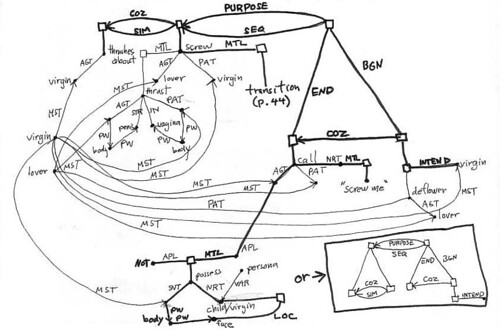
That same semester I was also studying with David Hays in linguistics. On the one hand I was enrolled in a course, Linguistics as a Focus of Intellectual Integration, in which we read books by William Powers (control theory and psychology), Talcott Parsons (sociology), Northrup Frye (literary criticism), Ernst Gombrich (art history), Gregory Bateson (systems, mind, ecology), and most likely someone else. But Hays, a computational linguist, was also tutoring me in his semantic model.

I used that semantic model to examine some passages from William Carlos Williams, Patterson, Book V, and submitted that (rather long) paper to both Altieri and Hays. That’s the kind of place Buffalo was in those days. Here’s one of the many diagrams from that paper:

deflower-virgin-crop

Looking at it now I’m appalled at how sloppy it is. But I’m sure I was proud of it at the time, and even thought it a bit stylish. I’d bought a set of technical fountain pens (Rapidograph) just so I could draw such diagrams. These days I’d use the computer, probably Omnigraffle, to draw something that complex.

I remember Charlie making two verbal comments to me about it (above and beyond what he wrote in the margins): 1) that I was using literature as a vehicle for elaborating other interests, and 2) like I. A. Richards I had moved beyond literature to a more general interest in language and the mind. The second was flattering, but I bridled at the first, though it was true. However, it is by no means clear, then or now, in just what the proper study of literature consists.

Anyhow, here’s an open letter to Charlie. Why Charlie? That I studied with him at a critical point in my career is sufficient reason. But there is one other thing: Charlie takes a philosophical approach and is conversant in both Continental and Anglo-American idioms. Despite a spate of dumb remarks from prominent physicists, philosophy remains intellectually necessary.

I start by recounting, for the 4th time I believe [1], my early intellectual history. After that I talk about my analytic work on ring-composition and then on to other things.

* * * * *

Hi Charlie,

I’ve been looking at some of the stuff on your website and notice that you’ve taken to posing as an old scholar reflecting on the profession. That’s a pose I know well, and have explored it myself in this and that, except that here and now I’m pretending to be a Martian. It’s a metaphor of course, but not, as I’ll explain, a mere metaphor. And like you I’m suspicious about the “materialist” allegories that have come to dominate the field, though I’m not so bothered by the erasure of authors – but that particular issue would take me a bit far afield.

From Johns Hopkins to Buffalo

I’ve spent a great deal of time thinking about the profession, by which I mean academic literary criticism, and wondering about its future. On the one hand I’m amazed at the variety of work done in the name of (academic) literary criticism. I certainly can’t get a grip on the full range. Can anyone? Someone who’s chaired a large and diverse department, or served as editor for a generalist journal, they’d have seen a wide range of work parade before them over the years. But really grasp it all?

Moreover I look at the discipline as an outsider. I’m an outsider in the sense that I don’t hold an academic appointment and haven’t had one since I failed to make tenure at RPI back in 1985. But I’m hardly the only capable scholar – or whatever it is that I am – to operate outside the academy. I’m an outsider in a deeper and more fundamental sense and have been, I realize in retrospect, ever since I completed my MA degree at Hopkins in 1972, ever since I wrote that MA thesis on “Kubla Khan”.

That is to say, I was an intellectual outsider when I arrived at Buffalo in the fall of 1973 for the purpose of getting the credential, the PhD, that is the all but necessary requirement for an academic post. At that time it was obvious that my MA thesis was a very unusual piece of work. I had a sense that, though it was my work – I’d written the thing, hadn't I? – I didn’t really know what I’d done. For knowledge is ineluctably social – there are no private languages – and it wasn’t at all clear just which intellectual community could accommodate that work.

It was quite unlike anything that had been written about “Kubla Khan”. And while it had obvious antecedents in structuralism and in linguistics, in various respects it was quite different from what Jakobson, Lévi-Strauss, and others had done with poetry. What was it, a duck or a swan? Who knew how to answer the question?

When I arrived at Buffalo I was apprehensive about whether I’d be able to do the work I wanted to do, not that I had any clear idea of what that was. All I knew is that I wanted to somehow make sense of the structure I’d found in that poem. So I showed the thesis around, to Mac Hammond, my advisor, to Al Cook who was, well, Al Cook, and in my second year, to you. Everyone accepted it as well, I don’t know what, but it was in some way accepted. And, with the help of another graduate student, Ralph Henry Reese, who’d worked with David Hays, I managed to find my way to the Linguistics Department where I joined Hays’s research group in computational linguistics.

Back then, the world seemed wide open – “it was the age of wisdom, it was the age of foolishness, it was the epoch of belief, it was the epoch of incredulity, it was the season of Light, it was the season of Darkness, it was the spring of hope, it was the winter of despair, we had everything before us” – and who knew how the discipline would develop. It was worth a shot.

Monday, October 26, 2015

Here Come the Sun – On Photographing a Sunrise

There is this word, “photorealism”, which refers to the quality of an image that has been drawn or painted. Not only does such an image represent some object or scene in a “realistic” manner, as opposed, say, to an impressionist or cubist manner, but it does so as well as a photograph. “Photorealism” designates a standard, one defined by a technology, photography. One of the defining characteristics of this technology is that the image is imposed on a surface, a chemical emulsion or an array of electronic senses, in a purely mechanical way that is true to the geometry of the scene as conveyed by light.

But, in what sense does the photographic image depict the visual world as it “really” is?

Here’s a photograph of a sunrise as it came out of my camera and into Adobe’s Lightroom rendering program:

20151024-_IGP6448

That’s not what I saw as I took the photograph. It’s much too dark.

Which am I to believe, the truth-telling camera or my lying eyes?

Both.

The reason that image is so dark is that, by pointing my camera directly at the rising sun, I flooded it with light. That’s one thing. But there’s something else. The sensor can handle a wider dynamic range than any monitor can display and than can be realized on any photographic paper ¬– this is a problem that Ernst Gombrich explored at some length in Truth and Illusion, though he was interested in painting, not photography. So the software has to compress the image in order to display it. That darkness is the result of that compression.

Here’s the same image after I’ve done a thing or two with it:

20151024-_IGP6448-2

This image is brighter over all and it has much more definition. The buildings of the skyline are no longer lost in dark shadow. You can now see distinct buildings and even see features of some.

Monday, September 8, 2014

10 Influential Books, aka What goes around comes around

Back in 2010, at the urging of one of his readers,, Tyler Cowen seems to have started a books meme: What 10 books have influenced you the most? I posted my answer back then (you can find it tacked to the end of New Savanna's "Bill Benzon" page) and now I'm reposting it.  My list is limited to non-fiction.

My Teacher

David Hays, Cognitive Structures. Hays was my teacher, and most of what I learned from him I learned directly from him. His aim in this book was to integrate the analog and servomechanical model of William Powers (see below) with the propositional and digital style of his own earlier work in computational linguistics. It is embodied cognition before the term was coined and gained currency. I believe this is the most profound such attempt to date (Hays wrote the book in the Spring of 1976), but, of course, I am biased. It is also, alas, rather obscure in points, no bias.

Some Others

Claude Lévi-Strauss, The Raw and the Cooked. I’ve read a good deal of Lévi-Strauss, and this wasn’t the first. But it has had the most lasting effect on my thinking, which I’ve discussed at The Valve. Lévi-Strauss sees that there is a rigorous, but hidden, logic to a body of South American myths. He evokes this hidden logic by careful comparisons between myths, while discussing them in their larger socio-cultural context.

John Bowlby, Attachment. I read this in typescript under the tutelage of the late Mary Ainsworth. Bowlby set out to reconstruct psychoanalytic object relations theory using systems models (TOTE from Miller, Gallanter, and Pribram, Plans and the Structure of Behavior) and evidence from ethology, especially of primates. This became my model of biologically-based psychology.

Jean Piaget, Play, Dreams and Imitation in Childhood. I’ve read a good deal of Piaget, and this wasn’t the first (most likely that was The Origins of Intelligence in Children.) Though now somewhat eclipsed, his concept of developmental stages was enormously useful and, I believe, still holds water. But be careful. (Given its subjects, this book connects nicely with an interest in literature.)

Lev Vygotsky, Language and Thought. Vygotsky argued that children acquire language by completely internalizing that started as interaction with another. First the parent uses language to direct the child’s attention and behavior. Over time the child becomes able, first to use his own speech for those tasks, and then becomes able to dispense with external speech entirely.

Karl Pribram, Languages of the Brain. Pribram was a champion of the notion that the brain processes and stores information holographically. You’ll find that idea here, plus much more besides. Pribram was, and remains, one of our most comprehensive thinkers about the brain and its mind. But this book’s a tough read.

Philippe Ariès, Centuries of Childhood. Medievals and Early Moderns didn’t think about children as we do, which Ariès argued from paintings, diaries, and other sources. The basic idea is that people way back when didn’t think and act about something very basic in the way we do. Children are children, no? Well, biologically, yes. Culturally, no.

William Powers, Behavior: The Control of Perception. Powers has two ideas, both from control theory (and one of them is more or less given in his title), and both quite elegant. This is how to go about theorizing, be as clear as you can and use elegant examples. FWIW, Powers was an engineer and very much concerned with building real things.

Philosophers

Except for the Powers, all of the above books came to me within a minute or two. Then I drew a blank for a couple of minutes. “But you know,” says I to myself, “I was quite influenced by some philosophers early on, even if I no longer read philosophy. Oo why not mention them.” So I will. That I had to kick Merleau-Ponty into the omissions pile, rather than one of these, is somewhat arbitrary.

Ludwig Wittgenstein, Tractatus Logico-Philosophicus. Two things got me, the rigorous order of the whole affair, each proposition numbered in outline form. And the mysticism.

Friedrich Nietzsche, The Birth of Tragedy. Read a lot of Nietzsche too. But his account of the birth of tragedy linked up with other things in a powerful (including two of the books in the omissions pile.) And, of course, the Apollonian and Dionysian.

Omissions

Since the exercise limited us to ten I didn’t list Thomas Kuhn, The Structure of Scientific Revolutions, Maurice Merleau-Ponty, The Phenomenology of Perception, Walter Wiora, The Four Ages of Music, or Ernst Gombrich, Art and Illusion. The more I think about this, the longer this list will get. Some Freud belongs on the list (The Interpretation of Dreams?). Charlie Keil, Urban Blues. And Gregory Bateson, Bertrand Russell. Well, I know why Russell didn’t make the list. I read a lot of his stuff in my mid-teens, but not after. I hadn’t started “serious” thinking when I left off reading him.

Wednesday, August 27, 2014

Reading Macroanalysis 6.4: Themes and how they evolve over time

Note: This may be the most important post in the series. But it’s a long way through, 6000 words or so. Fortunately, there are a lot of illustrations, and much of the argument is in those illustrations.
This will concludes my examination of the “Theme” chapter from Matthew Jockers, Macroanalysis: Digital Methods and Literary History. First I say a word or three about topic modeling. Then I review Jockers’ own findings. Then I ride one of my current hobby horses, Leslie Fiedler’s argument in Love and Death in the American Novel. First I look the waxing and waning of themes through the 19th century and then I return to Moby Dick and move on briefly to The Adventures of Huckleberry Finn. I conclude with some informal remarks about argument, evidence, epistemology, and interface design.

Operationalizing the Idea of Theme

When I was originally thinking about this post I decided that, since I’d already explained topic modeling elsewhere (e.g. HERE), there was no point in doing it again. But I’ve now decided to do it again just to make the point that we’re operating in an “operationalized” intellectual world and we must be aware of that.

For example, while Jockers has identified 500 themes (a term in ordinary language) in his corpus of 3346 novels, it would be somewhere between misleading and outright mistaken to say that he discovered 500 themes. For that would imply that it could have been 386 or 617 or 239 or any other number of themes, but that, no, it turns out that there are 500 of them, no more, no less.

Jockers has 500 themes because he ‘instructed’ his algorithm to prepare that many. He could have instructed it to prepare any number of topics (a term of art in corpus linguistics) he wished, 386, 617, or 239, for example. There’s no discovery involved. What’s involved is more like tuning. Jockers explored various possibilities and 500 seemed like a useful number of topics.

What’s going on?

Topic analysis depends on the fact that the words used to state some theme are going to occur together in any text where that theme shows up. It’s all about context. That fact isn’t of much use if you’re dealing with only a handful of themes in a small body of text. But if you’ve got a large body of texts with an appreciable number of themes, then there’s a way you can get a computer to list the words in each theme, more or less.

If a given text doesn’t contain a given topic then the words associated with that topic won’t appear in that text, obviously. Oh, some of them might, but not all of them. So, the computer does a massive comparison of the words that occur throughout the corpus. Just how it does this is irrelevant at the moment, as least, it’s irrelevant if you’re willing to trust that the researchers who invented the technique know what they’re doing. One interesting thing about the technique is that the results improve as the corpus gets larger–assuming you’ve got the computer power needed to crunch the data. That’s because a larger corpus will have a larger number of topics and each different topic will appear in contrast to a larger universe of topics. It’s the contrast that the computer’s looking for.

But, as I’ve said above, in order to run the algorithm, you’ve got to specify how many topics you’re looking for. If the number is too high the algorithm returns (p. 128)
topics lacking enough contextual markers to provide a clear sense of how the topic is being expressed in the text; setting the number too low may result in topics of such a general nature that they tend to occur throughout the entire corpus.
But you don’t necessarily want to run your algorithm against the entire text as a single analytical unit if the texts are individually large, as is the case with novels. What happens then is that just about any topic can be found in a given text. Jockers determined that he needed to slice his texts into 1000 word chunks. That is, each whole novel is searched, but the algorithm treats each 1000-word segment of a novel as an independent text for the purpose of determining word co-occurrence.

This has the benefit that it is possible to track the distribution of a given topic in a novel (Jockers gives examples on pp. 142-43). Thus topic modeling returns useful results both at the macro scale of the whole corpus and the meso scale of the individual text (on scales, see Reading Macroanalysis 5: An Interlude on Scale: Micro, Meso, and Macro in this series).

What the algorithm returns for each topic is a weighted list of words for that topic, where the weighting of a word is proportional to its frequency in the topic. Jockers’ preferred representation for a topic is a word cloud, such as this one:

TENANTS AND LANDLORDS

But it’s not convenient to use those clouds as devices for referring to a given topic. For that purpose it’s useful to have names. The general practice is to devise a name from the words most prominent in the topic. Thus, Jockers has called that topic TENANTS AND LANDLORDS.

Wednesday, December 18, 2013

Frye on Comedy and Tragedy

First some notes on my encounter with Frye, and then some passages from the Anatomy on comedy and tragedy.

* * * * *

I believe that I have read through Northrup Frye’s Anatomy of Criticism, beginning to end, twice, once as an undergraduate and once as a graduate student. I don’t recall the circumstances of my undergraduate reading, but I was no doubt in connection with a course taught by Dick Macksey; I don’t recall whether it was required or optional. The graduate reading would have been in a seminar taught by David Hays, in linguistics, where we read a number of major works in various fields, some suggested by the students, some by Hays. We also read Gombrich’s Art and Illusion, for example.

My copy is heavily notated. The title page has a handwritten list of page numbers and associated topics written in blue and red ink. The body of the book has underlining in red and blue along with marginal notations and cross-references to other pages.

One of a small number of things that sticks with me, and about which I have thought time and again over the years, are some remarks Frye made about the curious kinship between comedy and tragedy. Crudely: comedy is a triple form; you lop off the third section and you get a tragedy.

That’s one reason I’ve been so attracted to Much Ado About Nothing and Othello. One is a comedy, the other a tragedy. While the comedy has a double plot, as Shakespeare’s comedies do (if not triple), the plot that gives the play its shape is set in motion in the same way as the plot in the tragedy: in both cases a man (Claudio, Othello) wrongly accuses his beloved (Hero, Desdemona) of being unfaithful. Thus we have a natural experiment on which to “test” Frye’s observation. I’ve written an essay on that and, though I do like that essay, the results are inconclusive.

Monday, September 3, 2012

Bryant Watch: Art as Making


A poem should not mean
But be. 
—Archibald McLeish

Someone, please, tell Bryant the Philosopher King Manqué that he needs to read Ernst Gombrich.

NOW!

He’s about to deliver a paper, "Towards a Machine-Oriented Aesthetics: On the Power of Art," in which he argues against the idea that art works express something and thus demand a criticism in search of meaning. Rather, art works ARE something and so demand a criticism that “is not so much about the work, as about activating the work as a machine with reference to the present.” I can live with that, sorta’. What bothers me is that he seems to think this conception of art is new or, if not new—for nothing’s ever completely new, is it?—at least it’s such an underappreciated and underdeveloped idea that he need not cite any precedent.

Bollocks!

The idea is old, and has been developed with considerable sophistication by Ernst Gombrich in his magisterial study, Art and Illusion (1960). Bryant’s ignorance of this work would be one thing if Gombrich had been an obscurantist provincial scholar laboring in, say, a community college in the Texas hinterlands. Alas, that is not the case. He labored in London, was arguably the most prominent art historian of the 20th Century, was certainly one of the most important theorists, and was noted for the clarity of his writing. A scholar who writes on this topic without mentioning Gombrich might as well write about phenomenology without mentioning Husserl or  Heidegger.

* * * * *

Tuesday, July 17, 2012

Dynamic Range, Eye vs. Display

The human eye has a much greater dynamic range than any film or digital display. By dynamic range I mean, roughly, the ability to discrimate between slighly different light values over a wide range of light values. This photograph illustrates the problem:

IMGP5207rd2012AsShot

There's a large area at left center where we see a well-articulated image, three water towers and some other stuff (including the Empire State Building) against the sky. The surrounding area, however, is lost in dark murk. But, I assure you, I wasn't standing in the dark when I took the shot. I could see my surroundings perfectly well.

Now, a digital camera can register a greater dynamic range than any display or film can present. So it is possible rebalance the pixel values so that the foreground structure is nicely articulated:

IMGP5207rd3

Thursday, October 27, 2011

OOO Aesthetics: Some Photographs of Natural Objects

Object-Oriented Ontology (OOO) shows how one can activate the tension between patterned color forms and the objects they represent.

In pursuit of an object-oriented aesthetics of photography, I want to quote one of Graham Harman’s remarks in his ASK/TELL interview. Early on he notes “For me, art in general is a special way of breaking the bond between an object and its own qualities, and I believe it is now the central mission of philosophy to theorize the deformations and breakdowns in this bond.” He later goes on to talk about installations, which are, of course, visual, but perhaps tactile, haptic, and kinesthetic as well.

mad cow behind white puff.jpg

The Perils of Representation

I want to remain with the visual mode, but I want to talk about two-dimensionsal (2D) art: paintings, drawings, etchings, lithographs, collages, whatever. One could certainly write a history of Western 2D art in terms of the “tension between objects and their qualities” (a phrase Harman uses later in the interview), that, BUT ALSO the tension between the 2D medium and its 2D and/or 1D images, and the manifold qualities of the objects represented through that medium. Such histories, I’m sure, have been written, though perhaps not quite in those terms.

I’m thinking in particular of Ernst Gombrich’s magisterial Art and Illusion which, though it isn’t a history, certainly has a historical flavor. Gombrich was interested in the conventions and techniques that were developed for representing objects and scenes on 2D surfaces. Gombrich’s point is that, while pictorial realism was the representational objective for several centuries, art is fundamentally an act of making, and only secondarily one of mimesis. The mimetic project, he points out time and again, always fails in some respect, even if the making succeeds.

During the decades of the transition to the 20th century the realist project collapsed, in part, at least, under the inherent impossibility of ever achieving a fully realistic image. You simply can’t ‘squish’ 3D reality onto a 2D surface nor can you compress, WITHOUT LOSS, the full dynamic range of visible light into the much narrower range possible with reflected light.

In the wake of this collapse many other forms of painting and drawing emerged. Some of them, e.g. surrealism, still depicted objects and scenes, but simply discarded the requirement that they be (potentially) real. And some forms abandoned representation entirely, post-WWII abstract expressionism being perhaps the best-known school.