This level of desperation perfectly encapsulates the "monetization crisis" of the current AI paradigm. We’ve seen staggering capital injection, yet the path to a sustainable business loop remains so elusive that even "ethically bankrupt" shortcuts are now being legitimized in…
— David Wall (@DavidWall9987) March 11, 2026
Showing posts with label IP. Show all posts
Showing posts with label IP. Show all posts
Wednesday, March 11, 2026
The rush to money and IP theft in the AI world
Saturday, January 20, 2024
Free at Last
STEAMBOAT WILLIE REMIX pic.twitter.com/BwQPU0A6sD
— Eclectic Method ♻️ (@EclecticMethod) January 1, 2024
Monday, January 8, 2024
How Dan Dan O'Neill "The Air Pirates" went after Mickey Mouse
Posted at YouTube:
This is the untold story of Dan O'Neill and his underground comic collective "The Air Pirates" which would take on the brass at Disney in a notorious decade-long legal battle over copyright infringement and freedom of speech. Dan O'Neill's battle against Walt Disney Productions would be the longest legal copyright case in history.
In 1970, Dan O'Neill founded the underground comics collective, The Air Pirates, to satirize Disney. The group included Bobby London, Shary Flenniken, Gary Hallgren, and Ted Richards.
The original Air Pirates were a gang of Mickey Mouse antagonists from the 1930s. Dan O'Neill saw Mickey Mouse as a symbol of conformist hypocrisy in American culture, and therefore a ripe target for satire.
Now in 2024, with the cartoon image of the Mouse reaching the public domain, Dan O'Neill finally has the last laugh as drawing a cartoon mouse will no longer be considered a federal crime.
Monday, January 1, 2024
Mickey Mouse, Free at Last! – And not only Mickey and Minnie
Happy new year ! And happy public domain day with a major new entry: the original design of Mickey Mouse!
— Alexander Doria (@Dorialexander) December 31, 2023
For the occasion I’m releasing Mickey-1928 a model on @HuggingFace that can generate pictures of Mickey, Minnie and Pete from 1928. https://t.co/Cy8am3Ra5w pic.twitter.com/XiWR837hmE
Sopan Deb, These Classic Characters Are Losing Copyright Protection. They May Never Be the Same. NYTimes, Jan. 1, 2024. The opening paragraphs:
If you’re the creative type and you’re struggling to come up with your next idea, do not fear: some big works, including the original version of Mickey Mouse, are entering the public domain on Jan. 1 in the United States.
And if, on the other hand, you prefer your Disney characters to be cute, cuddly and never-changing, well … you might want to stop reading.
In 2024, thousands of copyrighted works published in 1928 are entering the public domain, after their 95-year term expires.
This means that those characters and stories can be remade — on the page, stage or screen — without permission. (Finally, I can make that Peter Pan musical where a middle-aged Peter laments unexplained back pains at the end of Act I.)
“It’s important for the preservation of our cultural record, for meaningful access to older works for inspiring future creativity,” Jennifer Jenkins, the director for the Center for the Study of the Public Domain at Duke Law School, said.
The crème de la crème of this year’s public domain class are Mickey Mouse and, of course, Minnie, or at least black-and-white versions of our favorite squeaky rodents that appeared in “Steamboat Willie.” Disney is famously litigious, and this copyright only covers the original versions of the character.
Near the end, some possibilities:
The playwright Lindsey Ferrentino proposed a mash-up of titles.
“Maybe a production of ‘Threepenny Opera’ with the character of Mackie Messer recast as Mickey Mouse. Very Brechtian,” Ferrentino said. “Don’t ask me to write it though.”
The steamy “Lady Chatterley’s Lover” sparked a lot of interest. Neil Meron, a producer of the Broadway musical “Some Like It Hot,” suggested “a gender fluid immersive” musical adaptation with a score from Sam Smith.
Karen Chee, a writer for “Late Night With Seth Meyers,” pitched “Lady Chatterley’s Millions of Cats.” Ah, but let’s flesh this out! Chee added: “A lonely wife who forgoes sexy times to instead adopt millions of cats.” (Of course.)
From Bob Gale, co-writer of both the film and musical versions of “Back To The Future”: “Is Mickey the new lover of Lady Chatterley, or is he only a voyeur?”
There's more at the link
Nina Paley loves being sucked into AI [Happy New Year!]
Other artists hate having their work and styles sucked into AI. But I love it! My work is all Free Culture, I am thrilled to find my name on this list. If Midjourney would actually generate something that looks like my style… https://t.co/DwOGhbl6YS
— Nina Paley (@ninapaley) January 1, 2024
Don't forget this, from a decade ago:
Saturday, July 15, 2023
Do AI companies have the right to harvest anything anyone uploads to the web and use it for training their engines? [& invention?]
Sheera Frenkel and Stuart A. Thompson, ‘Not for Machines to Harvest’: Data Revolts Break Out Against A.I., NYTimes, July 15, 2023. From the article:
Ms. Loffstadt also helped organize an act of rebellion last month against A.I. systems. Along with dozens of other fan fiction writers, she published a flood of irreverent stories online to overwhelm and confuse the data-collection services that feed writers’ work into A.I. technology.
“We each have to do whatever we can to show them the output of our creativity is not for machines to harvest as they like,” said Ms. Loffstadt, a 42-year-old voice actor from South Yorkshire in Britain.
Fan fiction writers are just one group now staging revolts against A.I. systems as a fever over the technology has gripped Silicon Valley and the world. In recent months, social media companies such as Reddit and Twitter, news organizations including The New York Times and NBC News, authors such as Paul Tremblay and the actress Sarah Silverman have all taken a position against A.I. sucking up their data without permission.
Their protests have taken different forms. Writers and artists are locking their files to protect their work or are boycotting certain websites that publish A.I.-generated content, while companies like Reddit want to charge for access to their data. At least 10 lawsuits have been filed this year against A.I. companies, accusing them of training their systems on artists’ creative work without consent. This past week, Ms. Silverman and the authors Christopher Golden and Richard Kadrey sued OpenAI, the maker of ChatGPT, and others over A.I.’s use of their work. [...]
“The data rebellion that we’re seeing across the country is society’s way of pushing back against this idea that Big Tech is simply entitled to take any and all information from any source whatsoever, and make it their own,” said Ryan Clarkson, the founder of Clarkson.
Eric Goldman, a professor at Santa Clara University School of Law, said the lawsuit’s arguments were expansive and unlikely to be accepted by the court. But the wave of litigation is just beginning, he said, with a “second and third wave” coming that would define A.I.’s future.
What about A.I. invention? See Steve Lohr, Can A.I. Invent? NYTimes, July 15, 2023.
Thursday, February 27, 2020
A guerilla attack on (bogus) copyright claims over musical melodies: Create them all and release them into the publid domain
Samatha Cole, Musicians Algorithmically Generate Every Possible Melody, Release Them to Public Domain, Vice, 25 February 2020:
Two programmer-musicians wrote every possible MIDI melody in existence to a hard drive, copyrighted the whole thing, and then released it all to the public in an attempt to stop musicians from getting sued.
Programmer, musician, and copyright attorney Damien Riehl, along with fellow musician/programmer Noah Rubin, sought to stop copyright lawsuits that they believe stifle the creative freedom of artists.
Often in copyright cases for song melodies, if the artist being sued for infringement could have possibly had access to the music they're accused of copying—even if it was something they listened to once—they can be accused of "subconsciously" infringing on the original content. One of the most notorious examples of this is Tom Petty's claim that Sam Smith's “Stay With Me” sounded too close to Petty's “I Won’t Back Down." Smith eventually had to give Petty co-writing credits on his own chart-topping song, which entitled Petty to royalties.
Defending a case like that in court can cost millions of dollars in legal fees, and the outcome is never assured. Riehl and Rubin hope that by releasing the melodies publicly, they'll prevent a lot of these cases from standing a chance in court.
In a recent talk about the project, Riehl explained that to get their melody database, they algorithmically determined every melody contained within a single octave.
Tuesday, February 20, 2018
What are the implications of the 5Pointz decision?
Last week, a federal judge, Frederic Block, may have established legal precedent to the unwritten code. Jerry Wolkoff, the developer who owns the building known as 5Pointz in Long Island City, Queens, was fined $6.7 million for painting over the works of 21 graffiti artists. Even though Mr. Wolkoff owned the building that was painted, a jury found that under the Visual Arts Rights Act, the art was protected.It was an odd and belated sense of validation for the graffiti artists, even though they sensed that Mr. Wolkoff’s legal team underestimated the art form. [...]Still, the artists were stunned by the size of the award issued by Judge Block. The $6.7 million was the maximum penalty, based on $150,000 for each of the 45 works the judge deemed worthy of protection.
Here's the interesting part:
The way the art was destroyed, however, was most upsetting. Mr. Wolkoff, intending to raze the building to build condominiums, hired a team to whitewash the building at night. But the warehouse remained standing for nearly a year after the graffiti had been destroyed. It seemed to the artists to be a deliberate insult to the thousands of hours of work put into the murals. Judge Block thought so as well.“If not for Wolkoff’s insolence, these damages would not have been assessed,” the judge said at the ruling. “If he did not destroy 5Pointz until he received his permits and demolished it 10 months later, the court would not have found that he had acted willfully.”It was the fact that galvanized the artists as well. “It gave the vibe to everyone that our art was worthless,” Mr. Tramontozzi said.
Limitations:
Dean Nicyper, a New York-based lawyer specializing in art law, considers Monday’s ruling to be a landmark decision.“But I do think the breadth of the decision might be somewhat limited,” he said. “It’s limited to cases where people have created their art on a structure with permission.”Mr. Nicyper said he believes the decision may have been different if Mr. Wolkoff had not granted the artists permission. It could also hinder graffiti artists in the future. “Does this create a chilling effect?” Mr. Nicyper asked. “Building owners are going to be reluctant to give permission.”
Tuesday, January 16, 2018
Barbie, Bratz, IP, and #MeToo
Jill Lepore has a fascinating article in The New Yorker about an IP (intellectual property) squabble over Barbie and Bratz dolls, which do billions of dollars in business. Yes, tells us a bit about the history of copyright, which is at issue in several law suits she discusses. But the article also discusses sexual harassment and feminism. Here's two paragraphs near the end:
The final sentence: "Mattel owns Barbie. MGA owns Bratz. And corporations still own the imaginations of little girls."Empowerment feminism is a cynical sham. As Margaret Talbot once noted in these pages, “To change a Bratz doll’s shoes, you have to snap off its feet at the ankles.” That is pretty much what girlhood feels like. In a 2014 study, girls between four and seven were asked about possible careers for boys and girls after playing with either Fashion Barbie, Doctor Barbie, or, as a control, Mrs. Potato Head. The girls who had played with Mrs. Potato Head were significantly more likely to answer yes to the question “Could you do this job when you grow up?” when shown a picture of the workplaces of a construction worker, a firefighter, a pilot, a doctor, and a police officer. The study had a tiny sample size, and, like most slightly nutty research in the field of social psychology, has never been replicated, or scaled up, except that, since nearly all American girls own a Barbie, the population of American girls has been the subject of the scaled-up version of that experiment for nearly six decades.#MeToo arises from the failure of empowerment feminism. Women have uncannily similar and all too often harrowing and even devastating stories about things that have happened to them at work because men do very similar things to women; leaning in doesn’t help. There’s more copying going on, too: pornography and accounts of sexual harassment follow the same script. Nobody writes anything from scratch. Abandoning structural remedies and legislative reform for the politics of personal charm—leaning in, dressing for success, being Doctor Barbie—left women in the workplace with few choices but to shut up and lean in more and to dress better. It’s no accident that #MeToo started in the entertainment and television-news businesses, where women are required to look as much like Barbie and Bratz dolls as possible, with the help of personal trainers, makeup artists, hair stylists, personal shoppers, and surgeons. Unfortunately, an extrajudicial crusade of public shaming of men accused of “sexual misconduct” is no solution, and a poor kind of justice, not least because it brooks no dissent, as if all that women are allowed to say about #MeToo is “Me, too!” The pull string wriggles.
Monday, March 6, 2017
Theft! A History of Music
From Duke University's Center for the Study of the Public Domain:
Here's a sample page:
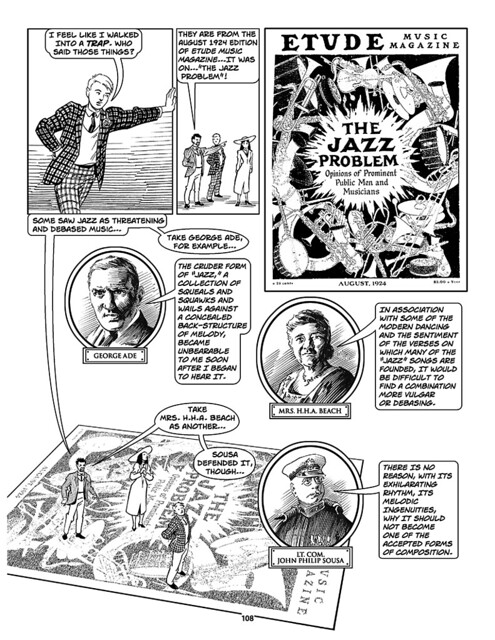
We are proud to announce the publication of Theft! A History of Music, a graphic novel laying out a 2000 year long history of musical borrowing from Plato to rap. The comic, by James Boyle, Jennifer Jenkins and the late Keith Aoki, is available as a handsome 8.5 x 11″ paperback, and for free download under a Creative Commons license.
About the Book
This comic lays out 2000 years of musical history. A neglected part of musical history. Again and again there have been attempts to police music; to restrict borrowing and cultural cross-fertilization. But music builds on itself. To those who think that mash-ups and sampling started with YouTube or the DJ’s turntables, it might be shocking to find that musicians have been borrowing—extensively borrowing—from each other since music began. Then why try to stop that process? The reasons varied. Philosophy, religion, politics, race—again and again, race—and law. And because music affects us so deeply, those struggles were passionate ones. They still are.
The history in this book runs from Plato to Blurred Lines and beyond. You will read about the Holy Roman Empire’s attempts to standardize religious music with the first great musical technology (notation) and the inevitable backfire of that attempt. You will read about troubadours and church composers, swapping tunes (and remarkably profane lyrics), changing both religion and music in the process. You will see diatribes against jazz for corrupting musical culture, against rock and roll for breaching the color-line. You will learn about the lawsuits that, surprisingly, shaped rap. You will read the story of some of music’s iconoclasts—from Handel and Beethoven to Robert Johnson, Chuck Berry, Little Richard, Ray Charles, the British Invasion and Public Enemy.
To understand this history fully, one has to roam wider still—into musical technologies from notation to the sample deck, aesthetics, the incentive systems that got musicians paid, and law’s 250 year struggle to assimilate music, without destroying it in the process. Would jazz, soul or rock and roll be legal if they were reinvented today? We are not sure. Which as you will read, is profoundly worrying because today, more than ever, we need the arts.
All of this makes up our story. It is assuredly not the only history of music. But it is definitely a part—a fascinating part—of that history. We hope you like it.You can read the book online, download a free PDF, or buy a paperback.
Here's a sample page:
Sunday, January 13, 2013
Aaron Swartz, Depression, and Prosecution
Writing at Question Copyright, Karl Fogel observes:
There are many remembrances [of Aaron Swartz] already on the Internet, but two in particular stand out: Rick Perlstein's and Lawrence Lessig's. Both are personal remembrances, but both make the point (Rick even more directly in a separate Facebook post) that it would be a mistake to reflexively pathologize this and blame it simply on Aaron's occasional depression. In Rick's words, from a Facebook conversation: "I would downplay the depression angle. The big piece he wrote about his depression came when he was 17. When I talked to him about my own depression a year ago, he really didn't respond as a fellow-traveler. I can't say precisely, but I don't think it was a huge part of his life. Having his soul gnarled down to a nub by a Javert had much more to do with it, I think." You'd be depressed too if the might of the U.S. federal judicial system seemed dedicated to sending you to jail for most of your life over an essentially altruistic act that harmed no one. I can't read Aaron's mind and don't know what he was thinking, but the relentlessness of that system bearing down on him was there, every day, with no sign of respite. Whether one is prone to depression or not, that's a hard, hard road. And your friends and allies may defend you till they're blue in the face, but they're not going to be there in the jail cell with you.
Thursday, January 10, 2013
IBM First in Patents in 2012
So says the Bits blog at The New York Times:
I.B.M. collected 6,478 patents last year. I.B.M.’s patent asset generates an estimated $1 billion a year in license revenue. But it also a shield against patent litigation by competitors and patent-holding firms.
That makes it 20 years in a row that IBM has been first. Samsung Electronics was second with 5,081 patents. Apple and Google, though coming up in the rankings, were somewhat further down in the rankings. However:
But in the Boston Consulting ranking, based mainly on an opinion survey of 1,500 executives, I.B.M. placed sixth among the most innovative companies in 2012. Apple came in first, followed by Google, in this measure of perception rather than patent counts.
Sunday, November 18, 2012
Copyright May be in Play
The House Republicans want to rein it in. And the Mouse is pissed!
There's one discussion at Crooked Timber and another at Marginal Revolution.
Saturday, April 21, 2012
Dueling Watsons
Language Log has a post telling us that, just as IBM has a speech understanding system named Watson (after the first president of the company), so AT&T has a somewhat older system named Watson (after Alexander Graham Bell's assistant). In a comment, Jon Weinberg further informs us:
Each company has filed for U.S. trademarks — IBM for "IBM Watson" and AT&T for "AT&T Watson". The requested trademarks haven't issued. IBM's applications have been kicked back by the examiner, and AT&T's application was opposed by IBM in a proceeding before the Trademark Trial and Appeal Board; the two companies are in settlement negotiations
Saturday, October 8, 2011
Bleg: The Social Responsibility of Artists
Lately I've been having vague thoughts about an artist's responsibility to the culture from which they draw their 'memes.' These vague thoughts have arisen specifically in the context of current thinking about how copyright has gotten out of control and should be trimmed back, if not entirely abolished. This post is a vague and rambling toss in that general direction. It’s thinking outloud.
* * * * *
So, if one is going to make an ethical case for releasing piles of materials from bondage to copyright, as people are doing these days, one needs to think about one’s obligations to make ethical use of that material. Perhaps the issue will take care of itself, whatever the issue is. But, if we drop the notion of the artist as protean creator, then it’s NOT simply an issue for the artist. And it’s not at all clear to me that we can simply say that the artist’s use will be ‘taken care of’ in post facto reception of their work.
* * * * *
As far as I can tell, the culturally dominant idea of the artist is still the romantic one of the protean creative genius. Such geniuses are obligated ONLY to their protean creativity, to which they must be true. As that two-faced SOB Polonius says in Hamlet: "To thine own self be true." The genius gets nothing from his culture and owes nothing to it.
What happens when you drop the notion of the creative genius while at the same time acknowledging the artist's dependence on existing cultural practices?
Sunday, September 11, 2011
Network Awesome Features Sita Sings the Blues
On Monday 12 September 2011 Network Awesome will feature Nina Paley’s Sita Sings the Blues.
Network Awesome? Never heard of it.
You’ve never heard of Network Awesome!#? What rock have you been sleeping under?
No rock, sheesh! Don’t get cranky on me. It’s a big world, you know, awesome. I’m busy, already flying on information overload. So chill out.
Well, to be honest, I didn’t know about Network Awesome ‘till about a month ago, when Michael Sporn hipped me to it. Well, not just me, but anyone who read his blog. Newtwork Awesome had programmed some classic Japanese animation, which interested him because he’s an animator—and, incidentally, runs one of the best animation blogs in Greater Blogistan. And it interests me because I’m interested in Japanese animation.
So I virtually hauled my virtual ass over there and took a look. Yep, there they were, old Japanese cartoons. Even better, interesting commentary, such as this piece by Cory Gross about Mitsuyeo Seo’s Divine Sea Warriors, which was Japan’s first feature-length animated film, and also war propaganda.
That’s the formula, interesting material intelligently curated coupled with compelling commentary. Where else can you find that?
Awesome!
See, I told you.
Network Awesome was founded in January of 2011 by Jason Forrest, an electronic musician and entrepreneur, who wants to make the best of an almost forgotten past available to us now and for the future. That is to say, he wants to keep culture alive, a mission that is particularly important as we face the daunting task of creating a new ways of living on this planet, not to mention an outpost on Mars one of these days.
Friday, July 29, 2011

Friday, June 24, 2011

Tuesday, June 7, 2011

Saturday, June 4, 2011
Lawyers Using Bots to Hassle Busy People, or: How I had to waste time giving myself permission to quote and paraphrase myself, really
It's all just so bleepin' INSANE.
Here's the deal. Two, no three, years ago a buddy of mine, who shall nameless so he’s not associated with this mini-quagmire, asked me to contribute a chapter to a book he's editing on a subject near and dear to me. Fine. Glad to. A couple months later I get a contributor’s agreement in which, among other things, I hand over copyright to the publisher and affirm that my essay doesn’t infringe on anyone else’s copyright. Standard stuff. I sign it and that’s that.
Meanwhile, I’ve been thinking, writing up notes, drafting prose. The usual. Then, something over a year ago I put some of my work in progress online at The Valve, a group blog where I have privileges, in order to get feedback on my ideas.
Which I did. Thank you very much, interwebs.
Time goes by, I turn in my final chapter. My buddy likes it, his editor likes it. And then the publisher sends some bots out on the web to compare text in their book-in-progress to whatever's on the web. What happens? My chapter gets flagged because, hey! some of my prose is out there on the web.
And you know why some of the prose in my chapter is out on the web you clueless bot-masters? Because I put it there! That's why.
Anyhow, my buddy sends me a note explaining the situation and asking me to send him a note explaining that, yes, I put that stuff out there on The Valve. Here’s my exact message: “Some of the prose in my [book name redacted to protect the innocent] chapter first appeared online at The Valve — where, for example, I’m quoting [some worthy]. So I’m just re-using my own prose.”
My buddy passed that on to his handlers and we figured that was the end of it. But, no, not good enough. His handlers got back to him, this time with the very passages the bots had swiped from the web.
Subscribe to:
Posts (Atom)