Showing posts with label my_mood. Show all posts

Monday, November 25, 2024

My Streaming Diet [Media Notes 145]

I’ve written previously about my posting habits over the long-term, posting charts showing wide variation over time, with periods lasting two to four months where I post very little, between longer periods with many posts per month, over a 100 in recent years. I’ve attributed this to mood swings; I’m depressed during periods when I’m not posting much. 


What do I do with my time when I’m not making many blog posts? I’m streaming a lot of movies and TV programs on Netflix and Amazon Prime and watching more YouTube videos that I otherwise do. I’ve been keeping a list of movies and TV programs since sometime in 2018. I’ve decided to post that list online as deep background for an article I’m preparing on my mood swings.  


The list is simple. I list the titles by year, and then by whether or not they’ve movies (films) or TV programs. I define movies as titles that are somewhat over an hour long and that reach a definite conclusion at the end of the title. This, I realize, is a crude criterion. There may, of course, be sequels. Everything else is a TV program. TV programs typically have multiple episodes and may or may not continue the same plotlines in the same story from one episode to the next. TV programs tend to have (somewhat shorter than) half-hour episodes or (somewhat shorter than) one-hour episodes. 


The distinction is rough, but reasonable. The list says almost nothing about how many episodes to a TV program I watch. In many cases I’ve watched all of the available episodes, which may stretch into the hundreds in some cases. I’ve watched some titles more than once and I’ve generally listed the title more than once.

* * * * *

2018 more or less

TV

Bourdain: A Cooks’ Tour, Parts Unknown
Death in Paradise
Shetland
Iron Fist
Luke Cage
Jessica Jones
Lilyhammer
The Get Down
Samurai Gourmet
The Ranch
The Chinese Mayor
The Crown
Sunny in Philadelphia
Bordertown
Sherlock
Master of None (Aziz Ansari)
Hip-Hop Evolution
Sense8
Fyre
Grace and Frankie
Jack Ryan
Lost in Space, S1
The Man in the High Castle
Transparent
Sneaky Pete

Movies

Jurassic Park, 1, 2, 3
Gimme the Loot (2 graffiti artists)
Sand Castle (war in the Middle East)
Road House (Patrick Swayze)
Indiana Jones, all of them
Ex Machina
One Mississippi
Running Man
American Playboy
Spectre
Wild Card
Julie & Julia

Friday, November 22, 2024

Time for another ramble: Melancholy, Claude, Bloom, Claude, Ring composition, and Other Stuff

It’s been a while since I’ve done one of these; May 29th was the last one. If you look over there to right at the Blog Archive you’ll see I’ve been on a posting slump, with 3-figure monthly totals from January through June, then a dip to 61 for July, August: 18, September: 15, October: 30, and now 33 for November as I write this, and the month isn’t over. Maybe I’m pulling out of the slump.

Anyhow, I’m feeling a little backed up with things to post about, so it’s time to ramble on and see what’s up.

Melancholy, Mind (Mine), and Growth

That’s the tentative title for my next 3 Quarks Daily article. Starting back in November 2017 I’ve been making occasional posts about my monthly posting habits, which tend to drop during the winter. I’m thinking of using that as the point of departure for my next 3QD piece, which will go up on December 2nd.

During those down times I’m depressed to one degree or another (melancholy). But why? Since those down times have been in the winter, perhaps its seasonal affective disorder (SAD). But that doesn’t square with all of the evidence. There was no down-time in the winder of 2022-2023 and 2023-2024, but there was a slump in the summer of 2023. Something else is going on, and I think it has to do with creativity. To that end I want to discuss the ridiculous blither of tags here, 665 by November or 2023.

Claude

I’ve starting working with Claude, Anthropic’s chatbot. I want to do some posts where I verify some of the work I’ve done with ChatGPT. I’m thinking of posts on stories, ontological structure, abstract definition, and the Girardian analysis of Jaws. I can then gather those into a working paper.

I also want to look at other things. At the moment I’m thinking of seeing how Claude summarizes longish documents. I’m thinking of the Hamlet chapter from Bloom’s Shakespeare book and Heart of Darkness.

Harold Bloom and GOAT literary critics

A year ago I began a series of posts on the theme of the greatest literary critics. I got bogged down in discussing Harold Bloom. It’s time to finish it off.

Bloom may well be as brilliant a literary critic as we’ve had in the last 50 or 60 years. But brilliance is one thing, greatness is another. Brilliance is a function of the individual, while greatness is a function of the relationship between an individual’s work and the arena in which they’re working.

I’m not sure about Bloom’s fit. While he’s got a wide readership, it’s not clear to me that scholars have taken up his work in any significant way. They may cite him – perhaps especially is concept of influence – but that they don’t much use of his ideas in his work. But we’ve also got to consider his work in the larger public arena, where he is hands-down the most prominent literary critic. I’m not sure of how to handle that.

However, if History wants to declare that Harold Bloom is one of the great all-time literary critics, maybe even the GOAT, what do I care? What would really bother me is if future critics should decide to take his work as a model and (attempt to) do more like it. Like most literary critics he’s neglected the study of form and he’s been deaf to the cognitive sciences. There’s little in his work that’s worth amplifying. It’s a dead end.

ChatGPT report

About a year or so ago I started writing a report summarizing my work on ChatGPT. I need to finish that report. I’d estimate the three-fourths or more are done. I’d like to be able to include some work with Claude. I don’t intend a lot on this, just enough to say that I’ve verified some things.

I’d like to finish this by the end of this year.

Why’s ring-form composition important?

That’s tricky. It has to do with the fact that literary works are extended in time, unlike the visual arts, which are static in time but extended in space. You can’t take the whole thing in at a glance like you can a painting.

There are constraints on how a literary work can unfold in time. There is a sense in which (the nature of) the end is inherent in the beginning. Ring-compositions are even more tightly constrained. Dylan Thomas consciously and deliberately plotted the ring-composition of the rhyme scheme in his “Author’s Prologue.” Rhyme is not about meaning; its patterns are arbitrary with respect to meaning. But Coleridge did not consciously work out the ring-compositions in “Kubla Khan,” not Conrad in Heart of Darkness. These patterns ARE NOT arbitrary with respect to meaning. On the contrary, they are central to how meaning is constituted.

Other Stuff

More Cobra Kai: Follow-up on my post where I explore the Freudian angle, saying a bit more about Girard, and extending that into history.

* *

More on meaning in LLMs: I’ve suggested that Ilya Sutskyver conflates mistakenly (and unknowingly?) conflates cognitive and semantic structure with the structure of the world and so suggests that robust next-token prediction requires knowledge of the world. In this post I argue that making that distinction is, in fact, difficult, and involves what I’ve been calling the word illusion. I first confronted the problem as an undergraduate when I was trying to understanding the difference between the signified, and mental structure, and the reference, something in the world, of a sign. I may not have gotten deep intuitions about that until I began studying cognitive networks in graduate school.

* *

Gila-monster venom and computational irreducibility: The idea is to start with a NYTimes article on drug discovery that starts with Gila-monster venom and ends up with Wolfram’s concept of computational irreducibility. This is about search, computation, and the complex and irregular structure of the (natural world).

* *

My work with Ramesh: Notes on conceptual ontology and hypergraphs in conceptual space.

* *

LLMs and literary study: Can we use LLMs to analyze the thematic structure of literary texts?

In particular, can we use them to examine Bloom’s these about Shakespeare as “inventing” the human. Are there themes that appear first in Shakespeare? We need more than Bloom’s vigorous assertion on this. We need to examine the thematic structure of prior texts and of Shakespeare’s texts and show that there are things new in Shakespeare. Do those new things then continue if texts after Shakespeare? To do this properly we need to examine a lot of texts.

I’d also like to know if LLMs could be used to find ring-composition in literary texts. It is by no means obvious to me that they can.

Thursday, January 4, 2024

Update: My mood over the long term [intellectual productivity]

As you may know, I use my posting pattern as a gauge of my overall long-term mood. The better my mood, the more I post in a month. I’ve written about this a number of times, most recently in mid-September of this year, New Savanna Moods: I was down, but I’ve started back up. The trend I reported in that post has continued through the end of the year, with a total of 112 posts in September, 120 in October, 132 in November, and 111 for December. Here’s how things look for the last three years:

And here’s how things look over the life of New Savanna, starting back in June 2010:

The overall trend is up. Last year (2023) is my highest annual total: 1004. Then we have 2019 (912) followed by 2018 (871).

I should note, however, that prior to September of 2018 I had not been posting tweets to New Savanna, though I joined Twitter in October of 2011. In terms of psychic energy, tweet posts are cheap posts, so I tend to think that some of the increase since has to be discounted in the sense that the increase doesn’t reflect my mood, rather it reflects ease of posting.

See also, A Mind Over the Long Haul: My Posting Patterns For that matter, take a look at this while you're at it, What is depression? [an umbrella term]..

Saturday, September 16, 2023

New Savanna Moods: I was down, but I’ve started back up.

I have, at various times, written about how my general mood is subject to long-term swings, apparently seasonal. I go down in the fall or winter and come back up in spring: A Mind Over the Long Haul: My Posting Patterns.

This has been going on, it seems like, my entire adult life, starting in young adulthood (my freshman year in college). At one time a friend suggested that I had seasonal affective disorder (SAD). I never really checked that out, though earlier this year I thought about getting those bright lights that are supposed to stave it off.

Anyhow, things changed this year. Look at this chart, which depicts my monthly blogging frequency since 2021:

We see the standard pattern in 2021. There’s a big drop from August to October, to a low in November. I start back up in December, but don’t come back until April.

In 2022 again, have a big drop between August and September, a low in November, but then I shoot up in December up through April and then, whoops! back down for May. What happened?

At the end of November 2022 Open AI released ChatGPT to the web. I started playing with it, a lot, and got back to blogging, a lot. I kept that going through the end of April, when I lost intellectual and creative steam. But then, late in August, things started back up (I wrote over half of the August posts in the last week of the month). My thinking has come back.

Why? Interesting question. I don’t really know. Let’s just leave it for now and move on.

If my winter slumps were due to SAD, then that shouldn’t have happened. Sure, there’s ChatGPT, so what? Why should that make a difference if my mood is controlled by biochemical events that are cued by seasonal variations in illumination? But what if my moods are not cued by the weather? What if something else is going on and, whatever that is, it just happened to more or less coincide with seasonal variations in light?

NOTE: The bar for September of this year, at the far right of the chart, is a guess. I set the number at 90 so the chart would show what I think is going on. The month isn’t over yet. It’s the 16th. When this post goes up I’ll have 50 for the month. I’m over half way to 90 and I still have half a month left.

Friday, November 2, 2018

A Mind Over the Long Haul: My Posting Patterns

I'm reposting from January 1, 2017, almost two years ago, but with the latest stats. As the title indicates, it’s about my blog posting since I started New Savanna. Here’s the new stats:

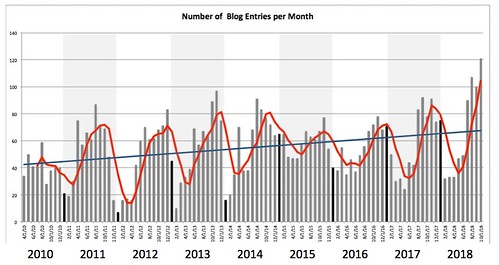
Apr-2010-Oct-2018

The length of a bar is proportional to the number of posts I made that month. Black bars indicate January.

A little calibration is in order. You’ll notice that prior to this year there wasn’t a single month with 100 posts; the highest was November 2013 with 97. Now, as of the end of October, we’ve got three months with 100 or more posts; what will November and December bring? But those months really aren’t directly comparable to the whole previous run. Why? Because it’s in those months that I began using Tweets as blog posts. I hadn’t done that before, but if I’d known that was possible, I’d have done it.

Why? Because it’s a low-energy way to make a post. And low energy’s is what’s going on in those slumps. Why the low energy? That’s what the rest of the post is about.

Finally, on December 18 of last year I posted, Reflections on entering my eighth decade and why it portends to be the most productive one of my life. When I posted that I can assure you that I was not anticipating the slump that slammed me in February and kept me down through June. Will that happen again? Who knows? But notice 2015; the slump wasn’t so bad. Who knows?

* * * * *

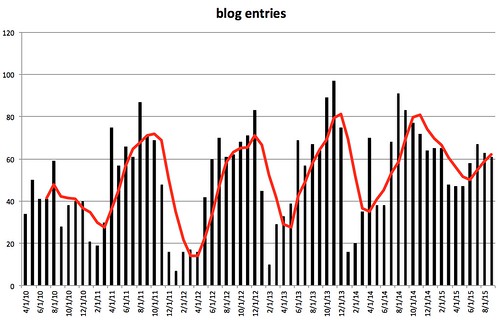
In October of 2015 I had a post at 3 Quarks Daily entitled, Have the Internets Rotted My Brain and Wrecked My Mind? I included the following figure:

WLB Blog entries

Each column represents on month’s worth of posts, starting with April 2010 and running through September 2015. Here’s what I said about it then:
It’s a very spiky pattern, with the dips happening in the winter months. Ever since I went away to college winter has been a down time for me. Am I afflicted with seasonal affective disorder? I don’t know.

Look at the recent end of that chart (to the right). There is a dip, but it’s not nearly so deep as in previous years, and the lowest three months aren’t in the winter, but in the spring and early summer. Wrong season. The pattern seems to be different.
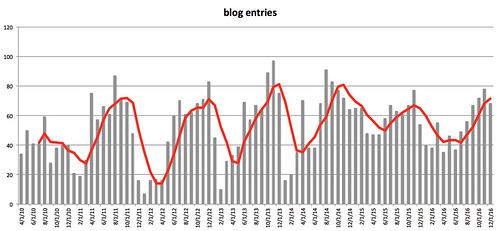
I’ve now updated the graph to the end of last year:

WLB blog entires thru 2016

The cyclicity continues, though, if you look closely, the troughs don’t line up particularly well with winter for 2015 and 2016. The 2015 trough is in spring while the 2016 trough is roughly the first half of the year.

What’s going on? Of course, I don’t really know, other than the obvious changes in blogging productivity. I do think my mood follows my productivity, or vice versa, and that’s what’s interesting. David Hays once conjectured that melancholy (aka depression) is the price you pay for large-scale reorganization or the sort implied by creativity. “Reorganization” is a term of art from William Powers’s account of the mind. It is so deeply embedded in that theory that there is, alas, no easy gloss.

Start out by thinking of learning. When you learn, your mind is also reorganizing on a large scale. Now think of mourning as well. When you mourn the loss of someone close you have to reorganize your mind for life without them. You don’t actually learn anything, but you have to figure out how to function in those situations where you would have go to that person. It’s unlearning.

In order to be creative you must first unlearn on a large scale. That is accompanied by melancholy. That, on this view, accounts for those troughs in my intellectual output, which is mostly though not entirely through New Savanna. That creates some “slack” in the system. Once enough unlearning has taken place I can then think new thoughts and my productivity goes up. When the slack has been used up, it’s time for more unlearning.

Do I believe this? How could I? I just made it up. And it’s rather vague, too vague to support strong belief. Still, I’m attracted to the idea that something like this is going on over the long haul.

Addendum, 1.2.17: Are we dealing with reorganization on a scale where we could talk of neural plasticity?