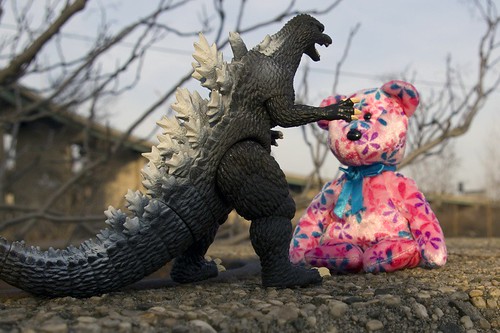
I need to say a bit more about Godzilla Minus One than I did in my earlier post, which is mostly about the film’s look and feel, its overall vibe.
One of the ideas in many of the reviews, including reviews on YouTube, is that unlike most Godzilla movies, this one is about the characters, rather than treating them as props and frames for rampaging kaiju. Godzilla Minus One centers on four characters: Kōichi Shikishima, a former kamakazi pilot, Noriko Ōishi, a girl he befriends who becomes his girlfriend during the course of the film, Kenji Noda, an engineer, and Sōsaku Tachibana, an airplane mechanic. As the film opens Shikishima has landed his plane on Odo Island, ostensibly for repairs. There’s nothing wrong. Later that day the island is attacked by Godzilla. Tachibana urges Shikishima to open fire from his plane. He chokes. Everyone on the island is killed except Tachibana and Shikishima.
Shikishima is overcome with shame for his actions. The film is about how he redeems himself. In the wreckage of post-war Tokyo he meets a young girl Noriko, who has been entrusted with an infant girl by a dying friend. He takes her in and the three come to function as a family. At the same time he takes a job on a mine sweeper, where he meets Noda. When Godzilla shows up in Tokyo harbor, the minesweeper is dispatched to deal with it, unsuccessfully.
Noda becomes involved in a civilian effort to destroy Godzilla. That the effort is civilian, and voluntary, is emphasized. Noda, in turn, recruits Shikishima to the project and he, in time, recruits Tachibana, who is angry with Shikishima because he failed to pull the trigger on Godzilla back on Odo Island. The mission is successful – it has to be, no? otherwise there’d be no film, but not before Godzilla levels a large swath of Tokyo.

Godzilla Minus One owes an obvious debt to the original Gojira (1954) in the way it depicts Godzilla’s destruction of Tokyo. There are a number of shots that are obvious references to the original, e.g. Godzilla with a train in its mouth, or TV reporters transmitting Godzilla’s actions from the top of a building as Godzilla approaches. Akira Ifukube’s Godzilla theme from the original Godzilla theme was used during the sequence in which Godzilla was finally destroyed, which, though quite different in substance from the original, had a similar ceremonial quality. At the end, the sailors involved in the action saluted the now-vanquished Godzilla. At this point the soundtrack has choral music, with a solo female voice, that is reminiscent of a segment in the original soundtrack.
At the end, though, there is an underwater shot that suggests that Godzilla may not have been killed.
Godzilla Minus One is the 37th film in the Godzilla franchise, which is, I believe the longest running franchise in film. I’ve seen, perhaps, a half dozen of them, maybe one or three more. The worst were really bad. Most that I’ve seen were run-of-the-pond kaiju films, or better. This is the best one I’ve seen since the original Gojira, from 1954, which was quite good, haunting. The special effects in the original were terrible, but the film itself rose well above that. The effects in Godzilla Minus One are very good, though not quite state of the art. But who cares?
Actually, that’s a serious question, and a tricky one at that. Opsis, spectacle, is one of the six categories Aristotle set forth for thinking about tragedy in his Poetics. If the original Godzilla film was excellent, despite having cheesy special effects, and having excellent effects is not sufficient to elevate the most recent films to the level of the original, then how important can opsis be? One obvious response is that there is more to spectacle than special effects.
There’s vibe as well. That’s where the original is so effective, in Godzilla Minus One as well the original Gojira. In fact, I’ll go so far as to say that this is the only Godzilla film I’ve seen that captures the vibe of the original, and that that’s an accomplishment of high artistry. Here I talk of vibe in the sense that Peli Grietzer develops, the total Gestalt, everything all included, plot, setting, action, acting, the whole shebang.
Here's an interesting video about visual effects in Godzilla Minus One:
From the YouTube page:
It only took 70 years, but Godzilla has finally gone home with the gold. Godzilla Minus One made history at the 96th Academy Awards, securing the Academy Award for Best Visual Effects, a first-time win for the Godzilla franchise. Given how important Godzilla has been to nearly a century of international film, it’s a long overdue accolade that couldn’t have gone to a more deserving entry. Minus One isn’t just a great movie, but a prime showcase of director Takashi Yamazaki’s strong artistic vision and proof that Godzilla’s ability to change with the times is unparalleled among film characters.
But there is another lesson that Hollywood should take away from Godzilla Minus One’s landmark achievement. How did a movie with a small VFX team of 35 artists and a frugal budget of $15 million show up the entire Hollywood blockbuster apparatus? Part of the answer lies in the film’s leaning into a distinctly 1990s way of depicting CG effects.
More so than resources or manpower, I would contend that the issue ultimately comes down to attitude, and how Hollywood has spent the past couple of decades denigrating the entire field of visual effects artistry. What was once a brand new field of exciting technology that was supposed to expand what was possible within the medium by a wide margin has instead spent much of the 21st century being treated like a laborious obligation that many filmmakers and audiences wish would go away.
Addendum: I discuss other aspects of the film in a new post: Godzilla Minus One [Media Notes 127 B] [has a heart ♥︎].
I’ve just watched Godzilla: King of the Monsters – in three sessions over two days (is there any movie capable of fully holding my attention for two hours given everything else I’m thinking about?). I’m talking about the 2019 sequel, if you can call it that, not the 1956 American re-edit of the 1954 Japanese Gojira. For my money it’s the best Godzilla film I’ve seen (and I’ve only seen a half-dozen or so) since the Japanese original. While it’s bulked up considerably, not only is Godzilla larger, but there are three or four monsters featured prominently, it manages to capture some of the spirituality of the Japanese original. I’m thinking particularly of the scene where the Serizawa travels to Godzilla’s underwater lair so he can energize it by exploding a small nuclear bomb, killing himself in the process. In the original, of course, Serizawa set out to kill Godzilla, and succeeded. But the 2019 film captures some of the ritual quality of that scene.
But that’s not what this note is about. While watching the film I was struck that THIS is SOMETHING I’ve been thinking about from time to time. I’ve probably made a post or two about that something, but I don’t know how to find those posts because I’ve never given it at name. I’m going to call it world-spanning thoughts. What do I mean? To the extent that we can perceive and conceive the world, not only do we seek to understand it, but to exert (some kind of) control over it, the WHOLE extent. In particular, I’m thinking about this in the context of the control theory of William Powers, though I’m going to have to leave that out of this little note.
If you are an animal, your ability to conceive of the world is quite limited, limited to what you have immediate access to, more or less. When a thunder storm blows, you deal with it. When it’s over, it’s gone from your mind. Not so with humans. We can remember, and brood, and worry. And not only about thunder storms, but about volcanoes, about lions and bears and snakes. What about the sun, the moon, the stars? What are they, how do they affect us, and how can we influence them? And so we invent magic, myth, and religion, and populate the world with strange and powerful creatures that we can appease through ritual.
All this is pretty much standard. You’ve read it many times before, and so have I. And yet, there’s more to be said about it. Just what, I’m not sure, and I am sure Powers would help, but not now.
What I’m after is how all this becomes REAL. If it’s not real, in some deep sense, it doesn’t work. Films like Godzilla: King of the Monsters, are one of the imaginative vehicles through which world-spanning thoughts engage with reality. On the one had we’ve got these huge ancient monsters, called Titans in the film: Rodan, King Ghidora, Mothra, and Godzilla (there are a bunch more, but they’re not depicted). We’ve got high-tech science, computers and submarines, and the whole damn thing hangs on a twelve-year-old girl. Above all else, she’s what brings human scale to the whole venture.
Fiction is full of such world-spanning thoughts, the function of which is to bring human scale the very large (but also the very small). James Bond films do it in a different way, conspiracies plus Bond himself. Super-hero films do it as well. But what of realistic films, what is their scope? But what is realism? Where do we situate 2001: A Space Odyssey?
More later.
Hmm...World spanning thoughts, or desires, goals, objectives?
BTW, lots of Gojira/Godzilla posts.
ALSO, check out this post from 2015, Our Rage for Order and Coherence.

Matthew Chernov ranks them in Variety. Chernov regards the first one, Gojira (1954), as the best. As I've not seen most of them, I can't really say it's the best. But it's the best one I've seen and I'd be very surprised if there are any better ones. Here's an essay I wrote about it; and here's a working paper that includes that essay and some other material, including a ring-form analysis.
So there are toys of Japanese monsters giving press conferences to apologize for destroying cities.
— Michael Warburton (@mikewarburton) March 20, 2021
And I want one. pic.twitter.com/He3kJoIkhZ
I’ve been laughing for 10 mins straight😭 pic.twitter.com/YWLypWrlLe— Naj📿 (@Zencsss) November 19, 2019
Haruo Nakajima and Momoko Kôchi on the set of Godzilla, 1954 pic.twitter.com/VNUWGNJgXi— 41 Strange (@41Strange) October 22, 2019


[Susan] Sontag argued that our taste for disaster films is constant and unchanging. On the contrary, we suggest that Godzilla is evolving in response to a spike in humanity’s collective anxiety. Whether reacting to geopolitical instability, a perceived threat from terrorists, or simply fear of “the other,” many democracies are electing nationalist leaders, strengthening borders, and bolstering their military presence around the world.
Personally, I think that another — simpler and less dramatic — hypothesis is more likely. More likely because it concerns not a particular film but a general pattern of the cultural evolution of art.
This hypothesis has to do with a common, though not very well studied, phenomenon of the intensification of artistic stimuli over time. Mnay artistic “devices” — techniques of manipulating pleasant emotions in the audience — tend to be used in more intense ways during their evolution. Godzilla is a device, similarly to King Kong or any other monster in the kaiju genre featuring giant monsters: somehow, the size on its own may be enough to evoke some pleasant fear in us.
Needless to say, it's epic!
Here's how it begins:
Godzilla's wrath, to Earth the direful springClick the link above to read the rest
Of woes unnumber'd, heavenly goddess, sing!
What grudge could fire the fierce atomic breath
That burnt so many citizens to death?
What move four mighty limbs to crush and tear
Whole city blocks and scatter them to air?
Vast anger that found voice and fuelled the roar
Of this whale-monkey-kind-of-ichthyosaur.
Declare, O Muse! what woke such monstrous foe
And summon'd him from ocean bed below;
What stirred him from millennial slumbers deep
To swap-out slaughter for abyssal sleep?
What made this slug-a-seabed rise as killer?
Good Gods, why did ye thus make ill Godzilla?
A blast from the past, from March 24, 2014. Should I add King Kong into the mix?This post is very tentative. I’m thinking out-loud, playing around.
The 1954 “Gojira” resonated so deeply with its audience because of the painfully fresh memories of entire Tokyo city blocks levelled by Allied firebombings less than a decade before. In the preview for “Godzilla Resurgence,” you can see how the directors are again mining the collective memories of Japanese viewers for dramatic effect. But their touchstones are no longer incendiary and nuclear bombs. Instead they are the 2011 earthquake and tsunami, which killed close to twenty thousand people and introduced Japan to a new form of nuclear horror caused by out-of-control civilian reactors. Indeed, the now fiery-complexioned Godzilla seems to be a walking nuclear power plant on the brink of melting down. For anyone who lived in Japan through the trying days of late March of 2011, the sight of blue-jumpsuited government spokesmen convening emergency press conferences is enough to send a chill down one’s spine. So is the shot in the trailer of a stunned man quietly regarding mountains of debris, something that could have been lifted straight out of television footage of the hardest-hit regions up north. Even the sight of the radioactive monster’s massive tail swishing over residential streets evokes memories of the fallout sent wafting over towns and cites in the course of Fukushima Daiichi’s meltdown.It’s an open question as to how foreign audiences will perceive the subtext of these scenes, or if they even really need to. Equally so for the shots of the Japanese military’s tanks, aircraft, cruisers, and howitzers engaging the giant monster, which at first glance might simply appear a homage to a classic movie trope. But “Godzilla Resurgence” appears at a time in Japanese history much changed from that of even its most recent predecessor. In the last twelve years, the Self-Defense Forces have gone from little more than an afterthought to folk heroes for their role in 2011 tsunami rescue efforts, and now to the center of a controversy as Prime Minister Shinzo Abe pushes through legislation to expand their role abroad. Traditionally, Japanese monster movies have used images of military hardware hurled indiscriminately against a much larger foe as a potent symbol of the nation’s own disastrous wartime experience. But the regional political situation for Japan is far more complicated now. The fight scenes hint at changing attitudes toward the military in Japan.