Showing posts with label Underwood&Sellers2015. Show all posts

Monday, July 16, 2018

Continuity and discontinuity in literary history, H vs. DH? (Literary Lab 4) – Tales from the Twitterverse [#DH]

If, a few years ago, you’d asked me whether or not a half dozen scholars could have an interesting and fruitful conversation 280 characters at a time, I’d have said “Are you freakin’ kidding me?”–or words to that effect. But it happens, not all the time, but often enough, and it even happened when we were restricted to 140 characters at a time. Such is life in the academic Twittersphere.

Ted Underwood kicked one off on Friday (the 13th, FWIW) and it continued on into Saturday. A half dozen or so joined in and who knows how many followed along–a dozen, 30, 50, more, who knows? I don’t know what Ted expected when he threw that first tweet into the maelstrom, nor does that much matter. What matters is what happened, and that was unplanned, spontaneous, even fun.

Of course, it requires interlocutors who understand the issues at hand well enough that they can speak in code. And they need to read one another charitably and in good faith. But, given those conditions, it is possible to do some good work.

But enough of this. Let’s get to it.

In the next section of this post I reproduce three tweets from that conversation and add some commentary. These set the stage for the next two sections, where I use the well-known Stanford Literary Lab Pamphlet 4 to interrogate the issues raised in the first section; this fleshes out an argument I tossed into the conversation in a five-tweet string.

Dropping science in the Twitterverse

Here’s the tweet that started things off:

So, yeah, it’s a bit aggressive: maybe the received wisdom ain’t necessarily so (as the song goes). And periodization is just dropped in there at the end, as a for-example. Of course, it’s an important case because literary studies is more or less organized according to periods: fields of study, journals, conferences, professional organizations, coursework, all organized by period. To be, period isn’t the only parameter of organization, we’ve also got author, genre, and a blither or theoretical proclivities, but it’s an important one.

And it’s one that Underwood has investigated. Here’s the abstract of an article he and Jordan Sellers recently published, The Longue Durée of Literary Prestige [1]:
A history of literary prestige needs to study both works that achieved distinction and the mass of volumes from which they were distinguished. To understand how those patterns of preference changed across a century, we gathered two samples of English-language poetry from the period 1820–1919: one drawn from volumes reviewed in prominent periodicals and one selected at random from a large digital library (in which the majority of authors are relatively obscure). The stylistic differences associated with literary prominence turn out to be quite stable: a statistical model trained to distinguish reviewed from random volumes in any quarter of this century can make predictions almost as accurate about the rest of the period. The “poetic revolutions” described by many histories are not visible in this model; instead, there is a steady tendency for new volumes of poetry to change by slightly exaggerating certain features that defined prestige in the recent past.
Those “poetic revolution” imply period boundaries, but those boundaries didn’t show up. To be sure, the model did show change, but it was gradual and seemed to have a historical direction–which is a whole different kettle of conceptual and perhaps even ideological fish.

I rather liked that work, and took a close look at it [2]. I particularly liked the apparent directionality it revealed, but let’s set that aside. As for the lack of period boundaries...well, I don’t think periodization is simply a matter of disciplinary hallucination. So I’m inclined to think that the method Underwood and Sellers used simply isn’t sensitive to such matters. But that’s not an argument; it’s merely a casual assertion. Underwood is right, there IS work to be done.

And that’s what caught people’s attention. Daniel Shore entered and exchanged tweets with Ted. Then I suggest color perception as an analogy:

In making that suggestion I had more in mind than the mere presence of categories over continuity. Color perception is tricky, and much studied. We know, and have know so for quite awhile, that there isn’t a simple and direct relationship between perceived color and wavelength of light. This is not the place for a primer in color vision (the Wikipedia article is a reasonable place to begin). But I can offer a few remarks.

Blue, for example, does not map directly to a fixed region in the electromagnetic spectrum, with violet and green in adjacent fixed regions. The color of a given region in the visual field is calculated over input from three kinds of retinal receptors (cones) having different sensitivities. Moreover the color of one region is “normalized” over adjacent regions. The upshot is that a red apple will appear to be red under a wide range of viewing conditions. Different illumination means different wavelengths incident on the apple. Hence light that the apple reflects to the eye varies in different situation. Because the brain normalizes, the apple’s color remains constant.

We’ll return to part of that story a bit later.

Let’s return to the twitter conversation with a pair of remarks by Ryan Heuser:

The conversation continued on. Others joined. It forked here and there. And somewhere in there I introduced a string of tweets about Lit Lab 4.
Thursday, June 25, 2015

On the Direction of 19th Century Poetic Style, Underwood and Sellers 2015

Another working paper (title above). Download at:

Abstract, contents, and introduction below:

Abstract: Underwood and Sellers have discovered that over the course of roughly a century (1820-1919) Anglo-American poetry has undergone a consistent change in style in a direction favored by editors and reviewers of elite journals. This directional shift aligns with the one Matthew Jockers found in Angophone novels during roughly the same period (from the beginning of the 19th century to its end). I argue that this change is characteristic of a cultural evolutionary process and sketch a way to simulate such a process as an interaction between a population of texts and a population of writers where texts and writers. I suggest that such directionality is a sign of autonomy in the aesthetic system, that it is not completely coupled to and subsumed by surrounding historical events.

C O N T E N T S

0. Introduction: Looking at Cultural Evolution whether You Like It or Not 2
1. Cosmic Background Radiation, an Aesthetic Realm, and the Direction of 19thC Poetic Diction 8
2. Beyond Whig History to Evolutionary Thinking 14
3. Could Heart of Darkness have been published in 1813? – a digression 19
4. Beyond narrative we have simulation 22

0. Introduction: Looking at Cultural Evolution whether You Like It or Not

I was of course thrilled to read How Quickly Do Literary Standards Change? (Underwood and Sellers 2015). Why? Because they provide preliminary evidence that 19th century Anglophone poetic culture has a direction. Just what that direction, and how to characterize it, that’s something else. But there does appear to be a direction. And just why is that exciting? Because Matthew Jockers made the same discovery about the 19th century Anglophone novel. To be sure, that’s not what he claimed – I’ve had to reinterpret his work (see my working paper, On the Direction of Cultural Evolution: Lessons from the 19th Century Anglophone Novel) – but that’s what he has in fact done.

So we’ve got two investigations making the same observation: there is a long-term direction 19th century literary culture. But not the same, as Jockers looked at novels and Underwood and Sellers looked at poetry. Moreover their observational methods are quite different. Jockers uncovered direction by looking for similarity between texts where similarity judgments are based on a variety of stylistic measures and on topic analysis. Underwood and Smalls bumped into directionality by looking for differences between the general run of literary texts and texts selected for review by elite publications. Jockers’ work, almost by design, uncovered continuity between successive cohorts of texts, but simply ignored elite culture. Underwood and Smalls had no explicit interest in local continuity but, by looking at elite choice, uncovered a possible factor in directional cultural change: the “pressure” of elite preference on the system as a whole.

Tuesday, June 16, 2015

Underwood and Sellers 2015: Beyond narrative we have simulation

It is one thing to use computers to crunch data. It’s something else to use computers to simulate a phenomenon. Simulation is common in many disciplines, including physics, sociology, biology, engineering, and computer graphics (CGI special effects generally involve simulation of the underlying physical phenomena). Could we simulate large-scale literary processes?

In principal, of course. Why not? In practice, not yet. To be sure, I’ve seen the possibility mentioned here and there, and I’ve seen an example or two. But it’s not something many are thinking about, much less doing.

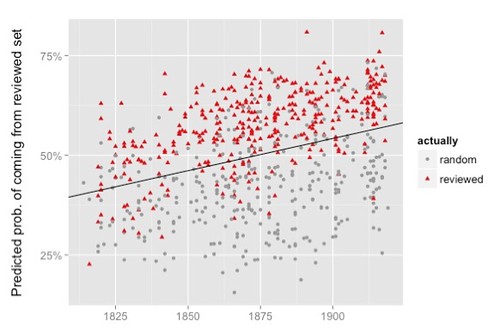
Nonetheless, as I was thinking about How Quickly Do Literary Standards Change? (Underwood and Sellers 2015) I found myself thinking about simulation. The object of such a simulation would be to demonstrate the principle result of that work, as illustrated in this figure:

19C Direction

Each dot, regardless of color or shape, represents the position of a volume of poetry in a one-dimensional abstraction over 3200 dimensional space – though that’s not how Underwood and Sellers explain it (for further remarks see “Drifting in Space” in my post, Underwood and Sellers 2015: Cosmic Background Radiation, an Aesthetic Realm, and the Direction of 19thC Poetic Diction). The trend line indicates that poetry is shifting in that space along a uniform direction over the course of the 19th century. Thus there seems to be a large-scale direction to that literary system. Could we create a simulation that achieves that result through ‘local’ means, without building a telos into the system?

The only way to find out would be to construct such a system. I’m not in a position to do that, but I can offer some remarks about how we might go about doing it.

* * * * *

I note that this post began as something I figured I could knock out in two or three afternoons. We’ve got a bunch of texts, a bunch of people, and the people choose to read texts, cycle after cycle after cycle. How complicated could it be to make a sketch of that? Pretty complicated.

What follows is no more than a sketch. There’s a bunch of places where I could say more and more places where things need to be said, but I don’t know how to say them. Still, if I can get this far in the course of a week or so, others can certainly take it further. It’s by no means a proof of concept, but it’s enough to convince me that at some time in the future we will be running simulations of large scale literary processes.

I don’t know whether or not I would create such a simulation given a budget and appropriate collaborators. But I’m inclined to think that, if not now, then within the next ten years we’re going to have to attempt something like this, if for no other reason than to see whether or not it can tell us anything at all. The fact is, at some point, simulation is the only way we’re going to get a feel for the dynamics of literary process.

* * * * *

It’s a long way through this post, almost 5000 words. I begin with a quick look at an overall approach to simulating a literary system. Then I add some details, starting with stand-ins (simulations of) texts and people. Next we have processes involving those objects. That’s the basic simulation, but it’s not the end of my post. I have some discussion of things we might do with this system followed with suggestions about extending it. I conclude with a short discussion of the E-word.

Wednesday, June 3, 2015

Where I’m at on cultural evolution, some quick remarks

I don’t know.

Some notes to myself.

1. Cultural Analogs to Genes and Phenotypes

I’ve spent a fair amount of time off and on over the last two decades hacking away at identifying cultural analogues to biological genes and phenotypes. In the past few years that effort has taken the form of an examination of Dan Dennett. I more or less like the current conceptual configuration, where I’ve got Cultural Beings as an analog to phenotypes and coordinators as analogs to genes. As far as I can tell – and I AM biased, of course, it’s the best such scheme going.

And it just lays there. So what? I don’t see that it allows me to explain anything that can’t otherwise be explained. Nor does it have obvious empirical consequences that one could test in obvious ways. It seems to me mostly a formal exercise at this point. In that it is not different from any version of memetics nor from Sperber’s cultural attractor theory. These are all formal exercises with little explanatory value that I can see.

That’s got to change. But how? I note that dealing with words as evolutionary objects seems somewhat different from treating literary works (or musical works and performances, works of visual art, etc.) as evolutionary objects.

Issues: Design, Human Communication

2. Cultural Direction

Perhaps the most interesting work I’ve done in the past year as been my work on Matt Jockers’ Macroanalysis and, just recently, on Underwood and Sellers’ paper on 19th century poetry. In the case of Jockers’ work on the novel, he’d done a study of influence which I’ve reconceptualized as a demonstration that the literary system as a direction. In the case of Underwood and Sellers, they’ve found themselves looking at directionality, but they hadn’t been looking for it. Their problem was to ward of the conceptual ‘threat’ of Whig historicism; they want to see if they can accept the directionality but not commit themselves to Whiggishness, and I’ve spent some time arguing that they need not worry.

What excites me is that two independent studies have come up with what looks like demonstrations of historical direction. I take this as an indication of the causal structure of the underlying historical process, which encompasses thousands upon thousands of people interaction with and through thousands of texts over the course of a century. What shows up in the texts can be thought of as a manifestation of Geist and so these studies are about the apparent direction of Geist.

Wednesday, May 27, 2015

Could Heart of Darkness have been published in 1813? – a digression from Underwood and Sellers 2015

Here I’m just thinking out loud. I want to play around a bit.
Conrad’s Heart of Darkness is well within the 1820-1919 time span covered by Underwood and Sellers in How Quickly Do Literary Standards Change?, while Austen’s Pride and Prejudice, published in 1813, is a bit before. And both are novels, while Underwood and Sellers wrote about poetry. But these are incidental matters. My purpose is to think about literary history and the direction of cultural change, which is front and center in their inquiry. But I want to think about that topic in a hypothetical mode that is quite different from their mode of inquiry.

So, how likely is it that a book like Heart of Darkness would have been published in the second decade of the 19th century, when Pride and Prejudice was published? A lot, obviously, hangs on that word “like”. For the purposes of this post likeness means similar in the sense that Matt Jockers defined in Chapter 9 of Macroanalysis. For all I know, such a book may well have been published; if so, I’d like to see it. But I’m going to proceed on the assumption that such a book doesn’t exist.

The question I’m asking is about whether or not the literary system operates in such a way that such a book is very unlikely to have been written. If that is so, then what happened that the literary system was able to produce such a book almost a century later?

What characteristics of Heart of Darkness would have made it unlikely/impossible to publish such a book in 1813? For one thing, it involved a steamship, and steamships didn’t exist at that time. This strikes me as a superficial matter given the existence of ships of all kinds and their extensive use for transport on rivers, canals, lakes, and oceans.

Another superficial impediment is the fact that Heart is set in the Belgian Congo, but the Congo hadn’t been colonized until the last quarter of the century. European colonialism was quite extensive by that time, and much of it was quite brutal. So far as I know, the British novel in the early 19th century did not concern itself with the brutality of colonialism. Why not? Correlatively, the British novel of the time was very much interested in courtship and marriage, topics not central to Heart, but not entirely absent either.

The world is a rich and complicated affair, bursting with stories of all kinds. But some kinds of stories are more salient in a given tradition than others. What determines the salience of a given story and what drives changes in salience over time? What had happened that colonial brutality had become highly salient at the turn of the 20th century?

Monday, May 25, 2015

Underwood and Sellers 2015: Beyond Whig History to Evolutionary Thinking

Evolutionary processes allow populations to survive and thrive in a world of contingencies

In the middle of their most interesting and challenging paper, How Quickly Do Literary Standards Change?, Underwood and Sellers have two paragraphs in which they raise the specter of Whig history and banish it. In the process they take some gratuitous swipes at Darwin and Lamarck and, by implication, at the idea that evolutionary thinking can be of benefit to literary history. I find these two paragraphs confused and confusing and so feel a need to comment on them.

Here’s what I’m doing: First, I present those two paragraphs in full, without interruption. That’s so you can get a sense of how their thought hangs togethe. Second, and the bulk of this post, I repeat those two paragraphs, in full, but this time with inserted commentary. Finally, I conclude with some remarks on evolutionary thinking in the study of culture.

Beware of Whig History

By this point in their text Underwood and Sellers have presented their evidence and their basic, albeit unexpected finding, that change in English-language poetry from 1820-1919 is continuous and in the direction of standards implicit in the choices made by 14 selective periodicals. They’ve even offered a generalization that they think may well extend beyond the period they’ve examined (p. 19): “Diachronic change across any given period tends to recapitulate the period’s synchronic axis of distinction.” While I may get around to discussing that hypothesis – which I like – in another post, we can set it aside for the moment.

I’m interested in two paragraphs they write in the course of showing how difficult it will be to tease a causal model out of their evidence. Those paragraphs are about Whig history. Here they are in full and without interruption (pp. 20-21):
Nor do we actually need a causal explanation of this phenomenon to see that it could have far-reaching consequences for literary history. The model we’ve presented here already suggests that some things we’ve tended to describe as rejections of tradition — modernist insistence on the concrete image, for instance — might better be explained as continuations of a long-term trend, guided by established standards. Of course, stable long-term trends also raise the specter of Whig history. If it’s true that diachronic trends parallel synchronic principles of judgment, then literary historians are confronted with material that has already, so to speak, made a teleological argument about itself. It could become tempting to draw Lamarckian inferences — as if Keats’s sensuous precision and disillusionment had been trying to become Swinburne all along.

We hope readers will remain wary of metaphors that present historically contingent standards as an impersonal process of adaptation. We don’t see any evidence yet for analogies to either Darwin or Lamarck, and we’ve insisted on the difficulty of tracing causality exactly to forestall those analogies. On the other hand, literary history is not a blank canvas that acquires historical self-consciousness only when retrospective observers touch a brush to it. It’s already full of historical observers. Writing and reviewing are evaluative activities already informed by ideas about “where we’ve been” and “where we ought to be headed.” If individual writers are already historical agents, then perhaps the system of interaction between writers, readers, and reviewers also tends to establish a resonance between (implicit, collective) evaluative opinions and directions of change. If that turns out to be true, we would still be free to reject a Whiggish interpretation, by refusing to endorse the standards that happen to have guided a trend. We may even be able to use predictive models to show how the actual path of literary history swerved away from a straight line. (It’s possible to extrapolate a model of nineteenth-century reception into the twentieth, for instance, and then describe how actual twentieth-century reception diverged from those predictions.) But we can’t strike a blow against Whig history simply by averting our eyes from continuity. The evidence we’re seeing here suggests that literary- historical trends do turn out to be relatively coherent over long timelines.
I agree with those last two sentences. It’s how Underwood and Sellers get there that has me a bit puzzled.

Friday, May 22, 2015

Underwood and Sellers 2015: Cosmic Background Radiation, an Aesthetic Realm, and the Direction of 19thC Poetic Diction

I’ve read and been thinking about Underwood and Sellers 2015, How Quickly Do Literary Standards Change?, both the blog post and the working paper. I’ve got a good many thoughts about their work and its relation to the superficially quite different work that Matt Jockers did on influence in chapter nine of Macroanalysis. I am, however, somewhat reluctant to embark on what might become another series of long-form posts, which I’m likely to need in order to sort out the intuitions and half-thoughts that are buzzing about in my mind.

What to do?

I figure that at the least I can just get it out there, quick and crude, without a lot of explanation. Think of it as a mark in the sand. More detailed explanations and explorations can come later.

19th Century Literary Culture has a Direction

My central thought is this: Both Jockers on influence and Underwood and Sellers on literary standards are looking at the same thing: long-term change in 19th Century literary culture has a direction – where that culture is understood to include readers, writers, reviewers, publishers and the interactions among them. Underwood and Sellers weren’t looking for such a direction, but have (perhaps somewhat reluctantly) come to realize that that’s what they’ve stumbled upon. Jockers seems a bit puzzled by the model of influence he built (pp. 167-168); but in any event, he doesn’t recognize it as a model of directional change. That interpretation of his model is my own.

When I say “direction” what do I mean?

That’s a very tricky question. In their full paper Underwood and Sellers devote two long paragraphs (pp. 20-21) to warding off the spectre of Whig history – the horror! the horror! In the Whiggish view, history has a direction, and that direction is a progression from primitive barbarism to the wonders of (current Western) civilization. When they talk of direction, THAT’s not what Underwood and Sellers mean.

But just what DO they mean? Here’s a figure from their work:

19C Direction

Notice that we’re depicting time along the X-axis (horizontal), from roughly 1820 at the left to 1920 on the right. Each dot in the graph, regardless of color (red, gray) or shape (triangle, circle), represents a volume of poetry and its position on the X-axis is volume’s publication date.

But what about the Y-axis (vertical)? That’s tricky, so let us set that aside for a moment. The thing to pay attention to is the overall relation of these volumes of poetry to that axis. Notice that as we move from left to right, the volumes seem to drift upward along the Y-axis, a drift that’s easily seen in the trend line. That upward drift is the direction that Underwood and Sellers are talking about. That upward drift was not at all what they were expecting.

Drifting in Space

But what does the upward drift represent? What’s it about? It represents movement in some space, and that space represents poetic diction or language. What we see along the Y-axis is a one-dimensional reduction or projection of a space that in fact has 3200 dimensions. Now, that’s not how Underwood and Sellers characterize the Y-axis. That’s my reinterpretation of that axis. I may or may not get around to writing a post in which I explain why that’s a reasonable interpretation.