Showing posts with label death. Show all posts

Thursday, June 12, 2025

Sexual activity is associated with a lower risk of mortality from all-cause and cancer.

Chao Cao, Lin Yang, Tianlin Xu, Patricia A. Cavazos-Rehg, Qinran Liu, Daragh McDermott, Nicola Veronese, Thomas Waldhoer, Petre Cristian Ilie, Shahrokh F. Shariat, Lee Smith, Trends in Sexual Activity and Associations with All-Cause and Cause-Specific Mortality Among US Adults, The Journal of Sexual Medicine, Volume 17, Issue 10, October 2020, Pages 1903–1913, https://doi.org/10.1016/j.jsxm.2020.05.028

Abstract

Background

Sexual activity can be referred to as a health behavior and may also act as an indicator of health status.

Aim

To evaluate temporal trends in sexual activity and to examine associations of sexual activity with all-cause and cause-specific mortality risk.

Methods

We examined the trends and prevalence of sexual activity and association of sexual activity with all-cause and cause-specific mortality in a nationally representative sample using data from the US National Health and Nutrition Examination Survey from 2005 to 2016 and the National Health and Nutrition Examination Survey 2005-2014 Linked Mortality File (through December 31, 2015).

Outcomes

All-cause, cardiovascular disease, and cancer mortality.

Results

A total of 15,269 US adults (mean age, 39.1 years [standard error, 0.18 years]) were included in the trend analysis. In the 2015-2016 cycle, while 71.7% (95% CI, 67.7–75.7%) US adults aged 20-59 years engaged in sexual activity ≥ 12 times/year (monthly), only 36.1% (95% CI, 31.6–40.7%) of them engaged in sexual activity ≥ 52 times/year (weekly). Since the 2005–2006 cycle, the estimated prevalence of sexual activity, ≥52 times/year and ≥12 times/year, were both stable over time among overall and each age group (all P for trend >0.1). During a median follow-up of 5.7 years (range, 1–11 years) and 71,960 person-years of observation, among 12,598 participants with eligible information on mortality status, 228 deaths occurred, including 29 associated with cardiovascular disease and 62 associated with cancer. Overall, participants with higher sexual activity frequency were at a lower risk of all-cause death in a dose-response manner (P for trend = 0.020) during the follow-up period. In addition, the multivariable-adjusted hazard ratios for all-cause mortality, CVD mortality, cancer mortality, and other cause mortality among participants who had sex ≥52 times/year compared with those having sex 0–1 time/year were 0.51 (95% CI, 0.34 to 0.76), 0.79 (95% CI, 0.19 to 3.21), 0.31 (95% CI, 0.11 to 0.84), and 0.52 (95% CI, 0.28 to 0.96), respectively.

Clinical Implications

Sexual activity appears to be a health indicator of all-cause and cancer mortality in US middle-aged adults.

Strengths & Limitations

Clear strengths of the present study include the large representative sample of the noninstitutionalized US population as well as the identification of precise estimates in relation to sexual activity and mortality. However, because of the observational nature of the study design, causality could not be determined.

Conclusions

Sexual activity was found to be associated with a lower risk of mortality from all cause and cancer.
Monday, May 26, 2025

Sarah Silverman: Postmortem [Media Notes 161]

Jason Zinoman, in the NYTimes (May 25, 2025):

“Death is really hard for me,” Sarah Silverman says with the kind of impeccably performed earnestness that makes you believe her banal statement for just long enough to be sideswiped by the punchline. “And that’s what makes me unique.” What actually makes Silverman different is that few others would handle the death of a father and stepmother in the same month by joking merrily about merch. “I really feel like my parents would want me to monetize this,” she says.

No amount of tragedy is going to turn Silverman into a maudlin solo artist. Her funniest jokes employ sarcasm, not sincerity.

That’s a reasonable characterization of the special. It’s worth watching. I enjoyed it. And of course I thought of the deaths of my own parents.

Very different. 

Silverman’s parents died nine days apart. My father died several years before my mother. He died of complications (sepsis) following surgery to remove his bladder (cancer). His surgeon thought he could save his life by removing his colon, but my father did not want the reduced quality of life. He’d signed a DNR (do not resuscitate), but my sister and I had to make the final authorization as my mother had Alzheimer’s. I’ve said more about his death in this post

That was 1998 when he was 86. My mother died in 2001 at the age of 85. 

Since she could no longer take care of herself after my father died, my sister and I had to make various arrangements for her. At first we arranged for a companion to stay with her in her home, where, my sister observed, she now slept on her husband’s side of the bed. But it was too exhausting for the companion – my sister and I were unable to make arrangements to relieve her often enough – and so we had to put her in some kind of home. My sister eventually found the Mary Drexel Home outside of Philadelphia, which was excellent.* One day she fell into a coma and didn’t wake up. My sister and I stayed with her until the end. Or at least, I assume, my sister did. I was tired and went down the hall to sleep, not very comfortably, on a small not-quite-sofa in a waiting room. 

* * * * *

*This post is about one Thanksgiving day at the Mary Drexel Home.

Monday, April 14, 2025

Why Daniel Kahneman chose to die on his own terms

Katarzyna de Lazari-Radek and Peter Singer, There’s a Lesson to Learn From Daniel Kahneman’s Death, NYTimes, April 14, 2025.

Daniel Kahneman was a world renowned psychologist and a Nobel Laureate in economics. He was old, 90 years, and in reasonable health. I did not have a debilitating or terminal illness. He was still capable of doing the intellectual work to which he had devoted his life. He died by assisted suicide on March 27 of this year. Lazari-Radek and Singer interviewed him on March 23.

About half-way through the article:

He surprised us by denying that his work had any objective significance. “Other people happen to respect it and say that this is for the benefit of humanity,” he said. “I just like to get up in the morning because I like the work.”

We pushed back, arguing that there are objectively good things to do with one’s life. But he resisted. “I feel I’ve lived my life well,” he said, “but it’s a feeling. I’m just reasonably happy with what I’ve done. I would say if there is an objective point of view, then I’m totally irrelevant to it. If you look at the universe and the complexity of the universe, what I do with my day cannot be relevant.”

We do not agree that the size and complexity of the universe render irrelevant an individual’s work for the benefit of humanity. But if, after careful reflection, you decide that your life is complete and remain firmly of that view for some time, you are the best judge of what is good for you. This is especially clear in the case of people who are at an age at which they cannot hope for improvement in their quality of life.

The final paragraph:

Professor Kahneman signaled concern that if he did not end his life when he was clearly mentally competent, he could lose control over the remainder of it and live and die with needless “miseries and indignities.” One lesson to learn from his death is that if we are to live well to the end, we need to be able to freely discuss when a life is complete, without shame or taboo. Such a discussion may help people to know what they really want. We may regret their decisions, but we should respect their choices and allow them to end their lives with dignity.

You might want to compare with a passage from Mary Douglas's Purity and Danger that I have quoted in this post: A spearmaster's way of death. Spearmasters are spiritual leaders among the Dinka of South Sudan. You might also read my account of my father's death. Here's the final paragraphs:

When, later that day, my sister, my mother, and I returned to the hospital, Dad was restless and tossed and turned quite a bit. Both my sister and I asked him whether or not he was uncomfortable and he indicated that he was not. One time when I asked him how he felt he just shrugged his shoulders and looked at me as if to say, "How should I know how I feel, I've never done this before." One thing he did, and it was quite striking, was to clasp his hands together and move them together over his right shoulder and then down to his waist. He seemed to be practicing his golf swing.

By this time the the morphine drip had began to relax him. Figuring we might have to be here all night, my sister, mother, and I went to the waiting room to rest. When we returned to his room, Gino, a nurse, was shaving him. Gino told us that he'd asked Dad if he wanted a shave and Dad indicated that he did. Dad had enough presence of mind to move his chin and cheeks to cooperate with the shave. Then he simply went to rest. About 10 minutes or so after that he'd died.

He went out swinging and smooth shaven.

Sunday, March 30, 2025

Talking with the virtual dead through AI

Cody Delistraty, We’re In a New Age of Techno-Spiritualism, NYTimes, March 30, 2025. Several paragraphs in:

A little over a century ago, Thomas Edison announced that he had been trying to invent an “apparatus” that would permit “personalities which have left this earth to communicate with us.” Known for his contributions to the telegraph, the incandescent lightbulb and the motion picture, Edison told The American Magazine that this device would function not by any “occult” or “weird means” but instead by “scientific methods.”

As science and technology have evolved, so too have the ways in which they attempt to transcend death. Where the 19th and early 20th centuries saw the rise of Spiritualism and pseudoscientific attempts at communing with the dead — through séances, ghost sightings and Edison’s theoretical “spirit phone” — with the invention of these A.I. avatars today, we’re now entering a new age of techno-spiritualism. [...]

A.I. used for psychological well-being is already relatively mainstream. These tend to come in the form of mental health chatbots or “companions,” [...] This latest wave of technology, however, has grief and loss specifically in its cross hairs.

Many of the companies producing A.I. avatars and chatbots have adopted the language of optimization, suggesting that their tools can help people “ease grief” or otherwise better process loss by providing a chance for postmortem conversations and closure.

There's a large potential for exploitation:

The potential risks of A.I. tools for grieving are significant, not least because the companies producing them are driven by profit — incentivized to exploit desires and delusions that may be unhealthy for their users. A recent study from the University of Cambridge, for instance, evaluated the ethics of “the digital afterlife industry” and posited that these businesses may soon realize there’s even more money to be made by requiring people to pay subscription fees or watch advertisements in order to continue interacting with their dead loved ones’ avatars, especially after hooking them on the ability to converse. [...]

Another possible dystopian scenario the Cambridge researchers imagined is a company failing (or refusing) to deactivate its “deadbots,” which could lead to survivors receiving “unsolicited notifications, reminders and updates” and instilling the feeling that they’re “being stalked by the dead.”

This mixing of reality, fantasy and enterprise is a detriment to grieving.

There's more at the link.

Monday, March 17, 2025

Connections between sexual activity, depression, and mortality

This video is based on information from the two studies below.

Chao Cao, Lin Yang, Tianlin Xu, Patricia A. Cavazos-Rehg, Qinran Liu, Daragh McDermott, Nicola Veronese, Thomas Waldhoer, Petre Cristian Ilie, Shahrokh F. Shariat, Lee Smith, Trends in Sexual Activity and Associations with All-Cause and Cause-Specific Mortality Among US Adults, The Journal of Sexual Medicine, Volume 17, Issue 10, October 2020, Pages 1903–1913, https://doi.org/10.1016/j.jsxm.2020.05.028

Abstract

Background: Sexual activity can be referred to as a health behavior and may also act as an indicator of health status.

Aim: To evaluate temporal trends in sexual activity and to examine associations of sexual activity with all-cause and cause-specific mortality risk.

Methods: We examined the trends and prevalence of sexual activity and association of sexual activity with all-cause and cause-specific mortality in a nationally representative sample using data from the US National Health and Nutrition Examination Survey from 2005 to 2016 and the National Health and Nutrition Examination Survey 2005-2014 Linked Mortality File (through December 31, 2015).

Outcomes: All-cause, cardiovascular disease, and cancer mortality.

Results: A total of 15,269 US adults (mean age, 39.1 years [standard error, 0.18 years]) were included in the trend analysis. In the 2015-2016 cycle, while 71.7% (95% CI, 67.7–75.7%) US adults aged 20-59 years engaged in sexual activity ≥ 12 times/year (monthly), only 36.1% (95% CI, 31.6–40.7%) of them engaged in sexual activity ≥ 52 times/year (weekly). Since the 2005–2006 cycle, the estimated prevalence of sexual activity, ≥52 times/year and ≥12 times/year, were both stable over time among overall and each age group (all P for trend >0.1). During a median follow-up of 5.7 years (range, 1–11 years) and 71,960 person-years of observation, among 12,598 participants with eligible information on mortality status, 228 deaths occurred, including 29 associated with cardiovascular disease and 62 associated with cancer. Overall, participants with higher sexual activity frequency were at a lower risk of all-cause death in a dose-response manner (P for trend = 0.020) during the follow-up period. In addition, the multivariable-adjusted hazard ratios for all-cause mortality, CVD mortality, cancer mortality, and other cause mortality among participants who had sex ≥52 times/year compared with those having sex 0–1 time/year were 0.51 (95% CI, 0.34 to 0.76), 0.79 (95% CI, 0.19 to 3.21), 0.31 (95% CI, 0.11 to 0.84), and 0.52 (95% CI, 0.28 to 0.96), respectively.

Clinical Implications: Sexual activity appears to be a health indicator of all-cause and cancer mortality in US middle-aged adults.

Strengths & Limitations: Clear strengths of the present study include the large representative sample of the noninstitutionalized US population as well as the identification of precise estimates in relation to sexual activity and mortality. However, because of the observational nature of the study design, causality could not be determined.

Conclusions: Sexual activity was found to be associated with a lower risk of mortality from all cause and cancer.
Banerjee S, Anderson P, Davis WS. Connection Between Depression, Sexual Frequency, and All-cause Mortality: Findings from a Nationally Representative Study. Journal of Psychosexual Health. 2024;6(1):35-44. doi:10.1177/26318318241256455

Abstract:

We used the 2005–2010 National Health and Nutrition Examination Survey (NHANES), constructed to evaluate health of adults in the United States using consolidated data from interviews and physical exams that were conducted to obtain data for this study. The analysis sample was representative of noninstitutionalized US adults aged 20–59 years. When considering sexual frequency, overall, only female participants with lower sexual frequency were at a higher risk of all-cause death in a dose-response manner with a hazard ratio (HR) of 1.70 (95% CI 1.38–2.10, p trend < .001) during the follow-up period. This relationship was not significant in males. However, when sexual frequency was categorized (<52 times/year vs. ≥52 times/year), the adjusted HR was elevated [2.97 (CI 1.20–7.32, p = .02)] among individuals who had depression and low sexual frequency, but it was close to 1.0 (1.75, CI 0.50–6.07, p = .36) among individuals who had depression and high sexual frequency after adjusting for medical (obesity) and demographic (age, gender, education, and ethnicity) risk factors, indicating a 197% increase in mortality among individuals with low sexual frequency and depression than depression alone. Sexual activity is important for overall cardiovascular health possibly due to reduction of heart rate variability and blood flow increase.

Monday, November 18, 2024

Bond, James Bond [Media Notes 142]

So far we’ve had 27 James Bond films, 25 by Eon Productions, and two others. I’ve seen many of them in theaters, perhaps even a majority, but certainly not all of them. Amazon has gathered the 25 Eon films together so we can conveniently binge them in chronological order or in whatever order we choose. In the past few weeks I’ve watched through them all, more or less in order.

When I started watching them I had no intention of publishing remarks about any of them, much less something about the lot of them. But then, as sometimes happens, I decided that perhaps I should write something. It happened like this:

I started watching from the beginning, with Dr. No (1962). This introduced much of the Bond nexus, such as the gun-barrel credit-opener, the women, the suits, the martini, the physical prowess, though not the gadget fetishism, which came two films later. It also introduced SPECTRE (Special Executive for Counter-intelligence, Terrorism, Revenge and Extortion) as a nebulous international criminal enterprise dedicated to enriching itself through elaborate schemes.

Then I watched the second one, From Russian with Love (1963). SPECTRE continues, and we get to see Robert Shaw as an athletic villain (13 years later he played Quint in Jaws). It became a smash success and was, and still is, regarded as one of the best Bond films. I read that judgment in the film’s Wikipedia entry, which I read after I saw the film (something I do regularly), and I concur. There’s minimal gadgetry and none of the big-tech nonsense which infested some of the Roger Moore films (I’m thinking of Moonraker in particular).

Next we have Goldfinger (1964). This may be the first Bond I saw in the theater, or was it From Russian with Love? I don’t recall, but whichever it was, the theater was packed. Auric Goldfinger, a dealer in gold bullion, is the villain. He’s a freelancer unaffiliated with any organization. This film introduced the first of the gadget tricked-out cars, the iconic Aston Martin DB5. Goldfinger also has an extensive pre-credit sequence which is unconnected with the rest of the film. That’s one of the features I had in mind when I started on this Bond orgy.

I was under the impression that that had become a feature of all the Bond films. Not quite. Most, perhaps all, later Bond films do have a long pre-credit sequence, but those sequences aren’t necessarily as disconnected from the plot as this one is. I suppose I should have been keeping notes on this, but I wasn’t, alas. In any event, this feature interests me because it’s characteristic of the Indiana Jones films and, in the case of The Temple of Doom, the precredit sequence is better than the film itself. The disconnected pre-credit sequence is also a feature of the delightful True Lies, which is somewhat of a parody of the spy-adventure film, perhaps even a comic critique of it.

That’s the first three Bond films, all with Sean Connery as Bond. He established Bond as a film character and was its best incarnation. If you’ve never seen any of the Bond films, watch these three, perhaps starting with From Russia with Love. After that I suggest you watch one of the Daniel Craig films (Skyfall, but I’m not sure it makes much difference), the most recent incarnation of Bond, and one of the Pierce Brosnan films (GoldenEye?), the penultimate Bond. After that, watch as you please. Roger Moore played Bond in seven films, more than any other. Some of the films were OK (perhaps Live and Let Die, with its Paul McCartney theme song), some were awful. He was the fourth Bond. Timothy Dalton played Bond in two films; he was the third Bond. George Lazenby was the second Bond, and had only one film.

It was a minor feature of that one film, On Her Majesty’s Secret Service (1969), that gave me the idea of writing something about Bond. The great Louis Armstrong shows up on the soundtrack singing a love ballad, “We Have All the Time in the World,” that was written for the film. It serves as the backdrop for Bond's courtship of the woman he rescues from suicide  (Diana Rigg) in the opening segment. The song also appears over the end credits of the most recent (and likely the last) Bond film (he dies at the end), No Time to Die. There’s more to the film than Satchmo on the soundtrack and recent opinion ranks it as one of the best Bond films. I concur.

That leaves me with a last set of remarks. Bond kills a lot of people in these films, and he does it well. Others kill people too and many of them are expert at it. That is, it’s not just the killing, it’s the expertise in the craft. Why? I don’t think it’s sufficient to point out that, after all, death is a signal feature of human existence, one that’s the source of a great deal of anxiety and grief. How do we get from that fact to the appearance of death in so many of our stories?

And Bond, he’s not only expert in killing. He’s also a womanizer. Is that combination a mere contingency or is it central to the franchise’s appeal?

Tuesday, July 2, 2024

Community in House, M.D. [Media Notes 135 B]

When I wrote yesterday’s post about House, M.D. I figured I might have more to say about it, but I didn’t have any explicit plans to do so. When I woke up this morning, I had an idea or two. These ideas center around community.

In this case we’re dealing with community on two levels. On the one level there’s the local community centered on our protagonist, Dr. Gregory House. This community includes his boss, Dr, Lisa Cuddy, his team of associates, Dr. Eric Foreman, Dr. Robert Chase, Dr. Allison Cameron, and his best friend, Dr. James Wilson. This local group then “shades out” through the hospital more generally. On another level there’s the community at large. This is where the patients come from. The hospital serves that community.

Illness and injury threaten that larger community. When a person is ill, they cannot participate fully in the community. When a person dies, the community is diminished. The hospital community exists to serve that larger community. The House-centered community operates within the hospital to serve that larger community.

The irony of the show is that at the center of this web of communal interactions we have an unpleasant misanthrope. House isn’t interested in the community. He’s interested in disease. What is the role of disease in the House community, if you will?

It structures their interactions, gives them purpose. In particular, differential diagnosis seems to be the central organizing activity in that local community. They meet, discuss and argue, and then go about their various tasks, usually assigned by House, who then may hang out in the office, while continuing to think, listen to music, watch TV, whatever. Those tasks will mostly take place elsewhere in hospital, though House’s associates will regularly venture outside the hospital to investigate patients’ homes and/or places of work.

The activity of differential diagnosis itself takes place through talk and writing on a white board. The talk is highly technical. I assume that it’s more or less technically correct, but I don’t know enough about medicine to judge that and I assume that’s true for most of the audience. What’s important is that we see the activity. We see investigation taking place. We experience diagnosis as a communal activity. How does this little community maintain itself in face of disease and under the pressure of the often at odds personalities of these doctors? That’s what we’re seeing. That’s what the show is about.

And then there’s serendipity. The process of differential diagnosis is driven by evidence, a patient’s symptoms and history, and by medical knowledge. And then there’s serendipity. Something accidental happens, someone notices something that might be totally unrelated to the case, but it sparks a train of thought the becomes relevant. Serendipity takes as to the edge of community, if not beyond it.

The upshot is that we see the social construction of truth, a construction that is tested in the process of treatment. The detective show does the same thing, but with a different set of procedures. We know that House was inspired in part by Conan Doyle’s Sherlock Holms and we know that the character of Holms was based, in part, on that of a surgeon, Joseph Bell. So we’ve got a century’s worth of narrative history trailing behind House, M.D., with each title having its particular mix of ingredients. It’s my impression that most of the titles don’t focus on the process of reasoning as closely as House, M.D. does. But this is not the place to even begin to sketch out the coordinates of that space.

* * * * *

Addendum 7.3.24: I should have at least mentioned that, more often than not, the differential diagnosis is a race against death. Generally House and his team win the race, but not always. So, that’s what’s at stake in the various discussions about House’s disregard for procedures and dogged pursuit of the diagnosis. This is a show that forces us to confront and think about death.

Sunday, January 14, 2024

The skilled and ruthless hit-man-for-hire is mostly myth

Jesse McKinley, Hit Men Are Easy to Find in the Movies. Real Life Is Another Story. NYTimes, Jan. 14. 2023.

Robert Baer, a former C.I.A. agent and the author of several books, including “The Perfect Kill: 21 Laws for Assassins,” says he has known many bad guys during his decades in law enforcement and espionage. But even he says finding a real-life killer would stump him.

“I could not find you a hit man,” he said. “And I know a lot of murderers.”

Dennis Kenney, a professor at John Jay College of Criminal Justice, concurred, calling the public perception of a slick, skilled hit man “pretty much myth,” adding that a for-hire killer is usually “nothing more than a thug who offers or agrees to a one-off payday.”

“Which is why they get caught,” Mr. Kenney said.

Only about half of all murders in the United States are cleared or solved each year, according to the F.B.I., making it difficult to say definitively how many people are killed specifically by hit men. While there are also no handy stats on how many murder-for-hire attempts fail, experts and indictments indicate that many are marred by amateurism and ineptitude.

Still, the non-hits just keep on coming.

“There isn’t a real efficient, high-quality hit service out there like in the movies,” said Michael C. Farkas, a defense attorney who has worked as a New York City homicide prosecutor.

Law enforcement officials and academics who study killers-for-hire put them into several large buckets. [...] There are also hit men for the mob, the enforcers working in-house to illegally police the criminal underworld. [...] Employed in a similar fashion are so-called sicarios, whose use by drug cartels has been heinously prolific at times. And of course there are also the professionals employed by government intelligence agencies, who have been suspected in assassinations in London and elsewhere.

If the hit man for hire is largely a myth, why is the myth so popular?

There's more at the link.

Monday, October 16, 2023

Childhood deaths are down

Saturday, March 18, 2023

Duck Soup and The Magnificent Seven [Media Notes 86]

Yes, I know, a strange juxtaposition. There’s a reason for it. Both films end in carnage, which is quite visible in one, but not the other.

Duck Soup is a 1933 film by the Marx Brothers. Groucho plays Rufus T. Firefly, leader of Freedonia, which is in conflict with its neighbor, Sylvania. After various high jinks, some funnier than others, war is declared and then enacted. Freedonia is in dire straits, but Freedonia somehow manages to win. We don’t actually see the carnage, but it is clearly implied by stock battle footage of various kinds. The film is short, 68 minutes.

As for The Magnificent Seven, I watched the 2016 remake (which I also saw in the theater, of the 1960 film directed by John Sturges, which is, in turn, based on the 1954 film, The Seven Samurai, by Akiro Kurosawa. A small town, Rose Creek, is taken over by Bartholomew Bogue, a wealthy goldminer. Some of the residents object to his actions and are murdered. Bogue leaves and the widow of one of the murdered men joins with a friend to find bounty hunters to help the town. They find Sam Chisolm (Denzel Washington) and he recruits six others.

They return to Rose Creek, train the townspeople how to shoot, and lay various traps for Bogue and his men. They arrive, there is a fierce battle in which many are killed, and the townspeople are victorious. All this takes 133 minutes.

As I say, these are very different films. Discussing them together because both end in carnage doesn’t seem like it makes much sense. Perhaps it doesn’t.

Yet, when you peel away the layers, each film tries to minimize violence between organized groups of people, the citizens of Freedonia and Sylvania in one film, the townspeople and Bogue and his men in the other film. National sovereignty seems at issue in one case while wealth and land are at issue in the other.

Duck Soup presents us with all sorts of mistakes and misunderstandings surrounding romantic competition between Firefly and Ambassador Trentino of Sylvania. They seek the hand of wealthy Mrs. Teasdale. That’s what the war is about. As the movie ends, Groucho and is comrades (played by his brothers, Chico, Harpo, and Zeppo) are pelting Trentino with fruit while Mrs. Teasdale sings the Freedonia national anthem.

The Magnificent Seven presents Bogue as an evil man. Near the end we learn that Chisolm has a personal grudge against him for murdering his family after the Civil War. At this point the control of the land and cheap labor has disappeared from view.

Thus, each in its own way, each film allows as to minimize group conflict and bracket death as the particularistic result of desires by specific individuals.

Saturday, February 25, 2023

Denying death the American way

Jeffrey Kluger, Why Americans Are Uniquely Afraid to Grow Old, Time, Feb. 23, 2023.

Why are Americans age averse?

But apart from fear of death—which, admittedly, is hard to get around—why exactly do Americans resist aging so much? It’s a privilege that is denied to too many, after all. And it comes with a raft of advantages like wisdom, respect, and for many, a comfortable retirement. So what is it exactly that makes us all so age-averse?

For one thing, argues Sheldon Solomon, professor of psychology at Skidmore College, and, at 69, a Baby Boomer himself, America’s senior cohort comes from a uniquely privileged background, one that has left them with the feeling that the frailties that come with aging—and even death itself—are not inevitable rites of human passage, but somehow negotiable.

But...

In the 1980s, Thomas Pyszczynski, 68, professor of psychology at the University of Colorado, Colorado Springs, was part of a group of researchers who developed the terror management theory of facing death which, as its name implies, addresses the way we somehow get through our days knowing that somewhere at the end of the existential line lies the utter annihilation of the self. That’s a knowledge that other animals are spared, but it’s one that both haunts and animates our thinking.

“We have this evolved imperative to stay alive,” says Pyszczynski. “So the awareness of death creates this potential for terror. As a result, we use the same intellectual abilities that make us aware of death to manage our fear of it.”

Humans do that in one of two ways. The first is to cultivate a belief in literal immortality. “We detoxify death with the hope of living in an afterlife—like reincarnation,” Pyszczynski says. “Every culture has its own version of afterlife beliefs.” The other, less direct means is symbolic immortality. “That’s what people get by being part of something greater than themselves—something that will last forever, like having children or creating works of art, or building buildings. We leave a mark that ensures the world—or at least our families—will remember us.”

Americans are no different from others in leaning both on faith in an afterlife and producing good works in this one as a palliative for our fear of our own mortality. But as Solomon says, our culture—and particularly the Boomer segment—is pushing back against those old ways too.

“I think we just never got out of the Disneyland idea that life was always going to get better,” he says.

There’s more at the link.

Saturday, July 31, 2021

What happens when you achieve a goal you’ve pursued for over 20 years? Crash, that’s what happens.

David Epstein talks with champion bobsledder, Steve Mesler.

Five or so years ago, Steve stayed with me while he was in town for work. I took him, and his gold medal, to meet the sports-crazy seven-year-old twin boys who lived next door. Everyone took a turn trying on the medal. When the boys’ father got his turn, he draped the saucer-sized medal over his neck, turned to Steve, and asked: “So, when you got this, was it just like, everything for the rest of your life is fine?” It was a compliment about Steve’s achievement, but also betrayed the gap between perception and reality when it comes to the lives of Olympians.

“If you would have asked me that question before I won gold,” Steve told me, “I would have said, ‘Yes, I’ll be good for the rest of my life.’ Bobsled was my identity, and that was everything that I wanted.” But over the next few years, Steve would struggle with building a new identity. He would also bury two teammates, both of whom struggled with mental health issues, and he would recognize and get help for his own depression.

Mesler talks of “Speedy” Peterson:

I remember watching Speedy win the Olympic medal that he’d strove for, and wanted for his whole career. He’d been through his ups and downs, and in February of 2010, he wins his silver medal. In July of 2011, he phones the police and lets them know where they can find his body. And he walks out into the woods in the mountains with a shotgun and…. So, you know, here’s Speedy in 2010, winning a medal, and a year later he’s dead. Speedy had that joyful side, and he also had a darker side. You know, our experiences were pretty similar in that we both reached our goals.

There’s sport and there’s the rest of your life:

I’m starting to talk to other athletes about, you know, some of the behaviors that you have are good for your sport, but not good for other parts of your life. And ultimately, I’m starting to recognize that it’s almost like you’ve got to go through the stages of grief, because you’re experiencing loss even when you win. Because I had this thing in my life, this pursuit of being the best in the world. I had these people in my life who are all going after the same thing, and then we accomplished it, which is fantastic. But nothing replaces that journey and camaraderie. That part of me is gone now. Whether it’s a win or a loss, the outcome is only a moment in time. February 27, 2010, that was the day I won a gold medal, but from June 1990 until February 2010 was the pursuit. And so you tell me which one you think is going to be easier to get over, the thing that happened in one day, whether you won or lost, or the thing that was 20 years?

H/t Tyler Cowen.

Sunday, June 21, 2020

William Benzon, 1912-1998: He Went Out Swinging and Smooth Shaven [born on Jan 31, 1912]

Father & co 400 dpi jpg copy

My father, William Benzon, was born on Jan. 31, 1912 in Baltimore, MD, and died November 21, 1998 in Allentown PA. His parents were Danish immigrants. For about the first six years of his life he lived with his parents and two older sisters, Karen and Signe, on Curtis Bay in Baltimore in a house which had formerly been a yacht club. The family then moved to Longwood St. He attended Boy's Latin School and, according to his high school year book, was regarded as an intellectual and as the 2nd brightest in his class. He was on the boxing, fencing, and football teams and his favorite expression was "Well blow me down."

He did two years at the University of Virginia, where he managed to run up gambling debts that his father had to satisfy. He completed his college education at Johns Hopkins, graduating in 1934 with a degree in chemical engineering. He then went to work for Bethlehem Steel (initially at Sparrows Point) where he spent his entire career. He entered their "loop" program which was for hotshot college graduates they wanted to nurture. I don't know what his initial duties were or how he ended up in the mining division of the company (Bethlehem Mines Corp.). He spent most of his career there and rose to Superintendent of Coal Preparation, a position that was created for him. He stayed in that post until his retirement in 1974. He continued to consult on coal preparation after retirement.

Early in his career he moved to Johnstown Pa. where Bethlehem Mines had its headquarters. There he met my mother, Elizabeth Tredennick, and married her in 1940. I was born in 1947 and my sister in 1951.

What was he like?

He was a brilliant man, attaining an international reputation in his field, coal preparation. He was also a loving father, expressing his love in various ways, including making some very fine things for me and my sister. He made furniture for my sister’s dolls, a high chair, and a very elegant play pen with the letters of the alphabet cut into the slats. He made me a gorgeous Indian headdress – feathers of various kinds, ermine tails, abalone shell ornament, a beaded head band – and various swords and knives etc. as appropriate for various Halloween costumes. He encouraged my sister and me in whatever we wanted to do. When I went off to Hopkins and grew long hair, a beard and mustache, that was OK. And so was going to graduate school in something as impractical as English literature. When, as an adult I needed to borrow money from him because I was out of work, he loaned me money (even after he had retired and was obviously living on a fixed income). He never ever suggested that I "face reality" and move into the corporate world, etc. He knew my intellectual work was important and helped me pursue that, as he has helped my sister pursue her interest in poetry.

He was an intellectual and books were important to him; he had many of them, including many he inherited from his father. I remember a number of Christmas seasons where he read Dickens' A Christmas Carol to the family after dinner on a number of evenings. And he certainly read stories to me before bed as a child – I remember him reading me from Mark Twain, Rafael Sabatini, and others. I was particularly struck by his ability to read dialog so naturally, with expression, like people would actually have said it. He spent a great deal of time helping me and my sister with our homework. He never just told me answers or worked problems. He always asked questions designed to lead me to the answers myself.

My father had an excellent sense of humor, which he slyly attributed to his Danish heritage. He loved Mark Twain, Charles Dickens, Lewis Carroll, and one Jerome K. Jerome, and the Marx Brothers. He was also quite fond for Victor Borge. For one thing, Borge was from Denmark, where his parents were born and raised. Borge's humor was often of a linguistic nature, and my father was interested in language (he owned books by Otto Jesperson, the Danish scholar of the English language, and H. L. Mencken). Borge was a musician and much of his humor involved committing mayhem on various pieces of classical and not-so-classical music.

An Athlete - Golf

He was a good and dedicated athlete. Beyond his high-school sports he was also an excellent swimmer and loved the sea. As an adult he was a cyclist (mostly in his youth, in Baltimore and in his early days in Johnstown) and, above all, golf. 

He took up the sport as an adult and pursued it passionately. During his prime – say from 30 though 55 – he had a single digit handicap, even as low as two or three. He kept systematic notes about his game throughout his entire golfing career. One winter he painted golf balls in red nail polish and golfed in the snow. He experimented with putters he either built himself or modified from putters he'd bought. He also had ideas about custom golf shoes which he half-way finished (my sister and I found the half-completed shoes in the basement).

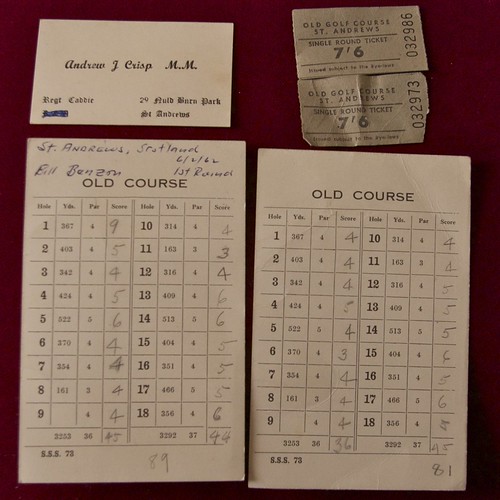
One of the highlights of his life was playing golf at St. Andrews in Scotland (he shot 81 on one round). He read a great deal about the sport, knew its history backwards and forwards, and had a good collection of golf books, including a classic written by a relative of Charles Darwin. It is absolutely clear to me that, as I use music to balance out my intellectuality, so my father used golf to achieve balance in his life.

IMGP5036
Caddie's card, tickets, and scorecards for two rounds at St. Andrews

Stamps

My father was an avid stamp collector, with particular interests in Canada, Liberia, Germany, and China. He loved the look of stamps, their design (line, color, shape, form, etc.), but also what they told about history and society. Stamps were his vehicle for encountering and organizing human history. Stamps commemorate individuals, events, ideas, and so forth, and thus tell the history of the nations that issue them. All of that was important to my father.

As was the craft of collecting itself. Used stamps are, of course, stuck on envelopes. They have to be separated from the envelope before they can be mounted in books. My father spent hours doing that. He had special chemicals, magnifying glasses, balances, tweezers, hinges etc. all relevant to the physical preparation of the stamps. He had books about stamps, and catalogues. He engaged in extensive correspondence with various stamp dealers, some he had come to know on an all but personal basis, even though he'd never met them. Over the years he'd developed relationships with them through the simple and cumulative acts of buying stamps.

Friday, April 24, 2020

Is terror management theory in trouble?

Sunday, March 15, 2020

Death, Terror Management, and Nationalism [#pandemic]

In Beethoven’s Anvil I cited Kierkegard, Ernst Becker and Franz Borkeneau in asserting (p. 90): “Our intelligence allows us to know that we will die, and the rituals though which we mark death are among the most important and intense we perform. I suggest that without such rituals, death threatens to become a psychological trap for the living. Periodic participation in ritual musicking reduces one’s sense of isolation and attaches one to the group, as Freeman has suggested, making one’s individual fate a matter of less concern.“

There is a body of theory more or less devoted to arguing that culture is primarily a device for dealing with our fear of death, Terror Management Theory. Here’s the opening of the Wikipedia entry:
In social psychology, terror management theory (TMT) proposes a basic psychological conflict that results from having a desire to live but realizing that death is inevitable. This conflict produces terror, and is believed to be unique to human beings. Moreover, the solution to the conflict is also generally unique to humans: culture. According to TMT, cultures are symbolic systems that act to provide life with meaning and value. Cultural values therefore serve to manage the terror of death by providing life with meaning.
At roughly the same time I came across an article with a very long title: Philip T. Hoffman, Why was it that Europeans conquered the rest of the world? The politics and economics of Europe’s comparative advantage in violence (PDF). The article argues that while it is not clear, in general, just when “Western Europe first forged ahead of other parts of the world,” it is clear that in one area, the ability to wage war, Europe had “an undeniable comparative advantage well before 1800...” While the whole argument is interesting, I’m interested in one sentence, from page 11: “In an era before nationalism motivated troops, armies had to be centralized, for if soldiers (many of whom were mercenaries) were scattered across a country, desertions would soar.”

There it is, our old friend death. Nationalism made a difference in how states could motivate their troops. Nationalism is one of those cultural inventions that distances us from death.

Monday, December 16, 2019

Was Elisabeth Kübler-Ross wrong about dying and bereavement?

Thursday, October 17, 2019

How do we define success for humans [and progress?]

Robert Pollack, evolutionary biologist at Columbia, at Edge: "Rethinking our Vision of Success".

From Darwin:
Inherited novelty may be a sufficient source of novelty over time, so that in enough time, new species emerge from old, and maybe we are all descended from the same living thing initially. And that's true. [...] Darwin gave 150 years ago a clear explanation for how the living world in nature is. His wonderful book On the Origin of Species has the metaphor of a tangled bank. When you look at the tangled bank of a river, you see plants and animals and bugs and worms, and they're all in dynamic tension with each other. That is the source of our notion of ecology.

I've lived as a biologist in the world of Darwin, trying to understand Darwinian pre-adaptive mutation in terms of cancer as distinct from normal cells. I fully think I understand it. Then, as I'm teaching my undergraduates, I discover that we as a single species are wholly out of that tangled bank. We are 100,000-fold in excess of our natural numbers, and we threaten the planet by our success. What I'm thinking about is, what is the language that says our problem is our success, not our failure? I am not one of the people who say, "Woe is us. We failed." My concern is how do I redefine success so that success is at equilibrium with the rest of the living world, and that we do not destroy the planet?
Are we a cancer on the face of the earth?
How do we understand that our 100,000-fold excess of numbers on this planet, plus what we do to feed ourselves, makes us a tumor on the body of the planet? I don't want the future that involves some end to us, which is a kind of surgery of the planet. That's not anybody's wish. How do we revert ourselves to normal while we can? How do we re-enter the world of natural selection, not by punishing each other, but by volunteering to take success as meaning success and survival of the future, not success in stuff now? How do we do that? We don't have a language for that.

We do have structures that value the future over current success. I'm at an institution that has one of those structures. Columbia University is one of the most well-endowed universities in the world. That endowment, which is permanent, according to the economic structure of the country, is stable, it produces wealth without taxation, and that wealth is, by government regulation, required to be spent in the public interest. My job is in the public interest, my teaching is in the public interest, my salary comes that way, my sabbatical, which allows me to find the time to talk to you now. The idea of an endowment is perhaps an expandable idea.
That question, of structures valuing the future over the present, is kinda' what's behind Tyler Cowen's Stubborn Attachments, which "makes the contemporary moral case for economic growth and delivers a great dose of inspiration and optimism about our future possibilities." I suspect that (growth) growth is not exactly what Pollack has in mind. He continues on the theme of endowment:
The more you have, the more you can set aside in a de facto endowment to stabilize the present so that the future doesn't collapse on us.

That's not a taxation. That's not a redistribution. It's a withholding. It's an agreement to do with less now for the sake of the future. I don't see economic structures that do that. I don't see politics that does that. But I see kids, like those in the street this week, knowing if we don't do something like that, they don't have a world.
Medicine:
Well, what is the medicine of a real whole life? What is the medicine of accepting mortality but still being alive? What is the social responsibility we have to each other as we help each other through that transition? Show me the taxation that's spent on that. Show me the infrastructure that goes to that. It's unspeakable, like we can't talk about it. But if we don't talk about it, either at the scale of individual mortality, or the scale of species mortality, or the scale of planetary mortality, we will have participated in the cooperation with nature to end ourselves.

* * * * *
How do we recover or perhaps invent species self-awareness? How do we invent the recognition of each of us as one of 7 billion people, not as one of 300 million Americans, not as one of ten people in our immediate family, not as you name how many different categories we are part of?
* * * * *

Let's repeat: What is the medicine of accepting mortality but still being alive? I'm reminded of a passage from Mary Douglas, Purity and Danger (1966, 178-179):
Another example of death being softened by welcome, if we can put it that way, is the ritual murder by which the Dinka put to death their aged spearmasters. This is the central rite in Dinka religion. All their other rites and bloodily expressive sacrifices pale in significance besides this one which is not a sacrifice. The spearmasters are a hereditary clan of priests. Their divinity, Flesh, is a symbol of life, light and truth. Spearmasters may be possessed by the divinity; the sacrifices they perform and blessings they give are more efficacious than other men’s. They mediate between their tribe and divinity. The doctrine underlying the ritual of their death is that the spearmaster’s life should not be allowed to escape with his last breath from his dying body. By keeping his life in his body his life is preserved; and the spirit of the spearmaster is thus transmitted to his successor for the good of the community. The community can live on as a rational order because of the unafraid self-sacrifice of its priest.

By reputation among foreign travellers this rite was a brutal suffocation of a helpless old man. An intimate study of Dinka religious ideas reveals the central theme to be the old man’s voluntary choosing of the time, manner and place of his death. The old man himself asks for the death to be prepared for him, he asks for it from his people and on their behalf. He is reverently carried to his grave, and lying in it says his last words to his grieving sons before his natural death is anticipated. By his free, deliberate decision he robs death of the uncertainty of its time and place of coming. His own willing death, ritually framed by the grave itself, is a communal victory for all his people (Lienhardt). By confronting death and grasping it firmly he has said something to his people about the nature of life. [...]

The old spearmaster giving the sign for his own slaying makes a stiffly ritual act. It has none of the exuberance of St. Francis of Assisi rolling naked in the filth and welcoming his Sister Death. But his act touches the same mystery. If anyone held the idea that death and suffering are not an integral part of nature, the delusion is corrected. If there was a temptation to treat ritual as a magic lamp to be rubbed for gaining unlimited riches and power, ritual shows its other side. If the hierarchy of values was crudely material, it is dramatically undermined by paradox and contradiction. In painting such dark themes, pollution symbols are as necessary as the use of black in any depiction whatsoever. Therefore we find corruption enshrined in sacred places and times.

Wednesday, June 5, 2019

Why do people die in novels?

Olivier Morin, Alberto Acerbi, Oleg Sobchuk, Why people die in novels: testing the ordeal simulation hypothesis, Palgrave Communications 5, Article number: 2 (2019)
Abstract

What is fiction about, and what is it good for? An influential family of theories sees fiction as rooted in adaptive simulation mechanisms. In this view, our propensity to create and enjoy narrative fictions was selected and maintained due to the training that we get from mentally simulating situations relevant to our survival and reproduction. We put forward and test a precise version of this claim, the “ordeal simulation hypothesis”. It states that fictional narrative primarily simulates “ordeals”: situations where a person’s reaction might dramatically improve or decrease her fitness, such as deadly aggressions, or decisions on long-term matrimonial commitments. Experience does not prepare us well for these rare, high-stakes occasions, in contrast with situations that are just as fitness-relevant but more frequent (e.g., exposure to pathogens). We study mortality in fictional and non-fictional texts as a partial test for this view. Based on an analysis of 744 extensive summaries of twentieth century American novels of various genres, we show that the odds of dying (in a given year) are vastly exaggerated in fiction compared to reality, but specifically more exaggerated for homicides as compared to suicides, accidents, war-related, or natural deaths. This evidence supports the ordeal simulation hypothesis but is also compatible with other accounts. For a more specific test, we look for indications that this focus on death, and in particular on death caused by an agent, is specific to narrative fiction as distinct from other verbal productions. In a comparison of 10,810 private letters and personal diary entries written by American women, with a set of 811 novels (also written by American women), we measure the occurrence of words related to natural death or agentive death. Private letters and diaries are as likely, or more likely, to use words relating to natural or agentive death. Novels written for an adult audience contain more words relating to natural deaths than do letters (though not diary entries), but this is not true for agentive death. Violent death, in spite of its clear appeal for fiction, does not necessarily provide a clear demarcation point between fictional and non-fictional content.
Comment: FWIW, or various reasons, color me skeptical. For one thing, the adaptive hypothesis implies that death shows up in fiction because it is something we all must confront, but that we can't prepare for by rehearsal. But is homicide more prevalent in 20th C. American novels because Americans want to prepare themselves for the threat of murder? Seems unlikely to me. I rather suspect that murder shows up because of the moral and psychological issues it raises about the murderer. Fans of The Sopranos, for example, weren't preparing for the possibility of being murdered by a mob boss. They're interested in how a mob boss thinks and feels about the murders he orders and the ones he commits.

Addendum: 9.20.19: Moreover I don't see how simply reading about this or that violent death at the hands of someone else can provide any simulation that would be of value in an actual physical confrontation. Fighters don't prepare for a match by reading about matches, or even watching film – though they may do some of that. Their primary preparation takes the form of sparing, actual physical practice. Reading about fights does nothing to train your physical actions and reactions.

Friday, March 8, 2019

Our Rage for Order and Coherence

A quickie, just to get it out there so I can see it (from January 2015).

IMGP0361rd.jpg

I have long believed that a need for order, coherence, patterns, is intrinsic to being human. I suppose I can date this belief to the mid-1970s when I read William Powers, Behavior: The Control of Perception (1973). Under the topic of reorganization (more conventionally, learning) Powers talked of intrinsic reference levels for the (proper) construction of control systems (which I’ve recently recounted in Cultural Beings, the Ontology of Culture, and a Return to Books and Blues). Hays and I included Powers’ notion in our paper, Principles and Structures of Natural Intelligence (1988), and I associated it with Csikszentmihalyi’s notion of flow in Culture as an Evolutionary Arena (1996).

That’s what’s behind ‘beauty’ or whatever it is that works of art are said to have, and for elegance in scientific theory and mathematical proof. And it is, I believe, behind cultural evolution. We must make order of the world; that is the ‘other side’ of anxiety.

But where’d it come from? In our paper on natural intelligence Hays and I associated the need for coherence with the process of reorganization (following Powers) and we linked that to the emergence of vertebrates. That makes it very old indeed. What seems to have happened with humankind is that this rage for order has been set free from merely biological imperatives, has been set from from the tyranny of the present, so that it now ranges over the whole of space and time.
IMGP0407rd.jpg

How’d that happen? And when? There is the emergence of human language. That sets cognition free of the present by allowing us to index the past, and thus recall it, and allows us to index the cognitive system itself, thus creating a need to order that index (ontology).

But there is also death (see Cultural Beings Evolving in the Mesh). It is one thing to mourn one’s fellows, as animals do. It is another think to know that you will, at some point, die. How is it that we came to know that? What are the cognitive presuppositions of such knowledge?

Explicit grave sites along with grave goods appear in the human record about 100,000 years ago. I take that as evidence that people have come to know that they will die. It may be the dead that are buried, but it is done for the benefit of the living. It is a way of keeping the living whole.

Somewhere in the nexus of language and death, that is where we’ll find our rage for order. That is what drives us.

Addendum: The order, to be meaningful, must be collective. Language can exist only in a group. Burial rites are meaningful only to a group. This sets up a peculiar dialectic in which “cultural beings” are utterly dependent on the people who participate in them even as the participants are dependent on those same cultural beings. It is through those cultural beings that the individuals experience the order and coherence that is so important to them.
 
And the sharing of experience is itself a source of pleasure. When experience alone grief, for example, is merely grief. Sharing it transforms it, not into pleasure in any direct sense of the world, but into something that is fulfilling. It’s the sharing that works the transformation. That’s why sad music can make us feel good; that’s why tragedy can be so powerful, so cathartic.

IMGP0367rd.jpg

* * * * *

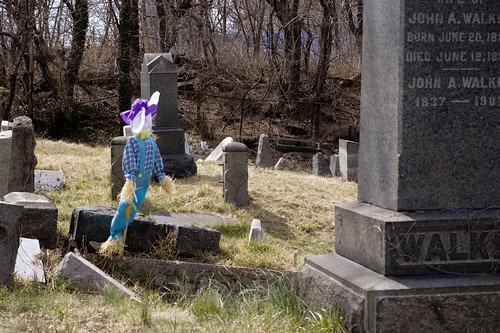
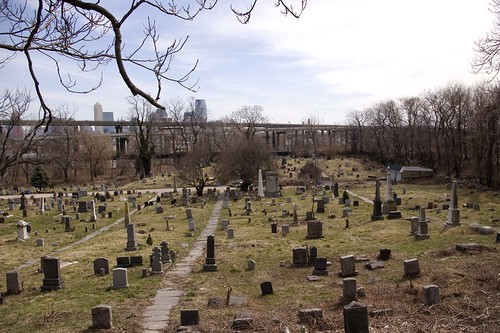
Photographs are of the Jersey City and Harsimus Cemetary and were taken in March 2009.

Thursday, February 21, 2019

First Man, a remark or two on how it achieves its effects


I saw First Man last fall when it came out. Last night I saw it again, on a large TV. I find it impressive, still. As I argued last year, the film reaches for a sense of the sacred. It’s not an action-adventure film, though there is adventure in it, and action too. It’s more contemplative.

How does it work? That’s what my few remarks are about.

The film opens on Neil Armstrong, the protagonist, in a test flight of an airplane. While we do have some shots of the plane from the outside and at a distance, most of the shots are of the planes cockpit, either from Armstrong’s point-of-view has he looks about the cockpit, often at his hands activating controls, or through the window at the sky. There’s trouble, the image vibrates, a reflection of the plane’s motions. We hear voices (I think). We know Armstrong’s going to pull out of it because, well, after all, he did go to the moon and that’s not yet happened. There’s a strong sense of being enclosed, being trapped, of being at the edge of desperation.

No sense of wide open spaces, no wild blue yonder.

And then it’s over. Armstrong lands the plane, gets out, and the film moves to a different register.

Now we see Armstrong and his wife dealing with Karen’s cancer (his young daughter) – I assume it was cancer, perhaps we’re told, but there’s radiation treatment. We see Neil playing with Karen; we see her playing. And then we hear the sound of a winching lowering a small casket into a grave; we see Armstrong, his wife, and so at the funeral.

And then it’s over. The film moves to a different register. We see Armstrong at work, in his office. His boss offers him time off, which he declines. He wants/needs to work. He scans his desktop, see a NASA newsletter with a story about the Gemini program. He decides to apply.

Was that decision a response to, a way of coping with, his daughter’s death? Who knows – and the scope of that question is strictly within the film itself and has nothing to do with the real Neil Armstrong, though, of course, this is a biopic about him. Armstrong doesn’t say that he’s applying to Gemini because his daughter has died. He says nothing at all about why he applied. He just does.

But the film creates a connection by virtue of its narrative strategy. First we see a dicey test flight. And then we cut to Karen’s illness. No causal connection is asserted or implied there, nor would I think that anyone infers cause. All we have is sequence, juxtaposition.

That’s all we have. Which is the point. Within the imaginative space that is First Man, that’s what we’ve got. Two things: a test flight, a death in the family. And then a third: Armstrong applies to Gemini.

Let’s skip over most of the film. What’s the last thing we see Armstrong do on the moon? He drops Karen’s identity bracelet into a crater. That action asserts a connection between his daughter’s death and his decision to enter the astronaut program. And that connection is how this film asserts the sacred quality of walking on the moon. The next shot has him safely back on earth. And then he’s in quarantine, where he meets his wife. They cannot touch, directly, but they touch the window separating them in the same spot. No talk.

And the film ends.

I skipped a lot, but I don’t intend to fill that in, not here, though I’m inclined to think that there is value in describing what happens all the way through, scene by scene, perhaps even shot by shot. But this is not the place to attempt that.

To a first approximation we see the juxtaposition of Armstrong’s professional life as an astronaut and his private life as husband and father, of (now) two sons. These narrative strands move in parallel.

And they collide just before Armstrong is to go to the moon. He’s packing his bags and hopes to slip out of the house without talking to his sons. His wife won’t allow this. She knows that he might not return, as does he, and wants him to acknowledge that to his sons. He talks with them and acknowledges that, yes, he might not return.

But he does return, after he’s left his daughter’s identity bracelet on the moon. Does he tell anyone about that? Who knows? But likely not.

And that’s how Chazelle, the director, creates a sense of the sacred – where I’m using Chazelle as a figure for the collective entity that created this film. Just why that creates the effect that it does, that’s worth thinking about. But not here, not now.

* * * * *

My other posts on First Man: