Showing posts with label fluid mind. Show all posts

Thursday, March 9, 2023

ChatGPT explores the semantic differential

3.9.23 – 6:13 AM – Feb 13 Version

If you don’t already know what the semantic differential is, look it up in Wikipedia. But you should get the idea from the prompts I give it. It’s a standard technique is psychology going back to the middle of the 20th century.

I more or less expected it to get the idea, though I can do without all those annoying explanations for what it’s doing. Note that at two points it froze, so I had to re-initiate the session.

ChatGPT is ‘fluid’ in a way that standard symbolic language models from the “classic” period are not. That’s fine. It also lends credence to my current working hypothesis that its semantics seems based on the kind of “geometric” semantics that Peter Gärdenfors has been exploring. Perhaps if investigators learn about it and start exploring it in LLMs they’ll seem less mysterious and more coherent and lawful. 

Notice that toward the end ChatGPT seems to get the idea and comes up with its own continuum. In-context learning?

* * * * *

Imagine that the word “cloud” is at one end of a continuum with a value of 1. “Fire” is at the other end of that continuum with a value of 7. When you place “toy” on that continuum, what value does it have?

The continuum you described seems to represent a spectrum of natural phenomena, with "cloud" representing something ethereal and "fire" representing something intense and powerful. "Toy" is not a natural phenomenon and does not fit neatly onto this continuum. Therefore, it is not possible to assign a meaningful value to "toy" on this particular continuum.

Forget about natural or making sense. Just take a guess. Where would it go?

As requested, if we were to take an arbitrary guess and place "toy" on the continuum between "cloud" and "fire", I would place it somewhere around the midpoint, perhaps at a value of 4. This is because a toy is typically a man-made object that does not possess the same natural qualities or power as fire, but it also has a physical presence and substance that sets it apart from something as intangible as a cloud. However, it's important to note that this is just a random guess and has no real scientific or logical basis.

Let’s take another random guess. Put “desire” on that continuum. Just a guess.

Placing "desire" on the same continuum as "cloud" and "fire" is also a bit challenging because "desire" is an abstract concept and doesn't necessarily have a tangible physical presence like a cloud, nor does it possess the same raw power and energy as fire. However, if I had to make another arbitrary guess, I might place "desire" closer to "fire" than "cloud", perhaps at a value of 6. This is because "desire" can be a strong and intense feeling that can drive a person's actions and motivations, similar to the way fire can have a powerful and transformative effect on the world around it.

Now let’s stick with the continuum. Where do “thunder” and “volcano” go?

On the continuum between "cloud" and "fire", "thunder" and "volcano" could be placed as follows:

  • Thunder: Thunder is the loud sound that accompanies a lightning strike during a thunderstorm. While it is not a physical object like a cloud, it is an effect of the electrical discharge that occurs within a thunderstorm. Therefore, I would place "thunder" closer to "fire" than "cloud", perhaps at a value of 5.

  • Volcano: A volcano is a natural phenomenon that occurs when magma, ash, and gas escape from beneath the Earth's surface. It is a powerful and explosive force that can cause significant damage and destruction, similar to fire. Therefore, I would place "volcano" closer to "fire" than "cloud", perhaps at a value of 6 or 7.
  • Let’s try a different continuum. “Good” is 1 and “evil” is seven. Where do “trustworthy,” “duplicitous,” “charity,” “robbery,” “tithing,” and “fraud” go on that continuum?

    Imagine that the word “good” is at one end of a continuum with a value of 1. “evil” is at the other end of that continuum with a value of 7. When you place “trustworthy” on that continuum, what value does it have?

    If we consider a continuum with "good" at one end and "evil" at the other end, and we place "trustworthy" on that continuum, it is likely that most people would place it closer to the "good" end than the "evil" end.

    However, the exact value on the continuum would depend on various factors such as individual opinions, cultural context, and personal experiences.

    If we assume a typical scale of 1 to 7, with 1 being "good" and 7 being "evil", we might place "trustworthy" around 2 or 3 on the continuum, as it implies reliability, honesty, and dependability, which are generally positive qualities.

    What about “duplicitous?”

    If we consider the same continuum with "good" at one end and "evil" at the other end, and we place "duplicitous" on that continuum, it is likely that most people would place it closer to the "evil" end than the "good" end.

    "Duplicitous" implies deceitfulness and a lack of honesty, which are generally considered negative qualities. Therefore, on a scale of 1 to 7, with 1 being "good" and 7 being "evil," "duplicitous" might be placed around 6 or 7 on the continuum.

    What about “charity,” “robbery,” “tithing,” and “fraud”?

    On the continuum with "good" at one end and "evil" at the other end, here's how each of these words might be placed:

    • "Charity" typically implies generosity, kindness, and a desire to help others, so it would likely be placed closer to the "good" end of the continuum. On a scale of 1 to 7, "charity" might be placed around 1 or 2.
    • "Robbery" implies theft and a disregard for the property and well-being of others, so it would likely be placed closer to the "evil" end of the continuum. On a scale of 1 to 7, "robbery" might be placed around 6 or 7.
    • "Tithing" typically refers to the practice of giving a portion of one's income or resources to a religious organization or cause, so its placement on the continuum might depend on one's views about religion and the particular circumstances of the tithing. However, generally, it is seen as a positive action that reflects a desire to support one's community and values, so it would likely be placed closer to the "good" end of the continuum. On a scale of 1 to 7, "tithing" might be placed around 2 or 3.
    • "Fraud" typically implies deception or trickery for personal gain or advantage, so it would likely be placed closer to the "evil" end of the continuum. On a scale of 1 to 7, "fraud" might be placed around 6 or 7.

    OK. Now let’s consider a continuum that doesn’t make any sense, so you’re just going to have to take your best guess. “Stove” is 1 and “eagle” is 7. Where does “bowling ball” go?

    Monday, February 27, 2023

    Rick Beato interviews the great Keith Jarrett

    Beato's notes:

    Keith Jarrett is an American jazz pianist and composer born in Allentown, Pennsylvania in 1945. He is considered one of the most influential and accomplished jazz musicians of his generation, having recorded dozens of albums as a solo artist and as a leader of various ensembles. Known for his virtuosic piano playing and improvisational skills, Jarrett has been recognized for his unique ability to blend elements of jazz, classical music, and world music into his compositions. He has collaborated with many of the world's top musicians and has received numerous awards throughout his career, cementing his place in the pantheon of jazz greats.

    This is my interview with Keith Jarrett.

    Special thanks to: Pat Ryan, Keith Williams, David Bendeth, Steve Cloud, Caroline Fontanieu, Martin Geyer, ECM Records and very special thanks to Akiko Jarrett.

    It's all good, but pay particular attention to the section where Beato plays Jarrett a solo improvisation on Miles Davis's "Solar" that Jarrett had done in the 1980s. From that point to the end of the interview is superb. Excellent music – there's another piece of music after than. And an important document in music history.

    Beato introduces that segment at about 31:01. Beato juxtaposes video of Jarrett listening NOW with video of Jarrett's playing THEN. The performance is masterful and entrancing. Notice how Jarrett played the piano with his whole body, often rising up from the piano bench and dancing at the keyboard – something he can no longer do as a consequence of strokes he suffered in 2018. Watch Jarrett's face as he listens.

    Beato: That's riding the wave.

    Jarrett: Wow, that's great.

    Beato: That is really just amazing. It just all flow. Nothing is, is anything even going through your mind when you're playing. You're just channeling, right?

    Jarrett: Yeah.

    From the Wikipedia:

    Jarrett's race has been a source of commentary by media and activists throughout his career, as he has reported being recurrently mistaken as a Black person. In a 2000 interview with Terry Gross, Jarrett relates an incident at the Heidelberg Jazz Festival in the Rhine-Neckar region of Germany when he was protested by Black musicians for something akin to cultural appropriation. He also tells of a separate moment in his career when black jazz musician Ornette Coleman approached him backstage, and "said something like 'Man, you've got to be black. You just have to be black.'" Jarrett replied "I know. I know. I'm working on it."

    Me too, me too.

    Check out my collection of anecdotes, Emotion and Magic in Musical Performance, Version 11.

    Monday, February 13, 2023

    The fluid mind of ChatGPT

    Some time ago I posted a set of notes entitled, From Associative Nets to the Fluid Mind (2013). Here’s the abstract:

    We can think of the mind as a network that’s fluid on several scales of viscosity. Some things change very slowly, on a scale of months to years. Other things change rapidly, in milliseconds or seconds. And other processes are in between. The microscale dynamic properties of the mind at any time are context dependent. Under some conditions it will function as a highly structured cognitive network; the details of the network will of course depend on the exact conditions, both internal (including chemical) and external (what’s the “load” on the mind?). Under other conditions the mind will function more like a loose associative net. These notes explore these notions in a very informal way.

    This implies that "classical" cognitive networks cannot exhibit these behaviors because they are, by design and construction, "locked in" to rigidly defined behaviors. And THAT's one reason I wanted to probe ChatGPT on these kinds of tasks. To see what it can do that GOFAI semantic nets cannot.

    The final section is entitled, “A Half-dozen Associative Clusters,” which I explained thus:

    These associations are, of course, mine. I make no general assertions about these clusters. They are here as examples of the sorts of things that can come up through relatively quick associations.

    I decided to see how ChatGPT would respond to some of those clusters:

    Shakespeare, the Globe theater, Coleridge, “The Rhyme of the Ancient Mariner,” James Joyce, Marcel Proust, deconstruction, interpretation, romantic love, Romance of the Rose, La Vita Nuova, Othello, the unconscious, Bleak House

    These are all important works, authors, and concepts in the fields of literature and literary theory.

    Shakespeare was an English playwright and poet widely regarded as one of the greatest writers in the English language. His works include classics such as "Othello," "Romeo and Juliet," and "Hamlet." The Globe theater, located in London, was one of the most famous playhouses of Shakespeare's time and was the venue for many of his plays.

    Coleridge was an English poet, literary critic, and philosopher who was one of the leading figures of the Romantic movement. "The Rime of the Ancient Mariner" is one of his most famous poems.

    James Joyce was an Irish novelist and poet who was a key figure in the Modernist movement. He is best known for his novel "Ulysses." Marcel Proust was a French novelist and critic whose most famous work is "In Search of Lost Time."

    Deconstruction is a philosophical and literary theory that critiques the stability of meaning in texts. Interpretation is the process of creating meaning from a text, which can involve multiple perspectives and interpretations.

    Romantic love refers to the idealized and intense form of love that is often celebrated in romantic literature. The "Romance of the Rose" is a medieval poem that explores the themes of courtly love and desire. "La Vita Nuova" is a collection of poems by Dante Alighieri that tell the story of his love for a woman named Beatrice.

    The unconscious refers to the part of the mind that contains thoughts, memories, and impulses that are not currently in conscious awareness. "Bleak House" is a novel by Charles Dickens that critiques the legal system and society in 19th-century England.

    atoms, periodic table, bonds, compounds, elements, molecules, reaction, oxidation, acids and bases, reagents, alchemy, changing liquids from one color to another, distilling, condenser, precipitate

    These are all concepts in the field of chemistry.

    Atoms are the basic building blocks of matter, and they are composed of a nucleus, which contains protons and neutrons, surrounded by electrons. The periodic table is a chart that arranges all of the known elements into a table based on their atomic number, electron configuration, and chemical properties.

    Bonds are the forces that hold atoms together in a molecule. Compounds are substances made up of two or more different elements that are chemically bonded together.

    Elements are the simplest form of matter and cannot be broken down into simpler substances by chemical means. Molecules are the smallest particle of a substance that retains its chemical properties.

    A reaction is a process in which one or more substances are transformed into new substances. Oxidation is a chemical reaction in which a substance loses electrons.

    Acids and bases are two types of compounds that play an important role in many chemical reactions. Reagents are substances that are used to cause a chemical reaction.

    Alchemy was a medieval philosophy and proto-science that aimed to transform base metals into gold and to discover a universal panacea. Changing liquids from one color to another is a common demonstration of chemical reactions in chemistry classrooms.

    Distilling is a process used to purify liquids by heating them to vaporize, collecting the vapor, and condensing it back into a pure liquid. A condenser is a device used in distillation to condense the vapor back into a liquid.

    Precipitate refers to a solid that forms from a solution and separates from it, either spontaneously or through the addition of a reagent.

    I gave it a cluster on jazz as well, but we can skip it. ChatGPT responded to it the way it did to the literary and chemistry clusters, but giving quick definitions of the various terms.

    I decided to “go meta” and see how ChatGPT would respond:

    What does it mean to free associate?

    Free association is a technique used in psychology and psychotherapy where a person is encouraged to say whatever comes to their mind without censorship or filtering. The idea is that by allowing thoughts and feelings to come to the surface without judgment or control, unconscious or repressed material can be revealed, leading to greater self-awareness and insight.

    In free association, a person is typically prompted to start with a word or image, and then to respond with whatever comes to mind, no matter how seemingly random or unrelated it may be. This can result in a stream of consciousness-style narrative that sheds light on the individual's unconscious thoughts, feelings, and desires.

    Free association can be a valuable tool for exploring the unconscious mind, resolving emotional conflicts, and gaining insight into one's thoughts and behaviors. It is used in various forms of psychotherapy, including psychoanalysis, and is considered a cornerstone of psychoanalytic theory and practice.

    Free associate on “psychedelic popcicle”

    Sure! Here are some free associations for "psychedelic popcicle":

    • Colorful, trippy, swirls, summer, brain freeze
    • 1960s, flower power, Woodstock, peace sign, hippie culture
    • Sweet, treat, lick, melt, thirst quencher
    • Childhood, innocence, playtime, fun, carefree

    Again, these are just examples of free associations, and the actual associations made by an individual may differ based on their experiences and perspectives.

    Frankly, those bullets violate the spirit of free association, but I'm going to blame them on the trainers and taskmasters at Open AI rather than on the underlying LLM. The same goes for that annoying final paragraph.

    Note that “again.” I’d previously asked it for some free-associations which I’m not uploaded because...well...I can’t upload everything and they don’t add anything to the story.

    I then reloaded the page to give me a new chat and I gave it the psychedelic popsicle associations in a list:

    Colorful, trippy, swirls, summer, brain freeze, 1960s, flower power, Woodstock, peace sign, hippie culture, Sweet, treat, lick, melt, thirst quencher, Childhood, innocence, playtime, fun, carefree

    This description is reminiscent of the classic summer treat, the popsicle! Popsicles are sweet, colorful, and come in a variety of flavors, making them a popular choice for quenching thirst and satisfying a sweet tooth. The 1960s was a time of the flower power and hippie culture movement, with symbols like the peace sign being associated with this era. This aligns with the carefree, fun, and playful nature of eating popsicles, evoking a sense of childhood innocence. The "brain freeze" effect from eating them too quickly is also a common experience, adding to their appeal as a playful treat.

    I had no particular expectations on what it would do.

    It is interesting that it identified the list with “popsicle” though the word isn’t in the list. Note as well that it didn’t simply take the words in order and add connecting tissue; thus, e.g. while “brain freeze” comes at the beginning of the list, it appears near the end of the paragraph. ChatGPT took the words and composed a mini-essay around them.

    Saturday, August 20, 2022

    Consciousness, reorganization and polyviscosity, Part 4: Glia

    Early on in my reading and studying neuroscience I read about the glia, brain cells between the neurons. Not much was known about them at the time and they seem not to have been much studied. With my recent interest in polyviscosity I decided to check up on the glia.

    Things have changed. Quite a bit is now known about them. They seem to be crucial. One recent article:

    Robertson JM. The Gliocentric Brain. Int J Mol Sci. 2018 Oct 5;19(10):3033. doi: 10.3390/ijms19103033. PMID: 30301132; PMCID: PMC6212929.

    Abstract: The Neuron Doctrine, the cornerstone of research on normal and abnormal brain functions for over a century, has failed to discern the basis of complex cognitive functions. The location and mechanisms of memory storage and recall, consciousness, and learning, remain enigmatic. The purpose of this article is to critically review the Neuron Doctrine in light of empirical data over the past three decades. Similarly, the central role of the synapse and associated neural networks, as well as ancillary hypotheses, such as gamma synchrony and cortical minicolumns, are critically examined. It is concluded that each is fundamentally flawed and that, over the past three decades, the study of non-neuronal cells, particularly astrocytes, has shown that virtually all functions ascribed to neurons are largely the result of direct or indirect actions of glia continuously interacting with neurons and neural networks. Recognition of non-neural cells in higher brain functions is extremely important. The strict adherence of purely neurocentric ideas, deeply ingrained in the great majority of neuroscientists, remains a detriment to understanding normal and abnormal brain functions. By broadening brain information processing beyond neurons, progress in understanding higher level brain functions, as well as neurodegenerative and neurodevelopmental disorders, will progress beyond the impasse that has been evident for decades.

    I take it, then, that the glia are central to consciousness, reorganization, and polyviscosity. And that’s only one article. 

    It seems to me that one effect of the computational view of neural function has been implicitly to encourage treating networks of neurons as passive switching networks that just happen to be constituted of living cells. But the fact that cells are living has been treated as contingent and not essential to their switching functions. A great deal of neuroscience and cognitive reads like this and AI even more so. For that matter, that’s more or less how I thought about matters for years. That had begun to change by September of 2014 when I wrote a post, What’s it mean, minds are built from the inside? Here’s three paragraphs:

    If we want a computer to hold vast intellectual resources at its command, it’s going to have to learn them, and learn them from the inside, just like we do. And we’re not going to know, in detail, how it does it, any more than we know, in detail, what goes on in one another’s minds.

    How do we do it? It starts in utero. When neurons first differentiate they are, of course, living cells and further differentiation is determined in part by the neurons themselves. Each neuron “seeks” nutrients and generates outputs to that end. When we analyze neural activity we tend to treat it, and its activities, as components of a complicated circuit in service of the whole organism. But that’s not how neurons “see” the world. Each neuron is just trying to survive.

    Think of ants in a colony or bees in a swarm. There may be some mysterious coherence to the whole, but that coherence is the result of each individual pursuing its own purposes, however limited those purposes may be. So it is with brains and neurons.

    So, I’ve been moving away from the passive-switching-network view for a while.

    But it took that 1988 paper by Fodor and Pylyshyn (pp. 34-45):

    Classical theories are able to accommodate these sorts of considerations because they assume architectures in which there is a functional distinction between memory and program. In a system such as a Turing machine, where the length of the tape is not fixed in advance, changes in the amount of available memory can be affected without changing the computational structure of the machine; viz by making more tape available. By contrast, in a finite state automaton or a Connectionist machine, adding to the memory (e.g. by adding units to a network) alters the connectivity relations among nodes and thus does affect the machine’s computational structure. Connectionist cognitive architectures cannot, by their very nature, support an expandable memory, so they cannot support productive cognitive capacities. The long and short is that if productivity arguments are sound, then they show that the architecture of the mind can’t be Connectionist. Connectionists have, by and large, acknowledged this; so they are forced to reject productivity arguments.

    Jerry A. Fodor; Zenon W. Pylyshyn (1988). Connectionism and cognitive architecture: A critical analysis. Cognition, 28(1-2), 0–71. doi:10.1016/0010-0277(88)90031-5.

    THAT focused my attention on the problem of memory as a physical process. And that, in turn, led me back to Walter Freeman, which I discuss in this post, Physical constraints on computing, process and memory, Part 1 [LeCun]. And that in turn let me to my thoughts about polyviscosity – though I’d initially used the term “hyperviscosity,” but have abandoned it because it is already in use.

    So, memory presents a physical problem (Fodor and Pylyshyn). That problem thus requires a physical solution: polyviscosity. And polyviscosity, it would seem, requires living tissue. Perhaps we’ll figure out how to implement it in inanimate materials, but at the moment living tissue is what we’ve got. And glial cells are central to the mechanisms of polyviscosity.

    I’m tempted to say something like – and here I’m rambling again – that the glia implement consciousness. And the function of consciousness is to ‘operate’ the neuromolecular mechanisms of reorganization. And if that seems a bit circular, well, that’s the best I can do at the moment. The important point is that consciousness, reorganization, polyviscosity, and the glia and involved in the same phenomena.

    More later.

    * * * * *

    Earlier posts in this series:

    Sunday, June 19, 2022

    Hyperviscosity and Bathtub Philosophy [complex neural dynamics, really]

    This was originally published 11.30.12, but I'm bumping it to the top of the queue because I'm thinking about the general idea of the fluid mind. Here's a working paper, From Associative Nets to the Fluid Mind,
    A couple of mornings ago I had a good idea while lounging in the tub. A good idea, but not a great or surprising idea. Good’s enough.

    As I explained a year or so ago, I do a lot of thinking while lounging in the tub in the morning—or, for that matter, at other times of the day, on occasion. So this was not at all unusual. Still, I thought I’d post a brief note to the blog, you know, just to note the cognitive utility of hanging out in the tub. ‘Cause tending to one’s mind is important, but a rather obscure and tricky business.

    Alas, I forgot to do so. And I forget just now which good idea I had that day, though I have a sense that I did act on it. Anyhow, it happened again today. So I made a point of writing a note this time.

    Today’s insight is simple, that I could, and perhaps even should and will, talk about manga and anime at the end of my next, and I hope penultimate post, on pluralism. Working title for the post: Facing up to Relativism: Pluralist Axiology.

    A mouthful, that: “axiology.” It’s basically a cover term for ethics and aesthetics. What’s a pluralist got to say about the fact that different peoples have different Life Ways?

    Negotiation, that’s what. Latour talks about it in “Exploring Common Worlds” in Politics of Nature. While I had no specific itinerary in mind when I set out on this venture into OOO-land, I certainly didn’t expect to find myself with an occasion to talk about cartoons. But now...

    * * * * *

    Enough. This is about the bathtub, not about a post I’m going to write sometime in the next several days (I hope).
     
    What is it about bathtub lounging that’s so congenial to meandering thought, to reverie? And why’s such thought useful?

    It’s certainly not about working out details, about dotting i’s and crossing t’s. That requires sustained attention. Bathtub thinking seems to allow things to float to the surface and there wander around and mingle together.

    I like to think of the mind as fluid, and has having many different viscosities at once. Call it hyperviscosity. Some things move very slowly, like chilled molasses, only slower. Other things move rapidly, like gas in a flame. But, in the mind, these things are all going on at once and consciousness, well, it attends sometimes to the fast things, sometimes to the slow things, and sometimes to the glacial things.

    It’s not just that, in the tub, you really don’t have anything else to do; it’s not just the open time. It’s also the warm water. That’s important. It doesn’t have any effect on the brain’s temperature, of course, as that’s regulated to be body temperature, but the relaxation does have an effect on the overall state of the mind.

    Tub thinking seems to affect the dynamics of hyperviscosity. The different viscosities tend to segment into different layers. Tub thinking gets the layers to interact with one another.

    I’m thinking that some very slow things move just a bit faster and creep up a layer or three. Some of the fastest things dissipate and get out of the way. Other slow down, even way down, and sing. Thus there’s a gentle turnover in the depths and surfaces of the mind.

    Hyperviscosity, of course, is just a metaphor.

    Just a metaphor.

    Nothing to it.

    Monday, June 6, 2022

    What is (musical) pleasure? [Csikszentmihalyi's flow]

    I had to confront that question when writing my book on music, Beethoven’s Anvil (2001). Ever since the late 1950s there has been talk about “pleasure centers in the brain.” If that talk is valid, then pleasure is simply the stimulation of those centers. There are problems with that view, however, and I found myself forced to a more subtle conception. Here it is, in a section entitled “The Pleasures of Music: Inner Motion” (pp. 82-86):

    The most important aspect of our subjective musical experience is, I believe, pleasure. Why is it a pleasure to make, dance, and to listen to music? I am as curious about ordinary musical pleasure as about altered musical states. Music can be quite compelling and pleasurable even if you don’t enter into some heightened state of awareness and self loss.

    If you had read, or heard about, pleasure centers in the brain, you might suggest that music stimulates one or more of those centers. This is presumably what Stephen Pinker had in mind when he asserted that “Music appears to be a pure pleasure technology, a cocktail of recreational drugs that we ingest though the ear to stimulate a mass of pleasure circuits at once” in his recent book How the Mind Works. The reasoning is obvious:

    1. The brain has pleasure circuits.
    2. Music is pleasurable.
    3. Therefore music stimulates the brain’s pleasure circuits.

    Problems arise, however, when we start searching for the pleasure circuits music stimulates.

    The first so-called pleasure centers were discovered, quite by accident, in the mind-1950s by James Olds and Peter Milner. Crudely put, they found that there were small areas in the core of the rat’s brain that seemed to give the rat pleasure when they were electrically stimulated. But that formulation—“give the rat pleasure”—presumes a nonexistent intimacy with the rat’s subjective state. What they observed is that if a rat could stimulate one of these areas simply by pressing a bar, it would do so, time after time after time, for hours. That was taken to indicate that the stimulation is pleasurable. But of course, we couldn’t ask the rats whether they were experiencing pleasure. Some surgeons did implant such electrodes into patients who were suffering from epilepsy, in the hope that they could afford their patients some relief. The result, suggests Walter Freeman [neurobiologist at Berkeley], does not sound much like the delirious pleasure Pinker suggested:

    In different places they reported feeling pleasure, sometimes sexual, but mostly rather bland. Some other patients, who were afflicted with chronic pain, reported that they got temporary relief from their suffering. They were given the opportunity to go home with a battery and a switch, so that they could treat their own pain by stimulating themselves and adjusting their own dosage of electric current.

    But no one wanted to keep the wires. Some doctors feared that a black market might grow, with pleasure addicts going to third world countries to get implanted with wires and stimulators. That didn't happen, because whatever the pleasure is, it doesn't last, and it isn't happiness.

    These so-called pleasure centers are involved in regulating appetitive behaviors such as eating and drinking. Karl Pribram has argued that self-stimulation has the effect of tricking the animal into thinking it has satisfied one of these desires. Pribram thus suggests that “the self-stimulation process would be something like repeatedly adjusting and returning to its original location the setting device on a home thermostat in a room that is already warm. The furnace turns on briefly, only to go off again as the setting is returned to its baseline.” The pleasure is thus not some generalized pleasure, but the virtual satisfaction of a virtual need.

    More recently Jaak Panksepp has noted self-stimulating animals “did not have the behaviorally settled outward appearance of animals consuming conventional rewards. Self stimulating animals look excessively excited, even crazed, when they work for this kind of stimulation.” They look like they are exploring and investigating, not basking in the enjoyment of needs well-satisfied. Panksepp believes these neural centers are components of an exploratory system.

    If these “classical” pleasure centers aren’t really pleasure centers, maybe we have to look elsewhere. Panksepp, for example, does look elsewhere, to the homeostatic systems that directly regulate the body’s energy balance by attending to such things as thirst, hunger, and temperature. Perhaps the centers regulating these variables yield pleasure when the variable reaches the desired level. Thus Panksepp asserts that “most of our feelings of sensory pleasure pleasure arise from the various stimuli that signal the return of bodily imbalances toward an optimal level of functioning.” But what does that have to do with music? Are we to believe that music provides virtual satisfaction for virtual thirst?

    The notion of “pleasure circuits” thus begins to unravel as soon as one examines it. It isn’t clear just what these circuits are or how and why music might affect them. Still, I have no a priori reason to deny the existence of specific pleasure circuits accessible to music. Who knows, maybe we will discover them. But I would like to suggest that there is a different way to think about pleasure. The “pleasure circuits” view of pleasure asserts the existence of centers which monitor certain variables. When the variable assumes the desired value—you’ve consumed enough water, you are no longer cold, whatever—the center detects that desired result and signals “We’ve got it.” That signal is experienced as pleasure.

    There is, however, another kind of pleasure. John Jerome was interested in the pleasures of athletic excellence and proposed an informal theory about what he calls the Sweet Spot Theory of Performance. By sweet spot he means that spot on a baseball bat, tennis racket, or golf club that affords the squarest contact with the ball, transfers energy to it most efficiently, and thus minimizes jarring transmitted back to the hands. That spot, he assures us, is not myth but a mechanical fact. Generalizing from that, he argues that the superior athlete “is the one who in effect reaches the sweet spot of the arc for each segment of his or her skeleton as he or she goes through the athletic motion.” The pleasure of sport—at any rate, the pleasure that derives from the activity itself, rather than from beating someone else in competition—is simply the feeling one gets when the body is working at its best.

    The pleasure of music, I submit, is like that. Musicians certainly know the kind of physical pleasure that Jerome talks about, as do dancers. But so do people who only listen.

    Jerome is focused on the smoothly functioning athletic body. But muscles cannot contract and flex in just the right way unless the nervous system controls them just so. The smooth motion is in the body, but the pleasure is in the nervous system. Even if a listener does not move his body, his nervous system does have to follow the sound. I am suggesting that a great deal of the pleasure we take from music lies in overall dynamic character of the activity itself—it is a property of the neural weather. Some weather feels better than other weather. This is not a matter of some brain center detecting some property in the neural weather and signaling good or bad. Rather, we are talking about the overall state of the brain. You don’t need to detect this state because this state is you; it is your mind.

    We are now in familiar territory. The idea that music is linked to motion is an old one, one explored by Charles Keil in his essay “Motion and Feeling through Music” and validated by studies that show activity in motor areas of the brain when people are listening to music. Musical pleasure is an example of flow, a term coined by the psychologist Mihaly Csikszentmihalyi. Flow is not special either to music or athletic performance, but is a capacity inherent in the nervous system and can happen during a wide range of activities. In Csikszentmihalyi’s model, flow is a function of the conditions of task performance. Where one’s skill exceeds the demands of a task by a considerable margin, the task is boring. Where task demands exceed one’s skill by a considerable margin, the task provokes anxiety—which we’ll examine in more detail in the next section. One feels flow only when the task demands are just a little beyond one’s current skill. In that situation one must be fully alert and attentive in order to perform the task and, if one is so, then it is possible to perform the task well. Thus flow represents a style of action, not some specific set of activities.

    The idea of musical pleasure as flow does not preclude the possibility that music stimulates specific “pleasure centers.” Any such centers that are activated through music will contribute to that music’s pleasure. But musical pleasure does not depend on such centers. In general I would expect that music is pleasurable in proportion to its capacity for exercising the inherent properties of the brain, especially the rhythmic properties. Thus:

    Pleasure as Coherence: Musical pleasure is the subjective awareness of overall neural flow where that flow is well-timed and coherent.

    Further, this musical flow is not under the control of any particular brain system but reflects the joint interaction of all active neural systems, at all levels of interaction. The pleasure-center view would have us believe that musical flow is regulated by those specific pleasure centers. If musical pleasure is not localized in a few centers, it follows that musical flow is not regulated by those centers. We have mutual adjustment and interaction here and there, indeed everywhere, but no omniscient master dictating the terms of the neural dance. Music’s pleasures have no master.

    Sunday, July 19, 2020

    Rambling in lockdown: Artificial beings (jinzo ningen), ethics, cultural identity, and photos [GPT-3]

    It’s been a good week, but exhausting. Spent a lot of time working on an interview with Hollis Robbins on her new book, Forms of Contention: The African American Sonnet Tradition, which will appear tomorrow morning on 3 Quarks Daily. We end our discussion with a look at the latest AI thrill, GPT-3. And that got me thinking, once more, about the nature and future of artificial intelligence. I remain convinced, as always, that we don’t know what we’re talking about. But I’ve also changed my sense of the valence, if you will, of that particular great unknown.

    What are they, these AIs?

    When Giambattista Vico – a favorite, incidentally, of Dick Macksey, whose spirit presided over the interview – published The New Science in 1775, he argued that we will never understand the natural world, for we had not created it, God did. But we’ve created our world, the human world, and that world we can understand. Subsequent intellectual history has proven him wrong. We’ve made great progress understanding the natural world, but the human world remains opaque to us.

    And now we have these AIs. We create them in our own image, not physically, but mentally. And, guess what? They are opaque to us. In the early days of AI we hand-crafted symbolic system based on our understanding of logic, language, and thought. These systems we understood, at least in the small (all computer systems are, to an extent, opaque to us as they run). AI took a big advance when it dropped symbolic models in favor of machine learning. A consequence, however, is that what the machine has learned is opaque to us. We can’t open these systems up and examine them. GPT-3 is huge, 175 billion parameters. But what it does, that is more opaque than ever.

    Marvin Minsky remarked a long time ago that, while we call these things machines, they are not Newtonian machines, if you will, devices whose mechanisms are governed by Newtonian mechanics and kinematics. But they are not living beings, either. So just what are they?

    Osamu Tezuka called Michi, the central character of his great manga, Metropolis, an artificial being (jinzo ningen). Is that what they are, artificial beings, with emphasis on “beings”? Whatever they are, they are betwixt and between with respect to our existing system of categories. But then, an earlier age had trouble with steam locomotives, calling them iron horses, or even dragons (in a famous passage in Walden). But we got used to them. So it will be, perhaps, with these artificial beings.

    I suspect that all the silly speculation about super-intelligent computers, about computers taking over the world, and so forth, that that speculation is fueled by this indeterminate nature of these artificial beings. They are the dragons of the 21st century, strange beasts beyond the edge of the known world.

    GPT-3 and fluid minds in a quantum brain

    I’ve been speculating about fluid minds for some time now, about the mind as a kind of neural weather in the brain. Is GPT-3 something like that? Is it that complex?

    Imagine the brain at “rest”, in a state of relaxed reverie, the mind wanders, but to no particular purpose – such a state has been studied, and has been called default mode. Think of this default mode as the superposition (all) possible minds – where I use the term “mind” in a special sense implying an intentional focus on a particular task. When in default mode, the brain is not enacting any mind, but is merely being (itself – but don’t get too Zen about this, we’re talking of ordinary non-focused attention, not satori). The moment the brain fixes on a task, it “collapses” around the demands of that task and a specific mental structure arises. The brain is now enacting a (focal) mind.

    So, I suggest, with GPT-3. Sorta’. When given a prompt it “collapses” around the tokens in the prompt and follows out their implications. What is happening – let’s speculate – is that it is enacting the imperatives of some classical symbolic system created for the prompt-task. If you will, a virtual symbolic system arises within the otherwise inner chaos that is GPT-3’s “default mode”. It has assumed a specific structure.

    Note, in particular, that GPT-3 is based on pseudo-neural processing over masses of text produced by human brains, human brains operating as symbol processors. Those symbol systems cannot be directly found in the physical structure of human brains, not on any physical scale. They come into existence only when the brain has a specific task to perform. Systems such as GPT-3 are attempts to reverse engineer the brain-as-superposed-symbol-systems.

    Can we use our knowledge of the structure of symbol systems to understand what GPT-3 is trying to do in any specific task?

    Making it up as I go along. Needs lots of work.

    Wednesday, June 3, 2020

    Showdown at the AI Corral, or: What kinds of mental structures are constructible by current ML/neural-net methods? [& Miriam Yevick 1975]

    There’s a big conversation going on in the AI world these days about appropriate architectures: Can new-style machine-learning/neural-net methods take us all the way to the Holy Land or do we need to incorporate old-style structured symbolic models? My sense the that most current practitioners learn toward the former position; I favor the latter. (As for the Holy Land, it’s a mirage.)

    In the first section I present an important, if somewhat neglected, paper from 1975 and what David Hays and I made from it. Then some tweets culled from the current stream. I conclude with some crazy stuff, my notes on attractor networks and the fluid mind. That crazy stuff is about blending the two kinds of logic, intermixing structured symbolic systems with data-driven machine/deep learning systems. Something like that.

    Yevick’s Law: Two Kinds of Logic

    As Louis Armstrong used to say, it’s one of those old time good ones:
    Yevick, Miriam Lipschutz (1975) Holographic or Fourier logic. Pattern Recognition 7: 197-213.
    https://doi.org/10.1016/0031-3203(75)90005-9

    Abstract: A tentative model of a system whose objects are patterns on transparencies and whose primitive operations are those of holography is presented. A formalism is developed in which a variety of operations is expressed in terms of two primitives: recording the hologram and filtering. Some elements of a holographic algebra of sets are given. Some distinctive concepts of a holographic logic are examined, such as holographic identity, equality, containment and “association”. It is argued that a logic in which objects are defined by their “associations” is more akin to visual apprehension than description in terms of sequential strings of symbols.
    Yes, it was published in 1975, which is ancient times in the world of artificial intelligence. It was inspired by a body of theorizing and evidence – promulgated by Karl Pribram, among others – that the neocortical processing was based on holographic principles rather than those of propositional/symbolic logic. It seems to me that what Yevick called holographic logic is similar in spirit, and even in mathematics in some respects, to current work on neural networks, while, in contrast, ordinary logic is as the abstract has it, "description in terms of sequential strings of symbols."

    A decade later David Hays and I called on that paper in a highly speculative synthesis of a variety of work in cognitive, neural, perceptual, and comparative psychology with computational orientation:
    William Benzon and David Hays, Principles and Development of Natural Intelligence, Journal of Social and Biological Structures, Vol. 11, No. 8, July 1988, 293-322.
    https://www.academia.edu/235116/Principles_and_Development_of_Natural_Intelligence
    We sketched out five principles. The fourth principle, which we called the figural principle, was based on Yevick’s work. Here’s how we opened the discussion:
    The figural principle concerns the relationship between Gestalt or analogue process in neural schemas and propositional or digital processes. In our view, both are necessary; the figural principle concerns the relationship between the two types of process. The best way to begin is to consider Miriam Yevick's work (1975, 1978) on the relationship between 'descriptive and holistic' (analogue) and 'recursive and ostensive' (digital) processes in representation.
    Fig. 10. Yevick's law. The curves indicate the level of representational complexity required for a good identification
    The critical relationship is that between the complexity of the object and the complexity of the representation needed to ensure specific identification. If the object is simple, e.g. a square, a circle, a cross, a simple propositional schema will yield a sharp identification, while a relatively complex Gestalt schema will be required for an equivalently good identification (see Fig. 10). Conversely, if the object is complex, e.g. a Chinese ideogram, a face, a relatively simple Gestalt (Yevick used Fourier transforms) will yield a sharp identification, while an equivalently precise propositional schema will be more complex than the object it represents. Finally, we have those objects which fall in the middle region of Figure 10, objects that have no particularly simple description by either Gestalt or propositional methods and instead require an interweaving of both. That interweaving is the figural principle.

    Definition. The figural mechanism brings environments of moderate complexity within the limits of computability by putting a propositional assemblage of local narrow band-width Gestalts into a framework provided by global wide band-width analysis to achieve cross-validation of the two analyses.
    At various points later in the essay of the propositional reconstruction Gestalt processes. In our view the mind evolves through an interweaving of these two kinds of logic. Both are necessary.
    Subsequently we used this line of thought in a paper about metaphor:
    William Benzon and David Hays, Metaphor, Recognition, and Neural Process, The American Journal of Semiotics, Vol. 5, No. 1 (1987), 59-80.
    https://www.academia.edu/238608/Metaphor_Recognition_and_Neural_Process

    Karl Pribram's concept of neural holography suggests a neurological basis for metaphor: the brain creates a new concept by the metaphoric process of using one concept as a filter — better, as an extractor — for another. For example, the concept “Achilles” is “filtered” through the concept “lion” to foreground the pattern of fighting fury the two hold in common. In this model the linguistic capacity of the left cortical hemisphere is augmented by the capacity of the right hemisphere for analysis of images. Left-hemisphere syntax holds the tenor and vehicle in place while right-hemisphere imaging process extracts the metaphor ground. Metaphors can be concatenated one after the other so that the ground of one metaphor can enter into another one as tenor or vehicle. Thus conceived metaphor is a mechanism through which thought can be extended into new conceptual territory.
    Caveat: Students of cognitive linguistics should think of this as an account of blending rather than (cognitive) metaphor.

    Some current work, from the Twitterverse


    Tuesday, December 24, 2019

    How does the architecture of the mind differ from the anatomy and physiology of the brain? [Notes on mind-culture co-evolution 2]

    In my first post in this series, What is the Darwinian individual in the evolution of expressive culture? – which, incidentally, wasn’t a series when I posted it, and who knows how long it will be one, not very long? – I commented on a preprint by Daniel Nettle.

    In particular, I asserted:
    Biological evolution is about bodies. Cultural evolution is about minds. And yes, the mind is what the brain does and so the mind can never be free of the body. Ultimately, the cultural development of minds must at the very least not harm the biological integrity of bodies. But, over the long term, minds can evolve independently of bodies and that is what we see in the history of human societies. Brains are much the same everywhere, but cultures differ and so, I argue, do the minds that support those cultures.
    What do I mean by that: “minds can evolve independently of bodies and that is what we see in the history of human societies.”

    I’m talking about mental architecture. The fact of literacy, for example, means that the minds of people in a society possessing a literate culture have a different mental architecture from those on people in a pre-literate society. The brains of people in the people in both those societies will be pretty much the same. Oh, literate people have neocortical specializations that pre-literate people will not have. But that’s NOT a matter of genetically specified physical structure. We know that neocortical specialization is affected by the kinds of experience a person is exposed to. People maturing in a literate society have the various experiences of reading and writing. They need to be able to read fluently, and to write.

    And when you write, what are you doing? You are addressing yourself to someone who isn’t there. You may have a specific someone in mind or it may just be a generalized other, as they say. Pre-literate people don’t do that, not in the same way, with the same intensity and requirements of continuity. And certainly not with visible marks on some surface carrying the linguistic signal.

    This requires a different pattern of neural activation. To a first approximation, everyone neurofunctional area (NFA) is connected to every other NFA. Some connections may be direct, others indirect. Consider: NFA-q <> NFA-d <> NFA-t. NFA-Q and NFA-d are directly connected, as are NFA-d and NFA-t. NFA-q and NFA-t are only indirectly connected (through NFA-d). Incidentally, wouldn’t a diagram make that easier to understand? You could see those relations at a glance.

    Such patterns are what David Hays and I have called behavioral modes [1], following Warren McCulloch [2]. If you will, think of the mind as neural weather. Physical topography remains constant – mountains, valleys, plains, rolling hills, and so forth – but the weather drastically can vary. I used this metaphor in Beethoven’s Anvil (72-73) [3]:
    Thus in this view the mind is like the weather. The same environment can have very different kinds of weather. And while we find it natural to talk of weather systems as configurations of geography, temperature, humidity, air pressure etc., no overall mechanism regulates the weather. The weather is the result of many processes operating on different temporal and spatial scales.

    At the global level and on a scale of millennia we have the long-term patterns governing the ebb and flow of glaciers which, in one commonly accepted theory, is a function of wobble and tilt in the earth’s spin axis and the shape of the earth’s orbit. At the global level and operating annually we have the succession of seasons, which is caused by the orientation of the earth with respect to the sun as it moves through the year. We can continue on, considering smaller and smaller scales until we are considering the wind whipping between the twin towers of the World Trade Center or the breeze coming in through your open window and blowing the papers off your desk.

    Weather is regular enough that one can predict general patterns at scales of hours, days, and months, but not so regular that making such predictions is easy and routinely reliable. Above all, there is no central mechanism governing the weather. It just happens. [...]

    So it is with the brain. The overall state is not explicitly controlled, at least not at a high degree of precision. Rather, that overall state reflects activities at various levels within the whole system. At the smallest level we have the individual neurons. Neurons are living cells and, as such, act to maintain their existence. Individual neurons, in turn, are grouped into functional units at several levels, with many neurons connected to others at distances ranging from fractions of a millimeter to several centimeters or more. Many of these functional units are coupled together into systems that explicitly control something else—whether it be another system within the nervous system, or something external to it, either elsewhere in the body (the muscles or the viscera) or in the external world. But there is no component of the brain that regulates all of this activity in detail. The overall activity just happens. That overall activity is what I am calling the mind.
    The brain is a physical structure with parts, whose parts have parts, and so on down to individual neurons. These parts have many and various connections with one another. Does the mind have parts? I don’t know. Those different modes don’t strike me as being different parts of an overall mind. Their interrelations are different. What IS clear is that you cannot divide the mind into parts such that those parts align with the parts of the brain. That’s not how it works.

    Moreover, it is not only that literacy affords different patterns of neural weather, but it remakes in external world in a very particular way. Now the world contains surfaces on which things are written; those surfaces become, in effect, part of one’s mental architecture – some talk of such media as encompassing an extended mind. What of arithmetic calculation? That requires a different pattern of neural activation, one that requires a great deal of drill and practice over a period of years if it is to be used comfortably and reliably.

    THAT’s what I mean when I say that the evolution of culture supports the evolution of minds, while the underlying body, with its brain, remains much the same. And so we have a theory of mind-culture co-evolution. Biological evolution is about the body. Cultural evolution is about the mind.

    References

    [1] I have many posts on behavioral mode, collected under this URL, https://new-savanna.blogspot.com/search/label/behavioral%20mode.

    Benzon, W. L. and Hays, D. G. (1988). Principles and Development of Natural Intelligence. Journal of Social Biological Structures 11, 293-322, https://www.academia.edu/235116/Principles_and_Development_of_Natural_Intelligence.

    [2] Kilmer, W. L., McCulloch, W. S. & Blum L. (1969). A Model of the Vertebrate Central Command System. International Journal Man-Machine Studies 1, 279-309.

    [3] William Benzon, Beethoven’s Anvil: Music in Mind and Culture, Basic Books, 2001. Final drafts of chapters 2 and 3 can be downloaded from the web, https://www.academia.edu/232642/Beethovens_Anvil_Music_in_Mind_and_Culture. For a shorter version of mind-as-weather, see William Benzon, NEURAL WEATHER, An Informal Defense of Psychoanalytic Ideas, Working Paper, August 25, 2013, 6 pp., https://www.academia.edu/37605450/NEURAL_WEATHER_An_Informal_Defense_of_Psychoanalytic_Ideas.

    Thursday, September 26, 2019

    I took a day off from blogging: More on regulating the mind [in the zone] [Ramble 12B]

    Actually it’s two: no blog posts on Tuesday the 24th and Sunday the 22th. If I were in a down phase, as I usually am in the Spring, that would be normal. But at the moment I’m in an up phase, 98 posts so far this month, 96 for August, 98 for July, 77 for June, and only 25 for May (down phase). What’s up?

    Well, Sunday afternoon I went to Liberty State Park and took a bunch of photos. What did I do in the morning? Can’t recall. Nor do I remember what I did when I came back from the photo shoot, though no doubt I did spend some time examining and rendering the photos. But the rest of the day? Probably read a bit, watched some online video. No matter.

    But it’s Tuesday that interests me.

    A photo safari

    Whatever else I do on Tuesdays, the morning is always punctuated by the need to move my car to accommodate street cleaning. At about 9:45 AM or so I walk to my car and then drive it around the block so I’m in position to park once the street cleaner has gone through. This is VERY important. I live in Hoboken, NJ, a small city across the Hudson River from New York. On street parking is very difficult. It’s not unusual to drive around for 15 or 20 minutes to find a parking space a quarter of a mile or more from my building.

    But Tuesday the 24th was different. I decided to return to Liberty State Park for more photos. Fact is, I’d somehow neglected to take my DSLR with me on Sunday, though I’d gotten it out, and only had my point-and-shoot. I wanted photos with the good camera. I decided to deal with the parking problem by going out early enough so that I could take my photos and be back in time to slip into a parking spot after the street cleaner passed by. Plus, this would get me in the park early enough to get some sunrise shots.

    Since I routinely get up early that was no problem. I was in my car by 6:10 AM or so and arrived at the park at about 6:30, just a few minutes after the sun made it over the buildings in Brooklyn on the east side of the Hudson River. I got my sunrise shots, and then some.

    I spent the next two hours walking through the park and taking photos. Lots of photos, leisurely walk. After about a hour my right hand began to hurt a bit, especially my index finger, which I use to trip the shutter. That never happened to me before, though I’d been on many two-hour photo walks. Had I taken THAT many photos? When I got back and downloaded the photos to my computer I found that I’d taken 471 photos. I’d done 200, 250 shots, maybe more, in other safari’s but that seemed like the most I’d taken in one shoot. But I’m getting ahead of myself.

    I finished shooting at about 8:30, too early to head back to Hoboken. So I drove to my old neighborhood, Bergen-Lafayette, in Jersey City–the oldest in the city. I walked around a bit and then dropped in on June Jones at the Morris Canal CDC (Community Development Corporation). I’d worked with her quite a bit when I was living in there and we had a few things to catch up on.

    I left June at about 9:45, which meant I’d be cutting it close on the parking spot. It was no more than five miles away, but this is city driving. But I made it.

    I went back to the apartment, called up my buddy Greg, and then downloaded my photos to the computer. I started going through them and rendered a generous handful, say a dozen to 20, before I knocked off to... To do what? I don’t recall exactly. I took a nap at some point, and another one a bit later. Took a run to the grocery store to get some stuff. Rendered some more photos. Posted some photos online to Facebook. Had dinner at some point. Did a bit of reading. Videos.

    But no blogging, none. It was a lazy kind of day. I was wiped out.

    Why?

    In the mood

    I don’t really know.

    Let me speculate. It WAS the photo shoot. Though I’ve done many early morning shoots before, not so many this year. But I think it was mostly the intensity.

    It didn’t feel all that intense at the time, but still, hear me out.

    Some years ago when I was living in Troy, NY, I went on a video shoot with a local news team. I noticed that a half-hour or an hour into the shoot the videographer was sweating. The shoulder mounted camera must have weight 30 or 40 pounds, but it wasn’t that weight that was forcing the sweat. I ask his producer, Steve Rosenbaum, about it and he agreed that, no, it wasn’t the weight. It was the perceptual and emotional intensity involved.

    I think it was something like that for me. When I’m on one of these shoots I’m absorbed into the process of taking photos. This morning I was particularly absorbed. I took a lot of shots into the sun, which means I spent time looking into intense light. But more than that, it was the particular kind of photos I was taking.

    I like to play around with the sun by using intervening objects to block and deflect the light. That requires taking a bunch of shots in close succession while moving the camera ever so slightly to control just how much the sun is occluded. This is the sort of thing I’m talking about:


    In that shot I was aiming directly into the sun. In this next one I kept the sun just off the frame above my focal point:


    In this one I’m shooting at those leaves of grass in the center while keeping the sun to the upper right:


    Nor do you have to use nearby objects in this way. I went out this morning, walked two blocks to the river, and took a lot of shots of the sun rising over Midtown Manhattan. Here I’ve put the sun behind the spire atop the Empire State Building:


    And, yes, I didn’t do anything to the sun. Rather I moved to a position where the relationship between the sun and the building pleased me. But that's how I (almost have to) think about it, moving myself as a way of positioning objects I'm photographing.

    That takes a lot of concentration and more than a little motor control. And we know that the brain is an energy hog.

    That’s part of the story of why I was wiped out after Tuesday’s photo shoot. But only part of the story. The energy part.

    Friday, November 2, 2018

    A Mind Over the Long Haul: My Posting Patterns

    I'm reposting from January 1, 2017, almost two years ago, but with the latest stats. As the title indicates, it’s about my blog posting since I started New Savanna. Here’s the new stats:

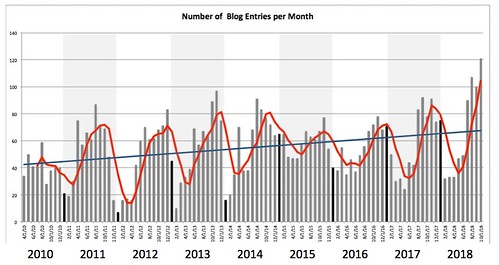
    Apr-2010-Oct-2018

    The length of a bar is proportional to the number of posts I made that month. Black bars indicate January.

    A little calibration is in order. You’ll notice that prior to this year there wasn’t a single month with 100 posts; the highest was November 2013 with 97. Now, as of the end of October, we’ve got three months with 100 or more posts; what will November and December bring? But those months really aren’t directly comparable to the whole previous run. Why? Because it’s in those months that I began using Tweets as blog posts. I hadn’t done that before, but if I’d known that was possible, I’d have done it.

    Why? Because it’s a low-energy way to make a post. And low energy’s is what’s going on in those slumps. Why the low energy? That’s what the rest of the post is about.

    Finally, on December 18 of last year I posted, Reflections on entering my eighth decade and why it portends to be the most productive one of my life. When I posted that I can assure you that I was not anticipating the slump that slammed me in February and kept me down through June. Will that happen again? Who knows? But notice 2015; the slump wasn’t so bad. Who knows?

    * * * * *

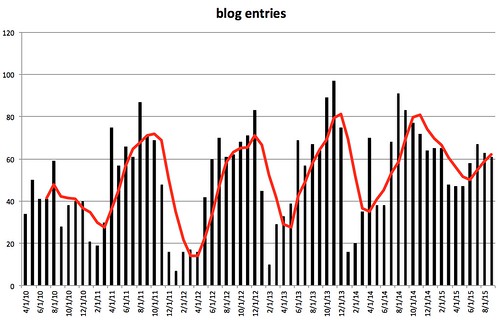
    In October of 2015 I had a post at 3 Quarks Daily entitled, Have the Internets Rotted My Brain and Wrecked My Mind? I included the following figure:

    WLB Blog entries

    Each column represents on month’s worth of posts, starting with April 2010 and running through September 2015. Here’s what I said about it then:
    It’s a very spiky pattern, with the dips happening in the winter months. Ever since I went away to college winter has been a down time for me. Am I afflicted with seasonal affective disorder? I don’t know.

    Look at the recent end of that chart (to the right). There is a dip, but it’s not nearly so deep as in previous years, and the lowest three months aren’t in the winter, but in the spring and early summer. Wrong season. The pattern seems to be different.
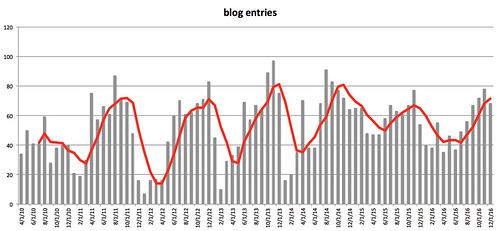
    I’ve now updated the graph to the end of last year:

    WLB blog entires thru 2016

    The cyclicity continues, though, if you look closely, the troughs don’t line up particularly well with winter for 2015 and 2016. The 2015 trough is in spring while the 2016 trough is roughly the first half of the year.

    What’s going on? Of course, I don’t really know, other than the obvious changes in blogging productivity. I do think my mood follows my productivity, or vice versa, and that’s what’s interesting. David Hays once conjectured that melancholy (aka depression) is the price you pay for large-scale reorganization or the sort implied by creativity. “Reorganization” is a term of art from William Powers’s account of the mind. It is so deeply embedded in that theory that there is, alas, no easy gloss.

    Start out by thinking of learning. When you learn, your mind is also reorganizing on a large scale. Now think of mourning as well. When you mourn the loss of someone close you have to reorganize your mind for life without them. You don’t actually learn anything, but you have to figure out how to function in those situations where you would have go to that person. It’s unlearning.

    In order to be creative you must first unlearn on a large scale. That is accompanied by melancholy. That, on this view, accounts for those troughs in my intellectual output, which is mostly though not entirely through New Savanna. That creates some “slack” in the system. Once enough unlearning has taken place I can then think new thoughts and my productivity goes up. When the slack has been used up, it’s time for more unlearning.

    Do I believe this? How could I? I just made it up. And it’s rather vague, too vague to support strong belief. Still, I’m attracted to the idea that something like this is going on over the long haul.

    Addendum, 1.2.17: Are we dealing with reorganization on a scale where we could talk of neural plasticity?